Tag Archives: Duke Energy

Valmont Profits From a Looming Repeat of Last Year's Drought

By Jacob Roche, The Motley Fool

Filed under:

Valmont Industries reported impressive first-quarter earnings recently, with operating income rising 43% on strong sales and increasing margins. The growth in sales was largely due to the company’s Utility Support Structures and Irrigation segments, which each had 25% sales growth.

Utility Support Structures was helped by an expansion of the electric grid in the United States. Valmont is one of the biggest manufacturers of utility poles in the U.S., and because of increasing power usage, utility companies are investing heavily in building infrastructure to handle it. Southern increased its capital expenditures by 20% from 2008 to 2012, and Duke Energy beat that in just the last year.

Irrigation was helped along by the continuing drought in the United States. Last summer was one of the worst droughts on record, and according to the United States Drought Monitor, almost the entire western half of the U.S. is still experiencing some kind of drought, with much of the Corn Belt and Great Plains regions experiencing “extreme” or “exceptional” drought conditions.

In 2008, only about 14% of cropland in the U.S. was irrigated, and less than half of that was done with high-efficiency center pivot systems, like the kind Valmont and its competitor Lindsay sell, so farmers have been scrambling to upgrade their equipment to deal with increasingly bad weather. This presents a big opportunity for Valmont, which gets about 28% of sales from irrigation equipment. The opportunity is even bigger for Lindsay, which gets about two-thirds of its sales from irrigation equipment.

Valmont mentioned in the earnings release that it has a decent backlog in the Irrigation segment, so the second quarter should be quite strong as well. As for the rest of the year, that will depend on how crop prices turn out, but given current weather conditions, it seems likely that high prices will persist, padding farmers’ income. On the whole, Valmont seems optimistic, hinting that it may raise its previously stated guidance for full-year total revenues.

Add these companies to My Watchlist to keep an eye on how both the energy and the agricultural markets are shaping up this year.

For another angle on the energy sector, The Motley Fool’s analysts have uncovered an under-the-radar company that’s dominating its industry. This company is a leading provider of equipment and components used in drilling and production operations and is poised to profit in a big way from it. To get the name and detailed analysis of this company that will prosper for years to come, check out the special free report: “The Only Energy Stock You’ll Ever Need.” Don’t miss out on this limited-time offer and your opportunity to discover this  company before the market does. Click here to access your report — it’s totally free.

The article Valmont Profits From a Looming Repeat of Last Year’s Drought originally appeared on Fool.com.

Fool contributor

Source: FULL ARTICLE at DailyFinance

This Week in Utilities: Dividend Increases and Earnings Reports

By Justin Loiseau, The Motley Fool

Filed under:

From dividend increases to Earth Day celebrations, utilities have been busy this week. Here’s what you need to know to keep your portfolio’s profits pouring in:

Electrifying Earth Day
Several utilities took the opportunity of Earth Day (Monday) to espouse environmental efforts. Southern loaded on 139 MW of solar and 250 MW of wind to its energy portfolio. The utility currently produces around 1,350 MW of generation from solar, hydropower, biomass, and landfill methane gas, equivalent to around 2.9% of its total capacity.

Duke Energy released its sustainability report, updating shareholders on its $9 billion modernization project. The utility expects to retire 6,300 MW of coal capacity over the next few years and expects to own or purchase 6,000 MW of wind, solar, or biomass power by 2020.

PPL celebrated Earth Day with the opening of a unique “clean coal” facility that recovers around 300,000 tons of gypsum mineral annually to be used in fertilizers. “Innovative projects like this show how coal has and will continue to be a major contributor to the economic vitality of Kentucky and of the U.S., not just in the energy sector, but in science and innovation and now agriculture,” said Senate Minority Leader Mitch McConnell (R-Ky.) at the plant‘s grand opening. In the next five years, PPL expects to invest around $6 billion in its system.

It’s earnings season
In the blink of an eye, Q1 2013 is here and gone. Southern reported earnings this week, hitting sales expectations but missing slightly on earnings. Any longer-term progress was negated by a $333 million after-tax charge for increased construction costs at a new power plant. The company increased its dividend last week for the 12th year in a row, calling into question the sustainability of its current cash flow.

After upping its dividend earlier in the week, American Electric Power reported earnings on Friday, beating sales estimates and matching earnings expectations. Lackluster industrial demand and impending deregulation in Ohio are trouble spots for the utility, but overall rate increases and new transmission agreements mean that sustainable income isn’t gone yet.

Dominion disappointed this quarter, missing on sales and reporting EPS 8.8% below analyst expectations. Regulated sales slumped, but $25 million in EBIT from the utility’s Blue Racer midstream joint venture kept earnings from evaporating. Looking ahead, the utility hopes to save $100 million on operating expenses for fiscal 2013 as it continues to grow its transmission business.

Stay current on electricity
The world of utilities is changing fast, and dividend stocks aren’t the stable stalwarts they once were. Be sure to check back weekly for the latest on your portfolio’s moves, and you’ll be well on your way to electrifying earnings.

As the nation moves increasingly toward clean energy, Exelon is perfectly positioned to capitalize on having the largest nuclear fleet in North America. This strength, combined with an increased focus on balance sheet health and

Source: FULL ARTICLE at DailyFinance

Consolidated Edison Stock Is Going Nowhere. Here's Why.

By Rich Smith, The Motley Fool

Filed under:

Electric utilities have never been the most exciting opportunities in the stock market, but lately, one stock in the group has been underperforming the stock market as a whole, and performing particularly poorly relative to its peers to boot: Consolidated Edison . Why?

Three reasons.

Consolidated Edison is average — at best
When you stack up Consolidated Edison stock up against two of its bigger rivals — American Electric Power and Duke Energy — at first glance, ConEd doesn’t look all that bad. Its dividend yield, 4%, is smack-dab in the middle between AEP‘s 3.8% yield and Duke’s 4.2%. Similarly, ConEd’s free cash flow yield, sandwiched between those of AEP and of Duke, looks pretty average.

ED Free Cash Flow Yield data by YCharts.

Given this, and with ConEd selling for only a 16 P/E, versus higher price-to-earnings ratios at both of its peers, you might start thinking that paying a little less for Consolidated Edison stock‘s middle-of-the-road dividend is a pretty bright idea.

But that would be a mistake.

Consolidated Average is losing its way
Take a closer look at that chart, and you may notice that while Consolidated Edison stock does generate decent cash relative to its peers, the rate of that cash production — a mere 2% — isn’t all that great, objectively speaking. That small trickle of cash doesn’t give ConEd a lot to work with as far as stock buybacks and dividend increases go. You may also notice that ConEd’s free cash flow yield is starting to trend downward.

Of course, that’s only to be expected, given how ConEd’s sales have been shrinking lately.

Consolidated Edison is going nowhere
The future doesn’t look particularly bright for Consolidated Edison stock, either. Over the next five years, most analysts who follow this industry expect to see ConEd grow its profits at barely half the rate of its peers — again, limiting the potential for dividend increases, share buybacks, or profits for its shareholders.

Given all this, it’s no great surprise that Consolidated Edison stock is up a mere 7% over the past year — less than half the average gain on the S&P 500. There’s little reason to hope that Consolidated Edison stock will do better in the future.

If you’re on the lookout for high-yielding stocks with better prospects than ConEd offers, The Motley Fool has compiled a special free report outlining our nine top dependable dividend-paying stocks. It’s called “Secure Your Future With 9 Rock-Solid Dividend Stocks.” You can access your copy today at no cost! Just click here.

The article Consolidated Edison Stock Is Going Nowhere. Here’s Why. originally appeared on Fool.com.

Fool contributor Rich Smith and The Motley Fool have no position in any of the stocks mentioned. Try any of our Foolish newsletter services free for 30 days. We Fools don’t all hold the same

From: http://www.dailyfinance.com/2013/04/14/consolidated-edison-stock-is-going-nowhere-heres-w/

This Week in Utilities: Solar Sales, Coal's Comeback, and More

By Justin Loiseau, The Motley Fool

Filed under:

From a solar-power project sale to new predictions for coal’s comeback, it’s been a busy week for utilities. Here’s what you need to know to stay current on your dividends’ profits.

Duke forecasts sunshine
On Wednesday, Duke Energy announced its purchase of two California solar farms from Germany-based SolarWorld. The new acquisitions will add 21 megawatts of solar electricity to its current 61 MW of capacity. Collectively, the two farms will become Duke’s largest commercial solar farm in the nation, and the company has already arranged a 20-year power purchase agreement with Edison International .

FirstEnergy plays management musical chairs
Following the retirement of two long-term leaders, FirstEnergy announced this week that it’s switching up high-level management in all four of its states’ regulated utilities operations. Although the moves reflect positive promotions throughout, a management makeover of this scale could influence FirstEnergy’s short-term efficiency or long-term strategic direction.

Southern silence
After an explosion at Southern‘s coal-fired Plant Bowen forced the facility offline last Thursday, the utility has remained silent on any findings. Southern noted in its initial press release that there were no serious injuries and that the explosion doesn’t present a threat to the local community. In an email correspondence this Thursday, an investor-relations representative noted that Southern will “release more details after our investigation is complete and thoroughly vetted.” Plant Bowen‘s 3,160 MW generating capacity represents approximately 7.3% of Southern’s total capacity.

Dog days for natural gas
A new report from the Energy Information Administration predicts a relative drop in natural gas use for electricity generation over the next year. As natural gas prices push higher, the EIA expects natural gas’ share of the generation pie to drop 2.4 percentage points to 28% for 2013. To fill the gap, the EIA expects coal to make a 7.8% comeback this year. Although many utilities with older energy portfolios are celebrating the news, coal-centric TECO Energy arguably has the most to gain from natural gas’ price increase. Not only does the company’s regulated division rely heavily on coal for 61% of its generation, but the utility also owns and operates Appalachian coal mines.

As the nation moves increasingly toward clean energy, utility company Exelon is perfectly positioned to capitalize on having the largest nuclear fleet in North America. This strength, combined with an increased focus on balance-sheet health and its recent merger with Constellation, places Exelon and its resized dividend on a short list of the top utilities. To determine whether Exelon is a good long-term fit for your portfolio, you’re invited to check out The Motley Fool’s premium research report on the company. Simply click here now for instant access.

From: http://www.dailyfinance.com/2013/04/13/this-week-in-utilities-solar-sales-coals-comeback/

A New Deal Between Coal and Utility Heavyweights

By Taylor Muckerman and Joel South, The Motley Fool

Filed under:

After a rough year in 2012, coal companies hope that they could bounce back a bit this year. In the latest deal between utilities and the coal industry, Duke Energy has agreed to purchase between 1.7 million and 1.9 million short tons of coal from Peabody Energy .

Currently, Peabody Energy is the lowest-cost producer of coal in the United States, which should be a critical fact now that natural gas prices are above $4 per MMBtu. It is well-diversified geographically and is the leading player in the cheapest basins in the U.S.

If you are an investor looking for another coal company that could capitalize from rising natural gas prices, turn to CONSOL Energy . This is a company that owns the largest export facility on the East Coast and has turned the majority of its attention toward natural gas production, a move that is likely to provide a nice hedge against any continued domestic coal weakness. 

The domestic market isn’t the only place these coal companies are trying to sell. Exports are becoming a much bigger part of the domestic coal landscape, and Peabody Energy has deals in place to get its cheaper coal from the Powder River and Illinois basins to India, China, and the EU. For investors looking to capitalize on a rebound in the U.S. coal market, The Motley Fool has authored a special new premium report detailing exactly why Peabody Energy is perhaps most worthy of your consideration. Don’t miss out on this invaluable resource — simply click here now to claim your copy today.

var FoolAnalyticsData = FoolAnalyticsData || []; FoolAnalyticsData.push({ eventType: “TickerReportPitch”, contentByline: “Taylor Muckerman and Joel South“, contentId: “cms.31106”, contentTickers: “NYSE:CNX, NYSE:BTU, NYSE:DUK”,

Source: FULL ARTICLE at DailyFinance

Will Obama Put Coal out of Business?

By Rich Duprey, The Motley Fool

Filed under:

In 2008, candidate Barack Obama infamously said that as president he would set policy that would bankrupt the coal industry: “So if somebody wants to build a coal-powered plant, they can; it’s just that it will bankrupt them because they’re going to be charged a huge sum for all that greenhouse gas that’s being emitted.”

The coming collapse
Now, according to a new Duke University study, pending regulations by President Obama’s Environmental Protection Agency may just accomplish that goal. It concluded that tougher air-quality standards would make two-thirds of the nation’s coal-fired power plants more expensive to operate than comparable natural-gas-fired facilities. And if the price of natural gas soared four times higher than what it currently trades for, the costs of operation between the two systems would simply be comparable.

The coal industry is already in an untenable situation as utilities shut down coal-fired plants. The Energy Information Administration says over the last year alone, the net generation of energy by coal producers fell 12% while natural gas soared 21%. During President Obama‘s tenure, coal generation has fallen by 25% while gas is up 39%.

Of course, not all the blame can be laid at the door of the Oval Office as greater shale production through new and innovative drilling techniques, like horizontal drilling, have caused gas prices to tumble during that time period. That alone has made it a resource that is more competitive with coal even as the older, inefficient plants continued to be taken off line.

Padlocking the front gate
Yet it can’t be denied that the demise of many plants has been hastened by the animus against the coal industry. In 2012 alone, Duke Energy retired eight coal plants representing 730 megawatts of capacity and Dominion took down nine, eliminating 1.1 gigawatts of capacity. FirstEnergy idled three for 500 megawatts. SourceWatch says two dozen plants will be retired in 2013 representing 2.9 gigawatts of capacity with nearly 50 plants expected to close next year totaling seven gigawatts of capacity. 

That’s odd because the researchers found that only 9% of coal-fired plants today are more costly to operate than natural-gas-fired ones. Something’s moving against coal and it’s clear the new EPA regulations will dramatically tilt the scales in favor of gas. This is despite emissions dropping steadily over the years to their lowest levels since 1992.

Yet as the university study concluded, reductions in emissions in the U.S. will likely be exceeded elsewhere in the world because China is still forging ahead. As Obama noted in his first campaign, China is building a new coal-fired plant a day, which may be the only thing that saves the industry.

Peabody Energy  realizes 25% of its revenues from Asia (up from 18% the year before) while earlier this year Consol Energy completed the largest shipment ever of metallurgical coal to China.

Deep, dark hole
With coal consumption and production in the U.S. on the decline, miners are abandoning the industry en masse. Rio …read more

Source: FULL ARTICLE at DailyFinance

3 Things to Know Before You Buy Duke Energy Stock

By Matt DiLallo, The Motley Fool

Filed under:

When I was a kid, my dad constantly reminded my siblings and me to turn off the lights when we went out of a room. I remember more than once he’d informed us that he didn’t work for the electric company. As I grew older and wiser I found out that you didn’t have to work for the electric company to benefit from all those lights being left on. Instead, you could own stock in the electric company and enjoy a nice stream of dividends as the company profited from keeping those lights on.

One such company that should be on any income seeking investor’s radar is Duke Energy . Based in Charlotte, N.C., Duke Energy has been keeping the lights on for more than 150 years. However, before considering whether to buy stock in the company, here’s three very important things you need to know.

It’s getting gassy
Duke is the largest utility in the U.S. by almost any metric. It has more than $100 billion in assets including 58 gigawatts of generating capacity all design to power the lives of its 7.2 million customers. That’s more than nuclear kingpin Exelon‘s nearly 35 gigawatts of generating capacity as well as its 6.6 million customers. It’s also larger than wind-powered NextEra Energy‘s more than 41 gigawatts of capacity as well as its 4.6 million customers.

What’s important here is that Duke Energy is really cleaning up that generating portfolio by shifting away from coal. However, it’s shifting much more into natural gas generation as opposed to renewables. By 2015 the company plans to cut coal’s portion of its generation portfolio from 55% in 2005 to 38% by 2015. Meanwhile the natural gas portion will go from just 5% all the way to 24% over that same time frame. Given the amount of natural gas we’ve discovered, and its low price, that move makes a lot of sense.

Merger with Progress
The other move that made a lot of sense is the company’s merger with Progress Energy. According to Duke, the purpose was to create a low-risk, predominantly regulated business to generate reliable earnings and cash flow. Part of the draw in acquiring Progress is that 100% of its earnings are regulated against just 77% for Duke Energy. Now the combined company isn’t just the country’s largest utility, but 85% of the earnings are regulated. For a dividend-seeking investor, you’ll want the stable earnings from the more regulated business mix.

Financial future
Over the next few years Duke Energy plans to spend about 30% of its annual $6 billion capital budget on growth projects. The addition of cheaper natural gas to its regulated business should lead to 4%-6% long-term earnings growth. Further, Duke Energy believes it has the ability to grow its stock dividend even as it maintains a target payout ratio of 65%-70%. Given that the dividend on its stock has been growing at …read more

Source: FULL ARTICLE at DailyFinance

3 Environmentally Friendlier Energy Investments

By Tyler Crowe, The Motley Fool

Filed under:

Sometimes, investing in the energy space can be an internal battle between doing what’s best for your wallet and what’s best for the environment. While many of us may want to get in on the ground floor of the next great alternative-energy idea, it’s hard to pass up the financial stability of a high dividend-yielding oil or coal company.

Fortunately, there are some investment strategies that can bridge the gap between these two competing ideals. Let’s look at three ways you can invest in the energy sector and still get a decent night’s rest.

It’s OK to invest in natural gas
Yes, natural gas is a fossil fuel. And yes, it does emit carbon dioxide. But when you compare it with the other fossil fuels we burn, it is much, much better. When compared with a coal plant, a natural gas-fired plant will emit half the carbon dioxide, one-third the nitrogen oxides, 1% of the sulfur dioxides, and almost no mercury. Consider that since 2007, the U.S. has reduced its total carbon dioxide levels to where they were in 1994, thanks mostly to a shift from coal-fired generation to gas generation.

Want to know the best part about this shift? It’s happened almost exclusively because of the price advantage that natural gas has over coal. The surge in U.S. gas production in the past couple of years sent gas prices to 12-year lows last year. Although the price has climbed since then, it’s still cheap enough that many utility companies are still using it in place of coal. Exelon  CEO Christopher Crane has said that U.S. utilities will shut down 19 gigawatts’ worth of coal plants between now and 2015, and former coal-heavy generator Duke Energy has plans to bring 2.8 gigawatts of new natural gas-powered plants online by the end of this year.   

Natural gas isn’t the perfect solution, but in terms of environmental impact, it’s definitely a better solution than coal. If we can reduce carbon emissions in a way that’s less expensive than the way we are doing it right now, that’s a win for all parties involved.

Scared of hydraulic fracturing? Pick the names that will clean up afterward.
Many people have voiced their concerns over the fluids used in hydraulic fracturing and the risks they may pose. Certainly, it would be a problem if these fluids were simply dumped, but the EPA mandates that fracking water disposed of either on the surface or in underground injection wells must meet the same requirements as municipal wastewater under the Safe Drinking Water Act. According to Chesapeake Energy , it requires on average 5.6 million gallons of water to complete a well, and so the cost to use fresh water and dispose of it for every new well would be extremely cost-prohibitive. That’s why you’re seeing more and more exploration and production companies moving toward reusing fracking fluids and treating them for safe disposal.

There are two major companies dealing with the treatment …read more

Source: FULL ARTICLE at DailyFinance

Duke Energy CEO Joins Push Urging Congress to Cut Debt

By Justin Loiseau, The Motley Fool

Filed under:

Duke Energy CEO Jim Rogers is calling on people to encourage federal lawmakers to “take immediate action to develop a more sustainable financial strategy for the country.”

Rogers released a statement today announcing he has joined the nonpartisan group Campaign to Fix the Debt.

“At more than $11.8 trillion, the size of our publicly held national debt currently amounts to more than 73% of our entire economy, and is set to hit 100% by the early 2030s,” Rogers said in his statement. “A debt burden of this magnitude could increase interest rates, inflation and unemployment, and could even lead to a debt-fueled fiscal crisis.”

The Campaign to Fix the Debt is a “non-partisan movement to put America on a better fiscal and economic path.” Among the group’s 350,000 members are more than 170 members of the CEO Fiscal Leadership Council. Notable names include Microsoft‘s Steve Ballmer, General Electric‘s Jeffrey Immelt, and Goldman Sachs‘ Lloyd Blankfein.

In his statement, Rogers urges Washington to consider sustainability, efficiency, reliability, “smart” spending cuts , and “comprehensive” tax reform .

link

The article Duke Energy CEO Joins Push Urging Congress to Cut Debt originally appeared on Fool.com.

Fool contributor Justin Loiseau owns shares of General Electric Company. You can follow him on Twitter, @TMFJLo, and on Motley Fool CAPS, @TMFJLo.
The Motley Fool recommends Goldman Sachs. The Motley Fool owns shares of General Electric Company and Microsoft. Try any of our Foolish newsletter services free for 30 days. We Fools may not all hold the same opinions, but we all believe that considering a diverse range of insights makes us better investors. The Motley Fool has a disclosure policy.

Copyright © 1995 – 2013 The Motley Fool, LLC. All rights reserved. The Motley Fool has a disclosure policy.

(function(c,a){window.mixpanel=a;var b,d,h,e;b=c.createElement(“script”);
b.type=”text/javascript”;b.async=!0;b.src=(“https:”===c.location.protocol?”https:”:”http:”)+
‘//cdn.mxpnl.com/libs/mixpanel-2.2.min.js’;d=c.getElementsByTagName(“script”)[0];
d.parentNode.insertBefore(b,d);a._i=[];a.init=function(b,c,f){function d(a,b){
var c=b.split(“.”);2==c.length&&(a=a[c[0]],b=c[1]);a[b]=function(){a.push([b].concat(
Array.prototype.slice.call(arguments,0)))}}var g=a;”undefined”!==typeof f?g=a[f]=[]:
f=”mixpanel”;g.people=g.people||[];h=[‘disable’,’track’,’track_pageview’,’track_links’,
‘track_forms’,’register’,’register_once’,’unregister’,’identify’,’alias’,’name_tag’,
‘set_config’,’people.set’,’people.increment’];for(e=0;e<h.length;e++)d(g,h[e]);
a._i.push([b,c,f])};a.__SV=1.2;})(document,window.mixpanel||[]);
mixpanel.init("9659875b92ba8fa639ba476aedbb73b9");

function addEvent(obj, evType, fn, useCapture){
if (obj.addEventListener){
obj.addEventListener(evType, fn, useCapture);
return true;
} else if (obj.attachEvent){
var r = obj.attachEvent("on"+evType, fn);
return r;
}
}

addEvent(window, "load", function(){new FoolVisualSciences();})
addEvent(window, "load", function(){new PickAd();})

var themeName = 'dailyfinance.com';
var _gaq = _gaq || [];
_gaq.push(['_setAccount', 'UA-24928199-1']);
_gaq.push(['_trackPageview']);

(function () {

var ga = document.createElement('script');
ga.type = 'text/javascript';
ga.async = true;
…read more

Source: FULL ARTICLE at DailyFinance
BP Just Sold Wind: Should These Dividend Stocks Follow Suit?

By Justin Loiseau, The Motley Fool

Filed under:

In an ironic twist of fate, BP has put up the “for sale” sign on its $1.5 billion of wind farms to help pay for its 2010 oil spill. Is BP‘s sale short-sighted, or does the energy company know something others don’t? Let’s look at wind energy, who has it, and whether wind will propel your portfolio to profits.

BP winds down wind
As part of its larger $38 billion garage sale, BP is in the process of selling off 16 wind farms across nine states. With a total generating capacity of 2,600 MW, this move is far from small peanuts for a company that famously renamed itself “Beyond Petroleum” in 2000.

But with $300 billion in assets, wind is hardly the winner that BP needs to succeed. The streamlining will help it focus on high-margin oil production and exploration, its bread and butter (excepting environmental disasters). As margins tighten and the global economic recovery continues to ooze along, it makes sense for energy companies to focus on what they do best. And for some utilities, what they do best increasingly includes wind.

Windy win?
When investors talk wind, NextEra Energy is the elephant in the room. Its 100 wind farms generate more than 10,000 net MW of electricity, accounting for 56% of the utility’s total generation capacity.

Source: NextEra 10-K. 

Exelon gets pigeonholed as a nuclear play, but its wind assets provide a significant portion of its assets. The utility operates 44 wind farms totaling nearly 1,300 MW of generation capacity, and it spent $650 million in 2012 on wind capital expenditures.

Source: Exelon investor relations website. 

The newest addition to the wind gang, Atlantic Power , recently announced that it will focus on natural gas and renewables in the years to come. The utility bought Ridgeline Energy from Veolia Environnement last year, adding three wind farms with 150 net MW to its assets.

Source: Atlantic Power Deutsche Bank Leverage Financed Conference Presentation. 

It’s also shedding less profitable assets to generate cash for acquisitions and manage its high 2.2 debt-to-equity ratio. Atlantic passed off a transmission project to Duke Energy and American Transmission for $193 million in cash and debt handoffs, and it’s planning on further specializing in the year to come.

Did BP make the right choice?
Energy portfolios are a lot like ice cream. Some flavors don’t mix, and even the smallest scoop of one flavor can threaten the whole taste. BP made a calculated choice to put aside its wind assets, but one corporation’s trash is another corporation’s treasure. With the right combination, any asset class can look tasty.

As the nation moves increasingly toward clean energy, Exelon is perfectly positioned to capitalize on having the largest nuclear fleet in North America. This strength, combined with an increased focus on balance sheet health and its recent merger with Constellation, places Exelon …read more

Source: FULL ARTICLE at DailyFinance

Is Southern Destined for Greatness?

By Alex Planes, The Motley Fool

SO Total Return Price Chart

Filed under:

Investors love stocks that consistently beat the Street without getting ahead of their fundamentals and risking a meltdown. The best stocks offer sustainable market-beating gains, with robust and improving financial metrics that support strong price growth. Does Southern fit the bill? Let’s look at what its recent results tell us about its potential for future gains.

What we’re looking for
The graphs you’re about to see tell Southern’s story, and we’ll be grading the quality of that story in several ways:

  • Growth: Are profits, margins, and free cash flow all increasing?
  • Valuation: Is share price growing in line with earnings per share?
  • Opportunities: Is return on equity increasing while debt to equity declines?
  • Dividends: Are dividends consistently growing in a sustainable way?

What the numbers tell you
Now, let’s take a look at Southern’s key statistics:

SO Total Return Price data by YCharts.

Passing Criteria

3-Year* Change 

Grade

Revenue growth > 30%

5%

Fail

Improving profit margin

46%

Pass

Free cash flow growth > Net income growth

106.9% vs. 43%

Pass

Improving EPS

29.6%

Pass

Stock growth (+ 15%) < EPS growth

61.8% vs. 29.6%

Fail

Source: YCharts.
*Period begins at end of Q4 2009.

SO Return on Equity data by YCharts.

Passing Criteria

3-Year* Change

Grade

Improving return on equity

10.1%

Pass

Declining debt to equity

(9.3%)

Pass

Dividend growth > 25%

12%

Fail

Free cash flow payout ratio < 50%

1,902% 

Fail

Source: YCharts.
*Period begins at end of Q4 2009.

How we got here and where we’re going
Five out of nine passing grades isn’t a bad showing, but it is a bit disturbing to see such a well-established company’s share price running away from its fundamental growth. More distressing is Southern’s unsustainably high level of dividend payouts relative to free cash flow, which has languished below earnings for many years — as you might expect for such a capital-intensive enterprise.

Southern’s in the process of transitioning toward more gas and nuclear power generation, which will understandably keep capital costs high for at least next several quarters. However, as my fellow Fool Justin Loiseau points out, Southern is hardly alone in overextending itself on dividend payments recently. Of its larger peers, only Exelon is paying out a comparatively reasonable amount of free cash flow in dividends — many utilities fell into negative free cash flow territory in 2012. Utilities have generally been a very mixed bag on a fundamental basis. Not only are they struggling to maintain positive free cash flow, but the only way anyone seems able to grow revenue is by merger, as Duke Energy and Exelon both went through the process last year.

On a more positive note, Southern is doing better than nearly every other utility (except Exelon) at reducing its debt levels relative to equity:

SO Debt to Equity Ratio Chart

SO Debt to Equity Ratio data by <a target=_blank …read more
Source: FULL ARTICLE at DailyFinance

5 Dividend Stocks for International Growth

By Justin Loiseau, The Motley Fool

^SPXTR Chart

Filed under:

U.S. utilities are in a rut and, according to recent energy projections, aren’t about to dig themselves out any time soon. But if you’re looking for a solid dividend with growth potential, you may find a match in U.S. utilities with international assets. I’ll highlight five utilities with different degrees of foreign forays and let you decide which fix fits your fancy.

America doesn’t want your energy
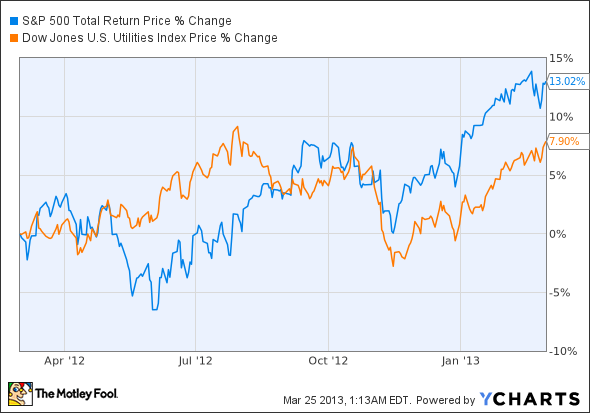
When Exelon CEO Chris Cane recently said “2012 was a difficult year on the economic front for our sector,” he wasn’t just making excuses for his company. Falling sales were a common trend for utilities last year, and the sector lagged the S&P 500 by more than 5 percentage points.

^SPXTR data by YCharts.

Looking ahead, projections aren’t peachy. A recent Department of Energy report predicts that electricity demand will clock in at 0.58% compound annual growth over the next decade, dulled by both America’s economy and advancements in energy efficiency.

The Federal Reserve announced last week that it expects U.S. GDP to fall between 2.9% and 3.7% by 2015, child’s play compared with many emerging markets. And although many utilities are overhauling their energy portfolios to set themselves up for a profitable future, some companies are looking abroad to propel top line growth.

Yes to AES?
When looking for utilities with international exposure, AES is the elephant in the room. Its 27-country spread offers formidable international exposure.

Source: AES Earnings Presentation (MCAC is Mexico, Central America, and the Caribbean. EMEA is Europe, Middle East, and Africa)

But diversification doesn’t make bad business good, and AES is currently working to cut costs. Its 4.9 debt-to-equity ratio is higher than 98% of its peers, and the company’s decision to sell 14 assets in nine countries over the past year is no coincidence. The utility’s stock jumped 6% on solid Q4 earnings, and BRIC bulls would do well to give AES a closer look.

Feeling Chile?
Hailing from my home state, North Carolina-based Duke Energy offers investors a nibble of internationalism with a big serving of Southern sauce. Its International Energy subsidiary is primarily focused on generation in Latin America, but it also owns a 25% stake in Saudi Arabian National Methanol Company. Duke axed a similar 25% stake in a Greek gas company in Q1 2012, while adding on a 240 MW thermal plant and 140 MW hydropower facility to its Chilean operations.

In total, Duke directly or indirectly generates 4,900 gross MW of international energy. That’s approximately 10% of the utility’s U.S. generation capacity, a significant slice of its portfolio pie. The utility beat top-line and earnings estimates last quarter and could be ready for some serious growth with its $12 billion of modernization projects well under way.

(Inter)National Grid
National Grid
is anything but, unless you’re based in the United Kingdom. This utility is listed on the U.S. stock exchange, but its blood runs …read more
Source: FULL ARTICLE at DailyFinance
The End of Utilities?

By Sara Murphy, The Motley Fool

Filed under:

NRG Energy has made some fascinating moves recently that suggest it’s written the first few drafts of a Dear John letter to utilities. It’s not the only one disrupting the status quo, either. As energy demand surges in response to a growing global population and emerging-market development, and a changing climate forces us to get serious about constraining greenhouse gas emissions, all signs point to an energy future that bears little resemblance to what we know today.

Paradigm disruption
Renewables are making tons of headway lately, and 2013 promises to be a very good year for energy sources such as wind and solar. Their growing share of generating capacity presents challenges to the old-school utilities, though: Given that solar photovoltaics and wind are randomly variable energy sources, traditional power plants and transmission lines that were designed for steady supply struggle to accommodate the power fluctuations of renewables.

This means that as companies such as SolarCity push their sun-powered energy systems further into the marketplace, they do so at traditional utilities’ expense. In furnishing consumers with their own generation capacity, SolarCity bypasses utilities. The company’s partnerships with electric-vehicle manufacturers further subvert the legacy systems.

Disintermediation
This process of cutting out the middleman is one we’ve seen before. If you have doubts, ask yourself this: When was the last time you used a travel agent? Exactly. As companies like SolarCity offer customers renewable energy that is typically cheaper than power from the grid, they erode the need for utilities at all. And utilities have noticed.

In an interview with Bloomberg, Duke Energy‘s chairman and CEO, Jim Rogers, directly acknowledged the trend’s potential threat to his company over the long term. Duke is the United States‘ largest utility owner, and Rogers conceded that businesses like his could become less important in the long run.

“If the cost of solar panels keeps coming down, installation costs come down, and if they combine solar with battery technology and a power management system, then we have someone just using us for backup,” Rogers said. He also said Duke was considering a move into rooftop solar, describing it as a short-term opportunity.

At a 2012 energy conference, Susan Story — CEO of Southern‘s services division — directly acknowledged the shifting energy landscape. Southern, the United States‘ largest vertically integrated utility, has been making strides toward a smarter grid and has dramatically shifted its fuel sources. Traditionally coal-reliant, Southern burned more natural gas than coal for the first time in 2012.

Edge power
But are companies like Southern and Duke moving quickly enough to survive the disruption that appears to be under way? Incumbents tend to weather disruptive events poorly, and this could be no exception. Especially when you consider “edge power.”

Edge power is a new and evolving concept, but its core components are distributed generation, distributed storage, and distributed energy management systems. The idea is …read more
Source: FULL ARTICLE at DailyFinance
1 Dark Tale of a Dying Dividend

By Justin Loiseau, The Motley Fool

AT Chart

Filed under:

Before March 1, Atlantic Power was at the top of its game, doling out monthly dividends to the tune of 10% a year. Sure, there were skeptics who questioned how a small growth-by-acquisition utility could return that much cash directly back to shareholders, but the truth was this: Atlantic’s dividend knocked every other utilities’ out of the water.

But on March 1, the company reported quarterly earnings and announced a 66% dividend cut, shocking income investors who couldn’t sell their shares fast enough. Atlantic, the company that had pumped profits into their brokerage account month after month, was waving the white flag. Its stock plummeted:

AT data by YCharts.

Atlantic wasn’t the only utility to recently announce a dividend haircut. Exelon sliced its dividend by 40%, ending its 6.8% dividend yield for Q2 2013. But on Feb. 7, the day of the announcement, Exelon’s stock bounced up.

EXC data by YCharts.

Not all dividends are created equal
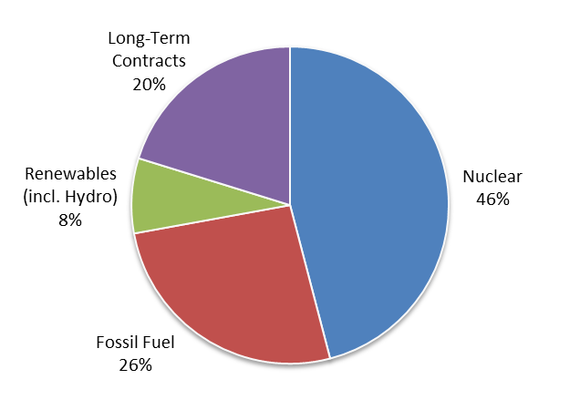
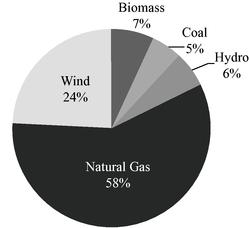
The reason for this mismatch is simple enough: Big dividends do not imply big profits, and Atlantic and Exelon are different companies. Their market caps alone put them in different bullpens, but each utility is in its own unique position. Their energy portfolios are different:

Source: Author; data from 10-K 

Source: Atlantic Power 10-K 

Their sales are headed in opposite directions, even as both utilities have acquired other businesses :

AT Revenue Quarterly Chart

AT Revenue Quarterly data by YCharts.

And, most importantly, each is in a very different debt situation:

EXC Debt to Equity Ratio Chart

EXC Debt to Equity Ratio data by YCharts.

Insult to injury
After Atlantic’s earnings report, I asked readers: Can it get any worse? The short answer: Yes.

As of last week, Atlantic may be in more trouble than even its books let on. Law firm Robins Geller Rudman & Dowd announced last Thursday that it is filing a class action lawsuit against Atlantic over allegedly misleading and/or false statements regarding its business and finances.

In its official complaint, the firm notes that “as the market learned the truth about Atlantic Power‘s mounting losses and its inability to maintain its outsized dividend through a number of misleading financial disclosures between Nov. 7, 2012, and March 4, 2013, more than $1 billion of the company’s market capitalization disappeared.”

These are serious allegations, and only time will tell whether Atlantic is found guilty of cooking its books. But either way, the once picture-perfect story of a darling dividend just grew darker.

Sustainable dividend
Big dividends don’t imply big profits, but they don’t imply big losses, either. Duke Energy‘s 0.23 cash dividend payout ratio ensures that its above-average 4.4% yield should be maintained for years to come, even as it dishes out $12 billion to modernize its aging generation fleet. Likewise, Ameren‘s 4.8% yield is …read more
Source: FULL ARTICLE at DailyFinance

Is Exelon a Cash King?

By James Royal, The Motley Fool

Filed under:

As an investor, it pays to follow the cash. If you figure out how a company moves its money, you might eventually find some of that cash flowing into your pockets.

In this series, we’ll highlight four companies in an industry, and compare their “cash king margins” over time, trying to determine which has the greatest likelihood of putting cash back in your pocket. After all, a company can pay dividends and buy back stock only after it’s actually received cash — not just when it books those accounting figments known as “profits.”

Today, let’s look at Exelon and three of its peers.

The cash king margin
Looking at a company’s cash flow statement can help you determine whether its free cash flow actually backs up its reported profit. Companies that can create 10% or more free cash flow from their revenue can be powerful compounding machines for your portfolio. A sustained high cash king margin can be a good predictor of long-term stock returns.

To find the cash king margin, divide the free cash flow from the cash flow statement by sales: cash king margin = free cash flow / sales

Let’s take McDonald‘s as an example. In the four quarters ending in December, the restaurateur generated $6.97 billion in operating cash flow. It invested about $3.05 billion in property, plant, and equipment. To calculate free cash flow, subtract McDonald’s investment from its operating cash flow. That leaves us with $3.92 billion in free cash flow, which the company can save for future expenditures or distribute to shareholders.

Taking McDonald’s sales of $25.5 billion over the same period, we can figure that the company has a cash king margin of about 14% — a nice high number. In other words, for every dollar of sales, McDonald’s produces $0.14 in free cash.

Ideally, we’d like to see the cash king margin top 10%. The best blue chips can notch numbers greater than 20%, making them true cash dynamos. But some businesses, including many types of retailing, just can’t sustain such margins.

We’re also looking for companies that can consistently increase their margins over time, which indicates that their competitive position is improving. Erratic swings in margins could signal a deteriorating business, or perhaps some financial skullduggery; you’ll have to dig deeper to discover the reason.

Four companies
Here are the cash king margins for four industry peers over a few periods.

<td …read more
Source: FULL ARTICLE at DailyFinance

Company

Cash King Margin (TTM)

1 Year Ago

3 Years Ago

5 Years Ago

Exelon

1.4%

4.3%

16.3%

9.6%

Southern Company

0.5%

7.8%

(8.9%)

(0.7%)

Duke Energy

(1.3%)

(4.9%)

(6.7%)

0.7%

Dominion Resources

(0.1%)

This Dividend Stock Just Chose Natural Gas. Duh.

By Justin Loiseau, The Motley Fool

Filed under:

Atlantic Power just sold off a transmission project to raise cash and funnel funds toward natural gas and renewable generation. “Focusing on ____” is a common theme among utilities as each carves out its own corporate corner, but a bad niche could turn into a bad itch on your portfolio’s profits. Let’s take a look at five utilities’ new-found niches and decide whether their focus will work for your wallet.

Transmission omission
On Monday, Atlantic Power announced that it will pass off its Path 15 transmission project to Duke Energy and American Transmission for $193 million in cash and debt handoffs. The deal is expected to close in Q2 2012 and will help reduce the utility’s $2 billion debt load by around 6.5%.

Atlantic CEO Barry Welch noted that while the project enjoyed “relatively stable cash flow,” his company will be carving out its new niche in renewable and natural gas generation. In 2012, Path 15 revenue clocked in at $31 million, with net income of $5.1 million.

If Welch calculates that consolidation will save Atlantic more than $5 million a year, then the move makes sense. The company already has a major focus on natural gas, and its wind portfolio recently mushroomed with Atlantic’s Ridgeline Energy acquisition. But if the sale is just a quick way to balance books, I’d rather Atlantic kick around in the red to make its return to black more sustainable. Either way, this utility needs all the strategy it can get with a slashed dividend and abysmal Q4 earnings.

Source: Atlantic Power 10-K. 

H2O is a no-go
NextEra Energy
, the nation’s largest renewable-energy producer, kicked out its last hydro assets last week. CEO Armando Pimentel cited resource concentration on greater growth as the primary reason for his company’s decision. Hydropower plays an important part in most major utilities’ generation portfolios, but it accounted for just 2% of NextEra’s generation capacity in 2012. With limited prospects for new hydro facilities and tax credits flowing in for wind and solar, NextEra’s decision gets my stamp of approval.

Source: NextEra 10-K 

Regulation over generation
Ameren
stumbled this quarter as the company reorganizes itself to focus on its regulated division. The utility will exit its generation business in 2013 and take a $1.5 billion to $2 billion non-cash impairment charge to clear its books. While other utilities have poured money into massive modernization projects, Ameren will focus funds on its 2.4 million customers across Missouri and Illinois.

In direct contrast to Atlantic, the company is also investing $2.2 billion over the next four years to upgrade its transmission division. These funds will help keep costs low for its regulated division and should provide steadier income than its aging generation fleet could offer.

Nuclear for the win?
NextEra may be the biggest renewable player around, but Exelon offers the …read more
Source: FULL ARTICLE at DailyFinance

Mary Schapiro Nominated to GE Board of Directors

By Business Wirevia The Motley Fool

Filed under:

Mary Schapiro Nominated to GE Board of Directors

FAIRFIELD, Conn.–(BUSINESS WIRE)– The Board of Directors of General Electric Company [NYSE: GE] has nominated Mary Schapiro, former chairman of the U.S. Securities and Exchange Commission (SEC), as a GE director. Schapiro will stand for election at GE‘s annual meeting of shareowners on April 24, 2013.

Mary Schapiro will bring valuable expertise to GE, particularly with her experience overseeing U.S. financial markets,” said GE Chairman and CEO Jeff Immelt. “Her understanding of corporate governance and financial regulation will be of great benefit to GE and its shareowners. I am pleased that we have nominated Mary to our board.”

Schapiro served as chairman of the SEC from January 2009 through December 2012. Prior to becoming SEC chairman, Schapiro served as chief executive officer of the Financial Industry Regulatory Authority (FINRA) from 2007 through 2008. She joined FINRA in 1996, serving as president of the National Association of Securities Dealers (NASD) Regulation from 1996 to 2002 and as vice chairman from 2002 to 2006, when she was named chairman.

Schapiro served as a commissioner of the SEC from December 1988 to October 1994, and left the SEC when appointed chairman of the CFTC, where she served until 1996.

Prior to her 2009 SEC appointment, Schapiro also served as a director and chair of the audit committee at Duke Energy, and as lead director and chair of the nominating and governance committee at Kraft Foods.

Schapiro is a graduate of Franklin & Marshall College and earned a law degree from George Washington University Law School.

About GE

GE (NYS: GE) works on things that matter. The best people and the best technologies taking on the toughest challenges. Finding solutions in energy, health and home, transportation and finance. Building, powering, moving and curing the world. Not just imagining. Doing. GE works. For more information, visit the company’s website at www.ge.com.

Media:
GE
Seth Martin
646-682-5602 (office)
203-572-3567 (cell)
seth.martin@ge.com

KEYWORDS:   United States  North America  Connecticut

INDUSTRY KEYWORDS:

The article Mary Schapiro Nominated to GE Board of Directors originally appeared on Fool.com.

Try any of …read more
Source: FULL ARTICLE at DailyFinance

Does This Utility Have the Best Position in the Business?

By Matt DiLallo, The Motley Fool

Filed under:

Investing in a utility should be simple: Just look at what company you pay to keep the lights on and buy its stock. Unfortunately, that is not the case, especially in our more environmentally conscious society. Now you need to find a utility that’s going green so that it keeps your portfolio flowing with green.

Here’s the rub: In order for that utility to generate the kind of returns you expect, it needs to generate its electricity from the cleaner sources that actually help boost the bottom line. Given the return differentials among the generating options, natural gas is the clean source offering the most bang for your utility’s buck at the moment.

With its prime position to profit from natural gas, Dominion Resources is, in my opinion, one of the best-positioned utilities. Not only does the company generate a lot of energy from natural gas, it also generates a lot of profit from transporting it. That’s right, Dominion has strategically positioned a growing midstream business inside its sleepy utility segments.

Its this midstream business embedded within Dominion’s energy subsidiary that has some very intriguing pieces being laid as the foundation for the company’s growth. While the segment houses two gas utilities located in Ohio and West Virginia that serve more than a million customers, there is much more here than I think investors realize.

Among the jewels are over 10,000 miles of gathering and transmission pipeline, a massive natural gas storage business and a good amount of processing capacity. Also, in what could be a real hidden gem, Dominion’s Cove Point LNG facility in Maryland has the potential to be used to export natural gas. What’s more, all of these assets are located in the heart of the natural-gas-rich Marcellus and Utica shales.

What else is nice about Dominion is that there is more to the company outside of natural gas. Its electricity generation fleet is pretty balanced between coal at 31%, natural gas at 28%, nuclear at 21%, and oil, renewables, and others representing the remaining capacity.

While renewables are a smaller portion, that’s not to say that Dominion isn’t planning to expand its portfolio, as it just announced its first foray into solar energy last week. The company also boasts of hydro, wind, and biomass among its generating assets. So, while it doesn’t have as clean a fleet as its wind-powered peer NextEra Energy , that’s only because its attention is elsewhere at the moment. 

Having a diversified generation portfolio is important — many in the industry have shifted their generation mixes toward cleaner sources. Duke Energy for example has gone from 55% coal and 5% natural gas generation in 2005 to a planned mix of 38% coal and 24% natural gas by 2015.

That’s still nowhere near as clean as NextEra, which already has a mix of 56% natural gas, 13% wind, and just 6% coal. For arguably the cleanest portfolio in the business, investors can turn to Atlantic …read more
Source: FULL ARTICLE at DailyFinance

AES Earnings Report: Can 27 Countries Kick-Start Your Portfolio?

By Justin Loiseau, The Motley Fool

AES Revenue Annual Chart

Filed under:

AES reported earnings this week, beating revenue estimates and squeaking in above analysts’ earnings expectations. Its stock shot up 6% on the news, but does this utility have what it takes to pull in long-term profits for your portfolio? Let’s look at this quarter’s earnings and some long-term trends and decide for ourselves whether AES makes the A-list.

Number-crunching
For Q4 2012, AES managed to grow its top line to $4.64 billion. The company beat analyst estimates by 20% and improved on 2011’s Q4 by 11%. 

On the bottom line, the utility slid past Mr. Market’s expectations by $0.01, with non-GAAP EPS clocking in at $0.32. Compared with Q4 2011, earnings for this quarter represent an almost 40% increase.

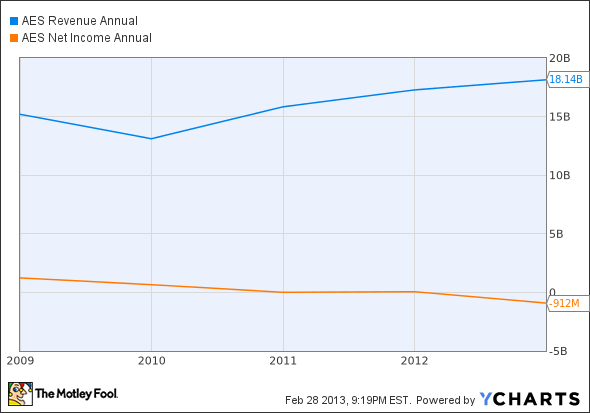
For a peck of long-term perspective, AES has grown sales 19% over the last years. In the same period, net income dropped 173% and dipped into the red for 2012.

AES Revenue Annual data by YCharts.

Looking ahead, AES expects to grow revenue to $5.23 billion and EPS to $0.35 in Q1 2013 .

AES around the world
When it comes to diversification, it’s hard to argue with AES. Not only does the company offer the stalwart opportunity of a utility, but its 27-country spread gives it a level of international diversity that is unmatched in its sector. Here’s a quick breakdown of AES‘s $2.1 billion worth of 2012 pre-tax contributions:

Source: AES Earnings Presentation. 

That said, broader is not always better, and AES is working hard to cut costs across the board. In addition to skimming the fat off corporate spending (to the tune of $90 million in 2012), the utility sold 14 assets in nine countries over the past year. Of the $946 million in shed assets, the largest chunk came from $284 million Brazil telecom Atimus, a non-core asset stinking of “diworsification.” AES looks to be focusing its geographic plans, following the likes of international utility National Grid , which offers global diversification through its United Kingdom and United States divisions, but without the high-risk worries of emerging markets.

Even with the clunkers off its sheets, AES still has an upward battle to keep costs competitive. The company expects to spend around $500 million over the next three years in the U.S. to replace and/or upgrade its older-generation facilities. According to CFO Thomas Flynn, environmental costs will account for about two-thirds of the company’s $300 million proportional cash flow decline for 2013.

For utilities based solely in the United States, environmental regulation is pushing massive upgrades across the sector. Southern recently received approval for two new nuclear facilities and expects to spend $16.5 billion in the next two years to kick costly coal out of its energy portfolio. During its Q4 conference call, Duke Energy‘s CEO called out Southern for showing up late to the modernization party, celebrating his own company’s progress. In total, Duke expects to spend approximately …read more
Source: FULL ARTICLE at DailyFinance