Tag Archives: EIA

This State Quietly Became an Economic Powerhouse

By Travis Hoium, The Motley Fool

Filed under:

Over the past decade, no state has grown faster than North Dakota. It leads in GDP growth and personal income growth, and it has a wide lead in oil production growth. So how did one of the coldest, flattest, least populated states in the country become an economic hot spot?

The bang that led to a boom
Oil was discovered in western North Dakota in the Bakken formation in 1951, and for a long time there’s been a limited amount of drilling in that part of the state. Until recently, the technology didn’t yet exist to extract most of the oil trapped between rocks — shale oil — at an economical cost.

In the early to mid 2000s, companies such as Halliburton developed the technology to extract both oil and gas from shale plays economically, unlocking energy plays across the country. One of the largest plays in oil was the Bakken Shale in western North Dakota and eastern Montana, and companies flooded in to pick up as much land as possible.

Today, Continental Resources , Whiting Petroleum , Statoil , and Kodiak Oil & Gas have access to nearly 2 million combined acres ,equivalent to 1,280 square miles. They’re dotting the plains of western North Dakota with drilling rigs and production wells. All of this drilling has led to massive growth in oil production, which brings economic development and jobs to this once forgotten state. For a visual showing how fast oil production grew, click here to see a 25-year EIA time lapse of energy production in the Bakken. 

All of this oil production has been fabulous for the economy and the residents of North Dakota. Over the past decade, North Dakota‘s GDP has grown at an annual rate of 4.04%, which compares with 0.54% nationally. Only Oregon can compare, with 3.36% growth. Every other state in the country has grown at a compound rate of less than 2% over that time.

More jobs than the prairie can handle
The explosion in GDP growth hasn’t been enjoyed just among the oil big wigs: There’s been huge growth in personal incomes as well. According to the Bureau of Economic Analysis, since 2005 per capita personal income has grown at a compound rate of 7.25% in North Dakota, which is more than a 50% increase in salary over six years. That compares with just 2.69% in the U.S. and 4.19% in second-place Louisiana, which also benefits from the growth in oil production. Here’s a look at the top five states for personal income growth since 2005. 

Amazingly, there are 11 counties in North Dakota that have seen per capita personal income grow 11.48% or more per year over that time, nearly doubling salaries.

If you’re interested in one of these high-paying jobs, you might have to find a home on

From: http://www.dailyfinance.com/2013/04/14/how-north-dakota-quietly-became-an-economic-powerh/

The U.S. Oil Import Story in 5 Charts

By Aimee Duffy, The Motley Fool

Filed under:

You can’t read the news lately without some mention of the current domestic energy boom. The U.S. is producing more oil than it has in a long time, and as a result we are importing less oil than we have in decades. Today, I’m going to take a closer look at five charts to show what it is exactly we are importing, where it comes from, where it goes, and what our energy import future really looks like.

1. Imports by type
Unless explicitly referred to as crude oil, when we read about “oil imports” the number tossed about often includes refined petroleum products such as diesel, jet fuel, and gasoline. Though the overwhelming majority of our oil imports are in fact comprised of crude oil, we do import significant quantities of refined products. In March, crude oil imports were about 7.6 million barrels per day, while products imports came to about 1.8 million barrels per day. The chart below shows the types of products and relative quantities that made up the bulk of our petroleum imports last year, not including crude oil.

Source: EIA 

2. Imports from world regions
Many politicians tout “North American” energy independence as an achievable goal in the coming years, and the chart below indicates why. As recently as March of this year, Mexico and Canada were two of our three top sources for oil imports. In fact, in January Mexico actually sent us more oil than Saudi Arabia did, the difference between imports from the two countries often comes down to volumes as small as 100 barrels per day.

Source: EIA 

You’ll notice that imports from Nigeria and Angola are among the smallest slivers in this pie chart. Light sweet crude from West Africa has almost completely been replaced by light sweet crude produced domestically in places like North Dakota and South Texas.

3. Imports to U.S. regions
Our changing import story has different effects on different regions of the country. For example, the major refining center on the Gulf Coast has drastically cut imports, as evidenced by the chart below. That move makes sense: Domestic oil is cheaper, so refiners are buying that instead.

Source: EIA 

The Midwest region is increasing imports, which sounds perplexing; after all, the Midwest is home to the Bakken Shale, the source of much of U.S. production growth right now. But the Midwest also serves as a hub for Canadian crude imports, and that line on our chart will probably continue to tick upward in the future.

4. Watch out for falling imports
Last month, the EIA released a report that indicated that if everything goes according to plan, next year the U.S. will produce more oil than it imports for the first time since 1995.

Source: EIA 

5. Surging domestic production
As the chart above shows, increasing production is a big part of

From: http://www.dailyfinance.com/2013/04/13/the-us-oil-import-story-in-5-charts/

This Week in Utilities: Solar Sales, Coal's Comeback, and More

By Justin Loiseau, The Motley Fool

Filed under:

From a solar-power project sale to new predictions for coal’s comeback, it’s been a busy week for utilities. Here’s what you need to know to stay current on your dividends’ profits.

Duke forecasts sunshine
On Wednesday, Duke Energy announced its purchase of two California solar farms from Germany-based SolarWorld. The new acquisitions will add 21 megawatts of solar electricity to its current 61 MW of capacity. Collectively, the two farms will become Duke’s largest commercial solar farm in the nation, and the company has already arranged a 20-year power purchase agreement with Edison International .

FirstEnergy plays management musical chairs
Following the retirement of two long-term leaders, FirstEnergy announced this week that it’s switching up high-level management in all four of its states’ regulated utilities operations. Although the moves reflect positive promotions throughout, a management makeover of this scale could influence FirstEnergy’s short-term efficiency or long-term strategic direction.

Southern silence
After an explosion at Southern‘s coal-fired Plant Bowen forced the facility offline last Thursday, the utility has remained silent on any findings. Southern noted in its initial press release that there were no serious injuries and that the explosion doesn’t present a threat to the local community. In an email correspondence this Thursday, an investor-relations representative noted that Southern will “release more details after our investigation is complete and thoroughly vetted.” Plant Bowen‘s 3,160 MW generating capacity represents approximately 7.3% of Southern’s total capacity.

Dog days for natural gas
A new report from the Energy Information Administration predicts a relative drop in natural gas use for electricity generation over the next year. As natural gas prices push higher, the EIA expects natural gas’ share of the generation pie to drop 2.4 percentage points to 28% for 2013. To fill the gap, the EIA expects coal to make a 7.8% comeback this year. Although many utilities with older energy portfolios are celebrating the news, coal-centric TECO Energy arguably has the most to gain from natural gas’ price increase. Not only does the company’s regulated division rely heavily on coal for 61% of its generation, but the utility also owns and operates Appalachian coal mines.

As the nation moves increasingly toward clean energy, utility company Exelon is perfectly positioned to capitalize on having the largest nuclear fleet in North America. This strength, combined with an increased focus on balance-sheet health and its recent merger with Constellation, places Exelon and its resized dividend on a short list of the top utilities. To determine whether Exelon is a good long-term fit for your portfolio, you’re invited to check out The Motley Fool’s premium research report on the company. Simply click here now for instant access.

From: http://www.dailyfinance.com/2013/04/13/this-week-in-utilities-solar-sales-coals-comeback/

Utilities Expected to Reduce Natural Gas Use in 2013

By Justin Loiseau, The Motley Fool

Filed under:

New electricity data and projections are in, thanks to a new Short-Term Energy Outlook report from the Energy Information Administration, or EIA.

On the residential consumption front, electricity prices are expected to rise a below-average 2.8% in 2013. Although projected prices represent the largest percentage increase since 2008, they fall well below the 10-year average.

Source: EIA.gov 

Despite relatively cheap electricity, the Administration expects consumption to drop a seasonally adjusted 5% for the upcoming summer. For 2013 overall, residential sales are expected to bump up 0.5%, while commercial sales rise 0.8%. Industry is projected to consume the most, upping electricity use by 1.2% in 2013. 

On the generation front, the EIA expects utilities to push out 1% more power in 2013. As natural gas prices continue to rise, the Administration projects a slight coal comeback in 2013. Although coal generation is expected to increase 7.8% this year, its 39.9% share of total generation still falls shy of 2011’s 42.3%. Concurrent to coal, natural gas’ 2013 generation share is expected to fall 2.4 percentage points, to 28%. 

The article Utilities Expected to Reduce Natural Gas Use in 2013 originally appeared on Fool.com.

Y
ou can follow Justin Loiseau on Twitter @TMFJLo and on Motley Fool CAPS @TMFJLo.
Try any of our Foolish newsletter services free for 30 days. We Fools may not all hold the same opinions, but we all believe that considering a diverse range of insights makes us better investors. The Motley Fool has a disclosure policy.

Copyright © 1995 – 2013 The Motley Fool, LLC. All rights reserved. The Motley Fool has a disclosure policy.

(function(c,a){window.mixpanel=a;var b,d,h,e;b=c.createElement(“script”);
b.type=”text/javascript”;b.async=!0;b.src=(“https:”===c.location.protocol?”https:”:”http:”)+
‘//cdn.mxpnl.com/libs/mixpanel-2.2.min.js’;d=c.getElementsByTagName(“script”)[0];
d.parentNode.insertBefore(b,d);a._i=[];a.init=function(b,c,f){function d(a,b){
var c=b.split(“.”);2==c.length&&(a=a[c[0]],b=c[1]);a[b]=function(){a.push([b].concat(
Array.prototype.slice.call(arguments,0)))}}var g=a;”undefined”!==typeof f?g=a[f]=[]:
f=”mixpanel”;g.people=g.people||[];h=[‘disable’,’track’,’track_pageview’,’track_links’,
‘track_forms’,’register’,’register_once’,’unregister’,’identify’,’alias’,’name_tag’,
‘set_config’,’people.set’,’people.increment’];for(e=0;e<h.length;e++)d(g,h[e]);
a._i.push([b,c,f])};a.__SV=1.2;})(document,window.mixpanel||[]);
mixpanel.init("9659875b92ba8fa639ba476aedbb73b9");

function addEvent(obj, evType, fn, useCapture){
if (obj.addEventListener){
obj.addEventListener(evType, fn, useCapture);
return true;
} else if (obj.attachEvent){
var r = obj.attachEvent("on"+evType, fn);
return r;
}
}

addEvent(window, "load", function(){new FoolVisualSciences();})
addEvent(window, "load", function(){new PickAd();})

var themeName = 'dailyfinance.com';
var _gaq = _gaq || [];
_gaq.push(['_setAccount', 'UA-24928199-1']);
_gaq.push(['_trackPageview']);

(function () {

var ga = document.createElement('script');
ga.type = 'text/javascript';
ga.async = true;
ga.src = ('https:' == document.location.protocol ? 'https://ssl' : 'http://www') + '.google-analytics.com/ga.js';

var s = document.getElementsByTagName('script')[0];
s.parentNode.insertBefore(ga, s);
})();

<p style="clear: both;padding: 8px 0 0 0;height: 2px;font-size:

From: http://www.dailyfinance.com/2013/04/11/utilities-expected-to-reduce-natural-gas-use-in/

Auxillium to Increase Focus on Polish Shale Gas

By Business Wirevia The Motley Fool

Filed under:

Auxillium to Increase Focus on Polish Shale Gas

WHITE PLAINS, N.Y.–(BUSINESS WIRE)– AUXILLIUM ENERGY INC. (“AUXILLIUM” or the “Company”), (OTCQB: AXLM) is pleased to announce that it is accelerating its efforts in the exploration of potential opportunities in the Baltic Sea area of Northern Poland.

The Company’s management identified Poland as an excellent prospect for oil and gas exploration based on EIA data that indicates Poland may contain the largest estimated shale gas reserves in Europe. Poland contains approximately 777 trillion cubic feet (TCF) of shale gas, with an estimated 67 trillion cubic feet that is technically recoverable. In particular, most of the shale gas is in the Baltic Sea area in the region of the Lublin Basin and in the Podlasie region.

The potential of Poland has not gone unnoticed with the Polish government having granted 111 shale gas exploration concessions covering 29% of Poland to date. The shale gas boom in Poland has attracted oil majors and independents such as PGNiG, Marathon Oil, Talisman Energy, Chevron, etc.

“The Company’s increased effort in Poland is shaping up to be a fantastic opportunity for both Auxillium and its shareholders,” said Mr. Warmond Fang, the company’s CEO. “I believe that Poland has great potential to be the next major shale gas play if you look at what is happening in Europe. With bans on hydraulic fracturing in France, Bulgaria, and resource rich regions in Spain, Poland has a near monopoly of this valuable resource. It is an exciting time for Auxillium as we take steps to strategically position ourselves as a potential player in the evolving Polish shale gas industry.”

About Auxillium Energy Inc.

Auxillium Energy Inc., is a US based oil and gas exploration company that focuses on exploration and development of conventional and unconventional hydrocarbons. Through its wholly owned subsidiary Auxillium Alaska Inc., the company has two strategic oil and gas leases covering 9,600 acres in the North Slope Foothills of Alaska.

Disclaimer:

Legal Notice Regarding Forward Looking Statements:

The information presented herein contains certain statements that may be deemed “forward looking statements” within the meaning of Section 27A of the Securities Act of 1933, as amended and Section 21E of the Securities and Exchange Act of 1934, as amended. Any statements that express or involve discussions with respect to predictions, expectations, beliefs, plans, projections, objectives, goals, assumptions

From: http://www.dailyfinance.com/2013/04/11/auxillium-to-increase-focus-on-polish-shale-gas/

Breathe Easy: Natural Gas Is Lowering CO2 Emissions

By Arjun Sreekumar, The Motley Fool

Filed under:

America’s shale gas revolution is already paying off big time. Not only has it been a boon to consumers and companies who use natural gas for heating their homes and offices, it also appears to be benefiting the environment. Let’s take a closer look.

EIA reports lower CO2 emissions
Last week, the U.S. Energy Information Administration (EIA) reported that U.S. energy-related carbon dioxide emissions for 2012 fell to 5.3 billion tons – the lowest level in nearly two decades. What’s more is that since 2007, emissions have declined consecutively each year, with the exception of 2010. The reason?

The EIA attributed the decline in CO2 emissions primarily to the shift away from coal, the most carbon-intensive fossil fuel, and toward natural gas, the least carbon-intensive fuel, for electric power generation. Less demand for transportation fuels and relatively weak demand for winter heating also played a role in driving emissions lower.

Coal-to-gas switching
Over the past few years, the transition toward natural-gas-fired plants and the retirement of older, coal-powered plants has been an unmistakable trend among utility companies.

For the better part of the past couple of decades, coal traded at a substantial discount to natural gas on an energy equivalent basis. In fact, it held up as the least expensive thermal fuel in the U.S. over that time period.

But all that changed in 2011, as natural gas prices slipped below $3 per Mcf that November. The downward trend in prices continued until spring of 2012, when gas hit a decade low of around $1.82 per Mcf on April 20.

Massively discounted gas prices drove utility companies with the flexibility to rebalance their production mix to burn more natural gas and less coal. In the first half of 2012, when natural gas was especially cheap, several utilities announced plans to curtail coal-powered generation in favor of gas-fired plants.

For instance, Southern Company‘s share of coal used for total power generation fell from 70% to 30%, while the share of natural gas rose from 11% to 47%. Not surprisingly, the company ended up burning more natural gas than it did coal for the first time in its century-long history.  

Impact on coal producers
As increasing numbers of utility companies made the switch to natural gas, the price of thermal coal – the varietal used mainly for power generation – plummeted, leading many producers to reduce production drastically and, in many cases, lay off workers.

For instance, in the second quarter of last year, Arch Coal shuttered four thermal coal mines in Appalachia and idled another, as it struggled to cut costs in the face of falling demand for thermal coal. Not long after, in September, Alpha Natural Resources announced that it would idle mines in Pennsylvania, West Virginia, and Virginia and lay off almost 10% of its employees.  

However, some coal producers, such as Cliffs Natural Resources and Peabody Energy , fared relatively better due to the

From: http://www.dailyfinance.com/2013/04/11/breathe-easy-natural-gas-is-lowering-co2-emissions/

Gas Prices To Track Lower This Summer, But Will Car Buyers Notice?

By Jim Gorzelany, Contributor

Barack Obama between flags SC White House Admits Obama Budget Has Middle Class Tax Hike

The good news for motorists is that gasoline prices are expected to be more affordable in the coming months than they were during the two preceding summers. According to the U.S. Energy Information Administration’s (EIA) just released Short Term Energy Outlook, retail gas prices are expected to average $3.63 a gallon during this summer’s driving season. This figure is slightly below the $3.69 figure recorded last year and $3.71 in summer of 2011, and is only slightly higher than the national average of $3.61 a gallon as of April 8.

Source: FULL ARTICLE at Forbes Latest

U.S. Crude Oil Inventories Steady as Pump Prices Drop

By Justin Loiseau, The Motley Fool

Filed under:

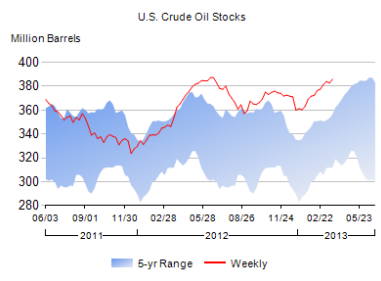
U.S. crude oil inventories bumped up 0.3 million barrels for the week ending April 5, according to an Energy Information Administration (EIA) report (link opens in PDF) released today. At 388.9 million barrels total, the newest number represents a 0.08% increase compared to the previous week.

For the same period, crude oil refinery inputs increased by 106,000 barrels per day (bpd), while imports fell by 211,000 bpd. These newest numbers carry forward the previous week’s trend, when inputs rose 130,000 bpd and imports fell 227,000 bpd. Overall inventories remain “well above the upper limit of the average range for this time of year,” according to the EIA.

Source: eia.gov.

Gasoline inventories rose 1.7 million barrels but remain within their average range. Prices at the pump fell for the sixth straight week to a national average of $3.608, $0.037 per gallon less than the previous week and $0.331 cheaper than a year ago.

Source: eia.gov.

Distillate fuel inventories fell slightly by 0.2 million barrels, keeping inventories low but within their five-year range. After a boost in wholesale demand dropped inventories by 2.3 million barrels the previous week, supply and demand seem to be averaging out for the summer season.

Source: eia.gov.

The article U.S. Crude Oil Inventories Steady as Pump Prices Drop originally appeared on Fool.com.

Copyright © 1995 – 2013 The Motley Fool, LLC. All rights reserved. The Motley Fool has a disclosure policy.

(function(c,a){window.mixpanel=a;var b,d,h,e;b=c.createElement(“script”);
b.type=”text/javascript”;b.async=!0;b.src=(“https:”===c.location.protocol?”https:”:”http:”)+
‘//cdn.mxpnl.com/libs/mixpanel-2.2.min.js’;d=c.getElementsByTagName(“script”)[0];
d.parentNode.insertBefore(b,d);a._i=[];a.init=function(b,c,f){function d(a,b){
var c=b.split(“.”);2==c.length&&(a=a[c[0]],b=c[1]);a[b]=function(){a.push([b].concat(
Array.prototype.slice.call(arguments,0)))}}var g=a;”undefined”!==typeof f?g=a[f]=[]:
f=”mixpanel”;g.people=g.people||[];h=[‘disable’,’track’,’track_pageview’,’track_links’,
‘track_forms’,’register’,’register_once’,’unregister’,’identify’,’alias’,’name_tag’,
‘set_config’,’people.set’,’people.increment’];for(e=0;e<h.length;e++)d(g,h[e]);
a._i.push([b,c,f])};a.__SV=1.2;})(document,window.mixpanel||[]);
mixpanel.init("9659875b92ba8fa639ba476aedbb73b9");

function addEvent(obj, evType, fn, useCapture){
if (obj.addEventListener){
obj.addEventListener(evType, fn, useCapture);
return true;
} else if (obj.attachEvent){
var r = obj.attachEvent("on"+evType, fn);
return r;
}
}

addEvent(window, "load", function(){new FoolVisualSciences();})
addEvent(window, "load", function(){new PickAd();})

var themeName = 'dailyfinance.com';
var _gaq = _gaq || [];
_gaq.push(['_setAccount', 'UA-24928199-1']);
_gaq.push(['_trackPageview']);

(function () {

var ga = document.createElement('script');
ga.type = 'text/javascript';
ga.async = true;
ga.src = ('https:' == document.location.protocol ? 'https://ssl' : 'http://www') + '.google-analytics.com/ga.js';

var s = document.getElementsByTagName('script')[0];
s.parentNode.insertBefore(ga, s);
})();

Read | Permalink | Email this

Source: FULL ARTICLE at DailyFinance

3 Regions Where Natural Gas Production Is Growing

By Matt DiLallo, The Motley Fool

Filed under:

If you haven’t noticed yet, natural gas prices have started to head higher. A combination of factors, including a surprisingly cold March, have led to resilient demand. As prices have inched up, two top Wall Street banks have seen enough momentum to raise their 2013 price target for natural gas. Morgan Stanley‘s price forecast was bumped up by 7% to $3.93 per million British thermal units, or MMBtu, while Goldman Sachs raised its forecast from $3.75 per MMBtu all the way to $4.40 per MMBtu.

That’s good news for those companies in regions where natural gas production is actually growing. Overall since the end of 2011, North American dry shale gas production has risen by 9.95% to 27.2 billion cubic feet of production per day as of the beginning of this past February. This rise has been driven primarily by production growth at three big plays. Let’s take a look.

Eagle Ford
While not known for natural gas, the Eagle Ford Shale has actually seen a 43.12% pop in natural gas production according to data from the Energy Information Administration, or EIA, over the past year. Most of this gas is associated with oil and liquids, as fewer companies are drilling in the dry gas window at the moment.

For example, Chesapeake Energy‘s core acreage is in the sweet spot of the oil window. Despite that, 19% of the company’s fourth-quarter production was natural gas. As Chesapeake increases its overall production, natural gas production increases as a byproduct of its liquids-focused drilling. Further, as the nation’s No. 2 gas producer, Chesapeake is one of the biggest beneficiaries of higher gas prices.

Marcellus
According to the EIA, natural gas production out of the Marcellus jumped 55.28% over the past year. Top producer, Range Resources , produced a total of 146 Bcf of natural gas last year. That production easily exceeded that of number two producer EQT‘s 103 Bcf of natural gas production last year.

These two companies hold one thing in common: Both are among the lowest-cost producers of natural gas in the country, which gives them a competitive advantage to make money when most of their competitors cannot. Investors in these low-cost producers have been served well as both have returned around 40% over the past year. 

Bakken
While the Bakken is known for its oil, natural gas production skyrocketed by 94.38% according to data from the EIA. Part of the reason more gas is being produced is because less of it is being flared — instead, it’s being put into pipelines. Most of this infrastructure simply didn’t exist until recently and now that companies have a way to get gas to market, they’re able to sell instead of flare.

The impact of this reduced flaring is clearly evident at Kodiak Oil & Gas . In 2011 the company produced 1,329 MMcf of gas, but flared 807 MMcf. That’s 61% of the gas! Last year the

Source: FULL ARTICLE at DailyFinance

Pump Prices Predicted to Drop for 2nd Summer in a Row

By Justin Loiseau, The Motley Fool

2013 Ford Focus ST

Filed under:

Prices at the pump are expected to drop for the second consecutive summer, according to a U.S. Energy Information Administration (EIA) report (link opens in PDF) released today.

After a 34% spike from 2010 to 2011, summer retail gasoline prices bumped down in the summer of 2012 and are expected to drop again this summer. According to EIA‘s report, drivers can expect an additional $0.06 shaved off this summer’s per-gallon cost, putting the average at $3.63, compared to last summer’s $3.69 average.

Source: eia.gov. 

The EIA assessment notes lower Brent crude oil prices, non-OPEC supply growth, and increased fuel economy as the main drivers behind the projected drop.

On a regional basis, West Coast pump prices should drop the most, from $4.02 last summer to $3.89 per gallon  this summer. The Midwest and Rocky Mountain regions are expected to receive a $0.09 cut from 2012’s pump prices, followed by a $0.04 drop on the East Coast and a $0.02 decrease for the Gulf Coast.

link

The article Pump Prices Predicted to Drop for 2nd Summer in a Row originally appeared on Fool.com.

Y
ou can follow Justin Loiseau on Twitter, @TMFJLo, and on Motley Fool CAPS, @TMFJLo.
Try any of our Foolish newsletter services free for 30 days. We Fools don’t all hold the same opinions, but we all believe that considering a diverse range of insights makes us better investors. The Motley Fool has a disclosure policy.

Copyright © 1995 – 2013 The Motley Fool, LLC. All rights reserved. The Motley Fool has a disclosure policy.

(function(c,a){window.mixpanel=a;var b,d,h,e;b=c.createElement(“script”);
b.type=”text/javascript”;b.async=!0;b.src=(“https:”===c.location.protocol?”https:”:”http:”)+
‘//cdn.mxpnl.com/libs/mixpanel-2.2.min.js’;d=c.getElementsByTagName(“script”)[0];
d.parentNode.insertBefore(b,d);a._i=[];a.init=function(b,c,f){function d(a,b){
var c=b.split(“.”);2==c.length&&(a=a[c[0]],b=c[1]);a[b]=function(){a.push([b].concat(
Array.prototype.slice.call(arguments,0)))}}var g=a;”undefined”!==typeof f?g=a[f]=[]:
f=”mixpanel”;g.people=g.people||[];h=[‘disable’,’track’,’track_pageview’,’track_links’,
‘track_forms’,’register’,’register_once’,’unregister’,’identify’,’alias’,’name_tag’,
‘set_config’,’people.set’,’people.increment’];for(e=0;e<h.length;e++)d(g,h[e]);
a._i.push([b,c,f])};a.__SV=1.2;})(document,window.mixpanel||[]);
mixpanel.init("9659875b92ba8fa639ba476aedbb73b9");

function addEvent(obj, evType, fn, useCapture){
if (obj.addEventListener){
obj.addEventListener(evType, fn, useCapture);
return true;
} else if (obj.attachEvent){
var r = obj.attachEvent("on"+evType, fn);
return r;
}
}

addEvent(window, "load", function(){new FoolVisualSciences();})
addEvent(window, "load", function(){new PickAd();})

var themeName = 'dailyfinance.com';
var _gaq = _gaq || [];
_gaq.push(['_setAccount', 'UA-24928199-1']);
_gaq.push(['_trackPageview']);

(function () {

var ga = document.createElement('script');
ga.type = 'text/javascript';
ga.async = true;
ga.src = ('https:' == document.location.protocol ? 'https://ssl' : 'http://www') + '.google-analytics.com/ga.js';

var s = document.getElementsByTagName('script')[0];
s.parentNode.insertBefore(ga, s);
})();

Read | <a target=_blank href="http://www.dailyfinance.com/2013/04/09/pump-prices-predicted-to-drop-for-2nd-summer-in-a/" …read more

Source: FULL ARTICLE at DailyFinance

Biodiesel Use Up 240% in 2011

By Justin Loiseau, The Motley Fool

Filed under:

Alternative and replacement fuels are making moves, according to the most recent data released by the Energy Information Administration on Monday. From 2007 to 2011, traditional fuel use dropped 7.8% to 171 billion gasoline equivalent gallons, while alternative fuels bumped up 124%.

Pushed ahead by a 240% spike in biodiesels, replacement fuels took the consumption cake, with a 187% jump to 9.5 billion gasoline equivalent gallons in 2011. According to the EIA, biodiesel’s boost is primarily due to the reinstatement of the biodiesel tax credit under the Renewable Fuel Standard.

Source: eia.gov.

Alternative transportation fuel use jumped up nearly 13% to 516 million gallons in 2011. Although natural gas continues to comprise nearly 50% of total alternative fuel consumption, a new wave of E85-capable vehicles helped push ethanol use up 52% from 2010 to 2011.

Source: eia.gov. 

The article Biodiesel Use Up 240% in 2011 originally appeared on Fool.com.

Y
ou can follow Justin Loiseau on Twitter, @TMFJLo, and on Motley Fool CAPS, @TMFJLo.
Try any of our Foolish newsletter services free for 30 days. We Fools don’t all hold the same opinions, but we all believe that considering a diverse range of insights makes us better investors. The Motley Fool has a disclosure policy.

Copyright © 1995 – 2013 The Motley Fool, LLC. All rights reserved. The Motley Fool has a disclosure policy.

(function(c,a){window.mixpanel=a;var b,d,h,e;b=c.createElement(“script”);
b.type=”text/javascript”;b.async=!0;b.src=(“https:”===c.location.protocol?”https:”:”http:”)+
‘//cdn.mxpnl.com/libs/mixpanel-2.2.min.js’;d=c.getElementsByTagName(“script”)[0];
d.parentNode.insertBefore(b,d);a._i=[];a.init=function(b,c,f){function d(a,b){
var c=b.split(“.”);2==c.length&&(a=a[c[0]],b=c[1]);a[b]=function(){a.push([b].concat(
Array.prototype.slice.call(arguments,0)))}}var g=a;”undefined”!==typeof f?g=a[f]=[]:
f=”mixpanel”;g.people=g.people||[];h=[‘disable’,’track’,’track_pageview’,’track_links’,
‘track_forms’,’register’,’register_once’,’unregister’,’identify’,’alias’,’name_tag’,
‘set_config’,’people.set’,’people.increment’];for(e=0;e<h.length;e++)d(g,h[e]);
a._i.push([b,c,f])};a.__SV=1.2;})(document,window.mixpanel||[]);
mixpanel.init("9659875b92ba8fa639ba476aedbb73b9");

function addEvent(obj, evType, fn, useCapture){
if (obj.addEventListener){
obj.addEventListener(evType, fn, useCapture);
return true;
} else if (obj.attachEvent){
var r = obj.attachEvent("on"+evType, fn);
return r;
}
}

addEvent(window, "load", function(){new FoolVisualSciences();})
addEvent(window, "load", function(){new PickAd();})

var themeName = 'dailyfinance.com';
var _gaq = _gaq || [];
_gaq.push(['_setAccount', 'UA-24928199-1']);
_gaq.push(['_trackPageview']);

(function () {

var ga = document.createElement('script');
ga.type = 'text/javascript';
ga.async = true;
ga.src = ('https:' == document.location.protocol ? 'https://ssl' : 'http://www') + '.google-analytics.com/ga.js';

var s = document.getElementsByTagName('script')[0];
s.parentNode.insertBefore(ga, s);
})();

Read | Permalink | Email this | Linking Blogs | <a target=_blank href="http://www.dailyfinance.com/2013/04/08/alternative-fuel-vehicle-data/#comments" …read more

Source: FULL ARTICLE at DailyFinance

Dow May Gain After Japanese Central Bank Doubles QE

By Roland Head, The Motley Fool

Filed under:

LONDON — Stock index futures at 7 a.m. EDT indicate that the Dow Jones Industrial Average may open 0.36% higher this morning, while the S&P 500 may open up by 0.4%. Both indexes closed sharply lower yesterday after weaker-than-expected economic data dented investor sentiment and led to a big drop for the CNN Fear & Greed Index, which closed down 13 points at 58.

This morning’s trading is likely to be influenced by the Japanese central bank’s surprise decision to accelerate its bond-buying program and double its monetary base in the next two years. The Bank of Japan said it would expand its balance sheet from $1.43 trillion to $2.86 trillion by March 2015 by doubling its asset purchases, the majority of which will be long-term government bonds. The bank is targeting inflation of 2% to kick-start growth after years of deflation.

In Europe, markets rose ahead of the European Central Bank announcement due later today, although the ECB is expected to leave interest rates unchanged. The eurozone service sector continued to contract in March, according to the Markit eurozone services PMI, which fell to 46.4 in March from 47.9 in February, indicating that the rate of contraction is increasing. In London, the FTSE 100 was 0.17% lower at the time of writing following the Bank of England‘s announcement that it would leave both interest rates and its asset purchase program unchanged this month.

In the U.S., today’s initial jobless claims report at 8:30 a.m. EDT is likely to be closely watched after yesterday’s ADP employment figures came in below expectations. A Reuters survey suggests that 350,000 new jobless claims were made last week, down slightly from 357,000 the previous week. Today’s figures are likely to be seen as a leading indicator ahead of tomorrow’s nonfarm payrolls and unemployment reports. Meanwhile, this morning’s Challenger job-cut report said that layoffs planned by U.S. companies spiked 37% from January to February. However, the cuts were more than offset by planned hiring.

Other economic data due today includes the EIA weekly natural-gas storage report at 10:30 a.m. EDT and the global services PMI at 11 a.m. EDT.

Companies expected to report quarterly earnings before markets open include International Speedway, Jos. A Bank Clothiers, and RPM International. Facebook stock could also be actively traded ahead of today’s much-hyped media launch of a new Android-related product — widely expected to be a Facebook phone. Facebook stock climbed 3.3% yesterday and was 1.2% higher in premarket trading this morning.

Finally, let’s not forget that the Dow’s daily movements can add up to serious long-term gains. Indeed, Warren Buffett recently wrote, “The Dow advanced from 66 to 11,497 in the 20th Century, a staggering 17,320% increase that materialized despite four costly wars, a Great Depression and many recessions.” If you, like Buffett, are convinced of the long-term power of the Dow, you should read “5 Stocks To Retire On.” Your long-term wealth could be transformed, even in this uncertain …read more

Source: FULL ARTICLE at DailyFinance

Crude Oil Inventories Up 0.7% on Increased Production

By Justin Loiseau, The Motley Fool

Filed under:

U.S. crude oil inventories bumped up 0.7% (2.7 million barrels) to 388.6 million barrels total for the week ending March 29, according to an Energy Information Administration (EIA) report (link opens a PDF) released today.

In a reversal from last week’s report, imports dropped 227,000 to 7.9 million barrels per day while refinery inputs added on 130,000 to reach 15 million barrels per day.

In what has been a common theme for crude oil inventories in 2013, the latest week’s rise keeps levels “well above the upper limit of the average range,” according to the EIA. The nation’s supply of oil is now 7.2% above year-ago levels and the highest since July 27, 1990, when it was at 391.9 million barrels.

Source: eia.gov. 

Gasoline inventories dropped 0.6 million barrels after falling 1.6 million barrels the previous week. In contrast to crude oil, gasoline’s supply remains within its average range as it tapers off for the summer months. Prices at the pump fell for the fifth consecutive week, down $0.035 to a national average of $3.645 per gallon. That’s down $0.11 from a month ago and $0.29 lower than at this time last year.

Source: eia.gov. 

Distillate inventories also fell, down 2.3 million barrels after a 4.5-million-barrel drop the previous week. While crude oil inventories remain well above their upper limit, increasing demand (+5.5%) for distillates may push inventories below their lower limit average in the coming weeks.

Source: eia.gov. 

link

The article Crude Oil Inventories Up 0.7% on Increased Production originally appeared on Fool.com.

Y
ou can follow Justin Loiseau on Twitter, @TMFJLo, and on Motley Fool CAPS, @TMFJLo.
Try any of our Foolish newsletter services free for 30 days. We Fools may not all hold the same opinions, but we all believe that considering a diverse range of insights makes us better investors. The Motley Fool has a disclosure policy.

Copyright © 1995 – 2013 The Motley Fool, LLC. All rights reserved. The Motley Fool has a disclosure policy.

(function(c,a){window.mixpanel=a;var b,d,h,e;b=c.createElement(“script”);
b.type=”text/javascript”;b.async=!0;b.src=(“https:”===c.location.protocol?”https:”:”http:”)+
‘//cdn.mxpnl.com/libs/mixpanel-2.2.min.js’;d=c.getElementsByTagName(“script”)[0];
d.parentNode.insertBefore(b,d);a._i=[];a.init=function(b,c,f){function d(a,b){
var c=b.split(“.”);2==c.length&&(a=a[c[0]],b=c[1]);a[b]=function(){a.push([b].concat(
Array.prototype.slice.call(arguments,0)))}}var g=a;”undefined”!==typeof f?g=a[f]=[]:
f=”mixpanel”;g.people=g.people||[];h=[‘disable’,’track’,’track_pageview’,’track_links’,
‘track_forms’,’register’,’register_once’,’unregister’,’identify’,’alias’,’name_tag’,
‘set_config’,’people.set’,’people.increment’];for(e=0;e<h.length;e++)d(g,h[e]);
a._i.push([b,c,f])};a.__SV=1.2;})(document,window.mixpanel||[]);
mixpanel.init("9659875b92ba8fa639ba476aedbb73b9");

function addEvent(obj, evType, fn, useCapture){
if (obj.addEventListener){
obj.addEventListener(evType, fn, useCapture);
return true;
} else if (obj.attachEvent){
var r = obj.attachEvent("on"+evType, fn);
return r;
…read more
Source: FULL ARTICLE at DailyFinance

U.S. Crude Oil Inventories Rise to Highest Level Since 1990

By Reuters

Filed under: , , , ,

Damian Dovarganes/AP

By Robert Gibbons

NEW YORK — Oil prices fell more than 2 percent on Wednesday as U.S. crude oil inventories grew to their highest level since 1990 and weak economic data stoked worries about U.S. energy demand.

U.S. crude stocks rose 2.71 million barrels last week, the Energy Information Administration said in its weekly report.

The rise was slightly more than the build of 2.2 million barrels expected in a Reuters survey of analysts and put U.S. commercial inventories at 388.62 million barrels, the most since 1990 and close to the record 391.9 million barrels reached in 1982, the year the EIA started tracking inventories.

“The report is somewhat bearish given the build in crude oil inventories and modest decline in gasoline inventories, which are the focus of the market,” said John Kilduff, partner at Again Capital LLC in New York.

“The rise in the refinery utilization to above 86 percent also signals further easing of the concerns over refined product inventories,” Kilduff said.

U.S. RBOB gasoline futures fell 3 percent, more than 9 cents, after or dropping 6 cents on Tuesday, as the EIA said gasoline stocks fell 572,000 barrels, less than expected and much less than the drop of 5 million barrels reported late on Tuesday by the American Petroleum Institute.

Brent crude was down $2.72 at $107.97 a barrel at 12:52 p.m. EDT, having fallen as low as $107.78.

U.S. crude was down $2.19 at $95 a barrel, having fallen to $94.89, just above the 50-day moving average at $94.64. Brent’s premium to U.S. crude fell back below $13 a barrel on Wednesday, after it reached $14.66 on Tuesday.

The spread between the two contracts had been widened because of expectations that crude stocks at the Cushing, Okla., hub, delivery point for the U.S. crude contract, would be increasing after Exxon Mobil Corp. (XOM) shut its Pegasus pipeline on Friday.

The pipeline moves crude oil from Illinois to the refinery-rich Texas Gulf Coast and a prolonged shut down would curb efforts to relieve the glut of crude oil in the Midwest.

Economic Concerns

Crude stocks at Cushing fell 287,000 barrels in the week to last Friday, the EIA report said.

With the North American heating fuel season waning and crude futures sliding, U.S. heating oil futures, the benchmark distillate contract, also fell and pushed below the 50-day and 100-day moving averages, technical levels monitored by chart watching analysts and traders.

Total distillate stocks fell 2.27 million barrels last week, the EIA said, more than expected, but the inventory drop and data showing demand over the previous four weeks was up 5.5 percent from the year-ago period didn’t prevent heating oil’s price slide.

U.S. companies hired at the weakest pace in five …read more
Source: FULL ARTICLE at DailyFinance

2 Ways Cleaner Gasoline Will Help Refiners

By Maxx Chatsko, The Motley Fool

Filed under:

Just last week the Environmental Protection Agency, or EPA, announced plans for cleaning up the nation’s transportation fuels. The new standards would cut the sulfur content of gasoline by 67%, and the content of nitrogen oxides, or ground-level ozone, by 80%. Although the health benefits alone could total billions of dollars per year, the refining industry is warning consumers that they’ll have to fork over more money at the pump.     

It seems the ongoing spat between the EPA and refining industry over mandatory ethanol credits hasn’t left either side running on empty. The two are now battling over how the new standard will affect gasoline prices. The EPA says prices will rise by one penny per gallon, while a study from the American Petroleum Institute claims the number will be between six and nine cents. In the end, the added costs could easily be swallowed up by several consumer- and industry-friendly trends. In fact, it’s likely that the mandate could actually help boost profits for refining companies.  

1. Upgrading domestic infrastructure
As a general rule of thumb, oil tends to get “dirtier” as it becomes more difficult to recover. That poses a problem for refineries processing the growing volumes of unconventional hydrocarbons flowing out shale reserves and the Canadian tar sands. The Energy Information Agency, or EIA, has watched the sulfur content of crude oil inputs into American refineries climb in recent years as conventional oil reserves dry up. Here’s a brief comparison of sulfur content of crude oils sourced from various locations:

Source: EIA

Despite the heavier crude going into refineries, gasoline prices today are $0.30 lower than they were this time last year. How? One reason: Companies processing the influx of shale oil have already begun responding to changes on the ground and show no signs of slowing. HollyFrontier has raised its budget for capital expenditures from just $140 million in 2011 to an estimated $400 million in 2013. BP spent that much bringing a single refinery in Ohio into the future.  

Not all refineries are created equal, but no novel or prohibitively expensive technology is required to comply with the new standards. One senior official said that only 16 of the nation’s 144 refineries would require major capital investments. In other words, the industry has already begun preparing facilities for heavier crudes and cleaner fuels.  

The new standards will act as the extra motivation needed to expedite capital projects and revitalize all of America’s refining capacity. That’s great news for investors, since improving infrastructure has been the driving force behind the most profitable trend sweeping the industry: exports.  

2. Fanning the flames of exports
The proposed rules will normalize the quality of gasoline sold in all 50 states to that of California, Japan, and the European Union — all of which have taken steps to reduce impurities. Currently only 29 domestic refineries can efficiently produce in-spec …read more
Source: FULL ARTICLE at DailyFinance

Ignore This Pipeline Statistic

By Aimee Duffy, The Motley Fool

Filed under:

The Energy Information Administration, or EIA, announced earlier this week that there were only 367 miles of natural gas pipelines built across the U.S. last year. As demand for natural gas climbs, keeping up our infrastructure is incredibly important. Today I’ll take a closer look at what investors really need to pay attention to when it comes to building out our pipeline network.

A brief construction history
Over the past 15 years, we’ve built a considerable amount of natural gas pipeline. Construction really dropped off last year, however, after a massive build out in 2008 and 2009:

Source: EIA

In 2011, we spent nearly $10 billion adding just shy of 2,500 miles of new pipeline. With the exception of six projects smaller than 100 miles each, that construction occurred outside of the Northeast region.

Though we built less than 400 miles of pipeline in 2012, most of that construction was in the Northeast, a region that is particularly wanting for infrastructure as production booms in the Marcellus Shale.

The more important number
This year, the EIA expects operators to bring on line more than 1,000 miles of natural gas pipeline projects. More importantly, capacity additions should reach 15 billion cubic feet per day, after failing to crack 5 bcfd in 2012.

It is important to distinguish between capacity and miles when we attempt to reconcile this construction growth. Capacity can be added by increasing pressure at compressor stations, or more obviously, by using bigger pipes. Taking a look at our next two charts really hammers home this point.

First we have the number of miles constructed in the Northeast from 1997 to proposed miles in 2015:

Source: EIA

Far and away the biggest growth year was 1999. Now let’s look at capacity additions over the same period:

Source: EIA

Right away the difference is striking. There is very little correspondence between miles constructed and capacity added. The easiest comparison to make is between 2012 and 2013. Construction miles in the Northeast are expected to increase slightly this year, but capacity will jump through the roof.

Why this matters
Our world is full of numbers, but not all of them matter. In the pipeline game, capacity and connections to valuable markets are much more important than mileage.

Take for example, Enterprise Products Partners‘ ATEX Express pipeline. It’s a long line that will travel from the Marcellus Shale down to the Gulf Coast, and it will certainly increase the company’s overall mileage statistics, but that doesn’t matter at all. What matters is that it will add 190,000 barrels per day of capacity to a region that desperately needs it. Chesapeake Energy has gone on record saying that it will not increase its liquids production in the Marcellus until this pipe comes on line. Range Resources is also counting on the project to deliver production to the Gulf.

Foolish takeaway
Whether or not …read more
Source: FULL ARTICLE at DailyFinance

Imports Drive Increase in Crude Oil Inventories

By Justin Loiseau, The Motley Fool

Filed under:

U.S. crude oil inventories jumped 3.3 million barrels to 385.9 million barrels for the week ending March 22, according to an Energy Information Administration (EIA) report (link opens a PDF) released today. That’s a 0.9% increase.

While refinery inputs increased by 364,000 barrels per day (bpd), the main addition came from a 841,000-bpd spike in crude oil imports.

Although inventories had dropped 1.3 million barrels the previous week, this newest report keeps inventories “well above the upper limit of the average range for this time of year,” according to the EIA.

Source: EIA.gov. 

Gasoline inventories fell 1.6 million barrels, just more than the previous week’s 1.5 million-barrel decrease. Unlike crude oil’s oversized inventory, gasoline’s supply remains within its average range. Prices at the pump continued their month-long decline, dropping another $0.016 for a national average of $3.68 per gallon.

Source: EIA.gov. 

Leading the supply shrink, distillates fell a whopping 4.5 million barrels due primarily to a 5.8% year-over-year increase in wholesale demand.

Source: EIA.gov. 

link

The article Imports Drive Increase in Crude Oil Inventories originally appeared on Fool.com.

Y
ou can follow Justin Loiseau on Twitter, @TMFJLo, and on Motley Fool CAPS, @TMFJLo.
Try any of our Foolish newsletter services free for 30 days. We Fools may not all hold the same opinions, but we all believe that considering a diverse range of insights makes us better investors. The Motley Fool has a disclosure policy.

Copyright © 1995 – 2013 The Motley Fool, LLC. All rights reserved. The Motley Fool has a disclosure policy.

(function(c,a){window.mixpanel=a;var b,d,h,e;b=c.createElement(“script”);
b.type=”text/javascript”;b.async=!0;b.src=(“https:”===c.location.protocol?”https:”:”http:”)+
‘//cdn.mxpnl.com/libs/mixpanel-2.2.min.js’;d=c.getElementsByTagName(“script”)[0];
d.parentNode.insertBefore(b,d);a._i=[];a.init=function(b,c,f){function d(a,b){
var c=b.split(“.”);2==c.length&&(a=a[c[0]],b=c[1]);a[b]=function(){a.push([b].concat(
Array.prototype.slice.call(arguments,0)))}}var g=a;”undefined”!==typeof f?g=a[f]=[]:
f=”mixpanel”;g.people=g.people||[];h=[‘disable’,’track’,’track_pageview’,’track_links’,
‘track_forms’,’register’,’register_once’,’unregister’,’identify’,’alias’,’name_tag’,
‘set_config’,’people.set’,’people.increment’];for(e=0;e<h.length;e++)d(g,h[e]);
a._i.push([b,c,f])};a.__SV=1.2;})(document,window.mixpanel||[]);
mixpanel.init("9659875b92ba8fa639ba476aedbb73b9");

function addEvent(obj, evType, fn, useCapture){
if (obj.addEventListener){
obj.addEventListener(evType, fn, useCapture);
return true;
} else if (obj.attachEvent){
var r = obj.attachEvent("on"+evType, fn);
return r;
}
}

addEvent(window, "load", function(){new FoolVisualSciences();})
addEvent(window, "load", function(){new PickAd();})

var themeName = 'dailyfinance.com';
var _gaq = _gaq || [];
_gaq.push(['_setAccount', 'UA-24928199-1']);
_gaq.push(['_trackPageview']);

(function () {

var ga = document.createElement('script');
ga.type = 'text/javascript';
ga.async = true;
ga.src = ('https:' == document.location.protocol ? 'https://ssl' : 'http://www') + '.google-analytics.com/ga.js';

var s = document.getElementsByTagName('script')[0];
s.parentNode.insertBefore(ga, s);
})();

<p style="clear: both;padding: 8px 0 0 0;height: 2px;font-size: 1px;border: 0;margin: …read more
Source: FULL ARTICLE at DailyFinance

4 Opportunities in Pennsylvania's Gas Boom

By Aimee Duffy, The Motley Fool

Filed under:

Last week, the Energy Information Administration, or EIA, reported that Pennsylvania‘s natural gas production climbed an astounding 69% between 2011 and 2012. The state sits above the Marcellus Shale, and exploiting that formation has likely catapulted Pennsylvania into the ranks of the top five natural gas producing states. Let’s take a closer look at this story, and what opportunities it may provide for investors.

Rapid growth
Pennsylvania‘s transformation from gasless laggard to methane monster happened seemingly overnight. In 2008, the state produced less than 1 billion cubic feet per day (bcfd) of natural gas. That was the first year producers started drilling horizontal wells in meaningful numbers. The results are impressive:

Source: EIA

In a mere four years, Pennsylvania‘s natural gas production has climbed from 1.0 bcfd to reach 6.1 bcfd in 2012. You can see how much of an impact shale drilling has had, given the rapid decline of non-horizontal wells in blue, and the corresponding rise of horizontal wells in brown.

Perhaps the more important take away from the graph above, is that this growth came at a time when drilling slowed overall. Between 2011 and 2012, there were about 750 fewer wells drilled, yet production increased 69% over that same period. Let’s take a look at how this happened, and at two key opportunities that came out of it for investors.

Fewer rigs, but more gas?
There are two reasons that drilling rig counts dropped but production increased. The first is that because of a lack of pipeline capacity in the Marcellus, many rigs were drilled and never turned on. Capacity grew in 2012, and will grow even more in 2013, and again in 2014. This will allow producers to move more gas, which should drive the price up, much the way additional pipeline capacity in Texas has boosted the price of oil.

The second reason is that producers are much more efficient at drilling wells now. Improved techniques contribute to not only shorter drilling times, but higher production rates per well. The average horizontal well drilled in the Marcellus costs about $3 million-$4 million. Obviously, any company that improves drilling efficiency has the opportunity to cut costs as well.

Companies to consider
Given what we know about what is behind the growth in Pennsylvania, it makes sense to search for pipeline operators and efficient drillers in the Marcellus Shale. Here are four companies to get your research started:

  • Kinder Morgan Energy Partners is the nation’s leading natural gas transporter and naturally has a stake in the Marcellus. It is expanding its Tennessee Gas Pipeline system in several places, which should increase takeaway capacity by more than 8.0 million cubic feet per day by the end of November 2013.
  • Enterprise Products Partners is bringing online one of the region’s most anticipated pipeline projects, the ATEX Express. Chesapeake Energy said in its last investor presentation that its wet gas production isn’t going to …read more
    Source: FULL ARTICLE at DailyFinance

Dow Jones May Slip on Euro Fears

By Roland Head, The Motley Fool

Filed under:

LONDON — Stock index futures at 7 a.m. EDT indicate that the Dow Jones Industrial Average may open 0.35% lower this morning after closing at a new high last night, while the S&P 500 may open down by 0.37% after closing within two points of its all-time high yesterday. As the S&P 500 approaches record levels, the CNN Fear & Greed Index has also moved higher, closing at 76 yesterday in a return to “extreme greed” territory.

In Europe, protests continue in Cyprus as the country’s central bank governor says its banks will open tomorrow with new capital restrictions in place. Italian markets moved lower after yet another set of negotiations failed to produce a coalition to govern the country. Italy has been without an effective government since elections were held at the end of February, and a new round of elections now looks increasingly likely.

In the U.K., the Bank of England said U.K. banks needed to raise a further $38 billion to meet capital shortfalls and cover potential loan losses. The report did not specify which banks were affected, but Lloyds Banking Group and Barclays moved higher after the announcement, which was lower than a previous $90 billion estimate. Revised GDP figures showed that the U.K. economy expanded by just 0.2% in 2012, less than the 0.3% previously reported. Both the British and French economies shrank by 0.3% in the final quarter of 2012.

In the U.S., investors will be looking ahead to February pending-home-sales figures, which are due at 10 a.m. EDT. Consensus forecasts suggest that sales may have fallen by 0.5% in February after rising by 4.5% in January. Also of interest may be the EIA weekly petroleum status report, due at 10:30 a.m. EDT.

Companies due to report before the opening bell today include UniFirst, which is expected to report earnings of $1.13 per share. Companies due to report after markets close today include Paychex, Red Hat, Texas Industries, SYNNEX, HB Fuller, Steelcase, Five Below, and PVH. SAIC stock could also be actively traded this morning after the technical-services provider announced a $1 special dividend in its full-year results, which were published after markets closed last night. SAIC shares moved 4.2% higher in after-hours trading last night.

Finally, let’s not forget the Dow’s daily movements can add up to serious long-term gains. Indeed, Warren Buffett recently wrote, “The Dow advanced from 66 to 11,497 in the 20th Century, a staggering 17,320% increase that materialized despite four costly wars, a Great Depression and many recessions.” If you, like Buffett, are convinced of the long-term power of the Dow, you should read “5 Stocks To Retire On.” Your long-term wealth could be transformed, even in this uncertain economy. Simply click here now to download this free, no-obligation report.

The article Dow Jones May Slip on Euro Fears originally appeared on Fool.com.


Roland Head has no position in …read more
Source: FULL ARTICLE at DailyFinance

Woman Allergic To Exercise Told To Stop By Doctors

Kasia Beaver, 33, from Redditch, Worcestershire, England, was diagnosed with exercise-induced angioedema (EIA) and has been told to stop exercising by her doctors. When her heart beats too rapidly her eyes puff up and shut, her throat narrows and she breaks out in hives. Many of us joke that we cannot go to the gym because we are allergic to exercise… …read more
Source: FULL ARTICLE at Medical News Today