Tag Archives: BRIC

Microsoft deal offers free Xbox LIVE Gold sub for Office 365, with numerous caveats

It sounds great: Microsoft now offers a free year’s subscription to its Xbox LIVE Gold service if you pick up an Office 365 subscription or Office 365 University.

But dig into the terms and conditions attached to the promotion, and you’ll find out quickly that it doesn’t apply to everybody. In fact, if you purchased either subscription within the United States, you’re out of luck.

What this does imply, however, is that Microsoft hopes to beef up its international penetration of Office 365 by piggybacking it onto the more popular Xbox game console. The deal is available in Canada and Mexico, plus many European countries like France, Spain, Germany, and the United Kingdom. Two of the so-called BRIC countries are also included: Brazil, and Russia.

Microsoft

But you’re also out of luck if you purchased any of the following, which are not eligible for the deal:

To read this article in full or to leave a comment, please click here

…read more

Source: FULL ARTICLE at PCWorld

A 'New Normal' for Private Equity

By Knowledge@Wharton on Forbes, Contributor The following post was published on the Knowledge@Wharton Today blog on July 11, 2013. Some $200 billion of new capital went to private equity and venture capital management partnerships (collectively referred to here as PE) throughout the world in 2012. For the first time, 20% of that total, some $40 billion, went to fund managers in emerging market countries. Surprisingly, of that $40 billion, only $15 billion went to the subset of emerging economies known as the BRICs (Brazil, Russia, India and China). That leaves $25 billion that went into the non-BRIC emerging markets. So where did the rest of it go? Countries like Columbia, Chile, Peru and Mexico have seen remarkable growth. Several African countries, such as South Africa, Kenya and Nigeria — indeed, the whole of sub-Saharan Africa — have witnessed growth in the number of fund managers and the capital under management. Turkey also has emerged as a destination, as have Malaysia, Thailand, Vietnam and now Indonesia. These new players still have work to do in improving their PE ecosystems. Management capacity building is high on the list, as are appropriate laws and regulations, tax treatment and acceptance of contractual provisions. These countries’ governments have recognized the role of PE in their industries and are motivated to make the needed changes. There is a discernible transfer of knowledge from mature economies to the emerged and emerging market PE players. These trends are reflected in two of the articles included in this year’s Wharton Private Equity Review. One offers coverage of a panel discussion titled, “Private Equity Survival Guide: How to Survive and Thrive in Emerging Markets,” which took place at the 2013 Wharton Private Equity & Venture Capital Conference. The second, written by a team of five Wharton MBA students, focuses on the impact of the Arab Spring on private equity in the Middle East and North Africa (MENA) region. Beyond emerging markets, this year’s review includes a piece by a Wharton MBA student that looks at how the regulatory scrutiny of the PE industry in the United States has evolved dramatically over recent years. The industry has moved from a lightly regulated, self-governing asset class to one that is coming under increasing scrutiny and reporting requirements. The author speculates on what is in store for the industry as regulators continue their investigations. An example of international activity is presented in a case study by another Wharton MBA student, titled “Investing in Times of Distress: the Bank of Ireland and WL Ross,” which provides a detailed overview of how PE investors have played a role in the recapitalization and restructuring of troubled financial institutions. Knowledge@Wharton then reports on another panel from the conference that addressed how PE firms create value and questioned some of the common wisdom surrounding the roles and actions of PE firms once they have acquired a company. Finally, a piece on venture capital from another conference panel then looks at the challenge of generating consistent returns and the growing allure of New York …read more

Source: FULL ARTICLE at Forbes Latest

The Great, Good And Ugly In Emerging Markets ETFs

By Ben Marks, Contributor

There is little question that the biggest story to come out of the first quarter has been the dramatic surge in U.S. equity prices. Investors, frustrated by the continued low-interest rate environment, have flooded the markets with capital and sent indexes soaring to a string of historic heights.   Lost in this excitement has been the troubling decline in emerging markets, especially in the so-called BRIC countries: Brazil, Russia, India and China.

From: http://www.forbes.com/sites/greatspeculations/2013/04/15/differentiating-among-the-emerging-markets-the-great-the-good-and-the-ugly-2/

Should I Buy Rexam?

By Harvey Jones, The Motley Fool

Filed under:

I’m shopping for shares, and I’ve found plenty of goodies for sale. Should I pop Rexam into my basket?

It’s in the can
If you’re reading this while sipping from a can of drink, there’s a good chance you are contributing to the profits of Rexam. This solid FTSE 100-listed stock earns most of its income by manufacturing drinks cans, and is one of the world’s top five consumer packaging firms. Should I buy it?

I have developed a quiet respect for the unsung heroes of the FTSE 100, names such as distribution group Bunzl, outsourcer Serco, plumbing merchant Wolseley, and now can-maker Rexam. These companies may be low on glamour but they have quietly knuckled down to the admirable job of boosting sales, pioneering new markets and boosting shareholder value. Rexam is up 77% in the last three years and 29% in the past 12 months. That puts it nicely ahead of the FTSE 100 as a whole, which grew 11% and 14% respectively in that time.

T-Rexam
Its full-year results for 2012 showed a 6% rise in beverage can volumes and 5% rise in operating profits to £456 million. Sales rose 2% to £4.31 billion, while adjusted profit before tax rose 1% to £418 million. There was good news for shareholders, with the board proposing a 6% hike in its final dividend to 10.2 pence, taking the total dividend to 15.2 pence for the year. Rexam is stripping out its non-core business to focus on beverage cans, a strategy that included the sale of its Personal Care business in December, which allowed it to return £395 million to shareholders.

While acknowledging “less than ideal” market conditions, chairman Stuart Chambers has highlighted Rexam’s “underlying resilience”, with disciplined capital spending and healthy cash generation maintaining a strong balance sheet. Its health care operation had a difficult year, largely due to one of its customers products coming off patent, with operating profit plunging from £65 million in 2011 to £48 million. But its return on capital employed (ROCE) looks healthier 14.7% in 2012, and Chambers says it is on course to hit its 15% target this year.

Tin cups
One of the key things I look for in a FTSE 100 company is exposure to fast-growing emerging markets. Rexam doesn’t disappoint on that score, with a market-leading position in beverage cans in three out of the four BRIC countries, and a new Brazilian plant coming online just in time for both the World Cup and Olympics. In these troubled times, I also like its focus on cost savings, which helped cut group net debt from £1.2 billion to just £800 million. Although I’m concerned about its exposure to the cost of one single commodity, aluminum.

Rexam now yields 2.9%, against 3.3 for the FTSE as a whole, neatly covered 2.3 times. Earnings per share growth looks strong at 15% this year and 8% in 2014. For me, the figure that really stands out is

From: http://www.dailyfinance.com/2013/04/11/should-i-buy-rexam-2/

Is America Cheap Enough for Your Portfolio?

By Dan Carroll, The Motley Fool

Filed under:

U.S. stocks have exploded out of the gate in 2013. The Dow Jones Industrial Average has repeatedly hit new all-time highs while surging nearly 8.6% since the start of the year. Yet despite those impressive gains, the Dow’s maintained a respectable average P/E valuation of just 14.9, a number that’s far from expensive.

The best investors know that buying good stocks on the cheap is a recipe for success, however. As U.S. markets have surged, others around the world have experienced mixed results. So just which international markets are too cheap to ignore right now — and which are too expensive for your investment?

Cheap China, expensive America
The United States’ national P/E average of stocks ranks quite a bit higher than the Dow’s — it’s currently at 17.7, still a respectable valuation but more in line with the impressive gains we’ve seen since the start of 2013.

Surprisingly, the U.S. ranks as more expensive than the big winner in 2013 that has gobbled up attention everywhere — Japan. Japanese markets boast a national average P/E of 16.9, even as the Nikkei index has significantly outperformed the Dow to start the year. Fueled by the weakening yen and new Prime Minister Shinzo Abe‘s inflationary tactics, the Nikkei has sprinted to gains of more than 20% year to date, and Japanese stocks remain an attractive buy despite the surge. With the country’s central bank unveiling an unprecedented stimulus action this past week, Japan‘s set to unload a massive amount of yen into its stagnant economy. It’s a risky move, but Japanese financial stocks in particular stand to reap rewards on the back of easy money.

Not every Asian nation’s doing quite as well as Japan, however. Disgruntled neighbor China, which has singled out Japan‘s bond-buying program as the precursor to a currency war, ranks as much cheaper. China sports an average P/E of only 7.9: Chinese stocks have struggled to stay above water to start the year, and the country’s slowdown has worried economists about the second-largest economy’s growth. Hong Kong’s Hang Seng Index has fallen by 6.8% since the start of 2013, although the index sports a slightly higher P/E of 10.9.

While China‘s economy is still growing faster than nearly every other advanced nation, it needs to grow at a considerably quicker rate to support its developing middle class. Unless China identifies a plan that will pick up growth soon, don’t be deceived by that cheap valuation: This country’s still experiencing the ups and downs of a developing society, and Japan‘s massive stimulus move won’t help Chinese exporters any.

China‘s fellow BRIC member, Russia, comes in as even cheaper, with an average P/E of just 6. That’s a cheaper valuation than any member of the Dow currently; the closest blue-chip stock to Russia is Chevron , which sports a P/E of 8.9. Coincidentally, one of Chevron’s biggest global rivals has become one of Russia‘s brightest companies: Russian state-owned …read more

Source: FULL ARTICLE at DailyFinance

America's 7th Best CEO Will Give You an Investing Edge

By Brian Stoffel, The Motley Fool

Filed under:

Once you get the hang of it, it’s pretty easy to dissect balance sheets, income, and cash flow statements. This is the first step in getting your feet wet in the investment world.

But it doesn’t stop there. If we were to base investing decisions solely on what we read in these statements, that would be akin to picking a significant other based solely on their Facebook profile — to many, it just doesn’t make sense to avoid real-life interaction.

Investigating these “soft” aspects of a company is important for investors. And although we can’t capture all of the intangibles of a company in one article, Glassdoor.com — a website that collects employee sentiment for companies across the world — recently came out with a list that could help: the Top CEOs of 2013.

Over the past few days, I’ve covered CEOs 25 through 8. Today, I’m going to introduce you to the company with the 7th-highest-rated CEO, give you some background on the company, and at the end, I’ll offer up access to a special free report that covers the biggest names in tech.

Accenture
Unlike some of the other companies on this list, unless you’re in Accenture’s field, its unlikely you’re familiar with the businesses. In fact, until recently, I knew Accenture for only two things: it was the first company to drop Tiger Woods after news of his philandering came out; and the company’s stock was one of the hardest hit during the “Flash Crash” of 2010 — it traded for just a penny.

But there’s more to this Dublin-based business than a few tidbits of trivia. Over the years, Accenture has become the second-largest technology-consulting firm in the world, second only to IBM .

CEO Pierre Nanterme, who has been at the helm since 2011, heads the company. Though that’s a pretty short tenure, Nanterme has been with the company since 1983 and has headed up several of the company’s foreign divisions.

Going global, staying mobile
Many times, “technology-consulting” is a fancy term for teaching companies how to outsource their work to areas where labor is cheaper. Perhaps it was Nanterme’s experience with several geographical divisions on his way up that helped him earn the top spot at the company. He has made it quite clear that there are three drivers that will guide his tenure at the company: global expansion, diversity, and working flexibility.

Of the company’s 250,000 employees, roughly 70,000 are located in India alone. The country accounts for half of Accenture’s annual revenue. But Nanterme isn’t too pleased that the executive suite is devoid of any Indian representation. “We are still very Anglo Saxon at the top,” says Nanterme. “We have extraordinarily qualified people in India and we will bring them to the top…It is definitely going to happen in my tenure.” 

As Accenture attempts to fill the outsourcing needs of emerging BRIC countries, don’t be too surprised to see the executive office include more …read more
Source: FULL ARTICLE at DailyFinance

Apple Gets Aggressive in Brazil

By Evan Niu, CFA, The Motley Fool

Filed under:

Brazil is No. 2 on Apple‘s BRIC priority list. CEO Tim Cook made that much clear late last year, saying the country is the next biggest opportunity behind China out of those emerging markets. While Cook didn’t “envision” Apple opening retail stores in Brazil anytime soon, the company has already begun hiring for retail positions, which suggests that Brazilian Apple Stores may not be too far off.

In the meantime, another challenge that Apple has historically faced in Brazil is that carriers don’t subsidize smartphones; the practice is considered an illegal tie-in sale. As investors know, unsubsidized iPhones are rather pricey, especially for consumers in emerging markets.

Well, the iPhone maker has now decided to get aggressive in Brazil by dropping the price of both the iPhone 4 and iPhone 4S. Apple has reduced retail iPhone pricing by 15% to 25%, depending on the model. The iPhone 4 saw its price fall from $741 to “just” $544, while the iPhone 4S now sits at the $840 price point, down from $989.

Installment payment plans are generally very popular in Brazil, and Apple also offers monthly plans to prospective buyers. Apple also offers a 10% discount to customers that willing to pay the full amount upfront.

When Cook spoke at the Goldman Sachs Technology and Internet Conference in February, he noted that Apple has been making numerous efforts recently to make its products more affordable. Apple supplier Foxconn has also been expanding in Brazil and is preparing to build its fifth facility. Producing iDevices locally can also help bring down costs since gadgets won’t face hefty import taxes.

Apple has just begun taking India seriously with a major overhaul of operations, with expanded distribution, payment plans, and increased marketing. Brazil is a more promising BRIC country than India, so it’s not surprising to see Apple put some more focus there now, too.

It’s incredible to think just how much of our digital and technological lives are almost entirely shaped and molded by just a handful of companies. Find out “Who Will Win the War Between the 5 Biggest Tech Stocks?” in The Motley Fool’s latest free report, which details the knock-down, drag-out battle being waged by the five kings of tech. Click here to keep reading.

The article Apple Gets Aggressive in Brazil originally appeared on Fool.com.

Fool contributor Evan Niu, CFA, owns shares of Apple. The Motley Fool recommends Apple and Goldman Sachs. The Motley Fool owns shares of Apple. Try any of our Foolish newsletter services free for 30 days. We Fools may not all hold the same opinions, but we all believe that considering a diverse range of insights makes us better investors. The Motley Fool has a disclosure policy.

Copyright © 1995 – 2013 The Motley Fool, LLC. All rights reserved. The Motley Fool has a disclosure policy.

…read more
Source: FULL ARTICLE at DailyFinance

5 Dividend Stocks for International Growth

By Justin Loiseau, The Motley Fool

^SPXTR Chart

Filed under:

U.S. utilities are in a rut and, according to recent energy projections, aren’t about to dig themselves out any time soon. But if you’re looking for a solid dividend with growth potential, you may find a match in U.S. utilities with international assets. I’ll highlight five utilities with different degrees of foreign forays and let you decide which fix fits your fancy.

America doesn’t want your energy
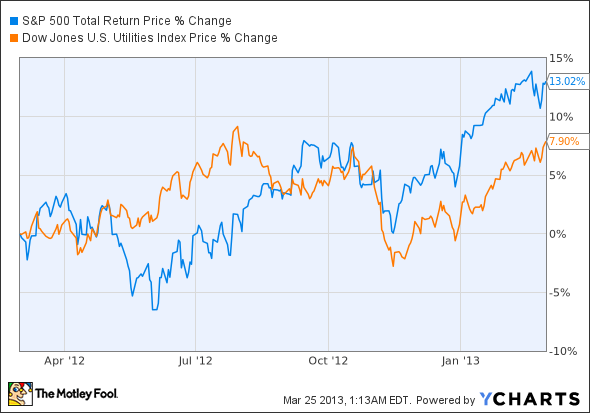
When Exelon CEO Chris Cane recently said “2012 was a difficult year on the economic front for our sector,” he wasn’t just making excuses for his company. Falling sales were a common trend for utilities last year, and the sector lagged the S&P 500 by more than 5 percentage points.

^SPXTR data by YCharts.

Looking ahead, projections aren’t peachy. A recent Department of Energy report predicts that electricity demand will clock in at 0.58% compound annual growth over the next decade, dulled by both America’s economy and advancements in energy efficiency.

The Federal Reserve announced last week that it expects U.S. GDP to fall between 2.9% and 3.7% by 2015, child’s play compared with many emerging markets. And although many utilities are overhauling their energy portfolios to set themselves up for a profitable future, some companies are looking abroad to propel top line growth.

Yes to AES?
When looking for utilities with international exposure, AES is the elephant in the room. Its 27-country spread offers formidable international exposure.

Source: AES Earnings Presentation (MCAC is Mexico, Central America, and the Caribbean. EMEA is Europe, Middle East, and Africa)

But diversification doesn’t make bad business good, and AES is currently working to cut costs. Its 4.9 debt-to-equity ratio is higher than 98% of its peers, and the company’s decision to sell 14 assets in nine countries over the past year is no coincidence. The utility’s stock jumped 6% on solid Q4 earnings, and BRIC bulls would do well to give AES a closer look.

Feeling Chile?
Hailing from my home state, North Carolina-based Duke Energy offers investors a nibble of internationalism with a big serving of Southern sauce. Its International Energy subsidiary is primarily focused on generation in Latin America, but it also owns a 25% stake in Saudi Arabian National Methanol Company. Duke axed a similar 25% stake in a Greek gas company in Q1 2012, while adding on a 240 MW thermal plant and 140 MW hydropower facility to its Chilean operations.

In total, Duke directly or indirectly generates 4,900 gross MW of international energy. That’s approximately 10% of the utility’s U.S. generation capacity, a significant slice of its portfolio pie. The utility beat top-line and earnings estimates last quarter and could be ready for some serious growth with its $12 billion of modernization projects well under way.

(Inter)National Grid
National Grid
is anything but, unless you’re based in the United Kingdom. This utility is listed on the U.S. stock exchange, but its blood runs …read more
Source: FULL ARTICLE at DailyFinance

5-Star ETFs Poised to Pop: WisdomTree Emerging Markets SmallCap Dividend

By Brian Pacampara, Pacampara, The Motley Fool

Filed under:

Based on the aggregated intelligence of 180,000-plus investors participating in Motley Fool CAPS, the Fool’s free investing community, the WisdomTree Emerging Markets SmallCap Dividend Fund (NYSE: DGS) has earned a coveted five-star ranking.

With that in mind, let’s take a closer look at DGS and see what CAPS investors are saying about the ETF right now.

DGS facts


Inception

Oct. 2007 

Total Assets

$1.5 billion

Investment Approach

Seeks to track the price and yield performance of the WisdomTree Emerging Markets SmallCap Dividend Index. The Index is a fundamentally weighted index that measures the performance of primarily small-cap stocks selected from the WisdomTree Emerging Markets Dividend Index.

Expense Ratio

0.64%

Dividend Yield

2.9%

1-Year / 3-Year / 5-Year Annualized Returns

9.5% / 9.6% / 7.5%

Alternatives

SPDR S&P Emerging Markets Small Cap (NYSE: EWX)

WisdomTree Emerging Markets Equity Income (NYSE: DEM)

iShares MSCI Emerging Markets Small Cap Index (NYSE: EEMS)

Sources: Morningstar and Motley Fool CAPS.

On CAPS, 99% of the 200 members who have rated WisdomTree Emerging Markets SmallCap Dividend Fund believe the ETF will outperform the S&P 500 going forward.

Just last week, one of those Fools, All-Star SH2F088, succinctly summed up the bull case for our community:

DGS is a small-cap emerging market ETF. I believe the BRIC emerging markets will outperform developed markets through the end of this secular bear and the following bull run, as they do relatively better job of exploiting the emerging global middle class.

The small cap dividend weighting should keep the fund focused on serious companies poised to benefit from higher long term growth of the emerging markets while limiting the downside risk of bankruptcy.

Owning exceptional ETFs is a surefire way to secure your financial future. Of course, despite a strong five-star rating, DGS may not be your top choice.

If that’s the case, our special report on ETFs highlights three funds that are poised to soar in the next recovery. It’s 100% free but it won’t last forever, so click here to access it now.

Want to see how well (or not so well) the stocks in this series are performing? Follow the TrackPoisedTo CAPS account.

The article 5-Star ETFs Poised to Pop: WisdomTree Emerging Markets SmallCap Dividend originally appeared on Fool.com.

Fool contributor Brian Pacampara owns no position in any of the companies mentioned, and neither does The Motley Fool. We Fools may not all hold the same opinions, but we all believe that considering a diverse range of insightsmakes us better investors. The Motley Fool has a disclosure policyTry any of our Foolish newsletter services free for 30 days.


Copyright © 1995 – 2013 The Motley Fool, LLC. All rights reserved. The Motley Fool has a …read more
Source: FULL ARTICLE at DailyFinance

Digital River World Payments to Sponsor, Exhibit and Speak at the 2013 Annual E-Commerce Payments an

By Business Wirevia The Motley Fool

Filed under:

Digital River World Payments to Sponsor, Exhibit and Speak at the 2013 Annual E-Commerce Payments and Risk Conference

MINNEAPOLIS–(BUSINESS WIRE)– Digital River, Inc. (NASDAQ: DRIV), the revenue growth experts in global cloud commerce, announced that it will be sponsoring, speaking and exhibiting at the 2013 Annual E-Commerce Payments and Risk Conference. The conference takes place Mar. 25-28, 2013, at the Aria Resort in Las Vegas. Attendees can visit the company in booth 1136, which will showcase its Digital River® World Payments solutions. Today, Digital River manages more than $22 billion in global online transactions.

During two panel presentations, Digital River World Payments experts will talk about how to manage e-payments in Brazil. The first session titled, “Ok, You Are in Brazil, Now How Do You Optimize?” will take place on Tuesday, Mar. 26 at 3:00-3:45 p.m. PDT. The second session, “Exploring BRIC,” is slated for Wednesday, Mar. 27 at 2:45-3:45 p.m. PDT.

“More and more of our clients are looking to Brazil and the other BRIC countries as high potential markets for future e-commerce growth,” commented Souheil Badran, Digital River World Payments‘ senior vice president and general manager. “While growth is one of the key drivers in the decision to expand into these geographies, companies also have to make sure they have the right fraud solutions in place. When you sell globally over the Internet, even one weak link in the risk management chain can jeopardize your revenue. This year’s Annual E-Commerce Payments and Risk Conference offers attendees a perfect opportunity to explore fraud prevention as a critical component of a global online payments program.”

The 2013 Annual E-Commerce Payments and Risk Conference is hosted by the Merchant Risk Council (MRC), a globally focused trade association that aims to make online and mobile payments efficient and safe. Badran is a member of the Merchant Risk Council’s Americas Advisory Board.

Conference attendees are encouraged to visit Digital River‘s booth (#1136) to participate in a survey about online payments and fraud. Survey results will be published after the conference. To receive a copy of the report, sign up for the Digital River World Payments newsletter at www.digitalriverpayments.com/newsletter.

Digital River World Payments offers relevant payment options in more than 190 countries and over 170 transaction and display currencies. The solution features a wide range of customizable services for managing the complete payment lifecycle. These services, which work through a single payments connection, include checkout page optimization, A/B testing, real-time fraud detection, solutions to manage PCI exposure and currency risk, as well as …read more
Source: FULL ARTICLE at DailyFinance

Infonetics: LTE Market Nearly Doubling in 2013

By Business Wirevia The Motley Fool

Filed under:

Infonetics: LTE Market Nearly Doubling in 2013

CAMPBELL, Calif.–(BUSINESS WIRE)– Market research firm Infonetics Research released excerpts from its 4th quarter 2012 (4Q12) and year-end 2G, 3G, 4G Mobile Infrastructure and Subscribers report, which tracks 2G, 3G, LTE, and WiMAX network equipment and subscribers.

ANALYST NOTE

“The U.S., Japan, and South Korea have been fueling the engine with LTE, but weak activity in BRIC countries dragged the overall mobile infrastructure market in 2012,” notes Stéphane Téral, principal analyst for mobile infrastructure and carrier economics at Infonetics Research. “The good news, though, is that this year BRIC is coming back with some serious LTE spending.”

Téral adds: “We’re forecasting the LTE market to almost double in 2013, easily passing the $10-billion mark for the first time. Operators are in the midst of a second wave of LTE deployments, and LTE-Advanced is gearing for true 4G prime time, with NTT DOCOMO, SK telecom, and likely Russia’s Yota all planning launches this year.”

MOBILE INFRASTRUCTURE MARKET HIGHLIGHTS

  • The global mobile infrastructure market—including 2G/3G, LTE, and WiMAX—rose 6% sequentially in 4Q12, to $10.8 billion, driven by North America, China, and sustained modernization projects in Europe
  • LTE revenue grew 115% in 2012 from 2011, fueled by an onslaught of new deployments worldwide paired with the existing strong markets of Japan, North America, and South Korea
  • The GSA reports that 145 commercial LTE networks have been launched in 66 countries as of January 2013
  • Ericsson maintains its lead in the LTE infrastructure market, though Nokia Siemens Networks is closing the gap as of the 4th quarter; meanwhile Alcatel-Lucent is #2 for the full year 2012 and posted its best LTE quarter to date in 4Q12
  • Subscriber growth is driving the mobile infrastructure market: wireless subscribers hit 6 billion in 2012 and are expected to reach 7 billion by 2017, including 569 million LTE subscribers
  • South …read more
    Source: FULL ARTICLE at DailyFinance

1 Great Dividend You Can Buy Right Now? Apple.

By Sean Williams, The Motley Fool

Filed under:

Dividend stocks are everywhere, but many just downright stink. In some cases, the business model is in serious jeopardy, or the dividend itself isn’t sustainable. In others, the dividend is so low, it’s not even worth the paper your dividend check is printed on. A solid dividend strikes the right balance of growth, value, and sustainability.

Today, and one day each week for the rest of the year, we’re going to look at one dividend-paying company that you can put in your portfolio for the long term without too much concern. This isn’t to say that these stocks don’t share the same macro risks that other companies have, but they are a step above your common grade of dividend stock. Check out last week’s selection.

This week, I’m going to highlight technological powerhouse and former largest company in the world, Apple .

One bad Apple spoiled the bunch?
We could probably debate from here until next week what’s wrong with Apple over the past couple of months. For time’s sake, I’m not going to do that. What I will do is point out the fact that Apple’s iPhone sales are slowing on a year-over-year basis as Samsung and other manufacturers running on Google‘s  Android-based operating system give Apple’s operating system a run for its money. In particular, the Samsung Galaxy S III, which offers a bigger screen and file-sharing capabilities with a touch, are slowing sales of the still highly coveted mobile device.

Competition in tablets is another area where Apple isn’t losing the war, but it’s needed to share its slice of the pie. Amazon.com has a fully Internet-capable tablet in the Kindle Fire that also provides the convenience of downloading books from its massive content library. Most notable about the Kindle Fire is that its new 8.9-inch model is priced at just $299. Compare that to the newest generation iPad, which almost always goes for $429 or more for the base model.

All this together, along with the simple fact that Apple didn’t stomp its usually conservative guidance into oblivion in the holiday quarter, was enough to throttle the share price. Short-term concerns and emotional trading aside, Apple is about as cheap as it’s been in a decade on an earnings basis and looks like one of the stronger buys in the market.

Emotions got the better of you?
To begin with, Apple’s smartphone sales are just fine and its market saturation in emerging markets and BRIC countries like Russia is still at a minimum, leaving plenty of room for growth. In that “monstrously bad” first-quarter, Apple delivered a record 47.8 million phones from 37 million in the year-ago period.

Furthermore, in the fourth quarter, Apple was the only smartphone platform that gained market share, rising from 34.3% to 37.8%, according to comScore. Google’s Android devices lost 1.3% to 52.3%, BlackBerry shed 1.9% to 5.9%, and Microsoft, whose operating system is found on the Nokia Lumia, dipped …read more
Source: FULL ARTICLE at DailyFinance

Endeavor Power Corp. Announces New CEO & Targets $14 Billion Point of Care Testing Market

By Business Wirevia The Motley Fool

Filed under:


Endeavor Power Corp. Announces New CEO & Targets $14 Billion Point of Care Testing Market

CAMBRIDGE, Mass.–(BUSINESS WIRE)– Endeavor Power Corporation (“Endeavor” or the “Company”) (OTCQB: EDVP) is pleased to announce that J. Michael Redmond has been appointed as the Company’s new CEO, President and member of the Company’s Board of Directors.

Mr. Redmond is an accomplished senior executive with wide-ranging experience and an industry veteran in the diagnostic, medical device and biotech markets. He brings over 29 years of experience in business development, licensing/acquisitions, sales management, product management and marketing management derived from his work at companies such as Abbott Laboratories Diagnostics Division, KMC Systems, Bioject and DxTech, Inc. Mr. Redmond has successfully grown early stage companies and created shareholder value. While at Bioject he helped grow the market cap from $10M to over $300M and while at KMC and DxTech he successfully negotiated partnerships with several international medical and diagnostic companies.

Endeavor Chairman Edward W. Withrow III commented, “The Company’s Board of Directors is thrilled to have Michael Redmond at the helm during this important stage in the Company’s development. The Board believes that Mike is the best person to grow Endeavor Sciences, Inc. and execute its business plan. He is a hands-on, pragmatic and very capable executive, and has a clear focus and vision for the Company and its shareholders.”

Endeavor’s wholly owned operating subsidiary, Endeavor Sciences Ltd., is a world-class, innovative medical diagnostics company headquartered in Cambridge, MA. The Company’s FDA approved innovative technology platform provides rapid, qualitative and quantitative, high performance point-of-care diagnostic tests. All that is required from the patient is a single prick of blood and Endeavor’s diagnostic technology can deliver extremely precise and accurate results. The testing takes place in close proximity to the patient, and results are delivered within 15 minutes without the need to send samples to a laboratory for analysis.

Mr. Redmond, the Company’s newly appointed President and CEO commented, “This is an exciting time to be in the Point of Care Testing (“POCT”) business. It is like a perfect storm of market drivers including the need to reduce healthcare costs, provide better healthcare to patients and the growing development of the healthcare industry in BRIC countries such as Brazil, Russia, India and China.”

The POCT market has been predicted to reach a total market value of $34.6 billion by 2021, according to a recent report published by Kalorama Information. With the …read more
Source: FULL ARTICLE at DailyFinance
Protein paves the way for correct stem cell differentiation

A single embryonic stem cell can develop into more than 200 specialized cell types that make up our body. This maturation process is called differentiation and is tightly regulated. If the regulation is lost, specialized cells cannot develop correctly during development. In adulthood, the specialized cells may forget their identity and develop into cancer cells. Research from BRIC, University of Copenhagen, has identified a crucial role of the molecule Fbxl10 in differentiation of embryonic stem cells and suggests the molecule as a new potential target for cancer therapy. …read more
Source: FULL ARTICLE at Phys.org

Thoughts on the UK Productivity Puzzle

By Karl Smith, Contributor Izabella Kaminska points to an argument that it is all about valuing capital formation: Current estimates of UK GDP are too low because the methodology undervalues private sector investments in a mature economy: Current GDP estimation methods were designed to value underdeveloped economies in which investment in tangible fixed assets is a good indicator of financial value; The private sector in mature economies like that of the UK is instead increasingly investing in other assets which are not valued by current GDP estimates; It will not be possible to improve GDP calculations to accurately reflect the value of the investments of a mature economy.   Ok but the US should have this same problem and yet However, looking through the IFS report – via Simon Wren-Lewis – it seems as if decomposition more or less answers the puzzle. The report does a decomposition and gets this The authors haltingly conclude that not much is gained from decompositional analysis The slowdown of productivity growth within industries since 2008 is important in explaining the aggregate productivity shortfall relative to the trend. The extent to which industries recover to their pre-recession trends in productivity growth will affect aggregate productivity growth going forward. Again, the trend is driven by within-industry effects and not changes in the composition of industries Right, but if you look at the results a two-part de-compossed narrative immediately comes out. First, the standard acceleration of de-industrialization, common to modern recessions: Construction and Manufacturing fell as fractions of the workforce leading to large negative “between” effects. Second, gains-from-trade which usually rescue advanced economies from aggregate productivity slowdowns failed to appear. Why? Because the good and services that the UK specializes in got whacked. Mining, which I assume is North Sea Oil, fell off a cliff. And, Finance through which London serves as banker to much of the world, also fell off a cliff. We would expect to see large “between” positives in those categories as workers shifted towards the industries in which the UK has a comparative advantage. Thus the pattern would be that all of productivity growth is being driven by increasing productivity in a few sectors which are themselves attracted ever more workers (because of the higher real wage.) That didn’t happen. Instead you got big negatives on the very sectors that one would expect to offset deindustrialization. So the total was a big negative fest. The US on the other hand has had an inverse story. Not only did manufacturing rebound, but natural resource extraction exploded. In addition the construction collapse came early. So looking at the chart below we can get the following pattern 2005: Ahh! Construction is going away 2007: Whew! We sold lots of Bulldozers to BRIC 2008: Ah! Detriot is gone. Ah!! Wall Street is gone.  Ah!! BRIC is gone On the bright side, we have a bunch of this Natural Gas stuff if anyone wants it. 2010: Yeah Detriot is coming back  Yeah Wall Street is coming back. 2011: We have more oil than God.
Source: FULL ARTICLE at Forbes Latest

For Some Int'l Funds, BRIC Markets Lack Conviction

By Kenneth Rapoza, Contributor Brazil[/entity], Russia, India and China, the so-called BRIC nations, are no longer the next great thing.  And while there might not be a next great thing anywhere at the moment, Frances Hudson, the Global Thematic Strategist at Standard Life Investments in Edinburgh is sure it’s not these guys.
Source: FULL ARTICLE at Forbes Latest

Apple's Basic Strategic Problem: Market Share Or Profit Margin?

By Tim Worstall, Contributor An interesting little piece of data that highlights Apple’s basic business conundrum. Should they be going for market share or should they instead be looking at maintaining profit margins? Obviously, either strategy would be aimed at maximising long term shareholder value. But what actually is the right answer to the question? Why it’s important is here: In a research note released today, Nielsen examines the potential for smartphone growth in the BRIC region (Brazil, Russia, India, China), where, in many cases, feature phones still dominate. According to the firm’s findings, only in China are smartphones predominant, where they’re now owned by two-thirds of mobile subscribers, as of the first half of 2012. However, in India, Russia and Brazil, users are only beginning to transition away from feature phones to newer, app-capable devices. So we’ve two to three billion people about to go through the transition from feature phones to smartphones. Sorry, deduct the number that already have them: some very large number of people. This transition is pretty much what we’ve all gone through over the past 5 years or so here in the richer countries.
Source: FULL ARTICLE at Forbes Latest