Tag Archives: Year Change Grade Improving

Is hhgregg's Stock Destined for Greatness?

By Alex Planes, The Motley Fool

Filed under:

Investors love stocks that consistently beat the Street without getting ahead of their fundamentals and risking a meltdown. The best stocks offer sustainable market-beating gains, with robust and improving financial metrics that support strong price growth. Does hhgregg fit the bill? Let’s take a look at what its recent results tell us about its potential for future gains.

What we’re looking for
The graphs you’re about to see tell hhgregg’s story, and we’ll be grading the quality of that story in several ways:

  • Growth: Are profits, margins, and free cash flow all increasing?
  • Valuation: Is share price growing in line with earnings per share?
  • Opportunities: Is return on equity increasing while debt to equity declines?
  • Dividends: Are dividends consistently growing in a sustainable way?

What the numbers tell you
Now, let’s take a look at hhgregg’s key statistics:

Source: HGG Total Return Price data by YCharts.

Passing Criteria

3-Year* Change 

Grade

Revenue growth > 30%

68.1%

Pass

Improving profit margin

(52.1%)

Fail

Free cash flow growth > Net income growth

5,190% vs. 60.6%

Pass

Improving EPS

60.3%

Pass

Stock growth (+ 15%) < EPS growth

(42.9%) vs. 60.3%

Pass

Source: YCharts. * Period begins at end of Q4 2009.

Source: HGG Return on Equity data by YCharts.

Passing Criteria

3-Year* Change

Grade

Improving return on equity

(23.4%)

Fail

Declining debt to equity

(100%)

Pass

Source: YCharts. * Period begins at end of Q4 2009.

How we got here and where we’re going
With the exception of a weaker profit margin, hhgregg puts forth a surprisingly strong performance for such a hated stock. Five out of seven passing grades is nothing to sneeze at, but with a share price nearly cut in half over the last three years, we really should ask: Is the market wrong, or are these numbers completely meaningless for the future? Let’s dig a little deeper to find out.

Although hhgregg’s three-year performance has been decidedly underwhelming, it’s joined fellow brick-and-mortar electronics retailers Best Buy and RadioShack in a bit of a 2013 rebound. None of these companies has actually shown progress — in fact, all three suffered same-store sales declines, and hhgregg’s took the worst fall, with its similar “comparable-store” metric down 8.3% for the holiday quarter. Since Best Buy‘s same-store results were essentially flat domestically, hhgregg investors ought to be seriously concerned about its long-term viability in a shrinking sector. Despite this threat, hhgregg’s shares were already moving higher during the actual holiday season, particularly after a November earnings report sent shares spiking.

However, there’s one obvious reason to appreciate hhgregg in spite of its flaws: It’s still profitable. Recent earnings reports from Best Buy, RadioShack, and specialty retailer GameStop all took floundering shares from value to value trap territory, and even prior to those reports, all posted higher valuations than hhgregg:

Source: HGG P/E Ratio TTM data by YCharts.

Conn’s …read more

Source: FULL ARTICLE at DailyFinance

Is Netflix's Stock Destined for Greatness?

By Alex Planes, The Motley Fool

Filed under:

Investors love stocks that consistently beat the Street without getting ahead of their fundamentals and risking a meltdown. The best stocks offer sustainable market-beating gains, with robust and improving financial metrics that support strong price growth. Does Netflix fit the bill? Let’s take a look at what its recent results tell us about its potential for future gains.

What we’re looking for
The graphs you’re about to see tell Netflix’s story, and we’ll be grading the quality of that story in several ways:

  • Growth: Are profits, margins, and free cash flow all increasing?
  • Valuation: Is share price growing in line with earnings per share?
  • Opportunities: Is return on equity increasing while debt to equity declines?
  • Dividends: Are dividends consistently growing in a sustainable way?

What the numbers tell you
Now, let’s take a look at Netflix’s key statistics:

Source: NFLX Total Return Price data by YCharts.

Passing Criteria

3-Year* Change 

Grade

Revenue growth > 30%

116.1%

Pass

Improving profit margin

(88%)

Fail

Free cash flow growth > Net income growth

(106.7%) vs. (85.2%)

Fail

Improving EPS

(85.4%)

Fail

Stock growth (+ 15%) < EPS growth

198.9% vs. (85.4%)

Fail

Source: YCharts. * Period begins at end of Q4 2009.

Source: NFLX Return on Equity data by YCharts.

Passing Criteria

3-Year* Change

Grade

Improving return on equity

(93.8%)

Fail

Declining debt to equity

(54.8%)

Pass

Source: YCharts. * Period begins at end of Q4 2009.

How we got here and where we’re going
Netflix’s performance — with the exception of the huge bounce in its stock price — has not been pretty. Investors have to be wondering what’s behind that big bounce and whether it will hold up over the long term. Netflix needs to really clamp down on its costs to improve on a two-out-of-seven performance here. Can it, or will it? Let’s dig a little deeper.

The big news this year isn’t so much Netflix’s progress (although it’s made some), its new in-house shows (although more seem to emerge every week), or its subscriber growth (although that continues apace.) The real story for Netflix shareholders is undoubtedly the massive earnings-related price spike that seems to say “It’s nothing but clear skies ahead.” As a result, much of the commentary has since focused on the share price, and Netflix’s ability to sustain it. Here’s a brief list of some good starting points for further valuation-based research:

There are plenty of arguments on both bull and bear sides of the Netflix fence. On the bull side, we’ve got the expectation of market dominance leading to greater profitability as pretenders fall away like so many clumps of powdered sugar from a delicious donut. Mmm, donut. And on the bearish side, we’ve got the purported threat of Amazon.com‘s …read more

Source: FULL ARTICLE at DailyFinance

Is BlackBerry Destined for Greatness?

By Alex Planes, The Motley Fool

Filed under:

Investors love stocks that consistently beat the Street without getting ahead of their fundamentals and risking a meltdown. The best stocks offer sustainable market-beating gains, with robust and improving financial metrics that support strong price growth. Does BlackBerry fit the bill? Let’s take a look at what its recent results tell us about its potential for future gains.

What we’re looking for
The graphs you’re about to see tell BlackBerry’s story, and we’ll be grading the quality of that story in several ways:

  • Growth: Are profits, margins, and free cash flow all increasing?
  • Valuation: Is share price growing in line with earnings per share?
  • Opportunities: Is return on equity increasing while debt to equity declines?
  • Dividends: Are dividends consistently growing in a sustainable way?

What the numbers tell you
Now, let’s take a look at BlackBerry’s key statistics:

BBRY Total Return Price data by YCharts.

Criteria

3-Year* Change 

Grade

Revenue growth > 30%

(26%)

Fail

Improving profit margin

(78.8%)

Fail

Free cash flow growth > Net income growth

(6.7%) vs. (126.3%)

Pass

Improving EPS

(128.5%)

Fail

Stock growth (+ 15%) < EPS growth

(78.9%) vs. (128.5%)

Fail

Source: YCharts. *Period begins in Q1 2010 (February).

BBRY Return on Equity data by YCharts.

Criteria

3-Year* Change

Grade

Improving return on equity

(118.5%)

Fail

Declining debt to equity

No debt

Pass

Source: YCharts. *Period begins in Q1 2010 (February).

How we got here and where we’re going
BlackBerry’s shortcomings are by now well-known, but its fundamental deterioration is not as complete as many investors may think. Free cash flow has actually held up better than revenue, which is rare, and BlackBerry has long operated debt-free, which gives it a lot of flexibility to fight back against the industry leaders. The big question remains: Can BlackBerry effectively fight back? It’s earned only two passing grades this time, and will need a monster performance in 2013 to get back into positive territory.

BlackBerry’s latest earnings report proved to be a mixed bag several days ago. Despite the earnings beat recorded for the fourth quarter, shares barely budged. The company also sold a million Z10s, many of which went to first-time buyers (who switched from other operating systems). Cash balances even held up better than expected. So why the mixed bag?

Well, let’s start with the obvious: BlackBerry is so far behind smartphone OS market leaders Google and Apple that its market share barely even registers. At this point, the former Research in Motion has slowed to a crawl, and is losing ground to Microsoft‘s Windows Phone OS — but beating Microsoft only lands BlackBerry back in a distant third place. BlackBerry was once the king of “smartphones” before most people used the word to describe the category. Since Apple (and then Google) arose with a new touchscreen mini-computer standard of design, BlackBerry’s been struggling to catch up.

The problem with that effort is pursuing a “me, too” strategy in the smartphone …read more

Source: FULL ARTICLE at DailyFinance

Is Select Comfort's Stock Destined for Greatness?

By Alex Planes, The Motley Fool

Filed under:

Investors love stocks that consistently beat the Street without getting ahead of their fundamentals and risking a meltdown. The best stocks offer sustainable market-beating gains, with robust and improving financial metrics that support strong price growth. Does Select Comfort fit the bill? Let’s take a look at what its recent results tell us about its potential for future gains.

What we’re looking for
The graphs you’re about to see tell Select Comfort‘s story, and we’ll be grading the quality of that story in several ways:

  • Growth: Are profits, margins, and free cash flow all increasing?
  • Valuation: Is share price growing in line with earnings per share?
  • Opportunities: Is return on equity increasing while debt to equity declines?
  • Dividends: Are dividends consistently growing in a sustainable way?

What the numbers tell you
Now, let’s take a look at Select Comfort‘s key statistics:

Source: SCSS Total Return Price data by YCharts.

Passing Criteria

3-Year* Change 

Grade

Revenue growth > 30%

71.8%

Pass

Improving profit margin

(78.1%)

Fail

Free cash flow growth > Net income growth

(19.2%) vs. 119.7%

Fail

Improving EPS

77.9%

Pass

Stock growth (+ 15%) < EPS growth

183.7% vs. 77.9%

Fail

Source: YCharts. * Period begins at end of Q4 2009.

Source: SCSS Return on Equity data by YCharts.

Passing Criteria

3-Year* Change

Grade

Improving return on equity

(41.8%) **

Fail

Declining debt to equity

(100%)

Pass

Source: YCharts. * Period begins at end of Q4 2009.
** Begins at Q4 2010 due to abnormally high starting value in 2009.

How we got here and where we’re going
Despite significant growth on some metrics, Select Comfort‘s had a hard time justifying its share price of late — which may explain why shares have fallen so far in the past few months. At three of seven passing grades, Select Comfort‘s performance definitely leaves room for improvement. For curious investors, the question is: will that improvement happen in 2013? If not now, when?

Select Comfort‘s been tossing and turning uncomfortably all year. Its latest agony, which arrived last month, warned of a short-term sales weakness that resulted in big profit target cuts on Wall Street. Despite the worry, Select Comfort‘s forward P/E is an even 10  as of this writing, and could easily slip into single digits on one underwhelming day. Keep in mind, also, that the average $1.85 price target cited last month is still a 35% increase over 2012’s result.

That makes Select Comfort, surprisingly, the best bargain by far in the shrinking mattress segment. An acquisition last year left only Tempur-Pedic and Mattress Firm remaining to contend with Select Comfort, and at present both have P/E’s more than twice as high as that of the maker of Sleep Number beds. This is a bit surprising, as the last time I examined Tempur-Pedic, it was the best value, and part of that rationale was that its growth rates were reportedly lower than Select Comfort‘s. …read more

Source: FULL ARTICLE at DailyFinance

Is Bristol-Myers Squibb Destined for Greatness?

By Alex Planes, The Motley Fool

Filed under:

Investors love stocks that consistently beat the Street without getting ahead of their fundamentals and risking a meltdown. The best stocks offer sustainable market-beating gains, with robust and improving financial metrics that support strong price growth. Does Bristol-Myers Squibb fit the bill? Let’s take a look at what its recent results tell us about its potential for future gains.

What we’re looking for
The graphs you’re about to see tell Bristol’s story, and we’ll be grading the quality of that story in several ways:

  • Growth: are profits, margins, and free cash flow all increasing?
  • Valuation: is share price growing in line with earnings per share?
  • Opportunities: is return on equity increasing while debt to equity declines?
  • Dividends: are dividends consistently growing in a sustainable way?

What the numbers tell you
Now, let’s take a look at Bristol’s key statistics:

BMY Total Return Price data by YCharts.

Passing Criteria

3-Year* Change 

Grade

Revenue growth > 30%

(6.3%)

Fail

Improving profit margin

42.8%

Pass

Free cash flow growth > Net income growth

64.3% vs. (81.5%)

Pass

Improving EPS

(78.3%)

Fail

Stock growth (+ 15%) < EPS growth

83.7% vs. (78.3%)

Fail

Source: YCharts. * Period begins at end of Q4 2009.

BMY Return on Equity data by YCharts.

Passing Criteria

3-Year* Change

Grade

Improving return on equity

(83.2%)

Fail

Declining debt to equity

26%

Fail

Dividend growth > 25%

9.4%

Fail

Free cash flow payout ratio < 50%

35.8% 

Pass

Source: YCharts. * Period begins at end of Q4 2009.

How we got here and where we’re going
A mere three out of nine passing grades isn’t particularly compelling for a well-established pharmaceutical leader. What looms over the horizon for Bristol? Are there drugs in the pipeline ready to bridge the inevitable patent cliff, or will investors be taken over the edge by a company with some wildly divergent financial fundamentals?

My fellow Fool Sean Williams pointed out valid reasons for optimism earlier this year, despite the big drop in net income of late. Most notably, the approval of stroke-prevention drug Eliquis, which was developed in tandem with Pfizer , is big news. The current stroke-prevention treatments don’t seem to hold a candle to Eliquis, which points to multibillion-dollar sales down the line. The oral SGLT-2 inhibitor drug Forxiga, developed with AstraZeneca , could also be a big step forward in diabetes treatments.

Bristol also appears to have a diverse enough pipeline to avoid a total patent cliff swan dive. Fool contributor Keith Speights notes that only Sanofi earns more of its revenue from its “other” drugs, the non-blockbusters that can still add up to big money over the course of a fiscal year. Until last year, Bristol actually initiated more clinical trials than Sanofi. It may need to pick up the pace in this regard, as it’s already lost a big chunk of revenue from the Plavix patent expiration, and only Eli Lilly …read more

Source: FULL ARTICLE at DailyFinance

Is Texas Instruments Destined for Greatness?

By Alex Planes, The Motley Fool

Filed under:

Investors love stocks that consistently beat the Street without getting ahead of their fundamentals and risking a meltdown. The best stocks offer sustainable market-beating gains, with robust and improving financial metrics that support strong price growth. Does Texas Instruments fit the bill? Let’s take a look at what its recent results tell us about its potential for future gains.

What we’re looking for
The graphs you’re about to see tell TI‘s story, and we’ll be grading the quality of that story in several ways:

  • Growth: are profits, margins, and free cash flow all increasing?
  • Valuation: is share price growing in line with earnings per share?
  • Opportunities: is return on equity increasing while debt to equity declines?
  • Dividends: are dividends consistently growing in a sustainable way?

What the numbers tell you
Now, let’s take a look at TI‘s key statistics:

TXN Total Return Price data by YCharts.

Passing Criteria

3-Year* Change 

Grade

Revenue growth > 30%

23%

Fail

Improving profit margin

(59.1%)

Fail

Free cash flow growth > Net income growth

54.4% vs. 18.9%

Pass

Improving EPS

31.3%

Pass

Stock growth (+ 15%) < EPS growth

40.4% vs. 31.3%

Pass

Source: YCharts.
*Period begins at end of Q4 2009.

TXN Return on Equity data by YCharts.

Passing Criteria

3-Year* Change

Grade

Improving return on equity

0.2%

Pass

Declining debt to equity

61.7% (since Q2 2011)

Fail

Dividend growth > 25%

75%

Pass

Free cash flow payout ratio < 50%

28.1% 

Pass

Source: YCharts.
*Period begins at end of Q4 2009.

How we got here and where we’re going
Most mature companies struggle to earn passing grades on many of these growth tests, but TI puts in a solid showing, earning six out of nine possible passing grades. The only real failing in the company’s progress is a deteriorating profit margin. Can TI push that margin higher by the time we examine it next year? Let’s dig a bit deeper into the company’s potential in 2013.

We know one area that won’t offer TI any potential for growth this year: mobile. That’s because the chipmaker made a high-profile decision to stop developing for the space last year, citing the fact that many large customers were beginning to produce chip designs in-house. According to Foolish tech analyst Evan Niu, that may have been the right choice. Samsung has long developed most of its chips in-house, and other major mobile makers (say that five times fast) either are doing the same, or soon will. Licensing ARM Holdings‘ reference designs, tweaking them for efficiency, and outsourcing the fabrication to Taiwan Semiconductor seems to be the order of the day. Where does that leave TI?

TI seems to be doing all right focusing on what it knows. One thing it’s been good at is developing simple Wi-Fi chips that are ideal for use in the nascent industrial Internet, a project spearheaded by General Electric but supported …read more

Source: FULL ARTICLE at DailyFinance

Is Kodiak Oil &amp; Gas Destined for Greatness?

By Alex Planes, The Motley Fool

Filed under:

Investors love stocks that consistently beat the Street without getting ahead of their fundamentals and risking a meltdown. The best stocks offer sustainable market-beating gains, with robust and improving financial metrics that support strong price growth. Does Kodiak Oil & Gas fit the bill? Let’s take a look at what its recent results tell us about its potential for future gains.

What we’re looking for
The graphs you’re about to see tell Kodiak’s story, and we’ll be grading the quality of that story in several ways:

  • Growth: are profits, margins, and free cash flow all increasing?
  • Valuation: is share price growing in line with earnings per share?
  • Opportunities: is return on equity increasing while debt to equity declines?
  • Dividends: are dividends consistently growing in a sustainable way?

What the numbers tell you
Now, let’s look at Kodiak’s key statistics:

KOG Total Return Price data by YCharts.

Passing Criteria

3-Year* Change 

Grade

Revenue growth > 30%

3,500%

Pass

Improving profit margin

414.5%

Pass

Free cash flow growth > Net income growth

(2,468.9%) vs. 5,233.8%

Fail

Improving EPS

2,600%

Pass

Stock growth (+ 15%) < EPS growth

274.8% vs. 2,600%

Pass

Source: YCharts.
*Period begins at end of Q4 2009.

KOG Return on Equity data by YCharts.

Passing Criteria

3-Year* Change

Grade

Improving return on equity

331.7%

Pass

Declining debt to equity

694.1%

Fail

Source: YCharts.
*Period begins at end of Q4 2009.

How we got here and where we’re going
Kodiak puts up the sort of strong performance — with some caveats — that you might expect out of a fast-growing oil exploration upstart. Free cash flow is in the tank, and debt has risen dramatically, but shouldn’t investors expect such financial trends of a company that’s rapidly expanding its production capacity? The major concerns going forward will revolve around whether this dramatic growth can continue, and whether it can continue in a way that will reverse the free cash flow bleed and bring debt to equity back down again.

Some of our Foolish energy analysts have taken a closer look at Kodiak since its latest earnings report, and they’ve generally come away with positive conclusions. Contributor Matt DiLallo points out that Kodiak’s debt is offset by a fairly deep pool of liquidity, and that Kodiak has done a much better job than larger peers Chesapeake Energy and SandRidge Energy at operating within its financial capacity, which means it’s unlikely to be forced to sell large swaths of promising acreage, as both companies have in the past year. Although free cash flow remains in the dumps, Kodiak’s operating cash has moved into positive territory.

Matt points to Kodiak’s high cost of drilling a well problem as one problem area preventing stronger cash flows. At roughly $10 million per well, Kodiak’s sinking wells with far less fiscal prudence than fellow Bakken players Whiting Petroleum or Continental Resources , which both report well …read more

Source: FULL ARTICLE at DailyFinance

Is Southern Destined for Greatness?

By Alex Planes, The Motley Fool

SO Total Return Price Chart

Filed under:

Investors love stocks that consistently beat the Street without getting ahead of their fundamentals and risking a meltdown. The best stocks offer sustainable market-beating gains, with robust and improving financial metrics that support strong price growth. Does Southern fit the bill? Let’s look at what its recent results tell us about its potential for future gains.

What we’re looking for
The graphs you’re about to see tell Southern’s story, and we’ll be grading the quality of that story in several ways:

  • Growth: Are profits, margins, and free cash flow all increasing?
  • Valuation: Is share price growing in line with earnings per share?
  • Opportunities: Is return on equity increasing while debt to equity declines?
  • Dividends: Are dividends consistently growing in a sustainable way?

What the numbers tell you
Now, let’s take a look at Southern’s key statistics:

SO Total Return Price data by YCharts.

Passing Criteria

3-Year* Change 

Grade

Revenue growth > 30%

5%

Fail

Improving profit margin

46%

Pass

Free cash flow growth > Net income growth

106.9% vs. 43%

Pass

Improving EPS

29.6%

Pass

Stock growth (+ 15%) < EPS growth

61.8% vs. 29.6%

Fail

Source: YCharts.
*Period begins at end of Q4 2009.

SO Return on Equity data by YCharts.

Passing Criteria

3-Year* Change

Grade

Improving return on equity

10.1%

Pass

Declining debt to equity

(9.3%)

Pass

Dividend growth > 25%

12%

Fail

Free cash flow payout ratio < 50%

1,902% 

Fail

Source: YCharts.
*Period begins at end of Q4 2009.

How we got here and where we’re going
Five out of nine passing grades isn’t a bad showing, but it is a bit disturbing to see such a well-established company’s share price running away from its fundamental growth. More distressing is Southern’s unsustainably high level of dividend payouts relative to free cash flow, which has languished below earnings for many years — as you might expect for such a capital-intensive enterprise.

Southern’s in the process of transitioning toward more gas and nuclear power generation, which will understandably keep capital costs high for at least next several quarters. However, as my fellow Fool Justin Loiseau points out, Southern is hardly alone in overextending itself on dividend payments recently. Of its larger peers, only Exelon is paying out a comparatively reasonable amount of free cash flow in dividends — many utilities fell into negative free cash flow territory in 2012. Utilities have generally been a very mixed bag on a fundamental basis. Not only are they struggling to maintain positive free cash flow, but the only way anyone seems able to grow revenue is by merger, as Duke Energy and Exelon both went through the process last year.

On a more positive note, Southern is doing better than nearly every other utility (except Exelon) at reducing its debt levels relative to equity:

SO Debt to Equity Ratio Chart

SO Debt to Equity Ratio data by <a target=_blank …read more
Source: FULL ARTICLE at DailyFinance

Is E*TRADE Destined for Greatness?

By Alex Planes, The Motley Fool

ETFC Total Return Price Chart

Filed under:

Investors love stocks that consistently beat the Street without getting ahead of their fundamentals and risking a meltdown. The best stocks offer sustainable market-beating gains, with robust and improving financial metrics that support strong price growth. Does E*TRADE Financial fit the bill? Let’s take a look at what its recent results tell us about its potential for future gains.

What we’re looking for
The graphs you’re about to see tell E*TRADE’s story, and we’ll be grading the quality of that story in several ways:

  • Growth: Are profits, margins, and free cash flow all increasing?
  • Valuation: Is share price growing in line with earnings per share?
  • Opportunities: Is return on equity increasing while debt to equity declines?
  • Dividends: Are dividends consistently growing in a sustainable way?

What the numbers tell you
Now, let’s take a look at E*TRADE’s key statistics:

ETFC Total Return Price data by YCharts.

Passing Criteria

3-Year* Change 

Grade

Revenue growth > 30%

(21.6%)

Fail

Improving profit margin

(227%)

Fail

Free cash flow growth > Net income growth

(126.9%) vs. 91.3%

Fail

Improving EPS

96.7%

Pass

Stock growth (+ 15%) < EPS growth

(39.5%) vs. 96.7%

Pass

Source: YCharts. *Period begins at end of Q4 2009.

ETFC Return on Equity data by YCharts.

Passing Criteria

3-Year* Change

Grade

Improving return on equity

94.7%

Pass

Declining debt to equity

(50.9%)

Pass

Source: YCharts. *Period begins at end of Q4 2009.

How we got here and where we’re going
E*TRADE hasn’t been doing particularly well on most of its fundamentals — despite improving EPS, the company continues to post losses — but its momentum on equity metrics is enough to convert a middling two passing grades into a solid four out of nine passing grades. But what will it take to get the popular online portfolio platform moving in the right direction again on a revenue and free cash flow basis?

E*TRADE has been in positive territory before. The company’s 2012 was terrible, with profits becoming losses, unfavorable debt restructurings that resulted in big writedowns, and most worryingly, a diminished trading volume among retail investors. Competing brokerages Charles Schwab and TD Ameritrade are diversified in ways E*TRADE isn’t — Schwab has a solid asset management division, and Ameritrade has been growing its investment products revenue at a brisk pace for some time. However, that hasn’t insulated them from the trading decline, as Ameritrade’s profit slipped in its most recent fiscal quarter. A lower profit beats no profit, though, and E*TRADE’s floundering has put up a roadblock in the way of Ameritrade’s rumored acquisition.

E*TRADE is also losing the faith of some major shareholders. One of Citadel’s hedge fund affiliates recently dumped over 27 million shares in a secondary offering, which served to suppress shares that had been rising strongly into 2013 despite the bad earnings news. E*TRADE is also a bit behind the curve in the ETF game. It provides <a target=_blank …read more
Source: FULL ARTICLE at DailyFinance

Is Glu Mobile Destined for Greatness?

By Alex Planes, The Motley Fool

GLUU Total Return Price Chart

Filed under:

Investors love stocks that consistently beat the Street without getting ahead of their fundamentals and risking a meltdown. The best stocks offer sustainable market-beating gains, with robust and improving financial metrics that support strong price growth. Does Glu Mobile fit the bill? Let’s take a look at what its recent results tell us about its potential for future gains.

What we’re looking for
The graphs you’re about to see tell Glu’s story, and we’ll be grading the quality of that story in several ways:

  • Growth: Are profits, margins, and free cash flow all increasing?
  • Valuation: Is share price growing in line with earnings per share?
  • Opportunities: Is return on equity increasing while debt to equity declines?
  • Dividends: Are dividends consistently growing in a sustainable way?

What the numbers tell you
Now, let’s take a look at Glu’s key statistics:

GLUU Total Return Price data by YCharts.

Criteria

3-Year* Change 

Grade

Revenue growth > 30%

10.3%

Fail

Improving profit margin

7.1%

Pass

Free cash flow growth > Net income growth

(3,100%) vs. (12.5%)

Fail

Improving EPS

47.5%

Pass

Stock growth (+ 15%) < EPS growth

165.2% vs. 47.5%

Fail

Source: YCharts. *Period begins at end of Q4 2009.

GLUU Return on Equity data by YCharts.

Criteria

3-Year* Change

Grade

Improving return on equity

49.7%

Pass

Declining debt to equity

No debt

Pass

Source: YCharts. *Period begins at end of Q4 2009.

How we got here and where we’re going
Four out of seven passing grades isn’t a bad showing, but Glu comes with some obvious shortcomings, particularly on its bottom line. In three years, the mobile game developer has failed to reach profitability, and what’s worse, narrowly positive free cash flow has collapsed (relatively speaking), forcing a doubling of the share count over the three-year period. What will it take to push Glu over the top and into profitable territory?

If the company’s strategy is any indication, real-money gaming is the future. It’s hardly the first downtrodden game developer to jump on the Vegas bandwagon — Zynga has been moving in the same direction for months, and recently secured a license from Nevada for real-money gaming. The similarities between the two companies have prompted copycat movements in share prices and tactical responses from Glu’s management saying, as my colleague Rick Munarriz put it, “I’m not Zynga, dude!” That may be true, but both companies have rebounded from their 2012 lows largely on the hope of big bucks from real-money bets.

Beyond that anticipation, there hasn’t been much reason to get excited about Glu’s mobile offerings. Freemium games live and die on the hitmaking top-app charts on Android and iOS devices. Glu’s got dozens of offerings, but none of them show up on either Android’s or iOS’ top lists, whether it’s free, paid, or simply top-grossing, which would be the best place for a freemium game to show up.

The first-mover advantage (Glu has been developing mobile games for years before the …read more
Source: FULL ARTICLE at DailyFinance

Is Chesapeake Energy Destined for Greatness?

By Alex Planes, The Motley Fool

CHK Total Return Price Chart

Filed under:

Investors love stocks that consistently beat the Street without getting ahead of their fundamentals and risking a meltdown. The best stocks offer sustainable market-beating gains, with robust and improving financial metrics that support strong price growth. Does Chesapeake Energy fit the bill? Let’s take a look at what its recent results tell us about its potential for future gains.

What we’re looking for
The graphs you’re about to see tell Chesapeake’s story, and we’ll be grading the quality of that story in several ways:

  • Growth: are profits, margins, and free cash flow all increasing?
  • Valuation: is share price growing in line with earnings per share?
  • Opportunities: is return on equity increasing while debt to equity declines?
  • Dividends: are dividends consistently growing in a sustainable way?

What the numbers tell you
Now, let’s take a look at Chesapeake’s key statistics:

CHK Total Return Price data by YCharts

Passing Criteria

3-Year* Change 

Grade

Revenue growth > 30%

59.9%

Pass

Improving profit margin

130.5%

Pass

Free cash flow growth > Net income growth

165.5% vs. 83.9%

Pass

Improving EPS

84.7%

Pass

Stock growth + 15% < EPS growth

(19.3%) vs. 84.7%

Pass

Source: YCharts. * Period begins at end of Q4 2009.

CHK Return on Equity data by YCharts

Passing Criteria

3-Year* Change

Grade

Improving return on equity

86.7%

Pass

Declining debt to equity

(29.2%)

Pass

Dividend growth > 25%

16.7%

Fail

Free cash flow payout ratio < 50%

4.2% 

Pass

Source: YCharts. * Period begins at end of Q4 2009.

How we got here and where we’re going
I have to admit to surprise at Chesapeake’s near-flawless performance. With a free cash flow payout ratio this low, there’s easily room to push the dividend higher and earn a perfect score — but there are a few major roadblocks that might prevent Chesapeake from making progress on these metrics through the rest of 2013. Let’s take a look at what Chesapeake faces this year as it struggles to regain profitability (positive momentum from a big 2009 hole notwithstanding).

It’s been half a year since I examined Chesapeake with two fellow Fools, and as the lone dissenter in our decision to place an outperform call on its stock, I’ve watched with some interest as Chesapeake’s struggled to regain the ground it’s lost since 2008. The company’s planned asset sales were already well-known at the time, and those have pushed free cash flow up quite a bit in the latter half of 2012. This year, we’ve already seen Sinopec pick up some of Chesapeake’s Mississippi Lime assets at fire-sale prices, which doesn’t say much for either the value of the rest of Chesapeake’s assets or for the wisdom of its earlier acquisition strategy.

Further sales now run the risk of reversing cash flow gains as the company may need to divest its more productive assets. A sale of Marcellus Shale leases, as my fellow Fool Arjun Sreekumar points out, …read more
Source: FULL ARTICLE at DailyFinance

Is Leap Wireless Destined for Greatness?

By Alex Planes, The Motley Fool

LEAP Total Return Price Chart

Filed under:

Investors love stocks that consistently beat the Street without getting ahead of their fundamentals and risking a meltdown. The best stocks offer sustainable market-beating gains, with robust and improving financial metrics that support strong price growth. Does Leap Wireless fit the bill? Let’s take a look at what its recent results tell us about its potential for future gains.

What we’re looking for
The graphs you’re about to see tell Leap’s story, and we’ll be grading the quality of that story in several ways:

  • Growth: Are profits, margins, and free cash flow all increasing?
  • Valuation: Is share price growing in line with earnings per share?
  • Opportunities: Is return on equity increasing while debt to equity declines?
  • Dividends: Are dividends consistently growing in a sustainable way?

What the numbers tell you
Now, let’s take a look at Leap’s key statistics:

LEAP Total Return Price data by YCharts.

Criteria

3-Year* Change 

Grade

Revenue growth > 30%

26.6%

Fail

Improving profit margin

(10.8%)

Fail

Free cash flow growth > Net income growth

38% vs. 21%

Pass

Improving EPS

25.8%

Pass

Stock growth (+ 15%) < EPS growth

(68%) vs. 25.8%

Pass

Source: YCharts. *Period begins at end of Q4 2009.

LEAP Return on Equity data by YCharts.

Criteria

3-Year* Change

Grade

Improving return on equity

(156.7%)

Fail

Declining debt to equity

369.8%

Fail

Source: YCharts. *Period begins at end of Q4 2009.

How we got here and where we’re going
It hasn’t been a particularly good three years for Leap, which has all but leapt (pardon the pun) off a cliff with its share price. Free cash flow and net income have both been moving in the right direction, but only from a deep hole to a slightly shallower hole. What will it take to get this second-string telecom into the market‘s starting lineup?

My fellow Fool Sean Williams just doesn’t see that happening. A de facto duopoly in AT&T and Verizon crowds out smaller competition, especially when you consider that both Sprint and T-Mobile have recently enhanced themselves — the former with a sale to SoftBank and the latter with a purchase of MetroPCS.

Leap picked up Apple‘s iPhone for its prepaid plans, and a $900 million minimum purchase commitment at first seemed easily reachable, as the company figured only about 10% of its subscribers will need to pick up the iPhone to make this deal work. That might be less likely that originally thought, as the company’s only on track to move half as many iPhones as it expected through the first half of 2013. Between this shortfall and a smallish subsidy, Leap is in a difficult position should it be unable to move Apple’s phones at a faster pace.

One backup option is Samsung’s Bada operating system, which seems poised to become the would-be Symbian of the smartphone era — a low-cost option for commodity phones. Since prepaid plans tend to attract value-seekers, this might be enough …read more
Source: FULL ARTICLE at DailyFinance

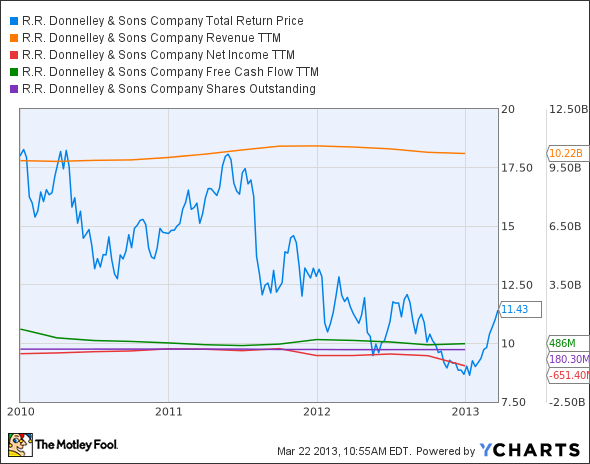
Is R.R. Donnelly Destined for Greatness?

By Alex Planes, The Motley Fool

RRD Total Return Price Chart

Filed under:

Investors love stocks that consistently beat the Street without getting ahead of their fundamentals and risking a meltdown. The best stocks offer sustainable market-beating gains, with robust and improving financial metrics that support strong price growth. Does R.R. Donnelly fit the bill? Let’s look at what its recent results tell us about its potential for future gains.

What we’re looking for
The graphs you’re about to see tell Donnelly’s story, and we’ll be grading the quality of that story in several ways:

  • Growth: are profits, margins, and free cash flow all increasing?
  • Valuation: is share price growing in line with earnings per share?
  • Opportunities: is return on equity increasing while debt to equity declines?
  • Dividends: are dividends consistently growing in a sustainable way?

What the numbers tell you
Now, let’s look at Donnelly’s key statistics:

RRD Total Return Price data by YCharts.

Passing Criteria

3-Year* Change 

Grade

Revenue growth > 30%

3.7%

Fail

Improving profit margin

(936.4%)

Fail

Free cash flow growth > Net income growth

(60.5%) vs. (2,286.1%)

Pass

Improving EPS

(2,676.9%)

Fail

Stock growth (+ 15%) < EPS growth

(36.5%) vs. (2,676.9%)

Fail

Source: YCharts.
*Period begins at end of Q4 2009.

RRD Return on Equity data by YCharts.

Passing Criteria

3-Year* Change

Grade

Improving return on equity

(5,995.8%)

Fail

Declining debt to equity

3,160.0%

Fail

Dividend growth > 25%

0.0%

Fail

Free cash flow payout ratio < 50%

38.5%

Pass

Source: YCharts.
*Period begins at end of Q4 2009.

How we got here and where we’re going
Donnelly barely squeaks through with two passing grades, and one of those is a technicality. Free cash flow might be in positive territory, but over the past three years, the company has shaved a great deal of that amount off as its businesses have declined. Is there any hope for this high-yielder with the near-double-digit payout, or is this one dangerous stock best left on the rejection pile?

Donnelly has actually been trending higher through 2013, which could be the start of a sustainable turnaround, but which is more likely to be a short-term dead-cat bounce based on dividend seekers jumping into a depressed stock. Consider what happened to the company in 2012: Its biggest news-making event was a pitiful filing error on Google‘s behalf with the SEC.

Someone at Donnelly got fat fingers with Big G’s quarterly report, and the reaction was so intense that trading in the stock had to be halted. Think about that. A $200 billion-plus company’s stock was halted because someone at Donnelly screwed up with the SEC. Donnelly’s ownership of the EDGAR online system, where millions of stock researchers (including yours truly) go to find SEC filings, makes this more egregious. Accuracy is essential, and human errors are unavoidable — but how can you let it happen to one of the most-followed companies in the world? Google switched filing providers after that brouhaha. How many other companies …read more
Source: FULL ARTICLE at DailyFinance

Is Smith &amp; Wesson Destined for Greatness?

By Alex Planes, The Motley Fool

SWHC Total Return Price Chart

Filed under:

Investors love stocks that consistently beat the Street without getting ahead of their fundamentals and risking a meltdown. The best stocks offer sustainable market-beating gains, with robust and improving financial metrics that support strong price growth. Does Smith & Wesson fit the bill? Let’s take a look at what its recent results tell us about its potential for future gains.

What we’re looking for
The graphs you’re about to see tell Smith & Wesson’s story, and we’ll be grading the quality of that story in several ways:

  • Growth: Are profits, margins, and free cash flow all increasing?
  • Valuation: Is share price growing in line with earnings per share?
  • Opportunities: Is return on equity increasing while debt to equity declines?
  • Dividends: Are dividends consistently growing in a sustainable way?

What the numbers tell you
Now, let’s take a look at Smith & Wesson’s key statistics:

Source: SWHC Total Return Price data by YCharts.

Passing Criteria

3-Year* Change 

Grade

Revenue growth > 30%

34.0%

Pass

Improving profit margin

212.3%

Pass

Free cash flow growth > Net income growth

111.7% vs. 77.2%

Pass

Improving EPS

57.1%

Pass

Stock growth (+ 15%) < EPS growth

136.1% vs. 57.1%

Fail

Source: YCharts. * Period begins at end of Q4 2009 (Jan. 28, 2010).

Source: SWHC Return on Equity data by YCharts.

Passing Criteria

3-Year* Change

Grade

Improving return on equity

43.6%

Pass

Declining debt to equity

(45.8%)

Pass

Source: YCharts. * Period begins at end of Q4 2009 (Jan. 28, 2010).

How we got here and where we’re going
Smith & Wesson misses out on a perfect score as a result of its share price growing faster than the underlying earnings per share. However, it’s hard to argue with a single-digit P/E — Smith & Wesson’s is 9.7 as of this writing — and the rest of the company’s results are pretty sterling. The question is: Will everything continue to move in the right direction?

Smith & Wesson’s come a long way from its history as the gun maker behind America’s first revolvers, but in recent years its financial progress has been surpassed by that of fellow gun maker Sturm, Ruger , which has a fast-growing dividend and is also debt-free. Both companies have seen their fortunes soar in the past few years. Whether you wish to attribute it to hoarding over fears of gun control, reactions to a dangerous world, or simply rising interest in recreational shooting, the results are obvious on the bottom line: It may never be a better time to be a gun maker.

However, the best time to be a gun maker may already be past. Despite a recent rejection of assault-rifle bans in Congress, a number of high-ranking politicians have pushed back hard against the NRA and unchecked gun ownership with minimal regulation. The Newtown shooting late last year has been a flashpoint for the gun industry. The post-Newtown plunge in both stocks has been …read more
Source: FULL ARTICLE at DailyFinance

Is Cummins Destined for Greatness?

By Alex Planes, The Motley Fool

CMI Total Return Price Chart

Filed under:

Every investor can appreciate a stock that consistently beats the Street without getting ahead of its fundamentals and risking a meltdown. The best stocks offer sustainable market-beating gains, with improving financial metrics that support strong price growth. Let’s take a look at what Cummins‘ recent results tell us about its potential for future gains.

What the numbers tell you
The graphs you’re about to see tell Cummins’ story, and we’ll be grading the quality of that story in several ways.

Growth is important on both top and bottom lines, and an improving profit margin is a great sign that a company’s become more efficient over time. Since profits may not always reported at a steady rate, we’ll also look at how much Cummins’ free cash flow has grown in comparison to its net income.

A company that generates more earnings per share over time, regardless of the number of shares outstanding, is heading in the right direction. If Cummins’ share price has kept pace with its earnings growth, that’s another good sign that its stock can move higher.

Is Cummins managing its resources well? A company’s return on equity should be improving, and its debt-to-equity ratio declining, if it’s to earn our approval.

Healthy dividends are always welcome, so we’ll also make sure that Cummins’ dividend payouts are increasing, but at a level that can be sustained by its free cash flow.

By the numbers
Now, let’s look at Cummins’ key statistics.

CMI Total Return Price data by YCharts.

Passing Criteria

3-Year* Change 

Grade

Revenue growth > 30%

60.5%

Pass

Improving profit margin

8.3%

Pass

Free cash flow growth > Net income growth

1.9% vs. 284.3%

Fail

Improving EPS

301.4%

Pass

Stock growth (+ 15%) < EPS growth

163.8% vs. 301.4%

Pass

Source: YCharts.
*Period begins at end of Q4 2009.

CMI Return on Equity data by YCharts.

Passing Criteria

3-Year* Change

Grade

Improving return on equity

117.2%

Pass

Declining debt to equity

(33.8%)

Pass

Dividend growth > 25%

185.7%

Pass

Free cash flow payout ratio < 50% 

39.9%

Pass

Source: YCharts.
*Period begins at end of Q4 2009.

How we got here and where we’re going
Cummins sure looks to be justifying its recent placement atop The Motley Fool’s list of America’s Best Companies — at least from an investor standpoint. The engine maker misses out on a perfect score only because its net income has grown faster than its free cash flow. This isn’t cause for concern, as Cummins’ free cash flow has been higher than its net income for all of our tracking period, and even today it remains more than twice as high as reported net income. Any growth in the future would be icing on the cake. But what will it take for Cummins to earn a very rare perfect score?

As you probably know, Cummins and Westport Innovations are on the vanguard of natural gas-fueled trucking. …read more
Source: FULL ARTICLE at DailyFinance

Is Procter &amp; Gamble Destined for Greatness?

By Alex Planes, The Motley Fool

PG Total Return Price Chart

Filed under:

Every investor can appreciate a stock that consistently beats the Street without getting ahead of its fundamentals and risking a meltdown. The best stocks offer sustainable market-beating gains, with improving financial metrics that support strong price growth. Let’s take a look at what Procter & Gamble‘s recent results tell us about its potential for future gains.

What the numbers tell you
The graphs you’re about to see tell P&G’s story, and we’ll be grading the quality of that story in several ways.

Growth is important on both top and bottom lines, and an improving profit margin is a great sign that a company’s become more efficient over time. Since profits may not always reported at a steady rate, we’ll also look at how much P&G’s free cash flow has grown in comparison to its net income.

A company that generates more earnings per share over time, regardless of the number of shares outstanding, is heading in the right direction. If P&G’s share price has kept pace with its earnings growth, that’s another good sign that its stock can move higher.

Is P&G managing its resources well? A company’s return on equity should be improving, and its debt-to-equity ratio declining, if it’s to earn our approval.

Healthy dividends are always welcome, so we’ll also make sure that P&G’s dividend payouts are increasing, but at a level that can be sustained by its free cash flow.

By the numbers
Now, let’s take a look at P&G’s key statistics:

PG Total Return Price data by YCharts.

Passing Criteria

3-Year* Change 

Grade

Revenue growth > 30%

8.5%

Fail

Improving profit margin

(17.4%)

Fail

Free cash flow growth > Net income growth

(19.4%) vs. (3%)

Fail

Improving EPS

5%

Pass

Stock growth (+ 15%) < EPS growth

39.5% vs. 5%

Fail

Source: YCharts.
*Period begins at end of Q4 2009.

PG Return on Equity data by YCharts.

Passing Criteria

3-Year* Change

Grade

Improving return on equity

(4.6%)

Fail

Declining debt to equity

13.8%

Fail

Dividend growth > 25%

27.7%

Pass

Free cash flow payout ratio < 50% 

45.8%

Pass

Source: YCharts.
*Period begins at end of Q4 2009.

How we got here and where we’re going
P&G doesn’t put forth a particularly compelling argument for its stock today. Nearly all of its price growth has been the result of higher valuations, which makes future returns far from certain and which contributes to several of its failing grades. Can P&G turn its drifting ship around and reclaim some positive momentum this year — and possibly earn more than just three out of nine passing grades the next time we examine it?

As a component on the Dow Jones Industrial Average , P&G isn’t really expected to be a growth stock. It’s more than a century old, after all. However, this year it’s returned roughly double the index’s gain, helping the Dow to a fresh all-time high in the …read more
Source: FULL ARTICLE at DailyFinance