Tag Archives: AES

Sony to sell 'world's first' SD card-based backup for PCs

Sony wants to simplify laptop backups.

The company says it will soon launch a new line of SD cards and accompanying software that will allow laptop users to carry their backups along with them while on the move. The solution is meant to take advantage of the memory card slots that are increasingly standard on portable computers, but are rarely used other than for transferring data from digital cameras or camcorders.

Like other backup solutions, Sony’s software allows the user to designate folders and specific files to be backed up, either when they are modified or on a schedule. The backups are encrypted using AES 256-bit, and the cards also require a password for access. The company’s new “Real-time Backup Utility” software works only with its memory cards, but it is allowing trial downloads that work for 30 days with cards from other companies.

Sony announced the product on Thursday, and said it will be available in Japan from August 20 in 16GB, 32GB, and 64GB versions. The backup software will initially support only Windows-based machines. The cards are rated Class 4 speed, a standard that provides write speeds of at least 4MBps.

To read this article in full or to leave a comment, please click here

…read more

Source: FULL ARTICLE at PCWorld

Why "Cold Fusion" Has to Die

By Mark Gibbs, Contributor

Having followed the antics of Andrea Rossi and his E-Cat system for the last couple of years I’ve read a lot about how this device might work. I’ve also read about a lot of other related systems and I’ve come to a conclusion: Whatever the principle is behind how these devices operate, the way people talk about them needs a new name.

Way back when I first heard about Andrea Rossi everyone was calling it “cold fusion” or using the rather newer term “Low Energy Nuclear Reaction”. The problem is that whatever is really going on is not, as yet, well enough understood to provide scientists in general with a common ground for discussion.

Indeed, if you use the term “cold fusion” most physicists’ heads explode and they start expounding why, from what is known about nuclear processes, “cold fusion” is simply not possible.

For example, consider Rossi’s claim that the E-Cat’s operation involves the transmutation of nickel into copper in a hydrogen atmosphere. In a blog posting by Ethan Siegel, a theoretical astrophysicist, titled “The Physics of why the e-Cat’s Cold Fusion Claims Collapse” Ethan argues that what Rossi claimed about the E-Cat would defy the laws of what constitutes known physics. Ethan’s argument looked good to me (though I am not a physicist) but, of course, there’s no proof that what Rossi claimed was, indeed, the truth … he could well have been intentionally leading everyone astray.

Why would Rossi do such a thing? Well, assuming that you give any kind of credibility to  the recent test of the E-Cat HT by a team of reputable scientists and conclude Rossi’s device really does something interesting that involves generating a lot of heat then a plausible reason might be that to protect whatever his real technology is, Rossi just made up the catalyst-nickel-copper description. Another explanation is that Rossi doesn’t actually know what’s actually happening inside the device.

But whatever Rossi’s reasons let’s for the moment leave Rossi and his E-Cats aside and ponder what is going on with the thousands of documented experiments that have shown unexplained heat outputs.

You’ve only got to browse the archives of LENR-CANR.ORG to discover not just an overwhelming number of papers on the subject along with an equally overwhelming catalog of theories that range from the almost understandable to incredibly complex explanations based on quantum mechanics. While some theories have found broader support than others there is, to date, no theory or theories that have been shown experimentally to explain the observed phenomena.

But here’s the thing: It appears something very interesting really is going with whatever you want to call the phenomena but if the field is to get any traction the theorists and believers have got to stop calling it “cold fusion.” Even “low energy nuclear reaction” is a problematic name. I don’t know what a good descriptive term might be but I’d suggest something like “Anomalous Energy System (AES)”.

Until there’s a common term used by the “cold fusion” or “LENR” experimenters, theorists, and believers that doesn’t trigger reflexive dismissal by mainstream scientists and non-believers it will be hard for the field to be treated fairly and rationally and ignoring AES just slows its potentially phenomenal impact.

Siegel opened another of his blog posts arguing against cold fusion with a quote from an excellent article by David Goodstein, Professor of Physics and Applied Physics at Caltech, that I shall close with:

“Between cold fusion and respectable science there is virtually no communication at all.…because the Cold-Fusioners see themselves as a community under siege, there is little internal criticism. Experiments and theories tend to be accepted at face value, for fear of providing even more fuel for external critics, if anyone outside the group was bothering to listen. In these circumstances, crackpots flourish, making matters worse for those who believe that there is serious science going on here … What all these experiments really need is critical examination by accomplished rivals intent on proving them wrong. That is part of the normal functioning of science. Unfortunately, in this area, science is not functioning normally. There is nobody out there listening.”

…read more

Source: FULL ARTICLE at Forbes Latest

Managing Your Data Growth by Migrating to Cloud Storage

By Michael Goodenough, AdVoice

Despite attempts to limit and even delete stored data, archived business data continues to grow exponentially. Once companies have eliminated unnecessary data and implemented an information lifecycle management solution, they’ll eventually need a data storage solution. Compliance, data retention requirements, and the rising cost of hardware infrastructure are pushing businesses to explore alternatives to traditional storage. At some point, it makes sense to investigate the realities of a cloud storage solution. You must follow the cloud migration best practices in order to begin moving your data to cloud storage. Preparing to Store Files in Cloud Storage Once you make the decision to store data in the cloud, it’s time to create a migration plan, including a diagram to help organize your files, data sets, and current onsite storage systems. Ask your website administrators to catalog your current storage volumes and file types in use to determine which files you need to store in the cloud. Next give some consideration as to where your files currently reside and determine if storing them in U.S. East Coast and/or U.S. West Coast location(s) would help improve your geographic redundancy and end-user access time to extract data from cloud storage. Also, have your staff consider the authorization structure for managing these files (images, html, text, audio or video files) since you will have the ability to use permissions to manage files securely in cloud storage. Do I Need a File Upload Application? The actual data migration process is actually the next step in managing data growth in the cloud. Because the file size for an initial upload can be large (100GB to 500GB) and might use a sizeable percentage of your total Internet connection (1.54 Mbps, 10Mbps, 100Mbps,>100Mbps LAN speed), you’ll want to schedule the data upload event during off-business hours to avoid service interruptions. In order to simplify the file migration process, ask your IT administrator to investigate the installation and configuration of a file upload and manage application, such as EMC GeoDrive, Google Chrome Atmos, or AtmosFox plug-ins. Accessing Cloud Storage: 3 Use Cases Following are three examples of how various user types can potentially access cloud storage, depending upon the service and how your IT department sets it up. 1)      Software Developer Application Writing to Cloud Storage through RESTful API Many software developers want cloud-based storage that will accept a RESTful Web Services API call to target storage for code and related assets. In this case they’ll find several services that do accept RESTful commands that integrate into development routines, giving flexible options for managing objects in the cloud. Software programming language bindings are also available to accelerate code development for popular languages, such as Python, Java, Ruby and others. The Python wrapper, for example, performs string signing, sends the HTTP requests, and parses the responses. 2)      IT Administrators Can Use Cloud Storage to Address Data Growth and Protections Administrators can add additional security to their files with many cloud storage services by applying 256 bit AES encryption using the letter

From: http://www.forbes.com/sites/centurylink/2013/04/16/managing-your-data-growth-by-migrating-to-cloud-storage/

AES Marks Energy Storage Milestone with 400,000 MW-h of PJM Service from Laurel Mountain

By Business Wirevia The Motley Fool

Filed under:

AES Marks Energy Storage Milestone with 400,000 MW-h of PJM Service from Laurel Mountain

64 MW Storage Resource Outperforming Generators; Providing Cost-Effective, Emissions-Free Flexibility Daily into Nation’s Largest Power System

ELKINS, W. Va.–(BUSINESS WIRE)– AES today announced a milestone in the energy storage industry as its AES Laurel Mountain facility surpassed the 400,000 MW-h mark of regulation service to the PJM Interconnection. Laurel Mountain, a plant comprised of 98 MW of wind generation and 64 MW of integrated battery-based energy storage resource, has entered its second year of continuous service supplying emissions-free renewable energy and clean, flexible, regulation service to PJM. AES Laurel Mountain is among the first wind generation facilities to supply critical grid stability services to help maintain the reliability of the power grid. The storage portion of the project is the largest of its kind.

The facility, which began operation in October 2011, provides a significant economic benefit to customers within the PJM electric power market. For more than a year and a half it has consistently been selected for regulation service from among competitively bid offerings in the power market, serving as a lower cost, better performing, zero-emissions, renewable energy alternative to traditional power generation for this service.

“As the largest grid operator in North America, PJM considers energy storage vital to the reliable operation of the electric system of the future,” said PJM President and CEO Terry Boston. “As with any resource that participates in our electricity market, the AES Laurel Mountain storage facility is proving its worth under real-world conditions.”

The energy storage facility provides fast response regulation, a critical reliability service typically supplied by power generators, but at higher levels of performance. Since the project began service on September 30, 2011, it has supplied over 400,000 MW-h of regulation service to PJM and achieved a service factor better than 98 percent.

AES Laurel Mountain has allowed PJM to unlock value at the system level by drawing on AES‘ extensive experience in advanced energy storage and the power industry,” said Chris Shelton, President of AES Energy Storage. “Utilities and system operators targeting reliability and resource adequacy can choose AES‘ advanced storage arrays as sustainable, scalable tools.”

The unit’s ability to regulate up and down, by charging and discharging stored energy, enables an operating range of 64 MW of flexible capacity with no minimum generating level. To achieve a similar flexible operating capability, a thermal power generator

From: http://www.dailyfinance.com/2013/04/11/aes-marks-energy-storage-milestone-with-400000-mw-/

AES to Webcast Investor Day and First Quarter 2013 Financial Results on Thursday, May 9, 2013

By Business Wirevia The Motley Fool

Filed under:

AES to Webcast Investor Day and First Quarter 2013 Financial Results on Thursday, May 9, 2013

ARLINGTON, Va.–(BUSINESS WIRE)– The AES Corporation (NYS: AES) will webcast its investor day on May 9, 2013 at 8:00 AM Eastern Daylight Time (EDT). At the event, AES Management will deliver prepared remarks, including a review of its first quarter 2013 results, and host a question and answer session with analysts and investors. Although attendance at the event is by invitation only, it will be webcast live in a listen-only format. Interested parties may access the webcast and presentation materials on the Company’s website at www.aes.com prior to the start of the event. For those unable to participate during the live broadcast, a replay will be available at www.aes.com by selecting “Investors” and then “Presentations and Webcasts.” From time to time, the Company posts new and/or revised material on its website, and anticipates doing so in connection with this event.

About AES

The AES Corporation (NYS: AES) is a Fortune 200 global power company. We provide affordable, sustainable energy to 25 countries through our diverse portfolio of distribution businesses as well as thermal and renewable generation facilities. Our workforce of 25,000 people is committed to operational excellence and meeting the world’s changing power needs. Our 2012 revenues were $18 billion and we own and manage $42 billion in total assets. To learn more, please visit www.aes.com.

Safe Harbor Disclosure

This news release contains forward-looking statements within the meaning of the Securities Act of 1933 and of the Securities Exchange Act of 1934. Such forward-looking statements include, but are not limited to, those related to future earnings, growth and financial and operating performance. Forward-looking statements are not intended to be a guarantee of future results, but instead constitute AES‘ current expectations based on reasonable assumptions. Forecasted financial information is based on certain material assumptions. These assumptions include, but are not limited to, our accurate projections of future interest rates, commodity price and foreign currency pricing, continued normal levels of operating performance and electricity volume at our distribution companies and operational performance at our generation businesses consistent with historical levels, as well as achievements of planned productivity improvements and incremental growth investments at normalized investment levels and rates of return consistent with prior experience.

…read more

Source: FULL ARTICLE at DailyFinance

Dayton Power & Light Seeks Bids for Coal Supply

By Business Wirevia The Motley Fool

Filed under:

Dayton Power & Light Seeks Bids for Coal Supply

DAYTON, Ohio–(BUSINESS WIRE)– The Dayton Power and Light Company (DP&L) has issued a Request for Proposals (RFP) for coal for use at its two Ohio River electric generating stations in Aberdeen and Wrightsville, Ohio.

DP&L is seeking proposals for coal delivery for quantities up to one million tons for calendar years 2014 and 2015. Proposals with less than one million tons will be considered. DP&L is interested in offers for all types of coal.

All proposals submitted in response to this RFP must be received by DP&L no later than 12 p.m. Eastern on April 16, 2013, and are subject to the terms of the RFP. Proposals can be submitted by email to DPLCoalRFP@dplinc.com or mailed to Fuel Procurement, Dayton Power & Light, 1065 Woodman Dr., Dayton, OH 45432.

The RFP along with supporting materials can be found on the DPL Inc. website. Suppliers interested in submitting a proposal may submit questions via email to DPLCoalRFP@dplinc.com.

About The Dayton Power and Light Company and DPL Inc.

The Dayton Power and Light Company is the principal subsidiary of DPL Inc., a regional energy company.

DPL Inc.’s other subsidiaries include DPL Energy, LLC (DPLE) and DPL Energy Resources, Inc. (DPLER), which also does business as DP&L Energy. The Dayton Power and Light Company, a regulated electric utility, provides service to over 500,000 retail customers in West Central Ohio; DPLE engages in the operation of merchant peaking generation facilities; and DPLER is a competitive retail electric supplier. DPL Inc., through its subsidiaries, owns and operates approximately 3,800 megawatts of generation capacity, of which 2,800 megawatts are coal-fired units and 1,000 megawatts are solar, natural gas and diesel peaking units. Further information can be found at www.dplinc.com.

DPL Inc. was acquired by The AES Corporation (NYS: AES) in 2011. AES is a Fortune 200 global power company. It provides affordable, sustainable energy to 25 countries through a diverse portfolio of distribution businesses as well as thermal and renewable generation facilities. Its workforce of 25,000 people is committed to operational excellence and meeting the world’s changing power needs. AES‘ 2012 revenues were $18 billion and it owns and manages $42 billion in total assets. To learn more, please visit www.aes.com.

…read more

Source: FULL ARTICLE at DailyFinance

CorEnergy Infrastructure Trust Announces Additions to the Leadership Team of its Manager, Corridor I

By Business Wirevia The Motley Fool

Filed under:

CorEnergy Infrastructure Trust Announces Additions to the Leadership Team of its Manager, Corridor InfraTrust Management and Wholly-Owned Subsidiary, Mowood

LEAWOOD, Kan.–(BUSINESS WIRE)– CorEnergy Infrastructure Trust, Inc. (NYS: CORR) today announced three new additions to its senior management team. Mike Jonagan and Jeff Fulmer joined Corridor InfraTrust Management, LLC, CorEnergy’s manager, as Senior Directors and will be primarily responsible for originating acquisitions, structuring lease agreements, managing operating partner relationships and overseeing CorEnergy’s portfolio of energy infrastructure real property assets. Rick Kreul has been named President of Mowood LLC, the company’s wholly-owned subsidiary. Mr. Kreul will be responsible for overseeing operations and developing strategic growth opportunities for both Mowood and its wholly-owned subsidiary, Omega Pipeline Company (“Omega”).

“These three new executive team members raise the bar for CorEnergy, expanding our capacity to evaluate and oversee a diverse portfolio of real property energy assets,” said David Schulte, Managing Director of Corridor and Chief Executive Officer of CorEnergy. “Jeff, Mike and Rick are engineers who bring a diverse range of energy sector experience to our team and we are pleased to have them on board.”

Mr. Jonagan comes to Corridor with more than 25 years of U.S. and international experience in the energy sector. He is a petroleum and mechanical engineer and has taken on a wide range of executive roles including managing electric and natural gas assets (regulated and unregulated) as well as telecommunications, construction, mining and energy trading operations. He has expertise in business restructuring, asset divestiture via sale or public offering and structured finance to support large capital investment projects. Most recently, Mr. Jonagan served as a Vice President and Country Manager for AES Corporation. Prior to his work with AES, Mr. Jonagan spent more than a decade in various roles, including Vice President of Capacity Services and Chief Executive Officer of U.S. Networks at Aquila Inc., which was an international electric and gas utility.

Mr. Fulmer has more than 29 years of energy industry experience and spent the last six years as a Senior Advisor with Corridor’s affiliate Tortoise Capital Advisors L.L.C. (“Tortoise”), an investment manager specializing in listed energy investments. At Tortoise he led the company’s retail marketing efforts. He will continue to support the Tortoise team as they transition his role. As a petroleum engineer and professional geologist, Mr. Fulmer’s experience includes work for the U.S. Department of Defense (DoD), where he headed a group of infrastructure analysts engaged globally in critical infrastructure analysis, assessment and protection. Prior to the DoD, Mr. Fulmer served as president of Redland Energy, was senior vice president …read more

Source: FULL ARTICLE at DailyFinance

New Version of EnCase® eDiscovery Boosts Control, Performance and Security

By Business Wirevia The Motley Fool

Filed under:

New Version of EnCase® eDiscovery Boosts Control, Performance and Security

Version 5.2 Streamlines Legal Hold, Supports “Military-Grade” Encryption and Provides Faster Transfer to SaaS Review Platform

PASADENA, Calif.–(BUSINESS WIRE)– Guidance Software (NAS: GUID) , the World Leader in Digital Investigations™, announced today EnCase® eDiscovery 5.2, the latest version of its comprehensive e-discovery software with additional legal hold control, military-grade encryption, and faster data transfer to EnCase® eDiscovery Review.

The release is the latest version of EnCase eDiscovery, which integrates complete e-discovery workflow functionality – from legal hold and preservation to SaaS-based review and production. Named a “leader” in Gartner’s 2012 Magic Quadrant for E-Discovery, EnCase eDiscovery provides in-house counsel with control and oversight of every phase of the e-discovery process.

“As data volumes continue to skyrocket, legal holds grow in complexity and difficulty with each additional day of forwarded emails, downloaded documents and corporate data walking out the door on personal devices,” said David Horrigan, Esq., E-Discovery and Information Governance Analyst at 451 Research. “Those of us who have served as in-house counsel appreciate the need for new technologies to improve legal hold and litigation preparation processes.”

New Legal Hold, Encryption and Speed Improvements

The legal hold capabilities included in EnCase eDiscovery now streamline the management of custodians by allowing for designation of individuals within a group as “inactive” or “active.” This feature enables reviewers to save time by selecting a logical workgroup of custodians, with the flexibility to make exceptions for those not involved with the current matter via the inactive status.

EnCase eDiscovery also now supports a new level of security protection with AES-256 encryption for collected data, providing the industry’s highest level of encryption for sensitive data residing in the cloud or in other areas outside of the corporate network. Users can set encryption options when the job is created and also lockdown access to their global repository with secure tracking and administration of keys and passwords.

File transfer speed to the SaaS-based EnCase eDiscovery Review platform is also improved in Version 5.2, allowing review teams to begin their work more quickly and efficiently. The improvements are two-fold with the addition of intelligent data transfer and packet compression. Now only data that is new to the repository is sent, reducing the total volume …read more
Source: FULL ARTICLE at DailyFinance

5 Dividend Stocks for International Growth

By Justin Loiseau, The Motley Fool

^SPXTR Chart

Filed under:

U.S. utilities are in a rut and, according to recent energy projections, aren’t about to dig themselves out any time soon. But if you’re looking for a solid dividend with growth potential, you may find a match in U.S. utilities with international assets. I’ll highlight five utilities with different degrees of foreign forays and let you decide which fix fits your fancy.

America doesn’t want your energy
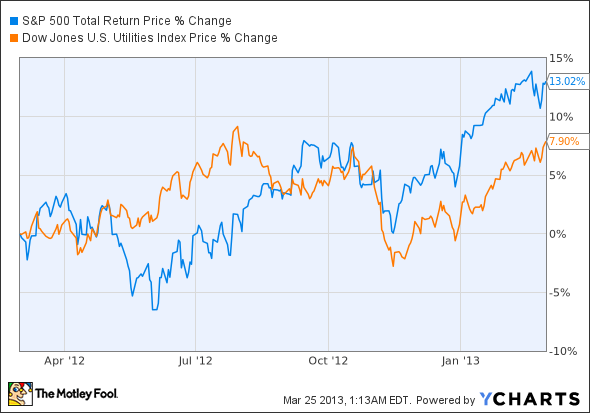
When Exelon CEO Chris Cane recently said “2012 was a difficult year on the economic front for our sector,” he wasn’t just making excuses for his company. Falling sales were a common trend for utilities last year, and the sector lagged the S&P 500 by more than 5 percentage points.

^SPXTR data by YCharts.

Looking ahead, projections aren’t peachy. A recent Department of Energy report predicts that electricity demand will clock in at 0.58% compound annual growth over the next decade, dulled by both America’s economy and advancements in energy efficiency.

The Federal Reserve announced last week that it expects U.S. GDP to fall between 2.9% and 3.7% by 2015, child’s play compared with many emerging markets. And although many utilities are overhauling their energy portfolios to set themselves up for a profitable future, some companies are looking abroad to propel top line growth.

Yes to AES?
When looking for utilities with international exposure, AES is the elephant in the room. Its 27-country spread offers formidable international exposure.

Source: AES Earnings Presentation (MCAC is Mexico, Central America, and the Caribbean. EMEA is Europe, Middle East, and Africa)

But diversification doesn’t make bad business good, and AES is currently working to cut costs. Its 4.9 debt-to-equity ratio is higher than 98% of its peers, and the company’s decision to sell 14 assets in nine countries over the past year is no coincidence. The utility’s stock jumped 6% on solid Q4 earnings, and BRIC bulls would do well to give AES a closer look.

Feeling Chile?
Hailing from my home state, North Carolina-based Duke Energy offers investors a nibble of internationalism with a big serving of Southern sauce. Its International Energy subsidiary is primarily focused on generation in Latin America, but it also owns a 25% stake in Saudi Arabian National Methanol Company. Duke axed a similar 25% stake in a Greek gas company in Q1 2012, while adding on a 240 MW thermal plant and 140 MW hydropower facility to its Chilean operations.

In total, Duke directly or indirectly generates 4,900 gross MW of international energy. That’s approximately 10% of the utility’s U.S. generation capacity, a significant slice of its portfolio pie. The utility beat top-line and earnings estimates last quarter and could be ready for some serious growth with its $12 billion of modernization projects well under way.

(Inter)National Grid
National Grid
is anything but, unless you’re based in the United Kingdom. This utility is listed on the U.S. stock exchange, but its blood runs …read more
Source: FULL ARTICLE at DailyFinance

Atlantic Power Names New COO

By Justin Loiseau, The Motley Fool

Filed under:

Atlantic Power has appointed Edward “Ned” Hall as its new COO, effective April 2. Hall will be joining Atlantic from AES , where he currently serves as COO of Global Generation.

Hall will be responsible for  all of Atlantic Power‘s operations, asset management, environmental health & safety, and engineering functions. He has also been named executive vice president.

“Ned is a great addition to our executive management team, bringing a valuable combination of operational, asset management and development capabilities, senior corporate experience and extensive knowledge and working network within the independent power, utility and infrastructure sectors,” said Atlantic President and CEO Barry Welch in a statement today. “Bringing Ned onboard continues to strengthen our operational focus on optimizing performance of our existing plants and finding synergies among existing and new plants we acquire and build.”

At AES, Hall managed 3,400 employees operating 28,000MW across 20 countries with $6 billion of revenue.. .

The article Atlantic Power Names New COO originally appeared on Fool.com.

Fool contributor Justin Loiseau has no position in any stocks mentioned, but he does use electricity. You can follow him on Twitter, @TMFJLo, and on Motley Fool CAPS, @TMFJLo.


…read more
Source: FULL ARTICLE at DailyFinance

Imation Expands IronKey Line of Secure USB Flash and Hard Drives

By Business Wirevia The Motley Fool

Filed under:

Imation Expands IronKey Line of Secure USB Flash and Hard Drives


Adds a cost-effective complement to military-grade IronKey portable storage offerings, meeting a wider range of mobile worker security requirements

OAKDALE, Minn.–(BUSINESS WIRE)– Imation Corp. (NYS: IMN) , a global scalable storage and data security company, today announced an expansion of the IronKey™ secure USB product line with new hardware encrypted flash and external hard disk drives. The IronKey D80 flash drives and H80 hard drives enable users to affordably comply with storage security mandates that do not require FIPS Certification. The new products feature tamper-resistant enclosures and hardware-based 256-bit AES encryption with strong authentication to reliably keep data private and secure.

Rising recognition of data security threats has expanded the need for secure portable USB drives beyond government, defense and regulated industries like healthcare and financial services. Many organizations are seeking smart, easy-to-use and highly secure solutions for employees to transport the information they need to be productive, while protecting private data, intellectual property and their brands.

Users that require the assurance of government and military level certification or centralized device management can choose IronKey’s FIPS 140 2 Level 3 validated S250 and D250 flash drives. IronKey D80 and H80 drives are ideal choices for organizations seeking compliance with most business policies and standards and who recognize the superior security offered by hardware encryption.

“Adding these new secure flash and hard disk drives to the IronKey portfolio extends our advanced security technology to meet the needs of an even broader number of users and organizations,” said Lawrence Reusing, Imation’s general manager for Mobile Security. “Organizations now have the flexibility to select the IronKey hardware encrypted drives that best balance their specific security, compliance and budget requirements.”

Features of the IronKey D80 and H80 drives include:

  • Advanced AES 256-bit encryption, the standard developed by the U.S. government to protect sensitive data;
  • “Always-on” hardware based encryption automatically protects all data that is saved to the device;
  • …read more
    Source: FULL ARTICLE at DailyFinance

Camellia Encryption Algorithm Selected for New e-Government Recommended Ciphers List

By Business Wirevia The Motley Fool

Filed under:

Camellia Encryption Algorithm Selected for New e-Government Recommended Ciphers List

Japan‘s only 128-bit block cipher encryption algorithm to be adopted –

TOKYO–(BUSINESS WIRE)– Nippon Telegraph and Telephone Corporation (NYS: NTT) and Mitsubishi Electric Corporation (TOKYO:6503) announced today that Camellia, the 128-bit block cipher jointly developed by the two companies in 2000, has been selected for adoption in Japan‘s new e-Government Recommended Ciphers List as the only 128-bit block cipher encryption algorithm developed in Japan.

The selection is attributed to Camellia’s high reputation for ease of procurement, and security and performance features comparable to those of the Advanced Encryption Standard (AES), the de facto standard 128-bit block Cipher adhering to U.S. government standards that was also selected for adoption in the new e-Government Recommended Ciphers List. As a leading technology strengthening the competitiveness of Japanese information security industries, Camellia is recognized as Japan‘s prime example of 128-bit block cipher algorithms, which are used widely in applications involving large-volume data, such as electronic communications, file encryption and mobile device authentication.

Background

The e-Government Recommended Ciphers List selected by the Cryptography Research and Evaluation Committees (CRYPTREC) consists of recommended cryptographic technologies that offer robust security and processing capabilities, for both software and hardware, and can be applied in system construction. The List, first released in February 2003, recently was updated for the first time in 10 years. Camellia, which also was selected for the original list, was reselected as the only Japanese encryption algorithm among 128-bit block ciphers.

Significance of the adoption

– Safety and performance

An encryption algorithm is proven to be secure when it has resisted multiple deciphering attacks over a long period of time. Camellia’s security has been continuously tested over a decade by the cryptography research community. Meanwhile, its ability to withstand newly-found attack techniques, including related-key, biclique-based meet-in-the-middle, and rebound attacks, was investigated, but no successful attack has been reported so far. Camellia’s level of security therefore surpasses that of AES, which was subject to successful (but impractical) related-key attacks reported on its 192- and 256-bit versions.

– Ease of procurement based on extensive applications

NTT and Mitsubishi Electric made essential patents for Camellia available at no cost in 2001, …read more
Source: FULL ARTICLE at DailyFinance

When you encrypt a file or a hard drive, is it really secure?

Porcupins asked the Antivirus & Security Software forum if encryption standards like AES really make your data secure.

There’s no such thing as perfect security. Someone with sufficient time and money, and a strong enough motive, can crack anything.

So the real question becomes: Is your encryption secure enough. And the answer is: If your encryption software uses a recognized and respected standard such as AES or Blowfish, and you use strong passwords and take other precautions, it almost certainly is.

[Email your tech questions to answer@pcworld.com or post them on the PCW Answer Line forum.]

To read this article in full or to leave a comment, please click here

…read more
Source: FULL ARTICLE at PCWorld

AES Earnings Report: Can 27 Countries Kick-Start Your Portfolio?

By Justin Loiseau, The Motley Fool

AES Revenue Annual Chart

Filed under:

AES reported earnings this week, beating revenue estimates and squeaking in above analysts’ earnings expectations. Its stock shot up 6% on the news, but does this utility have what it takes to pull in long-term profits for your portfolio? Let’s look at this quarter’s earnings and some long-term trends and decide for ourselves whether AES makes the A-list.

Number-crunching
For Q4 2012, AES managed to grow its top line to $4.64 billion. The company beat analyst estimates by 20% and improved on 2011’s Q4 by 11%. 

On the bottom line, the utility slid past Mr. Market’s expectations by $0.01, with non-GAAP EPS clocking in at $0.32. Compared with Q4 2011, earnings for this quarter represent an almost 40% increase.

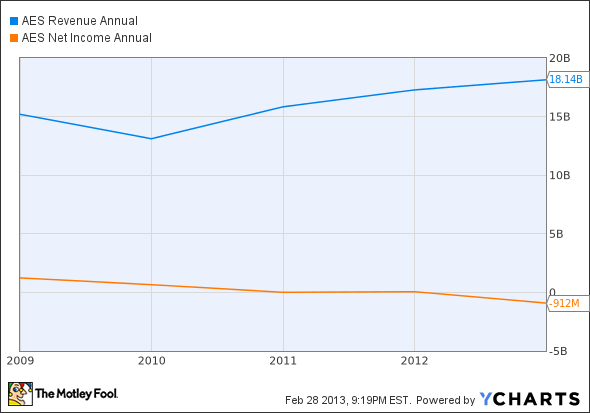
For a peck of long-term perspective, AES has grown sales 19% over the last years. In the same period, net income dropped 173% and dipped into the red for 2012.

AES Revenue Annual data by YCharts.

Looking ahead, AES expects to grow revenue to $5.23 billion and EPS to $0.35 in Q1 2013 .

AES around the world
When it comes to diversification, it’s hard to argue with AES. Not only does the company offer the stalwart opportunity of a utility, but its 27-country spread gives it a level of international diversity that is unmatched in its sector. Here’s a quick breakdown of AES‘s $2.1 billion worth of 2012 pre-tax contributions:

Source: AES Earnings Presentation. 

That said, broader is not always better, and AES is working hard to cut costs across the board. In addition to skimming the fat off corporate spending (to the tune of $90 million in 2012), the utility sold 14 assets in nine countries over the past year. Of the $946 million in shed assets, the largest chunk came from $284 million Brazil telecom Atimus, a non-core asset stinking of “diworsification.” AES looks to be focusing its geographic plans, following the likes of international utility National Grid , which offers global diversification through its United Kingdom and United States divisions, but without the high-risk worries of emerging markets.

Even with the clunkers off its sheets, AES still has an upward battle to keep costs competitive. The company expects to spend around $500 million over the next three years in the U.S. to replace and/or upgrade its older-generation facilities. According to CFO Thomas Flynn, environmental costs will account for about two-thirds of the company’s $300 million proportional cash flow decline for 2013.

For utilities based solely in the United States, environmental regulation is pushing massive upgrades across the sector. Southern recently received approval for two new nuclear facilities and expects to spend $16.5 billion in the next two years to kick costly coal out of its energy portfolio. During its Q4 conference call, Duke Energy‘s CEO called out Southern for showing up late to the modernization party, celebrating his own company’s progress. In total, Duke expects to spend approximately …read more
Source: FULL ARTICLE at DailyFinance