Tag Archives: MW

This Week in Utilities: Dividend Increases and Earnings Reports

By Justin Loiseau, The Motley Fool

Filed under:

From dividend increases to Earth Day celebrations, utilities have been busy this week. Here’s what you need to know to keep your portfolio’s profits pouring in:

Electrifying Earth Day
Several utilities took the opportunity of Earth Day (Monday) to espouse environmental efforts. Southern loaded on 139 MW of solar and 250 MW of wind to its energy portfolio. The utility currently produces around 1,350 MW of generation from solar, hydropower, biomass, and landfill methane gas, equivalent to around 2.9% of its total capacity.

Duke Energy released its sustainability report, updating shareholders on its $9 billion modernization project. The utility expects to retire 6,300 MW of coal capacity over the next few years and expects to own or purchase 6,000 MW of wind, solar, or biomass power by 2020.

PPL celebrated Earth Day with the opening of a unique “clean coal” facility that recovers around 300,000 tons of gypsum mineral annually to be used in fertilizers. “Innovative projects like this show how coal has and will continue to be a major contributor to the economic vitality of Kentucky and of the U.S., not just in the energy sector, but in science and innovation and now agriculture,” said Senate Minority Leader Mitch McConnell (R-Ky.) at the plant‘s grand opening. In the next five years, PPL expects to invest around $6 billion in its system.

It’s earnings season
In the blink of an eye, Q1 2013 is here and gone. Southern reported earnings this week, hitting sales expectations but missing slightly on earnings. Any longer-term progress was negated by a $333 million after-tax charge for increased construction costs at a new power plant. The company increased its dividend last week for the 12th year in a row, calling into question the sustainability of its current cash flow.

After upping its dividend earlier in the week, American Electric Power reported earnings on Friday, beating sales estimates and matching earnings expectations. Lackluster industrial demand and impending deregulation in Ohio are trouble spots for the utility, but overall rate increases and new transmission agreements mean that sustainable income isn’t gone yet.

Dominion disappointed this quarter, missing on sales and reporting EPS 8.8% below analyst expectations. Regulated sales slumped, but $25 million in EBIT from the utility’s Blue Racer midstream joint venture kept earnings from evaporating. Looking ahead, the utility hopes to save $100 million on operating expenses for fiscal 2013 as it continues to grow its transmission business.

Stay current on electricity
The world of utilities is changing fast, and dividend stocks aren’t the stable stalwarts they once were. Be sure to check back weekly for the latest on your portfolio’s moves, and you’ll be well on your way to electrifying earnings.

As the nation moves increasingly toward clean energy, Exelon is perfectly positioned to capitalize on having the largest nuclear fleet in North America. This strength, combined with an increased focus on balance sheet health and

Source: FULL ARTICLE at DailyFinance

What Value Does Warren Buffett See in Solar?

By Travis Hoium, The Motley Fool

Filed under:

Solar power has a growing presence in the U.S., which can be a contentious topic after a few high-profile failures in the industry. But Warren Buffett, arguably the best investor of our time, had invested billions of dollars in the industry long before most investors started making such bets. Why is he investing in solar when others are questioning it? Here’s a peak into what Buffett sees in solar.

On a quest for yield
Warren Buffett isn’t making just any investment in solar. Berkshire Hathaway‘s subsidiary MidAmerican Energy is buying huge solar projects with long-term power purchase agreements. As these projects generate electricity the contracted utility pays a set rate per kilowatt hour, which is negotiated long before a project is ever built. Since the cost of the project is fixed when Buffett buys it and the cash flows are easily predictable, in essence, Buffett is buying an asset similar to a bond, something he is very comfortable with.

The size of the investments Buffett is making is what makes his fascination with solar astounding. He owns two projects built by First Solar , including 49% of Agua Caliente, which he co-owns with NRG Energy , and a third project called Antelope Valley, the largest solar power plant in the world, which is currently under construction by SunPower .


Builder

Project Size

Cost

Ownership

Agua Caliente 

First Solar

290 MW

$1.8 billion

49%

Topaz 

First Solar

550 MW

$2 billion

100%

Antelope Valley 

SunPower

579 MW

$2.5 billion

100%

An investor as conservative as Warren Buffet wouldn’t make $5.4 billion in total investments in solar if he couldn’t reasonably predict the costs and revenue associated with such projects. That’s the big development in solar over the past half-decade, the industry can now build predictable models for projects all around the world, making it an investment even Warren Buffett could love.

Tax benefits
Another thing Buffett likes about solar is the tax benefits that come with it. Once these solar projects are completed Berkshire Hathaway will be eligible for a 30% investment tax credit, which he can write off against profits elsewhere in the business.

Solar projects are also eligible to be written off more quickly than most capital investments. Under federal law, Berkshire Hathaway can depreciate these projects over just five years with what’s called the Modified Accelerated Cost-Recovery System. This means that Buffett will save money on taxes in the first five years that the projects are on the books and, in turn, pay more in taxes later in the project’s life. The amount of taxes paid won’t change (assuming there is no change in policy), but for a business paying taxes later is always better than paying taxes earlier.  

Investments only Warren Buffett can make
The other big benefit Warren Buffett has over you and me is his ability to borrow

From: http://www.dailyfinance.com/2013/04/17/what-value-does-warren-buffett-see-in-solar/

This Week in Utilities: Solar Sales, Coal's Comeback, and More

By Justin Loiseau, The Motley Fool

Filed under:

From a solar-power project sale to new predictions for coal’s comeback, it’s been a busy week for utilities. Here’s what you need to know to stay current on your dividends’ profits.

Duke forecasts sunshine
On Wednesday, Duke Energy announced its purchase of two California solar farms from Germany-based SolarWorld. The new acquisitions will add 21 megawatts of solar electricity to its current 61 MW of capacity. Collectively, the two farms will become Duke’s largest commercial solar farm in the nation, and the company has already arranged a 20-year power purchase agreement with Edison International .

FirstEnergy plays management musical chairs
Following the retirement of two long-term leaders, FirstEnergy announced this week that it’s switching up high-level management in all four of its states’ regulated utilities operations. Although the moves reflect positive promotions throughout, a management makeover of this scale could influence FirstEnergy’s short-term efficiency or long-term strategic direction.

Southern silence
After an explosion at Southern‘s coal-fired Plant Bowen forced the facility offline last Thursday, the utility has remained silent on any findings. Southern noted in its initial press release that there were no serious injuries and that the explosion doesn’t present a threat to the local community. In an email correspondence this Thursday, an investor-relations representative noted that Southern will “release more details after our investigation is complete and thoroughly vetted.” Plant Bowen‘s 3,160 MW generating capacity represents approximately 7.3% of Southern’s total capacity.

Dog days for natural gas
A new report from the Energy Information Administration predicts a relative drop in natural gas use for electricity generation over the next year. As natural gas prices push higher, the EIA expects natural gas’ share of the generation pie to drop 2.4 percentage points to 28% for 2013. To fill the gap, the EIA expects coal to make a 7.8% comeback this year. Although many utilities with older energy portfolios are celebrating the news, coal-centric TECO Energy arguably has the most to gain from natural gas’ price increase. Not only does the company’s regulated division rely heavily on coal for 61% of its generation, but the utility also owns and operates Appalachian coal mines.

As the nation moves increasingly toward clean energy, utility company Exelon is perfectly positioned to capitalize on having the largest nuclear fleet in North America. This strength, combined with an increased focus on balance-sheet health and its recent merger with Constellation, places Exelon and its resized dividend on a short list of the top utilities. To determine whether Exelon is a good long-term fit for your portfolio, you’re invited to check out The Motley Fool’s premium research report on the company. Simply click here now for instant access.

From: http://www.dailyfinance.com/2013/04/13/this-week-in-utilities-solar-sales-coals-comeback/

Ken Fisher Buys Apple Inc, American Express Co, Coinstar, Sells America Movil, Petrobras, Visa

By GuruFocus, Contributor We have just updated the portfolio of Ken Fisher. He buys Apple Inc, Basf SE, American Express Co, McDonald’s Corporation, Rio Tinto PLC, BP etc. As of 03/31/2013, Fisher Asset Management, LLC owns 483 stocks with a total value of $37.6 billion. These are the details of the buys and sells that have the impact to portfolio of more than .1%. New Purchases: CSTR, VSH, VALE.P, Added Positions: AAPL, BASFY, AXP, MCD, RIO, BP, CSCO, JPM, MTU, RHHBY, Reduced Positions: AMX, PBR, V, BIDU, EC, VALE, BRGYY, EAT, Sold Out: KMTUY, MW, For the details of Ken Fisher’s stock buys and sells, go to http://www.gurufocus.com/StockBuy.php?GuruName=Ken+Fisher

From: http://www.forbes.com/sites/gurufocus/2013/04/11/ken-fisher-buys-apple-inc-american-express-co-coinstar-sells-america-movil-petrobras-visa/

AES Marks Energy Storage Milestone with 400,000 MW-h of PJM Service from Laurel Mountain

By Business Wirevia The Motley Fool

Filed under:

AES Marks Energy Storage Milestone with 400,000 MW-h of PJM Service from Laurel Mountain

64 MW Storage Resource Outperforming Generators; Providing Cost-Effective, Emissions-Free Flexibility Daily into Nation’s Largest Power System

ELKINS, W. Va.–(BUSINESS WIRE)– AES today announced a milestone in the energy storage industry as its AES Laurel Mountain facility surpassed the 400,000 MW-h mark of regulation service to the PJM Interconnection. Laurel Mountain, a plant comprised of 98 MW of wind generation and 64 MW of integrated battery-based energy storage resource, has entered its second year of continuous service supplying emissions-free renewable energy and clean, flexible, regulation service to PJM. AES Laurel Mountain is among the first wind generation facilities to supply critical grid stability services to help maintain the reliability of the power grid. The storage portion of the project is the largest of its kind.

The facility, which began operation in October 2011, provides a significant economic benefit to customers within the PJM electric power market. For more than a year and a half it has consistently been selected for regulation service from among competitively bid offerings in the power market, serving as a lower cost, better performing, zero-emissions, renewable energy alternative to traditional power generation for this service.

“As the largest grid operator in North America, PJM considers energy storage vital to the reliable operation of the electric system of the future,” said PJM President and CEO Terry Boston. “As with any resource that participates in our electricity market, the AES Laurel Mountain storage facility is proving its worth under real-world conditions.”

The energy storage facility provides fast response regulation, a critical reliability service typically supplied by power generators, but at higher levels of performance. Since the project began service on September 30, 2011, it has supplied over 400,000 MW-h of regulation service to PJM and achieved a service factor better than 98 percent.

AES Laurel Mountain has allowed PJM to unlock value at the system level by drawing on AES‘ extensive experience in advanced energy storage and the power industry,” said Chris Shelton, President of AES Energy Storage. “Utilities and system operators targeting reliability and resource adequacy can choose AES‘ advanced storage arrays as sustainable, scalable tools.”

The unit’s ability to regulate up and down, by charging and discharging stored energy, enables an operating range of 64 MW of flexible capacity with no minimum generating level. To achieve a similar flexible operating capability, a thermal power generator

From: http://www.dailyfinance.com/2013/04/11/aes-marks-energy-storage-milestone-with-400000-mw-/

Duke Buys 2 Solar Power Projects

By Rich Smith, The Motley Fool

Filed under:

Duke Energy is expanding its exposure to solar power.

On Wednesday, the electric utility announced that it’s adding to its nearly 100 megawatts of solar generating capacity by buying two Californian solar power projects from Germany’s SolarWorld. The solar farms in question, designated Highlander Solar 1 and 2, target production of 21 MW of electricity when they go on line — sufficient power to supply 4,000 homes with electricity. Duke Energy Renewables President Greg Wolf says that when combined into a single solar farm under Duke ownership, they will constitute “the company’s largest commercial solar farm in the nation.”

Duke says it has already lined up Edison International subsidiary Southern California Edison to buy the power generated by the farm under a 20-year-long power purchase agreement.

Financial terms were not disclosed.

The article Duke Buys 2 Solar Power Projects originally appeared on Fool.com.

Fool contributor Rich Smith and The Motley Fool have no position in any of the stocks mentioned. Try any of our Foolish newsletter services free for 30 days. We Fools don’t all hold the same opinions, but we all believe that considering a diverse range of insights makes us better investors. The Motley Fool has a disclosure policy.

Copyright © 1995 – 2013 The Motley Fool, LLC. All rights reserved. The Motley Fool has a disclosure policy.

(function(c,a){window.mixpanel=a;var b,d,h,e;b=c.createElement(“script”);
b.type=”text/javascript”;b.async=!0;b.src=(“https:”===c.location.protocol?”https:”:”http:”)+
‘//cdn.mxpnl.com/libs/mixpanel-2.2.min.js’;d=c.getElementsByTagName(“script”)[0];
d.parentNode.insertBefore(b,d);a._i=[];a.init=function(b,c,f){function d(a,b){
var c=b.split(“.”);2==c.length&&(a=a[c[0]],b=c[1]);a[b]=function(){a.push([b].concat(
Array.prototype.slice.call(arguments,0)))}}var g=a;”undefined”!==typeof f?g=a[f]=[]:
f=”mixpanel”;g.people=g.people||[];h=[‘disable’,’track’,’track_pageview’,’track_links’,
‘track_forms’,’register’,’register_once’,’unregister’,’identify’,’alias’,’name_tag’,
‘set_config’,’people.set’,’people.increment’];for(e=0;e<h.length;e++)d(g,h[e]);
a._i.push([b,c,f])};a.__SV=1.2;})(document,window.mixpanel||[]);
mixpanel.init("9659875b92ba8fa639ba476aedbb73b9");

function addEvent(obj, evType, fn, useCapture){
if (obj.addEventListener){
obj.addEventListener(evType, fn, useCapture);
return true;
} else if (obj.attachEvent){
var r = obj.attachEvent("on"+evType, fn);
return r;
}
}

addEvent(window, "load", function(){new FoolVisualSciences();})
addEvent(window, "load", function(){new PickAd();})

var themeName = 'dailyfinance.com';
var _gaq = _gaq || [];
_gaq.push(['_setAccount', 'UA-24928199-1']);
_gaq.push(['_trackPageview']);

(function () {

var ga = document.createElement('script');
ga.type = 'text/javascript';
ga.async = true;
ga.src = ('https:' == document.location.protocol ? 'https://ssl' : 'http://www') + '.google-analytics.com/ga.js';

var s = document.getElementsByTagName('script')[0];
s.parentNode.insertBefore(ga, s);
})();

Read | Permalink | Email this | Linking Blogs | <a target=_blank

Source: FULL ARTICLE at DailyFinance

NRG Energy to Acquire Corpus Christi, Texas Cogeneration Plant

By Business Wirevia The Motley Fool

Filed under:

NRG Energy to Acquire Corpus Christi, Texas Cogeneration Plant

Plant will expand NRG‘s growing cogeneration fleet as it provides NRG with additional cost-effective baseload power in one of the fastest growing states in the nation

PRINCETON, N.J. & HOUSTON–(BUSINESS WIRE)– NRG Energy, Inc. (NYS: NRG) , has entered into an agreement with a consortium of affiliates of Atlantic Power Corporation, John Hancock Life Insurance Company (U.S.A.), and Rockland Capital, LLC to acquire the Gregory cogeneration plant in Corpus Christi, Texas. The cogeneration plant is equivalent to an approximately 560 megawatt (MW) Combined Cycle Gas Turbine plant with generation capacity of approximately 400 nominal MW and steam capacity of more than a million pounds per hour (160 MW of electricity equivalent). NRG is paying approximately $244 million for the plant. Counting both electrical generation and steam production, this cost equates to approximately $436 per kilowatt.

“The addition of what is, in effect, a six heat rate, fast start, gas-fueled plant at a significant discount to replacement cost is an invaluable addition to our Texas fleet, particularly at this time with market rules and supply conditions in Texas placing a premium on flexible operations,” said David Crane, President and Chief Executive Officer of NRG.

The Gregory cogeneration plant provides steam, processed water and a small percentage of its electrical generation to the Corpus Christi Sherwin Alumina plant. The majority of the baseload generation is available for sale in ERCOT. This adds greater NRG capacity in ERCOT‘s south zone, where the company currently serves significant retail load and looks to continue to expand its customer base in this growing part of the state. The Gregory cogeneration unit came online in 2000.

“The Gregory plant’s long-term steam contract and additional generation in a zone where NRG sees significant growth potential complements our wholesale and retail positions in the State exceptionally well,” said John Ragan, president of NRG‘s Gulf Coast region. “Adding Gregory to NRG‘s existing portfolio of cogeneration and combined cycle plants also increases our ability to share expertise and best practices across Texas and the nation.”

The transaction is subject to customary closing conditions including Hart Scott Rodino pre-merger notification clearance and approval from Public Utility Commission of Texas, as well as third party consents. The transaction is expected to close in the third quarter.

About NRG

NRG is at the forefront of changing how people think about and use energy. We deliver cleaner and smarter energy choices …read more

Source: FULL ARTICLE at DailyFinance

BP Just Sold Wind: Should These Dividend Stocks Follow Suit?

By Justin Loiseau, The Motley Fool

Filed under:

In an ironic twist of fate, BP has put up the “for sale” sign on its $1.5 billion of wind farms to help pay for its 2010 oil spill. Is BP‘s sale short-sighted, or does the energy company know something others don’t? Let’s look at wind energy, who has it, and whether wind will propel your portfolio to profits.

BP winds down wind
As part of its larger $38 billion garage sale, BP is in the process of selling off 16 wind farms across nine states. With a total generating capacity of 2,600 MW, this move is far from small peanuts for a company that famously renamed itself “Beyond Petroleum” in 2000.

But with $300 billion in assets, wind is hardly the winner that BP needs to succeed. The streamlining will help it focus on high-margin oil production and exploration, its bread and butter (excepting environmental disasters). As margins tighten and the global economic recovery continues to ooze along, it makes sense for energy companies to focus on what they do best. And for some utilities, what they do best increasingly includes wind.

Windy win?
When investors talk wind, NextEra Energy is the elephant in the room. Its 100 wind farms generate more than 10,000 net MW of electricity, accounting for 56% of the utility’s total generation capacity.

Source: NextEra 10-K. 

Exelon gets pigeonholed as a nuclear play, but its wind assets provide a significant portion of its assets. The utility operates 44 wind farms totaling nearly 1,300 MW of generation capacity, and it spent $650 million in 2012 on wind capital expenditures.

Source: Exelon investor relations website. 

The newest addition to the wind gang, Atlantic Power , recently announced that it will focus on natural gas and renewables in the years to come. The utility bought Ridgeline Energy from Veolia Environnement last year, adding three wind farms with 150 net MW to its assets.

Source: Atlantic Power Deutsche Bank Leverage Financed Conference Presentation. 

It’s also shedding less profitable assets to generate cash for acquisitions and manage its high 2.2 debt-to-equity ratio. Atlantic passed off a transmission project to Duke Energy and American Transmission for $193 million in cash and debt handoffs, and it’s planning on further specializing in the year to come.

Did BP make the right choice?
Energy portfolios are a lot like ice cream. Some flavors don’t mix, and even the smallest scoop of one flavor can threaten the whole taste. BP made a calculated choice to put aside its wind assets, but one corporation’s trash is another corporation’s treasure. With the right combination, any asset class can look tasty.

As the nation moves increasingly toward clean energy, Exelon is perfectly positioned to capitalize on having the largest nuclear fleet in North America. This strength, combined with an increased focus on balance sheet health and its recent merger with Constellation, places Exelon …read more

Source: FULL ARTICLE at DailyFinance

Is This Energy Source a Key to National Security?

By Travis Hoium, The Motley Fool

Filed under:

When I think about energy and national security, the first thing that comes to mind is usually a disruption in oil imports or some sort of nuclear disaster. The form and function of the electrical grid itself wasn’t at the top of the list — until now.

Recent comments from David Crane of NRG Energy have made me think that maybe solar energy could play a role in national energy security. Speaking at The Wall Street Journal‘s ECO:nomics conference late last month, he said that solar energy may be a national security issue. When you step back and think about it, he’s probably right.

Solar energy is the first energy source we’re able to generate economically at home. A roof filled with solar panels can power an entire house, assuming it has some energy storage or grid backup. This is problematic for utilities, because solar owners will be using the grid only for backup, potentially adding cost to other consumers, but from a security standpoint it may be a step forward.

Look at the Fukushima disaster in Japan last year. The country shut down all nuclear reactors, which added to fossil fuel imports and disrupted service. A similar disaster or attack on major power plants in the U.S. could leave portions of the country without power for weeks. It took weeks to get power back to parts of New Jersey after Hurricane Sandy and the Northeast blackout of 2003 left millions without power without any notice.

Solar energy changes the landscape. A blackout would be more manageable for consumers if they have solar power during the day and may go unnoticed if they have battery backup. Maybe it’s true that solar power could be a piece of improved energy security.

The military is on board
We know that the U.S. military is already seeing solar as a powerful energy source. SunPower built a 14 MW plant at the Naval Air Weapons Station China Lake, generating 30% of the base’s annual power needs.  

On a smaller basis, the Army has introduced portable power solutions for forward bases and is testing other solar technologies and energy storage. If distributed energy on the grid doesn’t make you feel safer for the energy grid, giving usable power to our troops in the field should. Solar will not only be a useful tool for soldiers, but it will also save cost, since transporting fuel is an expensive and dangerous task on the battlefield.  

The winners in distributed solar
Distributed solar is one piece of a more secure energy grid, and investors can get onboard in a few different ways. NRG Energy owns large solar plants and is getting into the distributed solar business as well. SolarCity is the dominant player in residential solar, and panel manufacturer SunPower is expanding its reach through a leasing program. Finally, MEMC Electronic Materials is transforming itself into a project developer and is putting a big …read more

Source: FULL ARTICLE at DailyFinance

APS Announces Latest AZ Sun Photovoltaic Project

By Business Wirevia The Motley Fool

Filed under:

APS Announces Latest AZ Sun Photovoltaic Project

32-Megawatt Gila Bend Solar Power Plant Expected to Be Online by June 2014

PHOENIX–(BUSINESS WIRE)– Arizona Public Service Co. (APS) has selected Black & Veatch to design and build a new solar photovoltaic facility – the 32-megawatt Gila Bend Solar Power Plant, part of the APS AZ Sun Program.

Construction will begin in October 2013 with project completion expected in June 2014. The nine-month project will bring more than 150 jobs to Arizona.

“The Gila Bend Plant is just one more example of APS‘s commitment to solar energy. APS-owned, utility-scale solar is good for customers, the solar industry and the state of Arizona,” said Barbara Lockwood, APS General Manager of Energy Innovation. “The Gila Bend Plant, just like all of our solar facilities, is being built by a third-party solar developer. Black & Veatch was selected through a competitive bidding process, helping to ensure a cost-effective price for our customers. In addition, this project is bringing significant economic benefits to Arizona, including high-quality jobs.”

Located on 400 acres in Gila Bend, Ariz., the project will have more than 170,000 single-axis tracker polycrystalline modules that will generate enough solar energy to power 8,000 Arizona homes and businesses. The single-axis tracker design enables the solar panels to follow the sun across the sky.

APS is a leader in solar development in Arizona – providing opportunities for solar developers and installers, creating valuable jobs for the industry and helping to create a sustainable energy future for their customers,” said Dean Oskvig, President and CEO, B&V Energy, Black & Veatch. “Black & Veatch has been involved in nearly half the utility-scale photovoltaic plants currently operating in North America. We will bring this expertise to what will be the second largest plant under the AZ Sun program to date.”

The Gila Bend Plant will be the seventh AZ Sun facility to break ground. With AZ Sun, APS is investing in the development of photovoltaic power plants across the state. APS currently has 86 MW of AZ Sun in service, along with 64 MW under construction or in development. AZ Sun is one piece of APS‘s diverse solar portfolio, which includes third-party owned power purchase agreements, utility-scale APS owned facilities and customer-owned rooftop installations.

APS, Arizona’s largest and longest-serving electricity …read more

Source: FULL ARTICLE at DailyFinance

APS Adds to Solar Leadership in Arizona

By Business Wirevia The Motley Fool

Filed under:

APS Adds to Solar Leadership in Arizona

Expects 2013 to Eclipse a Record-Breaking 2012

PHOENIX–(BUSINESS WIRE)– An APS filing at the Arizona Corporation Commission underscores the company’s essential role in making Arizona one of the top solar energy markets in the nation.

Governor Jan Brewer announced last month that according to the 2012 U.S. Solar Market Insight Report from the Solar Energy Industries Association (SEIA), Arizona now ranks second nationally for solar installations, and the state topped the list with the most utility-scale solar technology installed.

APS, in 2012, added 148 megawatts (MW), a single-year record for the company and enough electricity to serve more than 35,000 customers. In 2013, APS expects to more than double this number.

Last year’s projects came from a variety of sources, including:

  • AZ Sun (24 MW) – SunEdison completed construction on the 19-MW Chino Valley Solar Plant and the final 5 MW of the Hyder I Solar Plant- which are owned and operated by APS as part of the AZ Sun program.
  • Power purchase agreements (15 MW) APS signed a long-term agreement to purchase 15 MW from another SunEdison facility, the Saddle Mountain Solar Power Plant.
  • Customer-owned solar (83 MW) Most of the solar added in 2012 came from customers installing systems on their homes and businesses. More than 7,500 did so last year, compared with fewer than 6,000 total installations in 2011.

APS will have more than 600 MW of solar on the system by the end of 2013, generating enough electricity to serve 150,000 customers,” said Don Brandt, APS Chairman and CEO. “This puts us well on pace to meet the Arizona Renewable Energy Standard, which calls for APS to get 15 percent of our power from renewable sources by 2025.”

Brandt noted that the company’s investment in solar is helping to stimulate the competitive solar industry in Arizona. “By 2015, 83 percent of the company’s renewable energy portfolio will be third-party owned. But more importantly, 100 percent of APS solar facilities are …read more
Source: FULL ARTICLE at DailyFinance
Notable ETF Outflow Detected – XRT, SVU, WAG, MW

By ETFChannel.com

Looking today at week-over-week shares outstanding changes among the universe of ETFs covered at ETF Channel, one standout is the SPDR S&P Retail ETF (AMEX: XRT) where we have detected an approximate $153.6 million dollar outflow — that’s a 13.7% decrease week over week (from 16,050,113 to 13,850,113). Among the largest underlying components of XRT, in trading today SUPERVALU Inc. (NYSE: SVU) is up about 0.6%, Walgreen Co. (NYSE: WAG) is up about 1.1%, and Men’s Wearhouse, Inc. (NYSE: MW) is lower by about 0.1%. For a complete list of holdings, visit the XRT Holdings page » …read more
Source: FULL ARTICLE at Forbes Markets

5 Dividend Stocks for International Growth

By Justin Loiseau, The Motley Fool

^SPXTR Chart

Filed under:

U.S. utilities are in a rut and, according to recent energy projections, aren’t about to dig themselves out any time soon. But if you’re looking for a solid dividend with growth potential, you may find a match in U.S. utilities with international assets. I’ll highlight five utilities with different degrees of foreign forays and let you decide which fix fits your fancy.

America doesn’t want your energy
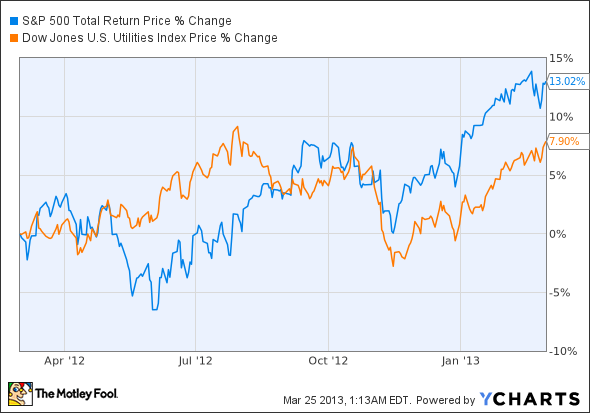
When Exelon CEO Chris Cane recently said “2012 was a difficult year on the economic front for our sector,” he wasn’t just making excuses for his company. Falling sales were a common trend for utilities last year, and the sector lagged the S&P 500 by more than 5 percentage points.

^SPXTR data by YCharts.

Looking ahead, projections aren’t peachy. A recent Department of Energy report predicts that electricity demand will clock in at 0.58% compound annual growth over the next decade, dulled by both America’s economy and advancements in energy efficiency.

The Federal Reserve announced last week that it expects U.S. GDP to fall between 2.9% and 3.7% by 2015, child’s play compared with many emerging markets. And although many utilities are overhauling their energy portfolios to set themselves up for a profitable future, some companies are looking abroad to propel top line growth.

Yes to AES?
When looking for utilities with international exposure, AES is the elephant in the room. Its 27-country spread offers formidable international exposure.

Source: AES Earnings Presentation (MCAC is Mexico, Central America, and the Caribbean. EMEA is Europe, Middle East, and Africa)

But diversification doesn’t make bad business good, and AES is currently working to cut costs. Its 4.9 debt-to-equity ratio is higher than 98% of its peers, and the company’s decision to sell 14 assets in nine countries over the past year is no coincidence. The utility’s stock jumped 6% on solid Q4 earnings, and BRIC bulls would do well to give AES a closer look.

Feeling Chile?
Hailing from my home state, North Carolina-based Duke Energy offers investors a nibble of internationalism with a big serving of Southern sauce. Its International Energy subsidiary is primarily focused on generation in Latin America, but it also owns a 25% stake in Saudi Arabian National Methanol Company. Duke axed a similar 25% stake in a Greek gas company in Q1 2012, while adding on a 240 MW thermal plant and 140 MW hydropower facility to its Chilean operations.

In total, Duke directly or indirectly generates 4,900 gross MW of international energy. That’s approximately 10% of the utility’s U.S. generation capacity, a significant slice of its portfolio pie. The utility beat top-line and earnings estimates last quarter and could be ready for some serious growth with its $12 billion of modernization projects well under way.

(Inter)National Grid
National Grid
is anything but, unless you’re based in the United Kingdom. This utility is listed on the U.S. stock exchange, but its blood runs …read more
Source: FULL ARTICLE at DailyFinance

Denmark: 1,000 Megawatts Of Offshore Wind, And No Signs of Slowing Down

By Peter Kelly-Detwiler, Contributor

On March 18, Dong Energy’s Anholt offshore wind farm connected its 36th Siemens 3.6 megawatt (MW) turbine to the electric grid, thereby bringing the total of Denmark‘s connected offshore wind to 1 gigawatt (1,000 megawatts).  This capacity covers the equivalent of about 1 million Danish households’ electricity consumption.  The Anholt complex itself will include 400 megawatts of capacity when completed.  And Denmark has no plans to stop there, recently announcing that it will invite bids for an additional 1,500 MW of offshore wind.  Denmark now gets almost 25% of its electricity from windpower, and this country of 5.5 million in habitants is planning to double that number to 50% by 2020. …read more
Source: FULL ARTICLE at Forbes Latest

Small Wind Power Annual Installations Will Double in Capacity by 2018, Forecasts Navigant Research

By Business Wirevia The Motley Fool

Filed under:

Small Wind Power Annual Installations Will Double in Capacity by 2018, Forecasts Navigant Research

BOULDER, Colo.–(BUSINESS WIRE)– The Small Wind Turbine (SWT) industry is maturing, signaled by the expanded role of SWT certification, the existence of hundreds of manufacturers located around the world, the expansion of dealer networks, and the growing number of national and regional industry associations. The number of applications is also growing, including applications in telecommunications, defense, and other sectors that involve producing power in remote locations. According to a new report from Navigant Research, annual global installations of SWTs will roughly double in the next five years, growing from 86 megawatts (MW) in 2012 to 172 MW in 2018 and representing $3.3 billion in revenues.

“While the U.S. market for small wind turbines tries to regain momentum following the reduction or expiration of rebates and other key incentive programs in leading states, the overall market for SWTs is growing as a result of Feed-in Tariff (FIT) policies in the United Kingdom and Italy,” says Dexter Gauntlett, research analyst with Navigant Research. “Beyond FITs, the small wind power market will be driven by growing demand for onsite generation, volatile diesel fuel costs, and China‘s growing need for power.”

At the same time, small wind faces a strong challenge from the solar Photovoltaic (PV) sector, which has seen dramatic price drops in solar PV modules over the past few years as well as the emergence of innovative business models – including leasing programs and third party financing models – that have yet to be made available to the vast majority of small wind customers. Wind still offers unique advantages, however, and the growth of solar PV has, in some regards, paved the way for SWTs.

The report, “Small Wind Power”, examines the global market for small wind power, focusing on manufacturers of small wind turbines. Market drivers and barriers, technology issues, and the competitive landscape are explored in detail, and worldwide forecasts for both revenue and capacity for small wind systems, segmented by region, extend through 2018. An Executive Summary of the report is available for free download on the Navigant Research website.

About Navigant Research

Navigant Research, a part of Navigant Consulting, Inc. (Navigant), provides in-depth analysis of global clean technology markets. The team’s research methodology combines supply-side industry analysis, end-user primary research and demand assessment, and deep examination of technology trends to provide a comprehensive view of the Smart Energy, Smart Utilities, …read more
Source: FULL ARTICLE at DailyFinance

Dynegy Buying 5 Coal Power Plants From Ameren

By Sara E., Murphy, The Motley Fool

Filed under:

Dynegy (NYSE: DYN) entered into an agreement today to buy Ameren Energy Resources (AER) from Ameren (NYSE: AEE). According to Dynegy’s most recent 10k, the company’s Illinois Power Holdings (IPH) subsidiary will acquire AER and its subsidiaries, thereby adding 4,119 megawatts (MW) of generation to Dynegy’s Illinois operations. The deal is subject to regulatory approval, and the companies expect the transaction to close in the fourth quarter of 2013.

The purchase involves no cash or stock issuance.  Dynegy will take on $825 million of debt with its acquisition of AER subsidiary Ameren Energy Generating Company (Genco), according to Dynegy’s press release. The company will gain five coal-fired power plants through this deal.

Dynegy sees several benefits to this acquisition. When the deal closes, the company will own more than 8,000 MW of generating capacity in Illinois, and nearly 14,000 MW nationally. The transaction creates synergies that Dynegy estimates will exceed $60 million by 2015, and supports Dynegy’s strategy to become a retail energy supplier for large commercial and industrial customers in Illinois. 

The deal allows Ameren to focus exclusively on its rate-regulated electric, natural gas, and transmission operations, according to the company’s press release. “We expect that this transaction will reduce business risk and improve the predictability of our future earnings and cash flows, which is expected to strengthen Ameren’s credit profile and support Ameren’s dividend,” said Thomas R. Voss, Ameren’s CEO.


The article Dynegy Buying 5 Coal Power Plants From Ameren originally appeared on Fool.com.


Sara E. Murphy has no position in any stocks mentioned. You can follow her on Twitter @SMurphSmiles. The Motley Fool has no position in any of the stocks mentioned. Try any of our Foolish newsletter services free for 30 days. We Fools may not all hold the same opinions, but we all believe that considering a diverse range of insights makes us better investors. The Motley Fool has a disclosure policy.

Copyright © 1995 – 2013 The Motley Fool, LLC. All rights reserved. The Motley Fool has a disclosure policy.

(function(c,a){window.mixpanel=a;var b,d,h,e;b=c.createElement(“script”);
b.type=”text/javascript”;b.async=!0;b.src=(“https:”===c.location.protocol?”https:”:”http:”)+
‘//cdn.mxpnl.com/libs/mixpanel-2.2.min.js’;d=c.getElementsByTagName(“script”)[0];
d.parentNode.insertBefore(b,d);a._i=[];a.init=function(b,c,f){function d(a,b){
var c=b.split(“.”);2==c.length&&(a=a[c[0]],b=c[1]);a[b]=function(){a.push([b].concat(
Array.prototype.slice.call(arguments,0)))}}var g=a;”undefined”!==typeof f?g=a[f]=[]:
f=”mixpanel”;g.people=g.people||[];h=[‘disable’,’track’,’track_pageview’,’track_links’,
‘track_forms’,’register’,’register_once’,’unregister’,’identify’,’alias’,’name_tag’,
‘set_config’,’people.set’,’people.increment’];for(e=0;e<h.length;e++)d(g,h[e]);
a._i.push([b,c,f])};a.__SV=1.2;})(document,window.mixpanel||[]);
mixpanel.init("9659875b92ba8fa639ba476aedbb73b9");

function addEvent(obj, evType, fn, useCapture){
if (obj.addEventListener){
obj.addEventListener(evType, fn, useCapture);
return true;
} else if (obj.attachEvent){
var r = obj.attachEvent("on"+evType, fn);
…read more
Source: FULL ARTICLE at DailyFinance

Market Close: Big Winners &amp; Losers for March 13, 2013 (ABIO, SSNI, KWK, DYNT, MW, VHC, SCON, VELT, OPTT, VRS)

By 24/7 Wall St.

stock symbol ticker

Filed under:

Here are today’s five biggest gaining stocks at closing:

ARCA biopharma Inc. (NASDAQ: ABIO) is up 44.4% at $3.32.

Silver Spring Network Inc. (NYSE: SSNI) is up 29.4% at $22.00.

Quicksilver Resources Inc. (NYSE: KWK) is up 26.9% at $2.74.

Dynatronics Corp. (NASDAQ: DYNT) is up 19.4% at $2.81.

Men’s Wearhouse Inc. (NYSE: MW) is up 18.5% at $34.46.

And here are today’s five biggest losing stocks at closing:

VirnetX Holding Corp. (NYSEMKT: VHC) is down 28.9% at $25.35.

Superconductor Technologies Inc. (NASDAQ: SCON) is down 16.8% at $3.21.

Velti plc (NASDAQ: VELT) is down 16.4% at $2.01.

Ocean Power Technologies Inc. (NASDAQ: OPTT) is down 15.4% at $1.65.

Verso Paper Corp. (NYSE: VRS) is down 14.1% at $1.42.

Filed under: 24/7 Wall St. Wire, HI/LOW, Market Close Tagged: ABIO, DYNT, KWK, MW, OPTT, SCON, SSNI, VELT, VHC, VRS

Read | Permalink | Email this | Linking Blogs | Comments

…read more
Source: FULL ARTICLE at DailyFinance

Market Close: Big Winners &amp; Losers for March 14, 2013 (ABIO, SSNI, KWK, DYNT, MW, VHC, SCON, VELT, OPTT, VRS)

By 24/7 Wall St.

stock symbol ticker

Filed under:

Here are today’s five biggest gaining stocks at closing:

ARCA biopharma Inc. (NASDAQ: ABIO) is up 44.4% at $3.32.

Silver Spring Network Inc. (NYSE: SSNI) is up 29.4% at $22.00.

Quicksilver Resources Inc. (NYSE: KWK) is up 26.9% at $2.74.

Dynatronics Corp. (NASDAQ: DYNT) is up 19.4% at $2.81.

Men’s Wearhouse Inc. (NYSE: MW) is up 18.5% at $34.46.

And here are today’s five biggest losing stocks at closing:

VirnetX Holding Corp. (NYSEMKT: VHC) is down 28.9% at $25.35.

Superconductor Technologies Inc. (NASDAQ: SCON) is down 16.8% at $3.21.

Velti plc (NASDAQ: VELT) is down 16.4% at $2.01.

Ocean Power Technologies Inc. (NASDAQ: OPTT) is down 15.4% at $1.65.

Verso Paper Corp. (NYSE: VRS) is down 14.1% at $1.42.

Filed under: 24/7 Wall St. Wire, HI/LOW, Market Close Tagged: ABIO, DYNT, KWK, MW, OPTT, SCON, SSNI, VELT, VHC, VRS

Read | Permalink | Email this | Linking Blogs | Comments

…read more
Source: FULL ARTICLE at DailyFinance

24/7 Wall St. Closing Bell — March 14, 2013: Markets Climb to New Highs Today (AMZN, EBAY, WFC, VMW, ETFC, BFAM, MW, VRA, LODE, SOL, AEO, MCP, ZUMZ, BWS, MGM, SD)

By 24/7 Wall St.

Bull and Bear figures

Filed under:

U.S. equity markets opened higher this morning following a better-than-expected report on new jobless benefits claims in the U.S. and a mostly inline report on producer prices (more coverage here). In Europe, eurozone unemployment fell a bit more than expected and Spanish retail sales were not as bad as expected. In Asia, key interest rates in New Zealand and South Korea remained unchanged. The Shanghai index closed higher for the first time in six days. The DJIA closed with a tenth straight day of gains and the S&P closed within a couple of bucks of its all-time high.

The U.S. dollar index fell 0.41% today, now at 82.553. The GSCI commodity index is down 0.4% at 647.17, with commodities prices mostly higher today on the weaker dollar. WTI crude oil closed up 0.6% today, at $93.03 a barrel. Brent crude trades up 0.7% at $109.00 a barrel. Natural gas is up 3.8% today at about $3.82 per million BTUs following a relatively large draw on stocks last week (more coverage here). Gold settled up 0.1% today at $1,590.70 an ounce.

The unofficial closing bells put the DJIA up more than 82 points to 14,538.99 (0.58%), the NASDAQ rose nearly 14 points (0.43%) to 3,258.93, and the S&P 500 rose 0.56% or nearly 9 points to 1,563.20.

There were a several analyst upgrades and downgrades today, including Amazon.com Inc. (NASDAQ: AMZN) cut to ‘neutral’ at J.P. Morgan; eBay Inc. (NASDAQ: EBAY) reiterated as ‘buy’ with a price target of $65 at Argus and raised to ‘overweight’ at Evercore; Wells Fargo & Co. (NYSE: WFC) started as ‘market perform’ at BMO Capital; VMware Inc. (NYSE: VMW) raised to ‘outperform’ at William Blair and maintained on Focus List at Credit Suisse; and E*Trade Financial Corp. (NASDAQ: ETFC) cut to ‘underperform’ at KBW.

Earnings reports since markets closed last night resulted in several price moves today, including these: Bright Horizons Family Solutions Inc. (NYSE: BFAM) is up 11.2% at $33.35 after posting a post-IPO high of $33.49 earlier today; Men’s Wearhouse Inc. (NYSE: MW) is up 19% at $34.60; Vera Bradley Inc. (NASDAQ: VRA) is down 8.4% at $22.81; Comstock Mining Inc. (NYSEMKT: LODE) is down 7.1% at $1.97; and ReneSola Ltd. (NYSE: SOL) is up 1.4% at $2.17.

Before markets open tomorrow morning we are scheduled to hear from Aeropostale Inc. (NYSE: AEO), Molycorp Inc. (NYSE: MCP), Zumiez Inc. (NASDAQ: ZUMZ), and Brown Shoe Co. Inc. (NYSE: BWS).

Some standouts among heavily traded stocks today include:

MGM Resorts International Inc. (NYSE: MGM) is up 6.5% at $13.21. The casino and resort operator is a likely target for further investment by Kirk Kerkorian’s Tracinda Corp. More coverage here.

SandRidge Energy Inc. (NYSE: SD) is down 3.3% at $5.66. The energy exploration and production company caved in to demands from a large investor and it looks the company’s CEO is headed for the door. More coverage here.

E*Trade Financial Corp. (NASDAQ: ETFC) is down 8.3% at $10.84. The online financial firm got battered after its largest investor said it would …read more
Source: FULL ARTICLE at DailyFinance