Tag Archives: Central America

How Much Is Mexican Zeta Leader Miguel Angel Treviño's Criminal Empire Worth?

By Dolia Estevez, Contributor

At the time of his capture last week, Miguel Angel Treviño, the notorious leader of the Zetas Mexican cartel, had built a criminal business empire that stretched from the Southwestern United States to Central America. Treviño, better known as Zeta-40, had $2 million in cash and eight fire arms with him when he was detained on July 15 in the northern Mexican state of Tamaulipas. Given his violent tendencies, it was surprising to many that he did not put up any resistance. …read more

Source: FULL ARTICLE at Forbes Latest

Zetas leader captured in precision operation

Mexico’s most brutal drug cartel leader built a business empire stretching from the Southwest United States to Central America, but Miguel Angel Trevino Morales’ final days of freedom were spent lying low in the hinterlands of Tamaulipas state, traveling only at night over back roads as Mexican marines closed in on his trail.

The last of the Zetas drug cartel’s old-guard leaders saw fate swoop in on him in the pre-dawn hours Monday when a military helicopter flew low over his pickup truck, then almost touching the ground, faced down the vehicle with its guns, Mexico Federal Security spokesman Eduardo Sanchez said.

The vehicle stopped, and three men emerged. Two hit the ground while the third tried to run. All were captured by marine ground forces who had been watching the movements of 40-year-old Trevino Morales, Sanchez told The Associated Press Tuesday. Not a single shot was fired.

Time was clearly running out for the cartel leader better known — and feared — by his nickname, “Z-40,” a play on police radio code for a commander. Mexico’s navy, which has brought down a number of top drug lords, “found out that he had been traveling in the early morning hours on dirt roads. They had been corralling him in little by little,” Sanchez said.

Trevino Morales had $2 million in cash and eight rifles with him when marines caught him outside the border city of Nuevo Laredo, long the Zetas’ base of operations. He was taken to Mexico City for questioning, but unlike the days of former President Felipe Calderon, there was no perp walk by a handcuffed suspect or piles of cash and guns put on display for the TV cameras.

Instead, the government released a single video of a rumpled-looking, un-handcuffed Trevino Morales walking through prosecutors’ headquarters, saying it wanted to avoid glamorizing drug traffickers or risk rights violations that could lead to a dismissal of charges. Authorities didn’t even refer to his nickname, Z-40.

The Zetas are Mexico’s most violent, if not richest, cartel, with the largest turf. A New York indictment against Trevino Morales estimates he received $10 million per month in income from cocaine sales alone, not to mention the money brought in by the cartel’s myriad other illicit activities, including kidnapping, extortion, migrant trafficking, weapons trafficking, even theft of oil from state pipelines.

His arrest was particularly pleasing for the United States. Trevino Morales allegedly orchestrated a series of killings …read more

Source: FULL ARTICLE at Fox World News

Capture of Zetas leader unlikely to quell violence

The capture of the notoriously brutal Zetas leader Miguel Angel Trevino Morales is a serious blow to Mexico’s most feared drug cartel but experts cautioned that taking down the group’s command structure is unlikely to diminish violence in the border states where it dominates through terror.

Trevino Morales, 40, was captured before dawn Monday by Mexican Marines who intercepted a pickup truck with $2 million in cash on a dirt road in the countryside outside the border city of Nuevo Laredo, which has long served as the Zetas’ base of operations. The truck was halted by a Marine helicopter and Trevino Morales was taken into custody along with a bodyguard and an accountant and eight guns, government spokesman Eduardo Sanchez told reporters.

It was the first major blow against an organized crime leader by a Mexican administration struggling to drive down persistently high levels of violence. Experts on the Zetas said that the arrest, at least the eighth capture or killing of a high-ranking Zeta since 2011, could leave behind a series of cells scattered across northern Mexico without a central command but with the same appetite for kidnapping, extortion and other crimes against innocent people.

“It’s another link in the destruction of the Zetas as a coherent, identifiable organization,” said Alejandro Hope, a former member of Mexico’s domestic intelligence service. “There will still be people who call themselves Zetas, bands of individuals who maintain the same modus operandi. There will be fights over illegal networks.”

The Zetas remain active in Nuevo Laredo, the nearby border state of Coahuila, the Gulf Coast state of Veracruz, parts of north central Mexico and Central America, although Trevino Morales’ arrest means the gang has become “a franchise operation not a vertical organization,” said George Grayson, an expert on the Zetas and professor of government at the College of William & Mary.

The Zetas leader and his alleged accomplices were flown to Mexico City, where they are expected to eventually be tried in a closed system that usually takes years to prosecute cases, particularly high-profile ones.

Trevino Morales, known as “Z-40,” is uniformly described as one of the two most powerful cartel heads in Mexico, the leader of a corps of special forces defectors who went to work for drug traffickers, splintered off into their own cartel in 2010 and metastasized across Mexico, expanding from drug dealing into extortion, kidnapping and human trafficking.

Along the way, the Zetas authored some of the worst …read more

Source: FULL ARTICLE at Fox World News

Suspected drug smuggler arrested in Venezuela

Venezuela‘s top security official says authorities have caught an alleged drug trafficker wanted in neighboring Colombia on drug smuggling, kidnapping and extortion charges.

Justice Minister Nestor Reverol says soldiers and officials from Venezuela‘s National Anti-Drug Office detained Rigoberto Castellon on Sunday in the western state of Falcon.

Colombian and U.S. officials say the majority of cocaine smuggling flights bound for Mexico and Central America pass through Venezuela.

Reverol has repeatedly said Venezuelan authorities are doing everything possible to stem the flow of cocaine through the country.

From: http://feeds.foxnews.com/~r/foxnews/world/~3/DCs5apzzxMU/

PriceSmart Earnings: An Early Look

By Dan Caplinger, The Motley Fool

Filed under:

Spring is finally here, and a new earnings season is right around the corner. Next Tuesday, PriceSmart will release its latest quarterly results. The key to making smart investment decisions on stocks reporting earnings is to anticipate how they’ll do before they announce results, leaving you fully prepared to respond quickly to whatever inevitable surprises arise. That way, you’ll be less likely to make an uninformed knee-jerk reaction to news that turns out to be exactly the wrong move.

PriceSmart isn’t a name you’ll see in the U.S., but the company has taken the warehouse-club model south of the border and turned it into a thriving business throughout Latin America and Caribbean. Can the company keep up its growth pace? Let’s take an early look at what’s been happening with PriceSmart over the past quarter and what we’re likely to see in its quarterly report on Tuesday.

Stats on PriceSmart

Analyst EPS Estimate

$0.77

Change From Year-Ago EPS

15%

Revenue Estimate

$609.7 million

Change From Year-Ago Revenue

10.9%

Earnings Beats in Past 4 Quarters

2

Source: Yahoo! Finance.

Is PriceSmart’s stock a good bargain?
Analysts have had mixed views on PriceSmart recently, reining in their estimates for the most recent quarter by a penny per share but boosting their full-year fiscal 2013 consensus by $0.03 per share. The stock has also had a tepid performance, with share prices up less than 3% since the beginning of 2013.

Given PriceSmart’s business model, investors inevitably make comparisons with U.S. warehouse king Costco and its hugely successful business model of reaping the bulk of its profit from membership fees. Right now, PriceSmart looks a lot like Costco did 25 years ago, with rapidly growing sales but plenty of untapped potential. For PriceSmart, that potential could come from southward expansion into key South American markets such as Brazil, as the company thus far has concentrated on the Caribbean and Central America for most of its stores.

Source: PriceSmart investor relations.

But competition may be coming for PriceSmart. Last month, Wal-Mart got environmental approval for a store in Costa Rica, directly challenging PriceSmart’s home territory.

Still, for now, PriceSmart has kept itself growing at a strong pace. In February, the company reported an 8% increase in sales with a jump in same-store comps of almost 9%. With the announcement of a new club coming to Honduras next year, PriceSmart remains on a steady path to growing its presence throughout the region.

In its earnings report, watch for PriceSmart to discuss its longer-term plans for expansion. With the prospects that Brazil could bring the company, investors won’t want PriceSmart to wait too long before making its move southward.

PriceSmart is smart to follow Costco’s path, as its low prices haven’t just benefited customers — shares have walloped the market, returning 11,000% over the past two decades. However, with …read more

Source: FULL ARTICLE at DailyFinance

US official: Caribbean to become larger drug route

A top U.S. State Department official says the Caribbean will likely see a surge in drug trafficking activity by 2015 as operations shift to the tropics due to a crackdown in much of Latin America.

William Brownfield says he believes drug traffickers squeezed out of Mexico, Central America and South America will target the Caribbean because it’s spacious and allows them to remain undercover and take advantage of weak law enforcement in certain countries.

Brownfield is assistant secretary of state for international narcotics and law enforcement. He spoke to The Associated Press Wednesday during an official visit to Puerto Rico.

Brownfield also said Congress recently approved $40 million to help boost security in the Caribbean as part of a federal program. Officials haven’t decided how the money will be spent.

…read more
Source: FULL ARTICLE at Fox World News

Latin American Nurses Migrating To US Could Help National Healthcare

By The Huffington Post News Editors

Solving healthcare issues on both sides of the border is the theme of the recently released report Strengthening Health Systems in North and Central America: What role for migration?

Migration Policy Institute Policy Analyst Eleanor Sohnen tells Saludify the study, which is co-authored by New York University College of Nursing’s Allison Squires, PhD, RN and Hiram Beltrán-Sánchez of the Population Studies Center at Harvard University, reveals two main findings.

“Although current registered nurse production in the U.S. is seen as sufficient to fulfill needs in the short- to medium-term, there are needs for under-served populations, specifically Spanish-speaking populations,” Sohnen said. “A very small percentage of these nurses speak Spanish, even those with Hispanic heritage. Another lesson is for Mexico and Central America, some of these countries have a critical lack of health services professionals, specifically nurses.”

Read More…
More on Health Care

…read more
Source: FULL ARTICLE at Huffington Post

5 Dividend Stocks for International Growth

By Justin Loiseau, The Motley Fool

^SPXTR Chart

Filed under:

U.S. utilities are in a rut and, according to recent energy projections, aren’t about to dig themselves out any time soon. But if you’re looking for a solid dividend with growth potential, you may find a match in U.S. utilities with international assets. I’ll highlight five utilities with different degrees of foreign forays and let you decide which fix fits your fancy.

America doesn’t want your energy
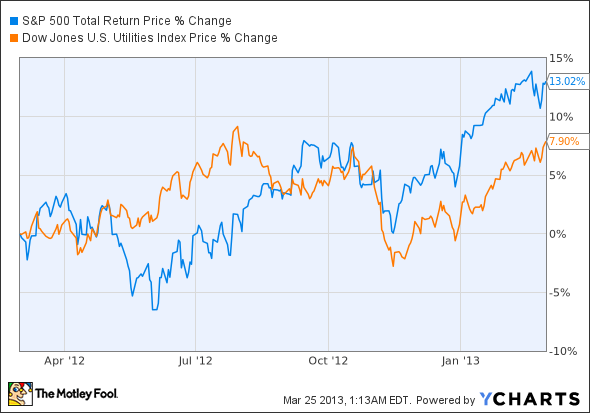
When Exelon CEO Chris Cane recently said “2012 was a difficult year on the economic front for our sector,” he wasn’t just making excuses for his company. Falling sales were a common trend for utilities last year, and the sector lagged the S&P 500 by more than 5 percentage points.

^SPXTR data by YCharts.

Looking ahead, projections aren’t peachy. A recent Department of Energy report predicts that electricity demand will clock in at 0.58% compound annual growth over the next decade, dulled by both America’s economy and advancements in energy efficiency.

The Federal Reserve announced last week that it expects U.S. GDP to fall between 2.9% and 3.7% by 2015, child’s play compared with many emerging markets. And although many utilities are overhauling their energy portfolios to set themselves up for a profitable future, some companies are looking abroad to propel top line growth.

Yes to AES?
When looking for utilities with international exposure, AES is the elephant in the room. Its 27-country spread offers formidable international exposure.

Source: AES Earnings Presentation (MCAC is Mexico, Central America, and the Caribbean. EMEA is Europe, Middle East, and Africa)

But diversification doesn’t make bad business good, and AES is currently working to cut costs. Its 4.9 debt-to-equity ratio is higher than 98% of its peers, and the company’s decision to sell 14 assets in nine countries over the past year is no coincidence. The utility’s stock jumped 6% on solid Q4 earnings, and BRIC bulls would do well to give AES a closer look.

Feeling Chile?
Hailing from my home state, North Carolina-based Duke Energy offers investors a nibble of internationalism with a big serving of Southern sauce. Its International Energy subsidiary is primarily focused on generation in Latin America, but it also owns a 25% stake in Saudi Arabian National Methanol Company. Duke axed a similar 25% stake in a Greek gas company in Q1 2012, while adding on a 240 MW thermal plant and 140 MW hydropower facility to its Chilean operations.

In total, Duke directly or indirectly generates 4,900 gross MW of international energy. That’s approximately 10% of the utility’s U.S. generation capacity, a significant slice of its portfolio pie. The utility beat top-line and earnings estimates last quarter and could be ready for some serious growth with its $12 billion of modernization projects well under way.

(Inter)National Grid
National Grid
is anything but, unless you’re based in the United Kingdom. This utility is listed on the U.S. stock exchange, but its blood runs …read more
Source: FULL ARTICLE at DailyFinance

The Most Powerful Company You've Never Heard Of

By Alex Planes, The Motley Fool

Filed under:

On this day in economic and financial history …

The United Fruit Company was formed on March 30, 1899, the result of a merger between the nearly bankrupt Tropical Trading and Transport Company and Boston Fruit. On its formation, United Fruit was already a giant in its field, with railroads, steamships, and plantations spread across the tropics. It would grow into an enterprise that clashed with governments. The phrase “banana republic” arose from United Fruit‘s efforts to bend entire Central American nations to its purposes, particularly in the growing of bananas, which are notoriously quick to rot and thus require greater control over their production to ensure a uniform — and profitable — product.

In Reason, Ira Stoll recently recounted the company’s sheer size:

It seems almost quaint to think that a company specializing in bananas might have once been considered a capitalist giant on the level of today’s firms, but so it was — at its height in the first half of the last century, United Fruit owned one of the largest private navies in the world. It owned 50% of the private land in Honduras and 70% of all private land and every mile of railroad in Guatemala.

The company’s transformation of the banana trade was a key element of Peter Chapman’s Bananas, which a New York Times article on United Fruit covered in 2008:

“[United Fruit was] more powerful than many nation states … a law unto itself and accustomed to regarding the republics as its private fiefdom.” United Fruit essentially invented not only “the concept and reality of the banana republic,” but also, as Chapman shows, the concept and reality of the modern banana. “If it weren’t for United Fruit,” he observes, “the banana would never have emerged from the dark, then arrived in such quantities as to bring prices that made it available to all.”

Today, “the banana is the world’s fourth major food, after rice, wheat, and milk.” But when a Brooklyn-born twentysomething named Minor Keith planted a few banana cuttings next to a railroad track in Costa Rica in the early 1870s, it was virtually unknown outside its native environs. … Until its demise a hundred years later, United Fruit controlled as much as 90 percent of the market.

United Fruit was fictionalized in Gabriel Garcia Marquez’s One Hundred Years of Solitude and managed to take part in multiple political uprisings and fiascos, including the “banana massacre” in 1928 Colombia and the 1954 Guatemalan coup d’etat. On both occasions, U.S. military forces intervened in Central America on the company’s behalf. United reached its apex in the years bookending World War II, after Sam “Banana Man” Zemurray took the reins — United Fruit‘s overextension before the Great Depression had jeopardized the wealth he’d gained from selling United his competing fruit company, prompting a takeover bid.

United Fruit became United Brands in 1970 and is now Chiquita …read more
Source: FULL ARTICLE at DailyFinance

Most of Europe reluctant to crack down on Hezbollah despite growing threat

By Benjamin Weinthal

A House hearing on Hezbollah as a global terrorist threat coupled with Thursday’s prison sentence of a Hezbollah member — the first in a European court — brings into sharp focus the rising danger of the Lebanese terror organization for the security of the U.S. and its allies.

The criminal court in Limassol, Cyprus, sentenced Hossam Taleb Yaacoub — a self-confessed Hezbollah operative — to four years in prison for plotting to kill Israeli tourists on the island. “There is no doubt these are serious crimes which could have potentially endangered Israeli citizens and targets in the republic,” the three-member judge panel said.

The Lebanese Shiite militant group Hezbollah — a major proxy of Iran‘s radical clerical rulers — has an extensive history of carrying out terror attacks on U.S. soldiers. In January 2007, Hezbollah operative Ali Mussa Daqduq played a critical role in the murders of five U.S. soldiers in Iraq. In 1983, a year after its founding, Hezbollah executed a double suicide attack against U.S. and French military barracks in Beirut, killing 241 American servicemen and 58 French paratroopers.

And Hezbollah’s mushrooming presence in United States‘ backyard is cause for concern. Matthew Levitt, director of the Stein Program on Counterterrorism and Intelligence at The Washington Institute for Near East Policy, told FoxNews.com, “With Hezbollah playing a central role in Iran‘s shadow war with the West, concerns over the group’s presence and capabilities in Latin America are well-placed. Hezbollah’s reach in the region extends beyond the tri-border area of Brazil, Argentina, and Paraguay — recent cases highlighted Hezbollah activities in Venezuela and Mexico, too.”

Levitt delivered testimony this month to the House Foreign Affairs Subcommittee on Terrorism, Proliferation and Trade, saying, “In early September 2012, Mexican authorities, in a joint operation conducted by migration and state police, arrested three men suspected of operating a Hezbollah cell in the Yucatan area and Central America.”

One of the suspects arrested was Rafic Mohammad Labboun Allaboun, a dual U.S.-Lebanese citizen, linked to a U.S.-based Hezbollah money laundering operation.

Roger F. Noriega, a former assistant secretary of state for Western Hemisphere affairs and a former U.S. ambassador, said at the congressional hearing, “Hezbollah is not a lone wolf. In this hemisphere it counts on the political, diplomatic, material and logistical support of governments – principally Venezuela and Iran – that have little in common but their hostility to the United States.”

Last week in Jerusalem, President Obama called on countriesto outlaw Hezbollah. In a clear reference to the ongoing EU talks about banning Hezbollah, Obama said, “That’s why every country that values justice should call Hezbollah what it truly is: a terrorist organization.”

Only a handful of Western democracies — the U.S., the Netherlands, Canada — consider Hezbollah a full-blown terrorist organization. The United Kingdom has merely blacklisted Hezbollah’s military wing for targeting British soldiers for death in Iraq.

The EU has so far snubbed Obama administration counterterrorism officials, who have repeatedly urged the 27-member body to crack down on Hezbollah’s legal status in Europe. The results of Bulgaria’s investigation last month …read more
Source: FULL ARTICLE at Fox World News

Statement by the Press Secretary on the President’s Trip to Mexico and Costa Rica

By The White House

President Obama will travel to Mexico and Costa Rica May 2-4. This trip is an important opportunity to reinforce the deep cultural, familial, and economic ties that so many Americans share with Mexico and Central America.

In Mexico, the President looks forward to meeting with President Peña Nieto, with whom he spoke by telephone today. The President welcomes the opportunity to discuss ways to deepen our economic and commercial partnership and further our engagement on the broad array of bilateral, regional, and global issues that connect our two countries. In Costa Rica, the President looks forward to the opportunity to meet with President Chinchilla as well as heads of state of the other Central American countries and the Dominican Republic, whom President Chinchilla has graciously offered to host. The trip will be an important chance to discuss our collective efforts to promote economic growth and development in Central America and our ongoing collaboration on citizen security.

…read more
Source: White House Press Office

2 shipping firms admit to illegal ocean dumping

Two international shipping firms pleaded guilty Thursday to obstruction and other charges in connection with what the U.S. Attorney’s Office characterized as a pattern of falsifying records to hide the illegal dumping of engine sludge and oil-contaminated waste into the ocean.

The four ships in question docked in New Jersey, Delaware and California, but the criminal cases were consolidated in New Jersey.

The German firm Columbia Shipmanagement and Cyprus-based Columbia Shipmanagement Ltd. agreed to pay a combined $10.4 million penalty, U.S. Attorney Paul Fishman said. Of that, $2.6 million will go to addressing environmental damage caused by Superstorm Sandy in New Jersey and Delaware.

The two companies also will be placed on probation for four years. They are affiliates owned by the same holding company, Fishman said.

According to the U.S. Attorney’s Office, whistleblowers played key roles in the various investigations.

The New Jersey probe into one of the Hamburg-based company’s ships, the King Emerald, began after crew members approached Coast Guard officers with cell phone photos during a routine inspection in Carteret last May. The company eventually admitted it had illegally discharged oil waste off the coast of Central America, including within 45 miles of a national park area in Costa Rica.

Crew members of another ship, the Nordic Passat, prompted the Delaware investigation last October when they provided the Coast Guard with a thumb drive that contained photos and video showing how the ship’s sewage system was rigged to send illegal discharges overboard. Similarly, whistleblowers alerted authorities to two others ships, one destined for New Jersey and another that docked in San Francisco.

“In this particular instance the whistleblowers were enormously helpful,” Fishman said Thursday.

Under federal law, oil-contaminated waste can be discharged overboard only if it contains less than 15 parts of oil per million parts of water. To achieve this, large vessels are required to have a pollution control device called an oily water separator. Engine sludge, produced by the process of purifying fuel oil and lubricating oil, must be burned in a ship’s incinerator or off-loaded on shore for disposal. At least one of the ships dumped sludge into the ocean and another falsified records to claim it incinerated sludge when it hadn’t, authorities said.

In their guilty pleas, the shipping companies admitted bypassing the oily water …read more
Source: FULL ARTICLE at Fox US News

General: Gitmo buildings in need of major repair

As much as $170 million is needed to improve facilities for the troops stationed at the Guantanamo Bay detention center that President Barack Obama has marked for extinction, the top U.S. commander in South and Central America said Wednesday.

The head of U.S. Southern Command, Gen. John Kelly, told the House Armed Services Committee that upgrades to buildings including barracks and the dining hall for the American personnel assigned to the joint task force at the U.S. base in Cuba are badly needed. He described the living conditions at Guantanamo as not quite squalor but “pretty questionable.”

“We need to take care of our troops,” Kelly said.

Kelly also said, though, that the detainees are living in humane conditions. He attributed a hunger strike that has grown to 25 detainees to frustration among prisoners over the failure to close Guantanamo. The hunger strike has become the largest and most sustained protest at Guantanamo in several years.

Obama had pledged to shutter the prison at Guantanamo soon after taking office but Congress opposed it, passing a law that prohibits the government from transferring Guantanamo prisoners to U.S. soil and requiring security guarantees before they can be sent elsewhere in the world.

Kelly told the committee that the facilities at Guantanamo were designed as temporary structures and never intended to last as long as they have. The prison opened on the base in January 2002.

“These are things that we have to do right now,” Kelly said of the repairs. “I’m assuming Guantanamo will be closed someday. But if you look at the past 11 years when it was supposed to be temporary, who knows where it’s going.”

Kelly said none of the projects are aimed at improving the “lifestyle” of the detainees. But the improvements will increase security and improve the ease of movement for the detainees, which will benefit the guards by making their jobs less complicated, he said.

Kelly also said there’s a proposed project to replace one of the facilities where “special detainees” are housed. But he declined to discuss details of the project.

The general estimated the price tag for the repairs at between $150 million to $170 million. Construction work at Guantanamo is expensive, he said, because of the base’s remote location and lack of local labor.

…read more
Source: FULL ARTICLE at Fox US News

Green Mountain Coffee Roasters, Inc. (GMCR) Increases Fair Trade Coffee Purchases by Five Million Po

By Business Wirevia The Motley Fool

Filed under:

Green Mountain Coffee Roasters, Inc. (GMCR) Increases Fair Trade Coffee Purchases by Five Million Pounds Annually

Coffee leader converts top-selling Nantucket Blend® to Fair Trade Certified™ coffee

WATERBURY, Vt.–(BUSINESS WIRE)– Green Mountain Coffee Roasters, Inc. (GMCR) (NAS: GMCR) today announced that another one of its best-selling coffees, Green Mountain Coffee® Nantucket Blend®, is now 100-percent Fair Trade Certified™. This conversion will represent approximately five million pounds of Fair Trade Certified™ coffee for fiscal year 2013 and will deliver an estimated $1 million in fair trade social premiums to coffee farmers annually.

Purchasing Green Mountain Coffee®Fair Trade Certified™ varieties helps farmers receive a fair price for their beans, resulting in quality coffee and a higher quality of life in coffee-farming communities. Beans for Nantucket Blend® are sourced from carefully-selected Fair Trade Certified™ coffee farms in Central America, South America, Africa, and Indonesia. The Nantucket Blend® conversion is the latest step in the Green Mountain Coffee® brand’s continued support of fair trade.

In 2000, GMCR became one of the first roasters in the United States to offer Fair Trade Certified™ coffees, and in 2012, the company was named the world’s largest purchaser of Fair Trade Certified™ coffee by Fair Trade USA for the second year in a row.

“Converting our Nantucket Blend now allows us to bring more Green Mountain Coffee fair trade varieties to a larger consumer base than ever before,” said Lindsey Bolger, Senior Director of Coffee for the Specialty Coffee business unit of GMCR. “We’re proud to be able to maintain the taste and quality of one of our most popular coffees while significantly changing the impact its existence will have around the world.”

The conversion of all Nantucket Blend® coffee sold in bags, K-Cup® and Vue® packs to Fair Trade Certified™ was completed in January 2013. The brand’s Brew Over Ice Nantucket Blend® Iced Coffee will be converted by May 2013, making it the first Fair Trade Certified™ Brew Over Ice beverage offered for the Keurig® K-Cup® and Vue® brewing systems.

Green Mountain Coffee® Nantucket Blend® is a complex blend that weaves three exotic and delicious coffee-attributes together – winey, berry tones from East Africa, deep, full-bodied flavor from Indonesia, and zesty and bright flavors from the Americas. Nantucket Blend® is currently available in 12-count, 18-count, 24-count and 80-count K-Cup® pack boxes, in 12 oz. ground coffee bags, and 16-count Vue® pack boxes. With the …read more
Source: FULL ARTICLE at DailyFinance

Midday Report: Starbucks Buys Coffee Farm in Costa Rica

By The Associated Press

Starbucks buys Coffee plantation

Filed under:

Starbucks (SBUX) goes into the farming business: The coffee retailer has bought its first farm – a 600-acre property in Costa Rica.

This doesn’t mean that baristas will have to pick their own beans, but Starbucks hopes its move into agriculture will benefit the entire coffee-growing business. The Seattle-based chain already offers 55 different varieties of coffee. You can get anything from a basic medium roast to a sun-dried Sumatra Rasuna or a Peppermint Mocha. And now that the company has its own farm, it will be able to develop proprietary coffee varietals, which could lead to new blends. Starbucks will also develop hybrid coffee beans, but it will not use genetic modification techniques. That’s part of the company’s commitment to ethically source all of its coffee beans by 2015.

Getty Images

In addition to creating new coffee varieties, Starbucks says it intends to use the new farm as a basis of research that will help coffee farmers around the world. One priority is to investigate a fungus, known as leaf rust, that is devastating crops in Central America and Mexico. It kills coffee leaves by sapping them of nutrients and lowers bean yields. An international trade group estimates the fungus could wipe out 2-1/2 million of those giant bags of coffee this year, and as much as 4-million bags next year.

Starbucks also says its research will focus on finding new methods to grow coffee, on farming techniques that improve coffee production, and on mitigating the impact of climate change. The company says it will share what it learns with other coffee farmers to improve the quality and size of the worldwide harvest.

Starbucks has more than 17,000 coffee shops in 40 countries. So how much coffee does it need to meet our thirst for these coffee brews? It bought 545 million pounds of coffee last year.

And the company’s stock has been a winner, even though growth has slowed: It’s up just 6 percent over the past year, but it’s more than doubled over three years, and it’s soared 250 percent over five years.

%Gallery-180120%

Permalink | Email this | Linking Blogs | Comments

…read more
Source: FULL ARTICLE at DailyFinance

7UP Named Official Soft Drink of 2013 CONCACAF Gold Cup

By Business Wirevia The Motley Fool

Filed under:

7UP Named Official Soft Drink of 2013 CONCACAF Gold Cup

MIAMI–(BUSINESS WIRE)– The Confederation of North, Central America and Caribbean Association Football (CONCACAF) today announced an agreement with Dr Pepper Snapple Group (NYS: DPS) that makes 7UP the Official Soft Drink of the 2013 CONCACAF Gold Cup.

Through the agreement, 7UP will work with CONCACAF and its commercial agency, Traffic Sports, to develop programs that engage and excite fans leading up to and surrounding the Gold Cup – including consumer promotions, retail merchandising, ticket giveaways, premium offers, in-game advertising, product sampling and inclusion in promotional marketing materials, among other activities. The agreement also includes Clamato, Squirt, Sunkist soda, Peñafiel and other DPS brands.

“7UP is an iconic brand known for providing uplifting refreshment to its consumers, and they are a natural partner for a tournament with a growing, passionate following,” said CONCACAF‘s general secretary, Enrique Sanz. “We are excited to team up with 7UP and DPS to connect with fans in ways they have never been reached and to ultimately enhance their enjoyment of the Gold Cup experience.”

“Soccer is defined by great moments, and 7UP fans love to savor life’s moments, which is why we are pleased to be sponsoring this year’s Gold Cup,” said Olivia Vela, director of multicultural marketing for DPS. “We’re looking forward to working with CONCACAF to develop programs that reward our fans’ passion for the Beautiful Game and for life in general with a truly memorable experience at one of the biggest soccer events on the continent.”

“We are delighted to have DPS back as a sponsor of the Gold Cup. Their participation is a great example of brands with multi-national appeal truly capitalizing on a multi-national tournament,” said Marcelo Radice, director of sponsorship sales & marketing at Traffic Sports. “Their commitment further demonstrates the growing popularity and power of soccer around the region.”

Taking place every two years, the Gold Cup has become the region’s most popular soccer event, routinely drawing capacity crowds and millions of TV viewers across North, Central America and the Caribbean. Featuring the best players from the CONCACAF‘s three sub-regions, the tournament has grown into a 12-nation championship.

Group matches will take place July 7-16 in nine cities across the U.S. Quarterfinal matches, followed by July 20 in Atlanta and July 21 in Baltimore. Semifinal matches will be played July 24 in Arlington, Texas, and the championship is set for historic Soldier Field in Chicago on July 28 (3:30 …read more
Source: FULL ARTICLE at DailyFinance

Solar America Begins Second Project in Mexico

By Business Wirevia The Motley Fool

Filed under:

Solar America Begins Second Project in Mexico

GULFPORT, Miss.–(BUSINESS WIRE)– Solar America Corp. (OTCBB: SOLX) announced today that it has executed a Memorandum of Understanding with Habitables Innca S.A. de C.V., the principal contractor for the San Nicolas housing project in Guadalajara. Under the terms of the Memorandum Solar America will be the exclusive provider of solar power and solar lighting solutions for San Nicolas project.

This residential project will reduce the carbon footprint of San Nicolas de la Primavera, a Guadalajara subdivision as well as showcase Solar America‘s innovative solutions. Solar America‘s alliance with Habitables Innca marks the expansion of the company’s efforts in Mexico, where Solar America is also participating in the Los Conejos housing project.

“Between Los Conejos and San Nicolas, our participation in the Guadalajara area is quickly expanding,” said Solar America CEO Robert Bludorn. “We are confident that our American solutions can be easily implemented throughout Mexico and Central America and look forward to continuing to build relationships in these countries.”

Mexico is looking to increase their use of alternative energy sources. Less than one percent of Mexico‘s land area would need to be developed to power the entire nation, according to the Secretaria de Energia de Mexico, Mexico‘s energy ministry.

About Solar America Corporation

Solar America Corporation intends to commercialize and distribute innovative solar energy products and solutions. Solar America intends to capitalize on its position in the alternative energy sector to develop cutting-edge solar technologies. Solar America common stock is traded under the symbol SOLX. For more information please visit www.solaramericacorp.com.

Safe Harbor Statement under the Private Securities Litigation Reform Act of 1995: This news release contains forward-looking information within the meaning of Section 27A of the Securities Act of 1933, as amended, and Section 21E of the Securities Exchange Act of 1934, as amended, including statements that include the words “believes,” “expects,” “anticipate” or similar expressions. Such forward-looking statements involve known and unknown risks, uncertainties and other factors that may cause the actual results, performance or achievements of the company to differ materially from those expressed or implied by such forward-looking statements. In addition, description of anyone’s past success, either financial or strategic, is no guarantee of future success. This news release speaks as of the date first set forth above and the company assumes no responsibility to update the information included herein for events occurring after the date hereof.

…read more
Source: FULL ARTICLE at DailyFinance