Tag Archives: CNBC

Greenspan's Rallying Cry: Separating Sense From Nonsense

By Alex Dumortier, CFA, The Motley Fool

Filed under:

Stocks’ winning streak ended today, as the S&P 500 , and the narrower, price-weighted Dow Jones Industrial Average both declined 0.2%. I’m highly skeptical concerning technical analysis, the pseudo-scientific discipline which seeks out patterns in price and volume data and ignores all fundamentals. Nevertheless, I have to admit that the S&P 500‘s Oct. 2007 record (nominal) high is proving remarkably resistant to this rally. Today will mark the sixth consecutive day on which the index closes within 1% of this level (it has not crossed it on an intraday basis, either.)

“Irrational exuberance” — then and now
It’s almost as if traders are skittish about crossing into uncharted waters; that would be odd, as I have yet to see a “here be dragons” warning beyond 1,565.15 on my S&P 500 price graph. If Captain Greenspan were still piloting this ship, surely we would have motored right through these waters by now. “Irrational exuberance is the last term I would use to characterize what is going on at the moment,” he told CNBC morning, adding that this bull market has “still got a ways to go as far as I can see.”

Option traders must have heard his reassuring words; despite stocks’ decline today, the VIX Index , Wall Street‘s fear gauge, was flat on the day, closing at 11.30. This ultra-low level is not uncharted waters per se — we are at the threshold for the bottom 3.5% of values going back to the Jan. 1990 inception of the index — but it is the equivalent of highly unusual meteorological conditions. (The VIX is calculated from S&P 500 option prices, and reflects investor expectations for stock market volatility over the coming thirty days.)

It’s not clear why one should listen to Mr. Greenspan when it comes to the stock market‘s valuation, as his record on that front is hardly unblemished. It turns out that he was probably right when he made his most famous “call,” famously referring to investors’ “irrational exuberance” in a speech on Dec. 5, 1996. Indeed, from that day’s close through today, the S&P 500 has risen less than 2.3% on an annualized basis, after inflation, which is significantly less than the long-term historical average. Oddly, though, when he delivered that speech, stocks were only about one-fifth more expensive than they are today with regard to their cyclically adjusted earnings.

Are you finally ready to invest on the basis of fundamentals, valuation, and competitive advantage? If so, the Motley Fool‘s chief investment officer has selected his No. 1 stock for this year. Find out which stock it is in the brand-new free report, “The Motley Fool’s Top Stock for 2013.” Just click here to access the report and find out the name of this under-the-radar company.

The article Greenspan’s Rallying Cry: Separating Sense From Nonsense originally appeared on Fool.com.

…read more
Source: FULL ARTICLE at DailyFinance

Treasury's Lew Sees Likelihood of Budget Deal

By The Associated Press

Filed under: , , , , ,

(J. Scott Applewhite/AP)

By MARTIN CRUTSINGER

WASHINGTON — Treasury Secretary Jacob Lew said Thursday that he is optimistic that President Barack Obama will be able to reach an agreement with Republicans in Congress to break a budget impasse that’s triggered across-the-board government spending cuts.

Lew said Obama has been “deeply engaged over the past week in trying to open the door for conversations” with lawmakers in the search for a “sensible center.”

Lew, who served as budget director for Obama and also in the Clinton administration, said he expected to be “very much involved in the conversations.”

“I think there is a broad understanding of the size of the problem,” Lew said. “There’s even a broad understanding of what an ultimate solution probably looks like, but we need to figure out the path to get from here to there.”

Lew spoke to reporters after touring a Siemens AG (SI) manufacturing plant outside Atlanta. It was his first trip since being sworn in as Treasury secretary last month.

Sponsored Links

Asked in an interview with CNBC whether he thought an agreement could end the automatic budget cuts that took effect March 1, Lew said it was too early to say what the agreement might entail. But he said all agree that the government cuts, which will reduce spending by $1.2 trillion over a decade, pose a threat to the economy.

“I think there are better alternatives, and we have a little bit of time,” Lew said. “The conversation is engaged now, and I hope over the coming weeks and months that we can work through this problem.”

Obama traveled to Capitol Hill this week to meet with Democratic and Republican lawmakers in both the House and Senate.

Lew said those conversations and discussions he had with senators during his confirmation hearing led him to conclude that “there is a growing number of members on a bipartisan basis who want to do something sensible.”

AP writer Johnny Clark in Atlanta contributed to this report.

Permalink | Email this | Linking Blogs | Comments

…read more
Source: FULL ARTICLE at DailyFinance

Is Jorge Bergoglio, the New Pope Francis, a Capitalist?

By Jerry Bowyer, Contributor

I remember when Cardinal Ratzinger was announced as Pope. It happened while I was on live TV, on CNBC with Larry Kudlow. They cut away from me and the other pundits to a live correspondent, who announced that the former Cardinal Ratzinger had decided to call himself Benedict XVI. …read more
Source: FULL ARTICLE at Forbes Latest

Is the Dow Approaching Bubble Territory?

By John Maxfield, The Motley Fool

Filed under:

If the market finishes the day where it is now, it will mark the eighth straight session in which blue-chip stocks have climbed. With roughly an hour left in the trading session, the Dow Jones Industrial Average is clinging to a one-point gain.

Given this run into record territory, many analysts are now beginning to ask the inevitable question: Are stock prices approaching bubble territory? Leaving little to the imagination, a headline on Yahoo! Finance reads, “The Stock Market Is a Debt-Fueled Bubble.” According to an economist interviewed therein: “Nothing can accelerate forever. At some point the acceleration stops, and when it does the market breaks.”

Not surprisingly, however, there’s another side to this story. David Tepper, the founder of hedge fund Appaloosa Management, has purportedly predicted that the S&P 500  could rise an additional 20% or more through the end of this year. Citing a person “familiar with his thinking,” Kate Kelly of CNBC said Tepper is confident in the U.S. economy and is expecting gross domestic product to grow by 2.25% for the first three months of the year.

Either way, today’s rally is based in large part on the fundamentals.

This morning, the Department of Commerce released data showing that retail sales in the United States jumped last month — “a sign that consumers are gaining confidence and spending more despite higher taxes and gasoline prices,” according to The Wall Street Journal. More specifically, seasonally adjusted sales of retail and food services rose by 1.1% over January and 4.6% on a year-over-year basis. This was more than double the 0.5% advance that economists surveyed by Bloomberg had predicted.

The results were great news for both McDonald’s and Wal-Mart , both of which are up in afternoon trading. While these companies have seen their stocks gain this year — McDonald’s by nearly 10% and Wal-Mart by 6.3% — it hasn’t been a smooth ride for either. Among other things, same-store sales at the fast-food giant fell by 1.5% last month, as the prior-year period included an extra day for the leap year. And Wal-Mart has been working to stem the tide leak of emails about severely lagging sales at the nation’s largest retailer.

Meanwhile, shares of Bank of America are trading higher in anticipation of tomorrow, when the nation’s largest banks learn whether or not they’ll be allowed to increase their dividend payouts and/or repurchase more shares. As I discussed, I believe the chances are good — and it seems the market does, too. The same can be said for JPMorgan Chase , the nation’s largest bank by assets.

The question is largely a function of capital — Tier 1 common capital, that is. Banks with excess capital beyond regulatory minimums will presumably be given the green light to return more of that capital to shareholders, while those not similarly situated will be denied the opportunity.

In B of A’s case, at the end of …read more
Source: FULL ARTICLE at DailyFinance

What If Apple Followed Warren Buffett's Advice?

By Daniel Sparks, The Motley Fool

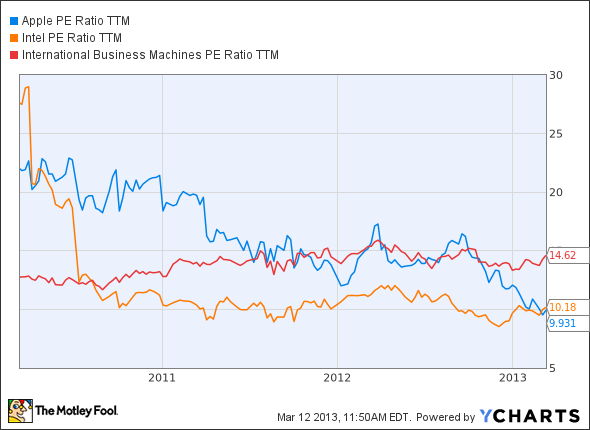
AAPL PE Ratio TTM Chart

Filed under:

Apple will announce plans for its cash hoard next month, according to Howard Ward, chief investment officer at investment firm Gamco. But if this rumor proves true, the most important question remains unanswered: How will Apple return cash to shareholders? Would the company be wise to take ace investor Warren Buffett‘s advice, and repurchase more shares?

Share buyback programs enhance shareholder value
Share buybacks offer corporations a tax-free way to build shareholder value by buying back their own shares and, in turn, increasing shareholders’ ownership percentage per share.

Buffett has been known to criticize companies for buying back their shares, but it’s never because he thinks share repurchase programs are inherently bad. Instead, he criticizes companies for overpaying for their own stock.

As Buffett outlined in the 2011 Berkshire Hathaway letter to shareholders, he “favor[s] repurchases when two conditions are met: first, a company has ample funds to take care of the operational and liquidity needs of its business; second, its stock is selling at a material discount to the company’s intrinsic business value, conservatively calculated.”

When a company buys back its own shares, they should be “purchased below intrinsic value,” Buffett explains. Price is everything: “The first law of capital allocation — whether the money is slated for acquisitions or share repurchases — is that what is smart at one price is dumb at another.”

With $137 billion in cash and investments, Apple has plenty of excess cash. As far as the second condition, Buffett signaled a go-ahead in his March 4 appearance on CNBC, when he commented on Apple’s cash hoard, “But if you could buy dollar bills for 80 cents, it’s a very good thing to do.”

Comparatively cheap and ripe for a buyback
Even if Buffett thinks Apple is cheap, Berkshire didn’t disclose any positions in Apple in the its Feb. 14 13-F filing with the Securities and Exchange Commission. His comments, nevertheless, are encouraging to Apple shareholders.

Investors don’t need to look far for proof that Apple is cheap. Based solely on fundamentals, Apple appears cheaper than nearly every company in the S&P 500.

Even Berkshire has made investments in both IBM and Intel in recent years, despite Buffett’s famed aversion to tech stocks. Though Berkshire sold the Intel shares less than a year later for a 25% gain, its investment in semiconductor technologies shows that even Berkshire is sometimes willing to put its money behind highly concentrated technology blue chips when the price is right. In fact, IBM remains Berkshire Hathaway‘s third-largest public holding. 

When measured by P/E, Apple now trades in line with Intel, and at a significant discount to IBM.

AAPL P/E Ratio TTM data by YCharts.

Apple was trading at a premium to IBM as recently as August 2012. But over the last six months, Apple has lost about 40% of its value as investors have grown concerned with declining margins and increased competition.

But a …read more
Source: FULL ARTICLE at DailyFinance

My Top Two Stocks: GM and Ford

By John Rosevear, The Motley Fool

Filed under:

It was almost embarrassing, really.

When a Fool editor asked me for an article about my top two stock holdings, I had to log into my brokerage account and look to see which ones they were.

While I closely follow the companies I own, I pay less attention to the moment-to-moment value of my holdings, which go up and down over time. I really didn’t know for sure which stocks would top the list until I looked.

But sure enough, my biggest positions at the moment are the two stocks I follow most closely for the Fool: General Motors and Ford .

I bought them both for good reasons. But would I buy them again now?

Ford has been a very good buy…
I’ve had my current position in Ford for about four years, dating back to the dark days of early 2009. Those were the days when the market seemed to be getting crazier by the day, following the “Autumn of the Massive Collective Pants-Soiling.” The voices on CNBC were getting shriller by the hour as that winter unfolded, and I decided to heed Warren Buffett‘s maxim and get ready to be greedy when others were at their most fearful.

I made up a list of stocks to buy. Most were big, high-quality dividend stocks that I hoped to own for years, companies like Diageo and Abbott Labs , both of which I still own. But I also slipped a sentimental favorite onto the list, a company I’d owned on and off at several points in the past: Ford.

I wrote an article at the time that explained what I was thinking. While GM and Chrysler were clearly headed for bankruptcy or worse, Ford – which had borrowed all it could back in 2006 in a last-ditch attempt to fund a turnaround, and had over $30 billion of debt at that moment – was showing signs of life, even in those dark days.

Ford’s latest cars were very good, its turnaround plan appeared to be on track, and CEO Alan Mulally’s strategy – called “One Ford” — inspired great confidence. If the company survived the economic crisis without going bankrupt – and I thought it had a very good chance of doing so – then its stock was a steal, I wrote at the time.

I made the buy not long after I wrote that article, in early March. As we now know, that turned out to be a clear-cut great move… unlike my investment in GM, where the jury is definitely still out.

…but the jury is still out on General Motors
I took a position in GM at around $33 not long after its November 2010 IPO, and bought more at around $23 the following summer. Taken as a whole, my GM investment is up about 4% at the moment.

But as I said, the jury is still out on whether buying GM was a good move or not. …read more
Source: FULL ARTICLE at DailyFinance

3 Reasons America's Wealthy Don't Give More to Charity

By CNBC

Warren Buffett

Filed under: ,

By Robert Frank

The American wealthy are hands down the most philanthropic in the world. Americans dominate global giving lists and surveys consistently show that the U.S. rich are far more likely to make philanthropy a priority.

But some say they could give more. One recent study found that a large share of people making $200,000 or more give only 2.8 percent of their income to charity. Other studies show that multimillionaires donate only about one percent of their wealth to charity (though billionaires tend to give a higher percentage).

Warren Buffett and Bill Gates launched their Giving Pledge in large part to persuade the super-rich and the non-super-rich alike to give more to charity. As Buffett told me in 2011, “The hope is that our larger population ends up giving a larger proportion of their income to fund philanthropy.”

So why don’t the rich give more?

Charity’s Biggest 2012 Spenders

CNBC‘s Robert Frank reports who were the nation’s most generous donors last year.

A new study of multimillionaires offers some answers. The study, by SEI Private Wealth Management, found that 82 percent of wealthy families believe that having more money means you have a greater obligation to be philanthropic.

But the respondents (worth $10 million or more) listed three main reasons for not giving more. First, nearly half said they needed more confidence “that the level of their wealth would continue to support their lifestyle and their family.” Second, they said they would give more if the markets improved.

Finally, a third of those polled said they needed to “find something they could be more passionate about.”


The first two reasons aren’t all that surprising. If they had more money, the wealthy would give more of it away.

But the third reason is worth noting. While more money helps, it’s also important to be motivated by a cause. And if you care enough about a particular problem, you’ll be more inclined to sacrifice some of life’s comforts to solve it.

Money, in other words, isn’t the only driver of philanthropy. It’s about the heart as much as the wallet.

More from CNBC

Permalink | Email this | Linking Blogs | Comments

…read more
Source: FULL ARTICLE at DailyFinance

Herbalife: Dog, or Just an Underdog?

By Rich Duprey, The Motley Fool

Filed under:

Short-sellers and hedge funds may be shadowy, but sometimes they’re the smartest guys in the room. They’ve done their homework, and they’re willing to bet their capital against the crowd — an investing strategy that can be as lucrative as it is contrarian.

On Motley Fool CAPS, the 180,000-member-driven investor community where informed opinion is translated into stock ratings of one to five stars, we also have investors who find the chinks in a company’s armor and correctly call its fall. We call them “Underdogs” if they’ve earned 100 or more CAPS points by correctly predicting that one or more stocks would underperform the market.

Today I’m looking at nutritional supplements maker Herbalife , which lost more than a third of its value after becoming the centerpiece of an argument between dueling hedge fund operators. Investors remain wary of its multi-level marketing structure, so there’s little doubt why the nutritionals seller carries the lowest one-star CAPS rating.

It’s been a bit of a wild ride, so if there are any who’ve scored big by correctly predicting which stocks will fail, it may be worth our while to check out those they think will ultimately succeed. And CAPS All-Star Valyooo is one who’s earned the underdog moniker and recently predicted that Herbalife would rout the shorts.

Herbalife snapshot

Market Cap

$4.3 billion

Revenues (TTM)

$4.1 billion

1-Year Stock Return

(35%)

Return on Investment

50.6%

Estimated 5-Year EPS Growth

14.8%

Dividend and Yield

$1.20/2.9%

Recent Price

$41.50

CAPS Rating (out of 5)

*

Source: FinViz.com.

Of course, not every short sale goes as planned, which makes shorting a risky proposition. Stock prices can be irrational longer than you have money to stay in the game. And you don’t want to end up with fleas by lying down with the dogs, so make sure you do your homework.

A scary opportunity
Not that there haven’t been doubts before about Herbalife and its MLM business model, but when David Einhorn of Greenlight Capital appeared on the supplement maker’s conference call early last year asking some tough questions about its operations, investors immediately suspected the worst and bolted for the exits. Einhorn never did take a position in Herbalife — short or long — and it seemed to be on its way to a comeback when Pershing Capital’s Bill Ackman made a very public splash of his very large short position, raising all the same fears and once again plunging the stock into chaos.

That itself turned into a bit of a melodrama when Daniel Loeb and Third Point Capital went very long on Herbalife, saying it was ludicrous to think the FTC would shut down the company. Then Ackman’s longtime arch-nemesis, Carl Icahn, came out and disparaged his rival’s position, with the two getting into a verbal sparring match on CNBC.

The MLM …read more
Source: FULL ARTICLE at DailyFinance

Is Hewlett-Packard Really on Its Way Back?

By Richard Saintvilus, The Motley Fool

Filed under:

Over the past three months, you’d be hard-pressed to find a hotter stock on the market than that of beleaguered tech giant Hewlett-Packard . That’s not a typo. Since hitting bottom at $11.35 per share on Nov. 20, the stock has shot up 85% to Friday’s close at $21. Investors are beginning to ask: Is the company back?

Remarkably, I’ve seen articles suggesting that this stock can double in a few years, while calling HP a “fallen angel” that can soon take on Apple and the rest of the tech world by storm. Really? Now, while the stock‘s recovery has indeed been remarkable, let’s not get carried away just yet. Sudden shift in equity sentiment is no indication of success. And nor does it dictate where this company is going. HP still has to execute. And so far, management has not shown that it is capable of realizing any value the business still has left.

How well is Whitman’s “fix and rebuild” progressing?
This is what investors have to ask themselves before wondering if the company is back. Investors still forget that HP is in the midst of a five-year “fix and rebuild” plan that CEO Meg Whitman told CNBC about several months ago. For that matter Whitman also advised that investors should not expect to see revenue growth in any segment (except software) until 2014 when new products hit the market.

Although there’s been some progress, and the company has improved its balance sheet, which is now generating as much as $4.1 billion in operating cash flow, I can’t say that this has been enough to spur an 85% run-up in the stock. Rather, a case can be made that HP didn’t deserve such a depressed valuation and the stock was too cheap relative to book value. Essentially, the Street corrected its mistake, which happens all the time.

However, strictly from an operational perspective, first-quarter earnings results suggest that the company is still missing some opportunities. Revenue arrived at $28.4 billion, falling 6% year over year and 5% sequentially. Revenue was down across all segments, which was not a surprise; Whitman had already advised that this would be the case.

The PC business dropped 8% year over year and 6% sequentially. But the rate of the drop was 6% slower than in Q4 (14%). So HP‘s new line of ultrabooks could have had some impact. If no news is good news, the rest of the segments did OK. That is to say, they were not any worse off than before. So for a stock that was trading on little-to-no expectations, investors rewarded HP with a “less bad” reaction, which is what’s driving the shares today.

I don’t think there is more near-term upside to these shares. Granted, the “less bad” quarter was rewarded. And HP‘s fundamental position assures the company’s viability. But there are still two major problems that management has failed to address. First, the company’s hardware business is not going …read more
Source: FULL ARTICLE at DailyFinance

Would Warren Buffett Ever Buy Apple?

By Eric Bleeker, CFA, The Motley Fool

Filed under:

In the following video, Fool senior technology analyst Eric Bleeker looks at a question that could seem ludicrous given Berkshire Hathaway‘s traditional aversion to technology: Would Warren Buffett ever buy Apple?

In spite of Buffett’s long stance that technology is either too complicated or lacks the right long-term competitive advantages for his investing style, recent evidence points to his having more interest in the space than he lets on. 

For example, Berkshire took a position in Intel  back in 2011. The deal was small enough that it was almost assuredly from potential Buffett successor Todd Combs. Also, in a surprising move that eschewed its traditional long-term focus, Berkshire sold the position within a year’s time for healthy gains. Yet the fact that Berkshire would invest in something that competes on the most cutting edge of technology — the non-stop march of semiconductor technologies — was intriguing. 

Much larger than Intel was Buffett’s buy of IBM . It’s a company that’s as blue-chip as they come in technology and has a tremendous model that increasingly layers software and services on top its hardware portfolio, yet there’s no denying it competes in some very fast-moving and advanced markets. IBM isn’t a small bet, either. It’s Buffett’s third largest public holding. The $14 billion Berkshire owns in IBM is only slightly smaller than its fabled Coca-Cola holding. 

Finally we come to Buffett and right-hand man Charlie Munger‘s description of Google  back in March 2009:

“Google has a huge new moat. In fact I’ve probably never seen such a wide moat,” said Munger. “I don’t know how to take [the moat] away from them,” said Buffett.” “Their moat is filled with sharks!” Munger added.

Google does have a fabulous competitive position, yet even with Buffett’s willingness to invest in great companies at fair prices, its current P/E of 26 is probably a bit too steep to see the Oracle sniffing around Google’s shares. 

So we have ample evidence that Buffett could very well be overly modest and cagey in his deference to technology investing. With Apple now within a modest one-day drop away from being in the 5% cheapest companies in the S&P 500, could Apple possibly be a stock on Buffett’s radar?

As Eric notes, it has some qualities Buffett likes. Its $137 billion in cash is beyond a fortress-like balance sheet, the company has a tremendous global brand, and its cash flow continues to outpace earnings growth. Buffett’s statements on CNBC last week also showed he doesn’t find the company terribly expensive, suggesting Tim Cook use the company’s cash to rebuy shares. 

In the end, the biggest strike against Apple would be the perception that it’s a hardware play prone to being dragged down by competitive forces in the coming years. Were Buffett to take any interest in even putting the sights of his elephant gun on Apple’s shares, it’d probably have to come with his believing that mobile operating systems provide a larger user lock-in than many of his value peers would believe. 

As Eric notes, seeing Berkshire …read more
Source: FULL ARTICLE at DailyFinance

Dow Jones Hits ‘Record High’ Thanks To Strong Performances From Smoke, Mirrors Sectors

By The Huffington Post News Editors

This week, amid the hullabaloo over President Barack Obama’s Deficit Dinner Diplomacy, and Sen. Rand Paul‘s 13-hour filibuster-cum-dissertation on drone strikes and civil liberties, financial news-watchers touted a milestone in their lives of Market Worship. We speak, of course, of the Dow Jones Industrial Average, which on Tuesday hit an “all-time high” of 14,253.77. The good times rolled steady on through the week, and the Dow closed Friday at 14,397.07.

Of course, the notion that these were “record” highs was not, strictly speaking, true. As Jeff Cox as CNBC pointed out, “in inflation-adjusted dollars, the Dow would need to hit 15,731.54 to break the record.” Nevertheless, the exciting new ordinal number sitting on the stock market index set off a chorus of hallelujahs. After all, this was the highest mark it had hit since October 2007. (Of course, if we recall correctly, it was about that time that all of our more recent tragic economic events began to occur.)

The fluctuations of the Dow are typically pored over, by the media, in the same way the ancient oracles pieced through the entrails of birds, seeking for whatever path leads to the most prosperity. And in the world of politics, partisans on both sides are quick to point to the Dow as generic confirmation that their policies are working. As long as the story suits their narrative, anyway.

Read More…
More on Financial Crisis

…read more
Source: FULL ARTICLE at Huffington Post

Why Did My Stock Just Die?

By Rich Duprey, The Motley Fool

Filed under:

It was only a 42-point gain yesterday, but the Dow Jones Industrial Average rose to yet another new record high, hitting 14,296 and making this the eighth longest bull market since 1928. With Fed Chairman Ben Bernanke greasing the skids with his QE-infinity, Warren Buffett agreed in a CNBC interview that “cheap money makes things happen.” Of course, what happens when the spigot gets turned off, as it eventually must, is left unsaid.

The three stocks below, however, were in no mood to celebrate, with several incurring double-digit losses on the day. But don’t go running over the cliff with them like a bunch of lemmings: This could just be a temporary situation. Let’s first see whether they had good reason to fall as panic-fueled routs can sometimes lead to excellent buying opportunities.

Company

% Change

Acura Pharmaceuticals

(12.2%)

Sohu.com

(11.1%)

AeroVironment

(9.8%)

Accurately depicted
Two steps forward, one step back. That describes what you’re seeing at Acura Pharmaceuticals after the stock pulled back following its 48% gain the day before after announcing the Kerr Drug chain would carry its Nexafed decongestant throughout its stores in North Carolina.

As part of the FDA‘s push to make it difficult to abuse certain drugs, Nexafed is designed so it is difficult to make into methamphetamine. Its composition is such that should a drug abuser try to extract the active ingredient, pseudoephedrine, the whole thing would turn into an unusable thick gel.

Acura began selling Nexafed in December and has been anticipating independent drug stores rather than chains picking up the decongestant, and when it reported its fourth quarter results on Monday, it said it had entered distribution agreements at the end of February with most national and regional drug wholesalers.

Although the stock is down another 9% in early morning trading, it remains up 10% so far this year.

Privately speaking
Sohu.com also gave back the gains it made the day before after the Chinese Internet portal denied rumors it was actively seeking a go-private deal. On Tuesday, Sohu’s stock jumped 12% after the South China Morning Post reported that the company was in talks with investment banks and private equity funds about a possible buyout, but yesterday the CFO shot them down saying the reports were inaccurate as not only were they not involved in any such discussions, but the idea wasn’t even being considered.

Sohu’s stock ended the day at $43.44, some $0.20 lower than where they had been before the rumor was published, making it down 16% for the past year.

It wouldn’t have been a surprise, though, had Sohu actually confirmed the rumor. After numerous reports of fraud and financial shenanigans occurred at small, Chinese companies over the past few years, investors lost their appetite for them, and many company insiders began mulling whether to take their companies private. The Chinese government jumped into the fray by actively …read more
Source: FULL ARTICLE at DailyFinance

Netflix Gets a Bizarre "Like" From RBC

By Adam Levine-Weinberg, The Motley Fool

NFLX Chart

Filed under:

On Tuesday, RBC analyst Mark Mahaney resumed coverage of Netflix with a buy rating and a $210 price target. While many investors have become bullish on Netflix recently, Mahaney’s decision to place a buy rating on the stock was odd for two reasons. Most obviously, he’s a little late. Netflix shares have already more than tripled in the past six months! While Mahaney sees another 15% upside, investors who have been waiting on his call missed the real party.

Netflix 6 Month Price Chart, data by YCharts.

However, the rating was also bizarre because the underlying analysis was not very bullish. Mahaney expects the domestic subscriber base to continue growing, but only at a moderate rate. Meanwhile, he expects the international business to lose money for at least two more years. With these parameters, Netflix looks more like a sell.

Slow subscriber growth
In an interview on CNBC on Tuesday, Mahaney stated that Netflix could continue to add around 5 million domestic subscribers per year for the next few years. The main growth driver, in his opinion, is the ongoing shift of video consumption from TV to the Internet. In his research note, Mahaney pinned down his growth expectation further, predicting 39 million domestic streaming subscribers by 2015.

This implies an approximately 15% CAGR in subscriber numbers (and domestic streaming revenue, assuming no price increases), depending on exactly when in 2015 Netflix hits 39 million subscribers. By contrast, Netflix grew its domestic subscriber base by 25% in 2012, and “real” Netflix bulls like my fellow Fool Anders Bylund expect growth to remain above 20% for at least the next few years.

The upshot
I think Mahaney’s subscriber growth estimates are probably on target. Competition from Amazon.com , which seems willing to run its Prime Instant Video service at a loss, will intensify over the next year or two. Furthermore, the streaming service has high churn: Netflix has thrown out numbers like 5% per month previously. As the subscriber base increases, it becomes harder to offset that churn: If churn is still 5%, that means that 1.35 million Netflix users are canceling every month. Even if Netflix’s investments in original and exclusive content eventually reduce churn to 3%, that still becomes a big drag as the subscriber count approaches 40 million or 50 million.

If Mahaney’s relatively modest subscriber growth projections hold true, domestic streaming profit will not replicate its recent growth. Domestic streaming contribution profit more than doubled from fourth-quarter 2011 to fourth-quarter 2012, due to 24% revenue growth offset by a modest 13% increase in costs. I do not expect cost growth to slow significantly in the near future; with competitors like Amazon joining the bidding, content prices will probably continue to rise.  However, if revenue only grows by 15% going forward, the contribution margin will not expand much further. This implies that profit from domestic streaming will only grow at perhaps 20% annually, which is not …read more
Source: FULL ARTICLE at DailyFinance

CNBC: Icahn Buys 100 Million Shares of Dell

By John Divine, The Motley Fool

Filed under:

Citing unnamed “trading sources,” CNBC reported this afternoon that activist investor Carl Icahn — who has been in the news quite a bit recently for his feud with Herbalife short Bill Ackman — has amassed an ownership stake in computer giant Dell . Buying close to 100 million shares of the stock, the report suggests that the legendary Wall Street financier could now own around 6% of the company.

Closing 1.8% higher after trading at a slight loss for most of the day, Dell has been the subject of much recent speculation regarding its future as a company. The PC maker already agreed in February to be taken private at the hands of its own founder and CEO, Michael Dell, for $13.65 per share. Today’s closing price of $14.32 indicates that shareholders believe they can get a sweeter deal; reportedly, Icahn’s preference is that the company leverages itself highly, and pays out a massive one-time dividend. The dividend sought by Icahn may even be as high as $9 per share.

The article CNBC: Icahn Buys 100 Million Shares of Dell originally appeared on Fool.com.

Fool contributor John Divine has no position in any stocks mentioned. 
You can follow him on Twitter

@divinebizkid

and on Motley Fool CAPS

@TMFDivine

.
The Motley Fool has the following options: Long Jan 2014 $50 Calls on Herbalife Ltd.. Try any of our Foolish newsletter services free for 30 days. We Fools may not all hold the same opinions, but we all believe that considering a diverse range of insights makes us better investors. The Motley Fool has a disclosure policy.

Copyright © 1995 – 2013 The Motley Fool, LLC. All rights reserved. The Motley Fool has a disclosure policy.

(function(c,a){window.mixpanel=a;var b,d,h,e;b=c.createElement(“script”);
b.type=”text/javascript”;b.async=!0;b.src=(“https:”===c.location.protocol?”https:”:”http:”)+
‘//cdn.mxpnl.com/libs/mixpanel-2.2.min.js’;d=c.getElementsByTagName(“script”)[0];
d.parentNode.insertBefore(b,d);a._i=[];a.init=function(b,c,f){function d(a,b){
var c=b.split(“.”);2==c.length&&(a=a[c[0]],b=c[1]);a[b]=function(){a.push([b].concat(
Array.prototype.slice.call(arguments,0)))}}var g=a;”undefined”!==typeof f?g=a[f]=[]:
f=”mixpanel”;g.people=g.people||[];h=[‘disable’,’track’,’track_pageview’,’track_links’,
‘track_forms’,’register’,’register_once’,’unregister’,’identify’,’alias’,’name_tag’,
‘set_config’,’people.set’,’people.increment’];for(e=0;e<h.length;e++)d(g,h[e]);
a._i.push([b,c,f])};a.__SV=1.2;})(document,window.mixpanel||[]);
mixpanel.init("9659875b92ba8fa639ba476aedbb73b9");

function addEvent(obj, evType, fn, useCapture){
if (obj.addEventListener){
obj.addEventListener(evType, fn, useCapture);
return true;
} else if (obj.attachEvent){
var r = obj.attachEvent("on"+evType, fn);
return r;
}
}

addEvent(window, "load", function(){new FoolVisualSciences();})
addEvent(window, "load", function(){new PickAd();})

var themeName = 'dailyfinance.com';
var _gaq = _gaq || [];
_gaq.push(['_setAccount', 'UA-24928199-1']);
_gaq.push(['_trackPageview']);

(function () {

var ga = document.createElement('script');
ga.type = …read more
Source: FULL ARTICLE at DailyFinance

Charlie Gasparino Re-signs Multi-Year Contract with FOX Business Network

By Business Wirevia The Motley Fool

Filed under:


Charlie Gasparino Re-signs Multi-Year Contract with FOX Business Network

NEW YORK–(BUSINESS WIRE)– FOX Business Network (FBN) has re-signed Charlie Gasparino to a multi-year deal where he will continue his role as senior correspondent for both FBN and FOX News Channel (FNC), announced Kevin Magee, Executive Vice President of the network.

In making the announcement, Magee said, “Charlie thrives on holding Wall Street accountable and his tenacious, hard-nosed approach to journalism has made him one of the most respected reporters in the industry. We look forward to his continued success in breaking market-moving news.”

Joining the company in February 2010, Gasparino provides on-air reports for FBN and FNC on the latest news impacting Wall Street and the financial markets. As senior correspondent, he has covered major business stories including the collapse of MF Global and Knight Capital, and has interviewed such financial heavyweights as JPMorgan Chase CEO Jamie Dimon and Morgan Stanley CEO James Gorman. In addition, he is widely recognized for breaking influential news surrounding the Lehman Brothers collapse, the Troubled Asset Relief Program (TARP), and restructure initiatives at Goldman Sachs, Merrill Lynch, and Morgan Stanley. He has also been credited for noteworthy scoops related to the business of sports, namely news of pro-golfer Tiger Woods’ return to golf following his extramarital affairs and the New York City Marathon‘s cancellation in 2012.

Gasparino commented, “Unlike many other financial news outlets, FBN doesn’t play the Wall Street apology game, which gives me the freedom to do my job.”

Prior to FBN, he served as an on-air editor for CNBC and before that, he was senior writer for Newsweek magazine and a reporter at the Wall Street Journal where his work was submitted for a Pulitzer Prize in 2002. A recipient of numerous business journalism awards, he has authored several best-selling financial books including the most recent Bought and Paid For: The Unholy Alliance Between Barack Obama and Wall Street.

FOX Business Network (FBN) is a financial news channel delivering real-time information across all platforms that impact both Main Street and Wall Street. Headquartered in New York—the business capital of the world—FBN launched in October 2007 under the leadership of FOX News Chairman & CEO Roger Ailes and is now available in more than 60 million homes in major markets across the United States. Owned by News Corp, the network has bureaus in Chicago, Los Angeles, Washington, DC and London. On the web at <a target=_blank …read more
Source: FULL ARTICLE at DailyFinance

Why Apple Rallied to Reclaim a Key Threshold

By Evan Niu, CFA, The Motley Fool

Filed under:

Shares of Apple enjoyed solid gains today, rising more than $15, or nearly 4%, by the afternoon following four days of relentless selling that saw the Mac maker shed nearly $29 since last Tuesday. That four-day streak of losses put the company down over 6%, representing a market cap decline of an incredible $27 billion.

Apple’s valuation fell below the important threshold of $400 billion in the process, with yesterday’s low of $419 valuing the company at $393 billion. Shares have now reclaimed that threshold. What drove the rally?

Talking heads
Two Street analysts appeared on CNBC this morning to discuss Apple’s prospects, which may have fed some bulls.

BGC Financial analyst Collin Gillis, who rates Apple a hold, acknowledged that it would seem that the stock is starting to bottom out. Gillis feels confident that investors will see some news out very soon regarding its cash balance and the inevitable dividend boost.

The analyst also points out that every time investors have tried to call the bottom thus far, they’ve been cut while trying to catch a falling knife since shares simply keep dropping. If Apple were to increase its dividend to closer to a 4% yield, Gillis sees shares responding. He was a bit surprised by the rally that Apple saw last year when it reinitiated its dividend in the first place.

Bernstein Research analyst Toni Sacconaghi, who considers Apple a buy and has assigned a $725 price target, was expectedly more bullish than Gillis. Investors widely believe that Apple is preparing to “materially” return more cash, a move that Sacconaghi believes could spark a rally of $40 to $50. Without this type of catalyst, shares could potentially be modestly higher or lower by the time the Mac maker’s April earnings release rolls around.

Sacconaghi also goes as far as to say that the June estimates are too high, and investors are now focusing heavily on Apple’s new method of providing guidance since Apple’s forecasts are no longer expected to be comically low. The company’s outlook could prove to weigh on shares, absent any other positive catalysts such as a dividend increase.

Overall, the analyst still believes Apple is “very inexpensively valued and an exceptional value for long-term investors,” but it still has some perception challenges with growth investors. This class of investors still needs to see some product catalysts, such as a major carrier partnership or a new device, to be satiated.

Maybe there’s a simpler explanation
Perhaps the analyst chatter is helping boost shares today. Perhaps it’s just a rebound rally, plain and simple.

On the way down over the past six months, Apple has posted several intense rebound rallies that proved to be nothing more than temporary reprieves. Investors may remember when shares surged a whopping 7% on a single day in November on no specific news. That rebound allowed Apple to reclaim the $500 billion market cap threshold, only to surrender it shortly thereafter.

Fellow …read more
Source: FULL ARTICLE at DailyFinance

Cramer and Analysts Further Talk Up Radian and MGIC

By 24/7 Wall St.

thumbs up

Filed under: , ,

Radian Group Inc. (NYSE: RDN) has been on fire and shares are ticking up yet again on Tuesday. It has risen for eight consecutive trading days, and if Tuesday’s preliminary gains can hold then it could be Radian’s ninth consecutive trading day with gains.

On Tuesday morning we saw that Barclays raised the ratings to Overweight from Underweight on both Radian and on MGIC Investment Corp. (NYSE: MTG). MGIC‘s price target was raised to $8 from $1, and Radian’s price target was raised to $14 from $4 for the stock.

Radian was also raised to Outperform from Market Perform at Keefe Bruyette and Woods just on Monday.

MGIC shares have risen for five consecutive trading days, and this will be a sixth consecutive day of gains if it holds.

Market pundit and TV personality Jim Cramer just said on CNBC that there may be a mortgage settlement coming the way of Radian and that it could be worth another $4 alone to the stock price.

Radian shares are up 8% to $10.69, a new 52-week high ($10.04 prior high). MGIC is up 15% to $4.82, and its 52-week high is $5.15.

Filed under: 24/7 Wall St. Wire, Analyst Calls, Banking & Finance, Housing Tagged: MTG, RDN

Read | Permalink | Email this | Linking Blogs | Comments

…read more
Source: FULL ARTICLE at DailyFinance

This Apple Bear Was Absolutely Right

By Evan Niu, CFA, The Motley Fool

AAPL Chart

Filed under:

OK, Jeff Gundlach. You were right. Absolutely right.

The bond guru has maintained bearish sentiment on Apple for the better part of a year. Last May at the Ira Sohn Conference in New York, Gundlach went as far as to recommend shorting Apple while going long natural gas, a trade that he said had “monster legs.” Let’s look at the price of United States Natural Gas Fund compared to the Mac maker to see how “monster” this trade turned out.

AAPL data by YCharts.

Over the next four months, Apple would continue rallying and top out at $705, nearly 30% higher than when Gundlach recommended shorting it, while natural gas was up less than 10%. Following Apple‘s peak, shares have cratered and are now down 22% from his initial call, although natural gas has given up most of its gains as well and is now only up 2.6%. Not so sure I would call that “monster,” even though his prediction that Apple would eventually fall has come to fruition.

In November, Gundlach appeared on CNBC at a time when Apple was trading near $550. The fund manager then expressed his belief that Apple has lost its main product innovator and that it would soon try to pass off “tooty-fruity” iPad colors as innovative. His crystal ball told him that Apple would soon hit $425, which was $125 below prices at the time and represented a market cap loss of nearly $120 billion. I panned Gundlach at the time, saying his price target was absurd since it would put Apple’s P/E firmly into single-digit territory of 9.6 (or 6.7 excluding cash), and that Apple’s cash would comprise 30% of its value.

Right after the new year kicked off, Gundlach went back on CNBC to reiterate the same $425 prediction. He said that his call wasn’t about being a bond guru or a equity specialist, but merely because he’s a “market guy” and that $425 was about the price that Apple went vertical and that the “bubble” would soon have to pop and shares would return from whence they came. I wondered if he would ever be right.

By mid-morning today, Apple shares tapped a fresh 52-week low of $422.90. Gundlach was right. Investors are looking at a pullback that has now officially reached 40% since late September — less than six months ago. It took a while for Gundlach’s call to pan out, but pan out it did.

Not so absurd anymore
As far as those “absurd” valuation figures I calculated from his first $425 prediction, they’re even cheaper now since Apple has posted an earnings release since, which also happened to spark a plunge.

Since Apple’s earnings per share last quarter were effectively flat from a year prior (down $0.06), the previously estimated P/E is still right on target at 9.6. However, Apple did add an additional $15.9 billion in cash to its coffers during the fourth …read more
Source: FULL ARTICLE at DailyFinance

What Warren Buffett Thinks Apple Should Do

By Evan Niu, CFA, The Motley Fool

AAPL P/E Ratio TTM Chart

Filed under:

Even though Warren Buffett is notoriously averse to tech stocks, he still has some advice for Apple . The Oracle was on CNBC this morning discussing a wide range of topics, including the Mac maker’s current predicament. When asked about shareholder pressure to boost the dividend, Buffett recalled the conversation he had with Steve Jobs years ago.

When Steve called me, I said, “Is your stock cheap?” He said, “Yes.” I said, “Do you have more cash than you need?” He said, “A little.” [laughs] I said, “Then buy back your stock.” He didn’t.

Of course, this conversation took place way back in 2010, and since then Apple has gotten cheaper relative to its earnings power and it has even more cash. Apple started off 2010 with $40 billion in cash, and the company now has nearly $100 billion more.

AAPL P/E Ratio TTM data by YCharts.

When it comes to investor pressure to raise the dividend or do a stock split or other initiatives that shareholders are calling for, Buffett believes that the best course of action is to ignore everyone and just focus on long-term value creation and eventually shares “will respond.” Buffett recalls plenty of times when outsiders would criticize Berkshire Hathaway and offer unsolicited advice on what the company should do.

Although David Einhorn’s Greenlight Capital holds a significant 1.3 million shares in Apple, the investor is among those that Buffett thinks should be ignored. Instead of being distracted by short-term movements, Apple should just run the business in a way that will deliver the most value over the next five to 10 years. CEO Tim Cook agrees with this sentiment, as at the annual shareholder meeting last month he urged fellow shareholders to focus on the long-term and reiterated that Apple remains intent on creating the best products.

Buffett does think that Apple has done a good job in building value, while acknowledging that the company does have too much cash right now. Berkshire Hathaway shares have dropped 50% on four separate occasions over the years, and Buffett said each time the best thing to do was simply to buy. When the A-class shares fell from $90,000 to about $40,000, he expressed an interest in buying. Berkshire never got around to it, but Buffett points out that it’s a pretty good deal to be able to buy a dollar bill for $0.80 whenever the opportunity presents itself.

Is such an opportunity presenting itself with Apple right now? While he didn’t say so explicitly, Buffett’s comments certainly imply that he thinks so.

There is a debate raging as to whether Apple remains a buy. The Motley Fool’s senior technology analyst and managing bureau chief, Eric Bleeker, is prepared to fill you in on both reasons to buy and reasons to sell Apple, and what opportunities are left for the company (and your portfolio) going forward. To get instant access to his latest thinking …read more
Source: FULL ARTICLE at DailyFinance

Regis Philbin Returning To TV With Fox Sports 1 Show

By The Huffington Post News Editors

Regis Philbin will reportedly return to TV in a new sports show on Fox Sports 1.

According to the New York Post, Philbin will host a sports show featuring a panel of hosts, similar to the ABC daytime talk show “The View.” Philbin will take on a Barbara Walters-type role on the panel. The show will debut in August.

The network is expected to make an official announcement on Tuesday. Philbin was on CNBC on Wednesday and was asked about the rumored sports show. “Major announcement next Tuesday,” he reportedly said.

Read More…
More on The View

…read more
Source: FULL ARTICLE at Huffington Post