Tag Archives: CNBC

Hedge Fund Giant Daniel Loeb Beats the Market with Yahoo, and Cheniere Energy

By GuruFocus, Contributor In a difficult quarter for hedge funds, and rather pleasant one for the S&P 500, Daniel Loeb bested the market with a 13.3% in his Ultra Fund in the first three months of the year, according to CNBC. By comparison, the S&P returned 10%, and the average hedge fund eked out just 3.13%. Loeb, the leader of hedge fund Third Point well known for his stormy business shakeups in his activist investment targets and event-driven investment strategy, saw several points of his strategy blossom this year. …read more

Source: FULL ARTICLE at Forbes Latest

GM CEO: Auto Sales Will Keep Growing

By John Rosevear, The Motley Fool

Filed under:

U.S. auto sales are expected to top 15 million this year, General Motors CEO Dan Akerson said in an interview on Thursday, and he expects those sales numbers to climb for at least four or five more years.

Akerson, in an appearance on CNBC on Thursday morning, attributed a recent slowing in retail auto sales growth to the payroll tax increase that hit in January and said that the U.S. economy’s recovery hasn’t been as strong as he’d like.

But for all that, he’s optimistic about the prospects for U.S. auto sales for the next several years – and about GM‘s chances of getting a larger share of those sales.

“Pent-up demand” to drive sales for several more years
Akerson feels that U.S. consumers’ demand for new cars and trucks will continue to be strong for several years as people continue to move to replace aging vehicles. The average age of individuals’ vehicles in the U.S. is now at about 11 years old, an all-time high.

Akerson feels that, despite a less than robust U.S. economy and lingering high unemployment, demand for new vehicles will continue to be brisk until that average age falls back to the eight- or nine-year range.

It’s a view I’ve heard from Ford CEO Alan Mulally as well, who has often referred to “pent-up demand” in the U.S. market resulting from the huge dip in car sales during the 2008-2009 economic crisis, and the slow recovery in sales since then.

As most auto executives see it, somewhere in there a lot of cars and trucks that might have been replaced during good times didn’t get replaced. Eventually, the thinking goes, those purchases will need to be made.

Still a way to go before the good times return
Even if U.S. auto sales top 15 million in 2013, they still won’t quite have returned to pre-recession levels, and that may mean they’ll still have more room to grow.

U.S. auto sales nearly hit 17 million in 2005, before settling back to 16.5 million in 2006 and 16.14 million in 2007 – that last a result that worried pundits characterized at the time as the weakest in a decade.

But automakers have been hoping for that kind of “weakness” ever since. Sales went sharply downhill as the economic crisis took hold in 2008 and 2009, and have made a slow recovery since.

Under Akerson, GM has moved aggressively to overhaul its entire product line. Over the next couple of years, GM will go from having the oldest product line in the U.S. to the freshest, as a slew of new models begin arriving at dealers.

If Akerson’s view of sales trends over the next few years is correct, GM‘s timing may turn out to be pretty good.

Worried about GM?
Few companies lead to such strong feelings as General Motors. But ignoring emotions to make good investing decisions is hard. The Fool’s premium GM research service can help, by telling you …read more

Source: FULL ARTICLE at DailyFinance

Warren Buffett's Timeless Investment Advice for Kids

By Motley Fool Staff

Filed under:

Everyone wants to know what’s on Warren Buffett‘s mind.

Tens of thousands of investors make the pilgrimage to Omaha for the Berkshire Hathaway annual meeting each spring. Many more read his annual letter to Berkshire shareholders. Lunches with Buffett auction for millions — last year’s went for $3.5 million. There’s even a cottage industry on following Buffett’s stock picks and market predictions (CNBC has a “Warren Buffett Watch” blog).

So when you get a chance to interview Buffett, you don’t pass it up, even if it’s not in person or over the phone.

As part of the promotional campaign for the DVD release of “Secret Millionaire’s Club, Volume One,” an animated series aimed at teaching kids about business, investing, and money management, Buffett answered some brief email questions from The Motley Fool. Our questions adhered to the themes of “Secret Millionaire’s Club,” which was released on DVD in mid-March, but, as always, Buffett gives thoughtful advice worth considering.

The Motley Fool: What are you hoping kids will learn from the DVD?

Warren Buffett: We are hoping to help kids understand money matters and develop healthy habits from a young age. Things like: “The best investment you can make is an investment in yourself.” “The more you learn, the more you’ll earn.” “Find something you like to do, and you’ll never work a day in your life.” “Great partnerships will make any job easier.”

TMF: What’s the most important business lesson you learned as a child, and at what age did you learn it?

Buffett: The best teacher I had was my Dad. I was lucky that my parents helped me develop the right financial habits from an early age. And I had wonderful teachers who taught me the fundamentals from an early age. Not calculus, but the basics. If you get the fundamentals right, the rest will follow. We are trying to teach the basics in “Secret Millionaire’s Club,” and hopefully help kids develop healthy habits from a young age.

TMF: How did you get involved with the project?

Buffett: My friend Andy Heyward, who is a producer of kids entertainment, and I came up with the idea to help educate kids about financial matters. I thought the idea of using the power of cartoon characters to carry a message teaching financial lessons at an age when it can help them.

TMF: What’s your hope for the distribution of the DVD? Do you think these topics should be required in public schools across the U.S.?

Buffett: I was lucky that I learned about money and business from my parents and my teachers, but not all kids have that. We created “Secret Millionaire Club” to help teach kids the basics to make good decisions and develop healthy habits from an early age.

In addition to the shows, we have a contest every year that thousands of schools and youth organizations have competed in called the “Learn & Earn” competition. Kids from across the country use what they’ve …read more
Source: FULL ARTICLE at DailyFinance

Why the Dow (and banks) Are Getting Pounded Today

By John Maxfield, The Motley Fool

Filed under:

Here’s my favorite headline of the day: “Retail Investors Are Back! But Don’t Hit ‘Sell’ Yet,” courtesy of our friends over at CNBC. The point of the article is simple. It’s long been assumed by professional traders that the time to start selling out of a market is when mom-and-pop investors start getting in. If you haven’t already done so, I suggest you consider the implications of that.

With this in mind, it should be no surprise that the Dow Jones Industrial Average is tanking today. According to data cited in the article, mutual funds and exchange-traded funds recorded net inflows of $4.5 billion over the last week, adding to an already considerable influx since the beginning of the year. “It’s driven today by people who feel that they’ve been missing out, but we’re still in the early innings of retail investors coming back,” an analyst told CNBC.

Of course, the other explanation is that today’s triple-digit sell-off was triggered instead by a handful of disappointing economic releases. In the first case, payroll-processing company ADP reported that private-sector employment increased by only 158,000 jobs last month. Economists surveyed by Bloomberg called for a gain of 200,000. And in the second case, the Mortgage Bankers Association said this morning that mortgage applications dropped last week by 4% despite the fact that mortgages rates declined as well.

While there’s probably some truth to both, the performance of the Dow’s banking stocks today certainly adds credibility to the latter. With about an hour left in trading, JPMorgan Chase and Bank of America are the index’s worst-performing components, down 2.5% and 3%, respectively. Given the importance of mortgages and the associated fees to these businesses, this should be no surprise. In the fourth quarter of last year, JPMorgan originated $51.2 billion in mortgages, while B of A notched $22.5 billion — though both were dramatically outdone by Wells Fargo.

Alternatively, the best-performing stock on the Dow this afternoon is Merck , up 1.6%. As my colleague Dan Dzombak observed earlier, the pharmaceutical company’s performance today comes on the heels of the government‘s surprise decision to expand, rather than contract, the amount of support it’s offering to Medicare Advantage customers. According to Dan, “While [the changes] don’t benefit Merck directly as they would health care plan providers, higher reimbursements should mean that drug revenue will not fall as previously expected.”

Can Merck beat the patent cliff?
This titan of the pharmaceutical industry stumbled into 2013 and continues to battle patent expirations and pipeline problems. Is Merck still a solid dividend play, or should investors be looking elsewhere? In a new premium research report on Merck, the Fool tackles all of the company’s moving parts, its major market opportunities, and reasons both to buy and to sell. To find out more, click here to claim your copy today.

…read more
Source: FULL ARTICLE at DailyFinance

Why Cyprus May Save the Gold Market

By Doug Ehrman, The Motley Fool

Filed under:

While it may be too soon to fully gauge the lasting effects of the Cyprus crisis and subsequent bailout, one certainty is that the EU will forever handle these situations differently. The critical change that was a part of the Cyprus package, and that you should expect to see in any scenario that occurs in the future, is that large depositors will shoulder a portion of the loss as the failing banks receive supportive funds from abroad. The measure is designed to encourage increased financial responsibility on the part of countries with weakening banking systems, but an ancillary effect is to undermine the faith large depositors may have in EU banks across the board.

In the simplest terms, depositors with more than 100,000 euros in the affected banks will lose 10% of their deposits to help facilitate the bailout. To put the importance of the Cyprus economy in perspective, it accounts for 0.5% of the EU economy, and yet the ramifications of this decision may be severe. With significantly decreased comfort as to the safety of deposits, investors will be likely to – at least to an extent – flee to safety. When a flight to safety on a global scale occurs, the most obvious place for capital to flow is into gold.

So why is gold falling?
You might be wondering why gold continues to fall if the Cyprus situation is so negative for the global economy and so bullish for gold. There are several reasonable explanations that should be considered. First, given the tiny relative size of Cyprus, the risk of immediate contagion is limited. The real impact will be felt when the next country in the EU gets hit.

On Tuesday, contrarian investor Marc Faber told CNBC that he sees similar situations to the one in Cyprus occurring all over the world: “You have more people that vote for a living than work for a living. I think you have to be prepared to lose 20 to 30 percent. I think you’re lucky if you don’t lose your life.” Leaving aside some of the obvious rhetoric, Faber’s point is that these situations result in a massive wealth transfer from the rich to the government. When this type of redistribution happens, it has a lasting impact. As investors prepare to weather this storm, or at least protect against it, gold looks increasingly attractive.

Is it too soon to leap?
While the Cyprus bailout – which has been clearly explained as a model for future occurrences – poses significant risk to the global economy, shorter-term concerns are driving the market. A strengthening dollar is one of the primary culprits for the weakness being seen in the gold market. The SPDR Gold Trust is down roughly 6.5% on a year-to-date basis, while miners are down even more. Newmont Mining is down about 15% this year, but has several positive factors working for it. A strong growth profile …read more
Source: FULL ARTICLE at DailyFinance

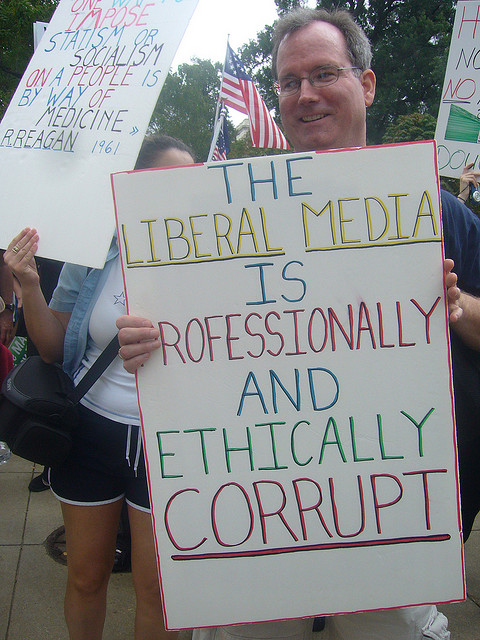
Corrupt Media Cheer For Homosexual Rights

By Cliff Kincaid

Liberal Media SC Corrupt Media Cheer for Homosexual Rights

More explosive evidence of the media bias driving the campaign to change America’s culture and Judeo-Christian foundations has emerged.

Speaking at a “gay journalists” event in New York City last Thursday night, Natalie Morales of the NBC Today Show declared: “Many of us here in this room—the media—we are responsible for opening the world’s eyes to these issues and the stories that have brought about such change. When you think 18 years ago when this organization was founded—think of where the country was back then. And now, 50 percent—according to the Pew poll that we talked about on the news today—support gay marriage, and…some other polls put that number even higher. [This] reflects a change in attitudes in this country.”

This was not just an event where journalists “came out of the closet” for homosexual rights; it was a fundraiser for the cause. Our media paid big money to participate as sponsors and hosts.

My associate Peter LaBarbera and I covered the homosexual rights fundraiser, held in New York City under the auspices of the National Lesbian & Gay Journalists Association (NLGJA), and saw first-hand that it was a “who’s who” of media stars from every major news organization in the U.S. They included Matt Lauer and Savannah Guthrie of NBC, Gayle King of CBS News, Christine Romans of CNN, Amy Robach of ABC News, and Amanda Drury of CNBC.

The really big star of the evening was Natalie Morales of NBC’s Today Show, who told LaBarbera in a brief interview: “I think what’s happening here is this is a new civil rights movement…And I believe that they should be allowed to get married and love equally.”

In her remarks to the gathering, she joked about getting a lesbian kiss. “Now I have to say I’m a little flustered because on my way in here I was actually in the ladies room, and making out with a woman,” she said at the start of her remarks. “She insisted I was Jane Velez-Mitchell [of HLN]…Seriously she was screaming and shouting, ‘Jane, Jane, Jane!’ And I was like ‘I’m not…’ But I just gave in because we all know HLN stands for the ‘Hysterical Ladies Network.’ And …it was a good kiss, I’ll give her that.” She also commented on the “queens” in the audience of the reception being held in the Prince George Ballroom. CNN’s Javier Morgado introduced her.

While the atmosphere was festive and “gay,” the New York papers were catching up with news about a new strain of bacterial meningitis breaking out in the gay community. This was something that nobody wanted to talk about, at least publicly.

Contessa Brewer, formerly an anchor at MSNBC, was a major star, posing for pictures before declaring her support for homosexual rights and homosexual marriage and denouncing opponents of such as the equivalent of racists. She wanted my associate Peter LaBarbera to know, in a brief interview captured on camera, that she felt this way even though she was the daughter of a Baptist preacher.

Here is the transcript:

Peter LaBarbera: …read more
Source: FULL ARTICLE at Western Journalism

As Cyprus' Woes Deepen, Interest in Bitcoin Soars

By David Schepp

Bitcoin and Cyprus Getty Images | Steve Jurvetson, Flickr.com

Filed under:

Getty Images | Steve Jurvetson, Flickr.com
The recent decision by the government of Cyprus to shut down the island’s banks and limit the amount depositors can withdraw from their accounts reveals just how real the country’s financial woes are. Yet even as Cypriots are most keen to get their hands on cold, hard cash, some investors are placing their bets on the virtual currency known as bitcoin.

Bitcoin in some senses is a financial island, operating at a safe distance from the traditional banking system.

Used primarily to buy goods and services online, bitcoin is a recent invention, created just four years ago by an Internet hacker (or group of hackers) known as Satoshi Nakamoto. As Bloomberg BusinessWeek notes, even by Web standards, bitcoin “is a strange and supergeeky phenomenon.”

Bitcoins operate on a network that somewhat resembles a typical exchange on the capital markets. As CNBC reports, buyers can exchange national currencies for bitcoins and use them wherever they are accepted, and sellers can exchange bitcoins for traditional national currencies.

As the financial crisis has deepened in Cyprus, and holders of euros and Russian rubles become increasingly anxious, the value of the bitcoin has surged. As ABC News reports, the exchange rate for 1 bitcoin has soared to nearly $80 from $40 just two weeks ago.

Sponsored Linksadsonar_placementId=1505951;adsonar_pid=1990767;adsonar_ps=-1;adsonar_zw=242;adsonar_zh=252;adsonar_jv=’ads.tw.adsonar.com’;

Bitcoin is “clearly having a breakthrough moment here, and a deeply surprising one given its novelty and nascent infrastructure,” Nicholas Colas, chief market strategist at ConvergEx Group, told the network.

As DailyFinance reported last year, bitcoin in some senses is a financial island, operating at a safe distance from the traditional banking system. It’s neither controlled by central banks nor governments, and thus not vulnerable to larger-scale shifts like changing interest rates, nor the rampant inflation of countries in decline.

It’s that isolation from geopolitical turmoil that has been its true selling point for people in Europe.

How does it work? As Motley Fool reports, instead of relying on a central bank or other regulatory body, bitcoin transactions are verified through peer-to-peer interactions. If a user sends bitcoins to another user’s “wallet” file, that transaction is verified through other users, and is written into a collective transaction log. Transactions are easy, and fees for transfers are minimal.

As with any currency, however, there are risks, including volatile swings in the value of bitcoin, which makes it difficult for businesses to accept them with any degree of confidence.

Currency analysts, however, are at least willing to give bitcoin the benefit of the doubt as a legitimate trading vehicle as situations like Cyprus continue to crop up.

As Christopher Vecchio, currency analyst at DailyFX, told CNBC. “Right now, it seems safe, [though] it wouldn’t be my preferred vehicle to trade money because it’s unregulated.”


<p style="clear: both;padding: 8px 0 0 0;height: 2px;font-size: …read more
Source: FULL ARTICLE at DailyFinance

These 3 Dow Stocks Are Winning Today

By Dan Dzombak, The Motley Fool

US Pending Home Sales Index Chart

Filed under:

The Dow Jones Industrial Average is down after a second day of worse-than-expected reports on the housing market. As of 1:15 p.m. EDT the Dow is down 53 points, or 0.36%, to 14,507. The S&P 500 is down 0.31%.

There was just one U.S. economic release today.

Report

Period

Actual

Previous

Pending home sales

February

(0.4%)

3.8%

Source: MarketWatch U.S. Economic Calendar.

Yesterday it was reported that new-home sales decreased in February to a seasonally adjusted annual rate of 411,000. Today there was more negative news on the housing front when the National Association of Realtors revised its January pending-home-sales index downward and reported a decline of 0.4% in February.

US Pending Home Sales Index data by YCharts.

While home prices rose in January, up 8.1% for the year, some economists are worried about the housing market. Professor Robert Shiller — of Case-Shiller Home Price Index fame — said yesterday in an interview with CNBC, “One thing that makes it very hard to forecast home prices right now is that we’re living in a totally artificial real-estate economy.” Shiller was referring to the continued long-term asset purchases by the Federal Reserve and the Fed’s efforts to keep the Federal Funds rate between 0% and 0.25%. He concluded: “All of these things are weighing on the futures of housing. One thing you learn from history is that bubbles can occur at any time.”

Today’s Dow leader
Today’s Dow leader is UnitedHealth , up 1.7%. The health care sector is up as a whole today. UnitedHealth has risen nearly 5% this month and 3% just this week. The company is in the unique position of both offering insurance and building the federally operated health-insurance exchange. As Obamacare comes into full effect, UnitedHealth should benefit as more Americans gain access to health care. While UnitedHealth is today’s top Dow stock, one Fool analyst thinks health care investors should focus on the company he calls “the investor’s best health care stock in the Dow.”

Second for the Dow today is Intel , up 0.8%. Intel shares are up 6.53% this year and up nearly 4% this week as the chip maker works to become a major force in the mobile-chip market. Intel has joined with Samsung to build a new operating system for mobile called Tizen to challenge Android and iOS’ dominance of the mobile-OS market. At the end of 2012, Android had a 68% market share, while iOS followed up with a 19% market share. Intel and Samsung hope to disrupt Android in Asia, where Android’s Web-application backbone is not the preferred option among telecoms. If the effort is successful, Intel and Samsung will have a significant advantage in some of the world’s largest telecom markets. While investors wait to see what will happen with Tizen, they can collect a 4.2% dividend from Intel — a high enough income for Intel to be included …read more
Source: FULL ARTICLE at DailyFinance

Netflix: Next Stop $225?

By Rick Aristotle Munarriz, The Motley Fool

Filed under:

Netflix‘s amazing run — as its shares have more than tripled since bottoming out this past summer — may not be over yet.

The stock moved 5% higher yesterday after Pacific Crest analyst Andy Hargreaves boosted his price target on the leading video service.

Hargreaves is jacking up his goal to $225 from a now obsolete target of $160.

He’s not merely keeping up with the buoyant share price. Hargreaves is also juicing up his expectations for the service’s growing magnetism.

The bullish analyst now sees Netflix serving as many as 46 million domestic streaming subscribers by 2021, higher than his earlier forecast of 43 million and well above the 27 million domestic streaming accounts that were on Netflix’s rolls when this year began.

There will naturally be heady upside outside of Netflix’s home turf. By 2015, Hargreaves sees 17 million international accounts, and that’s up sharply from today’s 6 million subscribers.

HBO is more of an opportunity than a threat
Hargreaves was on CNBC yesterday to discuss his refreshed optimism.

He was asked about Time Warner‘s HBO in light of recent comments by the premium movie channel indicating that it may make HBO Go a stand-alone option through broadband service providers.

“We think that that would be tremendously positive for Netflix, and at the end of the day that’s certainly underlining our view here, is that we think there’s a paradigm shift,” he responded. “Netflix is essentially the best in the world, we think, at executing that model.”

As a result of Netflix’s value proposition — face it, $7.99 a month for unlimited access to a growing digital library is pretty cheap — Hargreaves doesn’t have a problem seeing roughly half of the broadband-enabled homes in this country on the platform.

HBO itself will probably have a hard time competing at its substantially higher price, but it’s certainly feasible to see consumers moving away from cable and satellite in eight years and cherry-picking their channels and services.

A lot can change in three months
A target price of $225 would’ve seemed outrageous several months ago.

Coinstar‘s Redbox was teaming up with the country’s largest wireless carrier to introduce Redbox Instant. Amazon.com was busy making its own luck by slashing prices on Kindle tablets ahead of the holiday rush, as Amazon Prime subscribers can tap the leading e-tailer’s digital vault that way.

It’s hard to bet against Netflix these days, and it’s not just Hargreaves who’s growing more and more upbeat over time.

Just three months ago, the average consensus estimate from the more than two dozen major analysts modeling Netflix was a profit of $0.43 a share this year and $1.41 a share in 2014. Now those bottom-line forecasts are perched at $1.41 a share in 2013 and $2.99 a share come next year.

Hargreaves is naturally reiterating his earlier outperform rating, feeling that healthy overseas growth and natural margin expansion given the scalable model will breathe new life …read more
Source: FULL ARTICLE at DailyFinance
Why Cyprus Matters…

By Breaking News

Cyprus map SC Why Cyprus Matters...

Cyprus was “fixed” overnight. The decision was made that 40% of deposits over 100,000 Euros would be lost (stolen) at the Bank of Cyprus and 100% lost (stolen) at Laiki bank. The decision was made by the Troika and the bankers. The Cypriot legislature has no say one way or the the other. So much for sovereignty. One can only wonder what Mr. Putin and the Russians will think of this as they have a “few” of these uninsured deposits that are being “lost.” Mind you these “Russian deposits” are not those of the working class. No, these deposits represent the “silent polonium” class. It will be quite interesting to watch what “happens” to the international banking class over the next weeks and months.

So, like the title implies, “nothing here to see, please move along” …which is what you may be seeing soon in Italy, Spain, Portugal and even France. Depositors holding balances above (and even below) the “insured” amounts may have been incentivized to move their monies around. Will they move 1 million Euro balances into 10 different banks? Will some of this “movement” have a little bit of leakage which finds its way into the precious metals held outside of the banking system? Which country is next? Which bank? How will the next bank be handled? Oh, and the “stress tests,” didn’t all of the Cypriot banks pass these with flying colors over the last 6 months? Questions, lots and lots of questions and only one answer… “please move along, nothing to see here.”

THE most important lesson that I hope people learn from Cyprus is just how fast something, anything, can happen. Two weeks ago Cyprus was not even mentioned in the news. 99.9% of CNBC employees could not even pinpoint it on a map (even with names printed on the map). I wanted to mention “speed” because as I’ve written before, in today’s computerized world things can change faster than even a floor trader can react in real time. You, sitting at home or in an office stand zero chance of moving fast enough or competing in any fashion with the “computers.”

Read More at milesfranklin.com . By Bill Holter.

…read more
Source: FULL ARTICLE at Western Journalism

Is Warren Buffett Hurting Bank of America's Stock Price?

By John Maxfield, The Motley Fool

Filed under:

Warren Buffett often compares his search for good investments to hunting for elephants. Following Berkshire Hathaway‘s massive acquisition of Burlington Northern Santa Fe in 2010, he noted that “Our elephant gun has been reloaded, and my trigger finger is itchy.” And after this year’s purchase of H.J. Heinz, he reiterated the sentiment in an interview on CNBC. “I’m ready for another elephant. Please, if you see any walking by, just call me.”

As it turns out, no hunting will be necessary — at least for today. Thanks to Buffett’s adroit maneuvering during the depths of the financial crisis, one just laid down right in front of him.

The proverbial trap was set in Sept. 2008. In exchange for a $5 billion investment in preferred shares of Goldman Sachs , the investment bank gave Berkshire the right to purchase 43.5 million shares of its common stock at an exercise price of $115. We learned today, in turn, that Goldman will satisfy its obligation by delivering to Berkshire a commensurate amount of common stock. At today’s price, according to Forbes magazine, that would make it the 13th largest holder of the Goldman’s common stock.

As Buffett noted in the jointly issued press release, “We intend to hold a significant investment in Goldman Sachs, a firm that I did my first transaction with more than 50 years ago.”

But what about Bank of America?
At this point, you may be wondering what this has to do with Bank of America — and the dismal performance of its stock price today in particular. The answer is both nothing and everything. On the one hand, a transaction between Berkshire and Goldman should theoretically have no bearing whatsoever on Bank of America’s shares. But on the other hand, it serves as a reminder of the potentially dilutive impact of a similar agreement Berkshire inked with Bank of America.

In the middle of 2011, Berkshire took a page out of its own playbook and invested $5 billion in Bank of America’s preferred stock yielding 6%. Buffett noted at the time that “Bank of America is a strong, well-led company, and I called [CEO Brian Moynihan] to tell him I wanted to invest in it.” Buffett went on to say that “I am impressed with the profit-generating abilities of this franchise, and that they are acting aggressively to put their challenges behind them. Bank of America is focused on their customers and on serving them well. That’s what customers want, and that’s the company’s strategy.”

Beyond the preferred stake, and similar to his deal with Goldman, Berkshire also received warrants to buy 700 million shares of Bank of America’s common stock at $7.14 apiece. At today’s price, that equates to a nearly $3.6 billion gain. But while this was all well and good at the time, as news of the deal buoyed the bank’s share price, the problem is that it will soon …read more
Source: FULL ARTICLE at DailyFinance

Residents Struggle As Poverty Hits American Suburbs: CNBC

By The Huffington Post News Editors

CNBC:
Like many Americans who move to the suburbs, Tara Simons came to West Hartford, Conn., because she wanted her daughter to grow up in a nice, safe place with good schools.

Her fall from a more financially secure suburban life to one among the working poor also happened for the same reason it’s happened to so many others. She had a bout of unemployment and couldn’t find a new job that paid very well.

Read More…
More on The Recession

…read more
Source: FULL ARTICLE at Huffington Post

‘Mainstream Media’ Not Mainstream

By Tom Ballantyne Jr.

Media bias1 Mainstream Media Not Mainstream

I never imagined that I’d find myself quoting Bill’s one-time heart throb (okay, eons of time ago), but using her just happens to suit my purpose. (Guess Bill and I aren’t so different after all….)

A persistent (make that constant) theme I have extolled in both writing and speaking is that as Conservatives we should not fall prey to the ingrained habit of referring to the all-but-obsolete establishment media as “the mainstream” or “MSM.” Could anything be further from the truth? Stop and think about it for a minute….

As I like to tell audiences, “You’ll never see [David Gregory or Katie Couric, et al.] at a Denny’s!” It isn’t going to happen!

Back during the Roger Staubach Era, the Dallas Cowboys were affectionately referred to as “America’s Team.” As one might imagine, such a moniker would be considered the gold standard in the world of marketing or PR.

Imagine that you are starting a new grocery store chain, and through a stroke of luck you become known as “America’s Grocer.” Could it get any better than that?

Imagine, on the other hand, that you are one of the “Big Three” television and news networks – NBC, ABC, or CBS. Imagine also that over the past 50 years your viewership has plummeted from a virtual collective dominance of 100% to, say, 25% of the “news”- viewing public.

That would still represent one out of four American adults watching, but put in perspective, three out of four “news”-watchers would have rejected your collective “news” coverage. Not very good!

While that was merely a hypothetical construction on my part, here are some actual numbers for “Evening News Ratings,” obtained at MediaBistro.com:

NBC – 9,640,000 (Total Viewers)
ABC – 8,628,000 ( ” ” )
CBS – 7,482,000 ( ” ” )

Those numbers combined make 25,750,000 out of the current U.S. Population of 315,497,649. The annual population increase is estimated elsewhere (by extension) to be .76%. The U.S. Census Bureau estimated the number of adults 18 or over to be 234,564,000 in 2010, which would be roughly 240,000,000 today, in 2013.

Thus the “Big Three” viewers among the total U.S. adult population (over 18) would be approximately 10.7%…far less than my “guesstimate” of 25%.

One site I came across seemed to indicate that some 74% of adults watch at least some news program weekly. According to this site, “CNN (20%) and FOX News (18%) are the television channels adults most often turn to when they want news or information related to politics or public affairs. These are followed by the networks, including ABC (9%), NBC (8%) and CBS (7%). Other channels include MSNBC (5%), C-SPAN (3%), PBS (3%) and CNBC (1%).”

These figures – for those who watch news or “political/public affairs” programs, as opposed to strictly the “Nightly [Network] News” – show an aggregate of 24%of Adults watching the Big Three.

Getting back to the Nightly Network News (America’s staple before Cable and the Internet)…it would appear that my hypothesis was spot on among viewers …read more
Source: FULL ARTICLE at Western Journalism

Why the Dow Was Down More than 100 Points Earlier Today

By John Maxfield, The Motley Fool

Filed under:

Shares in the major indexes are broadly lower today on the back of a bevy of economic reports and a disappointing earnings release in the technology sector. With roughly an hour left in the trading session, the Dow Jones Industrial Average is lower by 70 points, or 0.48%.

The economic reports released today — which fellow Fool Dan Dzombak discusses at length — paint a generally positive picture of the domestic economy’s direction. Among other things, new claims for unemployment insurance came in lower than expected last week, existing-home sales climbed to a three-year high in February, and home prices for the month of January increased by 6.5% on a year-over-year basis.

Despite the generally upbeat news, however, all but six of the Dow’s 30 components are trading in the red. The explanation for this seems to be twofold. First, the ongoing crisis in Europe continues to roil the markets. Over the weekend, the Mediterranean island nation of Cyprus was bailed out by the EU and IMF. But to unlock the support, Cyprus must come up with 5.8 billion euros in new revenue, something that it has failed to do thus far. It now has only four more days to find a solution.

Suffice it to say, a Cyprus-induced fracture in the EU would cause panic throughout the financial markets. It would wreak particular havoc on the likes of JPMorgan Chase and Citigroup , both of which have significant global trading operations that would expose them to potentially massive losses. For its part, JPMorgan is down by 1.2% today, while Citigroup is 1.4% lower.

And second, technology shares are down following Oracle‘s earnings announcement last night. For the fiscal third quarter ended Feb. 28, the technology giant posted a 2% decline in new software sales and cloud-related subscription revenue. According to CNBC, this dramatically underperformed its previous estimates, which called for growth rates of 3% and 13%, respectively.

The impacts of this are being felt throughout the technology sector, which is down in aggregate by 1.3% in afternoon trading. “When you have a big company like that, it’s going to have a big impact on the sector,” an analyst at Wells Fargo told The Wall Street Journal. It’s largely for this reason, in turn, that the three worst-performing components on the Dow today are all tech stocks: Cisco Systems , IBM, and Hewlett-Packard.

With respect to Cisco, as my colleague Matt Thalman noted earlier, the two companies are close competitors in many of the same areas with similar products and services. Consequently, to echo Matt’s point, while “Oracle’s weak performance could mean that Cisco is gaining market share, but based on today’s stock performance … it’s safe to say investors feel that the market for these devices is weakening.”

Want to learn more about Cisco?
Once a highflying tech darling, Cisco is now on the radar of value-oriented dividend lovers. Get the low down …read more
Source: FULL ARTICLE at DailyFinance

Why You Should Completely Ignore Daily Stock Prices

By David Hanson, The Motley Fool

Filed under:

The American spirit fosters competition. We constantly measure ourselves against our peers and gloat about our accomplishments. Every day, investors point to their stock positions that jumped into the green and feel a sense of accomplishment.

In the investing community, the presence of daily stock prices has resulted in investors either feeling warm and fuzzy because their holding increased during the trading day or sick and nauseous if their daily position ticked into the red. When even great ones like Warren Buffett scoff at the idea of constantly checking daily quotes, why do investors continuously feel the urge to pull up their brokerage account or flip on CNBC? The answer can be chalked up to human nature and a lack of patience.

One of the most heavily traded stocks is Bank of America . Almost every investor has an opinion about the future prospects of the megabank, and the company’s stock price is constantly thrust onto front pages. After hordes of retail investors swore off the bank and vowed to never get burned again, the stock went on to more than double in 2012. An annual return of +100% is not something every investor experiences. By looking beyond the absolute annual return and into the daily movements, an interesting pattern emerges.

If one was to check Bank of America’s share price every single trading day of 2012 and not look at the YTD returns, I doubt many, if any, would predict gains of over 100%. The following graph is the breakdown of B of A’s stock performance each day of 2012:

Source: Google Finance.

The fact that Bank of America shares doubled in a year and still traded lower for almost half of the daily trading sessions highlights the lack of importance of obsessively tracking one’s daily positions. More so, not all of the daily declines were insignificant as Bank of America shares declined more than 1% during almost 28% of the trading days in 2012.

Stocks, particularly bank stocks, will undoubtedly jump up and down as external events impact the broader market, earnings miss forecasts, and fear or greed enters the marketplace. If investors continually focus on the market‘s short-term reactions to macro events or brief doubts about a company, countless opportunities will surely be missed. I am not advocating ignorance in regards to managing a portfolio, but if one is too shortsighted to recognize the lack of importance of daily movements, perhaps that person is better off handing his or her money to someone who can.

Forget that Bank of America’s stock doubled in 2012. Is there more yet to come? With significant challenges still ahead, it’s critical to have a solid understanding of this megabank before adding it to your portfolio. In The Motley Fool’s premium research report on B of A, analysts Anand Chokkavelu, CFA, and Matt Koppenheffer, Financials bureau chief, lift the veil on the bank’s operations, including detailing three reasons to buy and three reasons …read more
Source: FULL ARTICLE at DailyFinance

The Best Money Question You Can Ask: Why?

By Carl Richards, The Motley Fool

Filed under:

When I first started my career, I watched veteran stockbrokers cold-call people about a particular stock, mutual fund, or bond. I always wondered how they could possibly know if the investment they were calling about was appropriate for clients when they had never met them. It was a little bit like doctors writing a prescription before they talk to a patient.

In both instances, they skip the most important question: Why?

As an investor, the first thing you need to do is ask, “Why am I investing?” Simon Sinek’s book Start With Why reminded me that this question gets skipped over all too often.

In the world of investing, people start with the product and related matters:

  • What stock or fund am I going to buy today?
  • What asset allocation should I use?
  • What estate planning strategy should I adopt?

Most of us are trained to think “what” first, because it’s what you hear about all day long. It’s the message you read in some financial publications and see on CNBC. But “what” questions should come after we think about “why” and understand “how.”

People working in the more traditional parts of the financial services industry have used the product-first approach for decades. Only after pushing you to buy a certain investment do many advisors even attempt to fit it into a larger plan.

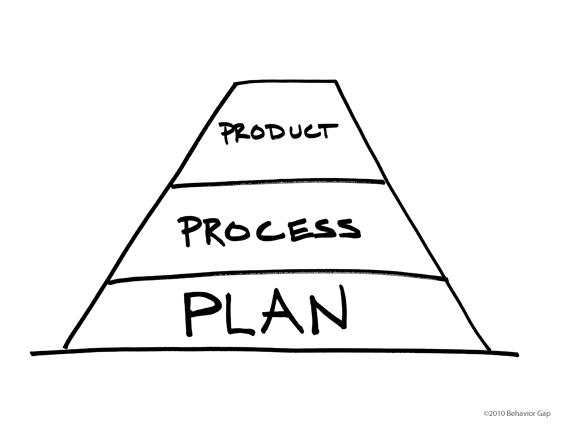
Starting with “why” means achieving clarity about your personal financial goals and creating a plan. To reach that point, you need to consider your values and then set some broad goals.

Laura Nash’s work on the “How much is enough?” question is helpful here. Or you could look at Howard Stevenson’s approach to similar questions. George Kinder suggests three questions to think about, too.

Whatever your approach, just remember to invert the traditional decision triangle. Start with the plan (ask why), then move on to the process (ask how), and only then look for the specific products (ask what).

A version of this post appeared previously at The New York Times.

Carl Richards is a financial planner and the director of investor education for the BAM ALLIANCE, a community of more than 130 independent wealth management firms throughout the United States. Visit Behavior Gap for more of Carl’s sketches and writings.

The Motley Fool has a disclosure policy.

link

The article The Best Money Question You Can Ask: Why? originally appeared on Fool.com.

Copyright © 1995 – 2013 The Motley Fool, LLC. All rights reserved. The Motley Fool has a disclosure policy.

(function(c,a){window.mixpanel=a;var b,d,h,e;b=c.createElement(“script”);
b.type=”text/javascript”;b.async=!0;b.src=(“https:”===c.location.protocol?”https:”:”http:”)+
‘//cdn.mxpnl.com/libs/mixpanel-2.2.min.js’;d=c.getElementsByTagName(“script”)[0];
d.parentNode.insertBefore(b,d);a._i=[];a.init=function(b,c,f){function d(a,b){
var c=b.split(“.”);2==c.length&&(a=a[c[0]],b=c[1]);a[b]=function(){a.push([b].concat(
Array.prototype.slice.call(arguments,0)))}}var g=a;”undefined”!==typeof f?g=a[f]=[]:
f=”mixpanel”;g.people=g.people||[];h=[‘disable’,’track’,’track_pageview’,’track_links’,
‘track_forms’,’register’,’register_once’,’unregister’,’identify’,’alias’,’name_tag’,
‘set_config’,’people.set’,’people.increment’];for(e=0;e<h.length;e++)d(g,h[e]);
a._i.push([b,c,f])};a.__SV=1.2;})(document,window.mixpanel||[]);
mixpanel.init("9659875b92ba8fa639ba476aedbb73b9");

function addEvent(obj, evType, fn, useCapture){
…read more
Source: FULL ARTICLE at DailyFinance

Ryanair CEO's Great Investing Tips for Boeing

By Blake Bos, The Motley Fool

Filed under:

A recent appearance of Ireland-based airliner Ryanair CEO Michael O’Leary on CNBC and Bloomberg left Boeing investors with a few great takeaways. He discussed the company’s recent agreement with Boeing for 175 Boeing 737s, the company’s battery problems, and one thing the investment community is currently ignoring regarding Boeing. Watch the following video as Fool analyst Blake Bos dissects O’Leary’s comments, highlights industry trends, and explains why he’s bullish an Boeing and buying now.

Boeing operates as a major player in a multitrillion-dollar market in which the opportunities and responsibilities are absolutely massive. However, emerging competitors and the company’s execution problems have investors wondering whether Boeing will live up to its shareholder responsibilities. In our premium research report on the company, two of The Motley Fool’s best minds on industrials have collaborated to provide investors with the key, must-know issues surrounding Boeing. They’ll be updating the report as key news hits, so don’t miss out — simply click here now to claim your copy today.

var FoolAnalyticsData = FoolAnalyticsData || []; FoolAnalyticsData.push({ eventType: “TickerReportPitch”, contentByline: “Blake Bos“, contentId: “cms.25373”, contentTickers: “NYSE:BA”, contentTitle: “Ryanair CEO’s Great Investing Tips for Boeing”, hasVideo: “True”, pitchId: “52”, pitchTickers: …read more
Source: FULL ARTICLE at DailyFinance

Gold: Golden for the Wrong Reason

By Matthew Zeitlin, The Motley Fool

Filed under:

One of gold’s most prominent bulls, John Paulson, the asset manager who made more than $1 billion betting on the housing downturn, is tarnished.

Bloomberg reported that Paulson’s $900 million gold fund is down 26% through the beginning of March, after falling 25% last year. The fund has been hurt by the price of gold falling to around $1,600 off its all-time high of more than $1,900, which it hit in Sept. 2011. Paulson told clients that “his Gold Fund would beat his other strategies over five years because the metal was the best hedge against inflation and currency debasement as countries pump money into their economies.”

Paulson echoes comments from Ray Dalio, the man behind the $140 billion hedge fund Bridgewater Associates. Dalio told Barron’s in March 2011, “Currency devaluations are good for stocks, good for commodities, and good for gold.”

The price of gold has fallen off those highs and, so best we can tell, another economic crisis isn’t happening soon, meaning investors are less likely to flock toward the most prominent bearish investment. But gold’s effectiveness as just that — protection against the worst economic and financial distress — is also under attack.

History
One of the most common arguments to invest in gold is inflation. Credit Suisse Senior Advisor Robert Parker told CNBC last month, “To get back into a bull market on gold we need inflation.” Although there are different ways to interpret gold as an “inflation hedge,” the simplest version is that changes in the consumer price index should drive changes in the price of gold: if prices (in dollars) rise 10%, then the price of gold should rise 10% as well, giving gold a constant purchasing power.

The historical record, however, suggests little relationship between the gold price and inflation. In a recent paper titled “The Golden Dilemma,” Claude Erb and Campbell Harvey found that “over 1, 5, 10, 15 and 20 year investment horizons the variation in the nominal and real returns of gold has not been driven by realized inflation.”

Looking at the price of gold and the consumer price index since 1975, when private ownership and trade of gold was reallowed in the U.S., they find that in March 2012 (when they last did the calculations), the price of gold “should” have been $780 an ounce, but the actual price was closer to $1,600. (It was right around $1,600 this morning.)

When it comes to whether gold can hedge unexpected inflation, the authors find “effectively no correlation” between the real price of gold and future inflation; any relationship is driven by 1980, when the real price of gold more than doubled and hit its all-time peak of around $2,440 (2013 dollars) and inflation was up above 12%.

After 1980, gold sharply declines and then starts moving sideways until 2003, while average annual inflation was around 4%. Even for 10-year periods, gold did little to nothing to hedge inflation, expected or …read more
Source: FULL ARTICLE at DailyFinance

Is Bank of America a Value and a Momentum Stock?

By Alex Dumortier, CFA, The Motley Fool

Filed under:

Blame it

on Cyprus

! The S&P 500
was once more denied a new all-time high, as stocks fell on concerns that the eurozone crisis could be coming out of hibernation. The S&P 500 and the narrower, price-weighted Dow Jones Industrial Average
lost 0.6% and 0.4%, respectively.

Unsurprisingly, the VIX surged 18% today, to close at 13.36. That’s a massive move — nearly in the top 1% of daily percentage increases going back to the inception of the index in January 1990 — resulting from the exothermic reaction you get when you mix rekindled concerns about the eurozone crisis with “no pulse” levels of implied volatility. (The VIX is calculated from S&P 500 option prices and reflects investor expectations for stock market volatility over the coming 30 days.)


Appearing on CNBC today, financial-sector analyst Meredith Whitney was very bullish on Dow component Bank of America
, stating:

Bank of America was already one of the most undervalued names going into the stress tests. What’s amazing about this is very rarely do these banks have value and momentum, and this has both of those. The stress test was a huge catalyst for this name. It has been this huge stealth deliverer. They announced cost-cutting measures in 2010. No bank has taken the kind of [cost-cutting] measures it has taken. And it takes two years to implement those. It can easily go to $15. And over the next two years, into the $20s. It’s all cost-cutting, it’s all operating leverage. I don’t have a lot of growth expectations for the big banks in general.

Does Bank of America exhibit value and momentum and, if so, what might it mean for the shares going forward?

The second attribute, momentum, is easy to demonstrate. Whether it be over five days, one month, three months, six months or a year,  B of A is beating the S&P 500. Furthermore, although I’m no technician, I’m told that the shares’ 14-day relative strength of 82.9 indicates strong momentum. Finally, the share price is above its 50-, 100- and 200-day moving average. Momentum? Check.

As far as “value” goes, shares that trade at a near 40% discount to their book value must surely qualify (mind you, the discount to tangible book value — 4% — is much smaller). The forward price-to-earnings multiple of 12.5 is also below that of the broad market. Value? Check.

What does this mean for investors? The combination of “momentum” and “value” factors has historically produced above-normal returns (link opens a PDF), and while that’s a statistical statement, I think there’s reason to believe Bank of America will fit that pattern over the next …read more
Source: FULL ARTICLE at DailyFinance

Here's Why Legg Mason Likes Groupon

By Tim Brugger, The Motley Fool

Filed under:

The ouster of Groupon founder and former CEO Andrew Mason wasn’t a surprise. Nor was its timing, following a disappointing Q4 and fiscal 2012 earnings report. With Groupon’s search for a new CEO in full swing, now’s a good time to sit back and watch it from the sidelines, right? According to the chairman of Legg Mason‘s Capital Management unit, Bill Miller, there’s no sense waiting: Groupon’s an attractive alternative right now.

What’s there to like?
Even as Groupon posts negative quarterly earnings — it’s lost about $723 million the past three years alone — an already impressive horde of cash continues to grow, and now stands at about $1.2 billion. Thankfully, Groupon’s solid cash from operations results are adequate to cover the costs associated with conducting business. And all that cash is especially impressive when you consider Groupon carries absolutely no debt.

Too often, analysts forget Groupon’s strong balance sheet, and focus instead on the growing competitive environment of the daily deals business, the new but low-margin Goods unit, and Mason’s inability to drive shareholder value. These are legitimate concerns, and they’re also why Miller’s comments are so refreshing. Finally, an analyst has awakened to the fact that $1.2 billion in cash can buy Groupon what it needs most: time.

In a recent CNBC interview, Miller summed up Groupon this way:

They have no debt; they have an enormous addressable market. Expectations are low. The stock is cheap.

And Miller isn’t some fresh-faced junior analyst just out of school: His track record of beating the S&P makes him the envy of his peers.

Competition’s tough, but so is Groupon
It’s easy to blame Mason for Groupon’s woes, and his aloofness and seeming lack of concern for Groupon’s share-price troubles gave investors plenty of reasons to gripe. But Mason initiated several strategic steps that make a lot of sense for Groupon going forward, even if some analysts choose to ignore them.

Some Groupon analysts have bemoaned what they call “daily deal fatigue” — the notion that Groupon’s bread-and-butter market is becoming saturated. When Mason conceived of the online coupon concept, Groupon didn’t have to compete with the many major players who now crowd the deals space. Amazon.com decided to invest $175 million in deals provider LivingSocial a couple of years ago, in addition its own AmazonLocal service. Even with recent losses on its LivingSocial investment, Amazon’s online deals aren’t going away.

Google quietly followed with its own Offers service about a year ago. Though a bit slower to the deals game, Google Offers gives customers discounts on an assortment of goodies, just like Groupon and Amazon. But Google has effectively woven Offers it into its world-dominating Android OS, and provides users with a host of free offers, too.

Facebook is another heavy hitter new to the online deals game, introducing its own Deals service a couple of years ago. Facebook’s need to generate revenues from its 1 billion users is well-documented. Like …read more
Source: FULL ARTICLE at DailyFinance