Tag Archives: Main Street

Will Apple's Latest Results Be Its Latest Letdown?

By The Associated Press

Filed under: , , ,

By MICHAEL LIEDTKE

SAN FRANCISCO (AP) – Apple’s (AAPL) latest quarterly results are likely to illustrate why investors are clamoring for the maker of the iPhone and the iPad to come out with another trend-setting device.

The report, due out after the stock market closes Tuesday, is expected to show that Apple Inc. is making less money as more customers buy its lower-priced iPhones and iPads instead of the top-of-the-line models. Other consumers increasingly are bypassing Apple products altogether as smartphones and tablet computers running Google’s Android software win more fans.

Those dynamics have changed the way that Wall Street – and even parts of Main Street – view Apple. Once regarded as an indomitable innovator, Apple now looks vulnerable and perhaps a step behind Google Inc. and the leading Android disciple, Samsung Electronics Co.

If analysts’ projections pan out, Apple’s earnings fell during the three months that ended in June, marking the second consecutive quarter of decline. The slump follows a decade-long streak of earnings growth that ended at the start of the year. Analysts surveyed by FactSet are expecting, on average, earnings of $7.34 per share, down from $9.32 per share a year ago.

Meanwhile, analysts are forecasting little or no revenue growth for the first time since the debut of the iPhone six years ago. Analysts are expecting $35 billion in revenue for the period, its fiscal third quarter. It was $35 billion at the same time last year.

Those would be impressive numbers for most companies, but the bar has been set high for Apple since the introduction of its iPhone triggered an upheaval that has changed the way people engage with technology. Smartphones and tablets are emerging as the preferred way to connect to the Internet and perform many other common computing tasks. In the process, those mobile devices are supplanting laptop and desktop computers.

Ignited by its early lead in smartphones and tablets, Apple’s financial performance launched into a scintillating trajectory that catapulted its stock into Wall Street’s stratosphere, too. The company’s shares rose nearly six-fold from the debut of the first iPhone in 2007 to the release of the latest model last September to establish Apple as the world’s most valuable company.

Since peaking 10 months ago at $705.07, Apple’s stock has plummeted by about 40 percent to about $425 to wipe out roughly $260 billion in shareholder wealth. It is now behind Exxon Mobil Corp. in market capitalization – at $400 billion, compared with $422 billion for the energy company. Not even a recent 15 percent increase in Apple’s quarterly dividend has done much for the stock.

Despite the downturn in the company’s fortunes, Apple’s products still have legions of admirers. Sales of iPhones for the just-ended quarter are expected to total about 26 million, around the same number as the same time last year. But a …read more

Source: FULL ARTICLE at DailyFinance

What Microsoft's Earnings Report Means for Small Businesses

Microsoft unveiled its earnings for Q4 2013 on Friday, and the results left some investors uneasy.  What matters on Wall Street, however, isn’t the same as what matters on Main Street, so small and medium businesses need to analyze the news through a different lens.

Microsoft actually had a decent quarter to cap off a very successful fiscal 2013. Revenue for Q4 was up 10 percent over Q4 2012, and profit was almost $5 billion (USD) compared to a $492 million loss in the same quarter last year. Revenue was also up for the year, and Microsoft profit was nearly 30 percent higher than 2012.

Despite declining PC sales, adoption of Windows 8 is on pace with that of its predecessor. There has been some backlash over the dramatic redesign of Windows 8, and Microsoft’s attempt to convert the OS to a touch-based interface, but most of the major complaints are addressed with the Windows 8.1 update, which will be officially available later this year.

Another silver lining from the Microsoft earnings report is the fact that the Business Division and Server and Tools units both reported solid increases in both revenue and profit over the previous year. Office 365 is a cost-effective way for SMBs to acquire Microsoft Office, along with hosted Exchange and SharePoint, and it has quickly grown into a $1.5 billion source of revenue for Microsoft.

To read this article in full or to leave a comment, please click here

…read more

Source: FULL ARTICLE at PCWorld

SC Johnson Billionaire Child Sex Abuse Case Heads To Trial After Two Year Wait, With Heir Facing 40 Years In Jail

By Clare O’Connor, Forbes Staff

Walk around downtown Racine, Wisconsin and you quickly notice the name Johnson popping up on signposts and street corners. There’s the shiny Johnson Building on Main Street, which houses the Johnson Financial Group, Johnson Bank and sports retailer Johnson Outdoors. Nearby is the Johnson-endowed Racine Museum of Art, a translucent white cube a mile from the drooping clapboard of the city’s outskirts. …read more

Source: FULL ARTICLE at Forbes Latest

Simple Changes Offer Big Solutions In Small Business Lending

By Young Entrepreneur Council, Contributor

Last month, new life was breathed into an effort to bring back some popular small business lending provisions that expired shortly before the 2012 presidential election. These expired programs enabled a record number of small businesses to refinance commercial mortgages. The renewed push to reinstate the programs, along with some additional policy changes, can go a long way toward aiding Main Street’s recovery. President Obama has done a number of positive things to help the small business sector. Business startups are up 8 percent from 2009 to 2011, and U.S. Small Business Administration loan processing reforms helped increase the number of small businesses that received financing in recent years. But more can be done, and Congress has stepped up recently. In March, House and Senate lawmakers introduced legislation to revitalize several successful programs from the Small Business Jobs Act of 2010 which expired just as they were gaining momentum. U.S. Senator Mary L. Landrieu (D-LA) recently introduced legislation (S.289) called the Commercial Real Estate and Economic Development (CREED) Act. In addition to Landrieu, Sen. Jeanne Shaheen (D-NH), Sen. Clair McCaskill (D-MO) and Sen. Johnny Isakson (R-GA) are co-sponsors of the CREED Act.  Rep. Judy Chu (D-CA) and Rep. Tom Petri (R-WI) announced support as well. Rep. Chu introduced a House version of the CREED Act, H.R. 1240. By expanding some SBA programs and loosening restrictions on others, capital flow to entrepreneurs can be increased. Here’s what I believe needs to be done: 1. Bring back successful refinancing programs. In 2010, the SBA created two temporary programs that enabled existing small businesses to refinance conventional loans at low rates. Such loans reduce mortgage interest burdens on business owners, helping to stimulate the economy. The First Mortgage Lien Pool (FMLP) program and the refinance provision for the SBA 504 program were both wildly successful and zero-subsidy, but they expired in September 2012 even though allocation limits were never within reach.  (Borrower and lender fees were slightly increased to offset any projected future losses in the program.) Bringing back these loan programs for another two years would greatly benefit entrepreneurs nationwide by offering access to much needed credit and growth capital.  It’s important to note that since these programs are not funded by the government, they have negligible impact on the federal budget. Furthermore, funds for these kinds of loans were never used before the programs expired, essentially leaving $15 billion “on the table” that could have been used by entrepreneurs. Reauthorizing these programs for a longer term, for example five years or until the authorized funds are spent, could represent an even better option. 2. Enable some small business lenders to expand. Currently, the Certified Development Companies (CDCs) that administer the federal portion of SBA 504 loans are limited to very specific geographies. This has led to a concentration of lending expertise in a few major market areas while leaving other areas underserved. Relaxing the geographic restrictions and enable qualified CDCs to expand into underrepresented areas. By allowing a free-market approach to flourish, more options —

From: http://www.forbes.com/sites/theyec/2013/04/11/simple-changes-offer-big-solutions-in-small-business-lending/

Retaining wall, fence, or some barrier?

By takkie

Hello.

I live on the corner house near a On a busy street, and adjacent to a Revsere T block. ( see below, xxx is my house, and the only house in between the 2 cross street.)

—–| | —–| | ——
—– xxx —–

My main entrance is facing the 2 cross street, and my front yard is splitted in half because my door is in the middle. so the front lawn is about 40ft x 20 and 60ft x 20 ft, splitter by a walk way. Have no fencing in the front yard, so the large piece is just grass.

Every week, I have garages on my lawn , from takeout boxes to plastic bags, to cigarette butts, to newspaper flying around. It’s because the wind blows the garbages on the street on to my lawn, from the Main Street, or down from the 2 cross street adjacent to my house. I spend a great deal of time and money redoing the lawn myself, after I bought this house 1 year ago.

The worse of all, in the fall, all the leaves are blown onto my lawn, behind the small bushes I have, and on the lawn itself. During hurricane sandy, I cleaned up the lawn with 12 bags of leaves, as it was around 3 inches thick all over y lawn.

Now I understand why the lawn is so ugly when the prev owner had it, it’s because if the time and effort required to keep it up so it doesn’t get trashed.

This spring, I called a few company to give me a quote on building a brick wall with post hats about 4 feet high. Quotes I got was 12000 (labor and material) and 1 week of job, 3 man per day.

That is too expensive. So I started looking into cheaper solutions, to keep garbage and leaves out. I saw those stackable stone wall or retaining wall, but it looks like they are all built behind lawn that’s also as high as the wall height. That’s not what I am looking for.

I am simply looking for some sort of nice looking wall that’s about 1.5 to 2 feet high, and I want to do it myself. Without lifting the lawn surface to the same height. My house is 1 story tall, so the front “fence” or “wall” cannot be too high, otherwise, it will look weird.

I cannot install picket fence or semi privacy, because hey have gaps in between, and garbages can still come in.

Can you give me ideas or suggestions how I can do it? Remember, Is not a retaining wall with sol to support behind it, it’s just a straight standing wall.

Thanks.

Source: DoItYourself.com

Primerica Schedules First Quarter 2013 Financial Results Webcast

By Business Wirevia The Motley Fool

Filed under:

Primerica Schedules First Quarter 2013 Financial Results Webcast

DULUTH, Ga.–(BUSINESS WIRE)– Primerica, Inc. (NYS: PRI) , the largest independent financial services marketing company in North America, announced today that it will hold a webcast on Wednesday, May 8, 2013 at 10:00 a.m. Eastern Time to discuss its results for the first quarter ended March 31, 2013, as well as other business-related matters.

The earnings news release announcing the first quarter 2013 financial results will be distributed on Tuesday, May 7, 2013, after the close of the market.

The earnings news release, financial supplement and a live webcast will be available on Primerica’s website at http://investors.primerica.com. A replay of the call will be available for approximately 30 days at http://investors.primerica.com.

Primerica, Inc., headquartered in Duluth, GA, is a leading distributor of financial products to middle income households in North America. Primerica representatives educate their Main Street clients about how to better prepare for a more secure financial future by assessing their needs and providing appropriate solutions through term life insurance, which we underwrite, and mutual funds, annuities and other financial products, which we distribute primarily on behalf of third parties. In addition, Primerica provides an entrepreneurial full or part-time business opportunity for individuals seeking to earn income by distributing the company’s financial products. We insured more than 4.3 million lives and approximately 1.9 million clients maintained investment accounts with us at December 31, 2012. Primerica stock is included in the S&P MidCap 400 and the Russell 2000 stock indices and is traded on The New York Stock Exchange under the symbol “PRI”.

Primerica, Inc.
Investor Relations Contact
Kathryn Kieser, 770-564-7757
investorrelations@primerica.com
or
Media Contact
Mark L. Supic, 770-564-6329
mark.supic@primerica.com

KEYWORDS:   United States  North America  Canada  Georgia

INDUSTRY KEYWORDS:

The article Primerica Schedules First Quarter 2013 Financial Results Webcast originally appeared on Fool.com.

Try any of our Foolish newsletter services free for 30 days. We Fools may not all hold the same opinions, but we all believe that considering a diverse range of insights makes us better investors. The Motley Fool has a disclosure policy.

Copyright © 1995 – 2013 The Motley Fool, LLC. All rights reserved. The Motley Fool has a disclosure policy.

(function(c,a){window.mixpanel=a;var b,d,h,e;b=c.createElement(“script”);
b.type=”text/javascript”;b.async=!0;b.src=(“https:”===c.location.protocol?”https:”:”http:”)+
…read more

Source: FULL ARTICLE at DailyFinance

A Community Bank Is Not A Little Big Bank

By Jim Blasingame, Contributor Wall Street’s too-big-to-fail banks were the parents of the 2008 financial crisis. But one-size-fits-all reform reaction to the crisis by Congress and regulators is turning Main Street banks into collateral damage, as if they were too-small-to-matter. Here’s why anything that unnecessarily burdens community banks should concern every small business owner. …read more

Source: FULL ARTICLE at Forbes Latest

Why the SEC's New Disclosure Rule Hurts Investors

By Jon Friedman, The Motley Fool

Filed under:

The Securities and Exchange Commission‘s new rule allowing companies to distribute information on social media will wind up doing more harm than good for Main Street investors. Now, investors potentially haven’t got the same access to pertinent company information as their Facebook-savvy neighbors. Plus, this makes it easier for public companies to escape the typical glare of the media. A win-win? Hardly.

Yes, it’s commendable that the SEC, by acknowledging the ascent and prominence of Facebook, Twitter, and the rest of the new-media genre, is showing its willingness to join the 21st century. Of course, a skeptic might ask, with much justification: Well, what kept you? 

It’s reasonable to assume that the Commission is being dragged, kicking and screaming, into the digital age. As The New York Times put it in its coverage of the story: “With the decision, the SEC is playing catch-up to the new era of social media.”

On April 2, the SEC detailed new disclosure regulations that explain how companies can employ Facebook, Twitter, and additional social networks to distribute information.

The decision came about largely because Netflix CEO Reed Hastings had such remarkable success when he took the pioneering move of communicating Netflix news on Facebook. Hastings was rather shrewd. As it turned out, he got beat up pretty badly in the mainstream business media. He was accused of everything from insensitivity to outright arrogance when he instituted a price increase in the summer of 2011.

In retrospect, the price hike was a modest one and probably shouldn’t have caused such a furor among journalists. But Hastings exhibited, above all else, a terrible sense of timing. The United States was in the grip of an oppressive economic downturn. It seemed piggy of a company to raise its prices at that sensitive point in history. 

No matter; Hastings figured he’d roll the dice and turn to social media as a distribution system. Since then, Netflix has gone on to become one of the hottest stocks around, crushing the results of the benchmark S&P 500 during comparable time frames.

The biggest problem I have with the idea is that it makes it possible for public corporations, which seldom willingly ‘fess up about their mistakes unless they’re cornered, to sidestep public scrutiny. Usually, it is the prying eyes of the business media that do the dogged research necessary to unearth a company’s sins. Now, the companies can communicate directly to you without any filter. The SEC‘s decision threatens to minimize the role of journalists acting as watchdogs of publicly held companies.

Unfortunately, most individual investors aren’t savvy enough from the jump to understand that a savvy social-media director can pull the wool over their eyes by issuing an announcement on Twitter, which has a 140-character limit for a message.

When a CEO takes his or her message to Facebook or Twitter, the individual investor community could wind up suffering. Someone who reads a CEO‘s message on a social-media outlet is likely to accept it …read more

Source: FULL ARTICLE at DailyFinance

TD Ameritrade's Investor Movement Index: March Numbers Rise as Low Market Volatility Continues

By Business Wirevia The Motley Fool

Filed under:

TD Ameritrade’s Investor Movement Index: March Numbers Rise as Low Market Volatility Continues

Investors remain bullish as IMX trends upward for seven of the past nine months

OMAHA, Neb.–(BUSINESS WIRE)– TD Ameritrade, Inc. (“TD Ameritrade”), a broker-dealer subsidiary of TD Ameritrade Holding Corporation (NYS: AMTD) , is today revealing the Investor Movement IndexSM score for March 2013. The Investor Movement Index, or the IMXSM, is a proprietary, behavior-based index created by TD Ameritrade that aggregates Main Street investor positions and activity to measure what investors are actually doing and how they are positioned in the markets.

The March 2013 Investor Movement Index for the five weeks ending March 28, 2013, reveals:

  • Score: 5.37 (compared to 5.14 in February)
  • Trend direction: Positive
  • Trend length: 2 months
  • Score relative to historic ranges: High

Following a spike in February, the IMX numbers for March are currently the highest the Company has on record since June 2011, adding to an ongoing bullish trend among the Company’s retail investor base spanning seven of the past nine months. TD Ameritrade’s retail clients continued to rotate their positions throughout the month, selling securities at highs and buying into lows. March also saw an increased number of clients seeking out stocks with higher dividend yields and holding positions with higher relative volatility compared to that of the general market.

“March’s IMX score indicates that our retail clients remain diligent in increasing their exposure carefully,” said Steve Quirk, senior vice president of TD Ameritrade’s Trader Group. “In this period of low volatility and a rising market, clients are leaning toward selection of yields and individual equities.”

The IMX value is calculated based on a complex proprietary formula. Each month, TD Ameritrade pulls a sample from its client base of 6 million funded accounts that includes all accounts that completed a trade in the past two months. The holdings and positions of this statistically significant sample are evaluated to calculate individual scores, and the median of those scores represents the monthly IMX.

For more information on the Investor Movement Index, including historical IMX data going back to December 2010, to view the full …read more

Source: FULL ARTICLE at DailyFinance

Governments Still Heavy-Handed 80 Years After FDR's Gold Confiscation

By Adrian Ash, Contributor

Of two men walking down Main Street, one with a gold coin in his pocket and the other carrying a bottle of booze, the first was now breaking the law and the second was an upstanding citizen. Or so went the joke in 1933, no funnier than it is today, with the Cyprus deposit-seizure fiasco neatly marking 80 years since President Franklin D.Roosevelt signed his infamous Executive Order 6102 on April 5, 1933. …read more

Source: FULL ARTICLE at Forbes Latest

CBIZ Small Business Employment Index Surges in March

By Business Wirevia The Motley Fool

Filed under:

CBIZ Small Business Employment Index Surges in March

-Unexpected strong growth displays signs of recovery on Main Street, USA-

CLEVELAND–(BUSINESS WIRE)– The CBIZ Small Business Employment Index (SBEI), a barometer for hiring trends for more than 3,500 companies with 300 or fewer employees, increased by 1.25 percent during March, following a slight increase of .20 percent in February.

In contrast, ADP’s March jobs survey illustrated that the private sector added just 158,000 jobs, which was the smallest since October 2012 and considerably less than analysts’ estimates of 200,000 jobs. Additionally, this month’s numbers were far below February’s revised tally of 237,000 added jobs.

“This month’s SBEI shows a 1.25 percent growth rate, which is extremely strong in terms of recent trends,” says Philip Noftsinger, business unit president for CBIZ Payroll Services.

To view and/or use a graphic illustration that tracks and illustrates the employment index, visit our blog here

Additional take-away points from the March data set include:

  • At-a-glance: Of the companies surveyed, 27 percent increased staffing while 19 percent decreased employee headcounts and 54 percent maintained their number of employees.
  • Small business sector: Small business owners are likely becoming more optimistic as the economic picture continues to improve. Consumer confidence will also continue to play a significant role as the summer nears and increases seasonal employment figures.
  • What to watch: With several months of positive data, and macroeconomic news showing signs of recovery, it’s possible that the small business owner is starting to see that translate into demand on Main Street.

“For the time being, we can expect hiring trends to accelerate as the economic engine begins to outweigh drag forces such as government spending reductions and concerns over Europe‘s debt,” says Noftsinger.

CBIZ Payroll Services manages payroll services for more than 3,500 businesses. Its index reflects a broad array of industries and geographies corresponding to the markets across the United States where CBIZ provides human capital services. The data represented by the SBEI is derived from …read more

Source: FULL ARTICLE at DailyFinance

How Profitable Is Main Street Capital?

By Robert Eberhard, The Motley Fool

Filed under:

Earlier this week, I took a look at where Main Street Capital gets its money, but revenue is only part of the story. What’s more important is how much of this revenue eventually makes its way to investors in the form of earnings.

Main Street is unique because it receives special tax treatment as a business development company, and because of this, it’s not as simple as subtracting expenses from the net revenues earned as it is for other companies. Nevertheless, when compared to others in its business, it seems to be a strong performer and should be able to perform well for quite some time.

What unique tax treatment?
Similar to real estate investment trusts (REITs), a business development company (BDC) can avoid paying corporate income taxes on its shareholder distributions as long as it distributes 90% of its “investment company taxable income” each year. Because of this, like REITs, BDCs also tend to have high dividend yields and tend to be favored by investors seeking regular income. Currently, Main Street‘s dividend yield is near 6%, making it an attractive investment option.

Because of its unique tax treatment, the “bottom line” at Main Street is different from most companies. Whereas most companies will report a net income after subtracting out expenses from revenues, Main Street is required to account for the gain in its investments as well, and reports the net increase in net assets each quarter. Earnings per share are then determined by dividing the number of outstanding shares by this number, which is why Main Street‘s payout ratio may not always equal 90%:


2012

2011

2010

Net increase in net assets per share

$3.53

$2.76

$2.38

Dividends paid per share

$1.71

$1.56

$1.50

Payout ratio

48.4%

56.5%

63%

Source: Company 10-K. 

Expenses still matter
Though Main Street has a unique way of determining its net income, we can still take a look at its expenses to see its costs for doing business. A large portion of the capital that Main Street uses when investing in companies comes from the Small Business Administration (SBA) in the form of loans, which totaled $225 million at the end of 2012. The interest paid on these and other loans was the largest expense paid by Main Street during 2012, totaling $15.6 million during the year.

Other expenses at Main Street also totaled around $15.6 million for the year. Unlike a bank like PNC Financial, which needs 56,000 employees to run its business, Main Street has only 30 employees, keeping personnel costs to a minimum. Its business model doesn’t require a lot of employees, but as it continues to expand, it could potentially add more down the road.

What about some other BDCs?
Traditionally, what Main Street and other BDCs do is typically the realm of private equity firms, so there aren’t a whole lot of …read more

Source: FULL ARTICLE at DailyFinance

2 Highflying Dow Stocks to Buy Today

By Anders Bylund, The Motley Fool

Filed under:

Past performance is never a guarantee of future success. But some stocks rise for good reason. Here are two Dow Jones stocks that are chasing all-time highs as we speak — without getting expensive in the process. These are momentum stocks of exceptionally high quality, and they may never be this cheap again.

If you need another indication that the market is firing on all cylinders, consider this: 15 of the 30 Dow components trade within 10% of their all-time highs right now.

Health insurance giant UnitedHealth set its all-time record in December of 2005. Then the company was hit with an options-backdating scandal that ultimately displaced its CEO, an industrywide bout of investor skepticism, and, of course, the pitch-black recession shared by the rest of the known universe.

Now UnitedHealth is back in record-level neighborhood and looking stronger than before. You can — and probably should — buy this stock right now.

UNH data by YCharts.

Since its fall from the original summit, UnitedHealth has reshaped its business plan, increased dividend payments nearly eightfold, and finally joined the elite Dow index. It’s a longtime and extremely successful recommendation of two Foolish newsletters and has a perfect five-star CAPS rating to boot. The reasons to buy this stock pile up to the rafters of Wall Street and Main Street alike.

Walt Disney is a more obvious success story. This stock hit its lifelong peak as recently as last month and has crushed the Dow by more than tripling in price over the last decade. Is the Mouse bound to run out of steam, or can you still buy the stock at current prices?

DIS data by YCharts.

I think it’s pretty obvious that the best is yet to come. Disney thrives on game-changing acquisitions like its Pixar and Marvel buyouts. Pixar still churns out surefire hits like clockwork, the benefits of the Marvel buy are still unfolding, and now Han Solo has joined the party in the recent Lucasfilm buyout. It’s like pouring nitroglycerin on the fire.

Mickey Mouse is shrinking in the Disney universe as he becomes surrounded by equally powerful consumer-attention magnets. The character stable is becoming as diversified as the business operations, which include movies, TV content, cruise ships, theme parks, lunch boxes, and more. It’ll take a meltdown of epic proportions to stop this gravy train.

So if you’re looking for stocks to buy right now, you really can’t go wrong with these two winners. They’re rising for a reason and won’t be going back down.

It’s easy to forget that Walt Disney is more than just the House of Mouse. Much of Disney’s allure for investors lies in its diversity, and The Motley Fool’s premium research report lays out the case for investing in Disney today. This report includes the key items investors must watch, as well as the opportunities and threats the company faces going …read more

Source: FULL ARTICLE at DailyFinance

How Does Main Street Capital Make Its Money?

By Robert Eberhard, The Motley Fool

Filed under:

I have been writing about investing for a while, and even I find it difficult to read a company’s entire 10-K or annual report. The information contained can often be overwhelming, and the ability to prioritize and parse this data is a learned skill. If you are so inclined, one great place to start is by examining how a company makes its money.

When it comes to business development company Main Street Capital , the short answer is that it makes its money from investing in small and midsize companies. However, if we dive a little deeper and examine the company a little further, we can truly see where its money comes from.

In its own words
According to its recent 10-K, Main Street Capital is a “principal investment firm primarily focused on providing customized debt and equity financing to lower middle market (LMM) companies and debt capital to middle market companies.” Per the company, its lower middle market companies generally have annual revenues between $10 million and $150 million, while its middle market companies have annual revenues between $150 million and $1.5 billion.

At the end of 2012, Main Street had investments with a fair value of $924.4 million in a total of 147 companies. Though the company is invested in more middle market companies, it’s the lower middle market companies that make up the bulk of the value, as well as account for most of the current gains:

Portfolio

Companies

Fair Value

Total Cost Basis

Lower middle market

59

$510.3 million

$408.0 million

Middle market

85

$390.0 million

$385.5 million

Other investments

3

$24.1 million

$23.6 million

Total

147

$924.4 million

$817.1 million

Source: Company 10-K. 

Converting investment to revenue
With a business focused on providing debt and equity infusions to businesses, it is fairly easy to determine where Main Street makes its money. It receives interest payments from its investees on a regular basis per the terms of the specific contract, with most loans generally having terms of three to seven years, with monthly or quarterly payments and interest rates between 12% and 14%. It also receives dividend payments from any equity investments, as well as the occasional fee that it receives for providing business consulting services.

Beyond the cash payments that Main Street receives as both dividends and interest payments, it also has unrealized gains from many of its equity investments. Ultimately, the goal is to recoup the investment, and Main Street works with its portfolio companies in planning exit opportunities, be it a sale to another company or a simple redemption of the outstanding shares or warrants. 

What kinds of companies are represented?
Main Street seeks to diversify its holdings over many industries and throughout the United States. According to the company, they currently have investments in over 36 different industries, ranging from energy equipment and services to thrifts and mortgage finance. A quick …read more
Source: FULL ARTICLE at DailyFinance

TD Ameritrade to Host Earnings Conference Call

By Business Wirevia The Motley Fool

Filed under:

TD Ameritrade to Host Earnings Conference Call

OMAHA, Neb.–(BUSINESS WIRE)– TD Ameritrade Holding Corporation (NYS: AMTD) will hold its quarterly conference call to discuss fiscal second quarter results and related matters, on Tuesday, Apr. 16, 2013 at 8:30 a.m. EDT (7:30 a.m. CDT).

Participants may listen to the conference call by dialing 877-881-2595. The Company will also webcast the call through its corporate web site, www.amtd.com. Participants will be able to access the webcast on the day of the call from a link on the web site’s home page, or from the Events and Presentations section of the site. A transcript of the webcast will also be available online beginning Wednesday, Apr. 17, 2013.

As the Company will discuss a number of financial metrics, participants are encouraged to download the slides associated with the presentation, which the Company will post to the Events and Presentations section of www.amtd.com at approximately 7:30 a.m. EDT, before the start of the call.

A phone replay of the call will be available by dialing 855-859-2056 and entering the Conference ID 22315975 beginning at 11:30 a.m. EDT (10:30 a.m. CDT) on Apr. 17, 2013. This replay will be available until 11:59 p.m. EDT (10:59 p.m. CDT) on Apr. 23, 2013. Interested parties may also view an archived version of the webcast, which will be available on www.amtd.com immediately following the call.

The Company asks that interested parties visit or subscribe to newsfeeds at www.amtd.com for the most up-to-date corporate financial information, presentation announcements, transcripts and archives. You can also follow the Company on Twitter, @TDAmeritradePR. Web site links, corporate titles and telephone numbers provided in this release, although correct when published, may change in the future.

AMTD-G

About TD Ameritrade Holding Corporation

Millions of investors and independent registered investment advisors (RIAs) have turned to TD Ameritrade’s (NYS: AMTD) technology, people and education to help make investing and trading easier to understand and do. Online or over the phone. In a branch or with an independent RIA. First-timer or sophisticated trader. Our clients want to take control, and we help them decide how – bringing Wall Street to Main Street for more than 36 years. An official sponsor of the 2014 and 2016 U.S. Olympic and Paralympic Teams, TD …read more
Source: FULL ARTICLE at DailyFinance

Reagan Budget Guru Declares: We’ve Been Lied To, Robbed, And Misled…

Then, when the Fed’s fire hoses started spraying an elephant soup of liquidity injections in every direction and its balance sheet grew by $1.3 trillion in just thirteen weeks compared to $850 billion during its first ninety-four years, I became convinced that the Fed was flying by the seat of its pants, making it up as it went along. It was evident that its aim was to stop the hissy fit on Wall Street and that the thread of a Great Depression 2.0 was just a cover story for a panicked spree of money printing that exceeded any other episode in recorded human history.

David StockmanThe Great Deformation

David Stockman, former director of the OMB under President Reagan, former US Representative, and veteran financier is an insider’s insider. Few people understand the ways in which both Washington DC and Wall Street work and intersect better than he does.

In his upcoming book, The Great Deformation: The Corruption of Capitalism in America, Stockman lays out how we have devolved from a free market economy into a managed one that operates for the benefit of a privileged few. And when trouble arises, these few are bailed out at the expense of the public good.

By manipulating the price of money through sustained and historically low interest rates, Greenspan and Bernanke created an era of asset mis-pricing that inevitably would need to correct.  And when market forces attempted to do so in 2008, Paulson et al hoodwinked the world into believing the repercussions would be so calamitous for all that the institutions responsible for the bad actions that instigated the problem needed to be rescued — in full — at all costs. 

Of course, history shows that our markets and economy would have been better off had the system been allowed to correct. Most of the “too big to fail” institutions would have survived or been broken into smaller, more resilient, entities. For those that would have failed, smaller, more responsible banks would have stepped up to replace them – as happens as part of the natural course of a free market system:

Essentially there was a cleansing run on the wholesale funding market in the canyons of Wall Street going on. It would have worked its will, just like JP Morgan allowed it to happen in 1907 when we did not have the Fed getting in the way. Because they stopped it in its tracks after the AIG bailout and then all the alphabet soup of different lines that the Fed threw out, and then the enactment of TARP, the last two investment banks standing were rescued, Goldman and Morgan [Stanley], and they should not have been. As a result of being rescued and having the cleansing liquidation of rotten balance sheets stopped, within a few weeks and certainly months they were back to the same old games, such that Goldman Sachs got $10 billion dollars for the fiscal year that started three months later after that check went out, which was October 2008. For the fiscal 2009 year, Goldman Sachs generated what I call a $29 billion surplus – $13 billion of net income after tax, and on top of that $16 billion of salaries and bonuses, 95% of it which was bonuses.

Therefore, the idea that they were on death’s door does not stack up. Even if they had been, it would not make any difference to the health of the financial system. These firms are supposed to come and go, and if people make really bad bets, if they have a trillion dollar balance sheet with six, seven, eight hundred billion dollars worth of hot-money short-term funding, then they ought to take their just reward, because it would create lessons, it would create discipline. So all the new firms that would have been formed out of the remnants of Goldman Sachs where everybody lost their stock values – which for most of these partners is tens of millions, hundreds of millions – when they formed a new firm, I doubt whether they would have gone back to the old game. What happened was the Fed stopped everything in its tracks, kept Goldman Sachs intact, the reckless Goldman Sachs and the reckless Morgan Stanley, everyone quickly recovered their stock value and the game continues. This is one of the evils that comes from this kind of deep intervention in the capital and money markets.

Stockman’s anger at the unnecessary and unfair capital transfer from taxpayer to TBTF bank is matched only by his concern that, even with those bailouts, the banking system is still unacceptably vulnerable to a repeat of the same crime:

The banks quickly worked out their solvency issues because the Fed basically took it out of the hides of Main Street savers and depositors throughout America. When the Fed panicked, it basically destroyed the free-market interest rate – you cannot have capitalism, you cannot have healthy financial markets without an interest rate, which is the price of money, the price of capital that can freely measure and reflect risk and true economic prospects.

Well, once you basically unplug the pricing mechanism of a capital market and make it entirely an administered rate by the Fed, you are going to cause all kinds of deformationsas I call them, or mal-investments as some of the Austrians used to call them, that basically pollutes and corrupts the system. Look at the deposit rate right now, it is 50 basis points, maybe 40, for six months. As a result of that, probably $400-500 billion a year is being transferred as a fiscal maneuver by the Fed from savers to the banks. They are collecting the spread, they’ve then booked the profits, they’ve rebuilt their book net worth, and they paid back the TARP basically out of what was thieved from the savers of America.

Now they go down and pound the table and whine and pout like JP Morgan and the rest of them,you have to let us do stock buy backs, you have to let us pay out dividends so we can ramp our stock and collect our stock option winnings. It is outrageous that the authorities, after the so-called “near death experience” of 2008 and this massive fiscal safety net and monetary safety net was put out there, is allowing them to pay dividends and to go into the market and buy back their stockThey should be under house arrest in a sense that every dime they are making from this artificial yield group being delivered by the Fed out of the hides of savers should be put on their balance sheet to build up retained earnings, to build up a cushion. I do not care whether it is fifteen or twenty or twenty-five percent common equity and retained earnings-to-assets or not, that is what we should be doing if we are going to protect the system from another raid by these people the next time we get a meltdown, which can happen at any time.

You can see why I talk about corruption, why crony capitalism is so bad. I mean, the Basel capital standards, they are a joke. We are just allowing the banks to go back into the same old game they were playing before. Everybody said the banks in late 2007 were the greatest thing since sliced bread. The market cap of the ten largest banks in America, including from Bear Stearns all the way to Citibank and JP Morgan and Goldman and so forth, was $1.25 trillion. That was up thirty times from where the predecessors of those institutions had been. Only in 1987, when Greenspan took over and began the era of bubble finance – slowly at first then rapidly, eventually, to have the market cap grow thirty times – and then on the eve of the great meltdown see the $1.25 trillion to market cap disappear, vanish, vaporize in panic in September 2008. Only a few months later, $1 trillion of that market cap disappeared in to the abyss and panic, and Bear Stearns is going down, and all the rest.

This tells you the system is dramatically unstable. In a healthy financial system and a free capital market, if I can put it that way, you are not going to have stuff going from nowhere to @1.2 trillion and then back to a trillion practically at the drop of a hat. That is instability; that is a case of a medicated market that is essentially very dangerous and is one of the many adverse consequences and deformations that result from the central-bank dominated, corrupt monetary system that has slowly built up ever since Nixon closed the gold window, but really as I say in my book, going back to 1933 in April when Roosevelt took all the private gold. So we are in a big dead-end trap, and they are digging deeper every time you get a new maneuver.

Reagan Budget Guru Declares: We've Been Lied To, Robbed, And Misled...

(Second column, 3rd story, link)


…read more
Source: Drudge Report

Tech firms bumping up perks to recruit, retain

Apple’s ring-shaped, gleaming “Spaceship Headquarters” will include a world class auditorium and an orchard for engineers to wander. Google’s new Bay View campus will feature walkways angled to force accidental encounters. Facebook, while putting the final touches on a Disney-inspired campus including a Main Street with a B-B-Q shack, sushi house and bike shop, is already planning an even larger, more exciting new campus. …read more
Source: FULL ARTICLE at Phys.org

Bailout, Cyprus-Style: Could It Happen Here?

By Amanda Alix, The Motley Fool

Filed under:

The deal to rescue the banking system of the tiny island of Cyprus has the world drawing a guarded deep breath. Certainly, the bailout is good news. Just as certain, however, is the distasteful quid pro quo: Many depositors will have their bank accounts raided to pay for it, in a pact agreed to by others.

This is only one uncomfortable facet of the bailout terms, but it is a corker. It didn’t take long for media reports to emerge strongly suggesting that this is the new European method for dealing with these ticking time bombs. Despite an official denial of this rumor, markets slogged to a desultory close, unsure of what will happen next.

Can it happen here?
The news that smaller savers — that is, those with bank accounts with less than $100,000 therein — won’t have to pony up for the rescue is good, of course. But those with larger accounts could lose up to 40% of that overage amount — not good news at all. And, since the largest bank, Bank of Cyprus, will be absorbing the assets of the next largest, Laiki Bank, depositors there will likely be completely out of luck.

This, of course, would be akin to JPMorgan Chase swallowing Bank of America whole, then taking some of its own clients’ money, and probably more from customers of B of A, to hand over to the government. Considering how upset Main Street was with our own bank bailout, I suspect this action would be met with an unusually vocal protest.

Then, of course, there are the very wealthy depositors. Considering that Bank of America, JPMorgan, Citigroup , and Wells Fargo all have private banks for well-to-do clients, you can just imagine the howling that would take place when those funds were seized. Assuming, of course, that the well-heeled — possibly learning a lesson from the current debacle — hadn’t withdrawn all of their money ahead of time.

But, you think, this would never happen here. After all, Cyprus is only taking the haircut from accounts harboring more than six figures, and the first $100,000 is insured by the Central Bank of Cyprus — just as our own deposits, up to $250,000, are insured by the Federal Deposit Insurance Corporation.

All true, but the ugly fact is that just last week, all account holders were going to take a hit. For small depositors, it was to be 6.75%; for amounts over $100,000, 10% was to be sacrificed. So, insurance would have meant nothing, just last week.

Could it happen here? If we were ever forced to ask the world for a bailout, it probably could. As the too-big-to-fail debate heats up again, that is something to keep in mind.

Wells Fargo‘s dedication to solid, conservative banking helped it vastly outperform its peers during the financial meltdown. Today, Wells is the same great bank as ever, but with its stock trading at a premium to the rest …read more
Source: FULL ARTICLE at DailyFinance

Ending ‘Too Big To Fail’

By Richard W. Fisher

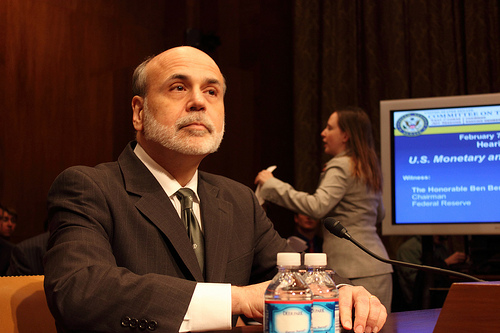
Ben Bernanke 3 SC Ending Too Big to Fail

Editor’s note: Below is the text of a speech given by Mr. Fisher at the Conservative Political Action Conference (CPAC) on March 16th, 2013:

Thank you, Chad [Barth].

I gather you all held a big dinner last night in honor of Ronald Reagan. My father-in-law, the late Congressman Jim Collins, was a good friend of the president. During the Convention of 1984, which was held in Dallas, Congressman Collins invited me to join a handful of family and friends to visit with Mr. Reagan. The president was in remarkable form and, great raconteur that he was, told this story:

Paddy McCoy, a hardworking Irish farmer, received a visit from an inspector of the Department for Works and Pensions.

“Tell me about your staff,” he asked of Paddy.

“Well,” said Paddy, “there are the farmhands. I pay them 240 a week and they have use of a free cottage.”

“That’s good,” said the inspector.

“Then there’s the housekeeper. She gets 190 a week, along with free board and lodging.”

“That sounds fine,” said the inspector.

Paddy went on to tell of the rest of his staff, all to the pleasant reception of the inspector. And then he said, “Now, there’s also the half-wit. He bears all the risk of this business, works a 16-hour day, nets about 25 a week when all is said and done, but takes down a bottle of whiskey and, as a special treat, occasionally gets to sleep with my wife.”

“That’s disgraceful, Paddy,” said the inspector. “I need to interview the half-wit.”

“Well,” said Paddy, “you’re lookin’ at him.”

Paddy McCoy was no half-wit: He simply represented the plight of the hardworking souls who want to be left alone to labor day and night to put food on the table for their employees and family. They ask for no advantage, just a level playing field and fair treatment. I am here today to speak of the plight of hardworking Main Street bankers who simply want to be given a level playing field and fair treatment in competing with megabanks.

Chad, the last time I spoke to an audience here in the nation’s capital, I was introduced by a descendant of the iconic patriot Patrick Henry.

In one of Patrick Henry’s greatest speeches, he noted that, “Different men often see the same subject in different lights.” And then he went on to appeal to all perspectives to do right: “This is no time for ceremony,” he said, for it “… is one of awful moment to this country.”

The great patriot was, of course, addressing the injustice of operating under the thumb of the British Crown. This morning, I am going to address what I consider the injustice of operating our economy under the thumb of financial institutions that are so large they are considered “too big to fail” (TBTF).

I will argue that these institutions operate under a privileged status that exacts an unfair tax upon the American people.

I will argue that they represent not only a threat to financial stability but to fair and open competition, that they are the practitioners …read more
Source: FULL ARTICLE at Western Journalism

This Could Be the Year Bank of America Pays Income Tax

By Amanda Alix, The Motley Fool

Filed under:

It’s the time of year when spring is in the air, and the first quarter is about to close, giving us an idea of how the new year will be treating our favorite companies. As an added treat — with April 15 just around the corner — we also begin to hear whispers regarding what these entities paid in taxes in previous years.

For investors, this information is often less irksome than for Main Street at large, since a smaller tax bill should result in more capital to share with stockholders. This is not necessarily the case, of course, particularly with the banking sector — which has just begun to blossom again in the wake of the Great Recession.

Taking a look at income taxes paid by big banks clearly points up the fact that those that pay the most in federal taxes also have the most income. This can be seen clearly by taking a look at Bank of America .

Tax refunds?
Since the financial crisis of 2008, the tax burden has been non-existent for B of A and Citigroup , neither of which has paid federal income tax since that year. Banks and other corporations enjoy tax benefits by holding money offshore and being able to deduct their own pay, which can pave the way for tax refunds. In the case of Citi, this was because of special tax treatment for past losses, lobbied for by then-CEO Vikram Pandit. For Bank of America, it was because of its purchase of the ticking time bomb called Countrywide.

Debt is a bona-fide tax write-off, as are legal expenses. With approximately $45 billion in settlement costs under its belt since 2009, Bank of America has shouldered a heavy load — and more suits are pending. The last quarter of 2012 entailed a lot of deck-clearing for the big guy, resulting in more losses against earnings, which came in at a mere $0.03 per share on an adjusted $20 billion in revenues, which fell by $6 billion in the year-ago quarter.

The fix: Increased earnings
Banks that make money pay taxes, evidenced by the tax bills of JPMorgan Chase and Wells Fargo . The former bank paid $7.6 billion in federal income taxes on pre-tax earnings of nearly $29 billion, and Wells forked over $9.1 billion in tax to Uncle Sam out of $28.5 billion in income.

The London Whale incident probably accounts for JPMorgan’s slightly lower tax bill, but both of these banks were very active in the mortgage-writing business, which boosted earnings considerably.

CEO Brian Moynihan has addressed B of A’s need to increase earnings, particularly via mortgage lending, and is currently working on bolstering that metric. If he delivers, Bank of America may currently be on its way to finally being able to pay an income tax bill next year.

While Bank of America’s stock doubled in 2012, the …read more
Source: FULL ARTICLE at DailyFinance