Tag Archives: Morgan Housel

Former AIG CEO Hank Greenberg on How the Global Economy Has Changed

By Morgan Housel, The Motley Fool

Filed under:

Deep recessions only occur every few decades. Big economic shifts occur only a few times a century. An analyst or businessman with 20 or 30 years’ experience can still be wet behind the ears as far as history is concerned.

Which is why someone like former AIG CEO Hank Greenberg is so fascinating to talk to. Greenberg has been an insurance executive since the 1950s, and has done business in dozens of countries. It’s not a stretch to say he is one of the most experienced financiers alive. If he hasn’t seen it all, he’s come darn close.

In a recent interview, I asked Greenberg how the global economy has changed since he began half a century ago. Here’s what he had to say (transcript follows):

Morgan Housel: You’ve been in this business for a long time, some 40-50 years. How is the global economy different today from what it was when you were starting and growing AIG, several decades ago?

Hank Greenberg: Much different — it’s a good question. We were first movers in many countries. Trade in services didn’t exist when we were building AIG. We traded with other countries for goods, but services they looked askance at you and said, “WTO doesn’t cover services.”

Banks, insurance companies, credit card companies, had to fight to get into a country and trade. I was on the President’s advisory board for trade negotiations. I had to first convince our own government that we ought to be negotiating trade in services.

We finally did. It took a long time, and even then many countries were very stubborn in opening their markets. You had to fight to get into these markets. That was one of the major differences; the amount of time that we had to spend in opening markets.

Then, as a first mover, you had an advantage. We could bring things, products, in countries that never had those products before — insurance products. It was an exciting adventure. Of course, we were very good at product innovation. The world changes all the time; new opportunities arise. If you’ve got the people and the vision, you do well — and we did.

For more on AIGAt the end of last year, AIG was the favorite stock among hedge fund managers. Have they identified the next big multi-bagger, or are the risks facing the insurance giant still too great? In The Motley Fool’s premium report on AIG, Financials Bureau Chief Matt Koppenheffer breaks down the key issues that you need to know about if you want to successfully invest in this stock. Simply click here now to claim your copy, and you’ll also receive a full year of key updates and expert analysis as news continues to develop.

…read more
Source: FULL ARTICLE at DailyFinance

Why the Federal Reserve's Announcement Sent Stocks Soaring

By John Maxfield, The Motley Fool

Filed under:

The market‘s recent rally to all-time highs appeared to be in jeopardy at the beginning of the week following the unexpected bailout of Cyprus on Sunday. But if yesterday and today are any indication, the market has since brushed the bad news off. After climbing marginally yesterday, the Dow Jones Industrial Average is up an impressive 78 points, or 0.54%, with roughly an hour left in the trading session.

On its face, the Cyprus bailout seems more like a tempest in a teapot (to steal a phrase from Jamie Dimon) than a serious economic crisis that would roil the international financial system. At $10 billion, the cost to the eurozone and International Monetary Fund hardly registers on the economic Richter scale. But given the media’s obsession with the matter, it’s clearly not the size of the bailout that matters. The devil, as they say, is in the details.

The most contentious aspect of the bailout concerns the country’s proposed manner of meeting its obligations, as it must come up with 5.8 billion euros to unlock the 10 billion euro package offered by the EU and IMF. Over the weekend, the parliament in Cyprus tentatively agreed to fund its portion by a levy on bank deposits. As my colleague Morgan Housel discussed, depositors with less than 100,000 euros in the bank would face a 6.75% haircut, while those with more than that figure would face a 9.9% tax.

While the proposed levy was subsequently amended to exclude depositors with less than 20,000 euros in a bank account, it was formally voted down yesterday by the nation’s politicians. If anything, however, this only makes the situation worse. As an article on our site noted this morning: “Tuesday’s decisive rejection of the plan to take a slice of all deposits above 20,000 euros ($25,888) has left the country’s bailout in question. Without the bailout, the Cypriot banking sector would collapse, devastating the country’s economy and potentially causing it to leave the euro.”

Beyond Cyprus, the most concrete catalyst for the market‘s ascent today was the anticipated — and now released — announcement by the Federal Reserve regarding its economic outlook. While analysts and commentators had been speculating for months that the Fed may back away from its former commitment to keep interest rates low for an extended time period, today’s announcement seems to contradict that narrative.

After noting that the domestic economy appears to have returned “to moderate economic growth following a pause late last year,” the central bank’s monetary-policy committee nevertheless noted that it “continues to see downside risks to the economic outlook [and] also anticipates that inflation over the medium term likely will run at or below its 2 percent objective.” Given this, the Fed will continue its current program of buying “additional agency mortgage-backed securities at a pace of $40 billion per month and longer-term Treasury securities at a pace of $45 billion per month.” In other words, …read more
Source: FULL ARTICLE at DailyFinance

Is Bank of America Headed to $15 a Share?

By John Maxfield, The Motley Fool

Filed under:

On a day when the financial sector, and banks in particular, are trading lower, shares of Bank of America are continuing their impressive post-stress test rally, up more than 1% roughly two hours before the market closes. By all appearances, the afterglow of last week’s $5 billion share buyback announcement and positive news out of the housing sector today are helping the bank buck the Cyrpus-induced downtrend.

The tiny Mediterranean island of Cyprus is now in its fourth day of deliberations over how to raise an additional 5.8 billion euros to satisfy the conditions of its bailout by the eurozone and the International Monetary Fund. The most contentious issue concerns a proposed levy on bank deposits. On Saturday morning, the country’s parliament tentatively agreed on legislation to this end. Under the terms of the draft bill, depositors with between 20,000 and 100,000 euros on deposit would pay a 6.75% rate, while those with more than 100,000 euros in the bank would pay 9.9%. Those with less than 20,000 euros would be spared the impact.

The reverberations from this news have been widespread, evidenced by the comprehensive coverage given to it by the mainstream financial media. Investors and analysts are principally concerned about the potential for contagion. The fear is that depositors throughout the European continent could begin moving their money to presumed safe havens lest their savings be effectively confiscated as well.

However, there’s a legitimate argument that much of this concern — and media coverage, for that matter — is arguably misinformed. As my colleague Morgan Housel presciently discussed yesterday, the alternative would be for Cyprus to leave the eurozone and set up shop on its own, including reinstituting its former currency and presumably putting its printing presses into overdrive. “That would eventually cause inflation,” Morgan notes. “How much? I don’t know, let’s say 6.75%. In that case, those with cash deposits in Cypriot banks would lose 6.75% of their money in real terms — the same amount being directly confiscated on most deposits through the IMF bailout.”

Thanks to these arguably misguided fears, financial stocks here at home have taken a turn for the worse since the news was made public. The KBW Bank Index is down by 1.4% compared to its Friday close. And all of the too-big-to-fail banks — including JPMorgan Chase , Citigroup , and Wells Fargo — are trading lower as well, even though all three of them got approval to increase the amount of capital that they return to shareholders last week — to read all about this, click here.

The one exception to this trend is Bank of America, the nation’s second largest bank by assets. As I mentioned above, shares of the nation’s second largest bank by assets are more than 1% higher in afternoon trading. What gives?

The answer to this question is twofold. First, unlike JPMorgan and Wells Fargo, shares of B of A have consistently …read more
Source: FULL ARTICLE at DailyFinance

The Difference Between Inflation and Outright Theft

By Chuck Saletta, The Motley Fool

Filed under:

My Foolish colleague Morgan Housel‘s recent analysis compared the proposed Cypriot banking bailout with inflation in making the case that it might not be as ugly as it seems at first blush. While Morgan is absolutely correct that theft by inflation hurts people over time just as assuredly as this bailout will immediately sting depositors, there are a few reasons why this proposed bailout is much worse than inflation.

Indeed, as initially structured, the bailout may very well further destabilize the Cypriot banking infrastructure while simultaneously throwing a monkey wrench into the economy. Inflation, while a sneaky eroder of wealth over time, does neither of those. Harsh medicine may very well be called for, but if so, it needs to be taken out of the bank investors, rather than the depositors, in order to protect the critical foundation of any deposit-based banking system — the reliability of the deposits themselves.

Outright theft from working stiffs
For one key difference, put yourself in the position of an ordinary Cypriot that works paycheck to paycheck. Your paycheck gets deposited into your bank account, you use the money to pay your bills, and by the time your next paycheck comes around, your account is mostly empty.

All of the sudden, you wake up one morning and find out that you’ve lost nearly 7% of your account value to this fee. The key problem: Your bills didn’t go away. Your mortgage still needs to be paid, and you still need to eat and pay the electric bill. Only with an instant 7% haircut to your account, the money ain’t there to pay the bills today. And when you can’t pay your bills, the people you owe may not be able to pay their bills, either…

Contrast that with inflation, even a 7% inflation rate. For one thing, one of your biggest expenses — housing — likely has fixed costs over locked time periods. That’s otherwise known as a rent contract, a fixed-rate mortgage, or even an adjustable-rate mortgage with annual adjustment windows. Sure, rent or an adjustable rate can go up, but only once per contract cycle, and you get an advanced warning that it’s coming. That advanced warning gives you time to prepare or adjust.

Additionally, while inflation is usually expressed as a single number, the reality is that not all prices go up uniformly, and consumers often have the ability to substitute other goods to keep their costs down. When your money just disappears because of legislative theft, you don’t have much choice to soften the blow.

Destructive to the banking system
Additionally, assuming this bailout plan goes through, it raises a key question: Who in their right mind would ever put another dime in a Cypriot bank account again? Bank depositors’ money has been sacrosanct for a reason: With no deposits, banks have nothing to lend out. That’s why programs like the U.S. FDIC are so focused on protecting depositors’ cash. If depositors pull their cash and cause a run, not only do the banks …read more
Source: FULL ARTICLE at DailyFinance

Today's Top 3 Dow Stocks

By Dan Dzombak, The Motley Fool

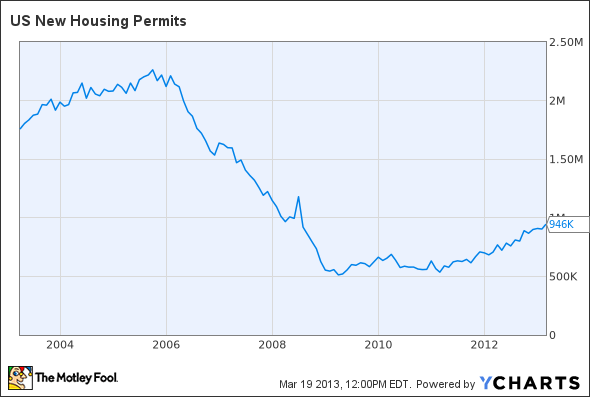
US New Housing Permits Chart

Filed under:

The Dow Jones Industrial Average is down after news out of Cyprus outweighed a better-than-expected housing report. As of 1:15 p.m. EDT the Dow is down 65 points, or 0.45%, to 14,387. The S&P 500 is down 0.85% to 1,539.

There was just one economic release today.

Report

Period

Result

Previous

Housing starts

February

917,000

890,000

Building permits

February

946,000

904,000

Source: MarketWatch U.S. Economic Calendar.

Following yesterday’s poor homebuilder confidence numbers, investors were relieved to see positive housing data. This morning the Department of Commerce reported that housing starts increased 0.8% to a seasonally adjusted rate of 917,000, up from January’s 890,000. February’s results are 27.7% higher than the February 2012 rate of 718,000. The positive housing-starts data shows continued strength in the housing market, which was a boon for the economy last year.

The number that really deserves a closer look is the positive building-permits figure. Building permits rose 4.6%, or 42,000, to a seasonally adjusted rate of 946,000. Building permits are an indication of future housing starts, so when building permits rise it’s a good sign of future housing-market strength.

US New Housing Permits data by YCharts.

The housing market took a beating in the most recent recession, but activity rose significantly last year. If the housing market can continue to improve, it bodes really well for the U.S. economy.

Still, the stock market is overlooking the positive news, as Cyprus‘ parliament is currently abstaining from a bailout vote, while the Cypriot finance minister has reportedly submitted his resignation. Cyprus is in turmoil as European leaders argue over how to bail out the country’s bankrupt banks. Investors are worried that if the country follows through on its plans to institute a one-time tax on bank accounts in the country, a run on banks could occur across Europe. If you want to know more, Fool banking analyst Morgan Housel took a long look at the situation in Cyprus and what it means for investors.

Today’s Dow leaders
Today’s Dow leader is Coca-Cola , up 1% to $39.14 on no real news. The beverage giant’s results are largely unaffected by the health of the economy, so the news in Cyprus isn’t scaring off Coke investors. Last week the company finished down 1% as Chinese authorities announced an investigation into Coca-Cola employees’ use of GPS devices. Some mapping and geographic information is regulated in China due to concern for “national security.”

There’s a lot to like about Coca-Cola. The company currently yields 2.9%, has the top two soda brands in the U.S. in terms of market share, and is expanding around the world. Investors and analysts are taking note of the company’s increasing dominance over PepsiCo, and just last week an analyst from CLSA upgraded the stock from underperform to outperform.

The second-best Dow stock today is Bank of America , up 0.5%. Bank of America’s results are largely dependent on …read more
Source: FULL ARTICLE at DailyFinance

The Dow Takes Another Mediterranean Vacation

By Jeremy Bowman, The Motley Fool

Filed under:

Well, if you thought that every country in Europe had already had its chance to spoil the markets at least one day, you were wrong. Today, tiny Cyprus stole the headlines following the IMF’s decision to bail it out over the weekend, sending stocks down around the world, and the Dow Jones Industrial Average south 62 points, or 0.4%.

The key issue in the bailout and the one roiling markets was a plan to tax deposits held in the small Mediterranean nation, often seen as a safe haven for European investors, and especially popular with Russians, similar to the Cayman Islands for Americans. Those holding bank deposits in Cyprus could lose up to 10% of their savings, and the decision seems to threaten the security of depositors elsewhere on the continent, though European officials insist this is a one-off solution. Parliament will vote on the bailout tomorrow. For more on the issue, see my colleague Morgan Housel’s take on the matter.

Despite today’s general downswing, Hewlett-Packard gained 2.9% on the day after Morgan Stanley Managing Director Katy Huberty said she expects HP to beat 2013 free-cash-flow estimates and upgraded the stock to “overweight.” Huberty noted that the tech giant delivered FCF of $2.1 billion in its latest quarter and expects the PC maker to finish the year with $6.7 billion, rather than the $5 billion it had guided for. HP shares have now doubled since hitting bottom four months ago, following the Autonomy debacle. Huberty also noted improvements in cost structure, the brand, and employee morale.

Verizon shares also moved up 1.5% after the telecom said it wishes to pay for TV channels, through its FIOS TV service, based on unique views rather than subscriber fees. Unique views would be defined as a viewer spending more than five minutes on a single channel. The plan will probably meet resistance but could shake up a business model that seems dated and inefficient. The communications company also seemed to benefit from a Citigroup report that it may buy out Vodafone‘s stake in Verizon Wireless, which came with an upgrade from “neutral” to “buy.”

Outside the Dow, two stocks were making news after hours. Shares of Electronic Arts were up 3.1% after CEO John Riccitello resigned because of his inability to drive profits at the struggling video-game maker. Chairman Larry Probst will return to the helm, and Riccitello accepted accountability for the company’s failure to meet its own guidance in his resignation letter.

Lululemon athletica shares were getting sent to the doghouse as well, falling more than 6% after the company lowered its first-quarter guidance because of a pants shortage. CEO Christine Day said expected comparable sales increase for the current quarter would be revised down from 11% to 5%-8% and reduced overall revenue guidance by about 4%. The company will provide more information in its fourth-quarter earnings call, scheduled for Thursday afternoon, and said the shortage was due …read more
Source: FULL ARTICLE at DailyFinance

HP Leads the Dow in a Shaky Trading Session

By Dan Dzombak, The Motley Fool

NAHB/Wells Fargo US Housing Market Index Chart

Filed under:

The Dow Jones Industrial Average is down slightly following worse-than-expected homebuilder confidence and worries that the Cyprus bank deposit tax will cause unrest in Europe. As of 1:15 p.m. EDT the Dow is down 15 points, or 0.1%, to 14,599. The S&P 500 is down % to 1,556.

There was just one U.S. economic release today.

Report

Period

Result

Previous

NAHB Housing Market Index

March

44

46

Source: MarketWatch U.S. Economic Calendar.

The National Association of Home Builders reported that its housing-market index fell by two points to 44 in March, falling short of analyst expectations of a rise to 47. The housing market improved throughout 2012 but leveled off at the end of the year, with the housing-market index hitting a five-year high of 47 in December. A level below 50 indicates that more builders see conditions as negative, rather than positive. It’s important to note that 46 is still far above the HMI’s March 2012 level of 28 and up more than fivefold from the low of eight hit in January 2009. Hopefully, this is not the start of a downward trend for the year.

NAHB/Wells Fargo US Housing Market Index data by YCharts.

NAHB Chief Economist David Crowe had this to say about the drop:

“In addition to tight credit and below-price appraisals, home building is beginning to suffer growth pains as the infrastructure that supports it tries to reestablish itself. During the Great Recession, the industry lost home building firms, building material production capacity, workers who retreated to other sectors and the pipeline of developed lots. The road to a housing recovery will be a bumpy one until these issues are addressed, but in the meantime, builders are much more optimistic today than they were at this time last year.”

While the housing market weighs on the U.S., the big reason stocks are down today was news over the weekend of the Cyprus bailout and bank account tax. To bailout the country’s bankrupt banks, in addition to a cash infusion from Europe, the country is instituting a tax of between 6.75% and 9.9% on the cash in people’s bank accounts, to be taken tomorrow. After the tax was announced, Cypriots immediately rushed to ATMs, which quickly ran out of cash; bank accounts have since been frozen. Investors are worried that the bank levy could cause runs on weaker banks across Europe. If you want to know more, Fool banking analyst Morgan Housel took a long look at the situation in Cyprus and what it means for investors.

Today’s Dow leaders
Today’s Dow leader is Hewlett-Packard , up 2.7%. Earlier today HP announced in a press release a new analytics and information-management service to help clients gain value from big data. Big data has been a hot topic the past few years as cheap computing power and memory allow companies to collect more data than ever before. The easy part is collecting …read more
Source: FULL ARTICLE at DailyFinance

Why Cyprus Won't Hold Back the Dow

By Dan Caplinger, The Motley Fool

Filed under:

With the stock market near record highs, investors are on edge, and the slightest hint of trouble can cause near-panic. Given the news over the weekend that not only will the European island nation of Cyprus need a bailout, but it will also come at the expense of bank depositors, visions of Great Depression-era bank runs and rhetoric about the confiscation of funds led to massive sell-offs in overseas stock markets. Yet as Fool contributor Morgan Housel noted earlier this morning, Cyprus’ bailout doesn’t deserve the huge hype that it’s getting. At least in the U.S., investors seem to have gotten that message, as the Dow Jones Industrials have recovered from initial losses of more than 100 points to trade down just 31 points as of 10:55 a.m. EDT. Broader markets are down roughly half a percent.

Within the Dow, banking stocks took the most substantial hit, with Bank of America down more than 1% and JPMorgan Chase falling 1.2%. The biggest threat from the Cypriot bailout is that bank customers in other countries will leap to the almost certainly false conclusion that their own deposits are at risk. With FDIC insurance, U.S. depositors are protected, but with ordinary Americans already predisposed against the banking industry, anything that leads more bank customers to withdraw deposits will only put an additional strain on the financial system.

Elsewhere, Incyte declined 7.2% after the company reported that a patient taking its myelofibrosis drug ruxolitinib contracted a disease called progressive multifocal leukoencephalopathy. Although this is the first case of PML associated with the drug, Incyte will get an independent assessment of the findings and could have to take additional steps in order to ensure the safety of the drug.

Finally, J. C. Penney soared more than 8% as two pieces of news helped boost the struggling retailer. One analyst said the company’s Joe Fresh concept has had a successful launch among customers, while a research group examining the value of the retailer’s real estate estimated that Penney could earn $1.2 billion in rental income by subletting store locations. Any move to unlock income will help the company, as it has been burning cash at an alarming rate during its restructuring.

J. C. Penney has been a true train wreck lately, but some value investors believe that J. C. Penney is a buy today. Make your own informed decision by claiming a copy of The Motley Fool’s must-read report on the company. Learn everything you need to know about JCP‘s turnaround odds — or lack thereof. Simply click here now for instant access.

var FoolAnalyticsData = FoolAnalyticsData || []; …read more
Source: FULL ARTICLE at DailyFinance

On Humility, and What Forecasters You Should Pay Attention to

By Morgan Housel, The Motley Fool

Filed under:

Yale economist Robert Shiller has been more right than most of his peers.

In 2000, his book Irrational Exuberance showed in clean detail how the stock market was overvalued. In 2004, the second edition of the book described how and why the housing market was an accident waiting to happen.

Shiller’s background makes him worth listening to. He has the credibility to make forecasts on the economy and financial markets — a distinction the great majorities of economists lack.

Yet when you listen to him talk, he is perhaps the most hesitant economist in the world. When I interviewed him a year ago, nearly every question was answered with some version of “I don’t know,” “It’s hard to say,” “It’s just too uncertain,” or “That’s impossible to tell.”

It may seem counterintuitive, but Shiller’s hesitancy to forecast is part of what has made him a good forecaster in the past. He is only willing to lay down a firm opinion during periods of wild extremes, when the stars align and the odds of making a good forecast are at their highest. Otherwise, he shrugs his shoulders. That respect for uncertainty sets him, and his record for being right, apart.

Last month, I sat down with Hoover Institute economist Russ Roberts. I asked him how to make sense of forecasts and opinions in a world where smart people are so bad at forecasting — a world with too few Shillers. Here’s what Roberts had to say:

The article On Humility, and What Forecasters You Should Pay Attention to originally appeared on Fool.com.

Morgan Housel doesn’t own shares in any of the companies mentioned in this article. Try any of our Foolish newsletter services free for 30 days. We Fools may not all hold the same opinions, but we all believe that considering a diverse range of insights makes us better investors. The Motley Fool has a disclosure policy.

Copyright © 1995 – 2013 The Motley Fool, LLC. All rights reserved. The Motley Fool has a disclosure policy.

(function(c,a){window.mixpanel=a;var b,d,h,e;b=c.createElement(“script”);
b.type=”text/javascript”;b.async=!0;b.src=(“https:”===c.location.protocol?”https:”:”http:”)+
‘//cdn.mxpnl.com/libs/mixpanel-2.2.min.js’;d=c.getElementsByTagName(“script”)[0];
d.parentNode.insertBefore(b,d);a._i=[];a.init=function(b,c,f){function d(a,b){
var c=b.split(“.”);2==c.length&&(a=a[c[0]],b=c[1]);a[b]=function(){a.push([b].concat(
Array.prototype.slice.call(arguments,0)))}}var g=a;”undefined”!==typeof f?g=a[f]=[]:
f=”mixpanel”;g.people=g.people||[];h=[‘disable’,’track’,’track_pageview’,’track_links’,
‘track_forms’,’register’,’register_once’,’unregister’,’identify’,’alias’,’name_tag’,
‘set_config’,’people.set’,’people.increment’];for(e=0;e<h.length;e++)d(g,h[e]);
a._i.push([b,c,f])};a.__SV=1.2;})(document,window.mixpanel||[]);
mixpanel.init("9659875b92ba8fa639ba476aedbb73b9");

function addEvent(obj, evType, fn, useCapture){
if (obj.addEventListener){
obj.addEventListener(evType, fn, useCapture);
return true;
} else if (obj.attachEvent){
var r = obj.attachEvent("on"+evType, fn);
return r;
}
}

addEvent(window, …read more
Source: FULL ARTICLE at DailyFinance

The World Is So Much More Complicated Than You Think

By Morgan Housel, The Motley Fool

Filed under:

One of the great tragedies of analyzing the economy or the stock market is that it’s so easy to oversimplify hugely complex things into simple one-liners. For example:

Stocks are overvalued.

Austrian economists got it all right (or wrong).

Keynesian economics doesn’t (or does) work.

The government created the housing bubble.

The stimulus did (or didn’t) work.

Wall Street is immoral.

“Buy and hold” is dead.

The Fed’s money-printing will cause hyperinflation.

And so on.

For each topic — and for so many other topics — both sides of the debate can show their evidence and make their case as persuasive as the other. The truth, which usually comes down to the phrase “We just don’t know, and it’s really complicated,” doesn’t sit well with economists who spent a decade in school and have a Ph.D. to justify.

Last month I interviewed Hoover Institution economist Russ Roberts. In his opening remarks, he tells a great story about how complex the economy is and how dangerous it can be to have an unshakable view one way or the other. Have a look:

link

The article The World Is So Much More Complicated Than You Think originally appeared on Fool.com.

Morgan Housel doesn’t own shares in any of the companies mentioned in this article. Try any of our Foolish newsletter services free for 30 days. We Fools may not all hold the same opinions, but we all believe that considering a diverse range of insights makes us better investors. The Motley Fool has a disclosure policy.

Copyright © 1995 – 2013 The Motley Fool, LLC. All rights reserved. The Motley Fool has a disclosure policy.

(function(c,a){window.mixpanel=a;var b,d,h,e;b=c.createElement(“script”);
b.type=”text/javascript”;b.async=!0;b.src=(“https:”===c.location.protocol?”https:”:”http:”)+
‘//cdn.mxpnl.com/libs/mixpanel-2.2.min.js’;d=c.getElementsByTagName(“script”)[0];
d.parentNode.insertBefore(b,d);a._i=[];a.init=function(b,c,f){function d(a,b){
var c=b.split(“.”);2==c.length&&(a=a[c[0]],b=c[1]);a[b]=function(){a.push([b].concat(
Array.prototype.slice.call(arguments,0)))}}var g=a;”undefined”!==typeof f?g=a[f]=[]:
f=”mixpanel”;g.people=g.people||[];h=[‘disable’,’track’,’track_pageview’,’track_links’,
‘track_forms’,’register’,’register_once’,’unregister’,’identify’,’alias’,’name_tag’,
‘set_config’,’people.set’,’people.increment’];for(e=0;e<h.length;e++)d(g,h[e]);
a._i.push([b,c,f])};a.__SV=1.2;})(document,window.mixpanel||[]);
mixpanel.init("9659875b92ba8fa639ba476aedbb73b9");

function addEvent(obj, evType, fn, useCapture){
if (obj.addEventListener){
obj.addEventListener(evType, fn, useCapture);
return true;
} else if (obj.attachEvent){
var r = obj.attachEvent("on"+evType, fn);
return r;
}
}

addEvent(window, "load", function(){new FoolVisualSciences();})
addEvent(window, "load", function(){new PickAd();})

var themeName = 'dailyfinance.com';
var _gaq = _gaq || [];
_gaq.push(['_setAccount', 'UA-24928199-1']);
_gaq.push(['_trackPageview']);

(function () {

var ga = document.createElement('script');
ga.type = 'text/javascript';
ga.async = true;
ga.src = ('https:' == document.location.protocol ? 'https://ssl' : 'http://www') + '.google-analytics.com/ga.js';

var s = document.getElementsByTagName('script')[0];
s.parentNode.insertBefore(ga, s);
})();

<p style="clear: both;padding: 8px 0 0 0;height: 2px;font-size: …read more
Source: FULL ARTICLE at DailyFinance

Interview With Former AIG CEO Hank Greenberg: Criticizing the Bailout in Hindsight

By Morgan Housel, The Motley Fool

Filed under:

Few people were as enraged at the terms of AIG‘s 2008 bailout as its former chairman and CEO, Hank Greenberg. Greenberg, who left AIG in 2005, is suing the government for $25 billion. “We have a Constitution in the United States, and there’s a provision against unlawful taking by the government,” he says, “You can take anything you want, but you have to pay for it.”

I sat down with Greenberg last week, and we talked at length about the bailout and his current lawsuit. Here’s what he had to say (transcript follows):

Morgan Housel: Hank Paulson talks in his book about how, in hindsight, it’s easy to say, “We should have done this. We did this wrong” … and they admit that they did things wrong, in hindsight, but they had such short time constraints — some of these bailouts they had to put together in literally hours — that when you’re under those constraints, you’re going to make big mistakes that are only visible in hindsight.

What’s your response to that?

Hank Greenberg: Well, I think that’s an easy statement to make. They were looking after some firms and didn’t care about other firms. It’s very simple.

AIG was used. Let’s face it, AIG was used. The government didn’t do badly. They made about $23 billion on AIG.

Morgan Housel: Your lawsuit is for $25 billion, based on the terms of the deal.

Hank Greenberg: Correct.

Morgan Housel: That goes to C.V. Starr? That goes to AIG shareholders?

Hank Greenberg: It goes to shareholders after deducting, obviously, the expense of the lawsuit.

Morgan Housel: Do you think we’ve learned anything over the past five years, or do you think we’re doomed to keep making these mistakes again?

Hank Greenberg: I think the pendulum sometimes runs too far in one direction, has to come back to the middle. That’s the way we’ve always been, unfortunately. Are we going to make the same mistake next time around?

Depends when next time around is. Is it going to be next month? I think we’ve learned. If it’s about 5-10 years from now, I’m not sure we’ve learned.

The article Interview With Former AIG CEO Hank Greenberg: Criticizing the Bailout in Hindsight originally appeared on Fool.com.

Morgan Housel has no position in any stocks mentioned. The Motley Fool recommends American International Group. The Motley Fool owns shares of American International Group and has the following options: Long Jan 2014 $25 Calls on American International Group. Try any of our Foolish newsletter services free for 30 days. We Fools may not all hold the same opinions, but we all believe that considering a diverse range of insights makes us better investors. The Motley Fool has a disclosure policy.

Copyright © 1995 – 2013 The Motley Fool, LLC. All rights reserved. The Motley Fool has a disclosure policy.

…read more
Source: FULL ARTICLE at DailyFinance

An Interview With Former AIG CEO Hank Greenberg

By Morgan Housel, The Motley Fool

Filed under:

Hank Greenberg stormed the beaches of Normandy, took part in the liberation of the Dachau concentration camp, and returned home to spend five decades building AIG into the world’s largest insurance company. He retired in 2005 as a multi-billionaire.

Three years later, the company collapsed. He says he lost 90% of his net worth.

Few people know as much about the global financial system as Hank Greenberg, and few are as angered about the 2008 Wall Street bailouts (he’s suing the government for $25 billion.)

Last week, I sat down with Greenberg to discuss AIG‘s early days, its rise to power, and its 2008 collapse. Below is the full interview (34 minutes — transcript follows):

Morgan Housel: Hi, I’m Morgan Housel from Fool.com, and with me today is former Chairman and CEO of AIG, Mr. Hank Greenberg. His new book, The AIG Story, chronicles the rise and growth of AIG, including the fall and bailout in 2008.

Mr. Greenberg, thank you for taking the time to talk to us today.

Hank Greenberg: Thank you.

Morgan Housel: Why now? You left AIG in 2005. AIG‘s downfall and bailout were more than four years ago. Why now to write this book?

Hank Greenberg: Well, several things. First of all, I was busy fighting a lot of lawsuits with AIG, and that took a lot of time.

Second, getting all of the facts as to what happened in the bailout and why, and getting all that documented so that, as you see in the book, everything is documented. There is no area that we left uncovered — just our view, not documented what actually happened. It took several years to get that.

Morgan Housel: What I liked about the book is that it spent most of the time on the early days and the growth of AIG during its heyday. I think what’s unfortunate is that for a lot of Americans the history of AIG begins in September 2008.

Hank Greenberg: That’s exactly right.

Morgan Housel: What was AIG‘s key to success during its heyday?

Hank Greenberg: Many things. First of all, we had a culture that was quite unique, and I think a lot of it was also when we started. Starr died in 1968. I became the head of the company in ’67, and the people around us then, most of us at the very senior level were veterans, had been officers of the military, so there was a separate culture that was just unique; almost a military-like culture of discipline.

We attracted the best and the brightest, people who could live with a very high-powered environment. We were totally committed to building a great company, and we did. It was the largest insurance company in history. The largest in history, in 130-odd countries; it didn’t happen by accident. The planning and the execution were great.

Morgan Housel: You talk a lot about the culture of success. What other publicly traded companies today do you admire, that are doing things right?

Hank …read more
Source: FULL ARTICLE at DailyFinance

Is the Financial System Safer Today Than It Was in 2007?

By Morgan Housel, The Motley Fool

Filed under:

It’s been more than four years since Wall Street collapsed. What’s happened since then?

Banks have raised tens of billions of dollars in capital. They’re less leveraged and have more liquidity than before.

Consumers have far less debt. Total debt-to-GDP has been declining for four years. 

New regulations dictate what should happen if a huge bank faces collapse, ostensibly ending bailouts (in theory, anyway).

We’ve made big strides in the right direction. But so much can still go wrong, and so much still is wrong. Is the financial system actually safer than it was five years ago?

I recently asked that question to former AIG CEO Hank Greenberg. Here’s what he had to say (transcript follows):

Morgan Housel: Do you think the global financial system is safer today than it was in 2007?

Hank Greenberg: It’s now so tight you can’t do anything.

Morgan Housel: That’s an interesting point of view. It might be as dangerous, but there’s not much we can do about it?

Hank Greenberg: I think that, if you look at the regulators that we have, and had at the time, how did all this start in housing? It started with the government.

When our governor was the head of HUD, they loosened the reins. The decision by the administration was, “We want more Americans to own their homes.” They dropped the qualifications for getting mortgages, and people who couldn’t afford a home got a home.

Morgan Housel: The mortgages are being purchased by Fannie and Freddie, right?

Hank Greenberg: Yeah.

Morgan Housel: But a tremendous amount, virtually all of the subprime that was being done in 2005-06 was all in the private market, correct?

Hank Greenberg: Yeah.

Morgan Housel: It wasn’t until 2007 that Fannie and Freddie started getting into subprime.

Hank Greenberg: No, I understand that. I understand that, but they fed on it. Once you start down that road, it became a little easier next time, to the next one, the next one, and the next one.

Then you go beyond that. The SEC, where were they when the investment banks were leveraging the capital 40 to 1? Did you hear anybody say anything?

The blame is widespread. I think if you look at some other countries — a city-state like Singapore — a tiny state, but very well run, and the regulators are terrific. They get paid as much as they would if they were in the private sector, or maybe more. They’re intelligent, smart.

We need to change the dynamics here in the regulatory structure.

For more on AIG
At the end of last year, AIG was the favorite stock among hedge fund managers. Have they identified the next big multi-bagger, or are the risks facing the insurance giant still too great? In The Motley Fool’s premium report on AIG, Financials Bureau Chief Matt Koppenheffer breaks down the key issues that you need to know about if you want to successfully invest in this stock. Simply click here …read more
Source: FULL ARTICLE at DailyFinance

Interview: Former AIG CEO Hank Greenberg: What the Government Should've Done in 2008

By Morgan Housel, The Motley Fool

Filed under:

Hank Paulson, Ben Bernanke, and Tim Geithner have probably been criticized and critiqued more than any other trio in the history of business for the Wall Street bailouts they designed in 2008 — as they should be.

But criticizing is one thing; saying, “Here’s what I would have done differently, and here’s why it would have been better,” is quite another, and something that happens far less often. 

Last week, I sat down with former AIG chairman and CEO Hank Greenberg (who left AIG in 2005, before the company’s downfall and bailout). I asked him what Paulson, Bernanke, and Geithner should have done differently in 2008. Here’s what he had to say (transcript follows):

Morgan Housel: How should Paulson, Bernanke, and Tim Geithner have responded in September 2008?

Hank Greenberg: They had their mind made up. They wanted to use AIG as a back-door bailout. You had Goldman Sachs, you had Morgan Stanley, you had many institutions who were using AIG to get them funds, and they did.

Now, they could have had access to the window, and they ultimately got access to the window, but they would have gotten a lot more access to the window. Their debt would have been much greater. This eliminated a lot of debt that they otherwise would have had to come up with.

Morgan Housel: What did you think about the terms and the validity of the other bailouts that were given to companies like Citigroup, Bank of America, Goldman Sachs?

Hank Greenberg: The Fed guaranteed — Citi and a number of others — guaranteed a lot of their assets at a fraction of the cost. If the Fed, as an example, had guaranteed AIG FB for whatever; 100 or 200 basis points…

Morgan Housel That was the Financial Products division of AIG that was running the derivatives?

Hank Greenberg: Yeah. It all would have been over. AIG would have regained its AAA rating, and there would have been no collateral calls necessary, and a lot of those assets came back. In fact, AIG was buying some of them last year. Buying them out of the Fed, so clearly if they hadn’t lost their nerve and they’d done it the right way, it all would have been over. 

For more on AIG
At the end of last year, AIG was the favorite stock among hedge fund managers. Have they identified the next big multi-bagger, or are the risks facing the insurance giant still too great? In The Motley Fool’s premium report on AIG, Financials Bureau Chief Matt Koppenheffer breaks down the key issues that you need to know about if you want to successfully invest in this stock. Simply click here now to claim your copy, and you’ll also receive a full year of key updates and expert analysis as news continues to develop.

…read more
Source: FULL ARTICLE at DailyFinance

Interview with Former AIG CEO Hank Greenberg: What Else Could AIG Have Done in 2008 Besides a Bailou

By Morgan Housel, The Motley Fool

Filed under:

In 2008, as the housing market collapsed from its bubble, AIG suddenly faced billions of dollars of “collateral calls” — counterparties demanding it put up money to back derivative insurance products AIG sold that served as bets on junk mortgages. It didn’t have nearly the kind of money on hand that its counterparties demanded. Facing collapse that would set off dominoes throughout the global financial system, the federal government bailed the company out. The rest was history.

More than four years later, it’s interesting to ask: What else could AIG have done in 2008 to avoid the mess taxpayers got stuck with? Was there a possible private-market solution other than bankruptcy to stabilize the insurer and avoid a public bailout?

Last week, I asked that question to former AIG chairman and CEO Hank Greenberg (who left AIG in 2005). Here’s what he had to say (transcript follows):

Morgan Housel: Was there any other option that AIG had in September 2008, in the private market, to stabilize the company?

Hank Greenberg: There were a lot of things they could have done. First of all, I wouldn’t have responded, as I indicated, to the collateral calls, because who knows what you’re responding to? There’s no price discovery. I wouldn’t have done that.

Of course, we wouldn’t have been in that position to begin with. AIG got in that position for failing to do just the common-sense things that we always did. We knew what risk management was. We had the only enterprise risk management system in the insurance industry at that time. We had both credit risk and market risk. We knew exactly how to run a company.

Morgan Housel: These aren’t arguments that I’m defending, but I want to put forth what the people who led that bailout respond, to that criticism.

They say that if AIG had gone bankrupt in September 2008, it would have caused larger systemic problems, and that since there were no private market solutions … because in the weeks previous, AIG did try to do some private market solutions. They tried to sell the P&C business to Warren Buffett, there were some possible deals with J.C. Flowers, none of which fell through, and here we are at the precipice.

This needs to be fixed right now — it’s Tuesday night and the Asian markets are opening in one hour, we’ve got to get this done now — so they put forth this bailout for AIG. The terms were quite onerous, but those terms were, within weeks, restructured down considerably.

Hank Greenberg: No they weren’t.

Morgan Housel: Please do correct me if I’m wrong, but the first interest rate was LIBOR plus 8.5%, and then that was restructured down to LIBOR plus 3, correct?

Hank Greenberg: Oh, now. That really was months and months later. Months and months later.

I went down to see Geithner — I knew Tim Geithner for a long time from my service on the Fed board — and he …read more
Source: FULL ARTICLE at DailyFinance

Exclusive Interview: Why Former AIG CEO Hank Greenberg Sued the Government for $25 Billion

By Morgan Housel, The Motley Fool

Filed under:

Hank Greenberg, former chairman and CEO of AIG , sued the government last year for $25 billion, related to the 2008 bailout of the company he founded and built. 

The common response when hearing that AIG‘s old boss is suing the government that saved his company is something between utter disgust and anger. It feels like the ultimate “thanks for nothing” move.

I sat down with Mr. Greenberg last week and asked him to explain the motive for the lawsuit. Here’s what he had to say (transcript follows):

Morgan Housel: You’ve recently been involved in a $25 billion lawsuit against the government, specifically the New York Federal Reserve.

Hank Greenberg: Not involved. We have commenced a lawsuit against the U.S. government.

Morgan Housel: Some people, when they hear about the lawsuit after the AIG bailout, they respond with a sense of shock. What was the purpose of that lawsuit?

Hank Greenberg: Several things. First of all, we have a Constitution in the United States, and there’s a provision against unlawful taking by the government. You can take anything you want, but you have to pay for it.

If you go back into the book and you see it started with Spitzer, it led to management changes and those management changes led to the company becoming deeper and deeper into the need for liquidity, so they sought liquidity from the New York Fed, from the window. They were turned down.

They tried to get a broker-dealer license, which would give them access to the window. They were turned down.

At the very last moment, Hank Paulson, then Secretary of the Treasury, calls Willumstad, who was then the Chairman of AIG and CEO. He says, “There’s only one deal we’re going to give you.” That was $85 billion at 14.5% interest. At the window, if they were borrowing, it would have been 1.5%.

As an aside, they opened the window to the Arab Bank, which was then 26% owned by Libya when Gaddafi was running it, so Libya could get access to the window, but AIG couldn’t.

So “14.5%, $85 billion, and we’re taking 79.5% of the equity of the company,” and incidentally he tells Willumstad, “You’re fired.” Here’s the Secretary of the Treasury, calling a public company CEO and firing him. Is this America? Does the government fire CEOs? I hadn’t heard that before.

He then says to Willumstad, “Sign that agreement” that I just related to you.

He says, “Just fire me. I’m not signing the agreement,” so Paulson sends in his replacement, a guy called Ed Liddy who’s on the Board of Goldman Sachs. He signs the agreement, still as the director of Goldman Sachs and resigns from Goldman Sachs three days later, retroactively. Very unusual, to say the least.

Of the $85 billion that they lent AIGAIG had about $800 billion of assets. They had plenty of collateral. They didn’t have to take 79.5% of the equity at the time.

Now you’ve got the $85 billion; …read more
Source: FULL ARTICLE at DailyFinance

Here's What This "Market-Destroying" Investor Is Buying

By Selena Maranjian, The Motley Fool

Filed under:

Every quarter, many money managers have to disclose what they’ve bought and sold, via “13F” filings. Their latest moves can shine a bright light on smart stock picks.

Today, let’s look at Joel Greenblatt’s Gotham Asset Management. It’s of great interest to many investors because Greenblatt is the author of the well-regarded bestseller “The Little Book That Beats the Market” and because his system of seeking out companies with high returns on capital and hefty earnings yields. His “Magic Formula” has many fans. As my colleague Morgan Housel has noted, “The simple formula absolutely destroys market averages over time. Greenblatt backs this up with considerable statistical evidence.”

The company’s reportable stock portfolio totaled $1.7 billion in value as of Dec. 31, 2012.

Interesting developments
So what does Gotham’s latest quarterly 13F filing tell us? Here are a few interesting details:

The biggest new holdings are Wells Fargo and Computer Sciences. Other new holdings of interest include American Capital , a business development company (BDC) that’s also involved in mortgage-backed securities. It was recently upgraded by analysts at Zacks who liked its expense and debt reduction and better-than-expected earnings. Some are hoping that the company will reinstate its dividend in the near future, as management has said it would like to do, but my colleague John Maxfield has warned that the company may be too inscrutable for most investors.

Among holdings in which Gotham increased its stake were R.R. Donnelley & Sons and InterDigital . Commercial printer Donnelley provides labels, packaging, and more to the private and public sector. It also prints many thousands of forms for the SEC, and bought Edgar Online. The company took some flack recently when it released Google’s earnings report early last year. Bears worry about its debt and fear a dividend cut. The dividend recently yielded a whopping 10%.

InterDigital may have disappointed investors by not being acquired, but it’s otherwise been busy raking in licensing revenue from its many patents (generally focused on mobile telecommunications), selling many of its patents, and also winning some significant legal battles. Also boding well for the company is its last earnings report, in which it handily topped expectations.

Gotham reduced its stake in lots of companies, including Sirius XM Radio . Heavily shorted, Sirius has faced threats from automakers offering their own entertainment products, but for now they are still offering Sirius radio as well. Growing sales of vehicles is also a plus for Sirius, as is Pandora’s recent decision to start charging its heaviest users. Despite the pessimism of bears, the stock recently hit a 52-week high.

Finally, Gotham’s biggest closed positions included Herbalife and Advanced Micro Devices . Advanced Micro hasn’t been kind to many investors, averaging an annual loss of about 7% over the past 20 years and down 66% over the past year. It’s fighting a struggling PC market and has suffered some heavy free cash flow losses in recent years. …read more
Source: FULL ARTICLE at DailyFinance

Exclusive Interview With Former AIG CEO Hank Greenberg: Black Boxes and Too Big to Fail

By Morgan Housel, The Motley Fool

Filed under:

I sat down with former AIG chairman and CEO Hank Greenberg last week. We talked about everything from AIG‘s early days, its growth, to its downfall and bailout in 2008.

Something I’ve thought about a lot since 2008 is whether an inquisitive investor last decade could have known how much risk financial companies were taking, or if it was something only insiders had the full details on. I posed that question to Mr. Greenberg, which led into a conversation about “too big to fail.” Here’s what he had to say (transcript follows).

Morgan Housel: These risk problems that came up after you left in 2005, were they something that a general public investor, someone just reading the public information, the 10-Ks, could have pieced together, or was the risk taking that was going on inside of AIG something that you needed to be on the inside to recognize?

Hank Greenberg: Probably, although I’m not sure the 10-Ks that they filed were complete. For example, when the auditors made that statement to the Chairman, that the current management was incapable of managing AIG, they went out to the market to raise $30 billion. They don’t disclose what the auditors had said to the Chairman.

Morgan Housel: Let’s say 2006-07, were you personally aware of the risk taking that was going on inside of AIG? I guess what I’m trying to figure out is, if someone owned AIG stock in 2007, could they, even with hindsight, go back and see, “Oh, look at all this risk that was being taken?”

Hank Greenberg: No, I don’t think so. I was a major shareholder of AIG, the largest individual shareholder. I lost about 90% of my net worth. I was in a war with AIG at that time, literally.

Morgan Housel: We hear a lot about the phrase, “too big to fail.” Was AIG “too big to manage?”

Hank Greenberg: No. We managed it for 40 years, for God’s sakes. You need the right management. Of course it wasn’t too big to manage.

After all, the company was doing very well. There was nothing wrong with the company. The year I left — my last year was 2004 — I think we earned $11 billion, growing at double-digit. What can I tell you?

Morgan Housel: What should we do about the problem of too big to fail? Or is too big to fail a problem?

Hank Greenberg: It depends on the management. If you’ve got the right management, why is it too big to fail?

Morgan Housel: With AIG, the amount of risk-taking that was going on in a fairly small portion of AIG

Or let’s say with JPMorgan. They had, last year, the London Whale transaction. That, some people look at as an issue of, Jamie Dimon is a well-respected manager, but when you have a company that size, with more than 200,000 employees, and you have a few bad apples over here that have the power to make …read more
Source: FULL ARTICLE at DailyFinance

Exclusive Interview with Former AIG CEO Hank Greenberg: How AIG Went Off Track

By Morgan Housel, The Motley Fool

Filed under:

I sat down with former AIG chairman and CEO Hank Greenberg this week. We talked about everything from AIG‘s early days, its growth, to its downfall and bailout in 2008.

Below is one of the most interesting clips from the talk. I asked Mr. Greenberg a simple question: When did AIG go off track?

Here’s what he had to say (transcript follows):

Morgan Housel: When did AIG go off track, from being a first-class global organization to where it found itself in 2008?

Hank Greenberg: I don’t think AIG went off track. We had an Attorney General in New York, now a disgraced Attorney General

Morgan Housel: There’s actually a quote in your book. I’m going to quote it here. It says, “Eliot Spitzer, an elected public prosecutor in New York, sparked the process that would drive AIG to near destruction.”

Hank Greenberg: That’s correct.

Morgan Housel: When people think about AIG‘s downfall, they think of derivatives and leverage and liquidity. They often don’t think about Eliot Spitzer. What was his role?

Hank Greenberg: Very simple. I was on a conference call with analysts, and one of them asked me, “What’s the regulatory environment like today?” This is after Enron and Sarbanes-Oxley.

There was a change in the atmosphere. Boards of directors became less supportive of companies and their management. They were more concerned about their own liability after Enron. When I was asked this question, I said, “A foot fault is like a murder charge today,” which was a way of trying to dramatize the change that had taken place.

If you read the book, you’ll see there’s an affidavit by a man called Vacco, who had been the prior Attorney General of New York, and he happened to be in Spitzer’s office when one of Spitzer’s deputies came in and said, “Did you hear what Greenberg just said on an analyst call?”

He said no. He repeated that I said a foot fault is like a murder charge. Spitzer then said, in front of this prior Attorney General, “I’m going to take Greenberg down.” He used some other language which was just a disgrace for him to be saying that. It’s in the book.

He used that. He was running for governor. He wanted to take down big names, and he went on a campaign to do that.

He focused on a transaction we did with Warren Buffett‘s company, General Re, which was our largest reinsurance partner. It was five years old, it had no effect on shareholders’ equity or earnings per share — nothing to do with that. It was a peanut transaction, and he tried to make that into a murder charge, and was successful. The board just gave up supporting the CEO.

Now, I was going to step down as the CEO in May. This was in March of 2005. I was going to step down as CEO, stay as chairman to make sure the transition to a new leadership team would go …read more
Source: FULL ARTICLE at DailyFinance

The Top 4 Contrarian Reads

By Alex Dumortier, CFA, The Motley Fool

Filed under:

For all that is written on the topic, the key to beating the market can be boiled down to a single concept: variant perception. In order to earn a return that is different from the market average, you need to do different things, based on views that are different from the consensus. In that spirit, here are some of the best contrarian articles I’ve read recently.

Invest with the best
According to a paper published last November, uncertainty (as measured by the implied volatility of stock options) accounted for half of the decrease in corporate investment and hiring in 2009, the first full year post-Lehman. In December, the CEOs of several blue-chip companies complained about uncertainty relating to the fiscal cliff. That same month, research firm FactSet projected that aggregate capital expenditures for the
S&P 500 would fall 1% over the next 12 months.

One corporate chieftain, however, is having none of that. In his annual letter to shareholders, released last Friday, Berkshire Hathaway‘s Warren Buffett exhorted executives to invest, citing his own example:

There was a lot of hand-wringing last year among CEOs who cried “uncertainty” when faced with capital allocation decisions (despite many of their businesses having enjoyed record levels of both earnings and cash). At Berkshire, we didn’t share their fears, instead spending a record $9.8 billion on plant and equipment in 2012, about 88% of it in the United States. That’s 19% more than we spent in 2011, our previous high. Charlie and I love investing large sums in worthwhile projects, whatever the pundits are saying. We instead heed the words from Gary Allan‘s new country song, “Every Storm Runs Out of Rain.”

We will keep our foot to the floor and will almost certainly set still another record for capital expenditures in 2013. Opportunities abound in America.

Buffett went on to extend the recommendation to individual investors:

American business will do fine over time. And stocks will do well just as certainly, since their fate is tied to business performance. Periodic setbacks will occur, yes, but investors and managers are in a game that is heavily stacked in their favor. … Since the basic game is so favorable, Charlie and I believe it’s a terrible mistake to try to dance in and out of it based upon the turn of tarot cards, the predictions of “experts,” or the ebb and flow of business activity. The risks of being out of the game are huge compared to the risks of being in it.

You can read Buffett’s letter in its entirety here. Otherwise, my Foolish colleague Morgan Housel has picked out the highlights in “Warren Buffett on Risk, Optimism and Ketchup.”

Wall Street lies
As any Fool knows, Wall Street constantly resorts to myths, half-truths, and outright falsehoods to prime the pump of investor appetite. The Wall Street Journal‘s esteemable Brett Arends has identified …read more
Source: FULL ARTICLE at DailyFinance