Tag Archives: Ben Bernanke

Larry Summers Next Fed Chief? Not If His Critics Can Help It

By John Johnson

Larry Summers or Janet Yellen. If you’re a weird hybrid of wonk and gambler, you already know those two are the heavy favorites to replace Ben Bernanke as Fed chief in January. Expect to hear much more as decision time nears for President Obama, especially because an influential hodgepodge of… …read more

Source: FULL ARTICLE at Newser – Home

Fears Rise That Larry Summers Is Likely To Be Named Fed Chairman

By The Huffington Post News Editors

WASHINGTON — President Barack Obama is leaning towards former White House Economic Adviser Larry Summers as his choice to replace Ben Bernanke as chairman of the Federal Reserve, according to people who have been briefed on the administration’s thinking. Liberal critics of Summers’ economic record, along with those who continue to question his ability to work with women, are waging a last-minute campaign to persuade the president to change his mind and instead choose the other frontrunner for the job, Fed Vice Chair Janet Yellen.

Chatter increased Tuesday among Summers’ opponents when Fed Governor Sarah Bloom Raskin’s name was floated as a possible deputy to Treasury Secretary Jack Lew. Raskin, who has been harshly critical of the Fed, is broadly popular with progressives. Liberal Fed watchers suspected the move was aimed at people pressing Obama to name a woman to the Fed, and they worried selecting Raskin for Treasury would give the president cover to name Summers Fed chairman.

“We are concerned by rumors that Larry Summers, a man known for his offensive and callous opinions on women, is currently being considered to head the Federal Reserve. Women will not soon forget if President Obama picks Mr. Summers for such an important post, a man who believes women are somehow inherently less capable than men,” Shaunna Thomas, co-founder of feminist group UltraViolet, said in a statement. “It is high time to shatter the glass ceiling at the Fed and appoint a woman to a post that impacts so many women, and Janet Yellen would be a much celebrated pick.”

Read More…
More on Ben Bernanke

…read more

Source: FULL ARTICLE at Huffington Post

Bernanke Tells Congress: I Don't Really Understand Gold

By Agustino Fontevecchia, Forbes Staff

While Ron Paul is no longer part of  the Congressional committees that grill Ben Bernanke twice a year, the Fed Chairman was forced to answer questions about gold on Thursday again.  Asked about the falling price of gold, which is down nearly 25% this year, Bernanke admitted he doesn’t understand the yellow metal. …read more

Source: FULL ARTICLE at Forbes Latest

Little Reward Anticipated Ahead Of Bernanke's Second Act

By Dean Popplewell, Contributor

It is halftime and ‘helicopter’ Ben Bernanke has pulled no punches, nor any surprises. The Federal Reserve chairman’s prepared semiannual monetary policy testimony was as expected — decidedly dovish in tone. Perhaps most significantly, the chairman did not take the idea of a September tapering of asset purchases off the table, and he repeated that the Federal Open Market Committee (FOMC) “expected to continue to reduce the pace of purchases in measured steps through the first half of next year, ending them around midyear.” A point that he was adamant to make was that the Fed’s “asset purchases depend on economic and financial developments, they are by no means on a preset course.” …read more

Source: FULL ARTICLE at Forbes Latest

Stocks Soft Ahead Of Bernanke, Market Overbought

By Scott Redler, Contributor

World markets are soft ahead of Ben Bernanke’s congressional testimony, which makes a bit of sense as most have enjoyed big rallies off the lows from June 24.  The S&P 500 is extended from the 8- and 21-day moving averages in a very overbought stage for some time now so digestion/weakness is a welcome sign.  A break and close below 1662 will let some steam out of the rally.  The bigger line in the sand comes in around 1642.  Pivot resistance stands at 1683-1684 with intraday all-time highs at 1687. …read more

Source: FULL ARTICLE at Forbes Latest

Event Risk Remains In Play Before Fed Testimony

By Dean Popplewell, Contributor

In the current environment, capital markets are being held captive by the smallest of expressions from key central bankers, with ‘helicopter’ Ben Bernanke’s appearance before U.S. Congress later today likely to dominate and test the nerves of most traders. Many expect the Chairman of the Federal Reserve to reiterate the point that he and his fellow policymakers will remain accommodative for an extended period, despite considering paring the amount of its monthly asset purchases. The market can expect the Fed to cite any economic “soft patch” examples as a temporary off-putting reason not to wholly engage in their definition of tapering. …read more

Source: FULL ARTICLE at Forbes Latest

Oil near $105 ahead of supplies data, Bernanke

The price of oil dropped to near $105 a barrel Wednesday as investors awaited a report on U.S. crude inventories and the Federal Reserve chairman’s congressional testimony.

Benchmark crude for August delivery was down 54 cents at $105.46 at early afternoon Bangkok time in electronic trading on the New York Mercantile Exchange. The contract fell 32 cents to finish Tuesday at $106 a barrel.

This week’s direction in oil futures could be determined by fresh information on U.S. stockpiles.

Data due Wednesday for the week ending July 12 is expected to show a decline of 2.5 million barrels in crude oil stocks and no change in gasoline stocks, according to a survey of analysts by Platts, the energy information arm of McGraw-Hill Cos. That would be the third straight week of a drop in U.S. crude supplies, suggesting an increase in demand.

Markets are also looking to Ben Bernanke’s remarks to Congress for any new insight into when the Federal Reserve will start scaling back its monthly purchases of bonds and other assets that are aimed at keeping interest rates low and encouraging an economic recovery.

The withdrawal of that stimulus could push the dollar higher as U.S. interest rates would tend to rise. That in turn might weigh on the oil price since the commodity is traded in dollars.

In London, Brent crude was down 38 cents to $107.76 a barrel on the ICE Futures exchange.

In other energy futures trading on Nymex:

— Wholesale gasoline fell 2.9 cents to $3.024 per gallon.

— Heating oil shed 1.1 cents to $3.035 a gallon.

— Natural gas dropped 2.1 cents to $3.656 per 1,000 cubic feet.

…read more

Source: FULL ARTICLE at Fox World News

FTSE up 0.16% at open

London equities rose at the start of trading on Tuesday as investors awaited a batch of regional data and economic testimony from US Federal Reserve chief Ben Bernanke.

The benchmark FTSE 100 index was up 0.16 percent to 6,596.76 points in opening deals, compared with Monday’s closing values.

Elsewhere, Frankfurt’s DAX 30 gained 0.20 percent to 8,251.51 points and the Paris CAC 40 advanced 0.09 percent to stand at 3,881.99 over the same period.

…read more

Source: FULL ARTICLE at Fox World News

Fed Officials Assure America There Is No Bubble In Sight

By Robert Lenzner, Forbes Staff In New York this week, Eric Rosengren, President of the Federal Reserve Bank of Boston, assured several audience members surrounding him after a speech on financial market regulation that he saw “no bubbles of any kind, even in real estate,” where he reckoned residential home prices were still selling at a discount to the peak values in 2006. He added that residential homes in Boston and New York were selling at a 10% to 20% discount from the records set before the great recession while prices in Miami, Phoenix and California were at even further below the peak. Rosengren is a member of the Fed’s Open Market Committee that rules over the application of monetary policy and especially the level of interest rates. He made it clear he would support the Fed’s record low interest rates until there is more “traction” in the economic recovery nationally. This comforting opinion has also been articulated in recent weeks by both Ben Bernanke, the Federal Reserve Board Chairman, other regional central bank presidents and even a leading policy maker at the Bank of England. On March 20, 2013, for instance, Chairman Bernanke exclaimed clearly that “in the stock market, you know, we don’t see at this point anything that’s out of line with historical patterns. In particular… while the Dow may be hitting a high, it’s in nominal terms, not in real terms. And if you adjust for inflation and for the growth of the economy… we’re still some distance from the high.” He also was of the opinion that “the relationship between stock prices and earnings is not particularly unusual at this point.” As well, Chicago Federal Reserve President Charles Evans said recently; ” We’ve looked at a lot of things and there’s nothing in the horizon that causes me great angst. Minneapolis Federal Reserve President Narayana added that bubbles are “something we have to keep monitoring”, but ” I don’t see” any risk at present. During a recent panel discussion at the Boston Fed a Bank of England official, David Miles, weighed in with his level of comfort by saying ” I don’t think we’re in that kind of territory that obviously makes these asset prices unsustainable and at a bubble level.”

From: http://www.forbes.com/sites/robertlenzner/2013/04/21/fed-officials-assure-america-there-is-no-bubble-in-sight/

“Common Core” The Marxist Brainwashing Of America’s Schoolchildren

By Suzanne Eovaldi

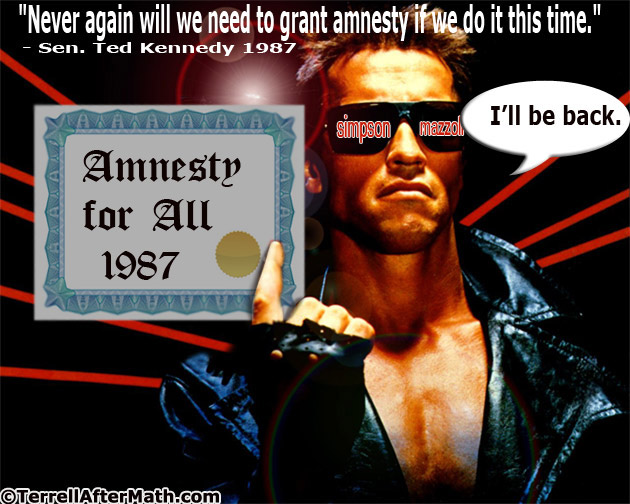
Amnesty 1987 Ill Be Back SC Amnesty to include a 50 percent increase of legal immigrants if S744 passes

Vlad the Impaler must be dancing in his grave as the beast known as the Federal Education Department makes the United States into Transylvania West by turning our public school system into its own, blood-sucking, Communist training camp! Orwellian standards, end runs around local school boards, and ruination of states’ rights are all part of the Obama administration’s dangerous Common Core initiative to strip our land of freedom.  Dr. Alison Rampersad, a Co-Chair of Eye on U.S. Education, gave a Florida workshop a frightening heads up on what really is in Common Core, slated to be a done deal within this year.  And what is most frightening is that teachers, parents, educators, and legislators themselves don’t know what they are getting our children into.

Three huge stoppers Common Core is throwing up in front of our school children in this K-12 disaster include: 1. Dumbing down of all levels of America’s public school system;  2.  Taking away the rights of states to individually design, administer, and control their own schools;  3. Setting up a 400 point “Data Mining” paradigm that will encode for the federal government a tracking system for each child.  Such data will include parental income, babysitters, bus stops, and even political affiliations of Democrat or Republican/family voting patterns!

“This will change the way students and teachers interact in the classroom and how the education system works in America,” Rampersad warned Floridians.  A crazy re-do of the already new, fuzzy math will require students to count in tens, prompting one math expert to opine that this will never work.  Parents will not be allowed to enter the schools, read their child’s textbooks (which have to be left at school), and would not have any local school board to meet.  Technical manuals, especially relating to the R rating of attic insulations and the Ben Bernanke two step of rules governing our financial systems, will become 70% of what our students will be reading.  The beloved classics of literature that teach moral truths, right from wrong, responsible citizenship, and the value of liberty are already being deconstructed along with the canon of early American history and literature.

Stephanie Austin, an advocate of explaining the dangers of wireless radiation, called the workshop audience’s attention to what is known as commercial routers of the WiFi systems as each child must use a wireless tablet.  She handed out the public warning about WiFi in schools, issued by the American Academy of Environmental Medicine: “Safer technology, such as use of hard-wiring, is strongly recommended in schools.”

As the No Common Core workshop wore on, cries of Communism, Socialism, and Marxism could be heard from participants just learning about the underlying goals of the program.  Loyal United States citizens in every one of our 50 states are being urged to call their state legislators and governor to deny Common Core’s infestation of our public schools by the Federal Education Beast.


Don't Fight The Fed, The Bull Market Ain't Dead

By Martin Sosnoff, Contributor

Normally, the Federal Reserve Board’s released minutes of its Federal Open Market Committee meeting of the 12 wise men and women read like the fable, “The Blind Men and the Elephant.”  Everyone gropes for a familiar reference point to identify the beast but nobody ever solves the puzzle in one attempt.  From speechifying outside the boardroom by FOMC members, several hard money advocates emerge, but so far, doves prevail with Ben Bernanke siding with monetary stimulus members (Thank God!).

From: http://www.forbes.com/sites/martinsosnoff/2013/04/18/dont-fight-the-fed-the-bull-market-aint-dead/

As the Dollar Strengthens, Gold and Crude Oil Drop in Tandem

By Robert Lenzner, Forbes Staff I wanted to explain to myself why the price of gold took such a fast sharp plunge, and as the shiny metal is supposed to trade in inverse relation to the dollar, I ran off a chart comparing gold, oil and the dollar from 2003, when gold began its run at about $250 an ounce. As the price of gold rose in fits and starts to $900 an ounce in 2008– and then magically and steadily all the way to nearly $1900 an ounce in 2011– an incredible double when stocks were in the doghouse– the dollar also was in a swoon. Look at any chart and you will by staggered by dangerously steep decline of the dollar; In the meantime, though, crude oil acted like gold’s camp follower, trailing the price of gold as it made its ascent. The graph lines for gold and oil almost overlap as if they were commodity twins. Then, in the summer of 2011, the fantasies of gold enthusiasts came up empty– as the European fiscal crisis whacked the Euro– ant the coming austerity there and slow growth here meant very little inflationary pressure– while QE was working its magical potion on stock prices. The truth of the matter– looking back since summer of 2011 is that the dollar began strengthening– and that dynamic relationship between the dollar and gold was being reversed. A rising dollar since August, 2011 was to dampen enthusiasm for gold– and large owners like George Soros apparently chose to lighten up. In short gold was a fantastic play– $250 to $1850 in 8 years– as long as the dollar cooperated and weakened as Ben Bernanke added more and more paper money to the financial system. It took a while to sink in, but this week the damage came fast and furiously. The Gold Group will have to wait for the dollar to weaken again– and currently I’m not too sanguine about it.

From: http://www.forbes.com/sites/robertlenzner/2013/04/16/as-the-dollar-strengthens-gold-and-crude-oil-drop-in-tandem/

21 Statistics About The Explosive Growth Of Poverty In America

By Breaking News

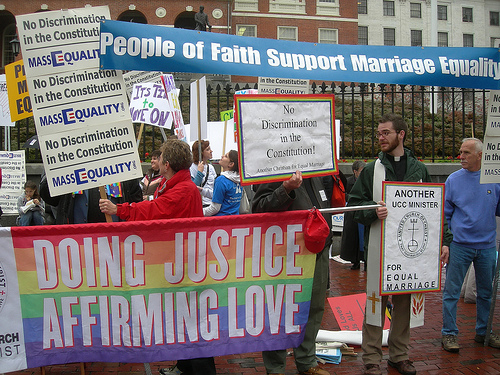
Gay Protest SC Religious Freedom And ‘Gay Marriage’ Cannot Coexist


If the economy is getting better, then why does poverty in America continue to grow so rapidly? Yes, the stock market has been hitting all-time highs recently, but also the number of Americans living in poverty has now reached a level not seen since the 1960s. Yes, corporate profits are at levels never seen before, but so is the number of Americans on food stamps. Yes, housing prices have started to rebound a little bit (especially in wealthy areas), but there are also more than a million public school students in America that are homeless. That is the first time that has ever happened in U.S. history. So should we measure our economic progress by the false stock market bubble that has been inflated by Ben Bernanke’s reckless money printing, or should we measure our economic progress by how the poor and the middle class are doing? Because if we look at how average Americans are doing these days, then there is not much to be excited about. In fact, poverty continues to experience explosive growth in the United States and the middle class continues to shrink. Sadly, the truth is that things are not getting better for most Americans. With each passing year the level of economic suffering in this country continues to go up, and we haven’t even reached the next major wave of the economic collapse yet. When that strikes, the level of economic pain in this nation is going to be off the charts.

The following are 21 statistics about the explosive growth of poverty in America that everyone should know…

1 – According to the U.S. Census Bureau, approximately one out of every six Americans is now living in poverty. The number of Americans living in poverty is now at a level not seen since the 1960s.

2 – When you add in the number of low income Americans it is even more sobering. According to the U.S. Census Bureau, more than 146 million Americans are either “poor” or “low income”.

3 – Today, approximately 20 percent of all children in the United States are living in poverty. Incredibly, a higher percentage of children is living in poverty in America today than was the case back in 1975.

Read More at theeconomiccollapseblog.com . By Michael.

From: http://www.westernjournalism.com/21-statistics-about-the-explosive-growth-of-poverty-in-america/

My Gold Guru Got It Right– and Then Wrong, as the Gold Craze Went Cold

By Robert Lenzner, Forbes Staff My gold guru, Frank Giustra of Vancouver, Canada pushed me hard on gold from the summer of 2008 when it was selling at $900 an ounce– all the way up to $1900 an ounce in the summer of 2011– a hell of a run of accumulated gain of more than a double– while stocks floundered pretty badly. The gold story went like this; Ben Bernanke‘s policy of one QE after another– dramatically increasing the supply of greenbacks– was bound, sooner or later, to cause the dollar to face its own severe crisis of devaluation. Faith in the dollar was going to swoon badly– and then the late to the game investors would recognize that the only true protection against the denouement of paper currency was that precious metal gold. Giustra even believed that the panicky selling of dollars to escape its tarring and feathering would trigger a parabolic rise in the value of gold to some astronomically fantastic level– and then you were supposed to make your exit, selling to the crowd. Such noted hedge fund barons as George Soros and John Paulson signed onto this playbook to one degree or another. Family offices, public pension funds, fixed income advisors looking for an extra kick to their bond portfolios– and the many camp followers no matter how amateur trailed along, thinking to make a killing when gold shot through $200 an ounce to $5000 an ounce and tghen God knows where. Chinese banks, encouraged by the Communist government, allowed their banks to establish monthly gold accumulation plans as the way to stay ahead of whatever inflation hit the fastest growing economy in the world. Indian gold jewelry was hoarded while retail lenders offered credit to accumulators of silver, which was expected to move jointly with gold. Central banks in Asia and in Russia regularly purchased gold whenever the IMF scheduled auctions of its inventory. The tv networks were filled wit come-one advertisements to join the smart money. Then came the denouement in Europe, and pressure on the euro, while the Japanese economy languished and China appeared to be tightening up credit to avoid some kind of bubble. Gold retreated, advanced again, then retreated again– and seems stuck in a trading range between $1525 and $1650 an ounce. The dollar has not collapsed; rather it has gotten stronger as US treasuries are the safe haven of choice and are at record price levels as well as record low yields. Simultaneously, the shares of gold mining stocks have retreated due to the high cost of producing gold, political turmoil and strikes at major mines, and the need of governments like australia or Peru to seek high tax revenues from their mining giants. Desperately, the dreamers, the fantasists and the conspiracy end of civilization fanatics are looking for the new gold- Bitcoins, with staggering face values, or some new currency that will somehow have legs. It has been a great run. Even at $1550, the return since July, 2008 has been 67% over …read more

Source: FULL ARTICLE at Forbes Latest

Bank of America Can't Be Kept Down Today

By John Maxfield, The Motley Fool

Filed under:

Shares of Bank of America , the nation’s second largest bank by assets, are trading higher this afternoon following the unofficial start of earnings season.

Alcoa kicked things off yesterday, offering a glimpse of how the nation’s largest companies performed in the first quarter. While the aluminum giant beat on the bottom line, with earnings per share exceeding the consensus estimate, it came up short on the top line, with revenue falling by 3% on weak aluminum demand.

The true test for banks will come at the end of this week. On Friday, both JPMorgan Chase and Wells Fargo are set to report. Investors and analysts will be watching for three things in particular: mortgage origination volumes, expense reduction, and trading profits/losses. As I’ve discussed before, Wells Fargo is particularly important given the fact that it controls roughly a third of the nation’s mortgage market.

Beyond earnings season, market participants are still working to parse yesterday evening’s remarks by Ben Bernanke, the chairman of the Federal Reserve. Despite the abysmal jobs report at the end of last week, Bernanke noted that “The economy is significantly stronger than it was four years ago, although conditions are clearly still far from where we would all like them to be.”

And with respect to banks in particular, he said: “The resilience of the U.S. banking system has greatly improved since [2009], and the more intensive use and greater sophistication of supervisory stress testing, as well as supervisors’ increased emphasis on the effectiveness of banks’ own capital planning processes, deserve some credit for that improvement.”

For those hoping that the Fed chairman would signal an end to the central bank’s quantitative easing programs, they were left disappointed. It seems safe to assume that banks like Bank of America will continue to struggle against monetary headwinds so long as inflation remains muted and unemployment heightened.

Despite this disappointment, bank stocks are generally up today, with the KBW Bank Index trading higher by 0.7% at the time of writing.

Want to learn more about Bank of America?
Bank of America’s stock doubled in 2012. Is there more yet to come? With significant challenges still ahead, it’s critical to have a solid understanding of this megabank before adding it to your portfolio. In The Motley Fool’s premium research report on B of A, analysts Anand Chokkavelu, CFA, and Matt Koppenheffer, Financials bureau chief, lift the veil on the bank’s operations, including detailing three reasons to buy and three reasons to sell. Click here now to claim your copy.

var FoolAnalyticsData = FoolAnalyticsData || []; …read more

Source: FULL ARTICLE at DailyFinance

Trashing The Gold Standard is Now The Stuff Of Amateurs

By Brian Domitrovic, Contributor

In 2008, Ben Bernanke’s and Paul Krugman’s star former doctoral student at Princeton, the economist Gauti B. Eggertsson, published an article in the American Economic Review, the field’s top journal, on the manifest excellence of the New Deal of the 1930s. One of the claims: “1933-1937 registered the strongest output growth (39 percent) of any four-year period in US history outside of wartime.” …read more

Source: FULL ARTICLE at Forbes Latest

My Cohort Believes QE Only Benefited the Nation's Wealthiest

By Robert Lenzner, Forbes Staff There was plenty of lively controversy– consternation and even angry shouting at a midtown New York restaurant last night as two hedge fund mavens, two immensely successful internet investment services, a closely-followed fixed income adviser and two journalists met to hash over the economic and market controversies of our day. To my way of thinking, there was just about unanimous opinion that Ben Bernanke‘s 4 years of quantitative easing (QE) had for the most part benefited only the nation’s wealthiest cohort– without doing much practically to create more jobs for ordinary people. At least one participant was strident about phasing out QE and letting interest rates begin to rise, arguing vociferously that QE was just one major policy making mistake for America. The yelling across the table rose several pitches at this moment. One closely followed blogger of sharp wit and tongue was clear that Messrs. Bernanke, Paulson and Geithner should have let the insolvent giant banks fail rather than stabilizing them with cheap money. What’s more, QE was judged to have created a possible “bubble” in common stocks– and had as well pushed bond prices to peak historical prices, though I didn’t hear the concept of “bubble” bonds used derogatively. As to the possible inflation from QE, there was sharp divisive debate, with no clear resolution. The quick-witted investment blogger with a cool million followers across the table from me was adamant about Bernanke reversing QE now, reducing the amount of money supply by $3 billion a month, and letting the stimulus run off before it caused some terrible denouement. I didn’t hear the rest of the group sign on to this radicalism. A great deal of animal spirits were spent arguing about the need for a fiscal stimulus financed with 2% money to serve the nation’s infrastructure needs without any clear resolution. Same for the debate about the extent or even existence of structural unemployment. The fixed income maven did clear up my wonder at the public’s continuing hunger for low-yielding bond funds in the face of no real return; the public is moving out of zero yielding money market funds and switching into short-term bond funds yielding 1%, he told me. As we parted to get to the championship basketball game I asked for a raising of hands for my obsessive fantasy that it just may be that the denizens of Wall Street were more or less in charge of the governing of these United States of America. I got the clear impression all participants impulsively signed on to that sentiment. Wow! Comes the revolution. Their emotional instincts strengthened my resolve to have a more concerted go at proving this supposition. And yes, I got the feeling my cohort last night felt to varying degrees that we could well experience another meltdown in the financial markets since major banking institutions had not truly reformed themselves into reformed stalwart institutions. Some wickedly irreverent comments were offered about the pathetic level of oversight by the guardians of financial propriety. …read more

Source: FULL ARTICLE at Forbes Latest

Earnings Season Kicks Off, Bernanke's Speech, and Today's Other Major Financial Stories

By John Maxfield, The Motley Fool

Filed under:

1. Earnings season kicks off

First-quarter earnings season unofficially kicks off today with
Alcoa

reporting after the close. The outlook this quarter has been particularly weak. According to Thompson Reuters, earnings at
S&P 500
companies are set to increase by only 1% compared to 6.2% in the fourth quarter of last year — analysts
surveyed by Bloomberg
estimate that the figure will fall 1.8%. Additionally,
data and analysis
from FactSet shows that 86 companies have issued negative guidance, versus 24 that have issued positive earnings guidance.

In terms of bank stocks, JPMorgan Chase and Wells Fargo both report on April 12, followed by Citigroup on the 15th, and Bank of America on the 17th.

2. Bernanke speaks after the bell
The chairman of the Federal Reserve, Ben Bernanke, is set to speak after the markets close today. Given the particularly abysmal jobs report last week, many are expecting him to continue pushing the central bank’s aggressive monetary stance, under which it’s purchasing $85 billion in treasuries and agency mortgage-backed securities a month.

3. Japan’s central bank has sparked a rally
Speaking of central banks, the Bank of Japan sparked a massive rally in Japanese stocks. The country’s most closely followed index, the Nikkea 225, is at a nearly five-year high, increasing by 46% over the last six months alone. The Yen is also well on its way to a five-year low relative to the dollar. After trading below 80 to the dollar for much of last year, it’s on the verge of breaking the 100 benchmark. As The Wall Street Journal noted, “The new and (as far the market and Japanese exporters are concerned) improved Bank of Japan under the leadership of Haruhiko Kuroda took a page from the Fed’s ‘shock and awe’ playbook, unveiling a bond-buying program that was far larger than anybody expected; in some quarters, it’s being called QQE.”

4. Bank of America seeks to woo customers
The nation’s second largest bank is rolling out a new advertising campaign in conjunction with the NCAA college basketball tournament. It’s designed to be a more humble approach. “We are a facilitator,” a Bank of America marketing executive said. “It’s not about us. We need to focus on customer needs first and we know our place. We know we’re not the center of your life, but we will connect you to what it is.” The move comes on …read more

Source: FULL ARTICLE at DailyFinance

Video: Insider: Obama Plans To ‘Kill’ U.S. Dollar

By Kris Zane

The so-called “Gang of Eight” yesterday announced they were very close to coming up with an immigration reform bill.

Leading conservative Republicans, however—not the gaggle of RINOS that make up half of the Gang of Eight—point out that the immigration “reform” bill has a flaw:  it will provide a back door for millions of illegal aliens to collect welfare.

The cost? Several trillion dollars.

That’s trillion with a “t.”

That would put our national debt above the “magic number” of twenty trillion, the point that many economists state is the tipping point of our economy. Tipping point meaning the U.S. economy would implode.

Add to this the fact that Obama is actually calling for a second Stimulus—as if a trillion dollars flushed down the toilet wasn’t enough.

Add to this the artificially high level of the stock market due to Fed Chairman Ben Bernanke’s endless printing of money in which many are stating a crash is imminent—losing up to 90% of its value.

If one were a conspiracy theorist, it would seem like Barack Obama was actually trying to collapse the economy, putting us in a place like Cyprus where the EU is “taxing”—that is, confiscating—privately held bank accounts to the tune of 40% of their value.

On April 2, Ben Bernanke was asked if the U.S. would do the same thing in a dire economic crisis.

Bernanke hemmed and hawed for several minutes and finally gave up this answer: “It’s unlikely.”

Gee, that sure instills confidence in our banking system.

I guess we’re just a bunch of knuckle-dragging conspiracy theorists who think Obama is actually trying to collapse the economy—by devaluing (killing) the U.S. dollar.

Except that is exactly what a high level source in the intelligence community has stated, as reported in the Canada Free Press on Monday, in the widely read article, “Intelligence Insider: Obama Administration Agenda to Kill U.S Dollar.”

But that is just the beginning. According to the source, after the collapse of the economy, after the collapse of the dollar—after the U.S. dollar is properly devalued and buried long after the collapse of the euro—there will be a banshee cry by the globalists and banksters for an international currency with global government in order to prevent another world-wide economic crisis.

Yes, the economic crisis that they caused.

Obama’s push to gut the Second Amendment, the DHS’s stockpiling of two billion rounds of hollow point ammunition and tens of thousands of assault weapons, and Obama pushing George W. Bush’s Patriot Act to Orwellian levels by spying on literally every single American—is all part of a plan to institute a totalitarian New World Order.

Welcome to Barack Hussein Obama’s fundamental transformation of America.

…read more

Source: FULL ARTICLE at Western Journalism

Ford and GM Shouldn't Fear the Bank of Japan

By Dan Caplinger, The Motley Fool

Filed under:

The Bank of Japan announced unprecedented moves overnight to try to pull the Japanese economy out of a slump that by many measure has lasted for nearly a quarter-century. As a result, Japanese automakers have seen their stocks rise sharply, with Toyota up more than 4% and Honda climbing 5% as of 1:40 p.m. EDT.

But the big question U.S. investors are asking is whether the central bank’s new policies will hurt U.S. automakers Ford and General Motors , which have both seen strong share-price gains since mid-2012. If the Bank of Japan is successful, could Toyota and Honda get a leg up on their American competitors?

What the Bank of Japan did
The Japanese central bank took a page from Ben Bernanke and the Federal Reserve by announcing an asset purchase program similar to the multiple rounds of quantitative easing that the Fed has carried out in recent years. The BOJ will spend nearly $80 billion each month buying Japanese government bonds, doubling its current commitment, and it will also increase purchases of exchange-traded funds and real-estate investment trusts. In a further step, though, the central bank set explicit targets for expanding the country’s monetary base to try to reverse deflationary pressures. The Bank of Japan‘s move had the intended effect of sending Japanese stocks higher, bond yields lower, and the yen’s value sharply downward.

The BOJ‘s moves will give Toyota and Honda some advantages with their exports, as goods sold for U.S. dollars will translate into more yen when the automakers repatriate their profits. But it won’t necessarily reverse troubling sales trends. Toyota’s core division saw sales drop 0.5% in March, as its Camry and Prius models have seen sales slip.

Meanwhile, Ford hasn’t let the already substantial declines in the yen affect its results. In March, U.S. auto sales for Ford rose a better-than-expected 6% thanks to sales of pickups and its new Escape SUV and Fusion sedan. GM saw a similar 6% rise, with the Cadillac ATS one of the highlights. Ford and GM are trading slightly lower today but don’t appear to be suffering much from the BOJ move.

Don’t count on huge gains for Japanese automakers
All in all, the big share-price gains for Honda and Toyota today won’t last unless the automakers can capitalize on the falling yen. So far, they haven’t, and further declines might not do much good anytime soon.

General Motors is an iconic American brand, but are GM’s shares a buy right now? Take a look at the Fool’s premium research report on the automaker, which will tell you the hidden truth about GM‘s growth potential in coming years. (Hint: It’s even bigger than you think. But it’s not a sure thing, and we’ll help you understand why.) It might help give you the courage to be greedy while others are still fearful, as well as a better understanding of the …read more

Source: FULL ARTICLE at DailyFinance