Tag Archives: Sprint Nextel

USA Mobility Receives NASDAQ Listing Compliance Letter Due to Late Filing of Annual Report on Form 1

By Business Wirevia The Motley Fool

Filed under:


USA Mobility Receives NASDAQ Listing Compliance Letter Due to Late Filing of Annual Report on Form 10-K

SPRINGFIELD, Va.–(BUSINESS WIRE)– USA Mobility, Inc. (NAS: USMO) , a leading provider of wireless messaging,mobile voice and data and unified communications solutions, today announced that it has received a letter from The NASDAQ Stock Market LLC notifying the Company that it is not in compliance with NASDAQ Listing Rule 5250(c)(1) because its Annual Report on Form 10-K for the year ended December 31, 2012, was not filed on a timely basis with the Securities and Exchange Commission.

As previously announced, USA Mobility is currently in the process of restating 2011 results for its software business due to a material weakness in the design of internal control over financial reporting relating to software revenue recognition processes. The Company believes there is no material impact to the previously reported interim periods of 2012. USA Mobility expects to complete the restatement process, which has delayed completion of the 2012 annual audit and the filing of the 2012 Form 10-K, as soon as practicable.

The NASDAQ letter dated April 2, 2013 requires the Company to submit a plan within 60 days to regain compliance with NASDAQ‘s filing requirements for continued listing. USA Mobility expects to have filed its 2012 Form 10-K and be in full compliance prior to the due date of the plan.


About USA Mobility

USA Mobility, Inc., headquartered in Springfield, Virginia, is a comprehensive provider of reliable and affordable wireless communications solutions to the healthcare, government, large enterprise and emergency response sectors through its wireless subsidiary, USA Mobility Wireless. In addition, through its software subsidiary, Amcom Software, it provides mission critical unified communications solutions for hospitals, contact centers, emergency management, mobile event notification and messaging nationally and internationally. As a single-source provider, USA Mobility Wireless focuses on the business-to-business marketplace and supplies wireless connectivity solutions to organizations nationwide. The Company operates the largest one-way paging and advanced two-way paging networks in the United States. USA Mobility Wireless also offers mobile voice and data services through Sprint Nextel and T-Mobile, including BlackBerry® smartphones and GPS location applications. Its product offerings include …read more

Source: FULL ARTICLE at DailyFinance

Clearwire Shareholder Offers Finance Deal

By Dan Radovsky, The Motley Fool

Filed under:

Crest Financial Limited, the largest Clearwire (NAS: CLWR) shareholder not affiliated with Sprint Nextel (NYS: S) , has proposed in a letter to Clearwire’s board a financing arrangement “superior to the financing provided by Sprint Nextel Corporation,” one that would allow the company to explore merger options other than Sprint’s offer, according to a Crest announcement.

Crest would like Clearwire instead to consider selling its excess spectrum to DISH Network (NAS: DISH) rather than give it up to Sprint for what Crest feels is less than what that spectrum is worth.

Crest’s offer of $240 million in convertible debt, along with the $160 million in financing Clearwire has already received from Sprint, would give Clearwire enough capital to complete its planned build-out of 2,000 LTE sites plus an additional 2,133 LTE sites for its network, according to Crest.

The article Clearwire Shareholder Offers Finance Deal originally appeared on Fool.com.

Fool contributor Dan Radovsky has no position in any stocks mentioned, and neither does The Motley Fool. Try any of our Foolish newsletter services free for 30 days. We Fools may not all hold the same opinions, but we all believe that considering a diverse range of insights makes us better investors. The Motley Fool has a disclosure policy.

Copyright © 1995 – 2013 The Motley Fool, LLC. All rights reserved. The Motley Fool has a disclosure policy.

(function(c,a){window.mixpanel=a;var b,d,h,e;b=c.createElement(“script”);
b.type=”text/javascript”;b.async=!0;b.src=(“https:”===c.location.protocol?”https:”:”http:”)+
‘//cdn.mxpnl.com/libs/mixpanel-2.2.min.js’;d=c.getElementsByTagName(“script”)[0];
d.parentNode.insertBefore(b,d);a._i=[];a.init=function(b,c,f){function d(a,b){
var c=b.split(“.”);2==c.length&&(a=a[c[0]],b=c[1]);a[b]=function(){a.push([b].concat(
Array.prototype.slice.call(arguments,0)))}}var g=a;”undefined”!==typeof f?g=a[f]=[]:
f=”mixpanel”;g.people=g.people||[];h=[‘disable’,’track’,’track_pageview’,’track_links’,
‘track_forms’,’register’,’register_once’,’unregister’,’identify’,’alias’,’name_tag’,
‘set_config’,’people.set’,’people.increment’];for(e=0;e<h.length;e++)d(g,h[e]);
a._i.push([b,c,f])};a.__SV=1.2;})(document,window.mixpanel||[]);
mixpanel.init("9659875b92ba8fa639ba476aedbb73b9");

function addEvent(obj, evType, fn, useCapture){
if (obj.addEventListener){
obj.addEventListener(evType, fn, useCapture);
return true;
} else if (obj.attachEvent){
var r = obj.attachEvent("on"+evType, fn);
return r;
}
}

addEvent(window, "load", function(){new FoolVisualSciences();})
addEvent(window, "load", function(){new PickAd();})

var themeName = 'dailyfinance.com';
var _gaq = _gaq || [];
_gaq.push(['_setAccount', 'UA-24928199-1']);
_gaq.push(['_trackPageview']);

(function () {

var ga = document.createElement('script');
ga.type = 'text/javascript';
ga.async = true;
ga.src = ('https:' == document.location.protocol ? 'https://ssl' : 'http://www') + '.google-analytics.com/ga.js';

var s = document.getElementsByTagName('script')[0];
s.parentNode.insertBefore(ga, s);
})();

Read | Permalink | <a target=_blank href="http://www.dailyfinance.com/forward/20532009/" …read more

Source: FULL ARTICLE at DailyFinance

The Only Place Amazon Can Go

By Evan Niu, CFA, The Motley Fool

Filed under:

It’s nearly a certainty at this point that e-tail giant Amazon.com is preparing to launch a smartphone, which is now casually known as the “Kindle Phone.” This isn’t just unfounded speculation anymore; there’s plenty of evidence that such a device is en route.

CEO Jeff Bezos has all but confirmed his interest in pursuing a smartphone, saying the hardest part will be to remain differentiated and not simply be another “me, too” device. Over the past couple of years Amazon has also been slowing hiring smartphone talent in the form of former Microsoft Windows Phone execs.

Make no mistake: a Kindle Phone is coming. But where is it going?

Where in the world is Amazon’s content?
When it comes to geographical regions, Amazon’s content offerings are strongest in the U.S., with little to nothing in most other parts of the world. Amazon has been expanding recently, most notably and naturally with e-books, but its music, TV shows, movies, and apps availability is focused primarily in the U.S. with a pinch of European offerings.

Amazon will have to launch the Kindle Phone in the U.S. first, since it won’t seek hardware margins and will rely on its content catalog.

The process of elimination
Of the four primary carriers, chances are that Verizon Wireless and Sprint Nextel won’t be carrier partners since they operate CDMA networks. If Amazon wants to truly be disruptive, it will follow in Google‘s footsteps and try to sell its device unsubsidized, unlocked, and off contract. Unlocked smartphones are typically GSM models because they have easily swappable SIM cards, leaving just AT&T and T-Mobile.

Amazon already has deals with AT&T as the service provider for its cellular-equipped tablets, and Amazon even finagled some incredibly cheap data plans, albeit with small data allowances. However, AT&T has always been predominantly an Apple iPhone carrier — a trend that has intensified over the years.

Source: SEC filings and conference calls.

Last quarter, the iPhone comprised 84% of all smartphones activated on Ma Bell‘s network. Amazon might launch on AT&T, but there’s not a lot to go around outside of Apple’s flagship, especially since AT&T is deeply entrenched in the subsidy model that I’m assuming Amazon is trying to skirt.

Pick a carrier, not any carrier
That leaves the “Uncarrier” as the perfect candidate for Amazon to focus on. T-Mobile is shifting from subsidies to financing programs, while pitching more affordable service plans. At the end of 2012, the No. 4 carrier had 26.1 million banded customers (excluding wholesale and MVNO connections).

While T-Mobile has ditched subsidies, it’s also concentrating very heavily on beefing up its product portfolio. Not only is the carrier now finally getting the iPhone, but it’s also Google’s only official Nexus 4 carrier. T-Mobile will also carry the Samsung Galaxy S4, HTC One, and BlackBerry Z10. These are all devices that Amazon will compete with.

To its Amazon’s credit, T-Mobile’s device pricing is …read more

Source: FULL ARTICLE at DailyFinance

Will Sprint Help You Retire Rich?

By Dan Caplinger, The Motley Fool

Filed under:

Now more than ever, a comfortable retirement depends on secure, stable investments. Unfortunately, the right stocks for retirement won’t just fall into your lap. As part of an ongoing series, I’m looking today at 10 measures to show whether Sprint Nextel makes a great retirement-oriented stock.

Sprint has had a long history of being perceived as the odd player out in the U.S. wireless telecom industry, as its two larger rivals have parceled up much of the most lucrative business over the years. But recent events have thrown the former third-wheel back into the competitive mix. Below, we’ll revisit how Sprint does on our 10-point scale.

The right stocks for retirees
With decades to go before you need to tap your investments, you can take greater risks, weighing the chance of big losses against the potential for mind-blowing returns. But as retirement approaches, you no longer have the luxury of waiting out a downturn.

Sure, you still want good returns, but you also need to manage your risk and protect yourself against bear markets, which can maul your finances at the worst possible time. The right stocks combine both of these elements in a single investment.

When scrutinizing a stock, retirees should look for:

  • Size. Most retirees would rather not take a flyer on unproven businesses. Bigger companies may lack their smaller counterparts’ growth potential, but they do offer greater security.
  • Consistency. While many investors look for fast-growing companies, conservative investors want to see steady, consistent gains in revenue, free cash flow, and other key metrics. Slow growth won’t make headlines, but it will help prevent the kind of ugly surprises that suddenly torpedo a stock‘s share price.
  • Stock stability. Conservative retirement investors prefer investments that move less dramatically than typical stocks, and they particularly want to avoid big losses. These investments will give up some gains during bull markets, but they won’t fall as far or as fast during bear markets. Beta measures volatility, but we also want a track record of solid performance as well.
  • Valuation. No one can afford to pay too much for a stock, even if its prospects are good. Using normalized earnings multiples helps smooth out one-time effects, giving you a longer-term context.
  • Dividends. Most of all, retirees look for stocks that can provide income through dividends. Retirees want healthy payouts now and consistent dividend growth over time — as long as it doesn’t jeopardize the company’s financial health.

With those factors in mind, let’s take a closer look at Sprint.

<td …read more
Source: FULL ARTICLE at DailyFinance
Factor

What We Want to See

Actual

Pass or Fail?

Size

Market cap > $10 billion

$18.8 billion

Pass

Consistency

Revenue growth > 0% in at least four of five past years

3 years

Fail


Free cash flow growth > 0% in at least four of past five years

1 year

Fail

Stock stability

Beta < 0.9

0.98

Fail


Clearwire Taking Sprint's Money; Still Talking to DISH

By Dan Radovsky, The Motley Fool

Filed under:

Clearwire will go ahead and take an $80 million draw provided by a financing agreement with Sprint Nextel , Clearwire announced today.

The money will come in the form of notes exchangeable for Clearwire common stock at $1.50 per share, a price that could be adjusted under certain conditions pursuant to the financing agreements with Sprint. Clearwire has not yet determined whether it will take any future draws under the agreements. According to The Wall Street Journal, Clearwire took an $80 million allotment for March and today’s announcement covers April.

Clearwire further said today that its fiduciary duties mandated discussions with DISH Network regarding the satellite TV provider’s unsolicited proposal to buy the wireless network. DISH‘s proposal is a counteroffer to Sprint’s proposal to purchase the outstanding Clearwire shares that Sprint does not already own.

Those discussions with DISH have been going on over the last three months and will continue until Clearwire can determine “the course of action that it believes is in the best interests of Clearwire’s non-Sprint Class A stockholders,” Clearwire said in its announcement.

link

The article Clearwire Taking Sprint’s Money; Still Talking to DISH originally appeared on Fool.com.

Fool contributor Dan Radovsky has no position in any stocks mentioned. The Motley Fool has no position in any of the stocks mentioned. Try any of our Foolish newsletter services free for 30 days. We Fools may not all hold the same opinions, but we all believe that considering a diverse range of insights makes us better investors. The Motley Fool has a disclosure policy.

Copyright © 1995 – 2013 The Motley Fool, LLC. All rights reserved. The Motley Fool has a disclosure policy.

(function(c,a){window.mixpanel=a;var b,d,h,e;b=c.createElement(“script”);
b.type=”text/javascript”;b.async=!0;b.src=(“https:”===c.location.protocol?”https:”:”http:”)+
‘//cdn.mxpnl.com/libs/mixpanel-2.2.min.js’;d=c.getElementsByTagName(“script”)[0];
d.parentNode.insertBefore(b,d);a._i=[];a.init=function(b,c,f){function d(a,b){
var c=b.split(“.”);2==c.length&&(a=a[c[0]],b=c[1]);a[b]=function(){a.push([b].concat(
Array.prototype.slice.call(arguments,0)))}}var g=a;”undefined”!==typeof f?g=a[f]=[]:
f=”mixpanel”;g.people=g.people||[];h=[‘disable’,’track’,’track_pageview’,’track_links’,
‘track_forms’,’register’,’register_once’,’unregister’,’identify’,’alias’,’name_tag’,
‘set_config’,’people.set’,’people.increment’];for(e=0;e<h.length;e++)d(g,h[e]);
a._i.push([b,c,f])};a.__SV=1.2;})(document,window.mixpanel||[]);
mixpanel.init("9659875b92ba8fa639ba476aedbb73b9");

function addEvent(obj, evType, fn, useCapture){
if (obj.addEventListener){
obj.addEventListener(evType, fn, useCapture);
return true;
} else if (obj.attachEvent){
var r = obj.attachEvent("on"+evType, fn);
return r;
}
}

addEvent(window, "load", function(){new FoolVisualSciences();})
addEvent(window, "load", function(){new PickAd();})

var themeName = 'dailyfinance.com';
var _gaq = _gaq || [];
_gaq.push(['_setAccount', 'UA-24928199-1']);
_gaq.push(['_trackPageview']);

(function () {

var ga = document.createElement('script');
ga.type = 'text/javascript';
ga.async = true;
ga.src = ('https:' == document.location.protocol ? 'https://ssl' : 'http://www') …read more
Source: FULL ARTICLE at DailyFinance

T-Mobile's Legere Kicks Butt. Will It Matter?

By Dan Radovsky, The Motley Fool

Filed under:

T-Mobile has been mentioned more lately than any time since the FCC and Department of Justice pulled the company from the wide-open merger maw of AT&T-Rex last year.

That mega merger not-to-be put a few billion dollars of penalty fees in T-Mobile’s treasury, but the question of “What next?” for the Deutsche Telekom subsidiary still lingered… along with something else: the chip on T-Mobile’s shoulder from being the U.S.’ No. 4 mobile carrier (after No. 3 Sprint Nextel , no less).

Here’s T-Mobile CEO John Legere’s no-holds-barred assessment of the quality of his company’s former altar-mate at this January’s CES:

Anybody here from New York? Any of you use AT&T? Any of you that use them, are you happy? Of course not, the network’s crap.

And that was just the beginning of the colorful language, folks. He got more explicit yesterday at the T-Mobile event in NYC staged to kick off the carrier’s LTE network, confirm getting the iPhone, and announce its new “Uncarrier” plans. Legere derided the postpaid contract model pushed by Verizon , AT&T, and Sprint.

“Carriers are really nice to you … once every 23 months,” he added.

A contract is a contract is a contract
But when consumers put the Uncarrier to the sniff test, they may come away with the same assessment of the plan that Legere has of the other carriers’ plans.

The current two-year commitment consumers must make at the other three first-tier U.S. wireless carriers gives them a phone at a much lower cost than what the phone’s retail price would be. Sometimes the phone even comes free.

A base iPhone 5’s retail price of $649 falls to $199 when coupled to a two-year contract from AT&T, Verizon, and Sprint. Of course, the $450 price difference will be made up for by the 24 monthly plan payments to come.

The T-Mobile plan, on the other hand, does not subsidize the cost of the phone. An iPhone 5, which T-Mobile will begin offering on April 12, will cost the full retail price. However, if customers prefer not to — or cannot afford to — pay full price, they will have the option of buying that phone over time.

For example, the iPhone 5 from T-Mobile will cost $580 — without a contract, of course, because there are no more contracts at T-Mobile. But, one can get that same phone by putting $100 down and committing to two years’ worth of $20 monthly phone payments .

But won’t the customer have to sign a two-year contract stipulating the 24 $20 payments? Of course they will. So is there really a difference between T-Mobile and the other carriers? In reality, no.

And who is eating/subsidizing the $70 difference between Apple‘s retail price for that phone and the price charged by T-Mobile? It looks like T-Mobile will have to choke down the difference.

In the end, I think, any subscriber increase for T-Mobile will have to come from quality of service coupled …read more
Source: FULL ARTICLE at DailyFinance

Sprint Nextel Schedules First-Quarter 2013 Results Announcement

By Business Wirevia The Motley Fool

Filed under:

Sprint Nextel Schedules First-Quarter 2013 Results Announcement

OVERLAND PARK, Kan.–(BUSINESS WIRE)– Sprint Nextel Corporation (NYS: S) will release its financial results for the first quarter 2013 on Wednesday, April 24. The results will be posted at www.sprint.com/investors at approximately 7 a.m. ET. Sprint Nextel management will host a conference call at 8 a.m. ET to discuss the results.

…read more
Source: FULL ARTICLE at DailyFinance


Sprint Nextel Conference Call Information

Date:   Wednesday, April 24, 2013
Time: 8 a.m. ET
Call-in Numbers:

More Wireless Competition in China?

By Dan Radovsky, The Motley Fool

Filed under:

China‘s three mobile operators, China Mobile , China Telecom , and China Unicom , may not only have to start gearing up for more competition, but also provide the network capacity for their new rivals.

Last January, the Chinese Ministry of Industry and Information, or MIIT, sought public comments on its plans to encourage more mobile competition by allowing mobile virtual network operators, or MVNOs, access to the country’s already installed wireless network infrastructure.

The window for that input closed on Feb. 6, and “as soon as in May,” according to media reports repeated by ShanghaiDaily.com, the MIIT will allow MVNO applicants to begin operating.

An MVNO buys network access from an established mobile operator and resells wireless services under its own brand. In the U.S., MVNOs include brands such as Virgin Mobile, which leases service from Sprint Nextel , and TracFone, which gets wireless access from AT&T and Verizon , as well as Sprint.

The government‘s proposal states any private Chinese company with telecom experience and employing over 50 people can apply for the two-year MVNO trial, according to ShanghaiDaily.com. The MIIT plan is for the wireless operators to provide the MVNOs use of their networks at “fair or favorable” prices, according to the draft proposal. The software company Ufida told ShanghaiDaily.com it had applied to become an MVNO.

Rumors of China allowing MVNOs to operate have been swirling around for at least 10 years, according to informa writer Tony Brown. He described an encounter back in October 2003 when a loose-tongued telecom industry executive told him about a done-deal in the strictest of secrecy: “Virgin Mobile is going to launch as an MVNO in Shanghai,” he told Brown.

That sure thing never happened, of course, but the MIIT call for input in January reminded Brown of that encounter and had him speculating on what companies would be likely MVNO candidates — and what that would mean for the actual operators that would have to service them.

If the mobile operators bring in lightweight companies just to meet the two-MVNO per operator mandate from the MIIT, the threat of serious competition is lessened. Those minor MVNOs could include electronics retailers who already sell handsets for the operators. That type of MVNO partner wouldn’t be a threat, but would not offer any — please excuse this overused word — synergy to the relationship.

On the other hand, partnering with a popular over-the-top, or OTT, company that provides broadband content delivery, such as audio and video, outside the control of an Internet service provider, could bring more subscribers to the network — but at some risk, depending on which direction the revenue from that increased traffic would flow.

Popular Chinese messaging service operator Tencent, and Chinese search engine Baidu , according to Brown, would be able to use being an MVNO to their own advantage, as well as providing upside to the mobile network they would use.

The OTTs would gain from not having to …read more
Source: FULL ARTICLE at DailyFinance

Make Money in Merger Arbitrage — the Easy Way

By Selena Maranjian, The Motley Fool

Filed under:

Exchange-traded funds offer a convenient way to invest in sectors or niches that interest you. If you’d like to invest in some merging companies in your portfolio, the IQ Merger Arbitrage ETF could save you a lot of trouble. Instead of trying to figure out which companies will perform best, you can use this ETF to invest in lots of them simultaneously.

The ETF is based on the IQ Merger Arbitrage Index, which “seeks to achieve capital appreciation by investing in global companies for which there has been a public announcement of a takeover by an acquirer.”

The basics
ETFs often sport lower expense ratios than their mutual fund cousins. The IQ ETF‘s expense ratio — its annual fee — is 0.76%. The fund is very small, too, so if you’re thinking of buying, beware of possibly large spreads between its bid and ask prices. Consider using a limit order if you want to buy in.

This ETF is too new to have a sufficient track record to assess. As with most investments, of course, we can’t expect outstanding performances in every quarter or year. Investors with conviction need to wait for their holdings to deliver.

Why mergers?
Some might be interested in merging companies because there are sometimes discrepancies in their prices and also because once a buyout plan is announced, until it is completed, things can change — with new bidders occasionally emerging, for example.

Recent occupants of the ETF include Clearwire and McMoRan Exploration . Clearwire is in the process of trying to combine with Sprint Nextel and Japan’s Softbank. If the deal is approved (the FCC is expected to decide by May 29), the new entity will be a strong competitor in the telecom arena, with my colleague Anders Bylund explaining: “That three-way combination puts Sprint’s large subscriber Rolodex together with Softbank’s cash reserves and maverick business ideas, underpinned by Clearwire’s generous spectrum license catalog. This Frankencarrier should scare the snot out of its direct rivals.”

Meanwhile, Freeport McMoRan Copper & Gold is buying McMoRan Exploration and Plains Exploration and Production. The mining specialist is diversifying its operations with these energy-focused companies, a move that some welcome and others doubt, seeing it as a dilution of focus. The stock looks attractive, trading near a 52-week low and with a forward P/E ratio of just 8. It sports a 3.8% dividend, too, and management is expecting moderate growth in the near term. One worry, though, is the possibility of interest-rate increases from the Federal Reserve, which can make some alternatives to gold more attractive. Still, Freeport is a low-cost producer of copper and molybdenum, positioned to benefit quickly from upturns in metals pricing. Its fourth-quarter earnings report was stronger than expected.

The big picture
A well-chosen ETF can grant you instant diversification across any industry or group of …read more
Source: FULL ARTICLE at DailyFinance

At Long Last, T-Mobile Gets the iPhone

By Evan Niu, CFA, The Motley Fool

Filed under:

There you have it, folks. Nearly six years after Apple launched the original iPhone, it has finally completed its domestic carrier lineup: T-Mobile will at long last get the iPhone. The lack of Apple’s smartphone has long been a major weakness in the No. 4 carrier’s device portfolio, one that was leading to massive subscriber losses to larger rivals that offer the device.

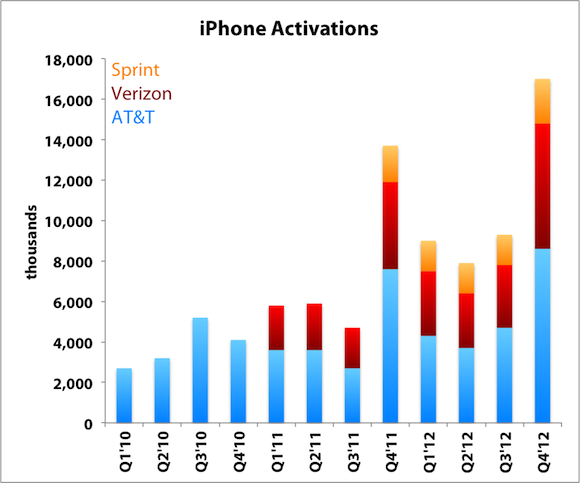
The iPhone will now be available on all four of the largest domestic wireless carriers, in addition to some of the regional ones that it has partnered with over the past year. Expanding carrier partnerships has been critical for Apple’s domestic iPhone sales. Following the first several years of exclusivity with AT&T , the company would quickly add both Verizon Wireless and Sprint Nextel in 2011. As you can see, those carrier partnerships have pitched in quite a lot, judging by their activation figures.

Sources: SEC filings and conference calls. Calendar quarters shown.

While T-Mobile is smallest of the big four, we’re still talking about 26.1 million branded customers that can now easily get their hands on the device. When you include wholesale connections, that figure rises to 33.4 million.

Of course, T-Mobile’s union with MetroPCS is nearly a done deal now, clearing all necessary regulatory hurdles and leaving just shareholder approval. It just so happens that the shareholder meeting to vote on the proposed merger takes place on the same day that T-Mobile customers get their hands on the iPhone. MetroPCS has never been an iPhone carrier, either, and chances are that MetroPCS investors will be all too happy to hook up with T-Mobile and the iPhone.

Living up to its promise, T-Mobile’s iPhone offering is quite different from the subsidized $200-on-contract model that’s become the industry standard.

Not-so-brave new world
T-Mobile is envisioning a brave new world without subsidies and service contracts, and the rest of the industry is keeping a close eye on how it fares. My bet is on “poorly,” judging by what happened in Spain, but only time will tell. At the same time, T-Mobile’s new strategic structure isn’t actually as dramatically different as you’d think.

Instead of offering a subsidized smartphone with a service contract that includes pricier service fees to recoup the subsidy, T-Mobile is splitting up that total payment into a cheaper service fee alongside an installment plan to pay for the device. The total can still be less and result in savings, but ultimately consumers are still paying for those pricey devices one way or another. T-Mobile’s way is just a little more straightforward.

T-Mobile is also marketing its data plans as “unlimited,” but is clear that it will throttle speeds to 2G levels after the included 500 MB of “high-speed data” is used up. Adding more high-speed data will cost extra. That will put it in marketing competition with Sprint, who also markets its data plans as unlimited. But keep in mind that …read more
Source: FULL ARTICLE at DailyFinance

Verizon's Got a Brand New … Phone

By Caroline Bennett, The Motley Fool

Filed under:

HTC lovers have been buzzing over the company’s newest phone offering, the HTC One. However, one big name was missing from the phone’s announcement last month: Verizon . This was especially odd, considering that the phone would be available on three of its biggest competitors: AT&T, Sprint Nextel, and T-Mobile.

Now, HTC is amending its earlier statement to include the telecom powerhouse as one of its newest carriers for the One. Verizon subscribers are still not out of the woods yet, however, because they’ll be two months later than the other carriers to take advantage of the new phone.  

What’s going on here? Does HTC have it in for Verizon, or is this simply a mistake? Fool contributor Caroline Bennett takes a closer look in the following video.

There’s no doubt that Apple is at the center of technology’s largest revolution ever and that longtime shareholders have been handsomely rewarded, with more than 1,000% gains. However, there is a debate raging as to whether Apple remains a buy. The Motley Fool’s senior technology analyst and managing bureau chief, Eric Bleeker, is prepared to fill you in on both reasons to buy and reasons to sell Apple and what opportunities are left for the company (and your portfolio) going forward. To get instant access to his latest thinking on Apple, simply click here now.

var FoolAnalyticsData = FoolAnalyticsData || []; FoolAnalyticsData.push({ eventType: “TickerReportPitch”, contentByline: “Caroline Bennett“, contentId: “cms.26690”, contentTickers: “NYSE:VZ”, contentTitle: “Verizon’s Got a Brand New … Phone”, hasVideo: “True”, …read more
Source: FULL ARTICLE at DailyFinance

These 2 Mobile Networks Will Almost Definitely Merge. Now What?

By Anders Bylund, The Motley Fool

PCS Revenue TTM Chart

Filed under:

The proposed merger between MetroPCS and T-Mobile USA had to wade through acres of red tape before consummation. All the legal and regulatory hurdles have been vaulted, leaving MetroPCS shareholders to issue a final seal of approval.

The seal of approval. You’re very welcome.

It’s still not a completely done deal. MetroPCS’s largest shareholder, hedge fund Paulson & Co., has said that it will vote its 9.9% stake against the current deal structure. On the other hand, second-largest shareholder Madison Dearborn Partners will absolutely support this deal with an 8.3% vote block — one of the the investment firm’s managing directors will have a seat in the new T-Mobile/MetroPCS boardroom.

I wouldn’t exactly call it a nail-biter. MetroPCS could use the scale and the deep pockets that T-Mobile brings to the table. Its own cash flows have become dependably positive in recent years, but top-line growth has trailed off. The company needs some kind of catalyst to jump to the next level, and merging into T-Mobile would most definitely be a game-changer. In short, MetroPCS investors would be silly to turn this deal down.

PCS Revenue TTM data by YCharts

Time to take action
This is no time to rest on your laurels. Sprint Nextel , the other mini-major among the big four, will pose a serious threat as it combines with Japanese sugar daddy Softbank and high-speed network partner Clearwire later this year. That three-way combination puts Sprint’s large subscriber Rolodex together with Softbank’s cash reserves and maverick business ideas, underpinned by Clearwire’s generous spectrum license catalog. This Frankencarrier should scare the snot out of its direct rivals.

SprintBank and T-Metro might even worry Verizon and AT&T . Smaller networks often introduce more innovative and consumer-friendly choices than Ma Bell and Big Red, but they can’t compete with the near-duopoly’s brand awareness and nationwide network builds. Putting pressure on their business models with credible threats from below can only be good for consumers. Investors behind the usurpers will obviously benefit right away, but even AT&T and Verizon should wind up healthier in the long run amid more serious competition.

MetroPCS adds 9 million subscribers to T-Mobile’s list, creating a 42 million-strong customer pool. That’s in the same ballpark as Sprint’s 56 million subscribers, but it’s still far behind Verizon’s 98 million and AT&T’s 105 million.

The smaller network also expands Magenta’s network coverage in major metro areas. In particular, this deal should accelerate T-Mobile’s introduction of 4G LTE services. Oh, and T-Mobile is jumping the gun by acting as if it could change the mobile game all by itself: The company is expected to introduce all new service plans next week, doing away with handset subsidies entirely and basing your service payments on data plans only — everyone gets unlimited calling and texting.

Big changes ahead

There’s a fork in the road ahead, and it will make consumers …read more
Source: FULL ARTICLE at DailyFinance

Is Sprint Changing Its iPhone Perspective?

By Dan Radovsky, The Motley Fool

Filed under:

Once upon a time, Sprint Nextel CEO Dan Hesse, after watching the movie Moneyball, likened the iPhone to a superstar baseball player able to “draw the crowd and fill the seats in [the team’s] high-fixed-cost stadium. iPhone has an expensive contract but he’s worth every penny.”

That contract was expensive all right; Sprint committed to buy from Apple $15 billion worth of iPhones over four years. But because Hesse felt “…the number one reason new customers don’t try Sprint has been no iPhone,” that money seemed like a mandatory cost of doing business.

Unfortunately for Sprint, as well as for AT&T and Verizon, the iPhone subsidies mobile carriers must pay to entice subscribers into signing long-term contracts just keep eating away at their profits. The more phones subsidized, the thinner the margins.

Now, in a much quieter voice announcing a program aimed at Sprint’s wholesale customers, the Mobile Virtual Network Operators, or MVNOs, which re-sell Sprint’s network services under their own brands, it seems Sprint is sidling up to Google‘s Android.

The company issued a statement today, recognizing Android’s popularity by citing research from mobile industry analyst firm Strategy Analytics saying that “70 percent of the world smartphone market share belonged at the end of 2012 to Android.”

It also brought up research firm comScore’s U.S. smartphone market share numbers, “which showed Android leading in market share with 53.4 percent of the total smartphone market.”

What Sprint says it will do for the MVNOs is offer them volume pricing on a selection of de-branded “marquee” Android handsets.

“The Android operating system provides such incredible flexibility and supply chain economy of scale that … [we] can now extend a … new branding opportunity to our wholesale customers,” said Bill Esrey, vice president of Emerging & Wholesale Solutions at Sprint.

This is quite an extraordinary reflection on the importance of Android made by the company that had put the iPhone on such a high pedestal.

The article Is Sprint Changing Its iPhone Perspective? originally appeared on Fool.com.

Fool contributor Dan Radovsky owns shares of AT&T. The Motley Fool recommends Apple and Google. The Motley Fool owns shares of Apple and Google. Try any of our Foolish newsletter services free for 30 days. We Fools may not all hold the same opinions, but we all believe that considering a diverse range of insights makes us better investors. The Motley Fool has a disclosure policy.

Copyright © 1995 – 2013 The Motley Fool, LLC. All rights reserved. The Motley Fool has a disclosure policy.

(function(c,a){window.mixpanel=a;var b,d,h,e;b=c.createElement(“script”);
b.type=”text/javascript”;b.async=!0;b.src=(“https:”===c.location.protocol?”https:”:”http:”)+
‘//cdn.mxpnl.com/libs/mixpanel-2.2.min.js’;d=c.getElementsByTagName(“script”)[0];
d.parentNode.insertBefore(b,d);a._i=[];a.init=function(b,c,f){function d(a,b){
var c=b.split(“.”);2==c.length&&(a=a[c[0]],b=c[1]);a[b]=function(){a.push([b].concat(
Array.prototype.slice.call(arguments,0)))}}var g=a;”undefined”!==typeof f?g=a[f]=[]:
f=”mixpanel”;g.people=g.people||[];h=[‘disable’,’track’,’track_pageview’,’track_links’,
‘track_forms’,’register’,’register_once’,’unregister’,’identify’,’alias’,’name_tag’,
‘set_config’,’people.set’,’people.increment’];for(e=0;e<h.length;e++)d(g,h[e]);
…read more
Source: FULL ARTICLE at DailyFinance

Will DISH Be Swallowed Whole by DIRECTV?

By Michael Lewis, The Motley Fool

Filed under:

Satellite-television giant DIRECTV has employed Latin America as its growth driver over the past couple of years, and it’s been a wonderful partnership. The company has gained millions of subscribers in the region while its North American business faces the same challenges felt by competitor DISH Network and other service providers. Recently, DIRECTV courted Vivendi-owned GTV, a Brazilian broadband player with 10% of the market share. However, the deal recently crumbled over disagreement on price. This left some analysts thinking now may be an appropriate time for DIRECTV and DISH Network to join forces. What would that look like?

A history of not merging
The DIRECTVDISH merger is not a new concept at all. The two companies actually tried to do it back in 2002, but regulators determined it was not in the best interest of free markets. This wouldn’t be the same situation today, though, given the formidable competition from streaming services such as Netflix and Amazon.com, in addition to traditional cable companies.

But why would the two companies want to merge? DIRECTV CEO Mike White said the two companies do, in fact, have strong potential synergies.

Two different strategies, same goal
Both DISH and DIRECTV have taken significant, though very different, strides to navigate the changing tides of content distribution. DIRECTV has taken what I consider to be a more traditional, risk-averse strategy of expanding into emerging markets — mainly Latin America. This has, as I mentioned, led to explosive subscriber growth quarter after quarter, even if ARPUs have suffered because of low price points and exchange rates. DIRECTV‘s shares are currently trading at an all-time high.

DISH, on the other hand, took the risky road, and it has yet to pay off. The company has been aggressively attempting to build out its own broadband network, with some degree of success. But what it really needs is a partner. The company recently made an offer for Clearwire that came in at a premium to Sprint Nextel‘s offer, but most believe Clearwire will ultimately go to the latter. This leaves DISH in a tricky position — it has billions invested in valuable spectrum, years of regulatory shuffling and positioning, and meanwhile, lackluster subscriber numbers in its U.S. market. If DISH is eventually able to launch its wireless network and compete head-on with telecoms, it would be a major value driver going forward, but this leaves little to be excited about in the short term.

So by merging with DIRECTV, DISH would solve its core business stagnation. The resulting company would easily be the satellite-television overlord of the Americas, with plenty of cash flow from both its higher ARPU North American subscribers, and its rapidly increasing Latin American operations.

DIRECTV, on the other hand, would get the spectrum and broadband play, possibly even more valuable than its proposed acquisition of GTV.

Many, including Investment bank Macquarie, think this merger makes more sense now than ever and could be right around the corner.

Good, …read more
Source: FULL ARTICLE at DailyFinance

Sirius XM Radio: Tomorrow's Monster Stock?

By Rich Duprey, The Motley Fool

Yet it’s tough to ignore the growing level of competition, not least of which is the recent deal between General Motors and AT&T to offer 4G mobile hotspots in most 2015 model-year cars. Sirius has been able to put off the threat posed by Pandora and Spotify thus far, but this new option seems a lot more insidious.

Online behind the wheel
Sirius is dismissive of the

Filed under:

Stocks climbing to 10 times their original price are rare breeds. But they’re not impossible to find, especially when you have Fools for friends.

The market’s best stocks include companies that have risen dozens of times in value by taking advantage of the market‘s weaknesses. These aren’t penny stocks; they’re viable companies with sound business prospects that are achieving phenomenal returns. Finding just one or two of these monstrously successful firms can help you establish a winning portfolio.

Stalking the monster
To find tomorrow’s winners, we’ve enlisted the help of the monster-trackers at Motley Fool CAPS, the 180,000-member-driven investor community where informed opinion is translated into stock ratings of one to five stars. We’ll be peering in on the picks of those who have successfully chosen stocks that doubled, tripled, or even quadrupled in price, and this week All-Star member mwink gives us satellite-radio operator Sirius XM Radio as his next monster pick. He made his mark with Apple , which soared 400% after he picked it to outperform the indexes, compared with the S&P 500’s 17% increase.

Of course, you shouldn’t jump into the breach just because an All-Star stock picker did. Just consider this as a starting point for your own research of extreme buying opportunities.

Debt and equity
With more than 23.9 million subscribers at the end of 2012, the continued growth of Sirius XM remains predicated on the health of the U.S. auto industry, and as seasonally adjusted sales of light duty vehicles remains above the 15 million mark for the third straight month, the satellite radio operator has a good chance of seeing sales expand.

Yet it’s tough to ignore the growing level of competition, not least of which is the recent deal between General Motors and AT&T to offer 4G mobile hotspots in most 2015 model-year cars. Sirius has been able to put off the threat posed by Pandora and Spotify thus far, but this new option seems a lot more insidious.

Online behind the wheel
Sirius is dismissive of the larger meaning behind the agreement, a brave game face despite its being a herald of things to come. AT&T is simply the first carrier to broadly offer fast connectivity to drivers; it won’t be long before Verizon and Sprint Nextel ink similar connected car deals, and GM will only be the first automaker to give car buyers the option of having a true mobile hotspot.

Luxury-car buyers already have limited cellular connections for dashboard apps for their Audis, BMWs, and Teslas , and Ford has also offers some connectivity with certain models, such as the Ford Focus EV. But it’s the breadth of vehicles covered by GM‘s plan and the willingness of AT&T to open up its bandwidth to more customers that sets it apart.

And even though it lost the GM OnStar contract to its rival, Verizon’s acquisition of …read more
Source: FULL ARTICLE at DailyFinance

1 Underappreciated Advantage That Apple Has in Smartphones

By Evan Niu, CFA, The Motley Fool

Filed under:

The smartphone market is one of the most brutal competitive landscapes known to consumer electronics companies. Fortunes rise and fall all the time, with today’s darling being tomorrow’s pariah. Just look at how quickly Taiwanese OEM HTC fell from grace, as Samsung roared from behind to leapfrog its fellow Google Android vendor.

One reason that the rivalry is so intense is that smartphones face relatively short upgrade cycles compared to other form factors. Consumers tend to buy new smartphones every two years as soon as their eligible for a carrier-subsidized upgrade. In comparison, TV upgrade cycles are upwards of seven years, and the average consumer hangs on to a new PC for about four years.

Carriers rule
There’s also another important determining factor when it comes to the smartphone wars though: carrier distribution. Since carriers are a necessary evil and serve as distribution middlemen between consumers and OEMs, their sales efforts are remarkably important with nudging the consumer this way or that way.

Needham & Company analyst Charlie Wolf recently took note of this fact since smartphone market shares can crater with “brutal speed.” Wolf believes that carriers have “exceptional influence” on what phones customers choose because their retail stores are the primary distribution point for many smartphone OEMs.

The analyst notes that when carriers decide to “punish or simply ignore a brand,” the platform can “rapidly die.” Wolf points to BlackBery and Nokia as two prominent examples. BlackBerry 7 unit sales suffered leading up to its BlackBerry 10 launch, while Nokia’s transition away from Symbian toward Microsoft Windows Phone has similarly been painful.

Palm is another perfect example of how OEMs can live or die by carrier ambivalence. When Verizon suddenly backed out of Pre exclusivity talks in favor of its Droid campaign, relegating Palm to ink a deal with the much smaller Sprint Nextel, it was a death knell for the turnaround candidate.

In the meantime, Google has offered numerous incentives for carriers and their sales reps to push Android. For example, Google has offered to split fees related with Google Wallet with carriers, while it also offers carrier billing for content purchased from Google Play. Walk into any carrier retail store and you’ll inevitably find a slew of Android offerings that overshadow perhaps a single iPhone display.

How does Apple stand apart from nearly all of its rival smartphone makers?

A direct advantage
Apple is one of the only smartphone vendors that operates its own retail stores and sells directly to consumers. Most iPhone sales are conducted directly, either through Apple’s online store or its retail stores. Consumers simply can’t go to a rival’s website to buy a smartphone directly — they’re instead pointed to a carrier or third-party retailer website.

The reason why Apple initially decided to open its own retail stores in the first place a decade ago remains the same: it can control the buying experience. At the time, Steve Jobs was tired of …read more
Source: FULL ARTICLE at DailyFinance

USA Mobility Announces Extension For Reporting Fourth Quarter and 2012 Results

By Business Wirevia The Motley Fool

Filed under:


USA Mobility Announces Extension For Reporting Fourth Quarter and 2012 Results

SPRINGFIELD, Va.–(BUSINESS WIRE)– USA Mobility, Inc. (NAS: USMO) , a leading provider of wireless messaging, mobile voice and data and unified communications solutions, today announced an extension for reporting operating results for the fourth quarter and year ended December 31, 2012.

The Company has delayed reporting of its operating results for the fourth quarter and year ended December 31, 2012 to address a material weakness in the design of internal control over financial reporting relating to the software revenue recognition process. The Company undertook a review of all relevant revenue transactions to ensure (1) that these transactions were recognized in the proper periods and (2) that multiple element arrangements in the delivery of software, hardware and related services were allocated to the appropriate revenue categories. The Company has determined that this material weakness did not impact the existence or validity of the underlying revenue transactions or the Company’s receipt of cash for these revenue transactions. In order to finalize this review the Company delayed completion of its annual audit and filing of its Annual Report on Form 10-K for the year ended December 31, 2012 with the Securities and Exchange Commission.

The Company will announce the date for reporting its fourth quarter and 2012 results and the date and details of its investor conference call as soon as practical.


About USA Mobility

USA Mobility, Inc., headquartered in Springfield, Virginia, is a comprehensive provider of reliable and affordable wireless communications solutions to the healthcare, government, large enterprise and emergency response sectors. In addition, through its Amcom Software subsidiary, it provides mission critical unified communications solutions for hospitals, contact centers, emergency management, mobile event notification and messaging nationally and internationally. As a single-source wireless provider, USA Mobilitys focus is on the business-to-business marketplace and supplying connectivity solutions to organizations nationwide. The Company operates the largest one-way paging and advanced two-way paging networks in the United States. USA Mobility also offers mobile voice and data services through Sprint Nextel and T-Mobile, including BlackBerry® smartphones and GPS location applications. The Company’s product offerings include customized wireless connectivity systems for …read more
Source: FULL ARTICLE at DailyFinance

Sprint Statement on the Upcoming Availability of Samsung Galaxy S 4

By Business Wirevia The Motley Fool

Filed under:

Sprint Statement on the Upcoming Availability of Samsung Galaxy S 4

NEW YORK & OVERLAND PARK, Kan.–(BUSINESS WIRE)– Today, Samsung Electronics Co., Ltd. introduced Galaxy S® 4, successor to the award-winning Samsung Galaxy S III. Sprint (NYS: S) will offer the U.S. variant of Galaxy S 4 in the second quarter of this year.

Fared Adib, senior vice president-Product Development at Sprint, issued the following statement:

“Sprint is excited to bring the benefit of Truly UnlimitedSM 4G LTE data to the U.S. variant of Galaxy S 4 in the second quarter of this year. Our customers will appreciate the ability to use Galaxy S 4 to surf the Web, share pictures and videos, and use this smartphone as much as they want without worrying about throttling or overage charges on their monthly bill due to data caps. NPD Group data indicated in 4Q 2012 that Sprint was the top U.S. seller of Samsung Galaxy S III, so we believe our customers will also enjoy its successor’s features and unlimited data.”

Galaxy S 4 customers can enjoy an unlimited data experience with Sprint Everything Data plans. Sprint’s Everything Data plan with Any Mobile, AnytimeSM includes unlimited Web, texting and calling to and from any mobile in North America while on the Sprint Network, starting at just $79.99 per month for smartphones – a savings of $20 per month versus Verizon’s comparable plan with unlimited talk, text and 2GB Web (excludes taxes and surcharges).

Additional details, including pricing, will be shared in the coming weeks.

About Sprint Nextel

Sprint Nextel offers a comprehensive range of wireless and wireline communications services bringing the freedom of mobility to consumers, businesses and government users. Sprint Nextel served more than 55 million customers at the end of 2012 and is widely recognized for developing, engineering and deploying innovative technologies, including the first wireless 4G service from a national carrier in the United States; offering industry-leading mobile data services, leading prepaid brands including Virgin Mobile USA, Boost Mobile, and Assurance Wireless; instant national and international push-to-talk capabilities; and a global Tier 1 Internet backbone. The American Customer Satisfaction Index rated Sprint No. 1 among all national carriers in customer satisfaction and most improved, across all 47 industries, during the last four years. Newsweek ranked Sprint No. 3 in both its 2011 and 2012 Green Rankings, listing it as one of the nation’s greenest …read more
Source: FULL ARTICLE at DailyFinance

What You Were Selling Last Week: Vodafone Group

By Jon Wallis, The Motley Fool

Filed under:

LONDON — One of Warren Buffett‘s famous investing sayings is “be fearful when others are greedy and greedy when others are fearful” — or, in other words, sell when others are buying and buy when they’re selling.

But we might expect Foolish investors to know that, and looking at what Fools have been selling recently might well provide us with some ideas for investments that are past their prime

So, in this series of articles, we’re going to look at what customers of The Motley Fool ShareDealing Service have been selling in the past week or so, and what might have made them decide to do so.

Six-month high
Less than a month ago, Vodafone was at the No. 1 spot in the “Top Ten Buys” list* — so what’s happened to put it at the top of the “Sells” list?

Well, for one thing, its share price hit a six-month high last week, reaching almost 188 pence during March 11, a level not seen since August last year. After the company’s somewhat roller-coaster progress since then — it dipped as low as 154 pence at the end of 2012 — people may have felt inclined to take some profits.

They may also have started having some concerns about Vodafone’s future. The surge in Vodafone’s price last week came on the back of strong rumors that U.S. telecom leader Verizon Communications was considering the future of its relationship with the UK..-based telecom giant. Perhaps Verizon will buy Vodafone out of its 45% share of Verizon Wireless — currently estimated to be worth around $115 billion (77 billion pounds) — or else there might be a merger which, if it happened, would be the biggest in corporate history. (In reality, Verizon would effectively buy Vodafone, but it’d be called a “merger” to keep everyone happy.)

While selling its stake in Verizon Wireless would give Vodafone a considerable lump sum to play with, it would also mean the loss of a generous cash-cow — Verizon Wireless generated a dividend of over $3.8 billion (2.5 billion pounds) for Vodafone at the end of 2012, and $4.5 billion (3 billion pounds) the year before.

And any potential merger would not be without considerable attendant risks. Large corporate mergers and acquisitions have a habit of being deeply disappointing, if not deadly — think AOL/Time Warner, HP/Compaq or (and also in the telecoms industry) Sprint/Nextel — with more failing to achieve their financial goals than succeeding. Any short-term gain in Vodafone’s value generated by the excitement of impending nuptials could easily be more than wiped out in the long-term by a failed marriage.

So perhaps some people decided to take some profit now from Vodafone’s improved share price, on the back of the initial rumors, and then wait and see what happens.

A high-quality income share
Many people will have bought Vodafone for its dividend, currently 5.2%. Here at the Fool, our analysts have been focused on finding The Motley Fool’s Top …read more
Source: FULL ARTICLE at DailyFinance

Apple Buying Sprint Fixes Everything

By Rick Munarriz, Munarriz, The Motley Fool

Filed under:

This isn’t supposed to be Apple‘s week.

We’re seeing iPhone rivals hog the spotlight. Yesterday we saw BlackBerry shares soar on buyout chatter and news that the Z10 smartphone will finally hit the stateside market later this month. In two days it will be Samsung’s turn to shine as it unveils the anxiously anticipated Galaxy S IV.

Apple doesn’t really have to worry about BlackBerry at the moment. The new BlackBerry 10 mobile operating system is impressive, but developer support will remain lukewarm until it achieves critical mass.

Thursday’s Samsung Unpacked event will be a game changer. If the leaked specs are accurate — the 5-inch screen with 1,080p resolution, the 13-megapixel camera with the ability to snap 3-D pictures, a speedy 1.8GHz processor, and a full two gigs of RAM — Apple’s iPhone 5 will be behind on all fronts.

Spec sheets alone don’t sell smartphones, but the gaps in software advantages and developer support have been narrowing between iPhone and Android.

Apple needs to do something big and bold. How does buying Sprint Nextel grab you?

Don’t laugh
Buying the country’s third-largest carrier would seem to be a colossal mistake on many different levels.

  • The move would upset Apple’s two largest domestic carriers, putting beefy subsidies and support at risk.
  • Sprint’s still losing a lot money.
  • Apple would only be tackling the stateside market when the larger problem is the price of its unsubsidized smartphone in overseas markets.

Let’s file that all away in the “I know where you’re coming from” folder, and get right back into why this could be exactly what Apple needs at this juncture.

Apple has a problem, and you’re seeing it on unconfirmed reports of Apple scaling back on iPhone 5 and new iPad devices from its suppliers.

Folks are buying the iPad Mini at $329 because it’s perfectly adequate and nearly as good as the $499 iPad. Apple and analysts were surprised with the product mix for iPhones during the holiday quarter as customers went for the cheaper iPhone 4 and iPhone 4S models that are $200 and $100 cheaper, respectively.

Is the primary takeaway here that consumers are trying to save money or that Apple is down to courting penny-pinchers to gain traction with the next wave of mainstream mobile gadgetry shoppers?

Let me introduce a new wrinkle to explain the lack of demand for the iPhone 5 despite its distinct advantages over earlier models. I’ve owned an iPhone through three generations of the defining smartphone, but I’m in no hurry to hop on the iPhone 5. AT&T and Verizon Wireless have grandfathered longtime customers with unlimited data plans, but that perk ends the moment that they upgrade to a 4G device. Verizon Wireless will toss you into tiered pricing unless you pay $450 more for an unsubsidized iPhone 5. AT&T caps the usage at 5 gigabytes before dramatically lowering the connectivity speed.

Sprint is the only one that continues to market unlimited data to new customers, but, …read more
Source: FULL ARTICLE at DailyFinance