Tag Archives: Steve Jobs

"Jobs" Movie Marketing Kicks Up Another Notch With Behind-The-Scenes 'Featurette'

By Connie Guglielmo, Forbes Staff

There have already been a few trailers. The movie poster was released earlier this month. And today the folks bringing us Jobs, the movie starring Ashton Kutcher and Josh Gad as Apple co-founders Steve Jobs and Steve Wozniak, released  what they’re calling a “featurette” — an almost 3-minute long promotional piece for the movie that takes viewers behind-the-scenes. …read more

Source: FULL ARTICLE at Forbes Latest

Lessons Steve Jobs Taught Me

By Vick Vaishnavi, Contributor

In a 1996 interview with Wired magazine, Steve Jobs, upset with Microsoft’s domination of the personal PC market, said, “The desktop computer industry is dead. Innovation has virtually ceased. Microsoft dominates with very little innovation. That’s over. Apple lost. The desktop market has entered the dark ages.”  From that quote it appears he’s waving the proverbial white Power Mac, but Jobs would go on to overhaul Apple, ultimately taking the floundering tech company from near-bankruptcy to one of the most profitable corporations in U.S. history. Although not quite the size of the California-based giant, and despite a near-decade of competing in a mercurial IT Security landscape, Aveksa has maintained its position as a leader in the Identity and Access Management (IAM) marketplace since its inception in 2004. …read more

Source: FULL ARTICLE at Forbes Latest

Is Apple's Dark Period Finally Coming To A Close?

By Mark Rogowsky, Contributor

It’s been a rough 10 months for Apple since the stock touched $700 and the iPhone 5 was released last September. Slowing growth, a lack of new products outside of a smaller iPad, and a relentless technology press have more or less created the impression the company is yesterday’s news. After Microsoft’s disappointing earnings results last week highlighted the software giant’s troubles transitioning to a mobile world, surely Apple will join its old rival in the tech company dead pool when it reports later today. Oh, and it’s going to let everyone know next quarter won’t be much better. That’s the conventional wisdom anyway. The source of Apple’s woes, according to the multitude of experts, is some combination of CEO Tim Cook’s failure to effectively replace Steve Jobs, a lost ability to innovate, or something to do with the admittedly poor rollout of Apple’s Maps product with the new iPhone. In the short run, though, the company has faced more tangible execution and product-cycle issues rather than ethereal “innovation” problems. And many of those seem to be clearing. Consider: The iPhone is too expensive, but still very popular. Apple sells iPhones to carriers for an average price of $641. That’s true even though nearly half of them are older iPhone 4 and 4S models, according to data from Consumer Intelligence Research Partners. (Their survey is U.S. only; it’s likely that the total is even more skewed toward older models in at least some other countries.) In Russia, these high prices recently led the three largest carriers to drop the iPhone entirely. Clearly, Apple has some problems, which is why nearly everyone expects a lower-priced model with a plastic-shell from the company this September. …read more

Source: FULL ARTICLE at Forbes Latest

Feedback Is Overrated

By Rajeev Peshawaria, Contributor What do Nelson Mandela, Steve Jobs, John Lennon and the Beatles, Mahatma Gandhi, Howard Schultz, Abraham Lincoln, Michelle Kwan, Thomas Edison, Beethoven, Steven Spielberg, Marilyn Monroe, Walt Disney, Soichiro Honda, Charles Darwin and Michael Jordan have in common? …read more

Source: FULL ARTICLE at Forbes Latest

Microsoft's New Toy Is a Preemptive Attack on Apple

By Rick Munarriz, The Motley Fool

Filed under:

A lot has been said about Microsoft‘s Xbox One since it was introduced on Tuesday. However, here’s something that you probably haven’t heard: Xbox One is a preemptive strike on Apple .

Think about it. Apple is working on a smart television. Shortly before his death, Steve Jobs told his biographer that he had cracked the problem with smart TVs. CEO Tim Cook told NBC’s Brian Williams — on primetime television — that it’s an area of “intense interest” at Apple.

Let’s dream out loud. What would an Apple smart TV do?

Well, thanks to the popularity of Siri, it’s a safe bet that there would be some degree of voice recognition. Xbox One has that. “Watch TV” switches to live TV. “Watch AMC” switches the channel. “What’s on HBO?” pulls up the channel’s listings guide.

Apple’s device would also probably incorporate FaceTime video chat. Yes, Microsoft’s all over that. The Xbox One allows for Skype video chats — with multiple users at the same time.

Naturally, there would be some App Store integration with live content, but Xbox One is there already. You can pull up personalized fantasy stats during NBA and NFL games. You can be playing a Blu-ray disc and switch to a split screen to pull up Internet Explorer to figure out where you know that actress from through IMDB or pull up movie ratings on Rotten Tomatoes.

App Store integration naturally means playing games on your TV, and Xbox One naturally will have Apple beat on that front.

The clincher here is that Microsoft already has tens of millions of active Xbox Live users. They all won’t hop on the Xbox One platform right away, but they will over time as prices get cheaper.

However, as expensive as the Xbox One will be, a full blown Apple HDTV will probably cost more than a Microsoft console with an existing flat screen. Now that we know that Microsoft will have its new toy out in time for this year’s holiday shopping season, it’s not as if Apple can get a head start here.

The more you think about it, the more you may start to realize that Apple may already be too late.

The only way Apple could realistically have a game-changer in an Xbox One world would be to revolutionize pay TV. Rolling out a piecemeal service in which consumers pay only for the channels that they watch — or the content that they watch — would more than justify Apple’s inevitably high price.

The problem, unfortunately, is that cable networks have every reason to be uncooperative here. They stand to lose big money if Apple disrupts cable and satellite television providers. If Apple hasn’t been able to get iRadio off the ground as negotiations with the music labels have been reportedly rough, how is Apple going to talk studios and content creators to disrupt a model that will save consumers money at their expense?

The Xbox One is bigger blow to …read more

Source: FULL ARTICLE at DailyFinance

First Pic of Ashton Kutcher as Steve Jobs

Jobs, Joshua Michael Stern’s forthcoming bioic of the life and times of Steve Jobs, has been announced as the closing night movie of the Sundance Film Festival.
And the first official image has been released of Ashton Kutcher as the Apple co-founder and former CEO.
Scroll down for a look at the picture, and head to Variety for a list of the Sundance feature and documentary premieres.

Continue reading…
Source: IGN Movies  

BlackBerry Is Still Underrated on Wall Street

By Adam Levine-Weinberg, The Motley Fool

BBRY Chart

Filed under:

For a prominent company that’s frequently in the news, BlackBerry is one of the most misunderstood stocks in the market today. Too much attention focuses on the company’s past missteps — which allowed Apple and Google to rapidly overtake it — rather than BlackBerry’s future prospects. Similarly, now that the new BB10 OS has come to market, too many people are focusing on the success or failure of the Z10 (BlackBerry’s first BB10 device) rather than the ecosystem’s overall potential.

To be “successful,” the Z10 would need to sell perhaps 2 million units per quarter — just a tiny fraction of Apple’s iPhone sales or Samsung‘s Galaxy S series sales. However, even that level of sales is not necessary to justify a higher valuation for BlackBerry, because the Z10 is just a small part of BlackBerry’s future. The much more important Q10 smartphone — equipped with BlackBerry’s signature QWERTY keyboard — is just hitting the market now. Furthermore, BlackBerry CEO Thorsten Heins has already revealed that lower-cost BB10 smartphones will come to market later this year, probably in the fall. Extremely low market expectations and a strong product roadmap will most likely combine to generate strong returns for BlackBerry investors.

Cheap stock
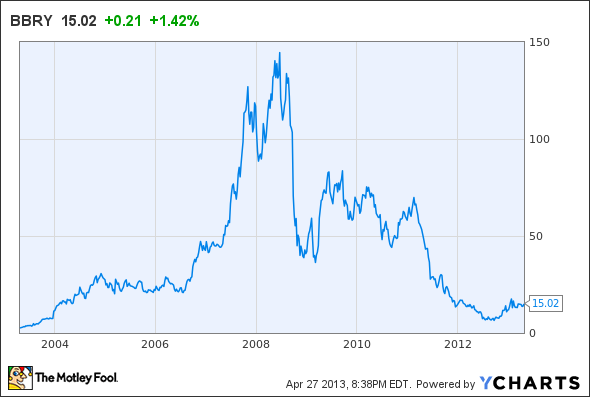
The investment case for BlackBerry is straightforward. First — and most obviously — the stock trades for $15, which is below book value. In other words, the company is priced to never earn a profit in the future and eventually go bankrupt. This is a big change from 2011, when the stock peaked above $70, or 2008, when BlackBerry shares briefly traded for more than $140:

BlackBerry 10-Year Price Chart; data by YCharts

To put it another way, for the past year, investors have been able to buy BlackBerry stock at prices that had not been seen since the company was a small start-up.

Great product
Second, BlackBerry has a competitive product again. The BB10 operating system is great for multitasking and includes several unique features that may appeal to current iPhone or Android users. Many people already claim that iOS is getting stale and that Apple has lost its touch for innovation since Steve Jobs passed away. More recently, Samsung’s Galaxy S4 has underwhelmed many reviewers, who see it as a great phone, but not a big improvement over the SIII.

In all likelihood, most iPhone users will stay within the iOS ecosystem, and most Android users will stay within Android going forward. But consumer desires for something “fresh” could drive a significant number of people to BlackBerry over the next couple of years. This may get BlackBerry to only 10% market share, but the smartphone market has grown tremendously since the original BlackBerry went out of fashion. Today, having 10% market share would involve having BlackBerry sell more phones than it did at the peak of its popularity.

Loyal user base
Lastly, BlackBerry has an extremely loyal high-end user base of 20

Source: FULL ARTICLE at DailyFinance

How Apple Accidentally Revolutionized Health Care

By Keith Speights, The Motley Fool

2014 Toyota 4Runner reveal at Stagecoach Music Fest

Filed under:

Apple didn’t necessarily intend to revolutionize health care, but that’s exactly what happened. Health care has changed dramatically since Steve Jobs first stood in front of an audience to introduce first the iPhone then later the iPad. Much of that change can be directly attributed to Apple.


Source: 3D4Medical.

Apples and doctors
It used to be said that an apple a day keeps the doctor away. That could still be applicable, but the opposite is true for doctors and Apple. Physicians love their iPhones and iPads.

A study by Manhattan Research in 2011 found that 75% of physicians owned at least one Apple product. Vitera Healthcare‘s 2012 survey of health-care professionals backed up this high number. The company’s study found that 60% of respondents used an iPhone and 45% owned an iPad.

The real revolution, though, has come from how physicians and other health-care professionals are using Apple’s devices. Mobile applications opened the door for clinicians to instantly access a world of medical information at the point of care.

For example, WebMD‘s Medscape application allows physicians to check drug interactions, look up information about procedures, and see medical news updates on the fly. Medscape ranks first among the most frequently downloaded medical apps for iPhones and iPads.

Yale University’s School of Medicine even did away with paper materials for training upcoming physicians. The school provided iPads and wireless keyboards to all of its medical students. Other schools followed suit.

Health eVillages’ experience underscores the transformational impact of Apple’s technology. The not-for-profit organization provides mobile health technology to medical professionals in areas such as Kenya and Haiti. Lives have been saved that otherwise would have been lost, thanks to doctors in remote areas who use an iPad to access needed information.

Use of Apple’s products goes beyond serving as a reference tool, though. An application that allows radiologists to view MRIs as well as CT, PET, and SPECT scans on iPhones and iPads received FDA approval in 2011. More recently, the FDA cleared the way for privately held Welch Allyn to connect its portable ophthalmoscope to an iPhone for doctors to view retinal images using the company’s app.

iPatients
Apple perhaps unwittingly opened new horizons for patients also. By April 2012, the company’s App Store included more than 13,600 health-related applications.

A peek at some of the current top-selling apps shows how much Apple’s technology has empowered patients. One application allows individuals to monitor their sleep cycles. Another provides a detailed guide to help expectant mothers through their pregnancies.

Pharmaceutical companies are getting into the act. For example, Vivus recently introduced an app for iPhones (and Android phones) that complements its weight-loss drug. The app allows patients to record what they eat and track their weight plus receive regular information updates.

Vital Art and Science recently gained FDA approval to sell its myVisionTrack product, which enables people with macular degeneration and other degenerative eye diseases to monitor their

Source: FULL ARTICLE at DailyFinance

Netflix's Need Is Apple's Opportunity

By Tim Beyers, The Motley Fool

Filed under:

Reed Hastings wants Netflix investing in more original series. And why not? House of Cards is already a success, and early signs point to a similarly strong showing for the horror series Hemlock Grove.

Trouble is, this sort of content doesn’t come cheap. In a manifesto posted to Netflix’s investor-relations site recently, Hastings confessed that original program development is “cash-intensive” and that producing more shows is likely to mean raising money from investors or partners:

As we expand Originals, they will consume cash. Since we are otherwise using domestic profits to fund international markets, we will raise capital as needed to fund the growth of Originals.

And that, Fool, is where Apple comes in. The Mac maker should be investing in Netflix original programming.

Source: Netflix.

How about an iPad with that?
It’s a rich opportunity. Netflix’s bulkier content portfolio led to hefty profits in Q1. Revenue rose 17.7% to $1.02 billion as the company turned an $0.08 per share loss into a $0.31 per share profit, after accounting for charges related to paying off debt. Wall Street was expecting just $0.18 a share. The stock promptly soared 20% on the news.

Why should Apple care? Math. Better TV apps means a better TV experience on the iPad, which means more reasons to buy an iPad, which means more iPad sales.

Or at least that’s how the market seems to be trending: iPad unit sales soared 65% and came in almost 1.5 million ahead of consensus estimates in fiscal Q2 versus a 7% year-over-year increase in iPhone sales. IDC is right — tablets are becoming an everyday item for American consumers, none more so than the iPad.

A natural partner
Apple and Netflix also share competitors. Consider Amazon.com and Google . Each sells individual tracks as iTunes does. They also offer music, books, and magazines in addition to streaming. Apple mutes their stores on its devices for this very reason.

Hulu isn’t a competitor, but management uncertainty makes partnering a risk. Redbox Instant would be an alternative as a development partner if executives had any interest in original programming. So far, they don’t.

Which brings us back to Netflix. Hastings needs Apple’s cash, and CEO Tim Cook has demonstrated a willingness to invest in ways the late Steve Jobs never would. Listen to how CFO Peter Oppenheimer described the company’s cash strategy in announcing fiscal Q2 earnings.

“We continue to generate cash in excess of our needs to operate the business, invest in our future, and maintain flexibility to take advantage of strategic opportunities,” Oppenheimer said in a press release. That, Fool, is how an investor talks when he’s searching for the next win.

Wait till Ringo hears about this
Starting a studio is probably out of the question given Apple’s litigious history with The Beatles. Any move to broaden the “Apple” brand in entertainment could get nasty in a hurry.

Yet Apple needn’t go that

Source: FULL ARTICLE at DailyFinance

Simple Innovations Can Have Huge Consequences

By Alex Planes, The Motley Fool

Filed under:

On this day in economic and business history …

Several innovations reached critical milestones in their development on April 27. All three of those we’ll examine today have affected the companies on the Dow Jones Industrial Average , but the effect isn’t always straightforward, nor is it always positive. In fact, the first development on our list never added much at all to its creator’s bottom line — but its influence on the computing industry (which has placed five companies on the Dow) is undeniable. Let’s take a closer look at these three developments, to better understand how they’ve helped shape the business world as it exists today.

Point and click, day one
Xerox introduced the world’s first commercially available computer mouse on April 27, 1981. The mouse had been invented way back in the 1960s by Douglas Englebart and his team of researchers at Stanford, but it would take many years for technologists to translate his innovations into commercially successful products. In fact, until the mouse was released as part of the Xerox Star workstation package, there had been no computers with graphical interfaces available for public purchase. Without graphical interfaces, there simply hadn’t been a reason for anyone to use a mouse.

The Star’s graphical interface and its mouse were both descendants of the legendary Xerox Alto, an experimental computer developed by Xerox’s Palo Alto Research Center that is largely known now for its influence on young entrepreneurs Steve Jobs and Bill Gates. However, like the Alto, the Star was too far ahead of its time and wound up quickly eclipsed by a lower-cost but less-functional computer released later in 1981: the PC.

It was not until 1984, when Apple launched the Macintosh, that a computer purpose-built for mouse controls caught on with the public. By the time Dow component Microsoft‘s Windows 1.0 hit the market in 1985, the mouse era had taken hold. The combination of a mouse with a graphical user interface could have propelled Xerox ahead of PC creator (and longtime Dow component) IBM, but Xerox’s inability to capitalize on advanced technology is the stuff of corporate legend. IBM is no less to blame for its inability to maintain control of the standard it created. By allowing Microsoft to control the PC‘s operating software, IBM missed a golden chance to leverage its scale and technological expertise into a fully proprietary mouse-based computing experience.

How much longer will the mouse era last? The mouse may soon find itself relegated to technology’s dustbin as touchscreen devices gain prominence with the public. That won’t happen for some time, but it’s interesting to think about what our next control scheme will be. Beyond touch, will we move things on the screen with our eyes? Will our brainwaves be the next control scheme? The answer may be just around the corner.

The 747’s biggest threat
The

Source: FULL ARTICLE at DailyFinance

Why Netflix Stock Is Cheap Despite a 700 P/E Ratio

By Anders Bylund, The Motley Fool

Filed under:

Netflix shares have more than tripled over the past six months in a flurry of subscriber growth and big content wins. But not everyone is impressed.

The stock is heavily shorted. On Wall Street, you’ll find nearly as many “sell” recommendations on Netflix as “buy” calls. Fellow Fool Adam Levine-Weinberg is not a fan of Netflix at current prices, calling it overvalued and worrying over negative cash flows. And when I presented three positive surprises from Netflix’s latest monster quarter, one skeptical reader wondered how I can see the stock doubling in the next three years and “still not be worth this P/E.”

Fair enough. The P/E ratio does look scary, north of 700 times trailing earnings. Negative cash flows are never comfortable, particularly for investors trained in the Foolish school of thought where cash is king. I get that. Netflix is not a stock for the faint of heart even with a few quarters of recently proven success under its belt.

But P/E ratios are a terrible metric for valuing Netflix today. And sometimes you have to burn cash today to build a reliable cash machine for tomorrow. Netflix is currently in that heavy investment phase of the digital-media era, and it would be a horrible mistake not to step on the accelerator as hard as possible right now.

Let me show you a familiar precedent for this situation. Take a look at this chart, showing a company that was down on its luck in the early 2000s:

AAPL P/E Ratio TTM data by YCharts

Yes, that’s Apple back in the iMac and iPod heyday. Earnings and cash flows were erratic and sometimes negative. Cupertino was breaking new ground in several important markets, starting with the music industry and preparing for the iPhone’s launch of a smartphone revolution.

P/E ratios were often sky-high or impossible to calculate back then, given Apple’s barely scraping-by financials. But that was only the surface story. Below the cracking veneer, Apple was innovating and planning ahead. Steve Jobs had seen the future, and he was busy building it. Never mind if Apple’s market cap dipped for a while — the long-term payoff was sure to be fantastic.

What happened next is the stuff of legend:

AAPL P/E Ratio TTM data by YCharts

Apple shares skyrocketed more than 1,100% between 2005 and 2012 as Steve’s vision turned the smartphone and tablet markets upside down. This was the game-changing future that Apple was spending its operating cash on a couple of years earlier.

And this is the kind of market traction that Netflix is building right now.

Digital video is still a very young industry. Netflix is leading the way into a new era in the same way that Apple created all-new markets in music and mobile computing during the last decade. Netflix is spending money now so it can reap the fruits of a peerless

Source: FULL ARTICLE at DailyFinance

Apple’s Fading Allure Worries Investors, Suppliers

By The Huffington Post News Editors

(Reuters) – Apple Inc marketing chief Phil Schiller let slip during last August’s courtroom battle with Samsung that when setting forecasts for new iPhones, the inside joke was that people should assume sales would equal all previous versions combined.

That quip, uttered in front of Samsung Electronics Co Ltd‘s trial lawyers and the media, no longer rings true as Apple appears to be losing a once vice-like grip on its supply chain and Wall Street.

Suppliers and investors are struggling to gauge demand for the iconic smartphone as Samsung and up-and-coming rivals grab market share. Indications of reduced shipments now send shares in Apple and its component-makers into a tailspin. And criticism that innovation has stalled after the death of its legendary co-founder Steve Jobs 18 months ago is hurting sentiment in a stock that closed the week below $400 for the first time since December 2011.

Read More…
More on Apple

From: http://www.huffingtonpost.com/2013/04/21/apple-stock-worries-suppliers-investors_n_3127912.html

Consumer Collaboration: How Charles Schwab Used Real-Time Research To Enhance Relationships

By Sean Rosensteel, Contributor

Shortly after Mark Parker became Nike CEO and started working on the Nike+ partnership with Apple, he had one of his first telephone conversations with Steve Jobs. At the end of the call Parker asked Jobs: “Do you have any advice for me?” Here’s what Jobs had to say:

From: http://www.forbes.com/sites/seanrosensteel/2013/04/19/consumer-collaboration-how-charles-schwab-used-real-time-research-to-enhance-relationships/

Funny or Die's iSteve Hits the 'Net

iSteve, Funny or Die’s biopic on the late Steve Jobs, officially debuted this week online. As the site’s longest video project to date, the 80-minute comedy is a parody of the biopic genre.

Justin Long — who used to play Mac in those “Mac vs. PC” commercials a few years back — stars as the titular Jobs, with former Lostie Jorge Garcia assuming the role of Apple co-founder Steve Wozniak.

Funnily enough, iSteve is the only Steve Jobs biopic that’s out right now, but there are two others in the works: one called jOBS, starring Ashton Kutcher and Josh Gad, which was recently bumped to a TBD release date, and another, currently untitled, penned by Aaron Sorkin.

Continue reading…

From: http://www.ign.com/articles/2013/04/17/funny-or-dies-isteve-hits-the-net

The Surprising iCloud Trick That Gives a Glimpse of Apple's Televised Future

By Tim Beyers, The Motley Fool

Filed under:

Quietly, Apple is rolling out iCloud syncing for both movies and TV shows.

How do I know? I’m one of what seems to be a growing number of iTunes season pass subscribers. Last week, I downloaded the latest episode of the second half of Series 7 of Doctor Who — see the trailer at the end — and started watching as I always do: 15 minutes at lunch at my desk, followed by a download to my iPad Mini during a workout break later in the day.

In years past, I’d write down the time stamp for where I’d left off so that, when switching devices, I’d catch myself up manually. Not this time. This time, iTunes was smarter. The download to my iPad included a bookmark for where I’d stopped watching on my Mac.

Source: Apple.

Later tests with Apple TV and my iPhone featuring other TV and movie content produced similar results, proving that iCloud is now syncing in much the same way Netflix does. It’s a brilliant move that offers two clues about the iEmpire’s thus-far enigmatic TV strategy:

  1. While possible, Apple is unlikely to embrace streaming. There’s never been a pressing need thanks to Netflix, YouTube, and now Amazon.com . In enabling iCloud syncing, the company enjoys bookmarking benefit of server-delivered content without incurring the costs of maintaining uptime and ensuring fast content delivery.

  2. Apple doesn’t so much want a TV as it does “TV Everywhere.” Netflix has already proved that there’s big money to be made delivering quality video content to viewers where and how they want. Apple is embracing this same strategy, but with newer, downloadable content. The likely result? Continued demand for the mini-TVs we call iPads, even as the iEmpire works to fulfill the late Steve Jobs’ vision for a better home entertainment experience.

Who loses in all this? Pure-play content distributors such as Cablevision Systems and DISH Network . Like partner Netflix, Apple is taking steps to eliminate the barriers between viewers and content created by these gatekeepers. Color me grateful — both as an investor and as a fan of great television.

Want even more Apple analysis? Allow me to introduce you to The Motley Fool’s senior technology analyst and managing bureau chief, Eric Bleeker, who has the skinny on the various reasons to buy or sell Apple right now. Click here to get his latest thinking on the stock and what opportunities are left for Apple (and your portfolio) going forward.

var FoolAnalyticsData = FoolAnalyticsData || [];

From: http://www.dailyfinance.com/2013/04/14/in-copying-netflix-apple-gives-a-glimpse-of-its-te/

Apple Stock: The Next Run Could Come Sooner Than You Think

By Adam Levine-Weinberg, The Motley Fool

Filed under:

Apple shareholders have understandably become very frustrated over the past seven months, as Apple stock has fallen nearly 40% from the all-time high it reached last September. Apple seems very cheap, at just 10 times earnings — or 6.5 times earnings if you exclude the company’s massive cash position — but that hasn’t managed to attract buyers. However, the negativity that has surrounded Apple recently may actually be setting the stage for another big run-up, which could reward the Apple shareholders who have been patient in the face of the stock‘s downward spiral.

Low expectations
The market‘s low expectations for revenue and earnings growth are one major reason for optimism about Apple stock going forward. Wall Street already expects tepid revenue growth and a sharp year-over-year EPS decline when Apple reports Q2 earnings later this month. While iPad unit sales will be boosted by the first full quarter of iPad Mini shipments, iPhone and Mac sales are expected to be fairly similar to last year’s Q2 totals. Moreover, a combination of higher component costs and lower average selling prices will lead to a significant drop in gross margin; Apple’s guidance in January implied that gross margin could fall as much as 990 basis points from the all-time high of 47.4% set in Q2 last year.

Apple’s poor recent stock performance can be attributed in part to the company’s long string of successes in the five years after the iPhone’s launch in mid-2007. That raised the bar so high that the company was bound to disappoint eventually. When it finally happened, Wall Street quickly soured on Apple stock, as seen in the rapid fall of price targets from analysts such as Peter Misek, whose $900 price target of early December became a $420 price target by early March. With many market participants expecting Apple to struggle for a long period of time, any evidence of a return to growth could quickly reinflate Apple stock.

Big opportunities
Yet behind Wall Street‘s current scorn for Apple and low expectations regarding the potential for innovation there, Apple has a variety of potential catalysts on the horizon. First, new product lines could be released as early as this fall, with an “iTV” the most likely candidate. Rumors of an iTV have been rampant ever since the release of Walter Isaacson‘s biography of Steve Jobs, since Jobs told Isaacson that he had “finally cracked” the TV. However, Apple followers have been disappointed as purported iTV release dates have come and gone. Today, the market seems to be assigning no value to new product lines, based on the low Apple stock price. I don’t know what Apple’s next product will be or when it will be released, but I’m very confident that there will be one; Apple’s R&D spending grew 40% in the last fiscal year, to $3.4 billion.

Furthermore, Apple will almost certainly release new versions of

From: http://www.dailyfinance.com/2013/04/13/apple-stock-the-next-run-could-come-sooner-than-yo/

Laurene Powell Jobs Advocates For Immigration Reform In First Public Appearance Since Husband's Death

By Ryan Mac, Forbes Staff

Laurene Powell Jobs, the widow of late Apple cofounder Steve Jobs, will make her first televised appearance since her husband’s death in an effort to push Congress to pass the DREAM Act, an immigration reform bill that would give children of undocumented immigrants a path to citizenship.

From: http://www.forbes.com/sites/ryanmac/2013/04/12/laurene-powell-jobs-advocates-for-immigration-reform-in-first-public-appearance-since-husbands-death/