Tag Archives: Strategy Analytics

Group led Microsoft, Nokia takes aim at Android with EU complaint

The FairSearch coalition, whose members include Microsoft, Nokia and Oracle, has filed a complaint with the European Commission against Google and Android, saying that the company is using the OS as a Trojan horse to deceive partners and monopolize the mobile marketplace.

Android has become the dominant smartphone operating system when counting units sold, with a market share of 70 percent during the fourth quarter, according to Strategy Analytics. Google is now using that dominance to lock out competition in mobile sector, FairSearch said.

The way Google packages apps such Maps and YouTube on Android-based smartphones “disadvantages other providers, and puts Google’s Android in control of consumer data on a majority of smartphones shipped today,” while the “predatory distribution of Android at below cost makes it difficult for other providers of operating systems to recoup investments in competing with Google’s dominant mobile platform,” according to the coalition.

“We are asking the Commission to move quickly and decisively to protect competition and innovation in this critical market. Failure to act will only embolden Google to repeat its desktop abuses of dominance as consumers increasingly turn to a mobile platform dominated by Google’s Android operating system,” said the FairSearch coalition’s Brussels-based counsel Thomas Vinje, in a statement.

To read this article in full or to leave a comment, please click here

…read more

Source: FULL ARTICLE at PCWorld

Does NVIDIA Deserve a Place in Your Portfolio?

By Alex Planes, The Motley Fool

Filed under:

I’ve had my eye on NVIDIA for a while now. As an old-school fan of PC games, I’ve used several NVIDIA graphics cards over the years, and as a follower of the fast-changing mobile landscape, I can appreciate the chipmaker’s efforts to diversify into the biggest new personal computing market since the market was created in the 1980s. However, I haven’t quite been able to step over the line and actually buy NVIDIA for my personal portfolio, as I’ve watched its stock lose an unexpectedly large amount of ground against the indexes for the last two years despite a stream of (generally) positive news:

NVDA Total Return Price data by YCharts.

What’s wrong with NVIDIA today? Are its problems too great to justify investing in it, or is the company poised for a mobile turnaround on the strength of its latest Tegra processors? Let’s dig into some pro and con arguments to figure out whether NVIDIA should be part of my (or your) portfolio, or if it’s better watched from afar.

Pro: Tegra 4i looks to get a leg up on the competition
NVIDIA‘s latest smartphone chip, the Tegra 4i, is shaping up to be a watershed release for the company’s mobile efforts. It’s the first NVIDIA chip with an integrated wireless 3G/4G LTE modem, and just as importantly, it’s purportedly half the size of smartphone processor market leader Qualcomm‘s competing Snapdragon 800. Small is beautiful when it comes to smartphone components, both in terms of the space premium for a device’s internal layout and in terms of its power consumption. NVIDIA CEO Jen-Hsun Huang pointed out that “we’ll have some phone success this year, but we’re not expecting to have a whole lot of phone design wins until we engage the market with LTE.” Well, NVIDIA‘s engaged the market now.

Con: NVIDIA is still far behind in mobile processors
The Tegra 4i is a big leap forward for NVIDIA, but it may not be enough to upend Qualcomm from its dominant position in smartphone processors. The Tegra 4i may be smaller than Qualcomm’s latest, but the new Snapdragons purportedly retain a power-consumption advantage. Qualcomm executives continue to boast of superior performance, which could be bluster, but may well not be — the market leader’s R&D spending over the past four quarters is nearly four times NVIDIA‘s, and Qualcomm has every incentive to laser-focus itself on holding that lead.

In the most recently available quarter, Strategy Analytics showed Qualcomm far in the lead on smartphone applications processors with a 42% market share. Samsung comes in second with 27%, in large part because of a long-standing relationship with Apple . NVIDIA doesn’t even crack the top five, and its smartphone share has been “relatively flat” year over year.

Pro: NVIDIA leads in non-Apple tablets
There is one area where NVIDIA bests Qualcomm: Android tablets. Apple still controls nearly half of the total tablet …read more
Source: FULL ARTICLE at DailyFinance

Is Android in the business world to stay?

It’s official, and it’s been official for a while—Android is far and away the most popular smartphone OS in America. Ever since January 2011, when the platform surpassed RIM to take the top spot for the first time in comScore’s monthly market share rankings, Google’s operating system has continued to grow its user base, which accounts for 52 percent of the market as of this January.

This growth has been created on the back of substantial software upgrades, in the form of Ice Cream Sandwich and Jelly Bean (Android 4.0 and 4.1, respectively), as well as increasingly impressive hardware from OEMs like Samsung, HTC, Sony, Motorola and LG. Last year’s Samsung Galaxy S III was the first phone to dethrone the iPhone in total quarterly sales in years, according to research from Strategy Analytics, though the subsequent release of the iPhone 5 saw Apple retake the top spot quickly thereafter.

Read the Do’s and Don’ts for Using Android in Business

It’s easy to find a host of reasons for Android’s ascendance among consumers—a wide variety of devices offers more choice to prospective buyers, stronger hardware and bigger screens appeal to fans of the latest and greatest, and as of Android 4.0 and 4.1, the interface is arguably more impressive than the latest version of Apple iOS.

To read this article in full or to leave a comment, please click here

…read more
Source: FULL ARTICLE at PCWorld
The Surprising Reason Dropbox Should Go Public Now

By Tim Beyers, The Motley Fool

Filed under:

Some of the best companies around are still private: Evernote, SpaceX, Twitter, and, of course, Dropbox, the file-sharing service that’s ostensibly surrounded by Google‘s Drive, Microsoft‘s SkyDrive, and Apple‘s iCloud.

More than anything else, the flexibility to handle work as well as personal files deftly has made Dropbox popular. What we didn’t know is just how popular. But then Strategy Analytics released a report that found it to be the second-most-popular “locker” for digital music and movies, trailing only iCloud.

Is now the time for Dropbox to go public? Tim Beyers of Motley Fool Rule Breakers and Motley Fool Supernova answers this question and more in the following video. Please watch, and then weigh in using the comments box below.

Interested in more information about Apple’s cloud aspirations? The Motley Fool’s senior technology analyst and managing bureau chief, Eric Bleeker, has the skinny on the various reasons to buy or sell Apple right now. Click here to get his latest thinking on the stock and what opportunities are left for Apple (and your portfolio) going forward.

var FoolAnalyticsData = FoolAnalyticsData || []; FoolAnalyticsData.push({ eventType: “TickerReportPitch”, contentByline: “Tim Beyers“, contentId: “cms.26258”, contentTickers: “NASDAQ:AAPL, NASDAQ:MSFT, NASDAQ:GOOG”, contentTitle: “The Surprising Reason Dropbox Should Go Public Now”, hasVideo: “True”, pitchId: “1”, …read more
Source: FULL ARTICLE at DailyFinance

Apple Named King of Cloud Computing

By Tim Beyers, The Motley Fool

Filed under:

When it comes to storing most of our online entertainment, Google and its Drive file system isn’t top dog. Neither is Microsoft‘s SkyDrive or Amazon.com‘s Cloud Drive. The winner? Apple , says a new report from Strategy Analytics.

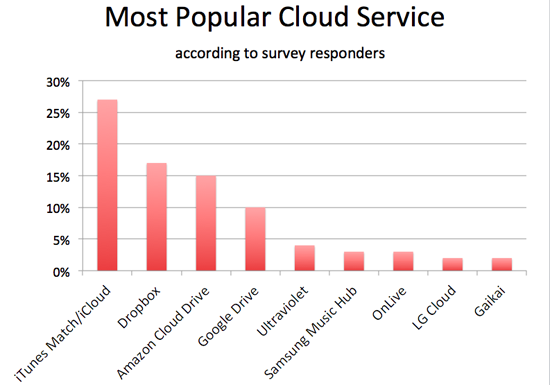
The survey asked respondents which digital locker services they use to store music or video. iCloud and iTunes topped the list with 27% using Apple’s services. Surprisingly, Dropbox ranked second, two percentage points ahead of Cloud Drive.

Source: Strategy Analytics.

Whether or not this is the first time anyone’s taken a serious look at the “entertainment cloud,” I think it’s fair to say that — up to this point — we’ve largely overlooked Apple’s growing presence online. How we could not? We’re too busy covering efforts by Google and Microsoft to win users to their respective cloud productivity suites.

Let’s take a break from that back and forth for a moment and consider a few numbers not included in the Strategy Analytics report, but which reflect the Mac Maker‘s increasing influence:

Source: Apple.

Imagine if only a third of them were backed up to iCloud. I’m almost surprised Apple doesn’t possess a greater share of the entertainment cloud. At the very least, I suspect some of its $140 billion fortune might go to building an overseas data center for serving the increasing number of iOS devices in use in non-U.S. markets.

Put simply: The cloud is expanding fast but, if the data is to be believed, not nearly as fast as iCloud.

For further analysis of Apple, I invite you try our newest premium research service in which Motley Fool senior technology analyst and managing bureau chief Eric Bleeker assesses the risks and opportunities of investing in the iEmpire. Access your report now by clicking here.

var FoolAnalyticsData = FoolAnalyticsData || []; FoolAnalyticsData.push({ eventType: “TickerReportPitch”, contentByline: “Tim Beyers”, …read more
Source: FULL ARTICLE at DailyFinance

Apple Is King of Cloud Storage

By Chris Neiger, The Motley Fool

Filed under:

Cloud storage doesn’t have the same razzle-dazzle as a new iPhone or Galaxy smartphone, but it can be just as important as a shiny new product. Consumers may focus on new products, but investors should also be looking at the cloud services that come with it.

Up, up, and away
Strategy Analytics just released a report earlier this week highlighting which services Internet consumers use the most. At the top of the list, and not so surprisingly, was Apple and Amazon.com . But Google , with all of it’s cloud offerings, fell short in fourth place. Here’s how they stack up:
 

Source: Engadget. 

The reason for Apple’s dominance may stem from consumers’ preferences to store massive amounts of music, rather than any other content. Around 90% of Apple, Amazon, and Google cloud users store music collections. According to Ed Barton at Strategy Analytics, music will continue to be one of the most important features of cloud services. He said in a press release, “Music is currently the key battleground in the war for cloud domination.”

What’s interesting about the chart is that Google offers certain features like music matching, similar to iTunes Match, for free, but falls behind both Apple and Amazon for cloud storage. Apple charges $25 a year for the service, and Amazon offers 250 songs for free, but then charges $25 as well for up to 250,000 songs.

Building Apple’s cloud
With consumers looking to the cloud for more content streaming and storage, Apple is in a good position to benefit from the trend, if it can seize the opportunity. Apple has had some missteps with the cloud in the past, including hang-ups with iCloud and the failed MobileMe and .Mac. But earlier this week, it hired a former Cupertino adversary, Adobe Systems Chief Technology Office Kevin Lynch.

Lynch sparred with Apple in the past over Adobe’s Flash technology, but has also helped build Adobe’s Creative Cloud software to 500,000 subscribers. Some analysts believe that Apple’s new hire will help usher in more cloud services at the company.

The sky’s the limit
Apple may not be known for its cloud services now, but if it can harnesses its massive number of cloud storage customers and build some new products through Lynch, it could become a vital part of its business. Some have been critical of Apple’s cloud strategy in the past, or lack thereof, but it’s clear now that it has the upper hand when it comes to cloud customers.

The critical part for Apple right now is to offer more cloud services to its current customers. As more people become familiar with storing and streaming media within the cloud, Apple may have to introduce products that meet consumer demand. An Apple music streaming service has been the most widely talked-about idea, but for now investors will have to be happy with the company’s first place position in cloud storage.

There’s no doubt that Apple …read more
Source: FULL ARTICLE at DailyFinance

Is Apple Winning the Cloud Storage War?

By Evan Niu, CFA, CFA, The Motley Fool

Filed under:

Cloud storage has become a bona fide battleground in the war for consumer mindshare. Storage and media services have become an important area of competitive distinction for companies, as ecosystems are now of critical importance to success.

One of the earliest and most popular services is Dropbox, a cloud storage and syncing service that Apple even attempted to acquire at one point. As it turns out, Apple has now jumped ahead of Dropbox in usage, along with all other rivals, according to a recent report from Strategy Analytics. The study found that cloud storage was closely related to music, with nearly half of users keeping their tunes in the cloud.

When including iTunes Match into the equation, Apple tops the rankings with 27% market share. Dropbox ranked in second place at 17%, which is particularly notable because the smaller company has no content ecosystem whatsoever, and is primarily a storage service. Dropbox only recently got into email through its acquisition of Mailbox, following an acquisition of Audiogalaxy late last year, showing clear music aspirations.

Amazon.com was actually one of the earlier movers among the tech titans, launching its Cloud Drive in March 2011. The e-tail giant is the No. 3 provider of cloud media services, with 15% of users onboard. Nearly a year ago, Google got in the game with Google Drive, which functions almost identically to Dropbox. Google Drive was being used by 10% of the respondents.

Samsung has been trying to make a big push into software and services, which was evident at its Galaxy S4 event. The South Korean company’s Music Hub service isn’t gaining much traction, with just 3% usage. That’s due, in part, to the fact that the service has historically been limited to Samsung devices, although Samsung is planning on expanding its horizons soon.

The overall fortunes in the cloud storage and media services market is anything but decided though, as Strategy Analytics estimates that 55% of connected Americans have never used a cloud storage service of any kind. That means there’s still plenty of fish left in the cloud storage sea.

There is a debate raging as to whether Apple remains a buy. The Motley Fool’s senior technology analyst and managing bureau chief, Eric Bleeker, is prepared to fill you in on both reasons to buy and reasons to sell Apple, and what opportunities are left for the company (and your portfolio) going forward. To get instant access to his latest thinking on Apple, simply click here now.

var FoolAnalyticsData = FoolAnalyticsData || []; …read more
Source: FULL ARTICLE at DailyFinance

Is Sprint Changing Its iPhone Perspective?

By Dan Radovsky, The Motley Fool

Filed under:

Once upon a time, Sprint Nextel CEO Dan Hesse, after watching the movie Moneyball, likened the iPhone to a superstar baseball player able to “draw the crowd and fill the seats in [the team’s] high-fixed-cost stadium. iPhone has an expensive contract but he’s worth every penny.”

That contract was expensive all right; Sprint committed to buy from Apple $15 billion worth of iPhones over four years. But because Hesse felt “…the number one reason new customers don’t try Sprint has been no iPhone,” that money seemed like a mandatory cost of doing business.

Unfortunately for Sprint, as well as for AT&T and Verizon, the iPhone subsidies mobile carriers must pay to entice subscribers into signing long-term contracts just keep eating away at their profits. The more phones subsidized, the thinner the margins.

Now, in a much quieter voice announcing a program aimed at Sprint’s wholesale customers, the Mobile Virtual Network Operators, or MVNOs, which re-sell Sprint’s network services under their own brands, it seems Sprint is sidling up to Google‘s Android.

The company issued a statement today, recognizing Android’s popularity by citing research from mobile industry analyst firm Strategy Analytics saying that “70 percent of the world smartphone market share belonged at the end of 2012 to Android.”

It also brought up research firm comScore’s U.S. smartphone market share numbers, “which showed Android leading in market share with 53.4 percent of the total smartphone market.”

What Sprint says it will do for the MVNOs is offer them volume pricing on a selection of de-branded “marquee” Android handsets.

“The Android operating system provides such incredible flexibility and supply chain economy of scale that … [we] can now extend a … new branding opportunity to our wholesale customers,” said Bill Esrey, vice president of Emerging & Wholesale Solutions at Sprint.

This is quite an extraordinary reflection on the importance of Android made by the company that had put the iPhone on such a high pedestal.

The article Is Sprint Changing Its iPhone Perspective? originally appeared on Fool.com.

Fool contributor Dan Radovsky owns shares of AT&T. The Motley Fool recommends Apple and Google. The Motley Fool owns shares of Apple and Google. Try any of our Foolish newsletter services free for 30 days. We Fools may not all hold the same opinions, but we all believe that considering a diverse range of insights makes us better investors. The Motley Fool has a disclosure policy.

Copyright © 1995 – 2013 The Motley Fool, LLC. All rights reserved. The Motley Fool has a disclosure policy.

(function(c,a){window.mixpanel=a;var b,d,h,e;b=c.createElement(“script”);
b.type=”text/javascript”;b.async=!0;b.src=(“https:”===c.location.protocol?”https:”:”http:”)+
‘//cdn.mxpnl.com/libs/mixpanel-2.2.min.js’;d=c.getElementsByTagName(“script”)[0];
d.parentNode.insertBefore(b,d);a._i=[];a.init=function(b,c,f){function d(a,b){
var c=b.split(“.”);2==c.length&&(a=a[c[0]],b=c[1]);a[b]=function(){a.push([b].concat(
Array.prototype.slice.call(arguments,0)))}}var g=a;”undefined”!==typeof f?g=a[f]=[]:
f=”mixpanel”;g.people=g.people||[];h=[‘disable’,’track’,’track_pageview’,’track_links’,
‘track_forms’,’register’,’register_once’,’unregister’,’identify’,’alias’,’name_tag’,
‘set_config’,’people.set’,’people.increment’];for(e=0;e<h.length;e++)d(g,h[e]);
…read more
Source: FULL ARTICLE at DailyFinance

Sprint Introduces Custom Branded Device Program, Enabling MVNOs to Custom-Brand White-Label Android

By Business Wirevia The Motley Fool

Filed under:

Sprint Introduces Custom Branded Device Program, Enabling MVNOs to Custom-Brand White-Label Android Phones

For the first time, MVNOs have greater access to completely de-branded devices from Sprint

Coupled with white-labeled Mobile ID and Mobile Zone products from Sprint, MVNOs can extend their brand elements to end users more efficiently

OVERLAND PARK, Kan.–(BUSINESS WIRE)– As the proliferation of smartphones continues to grow, Sprint (NYS: S) Emerging & Wholesale Solutions today introduced the Custom Branded Device Program. Through the program, MVNOs will have greater, and potentially quicker, access to a large selection of completely de-branded marquee Android handsets out of Sprint and Boost Mobile device inventory with volume pricing included.

Select Android devices can be automatically modified through Mobile ID and Mobile Zone, giving MVNOs the ability to extend their own brand directly to end users through over-the-air activation. Currently, Sprint has three devices available for this program – LG Optimus G, LG Mach and Sprint Flash. Several additional devices are expected to be added to the lineup by the end of this month.

Industry analyst firm Strategy Analytics reported in January that 70 percent of the world smartphone market share belonged at the end of 2012 to Android Meanwhile, in early February, research firm comScore released its quarterly U.S. smartphone market share numbers, which showed Android leading in market share with 53.4 percent of the total smartphone market.

“The Android operating system provides such incredible flexibility and supply chain economy of scale that, when coupled with the Sprint Mobile ID and Mobile Zone products, can now extend a value and a new branding opportunity to our wholesale customers,” said Bill Esrey, vice president, Emerging & Wholesale Solutions at Sprint. “The Custom Branded Device Program enables our MVNO customers to extend a personal and direct relationship that transcends outside of the store walls, at Sprint’s volume pricing.”

Sprint continues its commitment to the “open” mobile ecosystem through open platforms Mobile ID and Mobile Zone, which are white-labeled variations of the popular Sprint ID and Sprint Zone applications. These platforms enable Sprint’s international and wholesale customers to replicate Sprint’s success with the retail versions of the same services – driving enhanced customer engagement and revenue growth opportunities for MVNOs.

Samsung Unveils Latest iPhone Challenger

By The Associated Press

Filed under: , , , ,

Samsung Electronics unveiled its latest smartphone — the Samsung Galaxy S 4 — at a splashy event held at Radio City Music Hall on Thursday. (Jason DeCrow/AP)

By PETER SVENSSON

NEW YORK — Samsung Electronics is ratcheting up its rivalry with Apple with its new Galaxy S 4 smartphone, which has a larger, sharper screen than its predecessor, the best-selling S III.

Samsung trumpeted the much-anticipated phone’s arrival Thursday at an event accompanied by a live orchestra while an audience of thousands watched the theatrics unfold on a four-level stage at Radio City Music Hall. Summoning up a touch of Broadway, Samsung employed 17 actors to demonstrate the new phone’s features in a series of scripted vignettes.

The Galaxy S 4, which crams a 5-inch screen into body slightly smaller than the S III’s, will go sale in the U.S. sometime between the end of April and the end of June.

In the U.S., it will be sold by all four national carriers — AT&T Inc. (T), Verizon Wireless (VZ, VOD), Sprint Nextel Corp. (S) and T-Mobile USA — as well as by smaller ones US Cellular and Cricket. All told, Samsung plans to offer the Galaxy 4 S through 327 carriers in 155 countries, giving it a wider reach than Apple Inc.’s (AAPL) iPhone 5.

Samsung didn’t say what the phone will cost, but it can be expected to start at $200 with a two-year contract in the U.S. That’s comparable to the iPhone 5.

JK Shin, the executive in charge of Samsung’s mobile communications division, promised the money would be well spent for a “life companion” that will “improve the way most people live every day.”

That bold promise set the tone for the kind of flashy presentation associated with the showmanship of Apple, the company that Samsung has been trying to upstage. Apple contends Samsung has been trying to do it by stealing its ideas — an allegation has triggered bitter courtroom battles around the world.

Apple’s Primary Rival

In the last two years, Samsung has emerged as Apple’s main competitor in the high-end smartphone market. At the same time, it has sold enough inexpensive low-end phones to edge out Nokia Corp. as the world’s largest maker of phones.

The Galaxy line has been Samsung’s chief weapon in the smartphone fight, and it has succeeded in making it a recognizable brand while competitors like Taiwan’s HTC Corp. and Korean rival LG have stumbled. Samsung has sold 100 million Galaxy S phones since they first came out in 2010. That’s still well below the 268 million iPhones Apple has sold in the same period, but Samsung’s sales rate is catching up.

Sponsored Linksadsonar_placementId=1505951;adsonar_pid=1990767;adsonar_ps=-1;adsonar_zw=242;adsonar_zh=252;adsonar_jv=’ads.tw.adsonar.com’;

Research firm Strategy Analytics said the Galaxy S III overtook Apple’s iPhone …read more
Source: FULL ARTICLE at DailyFinance

Samsung Dominates China, but Apple Carves Out Lucrative Spot

By Eric Bleeker, CFA, The Motley Fool

Filed under:

In the following video, senior technology analyst Eric Bleeker looks at recent data out of the booming Chinese smartphone market.

China‘s smartphone market is now the largest in the world. DigiTimes Research pegged the country as accounting for 189 million of the more than 700 million smartphones shipped last year. That’s an astounding figure, considering estimates of smartphone sales were at just 30 million in 2010. Essentially, China has seen the kind of growth the U.S. has seen in smartphones, but instead of growth over five years, it has condensed it into a two-year time frame. 

In today’s video, Eric looks at recent data from Strategy Analytics which shows Samsung as the No. 1 smartphone vendor in the country with a 17.7% market share. Following Samsung is Lenovo with 13.2%, Apple  with 11%, and Huawei and Coolpad with just south of a 10% share. 

Eric notes that while the American smartphone market is heavily tilted toward Samsung and Apple, the Chinese smartphone market share breakdown looks similar to the global PC market. That is, no manufacturer exerts outsized influence. For example, in 2012 Hewlett-Packard had the highest PC market share, with about 16% of the total market

In past market-share studies, Apple had slipped out of the top five smartphone vendors, so its 11% market share in Strategy Analytics‘ most recent study is quite impressive. The company excels in urban areas where its market share is reported at over 20%. However, future Chinese smartphone growth is more focused on rural areas, which could challenge Apple’s overall market share, barring a more entry-level phone. 

In the end, Eric says the amount of competitive Android Chinese smartphones from smaller vendors priced in the sub-$150 range means the market won’t be dominated by any one large player. Instead, China‘s smartphone market will probably continue looking like America’s PC market. To see his full thoughts, watch the video.

After its recent sell-off, is there reason to sell Apple, or is this an opportunity to be greedy and buy more when others are fearful? The Motley Fool’s new research report on the company gives you the right information so you can make a decision whether Apple has a place in your portfolio. Best of all, it comes with continuing updates and exclusive reports. To get started, just click here now.

var FoolAnalyticsData = FoolAnalyticsData || []; FoolAnalyticsData.push({ …read more
Source: FULL ARTICLE at DailyFinance

Apple's iPhone 5 Outsells Samsung Galaxy S3 in Fourth Quarter

The sales war between rival smartphones rages ever forward. According to research firm Strategy Analytics, the iPhone 5 surpassed the Samsung Galaxy S3 in worldwide sales during the fourth quarter. Accounting for 13-percent of all shipped smartphones, the estimated 27.4 million iPhone 5 units moved during Q4 propelled Apple’s device to the top spot for the first time since launch.

Continue reading…

…read more
Source: FULL ARTICLE at IGN Tech

Apple Dethrones Samsung as Leading Smartphone Retailer

For the first time in the company’s history, Apple has become the number one mobile phone retailer in the United States, stealing the crown that Samsung has worn since 2008 with a 34% share of the market. According to a report by Strategy Analytics, Apple has grown 4% over the past year, selling 52 million units in 2012, compared to 2011’s 50.2 million.

The report comes at a clutch time for Apple, considering the persistent, if factually unsubstantiated, rumors that the company has been struggling to outpace its nearest rival, Samsung. Last month, Apple’s stock price fell to its lowest point in 9 months and today, the numbers were even lower. Apple’s stock has been on a steady decline for the past three days and at the time of this writing, the company’s stock price was hovering around $453. The race between the two mobile phone giants is still close, with Samsung selling 16.8 million units in Q4 – compared to Apple’s 17.7 million – to claim a 32% share of the US market.

Continue reading…

Source: FULL ARTICLE at IGN Tech

Apple iPhone5 #2 To Samsung's 213 Million Shipped Phones

By TJ McCue, Contributor According to the latest research from Strategy Analytics, global smartphone shipments grew 43 percent annually to reach a record 700 million units in 2012. Samsung was the star performer, capturing 30 percent marketshare worldwide and extending its lead over Apple and Nokia.
Source: FULL ARTICLE at Forbes Latest

Apple's iPhone Mini Can Stop Samsung, Says Analyst

By Louis Bedigian, Contributor Samsung is poised to extend its lead over Apple (NASDAQ: AAPL) in 2013. Neil Mawston, the executive director at Strategy Analytics, told Reuters that his firm expects Samsung to “slightly extend its lead over Apple this year because of its larger multitier product portfolio.” (What must-have amenity will soon be available via Apple?) “Samsung plays […]
Source: FULL ARTICLE at Forbes Latest