Tag Archives: TARP

Homeowner Rescue Effort: Nearly Half Of Mortgages Modified Under Obama Aid Program Are In Default, Again

By The Huffington Post News Editors

WASHINGTON, July 24 (Reuters) – Nearly half of the mortgages modified in 2009 under the Obama administration’s signature homeowner rescue effort are in default again, according to a report on Wednesday that raised concerns about the program’s effectiveness.
The report from the Special Inspector General for the Troubled Asset Relief Program (SIGTARP), the watchdog for the aid effort, said 46 percent of the struggling homeowners who received loan modifications in 2009 under the Home Affordable Modification Program had redefaulted.
The Obama administration launched HAMP in 2009 to aid struggling homeowners impacted by the housing boom and bust. The program, extended in May by two years to help more struggling borrowers keep their homes, draws from the Treasury Department’s financial bailout fund and pays lenders and servicers to rewrite loan terms for borrowers who can’t make their current mortgage payments.
“This is a program where there’s not enough people being helped,” Christy Romero, special inspector general for SIGTARP, told Reuters. “Ultimately, the Treasury needs to make good on its promise that TARP is not just a bailout for the largest financial institutions but it will also help bailout homeowners.”
While HAMP has helped about 865,100 homeowners avoid foreclosure over the lifetime of the program through permanent loan modifications, more than 306,000 homeowners had redefaulted on their modified mortgages as of the end of April, the report stated.
According to the inspector general, of the 865,100 homeowners in an active permanent HAMP modification, about 10 percent have missed one to two monthly mortgage payments and are at risk of continuing the default trend.
The administration has refined the HAMP program since its inception to broaden its reach, including by expanding eligibility and increasing payments to mortgage companies that lower borrowers’ monthly payments. When it was unveiled, the administration estimated that the foreclosure prevention program would offer a lifeline to as many as 4 million homeowners.
The inspector general urged the Treasury to try to determine why borrowers were going off track and said it should require mortgage servicers to look for early warning signals.
“Exactly why people are falling …read more

Source: FULL ARTICLE at Huffington Post

America's 6th-Best CEO Will Give You an Investing Edge

By Brian Stoffel, The Motley Fool

Filed under:

Once you get the hang of it, it’s pretty easy to dissect balance sheets, income, and cash flow statements. This is the first step in getting your feet wet in the investment world.

But it doesn’t stop there. If we were to base investing decisions solely on what we read in these statements, that would be akin to picking a significant other based solely on their Facebook profile — to many, it just doesn’t make sense to avoid real-life interaction.

Investigating these “soft” aspects of a company is important for investors. And although we can’t capture all of the intangibles of a company in one article, Glassdoor.com — a website that collects employee sentiment for companies across the world — recently came out with a list that could help: the Top CEOs of 2013.

Over the past few days, I’ve covered CEOs 25 through 7. Today, I’m going to introduce you to the company with the 6th-highest-rated CEO, give you some background on the company, and at the end, I’ll offer access to a special free report that serves up a stock Warren Buffett only wishes he could buy.

US Bank
This won’t be too much of a spoiler, but the list of America’s top 25 CEOs includes three chiefs of some of America’s largest banks. I’ve covered JPMorgan Chase‘s Jamie Dimon — who has taken a precipitous fall from last year’s 12th overall ranking to this year’s 25th. That may be due in part to the London Whale incident that made Dimon’s pleas for looser regulations seem hypocritical.

I also ran down PNC Financial‘s Jim Rohr, who has been with his company since 1972, and was previously named American Banker of the Year in 2007. Sadly for investors, however, Rohr’s tenure will soon be coming to a close.

That leaves us with U.S. Bank’s CEO, Richard K Davis, as the highest rated CEO of a major bank in America. Davis has been with the company since 1993 and has served as CEO since late 2006.

Lessons in prudence from the Great Depression
Taking over a company just before the Great Recession took hold could not have been an easy task, but Davis was probably the best man for the job. According to an interview he gave with Titan Magazine, Davis keenly remembers the lessons his parents taught him from their experience of the Great Depression, such as growing up in Hacienda Heights in a home where the furniture was covered with plastic. He recalls drying the dishes with threadbare tea towels while a couple of dozen new towels languished on the shelf. 

Those lessons came in handy. In the years leading up to the real-estate bubble bursting, “We were routinely criticized for not growing fast enough,” Davis states. But that prudence paid off, as his bank was one of the first to repay the federal government‘s $6.6 billion in TARP funds — accomplishing the feat all the …read more

Source: FULL ARTICLE at DailyFinance

Reagan Budget Guru Declares: We’ve Been Lied To, Robbed, And Misled…

Then, when the Fed’s fire hoses started spraying an elephant soup of liquidity injections in every direction and its balance sheet grew by $1.3 trillion in just thirteen weeks compared to $850 billion during its first ninety-four years, I became convinced that the Fed was flying by the seat of its pants, making it up as it went along. It was evident that its aim was to stop the hissy fit on Wall Street and that the thread of a Great Depression 2.0 was just a cover story for a panicked spree of money printing that exceeded any other episode in recorded human history.

David StockmanThe Great Deformation

David Stockman, former director of the OMB under President Reagan, former US Representative, and veteran financier is an insider’s insider. Few people understand the ways in which both Washington DC and Wall Street work and intersect better than he does.

In his upcoming book, The Great Deformation: The Corruption of Capitalism in America, Stockman lays out how we have devolved from a free market economy into a managed one that operates for the benefit of a privileged few. And when trouble arises, these few are bailed out at the expense of the public good.

By manipulating the price of money through sustained and historically low interest rates, Greenspan and Bernanke created an era of asset mis-pricing that inevitably would need to correct.  And when market forces attempted to do so in 2008, Paulson et al hoodwinked the world into believing the repercussions would be so calamitous for all that the institutions responsible for the bad actions that instigated the problem needed to be rescued — in full — at all costs. 

Of course, history shows that our markets and economy would have been better off had the system been allowed to correct. Most of the “too big to fail” institutions would have survived or been broken into smaller, more resilient, entities. For those that would have failed, smaller, more responsible banks would have stepped up to replace them – as happens as part of the natural course of a free market system:

Essentially there was a cleansing run on the wholesale funding market in the canyons of Wall Street going on. It would have worked its will, just like JP Morgan allowed it to happen in 1907 when we did not have the Fed getting in the way. Because they stopped it in its tracks after the AIG bailout and then all the alphabet soup of different lines that the Fed threw out, and then the enactment of TARP, the last two investment banks standing were rescued, Goldman and Morgan [Stanley], and they should not have been. As a result of being rescued and having the cleansing liquidation of rotten balance sheets stopped, within a few weeks and certainly months they were back to the same old games, such that Goldman Sachs got $10 billion dollars for the fiscal year that started three months later after that check went out, which was October 2008. For the fiscal 2009 year, Goldman Sachs generated what I call a $29 billion surplus – $13 billion of net income after tax, and on top of that $16 billion of salaries and bonuses, 95% of it which was bonuses.

Therefore, the idea that they were on death’s door does not stack up. Even if they had been, it would not make any difference to the health of the financial system. These firms are supposed to come and go, and if people make really bad bets, if they have a trillion dollar balance sheet with six, seven, eight hundred billion dollars worth of hot-money short-term funding, then they ought to take their just reward, because it would create lessons, it would create discipline. So all the new firms that would have been formed out of the remnants of Goldman Sachs where everybody lost their stock values – which for most of these partners is tens of millions, hundreds of millions – when they formed a new firm, I doubt whether they would have gone back to the old game. What happened was the Fed stopped everything in its tracks, kept Goldman Sachs intact, the reckless Goldman Sachs and the reckless Morgan Stanley, everyone quickly recovered their stock value and the game continues. This is one of the evils that comes from this kind of deep intervention in the capital and money markets.

Stockman’s anger at the unnecessary and unfair capital transfer from taxpayer to TBTF bank is matched only by his concern that, even with those bailouts, the banking system is still unacceptably vulnerable to a repeat of the same crime:

The banks quickly worked out their solvency issues because the Fed basically took it out of the hides of Main Street savers and depositors throughout America. When the Fed panicked, it basically destroyed the free-market interest rate – you cannot have capitalism, you cannot have healthy financial markets without an interest rate, which is the price of money, the price of capital that can freely measure and reflect risk and true economic prospects.

Well, once you basically unplug the pricing mechanism of a capital market and make it entirely an administered rate by the Fed, you are going to cause all kinds of deformationsas I call them, or mal-investments as some of the Austrians used to call them, that basically pollutes and corrupts the system. Look at the deposit rate right now, it is 50 basis points, maybe 40, for six months. As a result of that, probably $400-500 billion a year is being transferred as a fiscal maneuver by the Fed from savers to the banks. They are collecting the spread, they’ve then booked the profits, they’ve rebuilt their book net worth, and they paid back the TARP basically out of what was thieved from the savers of America.

Now they go down and pound the table and whine and pout like JP Morgan and the rest of them,you have to let us do stock buy backs, you have to let us pay out dividends so we can ramp our stock and collect our stock option winnings. It is outrageous that the authorities, after the so-called “near death experience” of 2008 and this massive fiscal safety net and monetary safety net was put out there, is allowing them to pay dividends and to go into the market and buy back their stockThey should be under house arrest in a sense that every dime they are making from this artificial yield group being delivered by the Fed out of the hides of savers should be put on their balance sheet to build up retained earnings, to build up a cushion. I do not care whether it is fifteen or twenty or twenty-five percent common equity and retained earnings-to-assets or not, that is what we should be doing if we are going to protect the system from another raid by these people the next time we get a meltdown, which can happen at any time.

You can see why I talk about corruption, why crony capitalism is so bad. I mean, the Basel capital standards, they are a joke. We are just allowing the banks to go back into the same old game they were playing before. Everybody said the banks in late 2007 were the greatest thing since sliced bread. The market cap of the ten largest banks in America, including from Bear Stearns all the way to Citibank and JP Morgan and Goldman and so forth, was $1.25 trillion. That was up thirty times from where the predecessors of those institutions had been. Only in 1987, when Greenspan took over and began the era of bubble finance – slowly at first then rapidly, eventually, to have the market cap grow thirty times – and then on the eve of the great meltdown see the $1.25 trillion to market cap disappear, vanish, vaporize in panic in September 2008. Only a few months later, $1 trillion of that market cap disappeared in to the abyss and panic, and Bear Stearns is going down, and all the rest.

This tells you the system is dramatically unstable. In a healthy financial system and a free capital market, if I can put it that way, you are not going to have stuff going from nowhere to @1.2 trillion and then back to a trillion practically at the drop of a hat. That is instability; that is a case of a medicated market that is essentially very dangerous and is one of the many adverse consequences and deformations that result from the central-bank dominated, corrupt monetary system that has slowly built up ever since Nixon closed the gold window, but really as I say in my book, going back to 1933 in April when Roosevelt took all the private gold. So we are in a big dead-end trap, and they are digging deeper every time you get a new maneuver.

Reagan Budget Guru Declares: We've Been Lied To, Robbed, And Misled...

(Second column, 3rd story, link)


…read more
Source: Drudge Report

Cathay General Repays Half of TARP Bailout

By Rich Duprey, The Motley Fool

Filed under:

Regional banking concern Cathay General Bancorp repaid the U.S. Treasury $129 million, plus accrued and unpaid dividends, related to its redemption of 50% of its outstanding Series B preferred stock that was issued through the Treasury’s TARP Capital Purchase Program. 

Since receiving the TARP money, Cathay has paid the Treasury Dept. approximately $54.7 million in dividends on its Series B preferred stock through Feb. 15. By redeeming half of the preferred stock, Cathay no longer needs to pay quarterly dividends to the Treasury of approximately $1.6 million.

Cathay’s chairman, president, and CEO Dunson K. Cheng said, “We believe that regulatory approval to repay one-half of our TARP obligation demonstrates the financial strength of our banking franchise.  We are also pleased that we had the retained earnings and liquidity to be able to repay this portion of our TARP obligation.”

As of Dec. 31, 2012, Cathay exceeded all regulatory capital requirements to be classified as a “well-capitalized” institution for regulatory purposes.

The article Cathay General Repays Half of TARP Bailout originally appeared on Fool.com.

Fool contributor Rich Duprey has no position in any stocks mentioned. The Motley Fool has no position in any of the stocks mentioned. Try any of our Foolish newsletter services free for 30 days. We Fools may not all hold the same opinions, but we all believe that considering a diverse range of insights makes us better investors. The Motley Fool has a disclosure policy.

Copyright © 1995 – 2013 The Motley Fool, LLC. All rights reserved. The Motley Fool has a disclosure policy.

(function(c,a){window.mixpanel=a;var b,d,h,e;b=c.createElement(“script”);
b.type=”text/javascript”;b.async=!0;b.src=(“https:”===c.location.protocol?”https:”:”http:”)+
‘//cdn.mxpnl.com/libs/mixpanel-2.2.min.js’;d=c.getElementsByTagName(“script”)[0];
d.parentNode.insertBefore(b,d);a._i=[];a.init=function(b,c,f){function d(a,b){
var c=b.split(“.”);2==c.length&&(a=a[c[0]],b=c[1]);a[b]=function(){a.push([b].concat(
Array.prototype.slice.call(arguments,0)))}}var g=a;”undefined”!==typeof f?g=a[f]=[]:
f=”mixpanel”;g.people=g.people||[];h=[‘disable’,’track’,’track_pageview’,’track_links’,
‘track_forms’,’register’,’register_once’,’unregister’,’identify’,’alias’,’name_tag’,
‘set_config’,’people.set’,’people.increment’];for(e=0;e<h.length;e++)d(g,h[e]);
a._i.push([b,c,f])};a.__SV=1.2;})(document,window.mixpanel||[]);
mixpanel.init("9659875b92ba8fa639ba476aedbb73b9");

function addEvent(obj, evType, fn, useCapture){
if (obj.addEventListener){
obj.addEventListener(evType, fn, useCapture);
return true;
} else if (obj.attachEvent){
var r = obj.attachEvent("on"+evType, fn);
return r;
}
}

addEvent(window, "load", function(){new FoolVisualSciences();})
addEvent(window, "load", function(){new PickAd();})

var themeName = 'dailyfinance.com';
var _gaq = _gaq || [];
_gaq.push(['_setAccount', 'UA-24928199-1']);
_gaq.push(['_trackPageview']);

(function () {

var ga = document.createElement('script');
ga.type = 'text/javascript';
ga.async = true;
ga.src = ('https:' == document.location.protocol ? 'https://ssl' : 'http://www') + '.google-analytics.com/ga.js';

var s = document.getElementsByTagName('script')[0];
s.parentNode.insertBefore(ga, s);
})();

Read | <a target=_blank href="http://www.dailyfinance.com/2013/03/21/cathay-general-repays-half-of-tarp-bailout/" rel="bookmark" title="Permanent link …read more
Source: FULL ARTICLE at DailyFinance

Here's What This Annual 20% Gainer Has Been Buying

By Selena Maranjian, The Motley Fool

Filed under:

Every quarter, many money managers have to disclose what they’ve bought and sold, via “13F” filings. Their latest moves can shine a bright light on smart stock picks.

Today, let’s look at Caxton Associates, founded in 1983 by Bruce Kovner. The investment company is known for relatively few years of negative returns and for average annual gains of about 20% since its inception nearly 30 years ago (per a Wall Street Journal article). That’s a powerful record.

Caxton is also known for charging clients dearly for the privilege of going along for the ride. In an industry known for routinely charging 2% of assets annually while also taking 20% of profits, Caxton had long charged 3% and 30%, though that was shaved down to 2.6% and 27.5% last year — still very steep. (It’s not the only one with such above-average fees.)

The company’s reportable stock portfolio totaled $2.4 billion in value as of Dec. 31, 2012.

Interesting developments
So what does Caxton Associates‘ latest quarterly 13F filing tell us? Here are a few interesting details:

The biggest new holdings are Williams and puts on the iShares Russell 2000 ETF , which focuses on small-cap companies. Other new holdings of interest include R.R. Donnelley & Sons and Northstar Realty Finance . Commercial printer Donnelley provides labels, packaging, and more to the private and public sector. It prints many thousands of forms for the SEC and bought Edgar Online. Bears worry about its steep debt load and a possible reduction of its massive dividend, which recently yielded 9.4%. To succeed, the company needs to do more digital business.

NorthStar Realty Finance is another strong dividend payer, recently yielding 7.5%. It has been growing its revenue at a double-digit clip over the past few years, and offers the benefit of being diversified between real estate debt, mortgage-backed securities, and the old-fashioned leasing of owned properties. While many mortgage-related real estate investment trusts (REITs) have been cutting their dividends, NorthStar recently upped its payout.

Among holdings in which Caxton increased its stake was Melco Crown Entertainment , which operates casinos in gaming Mecca Macau. The company has been performing well lately, racking up revenue and earnings gains and more than doubling its EBITDA margin over the past few years. It’s expanding with properties in the Philippines and elsewhere, too. (The Philippines is expected by some analysts to become a $3 billion gambling market by 2015.)

Caxton reduced its stake in lots of companies, including Regions Financial . The bank is attractive on many counts. It’s repaid its TARP obligation, is posting improving net interest margin and asset quality, and has a powerful presence in the growing Southeast region. Its recent quarter featured a swing from a big loss to a big gain, among other achievements, and a recent stress test revealed improvement in its financial condition, with dividend hikes on the way.

Finally, Caxton Associates …read more
Source: FULL ARTICLE at DailyFinance

Regions Financial Shareholders: Prepare for More Dividends

By Matt Koppenheffer, The Motley Fool

Filed under:

If more dividends and share buybacks were on the 2013 wish list for Regions Financials  shareholders, then dreams are coming true.

In the release of the Dodd-Frank stress tests last week, we saw that Regions’ financial position has improved markedly from last year. And last year, the bank’s capital plans revolved around raising new cash through share sales so it could pay down its TARP investment. But the rubber was set to meet the road this week as the Fed was on tap to release whether Regions’ 2013 capital plans — which investors hoped included capital distributions — were approved.

So I don’t keep you in suspense: They were approved, and they did include notable capital distributions. 

Show me the dividends!
Since the financial crisis, Regions’ dividend has been stalled out at the token rate of $0.01 per quarter. Following the latest stress-test results, that will be no more.

Source: Bank press release.

While the increase only brings Regions’ dividend yield to 1.4% (based on today’s stock price), it’s a good deal better than what shareholders were getting before, and a positive sign for the future.

What else do I get?
It wasn’t just dividends that the Fed gave Regions the go-ahead for; it also approved share buybacks for up to $350 million.

Source: Bank press release.

Notably, that only includes common share repurchases. The bank was also given approval to buy back up to $500 million of trust preferred securities.

While share buybacks can be an iffy proposition for shareholders if done at the wrong time, with Regions’ stock trading at a discount to book value, it strikes me as a pretty advantageous time for the bank to be conducting buybacks.

Onward and upward?
Regions has made it onto my personal bank watchlist and may soon be part of my personal portfolio. While the bank took some serious lumps during the downturn, it appears to be putting that in the rear view and turning over a new leaf. Capital strength is only part of the picture for a bank like Regions, but it’s an important one considering the trouble that banks got themselves into just five years ago.

To dig in further on the bank and look at some of the other factors that might make Regions a buy today, I invite you to read our premium research report on the company. Click here now for instant access.

var FoolAnalyticsData = FoolAnalyticsData || []; FoolAnalyticsData.push({ …read more
Source: FULL ARTICLE at DailyFinance

Preview: Another Week, Another Banking Stress Test

By David Hanson, The Motley Fool

Filed under:

During the boom of the U.S. banking system during the previous decade, investors were rewarded with hefty capital gains and massive chunks of cash in the form of common stock dividends.

As we fast forward to the present, shareholders of these banks are yearning and thirsty for a return to the cash-rich days. With the release of the Federal Reserve’s Comprehensive Capital Analysis and Review (CCAR) results on Thursday afternoon, investors will learn if the largest U.S. banks will be allowed to return more capital to shareholders. Despite the upward trajectory of bank profits in recent years, banks and regulators are still haunted by memories of the massive liquidity crisis almost five years ago.

The CCAR results will detail each bank’s capital positions assuming no additional capital actions plans (just like last week’s Dodd-Frank stress test results), as well as account for the impact of any proposed capital action plans (increases in dividends or share repurchase) that each bank has submitted for approval. Given the stigma of banks having to cut dividends, the Fed will only approve capital plans that do not bring the bank’s capital levels to a dangerously low level under a global economic downturn.

After last week’s Dodd-Frank stress test results showed consistent capital ratio improvement year over year for almost every bank, investors’ expectations for dividend growth and increased share repurchase capacity have crept higher. Here is a breakdown of what each bank proposed during last year’s CCAR process:

Click on the name of each company to see a preview of this year’s results:

                                                           The Big Four
Company Name 2012 CCAR Capital Actions
Bank of America Did not request a dividend increase or new buyback approval.
Wells Fargo Approved: Increased dividend and share buybacks.
JPMorgan Chase Approved: Increased dividend and share buybacks.
Citigroup  Denied: Increased dividend.
                                                           Regional Banks
Company Name 2012 CCAR Capital Actions
BB&T Approved: Increased dividend and redeemed trust preferred securities.
Regions Financial  Approved: Repurchase of preferred stock from TARP.
Fifth Third 

Denied: Increased dividend.
Approved: Share buybacks.

KeyCorp Approved: Share buybacks. Later increased dividend.
SunTrust  Did not request a dividend increase or new buyback approval.
PNC Financial Approved: Increased dividend and share buybacks.
U.S. Bancorp  Approved: Increased dividend and share buybacks.
                                                                  Others 
Company Name 2012 CCAR Capital Actions
Goldman Sachs  Approved: Increased dividend and share buybacks.
Morgan Stanley Approved: Use of cash on acquisition of Morgan Stanley Smith Barney.
Approved: Increased dividend and share buybacks.
Bank of New …read more
Source: FULL ARTICLE at DailyFinance

Will Regions Financial Increase Its Dividend?

By Matt Koppenheffer, The Motley Fool

Filed under:

Last week, the Federal Reserve released the first part of the annual banking industry stress test results, which examined the impact of a severe economic downturn on the largest U.S. banks. All but one bank passed the tests, but, at least in this Fool’s view, Regions Financial‘s results made the bank stand out as a “most improved” candidate.

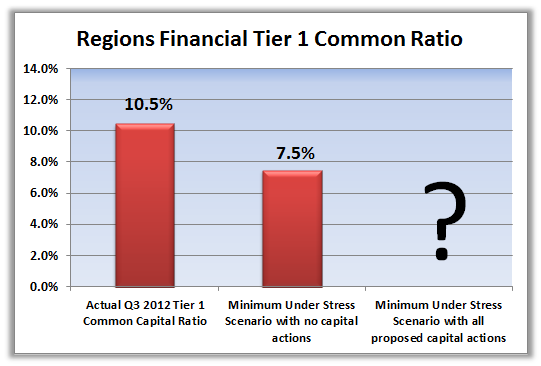
With that in mind, and the Fed’s Comprehensive Capital Analysis and Review (CCAR) results set to be released this week, Regions investors may be itching to find out if the bank will be able to raise its dividend.

How it fared last week
This year was the first year that the Fed ran through the Dodd-Frank portion of the stress tests, so we don’t have an exact comparison from last year. However, stacking Dodd-Frank results against last year’s CCAR — excluding the proposed capital actions — is a reasonable comparison. On that basis, Regions’ minimum stressed tier 1 common ratio of 7.5% compares very well to last year’s 5.7% from the CCAR

While that makes the prospect of capital distributions look promising, investors will still have to wait until Thursday to see how those capital plans shake out. To be sure, even if the bank has room to pay a higher dividend, that doesn’t mean its management team will ask for one. 

Source: Dodd-Frank Act Stress Test 2013: Supervisory Stress Test Methodology and Results.

Should Regions request a dividend bump?
This time last year, Regions Financial still had the government’s TARP investment sitting on its balance sheet. When the CCAR rolled around, instead of asking for a higher dividend or share buybacks, management focused its capital plan on raising additional capital through a $900 million stock offering so it could finally pay down TARP.

This time around, Regions appears to be much better positioned to ask for capital distributions. Though I’m a big proponent of dividends, considering that Regions is trading at a steep discount to its book value and only a slight premium to tangible book value, asking for a share buyback could be beneficial for shareholders.

That said, with the bank just one year out from paying down TARP and continuing to improve its balance sheet — at year end, nonperforming loans were still 2.4% of total loans — I couldn’t blame management for holding off on a distribution request altogether. 

How much?
I think slow and steady wins the race here for Regions. As I noted above, I wouldn’t be too surprised if management waited on asking for distributions. If it does, the best approach in my view would be to inch up its dividend, and perhaps combine that with a modest buyback.

For investors getting in on Regions today, the opportunity lies in the stock‘s low valuation and the bank’s ability to rebuild and grow over the long term, not a breakneck rush to push up the dividend.

Digging deeper on Regions
The CCAR results will be a big …read more
Source: FULL ARTICLE at DailyFinance

Make Money in "Strong Buy" Stocks the Easy Way

By Selena Maranjian, The Motley Fool

Filed under:

Exchange-traded funds offer a convenient way to invest in sectors or niches that interest you. If you’d like to add some highly rated stocks to your portfolio, the Guggenheim Raymond James SB-1 Equity ETF  could save you a lot of trouble. Instead of trying to figure out which companies will perform best, you can use this ETF to invest in lots of them simultaneously. It focuses on companies rated as “strong buys” by analysts at Raymond James.

The basics
ETFs often sport lower expense ratios than their mutual fund cousins. The Guggenheim ETF‘s expense ratio — its annual fee — is 0.75%, which is on the steep side for an ETF but still cheaper than a typical stock mutual fund. The fund is fairly small, so if you’re thinking of buying, beware of possibly large spreads between its bid and ask prices. Consider using a limit order if you want to buy in.

This ETF has performed reasonably, outpacing the S&P 500 over the past three and five years. As with most investments, of course, we can’t expect outstanding performances in every quarter or year. Investors with conviction need to wait for their holdings to deliver.

Why “strong buy” stocks?
Stocks deemed strong buys merit some consideration because savvy financial professionals have apparently found some appealing factors in them — though, of course, they’re not always right. (Indeed, my colleague Dan Dzombak has pointed out a blind spot they typically have.)

More than a handful of companies  that have sported a “strong buy” rating recently have performed well over the past year. Valero Energy surged 63%, for example, profiting by processing cheap U.S. oil and then selling it at higher prices in Latin America and Europe — thereby helping keep fuel prices in the U.S. high. It stands to benefit from the proposed and controversial Keystone XL Pipeline, and has been investing in railcars to boost profits from the Bakken shale fields.

Regions Financial gained 42% and is attractive on many counts, having repaid its TARP obligation, posted improving net interest margin and asset quality, and had a powerful presence in the growing Southeast region. Its recent quarter featured a swing from a big loss to a big gain, among other achievements. My colleague Sean Williams has nominated the company’s leader for CEO of the year.

Swift Transportation , a trucking company, climbed 22%. Its fourth-quarter earnings surged 27% over year-ago levels as the trucking industry enjoys a resurgence, with January tonnage having been the highest in five years. Its Moody’s credit rating has been hiked recently, and analysts at TheStreet.com upped its rating from sell to hold.

Other companies didn’t do quite as well last year, but could see their fortunes change in the coming years. Micron Technology , for example, advanced 10%, as its believers expect that growth in tablets and smartphones, …read more
Source: FULL ARTICLE at DailyFinance

Why Ordinary Americans Should Be Really Angry About the Wall Street Bailout

By John Reeves, The Motley Fool

Filed under:

During a meeting in 2009 about the performance of the Home Affordable Modification Program, or HAMP, Elizabeth Warren, who was head of the Congressional Oversight Panel for the Troubled Asset Relief Program, or TARP, kept challenging Treasury Secretary Tim Geithner about the program’s lack of progress in helping homeowners. At one point, an exasperated Geithner blurted out: “We estimate that they [the banks] can handle 10 million foreclosures, over time. This program will foam the runway for them.”

The expression “foam the runway” is often used to refer to the injecting of cash into a company that’s about to go bankrupt, which is somewhat similar in principle to an airport spreading fire-suppression foam on a runway to minimize the effects of an emergency landing. What Geithner was actually saying here was that home-mortgage modifications were helping the banks by preventing all of the likely foreclosures from hitting the banking system at precisely the same time. HAMP would ultimately allow the banks to spread out the foreclosures, while they restored their financial strength with government bailouts.

Now it all makes sense
Just as Geithner uttered those words, the full meaning of the bailout of Wall Street‘s banks became crystal clear to Neil Barofsky, who was the special inspector general for TARP. Geithner was being asked about how HAMP was helping homeowners, but he responded by saying how the program would help the banks. Barofsky now understood completely that it didn’t matter if the modifications failed or if struggling borrowers ended up worse off, as long as the banks could “stretch out their pain until their profits returned.”

Barofsky describes his epiphany in his outstanding Bailout: An Inside Account of How Washington Abandoned Main Street While Rescuing Wall Street. The book’s central argument is that all of the bailouts resulting from the financial crisis were ultimately designed to benefit the big Wall Street banks, and the interests of homeowners, auto dealers, and other ordinary Americans didn’t receive similar concern or attention. Barofsky, who was once a very effective prosecutor, builds an extremely detailed and compelling case against the government. I suspect that most readers will come away extremely angry about the fundamental unfairness of these bailouts.

The simple thesis that bailing out the big Wall Street banks was the overwhelming priority of the U.S. government in response to the financial crisis explains a lot. Why, for example, have there been so few criminal prosecutions related to the crisis? In a recent editorial in the Financial Times, Barofsky notes that there “would be no criminal prosecutions while the banks still teetered on the brink of collapse.” He continued: “The risk of causing them to fail, and thereby undoing all of the bailout efforts, was too high.”

And why did the ill-conceived HAMP fail so abysmally? An aggressive attempt to assist homeowners could have had adverse effects on the big banks, which would possibly, of course, put some of those institutions in jeopardy.

The …read more
Source: FULL ARTICLE at DailyFinance

Here's What Tomorrow's Stress Tests Mean for Regions Financial

By Matt Koppenheffer, The Motley Fool

Filed under:

The Regions Financial  of today is in a very different place than the Regions Financial of just a year ago. And that’s good news for investors as they prepare to tune into the release of the Dodd-Frank stress tests tomorrow afternoon.

To be clear, tomorrow’s stress tests are not the much-awaited Comprehensive Capital Analysis and Review (CCAR). Some confusion on that point is understandable — the CCAR is also referred to generically as “bank stress tests.” Also, both the CCAR and the Dodd-Frank stress tests are run by the Federal Reserve. And the testing criteria are very similar across both tests as well.

However, a key difference is the fact that it’s with the CCAR that the Fed approves or gives a thumbs-down on tested banks’ capital plans. So investors wondering whether Regions might be raising its dividend or buying back stock will have to wait another week until the CCAR comes out.

That said, the Dodd-Frank tests will give investors some insight into what the CCAR is going to reveal next week, so there’s very good reason to tune in.

In Regions’ case, there doesn’t appear to be a whole lot to worry about in the Dodd-Frank test results. When compared to last year, Regions is on steadier footing. 

Source: Company and regulatory filings.

Notable here is the fact that year over year, Regions’ tier 1 common ratio — arguably the most important of a bank’s capital measures — is up markedly. The bank’s stressed capital ratios were also above average during last year’s CCAR tests.

Given the pummeling that Regions took during the financial crisis, it may seem surprising to see its CCAR results above the likes of US Bancorp  and Wells Fargo  — two banks that are seen as very conservative lenders and that performed quite well through the crisis. But the comparison is hardly fair. While the capital plans of both Wells and USB included hefty dividend increases and share buybacks, Regions’ included a big share sale so that it could repurchase the government’s TARP preferred stock (yeah, that TARP).

But, hey, that was then. Fast-forward to today and Regions has paid down TARP — all $3.5 billion of it — and can still boast strong capital ratios.

Because these are ratios based on risk-based assets, it helps this time around that Regions’ total assets are down 6% year over year (based on Q3 2012). But the mix of assets also makes a difference because Regions was among the banks that the Fed expected would see higher-than-average loan losses based on last year’s CCAR scenario.

Some of Regions’ riskier loan exposures have fallen since the last round of stress tests — loans to real estate developers and home equity loans both declined. At the same time, impaired loans at Regions have dropped.

Source: Company filings.

Add this all up, and I don’t think there’s much for Regions investors to worry about when the Dodd-Frank stress …read more
Source: FULL ARTICLE at DailyFinance

SCVBank Reports Results of Treasury Auction of TARP

By Business Wirevia The Motley Fool

Filed under:

SCVBank Reports Results of Treasury Auction of TARP

SANTA PAULA, Calif.–(BUSINESS WIRE)– Scott K. Rushing, Chairman of Santa Clara Valley Bank, announced that the auction of Santa Clara Valley Bank‘s TARP preferred stock by the United States Treasury closed February 28, 2013 with Guy Cole as the successful bidder for 100% of the shares.

Mr. Rushing added that he was “pleased that this transaction achieved the goals of the bank to maintain local ownership.” Ms. Cheryl L. Knight, President & Chief Executive Officer, added, “It’s good to see repayment of the Treasury and good for the bank by reducing related restrictions and reporting.” She expressed her appreciation to the Cole family for their continued support.

Founded in 1998, SCVBank currently operates three branches in Santa Paula, Fillmore, and Valencia. Under its stock symbol of SCVE, SCVBank’s stock is traded through McAdams Wright Ragen, Raymond James & Associates Inc., and Monroe Securities. The Bank’s web site is www.SCVBank.com.

…read more
Source: FULL ARTICLE at DailyFinance

        Santa Clara Valley Bank Corporation Headquarters
901 East Main Street

4 Dow Stocks Lagging Since 2007's Record Highs

By Dan Caplinger, The Motley Fool

Filed under:

The Dow Jones Industrials is primed to set a new record today, if the market can hold on to its current gains. But even with the overall market at or near its best levels of the past five years, some stocks have completely missed out on the good times and have instead given their investors heartbreak and substantial losses.

Let’s find out which stocks have lagged behind the Dow since the last time the popular average set a new record high, back on Oct. 9, 2007.

Alcoa , down 77%
Back in 2007, Alcoa was still riding high on a wave of optimism about the construction and infrastructure industry. But when the bottom fell out of the commodities markets in mid-2008, Alcoa plunged with it, and the stock has never been the same since. Even as prices of other commodities have rebounded over the years, aluminum prices remain stubbornly low amid a glut of supply and rising levels of recycling activity, which are matched unfavorably with sluggish demand. The company has made some smart long-term strategic moves, but it needs an improving market to cash in on its efforts.

Bank of America , down 76%
Everyone’s familiar with the banks at the epicenter of the 2008 financial crisis, as the headlines continue to be filled with their exploits even five years later. In the end, the too-big-to-fail bank didn’t fail, but its rescue came at a huge cost to shareholders, who endured substantial dilution due to the TARP bailouts from which the stock has only partially recovered. Even with the possibility of a higher dividend coming as soon as this month, B of A has a lot further to go before investors will be happy with its performance.

Hewlett-Packard , down 59%
In 2007, former HP CEO Mark Hurd was still in charge of the printer and computer giant, whose stock had benefited greatly from the post-tech-bust bounce. Although it suffered in the market meltdown, HP climbed back to set new all-decade share-price highs in early 2010. But when Hurd left amid a harassment scandal, HP‘s leadership crisis began in earnest. A short-lived stint by Leo Apotheker resulted in the ill-fated purchase of Autonomy.

As the core PC business has declined, current CEO Meg Whitman has had to push the company in new directions, and only recently have investors started to accept the credibility of HP‘s turnaround efforts. Despite a nice bounce in the stock, HP has only begun the hard work of a full recovery.

Cisco Systems , down 35%
Cisco wasn’t even a member of the Dow in 2007, as the company was part of the 2009 shakeup that replaced Citigroup and General Motors. But since it set multiyear highs near the time the Dow set its last record, Cisco has struggled in its role as leader of the networking industry. Much of the trouble owed to the company’s attempt to expand its reach into much …read more
Source: FULL ARTICLE at DailyFinance

United Tech Wins Turkish F-16 Contract

By Rich Smith, The Motley Fool

Filed under:

On Friday, defense contractor United Technologies announced that its UTC Aerospace Systems subsidiary has won a contract of unspecified value to supply four advanced DB-110 airborne reconnaissance systems, and also three fixed/transportable Imagery Exploitation Systems, for use aboard Turkish Air Force F-16 fighter jets.

The contract, part of the ironically acronymed Turkish Airborne Reconnaissance Program, or TARP, is technically with Turkish defense contractor Aselsan Elektronic Sanayi ve Ticaret, which is ordering the recon systems on behalf of the Turkish Air Force. UTC will additionally be asked to provide training and logistics support services for the devices.

In a statement explaining the award, UTC notes: “The DB-110 digital, real-time, tactical reconnaissance system captures images day and night using electro-optical/infrared sensor technology. Images can then be transmitted in real-time to analysts on the ground as well as viewed on the cockpit video display, enabling the pilots to verify targets and retask based on opportunities revealed during the mission.”

Shares of the parent company, United Technologies, declined 0.5% in Friday trading, closing at $90.13.

The article United Tech Wins Turkish F-16 Contract originally appeared on Fool.com.

Fool contributor Rich Smith and The Motley Fool have no position in any of the stocks mentioned. Try any of our Foolish newsletter services free for 30 days. We Fools don’t all hold the same opinions, but we all believe that considering a diverse range of insights makes us better investors. The Motley Fool has a disclosure policy.

Copyright © 1995 – 2013 The Motley Fool, LLC. All rights reserved. The Motley Fool has a disclosure policy.

(function(c,a){window.mixpanel=a;var b,d,h,e;b=c.createElement(“script”);
b.type=”text/javascript”;b.async=!0;b.src=(“https:”===c.location.protocol?”https:”:”http:”)+
‘//cdn.mxpnl.com/libs/mixpanel-2.2.min.js’;d=c.getElementsByTagName(“script”)[0];
d.parentNode.insertBefore(b,d);a._i=[];a.init=function(b,c,f){function d(a,b){
var c=b.split(“.”);2==c.length&&(a=a[c[0]],b=c[1]);a[b]=function(){a.push([b].concat(
Array.prototype.slice.call(arguments,0)))}}var g=a;”undefined”!==typeof f?g=a[f]=[]:
f=”mixpanel”;g.people=g.people||[];h=[‘disable’,’track’,’track_pageview’,’track_links’,
‘track_forms’,’register’,’register_once’,’unregister’,’identify’,’alias’,’name_tag’,
‘set_config’,’people.set’,’people.increment’];for(e=0;e<h.length;e++)d(g,h[e]);
a._i.push([b,c,f])};a.__SV=1.2;})(document,window.mixpanel||[]);
mixpanel.init("9659875b92ba8fa639ba476aedbb73b9");

function addEvent(obj, evType, fn, useCapture){
if (obj.addEventListener){
obj.addEventListener(evType, fn, useCapture);
return true;
} else if (obj.attachEvent){
var r = obj.attachEvent("on"+evType, fn);
return r;
}
}

addEvent(window, "load", function(){new FoolVisualSciences();})
addEvent(window, "load", function(){new PickAd();})

var themeName = 'dailyfinance.com';
var _gaq = _gaq || [];
_gaq.push(['_setAccount', 'UA-24928199-1']);
_gaq.push(['_trackPageview']);

(function () {

var ga = document.createElement('script');
ga.type = 'text/javascript';
ga.async = true;
ga.src = ('https:' == document.location.protocol ? 'https://ssl' : 'http://www') + '.google-analytics.com/ga.js';

var s = document.getElementsByTagName('script')[0];
s.parentNode.insertBefore(ga, s);
})();

<p style="clear: both;padding: 8px 0 0 0;height: 2px;font-size: 1px;border: 0;margin: …read more
Source: FULL ARTICLE at DailyFinance