Tag Archives: legions

Will Apple's Latest Results Be Its Latest Letdown?

By The Associated Press

Filed under: , , ,

By MICHAEL LIEDTKE

SAN FRANCISCO (AP) – Apple’s (AAPL) latest quarterly results are likely to illustrate why investors are clamoring for the maker of the iPhone and the iPad to come out with another trend-setting device.

The report, due out after the stock market closes Tuesday, is expected to show that Apple Inc. is making less money as more customers buy its lower-priced iPhones and iPads instead of the top-of-the-line models. Other consumers increasingly are bypassing Apple products altogether as smartphones and tablet computers running Google’s Android software win more fans.

Those dynamics have changed the way that Wall Street – and even parts of Main Street – view Apple. Once regarded as an indomitable innovator, Apple now looks vulnerable and perhaps a step behind Google Inc. and the leading Android disciple, Samsung Electronics Co.

If analysts’ projections pan out, Apple’s earnings fell during the three months that ended in June, marking the second consecutive quarter of decline. The slump follows a decade-long streak of earnings growth that ended at the start of the year. Analysts surveyed by FactSet are expecting, on average, earnings of $7.34 per share, down from $9.32 per share a year ago.

Meanwhile, analysts are forecasting little or no revenue growth for the first time since the debut of the iPhone six years ago. Analysts are expecting $35 billion in revenue for the period, its fiscal third quarter. It was $35 billion at the same time last year.

Those would be impressive numbers for most companies, but the bar has been set high for Apple since the introduction of its iPhone triggered an upheaval that has changed the way people engage with technology. Smartphones and tablets are emerging as the preferred way to connect to the Internet and perform many other common computing tasks. In the process, those mobile devices are supplanting laptop and desktop computers.

Ignited by its early lead in smartphones and tablets, Apple’s financial performance launched into a scintillating trajectory that catapulted its stock into Wall Street’s stratosphere, too. The company’s shares rose nearly six-fold from the debut of the first iPhone in 2007 to the release of the latest model last September to establish Apple as the world’s most valuable company.

Since peaking 10 months ago at $705.07, Apple’s stock has plummeted by about 40 percent to about $425 to wipe out roughly $260 billion in shareholder wealth. It is now behind Exxon Mobil Corp. in market capitalization – at $400 billion, compared with $422 billion for the energy company. Not even a recent 15 percent increase in Apple’s quarterly dividend has done much for the stock.

Despite the downturn in the company’s fortunes, Apple’s products still have legions of admirers. Sales of iPhones for the just-ended quarter are expected to total about 26 million, around the same number as the same time last year. But a …read more

Source: FULL ARTICLE at DailyFinance

SAPVoice: Translating a Passion Into a Business

By Christopher Koch, AdVoice

I love riding bicycles. Yet I live in a place (Boston) that’s terrible for cycling, with roads that look like archaeological digs, legions of cranky drivers, and awful weather. What drives all this aberrant behavior (you should see my winter riding outfit – an Eskimo would look underdressed) is something we all share, whatever our individual interests: passion. …read more

Source: FULL ARTICLE at Forbes Latest

Bieber: Anne Frank 'Would Have Been a Belieber'

By Polly Davis Doig Justin Bieber spent another day on planet Earth yesterday, so inevitably something jaw – dropping ensued : It seems the Bieb decided to play tourist while in Amsterdam, and dropped by the Anne Frank House, entourage in tow and legions of screaming fans left bereft outside. Innocuous enough, even admirable. The…

From: http://www.newser.com/story/166207/bieber-anne-frank-would-have-been-a-belieber.html

Is SEGA Teasing a Castle of Illusion Remake?

SEGA has released a new teaser trailer for a game set to release in Summer 2013, adding further evidence to the notion that a re-release of Castle of Illusion may be on the cards.

The old-fashioned trailer, which you can check out below, features legions of toy soldiers as well as a shadowy figure that looks suspiciously like Sleeping Beauty villain, Maleficent.

Last month, an adventure platformer called Castle of Illusion was spotted on the Brazilian Ratings website for Xbox 360, PS3, Vita and Wii U, leading to speculation that a re-release of the 1990 SEGA Genesis game was imminent.

What do you reckon? Should we be expecting an official announcement any day now, or is it possible SEGA is teasing some other Disney-themed game we haven’t heard of? Let us know what you reckon in the comments below.

Continue reading…

From: http://www.ign.com/articles/2013/04/12/is-sega-teasing-a-castle-of-illusion-remake

Pain bites into Portuguese life as crisis deepens

Serving a frugal lunch in their kitchen not much bigger than a bathroom, Pedro and Elena Baptista spoon stewed chicken feet onto their boiled potatoes and leave the slightly meatier wings for their 12-year-old daughter, Vania, and 7-year-old son, Joao.

The Baptista family counts itself among the casualties of an unrelenting financial crisis that is squeezing the life out of some European Union economies, including Portugal. Pedro Baptista, a stocky 37-year-old, has found work as a part-time window cleaner but his wife Elena, 35, has been on welfare for almost a year after losing her job in a school canteen. Scraping by on a monthly household income of €650 ($840) and constantly going cap-in-hand to charities and family members has sapped their confidence.

But Pedro is determined to stay positive. “Ups and downs are part of life. Things will improve,” he says. “We just have to hold on.”

Exactly how long is hard to say, however, as Portugal‘s prime minister warns his nation to harden itself for more austerity.

It seems that every time Europe‘s leaders appear to have contained the continent’s 3-year-old crisis over too much government debt, it erupts again — witness the recent woes in Cyprus. Across Europe, the long-held belief that the state will always provide for its citizens’ well-being is vanishing.

In return for rescue loans, governments across the region are slashing spending and raising taxes. However, the austerity has a knock-on effect of choking the growth needed to pull countries out of their nosedive. Despite the acute hardship, Prime Minister Pedro Passos Coelho said Sunday that his government must cut even deeper. That’s because the Constitutional Court last week struck down some austerity measures aimed at government workers and pensioners, denying the government more than 1.3 billion euros in anticipated savings.

Meanwhile, the debt crisis risks jumping from Cyprus to Portugal. The creditors who lent Portugal 78 billion euros in a bailout two years ago are demanding that the government prune spending by another 4 billion euros in 2014 and 2015. If Portugal doesn’t comply, it could be denied the next installment of its bailout.

Portugal‘s ordeal has begun to send shivers across Europe, even as the pain becomes hard to bear at home. Pensioners, schools and government workers are in the crosshairs of the latest planned cuts. The austerity is destroying legions of small businesses. And charities say they are already struggling to cope with a deluge of calls for help.

…read more

Source: FULL ARTICLE at Fox World News

3 Ways the Government Has Pulled the Economy's Strings

By Alex Planes, The Motley Fool

Filed under:

On this day in economic and business history…

Is the prestige really worth a place on the Dow Jones Industrial Average ? Let’s ask Pfizer , Verizon , and American International Group , which all joined the Dow on April 8, 2004. AIG shareholders are lucky to even have the chance to ask, as the insurance giant received the lion’s share of the 2008 and 2009 government bailouts during the financial crisis. That knowledge should prepare you for the sobering results of these companies’ Dow performance:

  • Dow nine-year return (2004 to 2013): 39%
  • Pfizer nine-year total return: 19%
  • Verizon nine-year total return: 130%
  • AIG total membership return (company was removed in September 2008): -93%

It was only after the Dow swapped AIG out in 2008 that Verizon began to outperform. Up until AIG‘s removal, the index and the telecom company were neck and neck with respective gains of 5% and 8%. However, the swap was not a total loss. Kodak, one of the removed components, would go bankrupt in early 2012. Still, it doesn’t speak well for the Dow’s track record of new additions in the last several decades. One has only to look back at one horrendously bad swap at the height of the dot-com bubble to see the wisdom in standing pat.

Pfizer, the “respectable” underperformer of the group, failed to impress the market despite three megamergers since the turn of the 21st century. However, the most recent merger — with fellow pharmaceutical giant Wyeth in 2009 — turned Pfizer’s fortunes around. Since that merger was announced, Pfizer’s return has trounced the Dow’s, 95% to 60%. Perhaps what the index needs is more time to prove the value of its choices over the companies that were replaced.

FDR’s grand plan
President Franklin D. Roosevelt signed the Emergency Relief Appropriation Act into law on April 8, 1935. The cornerstone of this legislation was the ambitious Works Progress Administration, which superseded the Civil Works Administration that had done so much to build and rebuild the national infrastructure since its formation in late 1933. For its first year, the WPA was allocated nearly $5 billion, which at the time was almost 7% of GDP. Over the course of its existence, the WPA spent more than $13 billion. Wired‘s Tony Long writes on the opposition to, and outcome of, this massive project:

Roosevelt’s detractors, who spoke of “New Dealers” and “socialists” in the same breath, liked to characterize the WPA as a politically corrupt pork barrel where legions of layabouts leaned on their shovels while getting paid for it. But the project not only got about 8.5 million people off the dole, it yielded tangible results. During an eight-year run, WPA workers built or repaired 124,000 bridges, 650,000 miles of highway, 125,000 public buildings, 8,000 parks and 850 airfields.

More than $4 billion went to road improvement projects. More than $1 billion each went toward …read more

Source: FULL ARTICLE at DailyFinance

10% of Scots descended from Picts

By hnn

A RECENTLY discovered DNA marker suggests that 10 per cent of Scottish men are directly descended from the Picts, it is revealed today.

Mystery has long surrounded the fate of the tribe of fierce enigmatic people who battled with Rome’s legions before seeming to disappear from history.

Now new research from ScotlandsDNA, an ancestry testing company, has found a marker strongly suggesting for the first time that a large number of descendants of these northern tribes, known as “Picti” by the Romans meaning “Painted Ones”, are living in Scotland….

Source:
The Scotsman (UK)

Source URL:
http://www.scotsman.com/lifestyle/heritage/one-in-ten-scots-men-descended-from-picts-1-2855561

Date:
3-25-13

…read more
Source: FULL ARTICLE at History News Network – George Mason University

Housing's Labor Shortage

By Morgan Housel, The Motley Fool

Source: Federal Reserve.

Neil Irwin of The Washington Post

Filed under:

Late last year, Richard Dugas of homebuilder Pulte  noted that his company was having trouble hiring enough workers to keep up with demand. “The number of markets feeling some degree of labor pressure is growing,” he said. “In fact, almost all of our markets have now reached a point where labor pressures are being experienced to some degree.”

Yesterday, Catherine Rampell of The New York Times detailed a similar problem: 

In many areas, builders are scrambling to ramp up production but face delays because of the difficulty of finding construction workers and in obtaining permits from suddenly overwhelmed local authorities.

This makes sense. Homebuilders laid off a ton of workers during the housing bust. And while rebounding customers can put in orders for new homes quickly, hiring a crew of skilled construction workers takes time.

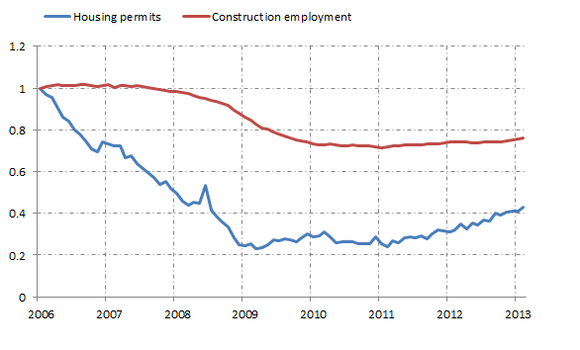
But this story is more complicated than it looks. Compared with the drop in construction permits, homebuilders actually didn’t lay off as many construction workers during the bust as you might think:

Source: Federal Reserve.

Neil Irwin of The Washington Post explains:

Key to understanding the sluggish growth in construction jobs is a concept called “labor hoarding.” That’s what happens during a recession when companies don’t fire as many workers as the decline in business would seem to have justified. Firms don’t want to lose all their quality workers and then be unable to keep up with demand when business finally turns around, so they keep people on staff even when there is not enough work to keep them fully busy.

This seems to have happened on a large scale in construction in the last few years. Kris Dawsey and Hui Shan at Goldman’s economics research group calculated that the economic value added per construction worker fell from $80,000 in 2006 to under $60,000 at the end of 2012. That is labor hoarding in a nutshell.

Construction can now rise much faster than employment because we’re coming off of a period when construction fell much faster than employment. Last year, Lennar CEO Stuart Miller said, “The homebuilding business is beginning to revert to normal, and that’s positive for the U.S. economy in general.” Jeff Mezger of KB Home said, “We’re on offense and pursuing our growth targets.” This is great for news for homebuilders! But it doesn’t necessarily mean they need legions of new construction workers. 

But how does that fit in with stories about a tight labor market? Here’s the key, from Rampell:

Many workers in the immigrant-heavy industry have left the area [California], returning to Mexico and other points south. Others pursued work in Texas’s energy boom, where both drilling and construction jobs have become more plentiful. Those who stayed in the local area often switched to medical data entry, U.P.S. delivery services, or anything else that they could find. Or they filed for disability and dropped out the labor force altogether.

So, it seems homebuilders are looking to hire a small number of workers — not …read more
Source: FULL ARTICLE at DailyFinance

Why PCs, not smartphones, are best for social media sharing

Part one of a two-part series. For a contrarian view, see “Why smartphones are the rightful kings of social media.”

Walk anywhere within a 3-mile radius of the PCWorld office, and you’ll find legions of new-economy hipsters with smartphones surgically implanted in their hands. But they’re not talking on their phones. They’re checking Facebook. They’re posting to Twitter. They’re making connections on LinkedIn. And a few of the more, well, eccentric souls may even be doing something on Google+.

But all these people are also making grave, grave mistakes. For, despite everything you’ve heard, the ultimate social media experience will never be found on a smartphone. No, it’s waiting for you on your desktop PC.

Forget all the conventional wisdom about phones being tailor-made for social media consumption and broadcasting. Desk-bound computers are better—and not just because they protect us from posting inane real-time updates like “Eggs Benedict! Yum!” Our lives were not meant to be virtualized and crammed into the restrictive confinements of a little 4- or 5-inch screen. No, social media is best savored on a PC, where it’s more productive, user-friendly, and fun.

To read this article in full or to leave a comment, please click here

…read more
Source: FULL ARTICLE at PCWorld

How to Attract the Right People to Your Life

By Dorie Clark, Contributor

Earlier this week, the annual South by Southwest conference was teeming with nearly 30,000 attendees – startup entrepreneurs desperate to get noticed, VCs on the prowl for the best investments, journalists clamoring to cultivate sources and spot the next big trend, and legions of fanboys hoping to meet Neil Gaiman or (even better?) Robert Scoble.  Amidst this chaos, how do you break through the clutter and draw the right people to you? John Hagel may have the recipe. …read more
Source: FULL ARTICLE at Forbes Latest

The Slow, Profitable Death of Traditional IT

By Tim Beyers, The Motley Fool

Filed under:

It’s almost hard to remember the days when a chief information officer, or CIO, would dictate the devices and software you’d use at work. That started to change when the Web and open standards rose to prominence and made data sharing across different platforms easier. That, in turn, freed users to choose to work with the devices they liked best.

Today, many companies have “BYOD,” or “bring your own device,” policies that cater to these control freaks. And none has benefited more than Apple , which has seen legions of fans bring iPhones to work rather than opt for company-approved BlackBerry alternatives.

But there are limits to the allowable chaos. Accordingly, Dropbox, a popular file sharing service that’s used in 95% of Fortune 500 organizations, just recently announced administrative tools to make it easier for CIOs to monitor those who use the software at work.

Is there a happy medium between BYOD and the command and control days that led the ascendancy of the PC and BlackBerry? Tim Beyers of Motley Fool Rule Breakers and Motley Fool Supernova addresses this question and more in the video below. Please watch, and then be sure to leave a comment to let us know what you think.

For further analysis of Apple, I invite you try our newest premium research service. The Motley Fool’s senior technology analyst and managing bureau chief, Eric Bleeker, will tell you whether Apple is a buy now and what opportunities remain for the company (and your portfolio) going forward. Just click here now to get instant access to his latest analysis.

//<!– var FoolAnalyticsData = FoolAnalyticsData || []; FoolAnalyticsData.push({ eventType: "TickerReportPitch", contentByline: "Tim Beyers", contentId: "cms.17819", contentTickers: "NASDAQ:AAPL, NASDAQ:BBRY", …read more
Source: FULL ARTICLE at DailyFinance

Buffy’s Mom On ‘The Following’: Kristine Sutherland Guest Stars (VIDEO)

By The Huffington Post News Editors

Yep, that was Buffy’s mom on “The Following.”

Kristine Sutherland, a.k.a. Joyce Summers to legions of “Buffy the Vampire Slayer” fans, appeared in the Monday, Feb. 25 episode of the Fox drama as Agent Parker’s (Annie Parisse) mother in flashbacks to the time the agent confronted her parents 15 years after fleeing a cult.

Post-“Buffy,” Sutherland’s other TV credits include “Comanche Moon” and “One Life to Live.” “Buffy” creator Joss Whedon recently revealed that killing off Sutherland’s character was one of the toughest deaths he’s ever written. Hey, at least she’s alive (in a flashback) on “The Following.”

Read More…
More on Video

…read more
Source: FULL ARTICLE at Huffington Post

Fist of the North Star: Ken's Rage 2 Review

Throughout much of popular culture, it’s sadly pretty common to see gamers depicted as drooling, zoned out automatons. Slouched too close to the screen, they spastically smash their fingers against every button at once while gazing vacantly, as if lobotomized, into their television set. Whenever I see this, I wonder the same thing: what game could they possibly be playing? I finally know the unsavory truth of the matter. It turns out that they were being forced to play Fist of the North Star: Ken’s Rage 2 all along, and they’ll never fully recover.

Being the latest entry in the popular musou sub-genre, it goes without saying that there’s a great deal of button mashing, and an ever greater deal of repetition. After all, having legions of defenseless, incompetent henchmen look-alikes is practically a mandate for games like this, and they’re bred to feel more like arcade brawlers than finely-tuned action masterpieces. Ken’s Rage 2 fulfills these requirements competently, along with the rest of the items on the now well established checklist that all musou fans go down when evaluating a new title. Its real problem is that it does all of it in such a banal, joyless manner, one can hardly squeeze even a drop of guilty pleasure out of it.

Continue reading…

…read more
Source: FULL ARTICLE at IGN Video Games

Railroad track size matters!

Railroads

ATT00001

Railroad tracks.
The U.S. Standard railroad gaug(distance between rails)
is 4 feet, 8.5 inches. That’s an exceedingly odd number.

Why was that gauge used?

Because that’s the way they built them in England, and English expatriates designed the

 U.S. Railroads.

Why did the English build

them like that?

  Because the first
rail lines were built by the same people who built
the pre-railroad tramways, and that’s the gauge they used.

Why did ‘they’ use that gauge then? Because the people who built the tramways used the same jigs and tools that they had used for building wagons, which used that wheel spacing.


ATT00002

Why did the wagons have that particular Odd wheel spacing?

Well, if they tried to use any other spacing, the wagon wheels would break on some of the old, long distance roads in England , because that’s the spacing of the wheel ruts ..

ATT00003

So, who built those old rutted roads?
Imperial Rome built the first long
distance roads in Europe (including England) for their legions. Those roads have been used ever since.

And the ruts in the roads?

 Roman war chariots formed the initial ruts, which everyone else had to match for fear of destroying their wagon wheels.

ATT00004

Since the chariots were made for Imperial Rome ,
they were all alike in the matter of wheel spacing. Therefore, the United States standard railroad gauge of 4 feet, 8.5 inches is derived from the original specifications for an Imperial Roman war chariot. In other words, bureaucracies live forever.

So the next time you are handed a specification, procedure, or process, and wonder, ‘What horse’s ass came up with this?’, you may be exactly right.

Imperial Roman army chariots were made just wide enough to accommodate the rear ends of two war horses …


ATT00005

Now, the twist to the story:

When you see a Space Shuttle sitting on its launch pad, you will notice that there are two big booster rockets attached to the sides of the main fuel tank. These are solid rocket boosters, or SRBs. The SRBs are made by Thiokol at their factory in Utah.


ATT00006

The engineers who designed the SRBs would have preferred to make them a bit larger, but the SRBs had to be shipped by train from the factory to the launch site. The railroad line from the factory happens to run through a tunnel in the mountains, and the SRBs had to it through that tunnel. The tunnel is slightly wider than the railroad track, and the railroad track, as you now know, is about as wide as two horses’ behinds.

ATT00007

So, a major Space Shuttle design feature
Of what is arguably the world’s most advanced transportation system was determined
over two thousand years ago by the width of a horse ‘s ass.

And you thought being a horse’s ass wasn’t important!

Now you know, Horses’ Asses control almost everything…


Explains a whole lot of stuff, doesn’t it?