Tag Archives: IRC

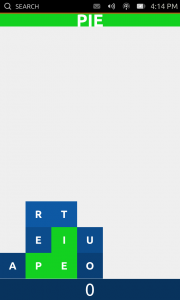
Michael Hall: Dropping Letters Hackfest

Mmmmmm, Pie....

We only have 2 days left in the Ubuntu Core Apps Hack Days!  I hope everybody who has participated has enjoyed it and found it informative and helpful.  If you haven’t participated yet, it’s not too late!  Come join us in #ubuntu-app-devel on Freenode’s IRC network anytime from 9am to 9pm UTC and ping either myself (mhall119) or Alan Pope (popey) and we’ll help you get setup and show you where you can start contributing to the Core Apps.

Today we get another chance to play while we work, because the focus is going to be on Dropping Letters, a simple, fun, yet surprisingly addictive little app written by Stuart Langridge.  Stuart has since handed off development of the app to others, but not before having it already in perfectly usable state.  Because of it’s simplicity, our list of dogfooding requirements wasn’t very long:

  • Start a new game. DONE!
  • View high scores.

Short as the list may be, it’s only half done!  We still need to integrate a high scores screen, which means we need you Javascript and QML developers!  Dropping Letters also needs to be tested, which means Autopilot, which of course means we have something for you Python hackers too!  So come and join us today in #ubuntu-app-devel and help make this great game even better.

…read more

Source: FULL ARTICLE at Planet Ubuntu

Valorie Zimmerman: Getting a Green Thumb

The phrase green thumb comes from gardening. When a person is really in tune with their garden plants, they often rub off nubs which will become branches in the wrong place, or pull out small, tender weeds before they grow to be pest-sized, thus ending up with green-stained fingers and thumbs. In our community, such tuned-in consciousness can help us grow and thrive. When one sees or hears a comment heading into negative territory, each of us can perhaps take a moment to ask the commenter more about their situation. Maybe they have encountered a bug, or just don’t see how to choose to do what they need to get their task done. If you are a developer, maybe their difficulty can guide you toward a better user interface! If you do documentation, their questions and difficulties might help you explain the software more clearly. Perhaps the person is feeling bad for some other reason entirely. In any case, by asking for more information, you will effectively have turned what could have turned into a “trollish” situation, into a pleasant personal interaction and maybe more. Of course not all of us have the time or feel like spending our time being tuned in all the time. Which is why I urge each of my readers to take your turn by doing this part of the time. Our list moderators, IRC channel operators, and forum admins get tired, have vacations and other time off, and so forth. We can all be leaders of the community part-time, in this gentle, non-confrontational way. If you’re good at it, and enjoy it, maybe it’s time to volunteer to help moderate a list, become one of the channel operators, or help administer the forums. It is not necessary to have an official leadership position though, to exercise leadership. Perhaps you would like to become part of the KDE Community Working Group?[1] We have a need for a new team member right now. See the KDE-Community list for more information.[2] And see the Freenode Catalysts page [3] for more details about this mode of leadership. The Ubuntu 1. Community Working Group: http://ev.kde.org/workinggroups/cwg.php 2. KDE-Community list: https://mail.kde.org/mailman/listinfo/kde-community 3. Be a Catalyst: http://freenode.net/catalysts.shtml …read more

Source: FULL ARTICLE at Planet Ubuntu

David Murphy: Tempus fugit

Nine years, one month.

That’s how long I’ve had one server running with Linode. It has been through a number of versions of Ubuntu, and been re-installed at least twice (once to switch from 32-bit to 64-bit). It has operated as a LugRadio mirror; hosted many websites, both static and dynamic; hosted my blog for many years; operated as a Jenkins server; and done more general duties as an IRC bouncer, and general dogsbody.

Why the sentimentality? I’m shutting the server down today. Not that anyone will notice of course (unless you’re paying close attention to IP addresses or SSH host keys) since it has already been replaced with a DigitalOcean droplet (still running Ubuntu of course).

Linode have done absolutely nothing wrong – in fact just the opposite. I have been regularly rewarded with extra storage/memory/bandwidth, and they have always been responsive to my few needs. So much so that I am still remaining a customer. (So far) I am only moving one server to DigitalOcean.

So why the change? A few reasons: that server now does very little besides running my IRC bouncer; I wanted to try DigitalOcean out (I have heard a lot of good things); finally, perhaps most importantly considering the first reason – the droplet is half the price of the linode. In fact if I had gone for the $5 per month droplet instead of the $10 one, I could have had four servers for the price of one!

The post Tempus fugit appeared first on David Murphy.

…read more

Source: FULL ARTICLE at Planet Ubuntu

Ubuntu Ohio – Burning Circle: Burning Circle Episode 123

In this week’s episode we talk about the most recent IRC meeting held while also mentioning the hostilities that took place against the Ubuntu Forums.

Download here (MP3) (ogg) (FLAC) (Speex), or subscribe to the podcast (MP3) to have episodes delivered to your media player. We suggest subscribing by way of a service like gpodder.net.

This work is licensed under the Creative Commons Attribution-ShareAlike 3.0 United States License. To view a copy of this license, visit http://creativecommons.org/licenses/by-sa/3.0/us/.

…read more

Source: FULL ARTICLE at Planet Ubuntu

Stephen Michael Kellat: Late July Notes From Ohio Leader

Ubuntu Ohio held an IRC meeting on Thursday. Leveraging the capabilities of the LoCo Portal allows for rough minutes to be maintained there. A few matters arose:

  • Jon Buckley and Scott Randby gave tentative expressions of interest in speaking at UbuCon during Ohio Linux Fest 2013. Proposals from members of Ubuntu Ohio and those outside the team are due to the Point of Contact & Leader by July 31st. First priority will be given to scheduling presentations by members of Ubuntu Ohio however this does not limit those from outside Ubuntu Ohio from being possibly scheduled to speak. Topics of interest include but are not limited to: Gaming, Server usage, Flavor Highlights, Highlights about finishing up Saucy Salamander for release, Thoughts looking forward to the next Long Term Support release, Reflections on the changes wrought by the virtual Ubuntu Developer Summit paradigm, Ways we need to work within the cultures found in Ohio to expand Ubuntu deployment.

  • Two issues were carried over to the mailing list for further discussion due to a lack of attendance. The summation was prepared by Scott Randby and can be read in the archive here where issues concerning scheduling a keysigning and what, if any, materials should be distributed were raised. Discussions on the team mailing list are encouraged.


In light of the hostile actions taken against the Ubuntu Forums which have sparked recovery processes, members of Ubuntu Ohio are asked at this time to stick to the mailing list and the IRC channel for discussions.


The package monkeysign is being investigated for use with the proposed possible keysigning at Ohio Linux Fest. Currently the package has been copied from Debian Unstable to the Saucy Salamander package archive and test backports have been made by the leader in his personal PPA. If it does not break their may be an Ubuntu Ohio PPA opened with backports for 12.04, 12.10, and 13.04. Other tools to ease the process for the proposed session are also being investigated. The Leader has committed to send out sets of instructions to the team for at least two weeks prior to Ohio Linux Fest if the keysigning session is to happen.

…read more

Source: FULL ARTICLE at Planet Ubuntu

Infiltration complete: Google's Chrome app launcher lands on Windows

After months of behind-the-scenes teases, Google appears to have quietly introduced the Chrome App Launcher in the stable version of Chrome for Windows. The Chrome OS feature—ported over to the Chrome for Windows developer channel in February—wasn’t available through a search of the Chrome Web Store or advertised on the site’s front page at this writing, but Windows users can install it now by navigating directly to the Chrome App Launcher page inside Chrome’s app store.

First spotted by Engadget, the new feature is Google’s incursion into the desktop PC, creating a self-sufficient Chrome ecosystem inside Microsoft’s OS. The Chrome App Launcher lets you directly fire up any Chrome Web app or packaged app right from the Windows taskbar—even when Chrome itself isn’t running.

Packaged apps are HTML 5-based standalone desktop apps based on Chrome that don’t look anything like your Web browser. There are no tabs, URL address bars, or bookmarks, but these apps do rely on Chrome’s underlying infrastructure and are installed via the Chrome Web Store.

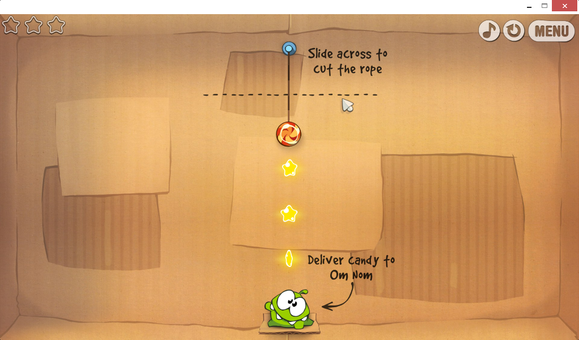
Play Cut The Rope on your desktop with the Chrome packaged app.

It’s still early days for packaged apps, but there are a number you can try out, such as a generic text editor and an IRC client, as well as known quantities like Cut the Rope, the Economist, and Weather Bug. For a list of interesting packaged apps to test see this post from Pocketables.

To read this article in full or to leave a comment, please click here

…read more

Source: FULL ARTICLE at PCWorld

Ubuntu Ohio – Burning Circle: Burning Circle Episode 112

This week’s episode talks about introspection and assessing where we stand in terms of participation. A rough transcript is included below.

Download here (MP3) (ogg) (FLAC), or subscribe to the podcast (MP3) to have episodes delivered to your media player. We suggest subscribing by way of a service like gpodder.net.

This work is licensed under the Creative Commons Attribution-ShareAlike 3.0 United States License. To view a copy of this license, visit http://creativecommons.org/licenses/by-sa/3.0/us/.


Welcome to the Burning Circle. For release on Monday, April 29th, this is episode 112.

Well, where do we start? We had the conference call aborted last week as nobody showed up. Yeah, the exercise proved successful for Erie Looking Productions to be ready for the event and to come online for it. Notwithstanding how low the friction level was for this, the event failed. This will be assessed. We do have the capability to try this again and it is merely a phone call away.

Yes, e-mails continue to happen and I do seem to send something out at least once per week. The current e-mail that has gone out is for members to check that they have in fact signed the Code of Conduct on Launchpad and to ensure they’re up to date. In response to that e-mail there have already been a couple membership deactivations in response.

Membership within this community gets interesting. We have many people who claim affiliation but quite a number of folks who are quite marginally attached. As a community, activity is hard to spur. When you look at it, how do you spur activity when people shut out the mailing list, don’t participate at the forums, may or may not listen to the podcast, may or may not be aware of the LoCo’s presence on social media, and more?

In terms of lurking, you at least have a passing notion of what is happening. You might see what the mailing list says or occasionally pop in on the IRC channel. What we have is a bit of anti-social membership where people declare geographic affiliation but do not want to be involved and do not want to be contacted at all. That’s not good for a community’s health.

Where are we going? I know there have been rumbles of discontent for a while. People have felt very disconnected from being able to participate in decision-making within the Ubuntu project. However I also note that a majority of people have not taken steps to become enfranchised to do so by gaining status as an Ubuntu Member let alone developer membership. I have voting rights on confirming the Community Council along with six other members of our community. That leaves 410 members of our community as of time of recording who

Source: FULL ARTICLE at Planet Ubuntu

Ubuntu Ohio – Burning Circle: Burning Circle Episode 111

This week’s episode talks about the community’s recent health check attempt and mentions the upcoming Raring Ringtail Release Party state-wide conference call. A rough transcript of the program is included in this show post.

Download here (MP3) (ogg) (FLAC), or subscribe to the podcast (MP3) to have episodes delivered to your media player. We suggest subscribing by way of a service like gpodder.net.

This work is licensed under the Creative Commons Attribution-ShareAlike 3.0 United States License. To view a copy of this license, visit http://creativecommons.org/licenses/by-sa/3.0/us/.


Welcome to the Burning Circle. For release on Monday, April 22nd, this is episode 111. We pause for a federal PSA.

Profile America — Monday, April 22nd. One of world’s most important medicines — insulin –became available for general use this month in 1923, saving the lives of millions of people suffering from diabetes. Insulin is a hormone produced by the pancreas, and is critical in the processing of carbohydrates in the human body. It was first isolated the year before by a Canadian team led by Dr. Frederick Banting at the University of Toronto. The effect was like a miracle. One year, the disease was an automatic death sentence, the next, people — even children — who were affected had hopes of living full and productive lives. One of the first beneficiaries was the daughter of U.S. Secretary of State Charles Evans Hughes. Pharmaceutical manufacturing is a $142 billion a year industry in the U.S. You can find more facts about America from the U.S. Census Bureau, online at www.census.gov.

The health check of our community continues. The membership awareness poll finished on Saturday and I got unexpected results. We had 33 responses. 29 people said they were aware they were members of the community. 3 people did not. 1 answered that they had no clue. We also had five membership deactivations out of this.

As for our Really Local Community groups, we only have word of Lima still having a community. John Freed, tnseditor, has noted that the Lima-area group is on a break right now but will be back in action this summer hopefully. We do not have anything elsewhere in the state reported active.

Okay, so where do we go from here? That’s a very good question. We have over 400 members claimed. 45% choose to receive mailing list e-mail. 0.05% are active in the IRC channel. Our forum on Ubuntu Forums is dead.

Since I have no indications of any spontaneously arranged release parties throughout our local community, I am setting the evening of Thursday, April 25th, for a statewide conference call to serve as our release party. The call will be hosted via TalkShoe.com. To participate you can call in via any regular old telephone to 724-444-7444. Once you dial in, enter the conference ID of 127739. Unless you already have a TalkShoe account, hit 1 and

From: http://ohio.ubuntu-us.org/node/144

Failed Deck Footing Inspection

By andrew10

I live in a county that has adopted the 2009 IRC and I was provided the DCA Prescriptive Residential Wood Deck Construction Guide by the Inspections and Permits Office.

I was looking to keep the footers as far from the home as possible so I have a 12′ (16′ x 16′ deck with 2×10 joists) joist span. According to the Deck Construction Guide I am permitted an overhand of 3′ (Lj / 4), but the inspector failed my footing holes because they were not within 24″ of the house. He told me that 24′ OC from the house was code for a free standing deck, and didn’t have any idea what I was talking about with respect to the overhang and joist span.

I also submitted my framing plan showing the footings 3′, but he said that didn’t matter.

Is the 24″ really code, I couldn’t find it anywhere in the IRC?

From: http://www.doityourself.com/forum/decks-patios-porches-docks/493522-failed-deck-footing-inspection.html

So you want to be a “Summer of Code” student…

… then here are some tips

Show us you are bright… and do your homework:

  • Read the documentation

We can’t be there for you 24/7, so don’t expect to be spoon-fed information you can look up in documentation available online. While you will probably never hear a RTFM from us (we are polite), we do expect coders to be able to document themselves. You will be given a lot of links to documentation to read in the welcoming mail, so please do that: read and learn!

  • Use your search engines and try to look up things on your own before asking.

In general, not doing some search on your own before asking questions is frowned upon, as it shows lazyness on your behalf.

  • Don’t send private mail to potential mentors, use the mailing list

KDE is a community and we work on our projects in a collaborative effort. While there is usually one mentor assigned to an idea, there are co-mentors and we do coordinate our work in the mailing list. If you want to work with us, please do use the right channels for that. It also greatly enhances the probability to get an answer, as there are more eyes to see your mail. Private mails from unknown people can easily get lost in a filter, especially if they are badly formatted and sometimes not even have a subject line… *cough*

  • Don’t ping people in IRC, and don’t open Queries without even asking if it is OK

There are some basic rules in IRC, all of which you can find online (search for “IRC Guidelines KDE”), so randomly pinging people you have never met or opening queries without asking beforehand are considered rude and are frowned upon. If you have an urgent matter, use the mailing list, not everybody is online all the time and not necessarily in your timezone. And if you ask a question on IRC, stick around so we can actually answer, don’t just leave after a few minutes. IRC is not for the impatient:

  • Be patient!

We are usually very much occupied with our every day work and life and simply can’t be at your service just because you are there NOW. We do our best to answer your requests and questions in a timely fashion, but don’t be impatient, that is not making things go faster. Your request is usually not as urgent as YOU might think it is. Did you try to search online and in the documentation on your own? No? Why not?

Remember: there is life out there, and that is often in the way of answering your requests as fast as you would like it to happen.

  • Know what you are going to work on

You want to be a GSoC student but you don’t know your basic 101 of coding? Sorry, that is not for you, then. Consider applying for SoK instead, then. You need to at least have some basic knowledge of the business you want to get involved in. So if you want to participate, show us you know

From: http://blogs.fsfe.org/myriam/2013/04/15/so-you-want-to-be-a-summer-of-code-student/

Community Working Group office hour: recruiting for everything but coding

KDE is a huge project and to keep it running it needs all kinds of people with very different talents – be it artists, translators, promoters, community managers, documentation writers, bug triagers and much more. We’re relatively good with recruiting coders. We could do better for everyone else. The Community Working Group would like to invite you to its next office hour to talk about this topic. How can we make it easier for non-coders to get involved? How can we improve the help we give them? How can we reach more of them?

Join us in #kde-cwg on freenode IRC at 4PM UTC on 21st of April. I hope to see many of you there

From: http://blog.lydiapintscher.de/2013/04/14/community-working-group-office-hour-recruiting-for-everything-but-coding/

Alan Pope: Discussing Ubuntu Touch Apps

I’ve been reading with great interest the blog posts from Michael Hall highlighting all the activity in the Ubuntu Touch developer community. It’s exciting to see people have started poking at our fledgling SDK and have already created some cool applications. Likewise, internally at Canonical developers are working hard on the infrastructure, platform and SDK to make it easy, fun and robust to create applications for Ubuntu Touch.

We’re keen to keep lines of communication between the developer community and platform developers wide open, while allowing everyone to get on with their work. From the Canonical side we’ll shortly be publishing more details of our plans for the platform so developers have a better understanding of our roadmap and can set their own expectations accordingly.

On the flip-side we’re also keen to get feedback from developers. We’ve scheduled regular check-up meetings with developers of the Core Apps which are listed on the wiki. Everyone is welcome to attend and join in, but the primary goal of each is to allow us to help Core Apps developers.

It’s great to see that new contributors, hackers and people just having a play with Ubuntu Touch Developer Preview are coming to #ubuntu-touch at all hours of the day and night to get and give help and discuss what they’re doing.

We have noticed though that sometimes people aren’t getting answers to their questions, usually because they ask when many core contributors are asleep or just busy doing other things. This is the nature of IRC, and we’re not looking to force people to only come to the channel at certain times.

We do though want to improve our communication by having a specific time when developers and other experts will actually be around, and if we can’t get an answer immediately, make a note of it so we can get back to people later.

So every Wednesday we’re also holding a regular open “Ubuntu Touch Weekly Clinic” in #ubuntu-touch on freenode IRC at 13:00 UTC. Feel free to ping myself (popey) or Michael Hall (mhall119) on IRC to get our attention

We picked a time when it seems most core contributors are available, covering European afternoon and American morning. Everyone is of course welcome at any time in the channel, this gives us a focal point for our users. This isn’t a formal “Q&A” like the Ubuntu On Air sessions, but simply an accessible-for-most slot when we can guarantee people will be around.

So come along on Wednesday to the “Ubuntu Touch Weekly Clinic” in #ubuntu-touch on freenode IRC at 13:00 UTC

              <a target=_blank …read more

Source: FULL ARTICLE at Planet Ubuntu

Michael Hall: UDS 13.05: Ubuntu’s second online developer summit

It’s official, UDS 13.05 is coming up next month, marking our second online Ubuntu Developer Summit, and coming only two months after the last one. While going virtual was part of our transition to make Ubuntu’s development more open and inclusive, the other side of that coin was to start holding them more often. The first we put into affect in March, and the second is coming in May. Read below for information about this UDS, and changes that have been made in response to feedback from the last one.

Scheduling

The dates for UDS 13.05 are May 14, 15 and 16, from 1400 UTC to 2000 UTC.  We will once again have 5 tracks: App Development, Community, Client, Server & Cloud and Foundations.  The track leads for these will be:

  • App Development: Alan Pope, David Planella & Michael Hall
  • Community: Daniel Holbach, Nick Skaggs & Jono Bacon
  • Client: Jason Warner & Sebastien Bacher
  • Server & Cloud: Dave Walker & Antonio Rosales
  • Foundations: Steve Langasek

Track leads will be in charge of approving Blueprints and getting them on the schedule.  If you are going to be responsible for running a session, please get with the track lead to make sure they have marked you as being required for that session. If you would like to get a session added for this UDS, you can do so either through registering a Blueprint or proposing a meeting through Summit itself.  Both approaches will require the approval of a Track Lead, so make sure you discuss it with them ahead of time.

Changes to…

Using feedback from attendees of the March UDS, we will be implementing a number of changes for UDS 13.05 to improve the experience.

Hangouts

Google+ Hangouts have a limit of 15 active participants (if started with a Canonical user account, it’s 10 if you don’t have a Google Apps domain), but in practice we rarely had that many people join in the last UDS.  This time around we’re going to encourage more people to join the video, especially community participants, so please check your webcams and microphones ahead of time to be ready.  If you want to join, just ask one of the session leaders on IRC for the hangout URL. We are also investigating ways to embed the IRC conversations in the Hangout window, to make it easier for those on the video to keep track of the conversation happening there.

The Plenaries

Most people agreed that the mid-day plenaries didn’t work as well online as they do in person.  There was also a desire to have a mid-day break to allow people to eat, stretch, or hold a sidebar conversation with somebody.  So we are replacing the mid-day plenaries with a “lunch” slot, giving you an hour break to do whatever you need to do. We will be keeping the introductory plenary on the morning of the first day, because that helps set the tone, goals and information needed for the rest of the week.  In addition to that, we have added back a closing plenary at the end of …read more

Source: FULL ARTICLE at Planet Ubuntu

KDE accepted for Google Summer of Code 2013

I’m happy to announce that KDE has been accepted as a mentoring organization in Google Summer of Code 2013. This is our 9th consecutive year. Congrats to all accepted organizations, and a big thanks to everyone who helped to make this happen for KDE!

This year KDE will also participate in the Free and Open Source Outreach Program for Women, an internship opportunity running almost simultaneously with Google Summer of Code, from June to September. Please note that while the Outreach Program for Women shares many goals and methods with Google Summer of Code, the two programs are not related. Unlike Google Summer of Code, the Outreach Program for Women also allows non-coding contributions. For more information about applying, see KDE’s Outreach Program for Women wiki page.

KDE will also be hostingSeason of KDE 2013, with more information to come in the following weeks. Season of KDE is expected to start later in the summer, around the Google Summer of Code midterm.

Students. Now that you have a list of accepted organizations, it’s time to start working on your proposal. The KDE community maintains an ideas pagewhich is an excellent starting point, and don’t forget to check our studentguidelines. Also, last year I published an article with some tips on how to structure your proposal, you might find it useful.

You can come up with your own idea or base your proposal on something from the ideas page, but either way it’s very important that you get feedback from the team you wish to work with well before the submissions deadline. If you have general questions about getting involved with KDE as a Google Summer of Code student you’re welcome to ask on our IRC channel #kde-soc on Freenode, or join the mailing list kde-soc@kde.org. For questions about a specific idea please contact the relevant team (subproject) directly.

Finally, make sure to keep an eye on the official Google Summer of Code timeline – those deadlines are always closer than they seem

Mentors. Now that we know that KDE has been accepted, it’s time to get ready to mentor some students. If you wish to be a mentor your next steps should be:

  1. subscribe to kde-soc-mentor@kde.org,
  2. sign up onhttp://www.google-melange.comand apply as a mentor for KDE,
  3. contact one of the admins to approve your requests.

For questions you can reach the admin team in #kde-soc on Freenode or at kde-soc-mentor-owner@kde.org.

And most importantly, in the following weeks you’ll be contacted by prospective students with questions and feedback requests for their proposals. It might take a bit of time and you might get questions with very obvious answers. Please be patient and keep an eye on the timeline

…read more

Source: FULL ARTICLE at Planet KDE

Promote Lamarckian evolution through GSoC

A short TED talk by neuroscientist Vilayanur Ramachandran inspired me to blog one more time about our upcoming Google Summer of Code project. Whether you are thinking of applying, are preparing to mentor, or are part of a team with some project ideas, give a listen (it’s only 7:44 minutes) about how we are literally built to teach and learn from one another. http://www.ted.com/talks/vs_ramachandran_the_neurons_that_shaped_civilization.html?quote=628

What caught my ear was his comparison of Darwinian evolution, which is very slow, with Larmarckian evolution, which can leap ahead, exactly as our culture does. The students who struggle in GSoC, are the ones out of touch with the team, and with their mentors. Sometimes it is the students who withdraw contact when they’re in trouble, and sometimes mentors are the ones who are not staying in touch. Either way, the team can notice what is happening, and in a friendly, helpful way, draw the two back into contact.

Success happens when we communicate, because that’s how learning happens. Students, when you encounter difficulty, please remember to get into the IRC channel, and if no one answers, write an email. Don’t wait a day; don’t wait an hour. The summer rushes by and you need all the time so that you can relax and do good work.

Mentors, please experiment with your student at the beginning of your bonding time, what forms of communication work the best for the two of you, or three of you if you have a mentor team. Google hangouts or other voice chats work, as long as someone writes an email summing up the understanding of the road ahead. IRC is important for the team, and students can get a bouncer account by asking the KDE sysadmins once their developer accounts are in place.

Stay in touch! As Vilayanur Ramachandran says,

There is no real independent self, aloof from other human beings, inspecting the world, inspecting other people. You are, in fact, connected not just via Facebook and Internet, you’re actually quite literally connected by your neurons.

So work with your brain, and stay connected. …read more

Source: FULL ARTICLE at Planet KDE

Bug Squashing: preparing the 4.6 release

I’ll carry on giving tips on how to make better bug reports but I would like to ask your participation at the bug squashing week which will start tomorrow and will last 7 days.

What is it? The aim is to detect and triage the more bugs possible so that the next beta already will benefit of an improved quality.

How? If you can install the beta, you have 2 possibilities: either run it in any possible way and report all the bugs you find. Or help triage and reproduce the bugs already reported.

Where? You can join on IRC Freenode #kde-bugs and you can ask there any question. There is also a Techbase Page to help you.

Following my last blog, I know that issuing bug reports is not easy. There’s the matter of having an account and I also hate this (fortunately as a KDE developer I use my svn credentials so I remember those). Issuying a bug report takes time, it needs to be in English which might not be your main language. But it is really worth it. I know some reports have been around for years and not taken care of but they are a very small minority. When you read Planet KDE you can see how developers care: Aaron asked for help on multiple screens, VHanda asked feedback on the new Nepomuk kcm, John explained Localisation, and so on… (I only noted here the very last entries). So yes, it is worth the effort!

If you only have 4.5.X you can still help triaging and look on your system if the bug is present. Yesterday on #kde I met 2 fantastic users who took time to help pointing an issue about capital keyboard layouts in systray (fixed in 4.6 but present in 4.5). Those 2 users devoted several minutes to the issue and this is enough to help KDE. They were contributors and actors, not just consumers.

So if you have a few minutes to dedicate to KDE feel free to drop on IRC or issue a bug report or help triaging.
By the way if you are not sure whether your bug was already submitted it’s better to issue a new report than none. If you find a duplicate for a bug you have, please add a comment like “I can reproduce on KDE from “.

Coincidently I’ll be talking about the bug effort in KDE tomorrow in Toulouse in the KDE monthly workshop of our lug!

I hope to meet you on IRC #kde-bugs during the week! You are KDE! …read more

Source: FULL ARTICLE at Planet KDE

Setting up a Quality Assurance and Testing Team in KDE

We have great tools in KDE to check our code but they are not all used the best they could. We also can go further in testing our software and deliver higher quality releases. This is why we decided to setup a Quality Assurance and Testing Team which will coordinate the efforts for testing better the next release, KDE SC 4.9 and the ones after it.
Here is a link to a document I wrote to expose some ideas in order to have a starting point to debate from: http://www.flootr.com/download.php?file=3374d1db022e34aa39083c22f06abc2e
(the source in .odt is available from my KDE git scratchpad).
The document outlines improvement in using existing tools or following existing policies (marked as “Reinforce”) and new testing methods (marked as “New”). For the post 4.9 releases more new targets will be set.
So, what to do to participate? You can subscribe to the mailing list and also join the IRC channel #kde-quality on Freenode and comment on the document or share your experience with testing software or present yourself and tell us you are interested in participating.
We are trying to assess and update the existing wiki resources and update them, this is done on the Community wiki: http://community.kde.org/Getinvolved/Testing. A page for brainstorming also exists if you have practical ideas on how to make this effort work: http://community.kde.org/Getinvolved/Testing/Brainstorming
We will use the beta phase to start testing, in coordination with distributions for providing packages, with the Bug Squad and with developers. Beta testers will be called for before the first beta and meantime we need to have all the documentation ready for them and specific goals set.
Hope you will join! …read more

Source: FULL ARTICLE at Planet KDE

Testing KDE 4.9 Beta1 (version 4.8.80)

As you may know, we recently set up a Quality and Testing team within KDE. We prepared some wiki pages (http://community.kde.org/Getinvolved/Testing/Beta) and now that the Beta 1 is out, several people already joined this Testing phase.

How can you get involved?
Install the Beta 1 from your distribution, most known distributions provide packages for it.
After that, you can choose two ways of testing:
– either use the release as you would normally and look for regressions, bugs, crashes,… Please report them to bugs.kde.org (try to search if the bug was already reported, for a quicker result you can ask on IRC, freenode, in #kde-bugs), do not forget to set up the version in your bug report as well as the precise stps to reproduce the bug. If it is a regression, explain how it was before.
– or choose a specific component to test in a more thorough way. We focus in priority on new additions to this release, on changed components and on new features. You can therefore test applets (http://community.kde.org/Getinvolved/Testing/Beta/Plasma) or test full programs (http://community.kde.org/Getinvolved/Testing/Beta/4.9Applications) or new features (http://community.kde.org/index.php?title=Getinvolved/Testing/Beta/AreasToTest). Copy the proposed tests in a text file and add a note like “works” or “OK” after testing each proposed feature. Then send your text to the Quality Team (kde-testing@kde.org) with your name or nickname. You can also extend those tests if you find other things to test, that will be useful in the future and also when we will move to more automated tests. I believe testing an applet does not require much time while testing a full application is more time demanding.
There is something to work on for everyone!
Testing does not require any specific knowledge: install the Beta and have a bugzilla account are the only requirements.
Please do not hesitate to join this effort and raise the quality of this release. Developers will then get batches of bugs to fix, priority will be given to regression and blockers. Several bugs already have been fixed!

IRC channels on freenode are #kde-quality and #kde-bugs
Mailing list is https://mail.kde.org/mailman/listinfo/kde-testing …read more

Source: FULL ARTICLE at Planet KDE

Testing KDE 4.9: status

Yesterday I indicated how one can participate to KDE 4.9 Beta 1 testing phase. There is indeed a Live CD available at http://susestudio.com/a/tAWYe6/kde-plasma-daily

We are prioritizing the testing of new applets, new applications and new features and we have functional tests ready to be used. Please read my previous post to learn more about this. Janek was the first person doing a functional test of the Now Playing applet and sending a report to the Quality mailing list. He opened 2 bug reports following his tests. Thanks a lot Janek!

Testers test and report bugs. Reporting good bugs is compulsory if we want devels to fix them. We need to make the developers focus on the most important bugs. Stating the KDE version in the “Version:” field in a bug report is compulsory. If you identify a regression, you can add the word “regression” in the “keywords” field. This will help targeting specific bug reports as a priority to be fixed.
I am pleased to report that some bugs have already been fixed and we triaged lots of bug reports, especially in Plasma. I’d like to thank all the users who take time to report bugs and who took time to answer our questions about older reports. We were pleased to see that lots of bug reporters care enough to help us having precise bug reports which will lead to better and quicker fixes.

The Quality Team will conduct a bugzilla training this week-end on IRC in #kde-bugs (freenode) (June 9th and 10th). We will also be available to help people wanting to be part in testing in #kde-quality. Do not hesitate to join if you can spare a bit of time for KDE. I also invite all developers to join this training in order to use bugzilla more efficiently! …read more

Source: FULL ARTICLE at Planet KDE

Wanted: Apply for this Junior Job!

Aaron implemented in plasma master (now kdeplasma-addons in in git) the functionality to use the Apply button in the C++ applets config dialogs: when you change a setting, Apply makes the setting visible without closing the configuration dialog.
So the changes were made in some plasma files and now all the C++ applets have to be ported. It’s really a very easy job and I did it with the Picture Frame applet (so I could test my git skills and do my first push): you only need to connect all UI widgets in the configuration dialog to the slot SLOT(settingsModified())
Read the mail from Aaron
http://mail.kde.org/pipermail/plasma-devel/2011-February/014888.html
look at my commit for the Picture Frame applet
https://projects.kde.org/projects/kde/kdeplasma-addons/repository/revisions/2a2d1c167c51fd2694b5873665fd669515cc4732

Folderview also is already ported.

If you need help, we’ll be happy to provide it on IRC in #plasma or using the plasma-devel mailing list.
You can either send me the patches or push yourself if you have an account.

Please remember to add the applet you are working on and your name on
http://community.kde.org/Plasma/Tasks#config_dialogs

Thanks a lot!

PS: my first problem with git was because my distro version (1.6.4.4) was too old to support separate urls so be sure to have a recent enough git version in order to be able to push. Again thanks to the 24/24 admin support (a Saturday morning!) the problem was quickly spotted! I built git from git and it’s all OK now.

I should note that it requires master (as kdelibs and kdebase and kdeplasma-addons are on git). Master is the new term for “trunk”. …read more

Source: FULL ARTICLE at Planet KDE