Tag Archives: Navigant Consulting

Smart Grid Industrial Control Systems Continue to Face Funding Challenges, According to Navigant Res

By Business Wirevia The Motley Fool

Filed under:

Smart Grid Industrial Control Systems Continue to Face Funding Challenges, According to Navigant Research

BOULDER, Colo.–(BUSINESS WIRE)– Discussions of security for smart grid industrial control systems (ICS) among utilities, vendors, systems integrators, and public regulatorshave become more common in recent years, and utilities as a group appear to be better informed of cyber risks to their gridsand substations. However, funding for these upgrades remains spotty, according to a recent report from Navigant Research. The market for smart grid ICS cyber security will reach $608 million in 2020, expanding at a relatively slow compound annual growth rate of 6.4 percent, the study concludes.

“Utilities’ awareness of potential threats and risks to industrial control systems is growing, but utilities mainly view security as a method of limiting costs, and advances toward meaningful regulations remain weak,” says Bob Lockhart, senior research analyst with Navigant Research. “Despite that discouraging overview, though, progress will be steady as the cost of complacency becomes more visible.”

One sign of progress is the increasing number of utility cyber security consulting engagements. However, legacy systems often lack basic information on devices’ locations and their mode of communicating with the network, making security assessments difficult. In such cases, a pre-assessment project to map the network is required. For utilities hoping to deploy one or two new products and declare victory, this can be disappointing news.

The report, “Industrial Control Systems Security”, examines in detail the market dynamics and most important technology issues for the emerging smart grid control systems security sector. The report profiles key providers of control systems cyber security, and provides detailed analysis of the market by smart grid application, by region, and by type of control system technology, including human-machine interfaces, control consoles, telecommunications, and device controllers. Worldwide market forecasts for 2012 through 2020, segmented by application, by technology, and by region, are also presented. An Executive Summary of the report is available for free download on the Navigant Research website.

About Navigant Research

Navigant Research, a part of Navigant Consulting, Inc. (Navigant), provides in-depth analysis of global clean technology markets. The team’s research methodology combines supply-side industry analysis, end-user primary research and demand assessment, and deep examination of technology trends to provide a comprehensive view of the Smart Energy, Smart Utilities, Smart Transportation, Smart Industry, and Smart Buildings sectors. Additional information about Navigant Research can be found at www.navigantresearch.com.

…read more
Source: FULL ARTICLE at DailyFinance

More Than 400 Microgrid Projects Are under Development Worldwide, Finds Navigant Research Tracker

By Business Wirevia The Motley Fool

Filed under:

More Than 400 Microgrid Projects Are under Development Worldwide, Finds Navigant Research Tracker

BOULDER, Colo.–(BUSINESS WIRE)– Recent widespread power outages from severe weather events and other causes have increased the appeal of microgrids, which can operate in isolation from the wider power grid. According to a recent tracker report from Navigant Research, the number of active microgrid projects around the world continues to increase rapidly. The report, the fourth edition of Navigant Research‘s Microgrid Deployment Tracker, identifies at least 405 microgrid projects that are currently planned, proposed, under development, or fully operating.

“The microgrid market is highly dynamic, and many projects remain under the radar,” says Peter Asmus, principal research analyst with Navigant Research. “However, the microgrid platform is moving increasingly into the mainstream, and new projects will feature substantial investments in hardware and software, and therefore represent more lucrative business opportunities than previously recognized.”

North America remains the world’s most fertile environment for microgrids, according to the report. Connecticut, which has suffered massive power outages several times in recent years, is the first state in the United States to move forward with a policy program to promote microgrids. The report identifies 219 microgrid projects in North America, more than half of the world total.

The report, “Microgrid Deployment Tracker 4Q12“, covers five microgrid market application segments and four principal geographies. The tracker lists proposed, planned, under development and operating microgrids – as well as selected projects that lay the foundation for viable microgrids over the next six years. The goal of this database is to provide the most up-to-date summary of microgrid projects available globally. An Executive Summary of the report is available for free download on the Navigant Research website.

About Navigant Research

Navigant Research, a part of Navigant Consulting, Inc. (Navigant), provides in-depth analysis of global clean technology markets. The team’s research methodology combines supply-side industry analysis, end-user primary research and demand assessment, and deep examination of technology trends to provide a comprehensive view of the Smart Energy, Smart Utilities, Smart Transportation, Smart Industry, and Smart Buildings sectors. Additional information about Navigant Research can be found at www.navigantresearch.com.

About Navigant

Navigant (NYS: NCI) is a specialized, global expert services firm dedicated to assisting clients in creating and protecting value in the …read more
Source: FULL ARTICLE at DailyFinance

North America Will Lead the World in Building Commissioning Services Revenue Through 2020, Forecasts

By Business Wirevia The Motley Fool

Filed under:

North America Will Lead the World in Building Commissioning Services Revenue Through 2020, Forecasts Navigant Research

BOULDER, Colo.–(BUSINESS WIRE)– Unlike automobiles, which are tested and tuned up on a nearly annual basis, buildings – which consume far more energy – often go through their entire lifecycles without ever being tuned, let alone re-tuned. According to a new report from Navigant Research, the demand for building commissioning services, which ensure that a commercial building’s equipment and control systems are performing as designed, is accelerating worldwide. North America will lead the world in this expanding market, accounting for $13.8 billion, or nearly half, of the $28.8 billion in total worldwide revenue for building commissioning services during the period from 2012 to 2020, the study concludes.

“Concerns about the initial costs of commissioning, as well as a lack of understanding and awareness of its benefits, have kept the practice of commissioning relatively rare in the construction industry worldwide,” says senior research analyst Eric Bloom. “In the long term, however, these barriers will start to fall as the concept is further proven and as green building certification and other high-performance building standards become more commonplace and desirable.”

Over time, the delivery of commissioning services will be transformed through the advent of building energy management systems with continuous commissioning capabilities, according to the report. These systems, which tie into a building’s existing building management system or building automation system, can continuously monitor and provide fault detection and diagnosis within a portfolio of buildings, enabling a level of continuous improvement that today’s commissioning services and solutions cannot.

The report, “Building Optimization and Commissioning Services”, examines the worldwide market for building commission services, including initial commissioning, recommissioning, retrocommissioning, and continuous commissioning. Market drivers and barriers are explored in detail, along with global demand-side dynamics. The report analyzes future technology trends in continuous commissioning and profiles 22 key industry players. Market forecasts, segmented by region and by type of commissioning, are provided through 2020. An Executive Summary of the report is available for free download on the Navigant Research website.

About Navigant Research

Navigant Research, a part of Navigant Consulting, Inc. (Navigant), provides in-depth analysis of global clean technology markets. The team’s research methodology combines supply-side industry analysis, end-user primary research and demand assessment, and deep examination of technology trends to provide a comprehensive view of the Smart Energy, Smart Utilities, Smart Transportation, Smart Industry, and Smart Buildings sectors. Additional information about Navigant Research …read more
Source: FULL ARTICLE at DailyFinance

Small Wind Power Annual Installations Will Double in Capacity by 2018, Forecasts Navigant Research

By Business Wirevia The Motley Fool

Filed under:

Small Wind Power Annual Installations Will Double in Capacity by 2018, Forecasts Navigant Research

BOULDER, Colo.–(BUSINESS WIRE)– The Small Wind Turbine (SWT) industry is maturing, signaled by the expanded role of SWT certification, the existence of hundreds of manufacturers located around the world, the expansion of dealer networks, and the growing number of national and regional industry associations. The number of applications is also growing, including applications in telecommunications, defense, and other sectors that involve producing power in remote locations. According to a new report from Navigant Research, annual global installations of SWTs will roughly double in the next five years, growing from 86 megawatts (MW) in 2012 to 172 MW in 2018 and representing $3.3 billion in revenues.

“While the U.S. market for small wind turbines tries to regain momentum following the reduction or expiration of rebates and other key incentive programs in leading states, the overall market for SWTs is growing as a result of Feed-in Tariff (FIT) policies in the United Kingdom and Italy,” says Dexter Gauntlett, research analyst with Navigant Research. “Beyond FITs, the small wind power market will be driven by growing demand for onsite generation, volatile diesel fuel costs, and China‘s growing need for power.”

At the same time, small wind faces a strong challenge from the solar Photovoltaic (PV) sector, which has seen dramatic price drops in solar PV modules over the past few years as well as the emergence of innovative business models – including leasing programs and third party financing models – that have yet to be made available to the vast majority of small wind customers. Wind still offers unique advantages, however, and the growth of solar PV has, in some regards, paved the way for SWTs.

The report, “Small Wind Power”, examines the global market for small wind power, focusing on manufacturers of small wind turbines. Market drivers and barriers, technology issues, and the competitive landscape are explored in detail, and worldwide forecasts for both revenue and capacity for small wind systems, segmented by region, extend through 2018. An Executive Summary of the report is available for free download on the Navigant Research website.

About Navigant Research

Navigant Research, a part of Navigant Consulting, Inc. (Navigant), provides in-depth analysis of global clean technology markets. The team’s research methodology combines supply-side industry analysis, end-user primary research and demand assessment, and deep examination of technology trends to provide a comprehensive view of the Smart Energy, Smart Utilities, …read more
Source: FULL ARTICLE at DailyFinance

Is Navigant Consulting's Cash Machine Empty?

By Seth Jayson, The Motley Fool

Filed under:

Although business headlines still tout earnings numbers, many investors have moved past net earnings as a measure of a company’s economic output. That’s because earnings are very often less trustworthy than cash flow, since earnings are more open to manipulation based on dubious judgment calls.

Earnings’ unreliability is one of the reasons Foolish investors often flip straight past the income statement to check the cash flow statement. In general, by taking a close look at the cash moving in and out of the business, you can better understand whether the last batch of earnings brought money into the company, or merely disguised a cash gusher with a pretty headline.

Calling all cash flows

When you are trying to buy the market’s best stocks, it’s worth checking up on your companies’ free cash flow once a quarter or so, to see whether it bears any relationship to the net income in the headlines. That’s what we do with this series. Today, we’re checking in on Navigant Consulting (NYS: NCI) , whose recent revenue and earnings are plotted below.

Source: S&P Capital IQ. Data is current as of last fully reported fiscal quarter. Dollar values in millions. FCF = free cash flow. FY = fiscal year. TTM = trailing 12 months.

Over the past 12 months, Navigant Consulting generated $55.9 million cash while it booked net income of $46.2 million. That means it turned 7.5% of its revenue into FCF. That sounds OK.

All cash is not equal
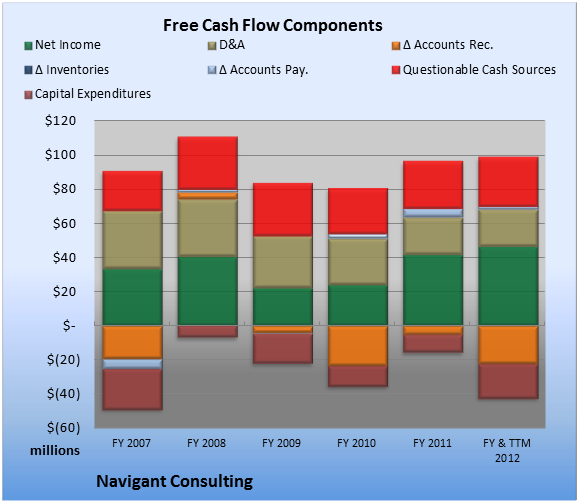
Unfortunately, the cash flow statement isn’t immune from nonsense, either. That’s why it pays to take a close look at the components of cash flow from operations, to make sure that the cash flows are of high quality. What does that mean? To me, it means they need to be real and replicable in the upcoming quarters, rather than being offset by continual cash outflows that don’t appear on the income statement (such as major capital expenditures).

For instance, cash flow based on cash net income and adjustments for non-cash income-statement expenses (like depreciation) is generally favorable. An increase in cash flow based on stiffing your suppliers (by increasing accounts payable for the short term) or shortchanging Uncle Sam on taxes will come back to bite investors later. The same goes for decreasing accounts receivable; this is good to see, but it’s ordinary in recessionary times, and you can only increase collections so much. Finally, adding stock-based compensation expense back to cash flows is questionable when a company hands out a lot of equity to employees and uses cash in later periods to buy back those shares.

So how does the cash flow at Navigant Consulting look? Take a peek at the …read more
Source: FULL ARTICLE at DailyFinance