Tag Archives: Source Apple

The Surprising iCloud Trick That Gives a Glimpse of Apple's Televised Future

By Tim Beyers, The Motley Fool

Filed under:

Quietly, Apple is rolling out iCloud syncing for both movies and TV shows.

How do I know? I’m one of what seems to be a growing number of iTunes season pass subscribers. Last week, I downloaded the latest episode of the second half of Series 7 of Doctor Who — see the trailer at the end — and started watching as I always do: 15 minutes at lunch at my desk, followed by a download to my iPad Mini during a workout break later in the day.

In years past, I’d write down the time stamp for where I’d left off so that, when switching devices, I’d catch myself up manually. Not this time. This time, iTunes was smarter. The download to my iPad included a bookmark for where I’d stopped watching on my Mac.

Source: Apple.

Later tests with Apple TV and my iPhone featuring other TV and movie content produced similar results, proving that iCloud is now syncing in much the same way Netflix does. It’s a brilliant move that offers two clues about the iEmpire’s thus-far enigmatic TV strategy:

  1. While possible, Apple is unlikely to embrace streaming. There’s never been a pressing need thanks to Netflix, YouTube, and now Amazon.com . In enabling iCloud syncing, the company enjoys bookmarking benefit of server-delivered content without incurring the costs of maintaining uptime and ensuring fast content delivery.

  2. Apple doesn’t so much want a TV as it does “TV Everywhere.” Netflix has already proved that there’s big money to be made delivering quality video content to viewers where and how they want. Apple is embracing this same strategy, but with newer, downloadable content. The likely result? Continued demand for the mini-TVs we call iPads, even as the iEmpire works to fulfill the late Steve Jobs’ vision for a better home entertainment experience.

Who loses in all this? Pure-play content distributors such as Cablevision Systems and DISH Network . Like partner Netflix, Apple is taking steps to eliminate the barriers between viewers and content created by these gatekeepers. Color me grateful — both as an investor and as a fan of great television.

Want even more Apple analysis? Allow me to introduce you to The Motley Fool’s senior technology analyst and managing bureau chief, Eric Bleeker, who has the skinny on the various reasons to buy or sell Apple right now. Click here to get his latest thinking on the stock and what opportunities are left for Apple (and your portfolio) going forward.

var FoolAnalyticsData = FoolAnalyticsData || [];

From: http://www.dailyfinance.com/2013/04/14/in-copying-netflix-apple-gives-a-glimpse-of-its-te/

Apple, Go Get Ron Johnson Back. Now.

By Evan Niu, CFA, The Motley Fool

Ford Fiesta ST Ken Block Video

Filed under:

Way back in June 2011 when Apple lost retail chief Ron Johnson to J.C. Penney , it was seen as a huge loss for Apple and a big win for J.C. Penney. Johnson accepted the promotion, becoming CEO of the struggling department store chain. Nearly two years later, it would seem that Johnson wasn’t such a victory for J.C. Penney after all.

JCP data by YCharts.

Shares lost 55% of their value under his tenure (not including the 12% drop the following day after Johnson’s predecessor, Mike Ullman, was rehired). J.C. Penney is an entirely different breed of retailer compared to the Mac maker. Johnson’s strategy of removing discounts, coupons, and sales in favor of more transparent pricing didn’t resonate with consumers, and J.C. Penney’s sales suffered for it.

Well, as luck would have it, Johnson’s former position at Apple is still up for grabs, following John Browett’s departure in October. Since then, Apple has been searching for a new retail chief, with retail operations falling under CEO Tim Cook’s jurisdiction in the interim. Browett came from the U.K.’s Dixons chain, and the British exec later said that he simply “just didn’t fit” at Apple, maintaining that he wasn’t rejected for a lack of competency. Browett failed to see the big picture, trying to save costs without realizing that cost cutting is the last thing that Apple should do, especially if the customer experience is the thing getting shortchanged.

Apple Retail has been doing just fine
Since Johnson’s departure, it’s not as if Apple’s retail operations have struggled. Far from it — Apple retail has grown and has now generated $19.2 billion in trailing-12-month sales.

Source: SEC filings. Calendar quarters shown. TTM = trailing 12 months.

The company has also expanded its total store count by 74 stores to 401, up from 327 when he left. Most of this expansion has been internationally, as Apple’s domestic retail footprint is rather mature and the company is rightly focusing abroad.

Source: Apple conference calls. Calendar quarters shown.

Foot traffic is also up, with record 120 million visitors last quarter. Average quarterly revenue per store is also flirting with all-time highs at $16.3 million in the fourth quarter.

Source: Apple conference calls. Calendar quarters shown.

Clearly, Apple isn’t in dire need of Johnson to return. But at the same time, Apple Retail lacks dedicated leadership right now, and Johnson gets Apple. This is the guy that launched Apple Retail in the first place, promptly silencing critics that initially derided the move as misguided and doomed to fail. The Genius Bar is now the paragon of modern customer tech support, the type of notion that’s mostly lost in a department store environment.

Other tech giants have since tried to emulate Apple’s retail strategy, most notably Microsoft and Samsung. Microsoft Retail stores bear more than a passing resemblance to

Source: FULL ARTICLE at DailyFinance

Is the iPhone 5 About to Disappear?

By Adam Levine-Weinberg, The Motley Fool

Filed under:

Since the introduction of the iPhone in 2007, Apple has reliably updated the device once a year. For the past several iterations, beginning with the release of the iPhone 3GS in 2009, Apple has dropped the price of the previous model by $100 to provide a lower-cost option for price-sensitive customers. Thus, the typical price structure for the current iPhone options in the U.S. — assuming a two-year contract and a carrier subsidy — is the following:

Standard U.S. iPhone Pricing

Model

Price

iPhone 5

$199

iPhone 4S

$99

iPhone 4

Free

Last week, The Wall Street Journal reported that the next-generation iPhone, thought to be called the “iPhone 5S,” will enter production this quarter. Analysts believe that time frame puts Apple on track to release the iPhone 5S in June or July. But I don’t think Apple will follow its previous custom by dropping the iPhone 5 subsidized price to $99 this summer.

The iPhone 5. Source: Apple.

Instead, the company may choose to discontinue the iPhone 5 when its replacement arrives. That would line up with the strategy Apple followed for the most recent iPad update: The fourth-generation iPad replaced the third-generation iPad as the high-end model, with the iPad 2 remaining in production as a cheaper alternative.

New iPhone coming
The main rationale for a new high-end iPhone is to keep the pressure up on Apple’s competitors. BlackBerry finally released its new Z10 all-touch smartphone in the U.S. last month, and CEO Thorsten Heins has publicly called the iPhone “outdated.” Meanwhile, major Google Android vendors such as Samsung and HTC are releasing new flagship phones this spring. Last year, Samsung used the gap between its spring release of the Galaxy SIII and the iPhone 5’s fall debut to pick up significant market share.

Apple needs to update the iPhone sooner rather than later to keep its products in the spotlight and bolster its position vis-a-vis Android phone vendors. However, it needs to do so without putting further pressure on its profitability, which has become a concern recently.

Gross margin is the key
The introduction of the iPhone 5 dented Apple’s gross margin, which dropped 610 basis points year over year, from 44.7% to 38.6%, in the fall quarter. Some of these increased costs relative to the 4S were temporary, as the iPhone 5 required a new manufacturing process, new equipment, and other upfront costs. However, while those initial cost headwinds may be subsiding, the iPhone 5 still includes more expensive components than the iPhone 4S — better screen, LTE modem, and the like.

In the fall quarter, Apple was able to make up for the lower-margin profile of the iPhone 5 and other products by boosting revenue. In contrast, the company is expected to post a significant year-over-year decline in profit this quarter. To restart earnings growth, Apple needs to halt or (preferably) reverse its gross-margin decline.

Most Apple followers …read more

Source: FULL ARTICLE at DailyFinance

How Does Google Really Feel About Facebook Home?

By Evan Niu, CFA, The Motley Fool

Filed under:

Yesterday, social networking giant Facebook unveiled its new Facebook Home suite of apps and tweaks. The package features heavy integration of numerous Facebook services directly into various Google Android devices, and will soon be available for broader download from Google Play.

Facebook Home isn’t quite a full-fledged fork of the operating system, like the route that Amazon.com has successfully pursued. Instead, it’s just a heavy modification that sits directly on top of the operating system, but hijacks numerous key features. You might even consider it a “half-fork.”

The standard Google search box is removed from the home screen. Actually, both the home screen and lock screen are replaced by Cover Feed, which will eventually include Facebook’s ads — and not Google’s. Mark Zuckerberg even argued that Facebook Home will end up being “really good for Android.”

That may be true since his point is that Home may boost developer interest in Android, since most developers “put most of their efforts” toward Apple‘s iPhone. However, as Google continues to lose more and more control over Android, what’s good for Android as a platform may not be good for Google as a business.

Google’s open stance on platforms facilitated Home, and Facebook didn’t even have to collaborate with its ad rival, even though Big G knew what Facebook was up to. “Google’s Android is open so we don’t have to work with them,” Zuckerberg noted.

That’s in contrast to Facebook’s relationship with Apple. Since Apple is set on maintaining control at all times, Facebook would need a lot more cooperation from Cupertino to make Home for iOS a reality. Zuckerberg acknowledged that Apple would have to be willing to partner. For now, the existing levels of Facebook and iOS integration will have to suffice.

Facebook integration in iOS 6. Source: Apple.

In a statement to VentureBeat, a Google spokesperson said:

The Android platform has spurred the development of hundreds of different types of devices. This latest collaboration demonstrates the openness and flexibility that has made Android so popular. And it’s a win for users who want a customized Facebook experience from Google Play — the heart of the Android ecosystem — along with their favorite Google services like Gmail, Search, and Google Maps.

These services are still present on Home-equipped Androids, but far less prominent. I wouldn’t expect Google to shamelessly bash Home, but I also wouldn’t expect the search giant to tell investors how it really feels about the potential threat.

Home is the latest in a string of hijackings and the most recent evidence of how Google has lost control of Android.

It’s more important than ever to understand each piece of Google’s sprawling empire. In The Motley Fool’s new premium research report on Google, we break down the risks and potential rewards for Google investors. Simply click here now to unlock your copy of this invaluable resource.

…read more

Source: FULL ARTICLE at DailyFinance

Apple Needs to Move Siri From Beta to Indispensable

By Chris Neiger, The Motley Fool

Detroit Electric SP:01

Filed under:

Recent postings on Apple‘s jobs site show the company is looking to hire 12 new Siri developers — and it may be just in time. With Apple’s increased competition with Samsung and others, it’s not surprising the company may be looking to its personal assistant more indispensable.

Over the past few years, Siri has become an integral part Apple’s iOS, and although it has had some setbacks, it’s still arguably one Apple’s most innovative mobile features. But others have begun to catch up to Siri’s functionality — some even surpass it.

Source: Apple.

When Samsung launched its new Galaxy S4, the company came up with the tag line “life companion” for the phone and touted the S Voice feature. Similar to Siri, Samsung’s S Voice allows users to use voice commands to ask questions, place calls, and send texts. In comparison tests by The Christian Science Monitor, S Voice on the Galaxy S III was competitive with Siri, and even outperformed it at times.

The next contender, although not a voice personal assistant, is Google‘s new Android app Google Now. Google Now offers calendar reminders, location-based traffic updates and other time-sensitive information. The app was the recent source of a little controversy between Apple and Google. Google said the app wasn’t available on the iPhone yet because Apple hadn’t approved it, meanwhile Apple said the app was never sent to App Store for approval.

Apple’s strength in the personal assistant arena lies with its first-mover advantage in the space — particularly in the automotive industry. Apple is working with about a dozen automotive companies to integrate Siri into cars, dubbing it “Eyes Free.” When Siri is paired to the car via Bluetooth, drivers can ask Siri for directions, make phone calls, send and read texts, play music, and ask questions that don’t require a web browser to open.

Detroit Electric SP:01

Source: Apple.

Apple’s move into the automotive space is just another way it’s trying to keep current iPhone users hooked on Siri. The company needs to fill in niches like the automotive market to prove to smartphone users that it’s an indispensable feature.

But Android phones are making a move into autos as well, through the use of Nuance Communications‘ voice technology. Nuance already works with over a dozen car companies to bring voice controls into cars, and some smartphone makers like ZTE are working with Nuance to bring car-ready voice integration to their devices. Nuance is currently developing a personal assistant of its own that has yet to be released, which has led to some speculation in the tech world that Apple may purchase the company to eliminate further competition.

With Apple opening up 12 new spots for Siri developers, it may be a sign that Apple recognizes the personal assistant competition is heating up. Given that iOS 7 is likely to launch this summer, it may be the right time for Apple to bring …read more
Source: FULL ARTICLE at DailyFinance

Could an iPad Refresh Boost Apple's Earnings? Not by Much.

By Daniel Sparks, The Motley Fool

Filed under:

Apple investors are looking for a driver to kick-start earnings back into a growth cycle. With an iPad refresh likely just around the corner, could the popular tablet save Apple from its not-so-impressive growth? Probably not.

Riding on the success of the iPad Mini
Apple’s iPad Mini has seen surprising success. Half of the company’s first-quarter record tablet sales were likely attributable to the smaller tablet, which was only available for purchase during two-thirds of the quarter, according to Canalys. Apple’s unit iPad sales were up 48% from the year-ago quarter. Revenue from the product segment was less impressive, due to the lower average selling price from the new product mix, which included the lower-priced iPad Mini. Even so, revenue for the segment was still up 22%, though these numbers were slightly skewed down because the quarter contained an extra week.

Much of the iPad Mini’s success is obviously attributable to its lower price point. But one can also argue that the significant departure from the old form factor to a redesigned encasing could also be a major driving force of sales.

Source: Apple.

The iPad Mini has significantly narrower bezels than the iPad, with the display making up a larger portion of the front side of the device. It’s 53% lighter and 23% thinner than the third-generation iPad. The encasing has an aluminum finish that gives the device a very refined look on the edges and the backside — especially the black version of the device.

The rumored iPad refresh in April will likely be a redesigned full-sized iPad to reflect the encasing design on the iPad Mini, according to iMore. But iMore is less sure about a new release of the iPad Mini.

Typically, Apple is limited by supply — not demand — in the quarters it launches new iPads and iPhones. Historically, Apple has managed to incrementally ramp up the availability of new products with each new generation of a product line. With a redesigned form factor and smoother rollout, an iPad should perform well in Apple’s third quarter if it arrives by late April or early May as rumored.

Don’t expect much
The overall growth of the tablet market will work in Apple’s favor yet again. A study released last week by IDC projects tablet shipments to increase 174.5% between 2012 and 2017. Year-over-year shipments increased 78.4% in 2012 alone.

In light of overall tablet market growth, a smoother rollout, and a redesigned form factor, investors can likely expect about a 25% to 30% increase in year-over-year iPad sales.

Assuming Apple‘s profit margins for the iPad segment are affected by the lower gross margins associated with the iPad Mini and the new form factor on a redesigned iPad, I’ll use an estimated gross margin on the product line of 36% for this year and 40% last year.

The result? Apple could end up with an incremental growth of approximately $0.3 to $0.4 billion in …read more
Source: FULL ARTICLE at DailyFinance

Should Corning Be Scared of Sapphire?

By Evan Niu, CFA, The Motley Fool

Sapphire camera lens covers used in the iPhone 5. Source: Apple.

Some analysts believe that 2013 will be the year that some smartphone OEMs begin using sapphire in their flagship devices. Apple is an obvious possibility as the biggest company that’s publicly marketing its use of the material, but Google is also rumored to use sapphire in the upcoming Motorola “X Phone.”

Talk of this possibility began last year, with Sterne Agee supply checks finding prototype smartphones with sapphire displays in the works. Most of the sapphire industry sells into the LED industry, and incremental opportunities in smartphones could be enormous. Sterne Agee estimated that the smartphone industry translated into 9 billion square inches of material in 2012, which towers over the 150 million square inches used by the LED industry over the same time. If sapphire were able to penetrate just 2% of the smartphone market, the industry’s addressable market would double.

Crystalline winners
Sapphire suppliers like Rubicon Technology and GT Advanced Technologies could benefit in the same way that Corning did years ago.

Cover and touchscreen applications of sapphire. Source: GT Advanced Technologies.

Rubicon is a vertically integrated supplier that uses a proprietary technology for growing the crystals that it calls 

Filed under:

The story of Corning‘s Gorilla Glass dates back over six decades. The glass maker accidentally made a product that no one was interested in using, and for years it was known as Chemcor and simply had no addressable market. In the early ’70s, Corning gave up trying to sell the stuff and the formula gathered dust for 40 years.

That was until Steve Jobs came around and wanted to cover Apple‘s iPhone with the material, since most smartphone displays predating Apple’s device were covered in plastic that was easily scratched. In the years since, Gorilla Glass has grown to become one of Corning’s most important growth businesses, thanks in large part to smartphone adoption and Apple effectively standardizing the material’s use in high-end mobile devices.

Source: SEC filings. “Other” segment not shown due to negligible sales.

Gorilla Glass is included in Corning’s specialty materials segment and is the primary reason why that operating segment has grown from just 6% of sales in 2009 to an impressive 17% of revenue in 2012.

In November, Corning guided the Gorilla Glass business to $1 billion in annual revenue, a target that it subsequently hit. That was up 44% from 2011, and the majority of the $1.3 billion in revenue that specialty materials generated in 2012. Gorilla Glass also carries gross margins that are much higher than the corporate average.

It turns out that there may be a threat on the horizon to Gorilla Glass, and one that Apple may be catalyzing. Should Corning be scared of sapphire?

Monkey business
Last week, MIT Technology Review published a report on the possible future use of sapphire in smartphone screens, which could potentially replace Gorilla Glass eventually. This threat isn’t at all imminent, as the cost differential remains very high, so most smartphone vendors wouldn’t yet consider adopting it.

A Gorilla Glass display cover currently costs less than $3, which is much cheaper than the $30 that a similar sapphire display would set an OEM back. Eventually, the cost of sapphire could decline to below $20 due to competition and technological advances.

Such a pricey component would put a serious damper on margins. For example, the iPhone 5’s bill of materials excluding manufacturing was estimated at $199, so an extra $27 for the display’s cover material would be a 14% increase in component costs that would represent a gross margin reduction of 4%. While Apple is one of the few smartphone OEMs that could technically afford this type of hit, it certainly doesn’t want to.

Sapphire is much stronger and more scratch resistant than glass, which would make it an ideal candidate if costs permit. At the same time, Corning isn’t resting on its laurels and has now launched Gorilla Glass 3, which includes what the company calls Native Damage Resistance for improved durability. The first smartphone to be unveiled with Gorilla Glass 3 was Samsung’s Galaxy S4 that was shown off earlier this …read more
Source: FULL ARTICLE at DailyFinance

What Will Googorola's iPhone Killer Look Like?

By Evan Niu, CFA, The Motley Fool

Sapphire camera lens covers used in the iPhone 5. Source: Apple.

Sapphire is three times stronger than Gorilla Glass but also costs up to 10 times as much. Those costs should come down in the future, which may spur adoption and potentially threaten one of Corning’s fastest-growing businesses. However, that cost discrepancy means that Corning has time to continue beefing up Gorilla Glass. The glass maker just unveiled Gorilla Glass 3, which debuted on Samsung’s Galaxy S4.

Apple was the first smartphone vendor to catalyze Gorilla Glass adoption, and it may be the same one to signal an eventual shift toward sapphire displays. Sapphire suppliers like Rubicon Technology and GT Advanced Technologies could potentially benefit from that transition if it materializes meaningfully over the next couple years.

All that and a bag of chips
Inside the X Phone should be one of Qualcomm‘s latest and greatest Snapdragon processors, potentially its high-end 800 Series that was just announced in January and is currently sampling for mid-year commercial launches. Specifically, phoneArena believes it may be a quad-core 2 GHz chip inside.

As with all rumors, none of the above may be true, especially since the rumbling directly contradicts another X Phone rumor from earlier this month. Android World had speculated that the device would carry a 4.7-inch display and notably a different processor — NVIDIA‘s quad-core

Filed under:

Late last year, rumors surfaced that Google‘s Motorola subsidiary was working on a new high-end flagship smartphone to take on Apple‘s iPhone. The device was reportedly called the “X Phone” internally, and it wasn’t long until the device’s existence was inadvertently confirmed through a job listing for a senior director of product management that was promptly taken down.

Just last month at the Morgan Stanley Technology Conference, Google CFO Patrick Pichette went and candidly bashed the product pipeline that Google inherited from Motorola, saying they wouldn’t live up to the search giant’s standards for “wow” products. “We’ve inherited 18 months of pipeline that we actually have to drain right now, while we’re actually building the next wave of innovation and product lines,” he said, adding, “We have to go through this transition. These are not easy transitions.”

Big G is clearly looking to flush out the mediocre devices that are already en route posthaste so that it can clear the way for a real “wow” smartphone. It’s now been 19 months since the acquisition was announced (and nearly 10 months since it closed). During that time, Apple has continued dominating the domestic smartphone market, comprising 65% of all smartphones activated on the three biggest domestic carriers during the fourth quarter.

Where is the X Phone when Google needs it?

Thankful for the X Phone?
According to a rumor out of phoneArena, Googorola is planning on launching the device in November ahead of the holiday shopping season. The anonymous source claims that the X Phone will sport a 4.8-inch display covered with sapphire glass instead of Corning‘s ubiquitous Gorilla Glass that almost all modern smartphones have. The device may also pack a substantially beefier battery.

The talk of sapphire comes just after the MIT Technology Review released a report last week discussing the use of manufactured sapphire in smartphones. Apple just started using sapphire crystal in the iPhone 5, but as the primary camera lens cover.

Sapphire camera lens covers used in the iPhone 5. Source: Apple.

Sapphire is three times stronger than Gorilla Glass but also costs up to 10 times as much. Those costs should come down in the future, which may spur adoption and potentially threaten one of Corning’s fastest-growing businesses. However, that cost discrepancy means that Corning has time to continue beefing up Gorilla Glass. The glass maker just unveiled Gorilla Glass 3, which debuted on Samsung’s Galaxy S4.

Apple was the first smartphone vendor to catalyze Gorilla Glass adoption, and it may be the same one to signal an eventual shift toward sapphire displays. Sapphire suppliers like Rubicon Technology and GT Advanced Technologies could potentially benefit from that transition if it materializes meaningfully over the next couple years.

All that and a bag of chips
Inside the X Phone should be one of Qualcomm‘s latest and greatest Snapdragon processors, potentially its high-end 800 Series that was just announced in January and is …read more
Source: FULL ARTICLE at DailyFinance

Apple's iPhone Claims the Consumer Satisfaction Crown Yet Again

By Daniel Sparks, The Motley Fool

Filed under:

“Turns out, we spoke too soon,” begins an email Apple sent out on Friday, March 22. It is the second fusillade in a new marketing campaign that outlines the main reasons consumers love the iPhone 5. In the Friday email, the company set the record straight: As of last Thursday, Apple has bragging rights to nine — not eight — straight J.D. Power and Associates awards for “Highest Customer Satisfaction with Consumer Smartphones.”

iPhone 5. Source: Apple press product images.

Signs of a new marketing approach
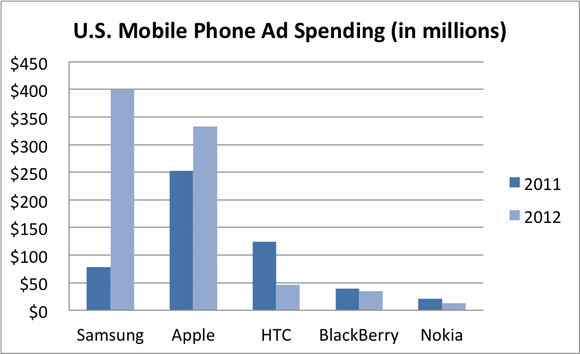
The first round of the well-timed campaign came just two days after Samsung launched its flagship Galaxy S4. The campaign is great news for Apple investors, after Samsung dramatically stepped up its advertising in 2012, even outspending Apple.

Samsung’s increased advertising spending during 2012 is nothing short of massive. Samsung spent more on advertising than HTC, BlackBerry , and Nokia combined. Even more mind-boggling, the company more than quadrupled its 2011 spending on advertising.

Source: Kantar Media.

Marketing experts — like ex-Apple ad executive Ken Segall, the man behind Apple’s legendary “Think Different” campaign — have suggested that Apple is losing some of its cool factor.

While Apple continues to stick to its traditional product-based ads, Samsung has spent a fortune on people-based ads featuring celebrities. And Samsung’s approach is working, Segall asserted several weeks ago. The premise behind the ads is to show consumers exactly what there is to love about the Galaxy line. According to Segall, Apple needs to step up its marketing in order to counter Samsung.

Apple’s new “Why iPhone” campaign “appears to be trying to bridge that divide somewhat by focusing on how the iPhone experience has drawn so many loyal and happy customers,” MacRumors’ Eric Slivka explains. 

Will the mobile ad war heat up in 2013?
There’s no doubt Apple’s top management team is keenly aware of Samsung’s remarkable inroads in the mobile market in 2013 — in both smartphones and tablets.

According to estimates from Gartner, Google‘s Android-powered smartphones grew 88% year over year from 2011 to 2012 while iOS smartphone sales grew just 23%. This brings the Android OS share of total smartphone market share to 70% in the fourth quarter of 2012, up from 51% in the fourth quarter of 2011. Meanwhile, iOS market share fell from 24% to 21%.

To be fair, Android is spread out across a whole spectrum of smartphone brands and models, with a far lower average selling price. Even so, Samsung’s Galaxy line represents the largest portion of Android sales. 

Samsung’s made inroads in tablets, too. The company shipped 7.6 million tablets in the fourth quarter of 2012, according to Canalys — that’s a 226% increase from the year-ago quarter, far more than Apple’s 48% increase.

Samsung’s gains are undoubtedly at least partly due to the quadrupling of its ad spending. The evidence goes both ways. BlackBerry and Nokia, two companies that reduced their already minuscule advertising budgets in 2012, saw smartphone …read more
Source: FULL ARTICLE at DailyFinance

Apple Named King of Cloud Computing

By Tim Beyers, The Motley Fool

Filed under:

When it comes to storing most of our online entertainment, Google and its Drive file system isn’t top dog. Neither is Microsoft‘s SkyDrive or Amazon.com‘s Cloud Drive. The winner? Apple , says a new report from Strategy Analytics.

The survey asked respondents which digital locker services they use to store music or video. iCloud and iTunes topped the list with 27% using Apple’s services. Surprisingly, Dropbox ranked second, two percentage points ahead of Cloud Drive.

Source: Strategy Analytics.

Whether or not this is the first time anyone’s taken a serious look at the “entertainment cloud,” I think it’s fair to say that — up to this point — we’ve largely overlooked Apple’s growing presence online. How we could not? We’re too busy covering efforts by Google and Microsoft to win users to their respective cloud productivity suites.

Let’s take a break from that back and forth for a moment and consider a few numbers not included in the Strategy Analytics report, but which reflect the Mac Maker‘s increasing influence:

Source: Apple.

Imagine if only a third of them were backed up to iCloud. I’m almost surprised Apple doesn’t possess a greater share of the entertainment cloud. At the very least, I suspect some of its $140 billion fortune might go to building an overseas data center for serving the increasing number of iOS devices in use in non-U.S. markets.

Put simply: The cloud is expanding fast but, if the data is to be believed, not nearly as fast as iCloud.

For further analysis of Apple, I invite you try our newest premium research service in which Motley Fool senior technology analyst and managing bureau chief Eric Bleeker assesses the risks and opportunities of investing in the iEmpire. Access your report now by clicking here.

var FoolAnalyticsData = FoolAnalyticsData || []; FoolAnalyticsData.push({ eventType: “TickerReportPitch”, contentByline: “Tim Beyers”, …read more
Source: FULL ARTICLE at DailyFinance

2013: The Year of Evolved Mobile Search Ads

By Chris Neiger, The Motley Fool

Filed under:

Just last month, Google launched its “enhanced campaigns” to meld desktop search ads with mobile search ads, removing the option for advertisers to opt out of using mobile ads in their campaign. It was a bold move by the company and showed that Google is moving its advertisers quickly into the mobile world, where competition is heating up.

Mobile search, the traditional way
Right now, Google enjoys about 95% of global mobile searches. In the U.S. alone, the market for mobile search advertising is expected to hit $3.36 billion this year, and eMarketer expects Google to snag 92.4% share of that. Google’s new, enhanced campaign strategy will help the company to acquire that market share by moving advertisers away from desktop-only campaigns and essentially forcing them to create ads around content rather than a specific platform .

Source: Google.

Google’s move comes at a strategic time in the mobile advertising space. Desktop search is on the decline while mobile search is skyrocketing. The latter now accounts for 25% of all Internet searches, and search marketing agency Covario estimates that mobile search will reach one in every three searches by the end of this year .

Google’s most vocal contender is Microsoft and its Bing search engine. Bing is the default search engine on the Windows Phone OS, but the operating system currently takes less than 3% of smartphone market share, and in 2011 Bing only took 2% of the mobile search market. Even if Windows Phone sales took off and Bing’s mobile search doubled or tripled its current percentage — both a difficult feat — Google would still own the market.

Searching without searching
It may not be Microsoft that Google needs to watch out for, though. Mobile search through apps is on the rise. Many apps utilize smartphone location-based features to integrate search results within apps, which bypass Google or Bing.

On Android devices, the Google Search app is currently the second most frequently used app, behind Google Play. But in Apple‘s iPhone, the Google Search app didn’t even make it in the top 10 for most-used app. It’s not that iPhone users don’t use Google search in their browser, but they don’t use the actual Google Search app like Android users do.


Source: Apple.

Apple’s place in the search market is an odd one. Back in 2010, Steve Jobs said, “On the desktop search is where it’s at; that’s where the money is. But on a mobile device search hasn’t happened. Search is not where it’s at, people are not searching on a mobile device like they do on the desktop.” Fast-forward three years and Apple’s Siri performs many search functions for mobile users. Siri consults Google for some results, but also taps Bing, Yahoo, Wolfram Alpha, Wikipedia, and other sites for queries. Although Siri doesn’t bring in any mobile search revenue for the Cupertino company, Siri could take up more mobile searches over …read more
Source: FULL ARTICLE at DailyFinance

Apple's Next iOS: Why Investors Should Care

By Chris Neiger, The Motley Fool

Filed under:

We’re still months away from a possible launch of Apple‘s latest iteration of its iOS, but some people close with Apple are already saying iOS 7 won’t be the revolutionary operating system that some are hoping for. Apple is much more than its mobile operating system, but at a time when Apple’s stock is waning so harshly, so the company could use a new OS to bring back some of its sparkle.

Building a new foundation
Earlier this week, BlackBerry CEO Thorsten Heins told the Australian Financial Review, “The rate of innovation is so high in our industry that if you don’t innovate at that speed you can be replaced pretty quickly. The user interface on the iPhone, with all due respect for what this invention was all about, is now five years old .” While it’s debatable how much the CEO of BlackBerry can speak on smartphone innovation, it is true that the user interface of iOS has, for the most part, stayed the same since 2007.

Obviously, big updates with each new version have come along, but with an iOS 7 launch looming this summer, many are hoping for a huge leap forward. But some people close to Apple have stressed that iOS 7 won’t be the drastic change some may be anticipating. An iOS developer, Guy English, who’s close with people at Apple, said this on well-known Apple blogger John Gruber‘s podcast, “Maybe iOS 8 will be interesting, but iOS 7 will be less of a leap than many people are hoping for.” He went on to say, “… no matter how impressive iOS7 will be, it’s not going to be the first iPhone .”

Source: Apple.

Skepticism like this is not completely unwarranted. Last year, Apple CEO Tim Cook fired the company’s chief of iOS Scott Forstall after the Apple Map fiasco and installed Jonathan Ive, Apple’s longtime hardware designer, and Craig Federighi. Although having fresh eyes working on iOS could eventually bring radical change to the mobile platform, this will take time. Ive and Federighi have only been in charge of the next iOS since October, which isn’t much time to build a completely new OS from the ground up.

Why investors should care
A new iOS isn’t technically a moneymaking product. It’s baked into Apple’s latest mobile devices and used as a selling point for the products. But investors shouldn’t overlook how important Apple’s mobile OS is to the iPad and iPhone. According to an IDC report in Q4 2012, developers prefer to make apps for iPads and iPhones over any other mobile platform.


Source: Appcelerator / IDC Q4 2012 Mobile Developer Report.

This helps Apple get more apps into its Apps Store, or at least get them sooner. More apps, and better apps keep users tied into Apple’s ecosystem and make them less likely to switch to another product.

As Android sales increase globally, iOS will continue to come under constant …read more
Source: FULL ARTICLE at DailyFinance

Apple's Down in China, but Far From Out

By Chris Neiger, The Motley Fool

Filed under:

Samsung recently took the top spot for smartphone market share in China, leaving Apple behind in the No. 3 spot. Apple may not be king in the largest smartphone market in the world, but its profits, and demand, speak for themselves in the country.

Who’s who in Chinese smartphones
Samsung’s whopping 30 million smartphone sales in China last year deserves a tip of the hat. The company surged from 10.9 million sales in 2011 to 300% increase in 2012. But despite the huge sales gain, the company took only an additional 5.3% of the smartphone market share. Granted, that was enough to stay ahead of Apple, which currently holds 11%. Here’s the breakdown of smartphone market share by sales.

Source: VentureBeat.

While it’s obvious Chinese consumers are willing to put a Samsung device in their pockets, investors can look beyond market share to some more concrete numbers: revenues.

In 2011, Apple’s sales in China were $4.08 billion. In 2012, that number increased by 67% to $6.83 billion. That’s a significant increase in sales in the region, considering its growth in North and South America was 15% and 13% in Europe. But one of the most important facts to remember is that Apple isn’t even on China‘s largest mobile network, China Mobile . Samsung and Lenovo, who lead in smartphone sales market share, both have deals to sell phones on China Mobile. Meanwhile, Apple has managed to claim the third spot without any deal with the company — but it’s coming.


Source: Apple.

Apple wants its iPhone available to China Mobile’s 700 million customers, and China Mobile wants to officially offer the coveted and social status-raising iPhone. As China Mobile’s 3G network grows, both companies cannot wait much longer to strike a deal. At the 2012 China Mobile Worldwide Developer Conference, the company’s president said about working a deal with Apple: “Technology is not a problem, [it’s] mainly about business model and benefit-sharing issues.” It’s high time Apple and China Mobile worked out some sort of deal.

As of this time last year, about 15 million China Mobile customers used their unlocked iPhones on the company’s 2G network. With millions of Chinese consumers already unofficially using new iPhones on China Mobile’s network, it shows how much demand there is for a China Mobile iPhone.

Morgan Stanley analyst Katy Huberty said last month that Apple could add $2.4 billion in iPhone revenue and triple its customer base in China if the company debuted an iPhone “Mini”. No one knows whether or not Apple will release a cheaper iPhone in China, but we do know that Apple won’t let an opportunity like China Mobile pass by. With Apple focusing much of its attention on the country, a deal with China Mobile is the next logical step to building its presence in China.

Taking it slow
Some investors may not …read more
Source: FULL ARTICLE at DailyFinance

Apple Tightens Its Golden Handcuffs

By Evan Niu, CFA, CFA, The Motley Fool

Filed under:

Despite Apple‘s uneventful annual shareholder meeting last Wednesday, the company has made some changes to its corporate bylaws (link opens PDF).

Leading up to the meeting, Greenlight Capital’s David Einhorn scored a victory in his suit against Apple, whereby Apple could not bundle three separate matters into one single vote. Apple had proposed some changes that it felt were in the best interests of shareholders and corporate governance advocates, but Einhorn wasn’t keen on the provision on preferreds. Apple had to remove the vote just days before the meeting.

As it turns out, Apple had actually decided to change its mind on another proposed measure, quietly instituting a change at the beginning of February that was just now noticed. Apple is tightening its golden handcuffs on executives.

Expensive handcuffs
The Mac maker is now requiring high-level executives to maintain certain equity holdings relative to their base salaries. The California Public Employees’ Retirement System had been seeking a similar move. Apple had initially opposed it but has now adopted a modified version of that proposal.

These are the ownership requirements now being implemented on employees and directors.

Role

Ownership Requirement

CEO

10 times annual base salary

Executive officers

3 times annual base salary

Non-employee directors

5 times annual retainer

Source: Apple.

Qualifying ownership includes any shares that these individuals own directly, own jointly or separately by a spouse, or hold in a trust. Equity awards only count once they’re vested, so that 1 million restricted stock unit grant that Tim Cook received upon becoming CEO won’t count quite yet.

The company expects these requirements to be satisfied for Cook and the board by November 2017, and other executives have until February 2018. Any new executive that becomes subject to the requirements has five years to meet the compliance requirement.

Here are the salaries and retainers and related requirements for 2013.

Role

Annual Base Salary or Retainer

Ownership Requirement

CEO

$1.4 million

$14 million

Executive officers

$875,000

$2.6 million

Non-employee directors

$50,000

$250,000

Source: Proxy statement.

Cook’s most recent Form 4 shows that he owns 13,858 shares directly, which is worth just under $6 million at current prices. However, remember that Cook was holding over 1.1 million restricted stock units, or RSUs, as of the proxy date. He became CEO in 2011 and he will have 500,000 shares vest in 2016. Once that happens, that ownership requirement will look like a drop in the bucket. At current prices, half a million shares are worth $216 million. The only way that those shares vesting will fail to meet his holding requirement is if Apple declines by 96% over the next three years, so I think he’s safe.

CFO Peter Oppenheimer is currently the proud owner of 4,834 shares, valued at $2.1 million, so he’s not too far away from his $2.6 million requirement anyway. Including his trust, …read more
Source: FULL ARTICLE at DailyFinance