Tag Archives: PDF

As North Korea Rattles Sabres, Congress May Sell F-35s to the South

By Rich Smith, The Motley Fool

Filed under:

As the confrontation on the Korean Peninsula heats up, the Defense Security Cooperation Agency announced (link opens a PDF) on Wednesday that it has notified Congress of plans to make a “Foreign Military Sale” to South Korea of 60 new F-35A Lightning II Joint Strike Fighters manufactured by Lockheed Martin .

The fighter jets, which would be sold in the “Conventional Take Off and Landing” configuration, are valued at $10.8 billion with included equipment, parts, training, and logistical support. They would be outfitted with F-135 engines built for the fighter by United Technologies‘ Pratt & Whitney division. In addition to installed engines, nine spare engines would be included in the price of the sale.

Justifying the sale, DSCA advised Congress that “this proposed sale will contribute to the foreign policy goals and national security objectives of the United States by meeting the legitimate security and defense needs of an ally and partner nation” and that “the proposed sale of F-35s will provide the Republic of Korea (ROK) with a credible defense capability to deter aggression in the region.”

DSCA further advised that as the F-35s are delivered to South Korea, the ROK Air Force plans to decommission the ancient F-4 Phantom fighter jets currently in its arsenal to make way for the new planes.

DSCA noted in its letter than the F-35 sale is no done deal. Rather, South Korea is holding a competition to choose its next generation of fighter jets. Congressional preapproval of a sale would pave the way for Lockheed’s participation in this competition.

The article As North Korea Rattles Sabres, Congress May Sell F-35s to the South originally appeared on Fool.com.

Fool contributor Rich Smith has no position in any stocks mentioned. The Motley Fool owns shares of Lockheed Martin. Try any of our Foolish newsletter services free for 30 days. We Fools don’t all hold the same opinions, but we all believe that considering a diverse range of insights makes us better investors. The Motley Fool has a disclosure policy.

Copyright © 1995 – 2013 The Motley Fool, LLC. All rights reserved. The Motley Fool has a disclosure policy.

(function(c,a){window.mixpanel=a;var b,d,h,e;b=c.createElement(“script”);
b.type=”text/javascript”;b.async=!0;b.src=(“https:”===c.location.protocol?”https:”:”http:”)+
‘//cdn.mxpnl.com/libs/mixpanel-2.2.min.js’;d=c.getElementsByTagName(“script”)[0];
d.parentNode.insertBefore(b,d);a._i=[];a.init=function(b,c,f){function d(a,b){
var c=b.split(“.”);2==c.length&&(a=a[c[0]],b=c[1]);a[b]=function(){a.push([b].concat(
Array.prototype.slice.call(arguments,0)))}}var g=a;”undefined”!==typeof f?g=a[f]=[]:
f=”mixpanel”;g.people=g.people||[];h=[‘disable’,’track’,’track_pageview’,’track_links’,
‘track_forms’,’register’,’register_once’,’unregister’,’identify’,’alias’,’name_tag’,
‘set_config’,’people.set’,’people.increment’];for(e=0;e<h.length;e++)d(g,h[e]);
a._i.push([b,c,f])};a.__SV=1.2;})(document,window.mixpanel||[]);
mixpanel.init("9659875b92ba8fa639ba476aedbb73b9");

function addEvent(obj, evType, fn, useCapture){
if (obj.addEventListener){
obj.addEventListener(evType, fn, useCapture);
return true;
} else if (obj.attachEvent){
…read more

Source: FULL ARTICLE at DailyFinance

Review: Free Opener can open almost any type of file you can think of

What do you use to open files? If you’re in the majority, your answer would be “depends on the file.” This is not the case with Free Opener. Free Opener claims to open over 80 different file formats—anything from Microsoft Office documents and PDF files, to image, video and music files, with many more in between. It may not open as many file types as Quick View Plus, and it’s certainly more of a viewer than an editor, but you can’t argue with the price. It’s a good first stop for trying to view that mystery document.

To read this article in full or to leave a comment, please click here

…read more
Source: FULL ARTICLE at PCWorld

Crude Oil Inventories Up 0.7% on Increased Production

By Justin Loiseau, The Motley Fool

Filed under:

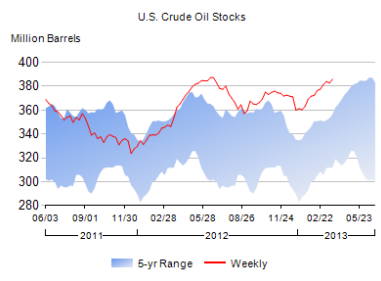
U.S. crude oil inventories bumped up 0.7% (2.7 million barrels) to 388.6 million barrels total for the week ending March 29, according to an Energy Information Administration (EIA) report (link opens a PDF) released today.

In a reversal from last week’s report, imports dropped 227,000 to 7.9 million barrels per day while refinery inputs added on 130,000 to reach 15 million barrels per day.

In what has been a common theme for crude oil inventories in 2013, the latest week’s rise keeps levels “well above the upper limit of the average range,” according to the EIA. The nation’s supply of oil is now 7.2% above year-ago levels and the highest since July 27, 1990, when it was at 391.9 million barrels.

Source: eia.gov. 

Gasoline inventories dropped 0.6 million barrels after falling 1.6 million barrels the previous week. In contrast to crude oil, gasoline’s supply remains within its average range as it tapers off for the summer months. Prices at the pump fell for the fifth consecutive week, down $0.035 to a national average of $3.645 per gallon. That’s down $0.11 from a month ago and $0.29 lower than at this time last year.

Source: eia.gov. 

Distillate inventories also fell, down 2.3 million barrels after a 4.5-million-barrel drop the previous week. While crude oil inventories remain well above their upper limit, increasing demand (+5.5%) for distillates may push inventories below their lower limit average in the coming weeks.

Source: eia.gov. 

link

The article Crude Oil Inventories Up 0.7% on Increased Production originally appeared on Fool.com.

Y
ou can follow Justin Loiseau on Twitter, @TMFJLo, and on Motley Fool CAPS, @TMFJLo.
Try any of our Foolish newsletter services free for 30 days. We Fools may not all hold the same opinions, but we all believe that considering a diverse range of insights makes us better investors. The Motley Fool has a disclosure policy.

Copyright © 1995 – 2013 The Motley Fool, LLC. All rights reserved. The Motley Fool has a disclosure policy.

(function(c,a){window.mixpanel=a;var b,d,h,e;b=c.createElement(“script”);
b.type=”text/javascript”;b.async=!0;b.src=(“https:”===c.location.protocol?”https:”:”http:”)+
‘//cdn.mxpnl.com/libs/mixpanel-2.2.min.js’;d=c.getElementsByTagName(“script”)[0];
d.parentNode.insertBefore(b,d);a._i=[];a.init=function(b,c,f){function d(a,b){
var c=b.split(“.”);2==c.length&&(a=a[c[0]],b=c[1]);a[b]=function(){a.push([b].concat(
Array.prototype.slice.call(arguments,0)))}}var g=a;”undefined”!==typeof f?g=a[f]=[]:
f=”mixpanel”;g.people=g.people||[];h=[‘disable’,’track’,’track_pageview’,’track_links’,
‘track_forms’,’register’,’register_once’,’unregister’,’identify’,’alias’,’name_tag’,
‘set_config’,’people.set’,’people.increment’];for(e=0;e<h.length;e++)d(g,h[e]);
a._i.push([b,c,f])};a.__SV=1.2;})(document,window.mixpanel||[]);
mixpanel.init("9659875b92ba8fa639ba476aedbb73b9");

function addEvent(obj, evType, fn, useCapture){
if (obj.addEventListener){
obj.addEventListener(evType, fn, useCapture);
return true;
} else if (obj.attachEvent){
var r = obj.attachEvent("on"+evType, fn);
return r;
…read more
Source: FULL ARTICLE at DailyFinance

March Employment Underwhelms

By Justin Loiseau, The Motley Fool

Filed under:

Nonfarm private employment increased by a seasonally adjusted 158,000 jobs for March, according to ADP‘s National Employment Report  (link opens in PDF) released today.

Human capital management company ADP partners with Moody’s Analytics to produce this monthly report based on ADP payroll data representing 416,000 U.S. clients employing nearly 24 million workers in the U.S..

Source: Author, data from ADP

Although this month continues a three-year streak of improvements, month-to-month gains haven’t been this low since October 2012. After February’s revised 237,000 additional jobs, market analysts had expected a 205,000-job jump for March.

Moody’s Analytics Chief Economist Mark Zandi said in a statement today: “Job growth moderated in March. Construction employment gains paused as the rebuilding surge in the wake of Superstorm Sandy ended. Anticipation of Health Care Reform may also be weighing on employment at companies with close to 50 employees. The job market continues to improve, but in fits and starts.”

Goods-producing employment was the main culprit for March’s mediocre results, adding just 7,000 jobs for the slowest growth rate in six months. Services managed a 151,000 increase in employment, boosted primarily by a 39,000 gain for professional/business services.

link

The article March Employment Underwhelms originally appeared on Fool.com.

Y
ou can follow Justin Loiseau on Twitter, @TMFJLo, and on Motley Fool CAPS, @TMFJLo.
Try any of our Foolish newsletter services free for 30 days. We Fools may not all hold the same opinions, but we all believe that considering a diverse range of insights makes us better investors. The Motley Fool has a disclosure policy.

Copyright © 1995 – 2013 The Motley Fool, LLC. All rights reserved. The Motley Fool has a disclosure policy.

(function(c,a){window.mixpanel=a;var b,d,h,e;b=c.createElement(“script”);
b.type=”text/javascript”;b.async=!0;b.src=(“https:”===c.location.protocol?”https:”:”http:”)+
‘//cdn.mxpnl.com/libs/mixpanel-2.2.min.js’;d=c.getElementsByTagName(“script”)[0];
d.parentNode.insertBefore(b,d);a._i=[];a.init=function(b,c,f){function d(a,b){
var c=b.split(“.”);2==c.length&&(a=a[c[0]],b=c[1]);a[b]=function(){a.push([b].concat(
Array.prototype.slice.call(arguments,0)))}}var g=a;”undefined”!==typeof f?g=a[f]=[]:
f=”mixpanel”;g.people=g.people||[];h=[‘disable’,’track’,’track_pageview’,’track_links’,
‘track_forms’,’register’,’register_once’,’unregister’,’identify’,’alias’,’name_tag’,
‘set_config’,’people.set’,’people.increment’];for(e=0;e<h.length;e++)d(g,h[e]);
a._i.push([b,c,f])};a.__SV=1.2;})(document,window.mixpanel||[]);
mixpanel.init("9659875b92ba8fa639ba476aedbb73b9");

function addEvent(obj, evType, fn, useCapture){
if (obj.addEventListener){
obj.addEventListener(evType, fn, useCapture);
return true;
} else if (obj.attachEvent){
var r = obj.attachEvent("on"+evType, fn);
return r;
}
}

addEvent(window, "load", function(){new FoolVisualSciences();})
addEvent(window, "load", function(){new PickAd();})

var themeName = 'dailyfinance.com';
var _gaq = _gaq || [];
_gaq.push(['_setAccount', 'UA-24928199-1']);
_gaq.push(['_trackPageview']);

(function () {

var ga = document.createElement('script');
ga.type = 'text/javascript';
ga.async = true;
ga.src = ('https:' == document.location.protocol ? 'https://ssl' : 'http://www') + '.google-analytics.com/ga.js';

var s = document.getElementsByTagName('script')[0];
…read more
Source: FULL ARTICLE at DailyFinance

New Orders for Manufactured Goods up 3% for February

By Justin Loiseau, The Motley Fool

Volkswagen Scirocco GTS - front three-quarter view, lights on

Filed under:

New orders for manufactured goods increased 3% to a seasonally adjusted $492 billion for February, according to a Commerce Department report (link opens in PDF) released today.

After a revised 1% dip in January, new orders have reached an all-time high since data were first collected in 1992. Market analysts had expected a 2.9% increase.

Source: Census.gov. 

Excluding transportation, new factory orders look less optimistic. Similar to the latest durable goods report, transportation accounted for 2.7 percentage points of all new orders. New orders for the transportation sector jumped 21.8%, with nondefense aircraft and parts playing the biggest role there.

Shipments and unfilled orders continued a consecutive climb in February, both up 0.9% for the fifth gain in six months. Inventories also increased 0.2% to $620 billion for the highest level ever recorded. Even as transportation drove new orders up in February, its 31 consecutive months of inventory increase continued to push inventories higher.

link

The article New Orders for Manufactured Goods up 3% for February originally appeared on Fool.com.


Copyright © 1995 – 2013 The Motley Fool, LLC. All rights reserved. The Motley Fool has a disclosure policy.

(function(c,a){window.mixpanel=a;var b,d,h,e;b=c.createElement(“script”);
b.type=”text/javascript”;b.async=!0;b.src=(“https:”===c.location.protocol?”https:”:”http:”)+
‘//cdn.mxpnl.com/libs/mixpanel-2.2.min.js’;d=c.getElementsByTagName(“script”)[0];
d.parentNode.insertBefore(b,d);a._i=[];a.init=function(b,c,f){function d(a,b){
var c=b.split(“.”);2==c.length&&(a=a[c[0]],b=c[1]);a[b]=function(){a.push([b].concat(
Array.prototype.slice.call(arguments,0)))}}var g=a;”undefined”!==typeof f?g=a[f]=[]:
f=”mixpanel”;g.people=g.people||[];h=[‘disable’,’track’,’track_pageview’,’track_links’,
‘track_forms’,’register’,’register_once’,’unregister’,’identify’,’alias’,’name_tag’,
‘set_config’,’people.set’,’people.increment’];for(e=0;e<h.length;e++)d(g,h[e]);
a._i.push([b,c,f])};a.__SV=1.2;})(document,window.mixpanel||[]);
mixpanel.init("9659875b92ba8fa639ba476aedbb73b9");

function addEvent(obj, evType, fn, useCapture){
if (obj.addEventListener){
obj.addEventListener(evType, fn, useCapture);
return true;
} else if (obj.attachEvent){
var r = obj.attachEvent("on"+evType, fn);
return r;
}
}

addEvent(window, "load", function(){new FoolVisualSciences();})
addEvent(window, "load", function(){new PickAd();})

var themeName = 'dailyfinance.com';
var _gaq = _gaq || [];
_gaq.push(['_setAccount', 'UA-24928199-1']);
_gaq.push(['_trackPageview']);

(function () {

var ga = document.createElement('script');
ga.type = 'text/javascript';
ga.async = true;
ga.src = ('https:' == document.location.protocol ? 'https://ssl' : 'http://www') + '.google-analytics.com/ga.js';

var s = document.getElementsByTagName('script')[0];
s.parentNode.insertBefore(ga, s);
})();

Read | Permalink | Email this | Linking Blogs | Comments

…read more
Source: FULL ARTICLE at DailyFinance

Qatar Orders 500 U.S. Javelin Anti-Tank Missiles

By Rich Smith, The Motley Fool

Filed under:

Last week, just before America broke for the long weekend, the Defense Security Cooperation Agency announced (link opens a PDF) that it has notified Congress of plans to make a “foreign military sale” to Qatar of 500 FGM-148 Javelin Guided Missiles. Including the cost of accessories, spare parts, training, and logistical support, the deal is estimated to be worth $122 million to the weapons’ manufacturers, Raytheon and Lockheed Martin .

Justifying the sale, DSCA advised Congress that “this proposed sale … [will] improve the security of an important partner which has been, and continues to be, a force for political stability and economic progress in the Middle East.” Importantly, DSCA argued, the sale will also “provide greater security for [Qatar‘s] critical oil and natural gas infrastructure.”

At the same time, the agency assured Congress that the sale of these missiles, designed primarily as an anti-tank weapon but also useful for attacking buildings and even low-flying helicopters, “will not alter the basic military balance in the region.”

At this time, the sale is still considered “potential” and has not yet been concluded.

The article Qatar Orders 500 U.S. Javelin Anti-Tank Missiles originally appeared on Fool.com.

Fool contributor Rich Smith has no position in any stocks mentioned. The Motley Fool owns shares of Lockheed Martin and Raytheon. Try any of our Foolish newsletter services free for 30 days. We Fools don’t all hold the same opinions, but we all believe that considering a diverse range of insights makes us better investors. The Motley Fool has a disclosure policy.

Copyright © 1995 – 2013 The Motley Fool, LLC. All rights reserved. The Motley Fool has a disclosure policy.

(function(c,a){window.mixpanel=a;var b,d,h,e;b=c.createElement(“script”);
b.type=”text/javascript”;b.async=!0;b.src=(“https:”===c.location.protocol?”https:”:”http:”)+
‘//cdn.mxpnl.com/libs/mixpanel-2.2.min.js’;d=c.getElementsByTagName(“script”)[0];
d.parentNode.insertBefore(b,d);a._i=[];a.init=function(b,c,f){function d(a,b){
var c=b.split(“.”);2==c.length&&(a=a[c[0]],b=c[1]);a[b]=function(){a.push([b].concat(
Array.prototype.slice.call(arguments,0)))}}var g=a;”undefined”!==typeof f?g=a[f]=[]:
f=”mixpanel”;g.people=g.people||[];h=[‘disable’,’track’,’track_pageview’,’track_links’,
‘track_forms’,’register’,’register_once’,’unregister’,’identify’,’alias’,’name_tag’,
‘set_config’,’people.set’,’people.increment’];for(e=0;e<h.length;e++)d(g,h[e]);
a._i.push([b,c,f])};a.__SV=1.2;})(document,window.mixpanel||[]);
mixpanel.init("9659875b92ba8fa639ba476aedbb73b9");

function addEvent(obj, evType, fn, useCapture){
if (obj.addEventListener){
obj.addEventListener(evType, fn, useCapture);
return true;
} else if (obj.attachEvent){
var r = obj.attachEvent("on"+evType, fn);
return r;
}
}

addEvent(window, "load", function(){new FoolVisualSciences();})
addEvent(window, "load", function(){new PickAd();})

var themeName = 'dailyfinance.com';
var _gaq = _gaq || [];
_gaq.push(['_setAccount', 'UA-24928199-1']);
_gaq.push(['_trackPageview']);

(function () {

var ga = document.createElement('script');
ga.type = 'text/javascript';
ga.async = true;
ga.src = ('https:' == document.location.protocol ? 'https://ssl' : 'http://www') + '.google-analytics.com/ga.js';

var s = …read more
Source: FULL ARTICLE at DailyFinance

Can America Blow Away Nuclear Power?

By Maxxwell A.R. Chatsko, The Motley Fool

Filed under:

Imagine if you opened up your electricity bill next month and it showed that your energy provider owed you money for sending you your monthly allotment of kilowatts. Think negative prices sound farfetched? Think again. Several Texas and Midwestern utilities, such as Exelon and Dominion Resources , are facing just such a predicament in several markets during off-peak hours.

OK, so customers don’t actually get paid by their providers since off-peak prices represent a small piece of the amount paid each month. Nonetheless, negative prices are a real problem facing utilities relying on nuclear and fossil-fuel generation — and they have little to do with cheap natural gas. The main contributor to off-peak negative prices is actually wind power. If the problem persists, energy companies such as Exelon and Dominion, which focus on nuclear and coal, respectively, may be forced to retire their less competitive plants. Can America really blow away nuclear power?

Good news, bad news
Last year, the power industry sprinted to capture what was expected to be the last opportunity for a federal tax credit for new wind farm construction. The credit was eventually extended through 2013, but that didn’t stop a record 13 GW of capacity from being added to the nation’s grid. In fact, 8.38 GW were added in the fourth quarter alone.  

That’s great news for renewable energy-minded power generators such as NextEra Energy . The company owns more than 10 GW of wind capacity, or one-sixth of the nation’s total. The subsidy has enabled NextEra to create an impressive fleet of wind farms:

Source: NextEra Energy. Powered by Google Maps.  

Say what you want about the federal tax credit for new construction, but that isn’t the government subsidy fueling negative prices. The owners of wind farms receive a production tax credit, or PTC, of $0.022 for every kWh of wind energy produced. That may not seem like much, but consider this: Wind speeds, on average, are inversely proportional to demand from the grid. When the grid needs the least amount of power — during the night and in spring and fall — wind speeds are at their peak.

Generally, providers curtail their power production during off-peak times to obey the law of supply and demand. Flooding the grid with juice that has nowhere to go results in negative prices, thus forcing providers to pay the grid to take the power they created. No business aims to sell products with negative values.

A question of fairness
The PTC for renewable-energy generation creates an artificial incentive for owners of wind farms. Why shut down turbines during the grid’s off-peak hours when it’s the best time to maximize production and therefore subsidy revenue? For instance, wholesale electricity prices for off-peak hours sank to negative-$0.0411 per kWh in October 2012. A recent report (link opens PDF) from the Northbridge Group, an electricity consultancy firm, showed that the problem is becoming more profound …read more
Source: FULL ARTICLE at DailyFinance

EPA proposes new Tier 3 emission rules, requiring cleaner cars and gasoline in 2017

By Sebastian Blanco

Filed under: ,

The Environmental Protection Agency (EPA) added a new word to the wider public lexicon today when it proposed new emission and fuel standards for cars and gasoline: Tier 3. This new regulation is “sensible” and will “significantly reduce harmful pollution, prevent thousands of premature deaths and illnesses, while also enabling efficiency improvements in the cars and trucks we drive,” the EPA says. Unsurprisingly, not everyone agrees.

The rules (885-page PDF here) would require that gasoline have a lower sulfur content – dropping from 30 parts per million today to 10 parts per million by 2017 – which will make it easier for cars to meet the new reduced tailpipe and evaporative emissions requirements. If the proposed rules take effect, they “will help avoid up to 2,400 premature deaths per year and 23,000 cases of respiratory ailments in children,” the EPA says. The European Respiratory Journal recently published a study that found that vehicle emissions can cause asthma in children.

Some numbers from the proposed rules: Smog-forming volatile organic compounds and nitrogen oxides will need to be reduced by 80 percent. Toxic air pollutants, such as benzene and 1,3-butadiene, will need to be cut by up to 40 percent. A particulate matter standard will need to be 70 percent tighter. Fuel vapor emissions will need to drop to “near zero.” The rules would go into effect in 2017 and are basically taking rules from the California Air Resources Board and making them valid nationwide.

The EPA says it had “extensive” input from “auto manufactures, refiners, and states,” which implies there is broad agreement on the rules. But Republican politicians and members of the gas and oil industy say that gas prices will rise, up to nine cents a gallon, if the EPA gets its way. Energy and Commerce Committee Chairman Fred Upton, R-MI, said in a statement that, “The Obama administration cannot be more out of touch” with the economic burden this will place on drivers. The EPA, instead, estimates it’ll cost less than a penny a gallon, but it will add an average cost of $130 per vehicle to new cars in 2025.

The Natural Resources Defense Council fought back against the criticism. Luke Tonachel, NRDC senior vehicles analyst, said in a statement that the new standards will save lives at a minimal cost, and that, “Big Oil companies want us to believe these benefits aren’t worth it. But that’s because they care about profits above all else.”

Continue reading EPA proposes new Tier 3 emission rules, requiring cleaner cars and gasoline in 2017

EPA proposes new Tier 3 emission rules, requiring cleaner cars and gasoline in 2017 originally appeared on Autoblog Green on Fri, 29 Mar 2013 14:17:00 EST. Please see our terms for use of feeds.

<a target=_blank href="http://green.autoblog.com/2013/03/29/epa-proposes-new-tier-3-emission-rules-cleaner-cars-gasoline/" rel="bookmark" title="Permanent link to …read more
Source: FULL ARTICLE at Autoblog

Q4 Corporate Profits Up 3.1%, Taxes Up 21%

By Justin Loiseau, The Motley Fool

Filed under:

Along with its final revision of Q4 GDP, the Commerce Department today released [link opens in PDF] its latest estimate on corporate profits for last quarter and 2012 overall.

For Q4 2012, corporate profits clocked in at a seasonally adjusted annual rate of $2.01 trillion, 3.1% above 2011’s fourth-quarter number. Taxes on corporate income jumped 21% year-over-year in the fourth quarter, while after-tax profits with inventory and capital consumption adjustments fell 1.1% to an annual rate of $1.57 trillion. Not accounting for inventories and capital consumption, Q4 profits improved 13.3% year-over-year to a rate of $1.77 trillion.

Domestic industries accounted for a seasonally adjusted annual rate of $1.56 trillion in profit (with inventory and capital consumption adjustments), while overseas corporations notched a $452 billion annual rate in the fourth quarter. In absolute terms, manufacturing improved the most from Q3 to Q4, adding on $15.3 billion more in profits to the annual rate. For the same period, transportation and warehousing brought up the rear with a $14.9 billion drop.

For 2012 overall, profits from current production bumped up 6.8%, slightly below 2011’s 7.3% improvement. Domestic profits pushed ahead 9.5%, but overseas profit dipped 2% in the last year. With profit pushing higher, tax rates swelled to 18.5% in 2012, compared to a mild 1.5% hike in 2011.

The article Q4 Corporate Profits Up 3.1%, Taxes Up 21% originally appeared on Fool.com.

Y
ou can follow Justin Loiseau on Twitter, @TMFJLo, and on Motley Fool CAPS, @TMFJLo.
Try any of our Foolish newsletter services free for 30 days. We Fools may not all hold the same opinions, but we all believe that considering a diverse range of insights makes us better investors. The Motley Fool has a disclosure policy.

Copyright © 1995 – 2013 The Motley Fool, LLC. All rights reserved. The Motley Fool has a disclosure policy.

(function(c,a){window.mixpanel=a;var b,d,h,e;b=c.createElement(“script”);
b.type=”text/javascript”;b.async=!0;b.src=(“https:”===c.location.protocol?”https:”:”http:”)+
‘//cdn.mxpnl.com/libs/mixpanel-2.2.min.js’;d=c.getElementsByTagName(“script”)[0];
d.parentNode.insertBefore(b,d);a._i=[];a.init=function(b,c,f){function d(a,b){
var c=b.split(“.”);2==c.length&&(a=a[c[0]],b=c[1]);a[b]=function(){a.push([b].concat(
Array.prototype.slice.call(arguments,0)))}}var g=a;”undefined”!==typeof f?g=a[f]=[]:
f=”mixpanel”;g.people=g.people||[];h=[‘disable’,’track’,’track_pageview’,’track_links’,
‘track_forms’,’register’,’register_once’,’unregister’,’identify’,’alias’,’name_tag’,
‘set_config’,’people.set’,’people.increment’];for(e=0;e<h.length;e++)d(g,h[e]);
a._i.push([b,c,f])};a.__SV=1.2;})(document,window.mixpanel||[]);
mixpanel.init("9659875b92ba8fa639ba476aedbb73b9");

function addEvent(obj, evType, fn, useCapture){
if (obj.addEventListener){
obj.addEventListener(evType, fn, useCapture);
return true;
} else if (obj.attachEvent){
var r = obj.attachEvent("on"+evType, fn);
return r;
}
}

addEvent(window, "load", function(){new FoolVisualSciences();})
addEvent(window, "load", function(){new PickAd();})

var themeName = 'dailyfinance.com';
var _gaq = _gaq || [];
_gaq.push(['_setAccount', 'UA-24928199-1']);
_gaq.push(['_trackPageview']);

(function () {

var ga = document.createElement('script');
ga.type = 'text/javascript';
…read more
Source: FULL ARTICLE at DailyFinance

IMF Seeks End to Energy Subsidies

By Sara Murphy, The Motley Fool

Filed under:

The International Monetary Fund (IMF) released a report this week that urges governments, including the U.S. government, to reform their energy subsidies substantially. In its report “Energy Subsidy Reform: Lessons and Implications,” [link opens PDF] the IMF says that while subsidies are meant to protect consumers, they have significantly negative consequences that ultimately hurt those same consumers.

The report says that subsidies “distort resource allocation by encouraging excessive energy consumption, artificially promoting capital-intensive industries, reducing incentives for investment in renewable energy, and accelerating the depletion of natural resources.” The IMF highlights further negative effects, including aggravated financial inequality and depressed private investment.

The report identifies the U.S. among the top three subsidizers across the world, in absolute terms, at $502 billion. China ($279 billion) and Russia ($116 billion) round out the list. In advanced economies like that of the U.S., the report finds that “prices remain below the levels needed to fully capture the negative externalities of energy consumption on the environment, public health, and traffic congestion.”

Among its reform recommendations, the IMF urges governments to phase in energy price increases across energy products, and to implement institutional reforms that depoliticize energy pricing, such as automatic pricing mechanisms. The report is dated Jan. 28 but was released this week.

link

The article IMF Seeks End to Energy Subsidies originally appeared on Fool.com.

Try any of our Foolish newsletter services free for 30 days. We Fools may not all hold the same opinions, but we all believe that considering a diverse range of insights makes us better investors. The Motley Fool has a disclosure policy.

Copyright © 1995 – 2013 The Motley Fool, LLC. All rights reserved. The Motley Fool has a disclosure policy.

(function(c,a){window.mixpanel=a;var b,d,h,e;b=c.createElement(“script”);
b.type=”text/javascript”;b.async=!0;b.src=(“https:”===c.location.protocol?”https:”:”http:”)+
‘//cdn.mxpnl.com/libs/mixpanel-2.2.min.js’;d=c.getElementsByTagName(“script”)[0];
d.parentNode.insertBefore(b,d);a._i=[];a.init=function(b,c,f){function d(a,b){
var c=b.split(“.”);2==c.length&&(a=a[c[0]],b=c[1]);a[b]=function(){a.push([b].concat(
Array.prototype.slice.call(arguments,0)))}}var g=a;”undefined”!==typeof f?g=a[f]=[]:
f=”mixpanel”;g.people=g.people||[];h=[‘disable’,’track’,’track_pageview’,’track_links’,
‘track_forms’,’register’,’register_once’,’unregister’,’identify’,’alias’,’name_tag’,
‘set_config’,’people.set’,’people.increment’];for(e=0;e<h.length;e++)d(g,h[e]);
a._i.push([b,c,f])};a.__SV=1.2;})(document,window.mixpanel||[]);
mixpanel.init("9659875b92ba8fa639ba476aedbb73b9");

function addEvent(obj, evType, fn, useCapture){
if (obj.addEventListener){
obj.addEventListener(evType, fn, useCapture);
return true;
} else if (obj.attachEvent){
var r = obj.attachEvent("on"+evType, fn);
return r;
}
}

addEvent(window, "load", function(){new FoolVisualSciences();})
addEvent(window, "load", function(){new PickAd();})

var themeName = 'dailyfinance.com';
var _gaq = _gaq || [];
_gaq.push(['_setAccount', 'UA-24928199-1']);
_gaq.push(['_trackPageview']);

(function () {

var ga = document.createElement('script');
ga.type = 'text/javascript';
ga.async = true;
ga.src = ('https:' == document.location.protocol ? 'https://ssl' : 'http://www') …read more
Source: FULL ARTICLE at DailyFinance

Q4 GDP up 0.4% in Final Revision

By Justin Loiseau, The Motley Fool

Filed under:

In its third and final estimate for Q4 2012, the Commerce Department announced [link opens a PDF] today that real GDP growth clocked in at an annual growth rate of 0.4%.  

This latest estimate is 0.3 percentage points above the Department’s second estimate of 0.1%, but fell short of analysts’ 0.6% expectations.

According to the government‘s press release, this newest revision “has not changed the general picture of the economy” despite upticks in personal spending (+1.8%) and residential/nonresidential fixed investment (+17.6% and +13.2%, respectively).

The main Q4 drags on economic growth were private inventory investment, federal government spending (-14.8%), exports (-2.8%), and state/local government spending (-1.5%). 

Although Q4‘s rate fell below Q3’s 3.1% growth, real GDP growth for 2012 overall clocked in at 2.2%, compared with 1.8% in 2011. Looking ahead, the Federal Reserve released new GDP estimates last week that put GDP growth between 2.3% and 2.8% for 2013.

link

The article Q4 GDP up 0.4% in Final Revision originally appeared on Fool.com.

Y
ou can follow Justin Loiseau on Twitter, @TMFJLo, and on Motley Fool CAPS, @TMFJLo.
Try any of our Foolish newsletter services free for 30 days. We Fools may not all hold the same opinions, but we all believe that considering a diverse range of insights makes us better investors. The Motley Fool has a disclosure policy.

Copyright © 1995 – 2013 The Motley Fool, LLC. All rights reserved. The Motley Fool has a disclosure policy.

(function(c,a){window.mixpanel=a;var b,d,h,e;b=c.createElement(“script”);
b.type=”text/javascript”;b.async=!0;b.src=(“https:”===c.location.protocol?”https:”:”http:”)+
‘//cdn.mxpnl.com/libs/mixpanel-2.2.min.js’;d=c.getElementsByTagName(“script”)[0];
d.parentNode.insertBefore(b,d);a._i=[];a.init=function(b,c,f){function d(a,b){
var c=b.split(“.”);2==c.length&&(a=a[c[0]],b=c[1]);a[b]=function(){a.push([b].concat(
Array.prototype.slice.call(arguments,0)))}}var g=a;”undefined”!==typeof f?g=a[f]=[]:
f=”mixpanel”;g.people=g.people||[];h=[‘disable’,’track’,’track_pageview’,’track_links’,
‘track_forms’,’register’,’register_once’,’unregister’,’identify’,’alias’,’name_tag’,
‘set_config’,’people.set’,’people.increment’];for(e=0;e<h.length;e++)d(g,h[e]);
a._i.push([b,c,f])};a.__SV=1.2;})(document,window.mixpanel||[]);
mixpanel.init("9659875b92ba8fa639ba476aedbb73b9");

function addEvent(obj, evType, fn, useCapture){
if (obj.addEventListener){
obj.addEventListener(evType, fn, useCapture);
return true;
} else if (obj.attachEvent){
var r = obj.attachEvent("on"+evType, fn);
return r;
}
}

addEvent(window, "load", function(){new FoolVisualSciences();})
addEvent(window, "load", function(){new PickAd();})

var themeName = 'dailyfinance.com';
var _gaq = _gaq || [];
_gaq.push(['_setAccount', 'UA-24928199-1']);
_gaq.push(['_trackPageview']);

(function () {

var ga = document.createElement('script');
ga.type = 'text/javascript';
ga.async = true;
ga.src = ('https:' == document.location.protocol ? 'https://ssl' : 'http://www') + '.google-analytics.com/ga.js';

var s = document.getElementsByTagName('script')[0];
s.parentNode.insertBefore(ga, s);
})();

Read | Permalink | Email this | <a target=_blank href="http://www.technorati.com/cosmos/search.html?rank=&fc=1&url=http://www.dailyfinance.com/2013/03/28/q4-gdp-up-04-in-final-revision/" …read more
Source: FULL ARTICLE at DailyFinance

Supreme Court Finds The Use Of A Drug-Sniffing Dog To Investigate A Home Unconstitutional

By John Villasenor, Contributor On March 26, the Supreme Court issued its decision [PDF] in Florida v. Jardines, a case involving police use of a drug-sniffing dog on the front porch of a home to detect marijuana growing inside. In a 5-4 opinion delivered by Justice Scalia, the Court held that “the government’s use of trained police dogs to investigate the home and its immediate surroundings is a ‘search’ within the meaning of the Fourth Amendment.” …read more
Source: FULL ARTICLE at Forbes Latest

Imports Drive Increase in Crude Oil Inventories

By Justin Loiseau, The Motley Fool

Filed under:

U.S. crude oil inventories jumped 3.3 million barrels to 385.9 million barrels for the week ending March 22, according to an Energy Information Administration (EIA) report (link opens a PDF) released today. That’s a 0.9% increase.

While refinery inputs increased by 364,000 barrels per day (bpd), the main addition came from a 841,000-bpd spike in crude oil imports.

Although inventories had dropped 1.3 million barrels the previous week, this newest report keeps inventories “well above the upper limit of the average range for this time of year,” according to the EIA.

Source: EIA.gov. 

Gasoline inventories fell 1.6 million barrels, just more than the previous week’s 1.5 million-barrel decrease. Unlike crude oil’s oversized inventory, gasoline’s supply remains within its average range. Prices at the pump continued their month-long decline, dropping another $0.016 for a national average of $3.68 per gallon.

Source: EIA.gov. 

Leading the supply shrink, distillates fell a whopping 4.5 million barrels due primarily to a 5.8% year-over-year increase in wholesale demand.

Source: EIA.gov. 

link

The article Imports Drive Increase in Crude Oil Inventories originally appeared on Fool.com.

Y
ou can follow Justin Loiseau on Twitter, @TMFJLo, and on Motley Fool CAPS, @TMFJLo.
Try any of our Foolish newsletter services free for 30 days. We Fools may not all hold the same opinions, but we all believe that considering a diverse range of insights makes us better investors. The Motley Fool has a disclosure policy.

Copyright © 1995 – 2013 The Motley Fool, LLC. All rights reserved. The Motley Fool has a disclosure policy.

(function(c,a){window.mixpanel=a;var b,d,h,e;b=c.createElement(“script”);
b.type=”text/javascript”;b.async=!0;b.src=(“https:”===c.location.protocol?”https:”:”http:”)+
‘//cdn.mxpnl.com/libs/mixpanel-2.2.min.js’;d=c.getElementsByTagName(“script”)[0];
d.parentNode.insertBefore(b,d);a._i=[];a.init=function(b,c,f){function d(a,b){
var c=b.split(“.”);2==c.length&&(a=a[c[0]],b=c[1]);a[b]=function(){a.push([b].concat(
Array.prototype.slice.call(arguments,0)))}}var g=a;”undefined”!==typeof f?g=a[f]=[]:
f=”mixpanel”;g.people=g.people||[];h=[‘disable’,’track’,’track_pageview’,’track_links’,
‘track_forms’,’register’,’register_once’,’unregister’,’identify’,’alias’,’name_tag’,
‘set_config’,’people.set’,’people.increment’];for(e=0;e<h.length;e++)d(g,h[e]);
a._i.push([b,c,f])};a.__SV=1.2;})(document,window.mixpanel||[]);
mixpanel.init("9659875b92ba8fa639ba476aedbb73b9");

function addEvent(obj, evType, fn, useCapture){
if (obj.addEventListener){
obj.addEventListener(evType, fn, useCapture);
return true;
} else if (obj.attachEvent){
var r = obj.attachEvent("on"+evType, fn);
return r;
}
}

addEvent(window, "load", function(){new FoolVisualSciences();})
addEvent(window, "load", function(){new PickAd();})

var themeName = 'dailyfinance.com';
var _gaq = _gaq || [];
_gaq.push(['_setAccount', 'UA-24928199-1']);
_gaq.push(['_trackPageview']);

(function () {

var ga = document.createElement('script');
ga.type = 'text/javascript';
ga.async = true;
ga.src = ('https:' == document.location.protocol ? 'https://ssl' : 'http://www') + '.google-analytics.com/ga.js';

var s = document.getElementsByTagName('script')[0];
s.parentNode.insertBefore(ga, s);
})();

<p style="clear: both;padding: 8px 0 0 0;height: 2px;font-size: 1px;border: 0;margin: …read more
Source: FULL ARTICLE at DailyFinance

Is Obamacare About to Skyrocket Your Health Care Costs?

By Sean Williams, The Motley Fool

Filed under:

If you think health care is expensive now, just wait until you see what it costs when it’s free!
— J.P. O’Rourke, The Liberty Manifesto (1993). 

I’ve heard this clever quip about health care reform many times before, but this quote by J.P. O’Rourke was supposed to prove meaningless thanks to the passing of the Affordable Care Act in 2010… right?

Crafted by President Obama and lawmakers, the ACA, also known in shorthand as Obamacare, was to create a competitive pool of insurance companies competing for consumers’ premium dollars which would help drive the costs of medical care and premiums lower. In addition to creating these pools, the ACA:

  • Required insurers to spend at least 80% of patient premiums on care or return the difference.
  • Would not allow insurers to turn away patients with pre-existing conditions.
  • Would expand the existing pool of qualifying government-sponsored Medicaid patients.
  • Would establish a medical device excise tax that would collect 2.3% of revenue from all medical device makers to help pay for the Medicaid expansion.
  • Would mandate individuals to carry health insurance.

Remember those savings? Yeah, not so fast…
Despite these sweeping reforms, the Society of Actuaries released a report (link opens PDF) this month showing that the ACA-driven costs associated with non-group members participating in the insurance pools are set to see an average increase of 32% in underlying claims costs by 2017. It’s true this report didn’t take into account the effects of pool pricing competition and focuses solely on non-group participants (those not covered by employers), but it’s still very concerning as actuaries are often conservative in their estimates.

Sure, the SOA‘s report demonstrated strength in certain states, with five expected to see underlying claims costs drop. However, that means costs are expected to rise in the remaining 45 states, with 37 of those states expecting costs to jump by 20% or more. According to the SOA‘s report, Ohio and Wisconsin can expect their claims costs to jump by 80% or more.

This leads me to question whether our medical costs are about to soar under Obamacare?

Not an encouraging start
The precursors to Obamacare going into full effect next year haven’t been encouraging. Medical device manufacturer Stryker cut its workforce by 5% in direct response to the added costs of the medical device excise tax while the CEO of NuVasive , Alexis Lukianov, threatened to move his research and development operations overseas because of the device tax last June. Similarly Medtronic , the largest medical device maker in the world, has been investing heavily in China in order to take advantage of cheap labor and a more favorable tax situation.

The CEO of insurer Aetna , Mark Bertolini, had this to say about the potential for premium price hikes in anticipation of the full implementation of Obamacare in 2014: “We’ve all done the math, we’ve shared it with regulators, we’ve shared it with all the people in Washington that need to see it, …read more
Source: FULL ARTICLE at DailyFinance

Facebook Ignores Research, Goes All-In With Targeted Ads

By Chris Neiger, The Motley Fool

Filed under:

Facebook is the darling of social media, but it’s been a bit of a disappointment to investors. The company is making big strides with its mobile advertising strategy lately, but Facebook’s ever-increasing targeted ads may not be all they’re cracked up to be.

Like it or not
Pew Research recently reported that 68% of online users don’t like online-targeted ads because they don’t want their browsing history tracked. But at the end of February, Facebook partnered with four data collection companies to gather information on Facebook users’ online habits for targeted ad campaigns. Acxiom , Datalogix, Epsilon, and BlueKai now provide Facebook with users’ browsing history, loyalty card purchases, spending habits — even court records and government documents. Facebook then uses this information to help advertisers target Facebook users that match very specific criteria.

For advertisers, the surface benefit is pretty obvious. Companies and brands can display ads to specific groups of people already interested in their products. The big question: Does target advertising really work?

To click or not to click
At the World Wide Web Conference last year, an employee from Yahoo! and an economics professor from Stanford University presented a study (link opens PDF) on targeted advertisement effectiveness. They found that targeted ads may cause more conversions for less money than a non-targeted ad, but said that conversions on targeted ads don’t paint the entire picture.

Here’s what they wrote in the concluding paragraph (emphasis mine):

Advertisers are seeking more and more to target their ads to the segments most likely to convert as a result of the advertising; however, this strategy may not be cost effective as this segment is likely to convert in the absence of any advertising. Our results indicate that more sophisticated targeting algorithms might not gain, and might even harm, the advertiser as those seeing the ad would convert in the absence of advertising.

The study suggests that if advertisers target those that are likely to convert on a targeted ad, then the advertisers may get the conversations they want, but the ad may have been unnecessary in the first place.

For Facebook advertisers, this information may not be of that much concern, though. Companies need to advertise, and when they spend money for an online campaign, they want to see conversions. If Facebook can provide them with specific user data that brings those conversions, that may be good enough for them.

The smart choice
The fact that 68% of online users don’t like targeted ads isn’t a good statistic for Facebook. But in the end, if advertisers flock to the targeted ads and enough Facebook users respond with clicks, then the new strategy could prove advantageous for Facebook. Online users have learned to tune out most ads and the same may eventually be true to targeted ads.

I’ve experienced the Facebook targeted ads firsthand and I haven’t found them intrusive. Despite some of the research, I think Facebook is …read more
Source: FULL ARTICLE at DailyFinance
Boeing's New Durable Goods Orders Up 5.7%

By Justin Loiseau, The Motley Fool

Filed under:

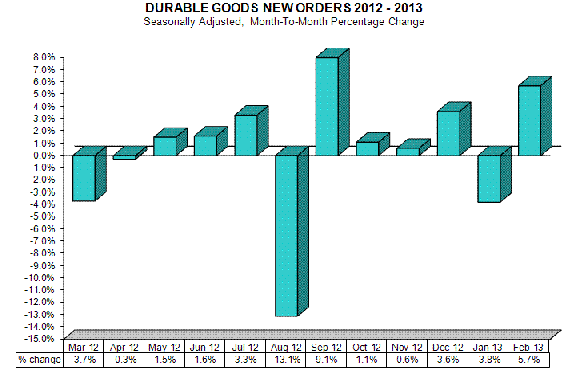
New orders for manufactured durable goods increased 5.7% in February to $232.1 billion, according to a Commerce Department report (link opens a PDF) released today. After falling a revised 3.8% in January, aircraft orders boosted durable goods past analysts’ expectations of a 3.5% increase.

Source: census.gov

New orders for nondefense aircraft rocketed up a seasonally adjusted 95.3% for February, primarily because of a boost in Boeing orders. The corporation’s sales pushed the overall transportation sector to a seasonally adjusted 21.7% gain for February. Excluding transportation, new orders for durable goods fell 0.5% overall, undercutting market projections of a 0.7% bump.

Durable-goods shipments and unfilled orders both posted modest gains, while inventories continued to climb 0.4% to $376.9 billion. Inventories have increased 16 of the past 17 months, and these newest numbers (once again) hit a new all-time high since data was first recorded in 1992.

The article Boeing’s New Durable Goods Orders Up 5.7% originally appeared on Fool.com.

Fool contributor Justin Loiseau has no position in any stocks mentioned and did not order a Boeing plane in February. You can follow him on Twitter, @TMFJLo, and on Motley Fool CAPS, @TMFJLo.
The Motley Fool has no position in any of the stocks mentioned. Try any of our Foolish newsletter services free for 30 days. We Fools don’t all hold the same opinions, but we all believe that considering a diverse range of insights makes us better investors. The Motley Fool has a disclosure policy.

Copyright © 1995 – 2013 The Motley Fool, LLC. All rights reserved. The Motley Fool has a disclosure policy.

(function(c,a){window.mixpanel=a;var b,d,h,e;b=c.createElement(“script”);
b.type=”text/javascript”;b.async=!0;b.src=(“https:”===c.location.protocol?”https:”:”http:”)+
‘//cdn.mxpnl.com/libs/mixpanel-2.2.min.js’;d=c.getElementsByTagName(“script”)[0];
d.parentNode.insertBefore(b,d);a._i=[];a.init=function(b,c,f){function d(a,b){
var c=b.split(“.”);2==c.length&&(a=a[c[0]],b=c[1]);a[b]=function(){a.push([b].concat(
Array.prototype.slice.call(arguments,0)))}}var g=a;”undefined”!==typeof f?g=a[f]=[]:
f=”mixpanel”;g.people=g.people||[];h=[‘disable’,’track’,’track_pageview’,’track_links’,
‘track_forms’,’register’,’register_once’,’unregister’,’identify’,’alias’,’name_tag’,
‘set_config’,’people.set’,’people.increment’];for(e=0;e<h.length;e++)d(g,h[e]);
a._i.push([b,c,f])};a.__SV=1.2;})(document,window.mixpanel||[]);
mixpanel.init("9659875b92ba8fa639ba476aedbb73b9");

function addEvent(obj, evType, fn, useCapture){
if (obj.addEventListener){
obj.addEventListener(evType, fn, useCapture);
return true;
} else if (obj.attachEvent){
var r = obj.attachEvent("on"+evType, fn);
return r;
}
}

addEvent(window, "load", function(){new FoolVisualSciences();})
addEvent(window, "load", function(){new PickAd();})

var themeName = 'dailyfinance.com';
var _gaq = _gaq || [];
_gaq.push(['_setAccount', 'UA-24928199-1']);
_gaq.push(['_trackPageview']);

(function () {

var ga = document.createElement('script');
ga.type = 'text/javascript';
ga.async = true;
ga.src = ('https:' == document.location.protocol ? 'https://ssl' : 'http://www') + '.google-analytics.com/ga.js';

var s = document.getElementsByTagName('script')[0];
s.parentNode.insertBefore(ga, s);
})();

<p style="clear: …read more
Source: FULL ARTICLE at DailyFinance

Home Price Gains Hit New Post-Recession Highs

By Justin Loiseau, The Motley Fool

Filed under:

Home prices continued to improve in January, according to an S&P/Case-Shiller Home Price Index report (link opens a PDF) released today. The report looks at single-family home prices around the nation to create two indices (10-city and 20-city composites).

According to the most recent numbers, average home prices increased by a seasonally adjusted 1% in January for both the index’s 10-city and 20-city composites. This met analyst expectations for the 20-city composite (no estimate available for the 10-city group) and continued the index’s upward trajectory after a seasonally adjusted 0.9% bump in December.

In more long-term news, year-over-year improvements for January hit new post-recession records. The 10-city composite increased 7.3% over the past 12 months, while the 20-city composite jumped up 8.3%. All 20 cities have posted gains, with Phoenix (+23.2%) leading the rally and New York bringing up the rear (+0.6%). 

S&P Chairman of the Index Committee David Blitzer noted that although the market has made significant strides, there are still improvements to be made:

Economic data continues to support the housing recovery. Single-family home building permits and housing starts posted double-digit year-over-year increases in February 2013. Despite a slight uptick in foreclosure filings, numbers are still down 25% year-over-year. Steady employment and low borrowing rates pushed inventories down to their lowest post-recession levels.

This latest report affirms Federal Housing Finance Agency findings issued last week on home prices.

The article Home Price Gains Hit New Post-Recession Highs originally appeared on Fool.com.

Y
ou can follow Justin Loiseau on Twitter, @TMFJLo, and on Motley Fool CAPS, @TMFJLo.
Try any of our Foolish newsletter services free for 30 days. We Fools don’t all hold the same opinions, but we all believe that considering a diverse range of insights makes us better investors. The Motley Fool has a disclosure policy.

Copyright © 1995 – 2013 The Motley Fool, LLC. All rights reserved. The Motley Fool has a disclosure policy.

(function(c,a){window.mixpanel=a;var b,d,h,e;b=c.createElement(“script”);
b.type=”text/javascript”;b.async=!0;b.src=(“https:”===c.location.protocol?”https:”:”http:”)+
‘//cdn.mxpnl.com/libs/mixpanel-2.2.min.js’;d=c.getElementsByTagName(“script”)[0];
d.parentNode.insertBefore(b,d);a._i=[];a.init=function(b,c,f){function d(a,b){
var c=b.split(“.”);2==c.length&&(a=a[c[0]],b=c[1]);a[b]=function(){a.push([b].concat(
Array.prototype.slice.call(arguments,0)))}}var g=a;”undefined”!==typeof f?g=a[f]=[]:
f=”mixpanel”;g.people=g.people||[];h=[‘disable’,’track’,’track_pageview’,’track_links’,
‘track_forms’,’register’,’register_once’,’unregister’,’identify’,’alias’,’name_tag’,
‘set_config’,’people.set’,’people.increment’];for(e=0;e<h.length;e++)d(g,h[e]);
a._i.push([b,c,f])};a.__SV=1.2;})(document,window.mixpanel||[]);
mixpanel.init("9659875b92ba8fa639ba476aedbb73b9");

function addEvent(obj, evType, fn, useCapture){
if (obj.addEventListener){
obj.addEventListener(evType, fn, useCapture);
return true;
} else if (obj.attachEvent){
var r = obj.attachEvent("on"+evType, fn);
return r;
}
}

addEvent(window, "load", function(){new FoolVisualSciences();})
addEvent(window, "load", function(){new PickAd();})

var themeName = 'dailyfinance.com';
var _gaq = _gaq || [];
_gaq.push(['_setAccount', 'UA-24928199-1']);
_gaq.push(['_trackPageview']);

(function () {

…read more
Source: FULL ARTICLE at DailyFinance

New Home Sales Slump, Supply Expands for February

By Justin Loiseau, The Motley Fool

Filed under:

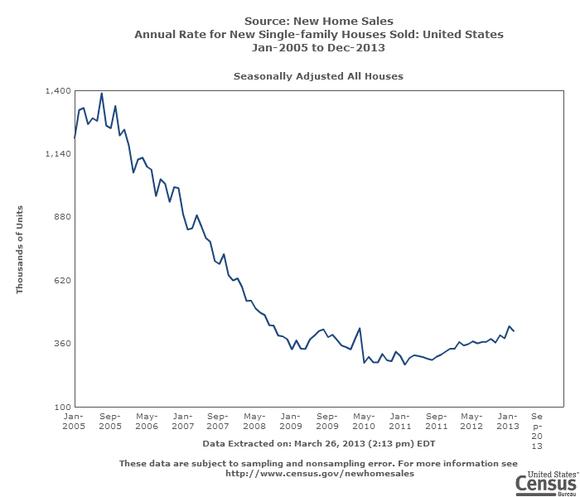
New home sales fell 4.6% in February to a seasonally adjusted annual rate of 411,000, according to a Department of Housing and Urban Development report (link opens a PDF) released today.

After a whopping 15.6% jump in January, market analysts had expected only a slight drop to 425,000.

Source: census.gov. 

In other news, median home prices moved up 3% to $246,800 while overall housing supply expanded 4.8% to 4.4 months at the current sales rate.

Economists have recently pointed to a lack of supply as one of the main setbacks to a full housing market recovery. A report last week from the National Association of Realtors confirmed that housing inventory for existing homes also increased in February.

The article New Home Sales Slump, Supply Expands for February originally appeared on Fool.com.

Y
ou can follow Justin Loiseau on Twitter, @TMFJLo, and on Motley Fool CAPS, @TMFJLo.
Try any of our Foolish newsletter services free for 30 days. We Fools may not all hold the same opinions, but we all believe that considering a diverse range of insights makes us better investors. The Motley Fool has a disclosure policy.

Copyright © 1995 – 2013 The Motley Fool, LLC. All rights reserved. The Motley Fool has a disclosure policy.

(function(c,a){window.mixpanel=a;var b,d,h,e;b=c.createElement(“script”);
b.type=”text/javascript”;b.async=!0;b.src=(“https:”===c.location.protocol?”https:”:”http:”)+
‘//cdn.mxpnl.com/libs/mixpanel-2.2.min.js’;d=c.getElementsByTagName(“script”)[0];
d.parentNode.insertBefore(b,d);a._i=[];a.init=function(b,c,f){function d(a,b){
var c=b.split(“.”);2==c.length&&(a=a[c[0]],b=c[1]);a[b]=function(){a.push([b].concat(
Array.prototype.slice.call(arguments,0)))}}var g=a;”undefined”!==typeof f?g=a[f]=[]:
f=”mixpanel”;g.people=g.people||[];h=[‘disable’,’track’,’track_pageview’,’track_links’,
‘track_forms’,’register’,’register_once’,’unregister’,’identify’,’alias’,’name_tag’,
‘set_config’,’people.set’,’people.increment’];for(e=0;e<h.length;e++)d(g,h[e]);
a._i.push([b,c,f])};a.__SV=1.2;})(document,window.mixpanel||[]);
mixpanel.init("9659875b92ba8fa639ba476aedbb73b9");

function addEvent(obj, evType, fn, useCapture){
if (obj.addEventListener){
obj.addEventListener(evType, fn, useCapture);
return true;
} else if (obj.attachEvent){
var r = obj.attachEvent("on"+evType, fn);
return r;
}
}

addEvent(window, "load", function(){new FoolVisualSciences();})
addEvent(window, "load", function(){new PickAd();})

var themeName = 'dailyfinance.com';
var _gaq = _gaq || [];
_gaq.push(['_setAccount', 'UA-24928199-1']);
_gaq.push(['_trackPageview']);

(function () {

var ga = document.createElement('script');
ga.type = 'text/javascript';
ga.async = true;
ga.src = ('https:' == document.location.protocol ? 'https://ssl' : 'http://www') + '.google-analytics.com/ga.js';

var s = document.getElementsByTagName('script')[0];
s.parentNode.insertBefore(ga, s);
})();

Read | Permalink | Email this | Linking Blogs | Comments

…read more
Source: FULL ARTICLE at DailyFinance

Veusz 1.17 (KDE Scientific)

Thumbnail

Veusz 1.17
(KDE Scientific)
Veusz is a scientific plotting package, designed to create publication-ready Postscript or PDF output. It can create line graphs, XY plots, histograms, shapes, images and contour plots. It features GUI, command-line, and scripting interfaces. Graphs are constructed from components, allowing complex layouts to be designed.

changelog:
Changes in 1.17:
* Add new broken axis widget with gaps in the numerical sequence
* Grid lines are plotted always under (or over) the data
* Shift+Scroll wheel scrolls left/right (thanks to Dave Hughes)
* Polar plots can have a “minimum” radius and log axes
* Many more LaTeX symbols added
* Add SAMP/VoTable support (thanks to Graham Bell)
* New shifted-points xy line mode, which plots a stepped line with the points shifted to lie between the coordinates given
* Points can be picked to console and/or clipboard (thanks to Valerio Mussi)
* Allow reversed ternary plot

Bug fixes:
* Fix unicode characters for circ and odot
* Fix for data type of pickable points
* Fix sort by group crash bug
* Many crashes fixed
* Fix width of key when using long titles/and or multiple columns
* Fix bold and italic output in SVG output

[read more]

job recommendations:

Sales Engineer full time employee
ownCloud Inc. United States of America, Boston more about this offer

[more jobs]
…read more
Source: FULL ARTICLE at KDE Apps

Frescobaldi 2.0.9 (KDE Sound Application)

Thumbnail

Frescobaldi 2.0.9
(KDE Sound Application)
Frescobaldi is a LilyPond sheet music editor. It aims to be powerful, yet lightweight and easy to use.

You can edit LilyPond documents and build and preview them with a mouse click. Clicking on notes in the PDF preview places the text cursor in the right place. A score wizard is provided to quickly setup a music score. There are editing tools to manipulate the rhythm, acticulations, lyrics hyphenation, etc.

Unlike version 1.2.0 the 2.0 versions do not need KDE4 anymore, but just Python and PyQt4.

When using the Windows installer, it might be necessary to install the MS VC 2008 runtime from
http://www.microsoft.com/download/en/details.aspx?id=29.

changelog:
2.0.9 implements many wishes (such as File->Reload, autodetection of files modified by other applications, the use of CSS when exporting syntax-highlighted HTML), new features and bug fixes.

[read more]

job recommendations:

Sales Engineer full time employee
ownCloud Inc. United States of America, Boston more about this offer

[more jobs]
…read more
Source: FULL ARTICLE at KDE Apps