Tag Archives: Big Oil

Big Oil's Next Takeover Target

By Aimee Duffy and Tyler Crowe, The Motley Fool

Filed under:

It’s getting increasingly difficult for Big Oil to move the needle on recoverable reserves, and the quest to discover the next giant oilfield has become outrageously expensive. For example, ExxonMobil is committed to spending $37 billion a year for the next three years. In this video, Fool.com contributor Aimee Duffy talks to Tyler Crowe about how this trend will lead to greater industry consolidation and analyzes what makes a good takeover target for Big Oil.

Domestic oil and gas service companies have taken a hit in the recent past because of a slowdown in the natural gas drilling boom of the past couple of years. As this market looks to rebound, investors would be wise to consider Halliburton, one of the top companies in the business and one of those most in tune with the domestic market. To access The Motley Fool’s new premium research report on this industry stalwart, simply click here now and learn everything you need to know about how Halliburton is positioning itself both at home and abroad.

var FoolAnalyticsData = FoolAnalyticsData || []; FoolAnalyticsData.push({ eventType: “TickerReportPitch”, contentByline: “Aimee Duffy and Tyler Crowe“, contentId: “cms.36253”, contentTickers: “NYSE:XOM, NYSE:HAL, NYSE:CIE”, contentTitle: “Big Oil‘s Next Takeover Target”, hasVideo: “True”, pitchId: “124”,

Source: FULL ARTICLE at DailyFinance

Big Oil: Time to Divest?

By Aimee Duffy and Tyler Crowe, The Motley Fool

Filed under:

Add the San Francisco Board of Supervisors to the list of cities and universities encouraging divestment from Big Oil and other fossil fuel securities. Jumping ship on fossil fuel stocks may be the latest investing trend, but does it affect everyday people? In this video, Fool.com contributor Aimee Duffy talks with Tyler Crowe to take a closer look at the San Francisco story, and how the divestment trend may affect you, even if you don’t think you own shares of Big Oil.

If you’re on the lookout for high-yielding stocks, The Motley Fool has compiled a special free report outlining our nine top dependable dividend-paying stocks. It’s called “Secure Your Future With 9 Rock-Solid Dividend Stocks.” You can access your copy today at no cost! Just click here.

The article Big Oil: Time to Divest? originally appeared on Fool.com.

Fool contributors Aimee Duffy and Tyler Crowe have no position in any stocks mentioned. For more energy information, follow them on Twitter, @TMFDuffy and @TylerCroweFool.


The Motley Fool recommends Chevron. Try any of our Foolish newsletter services free for 30 days. We Fools don’t all hold the same opinions, but we all believe that considering a diverse range of insights makes us better investors. The Motley Fool has a disclosure policy.

Copyright © 1995 – 2013 The Motley Fool, LLC. All rights reserved. The Motley Fool has a disclosure policy.

(function(c,a){window.mixpanel=a;var b,d,h,e;b=c.createElement(“script”);
b.type=”text/javascript”;b.async=!0;b.src=(“https:”===c.location.protocol?”https:”:”http:”)+
‘//cdn.mxpnl.com/libs/mixpanel-2.2.min.js’;d=c.getElementsByTagName(“script”)[0];
d.parentNode.insertBefore(b,d);a._i=[];a.init=function(b,c,f){function d(a,b){
var c=b.split(“.”);2==c.length&&(a=a[c[0]],b=c[1]);a[b]=function(){a.push([b].concat(
Array.prototype.slice.call(arguments,0)))}}var g=a;”undefined”!==typeof f?g=a[f]=[]:
f=”mixpanel”;g.people=g.people||[];h=[‘disable’,’track’,’track_pageview’,’track_links’,
‘track_forms’,’register’,’register_once’,’unregister’,’identify’,’alias’,’name_tag’,
‘set_config’,’people.set’,’people.increment’];for(e=0;e<h.length;e++)d(g,h[e]);
a._i.push([b,c,f])};a.__SV=1.2;})(document,window.mixpanel||[]);
mixpanel.init("9659875b92ba8fa639ba476aedbb73b9");

function addEvent(obj, evType, fn, useCapture){
if (obj.addEventListener){
obj.addEventListener(evType, fn, useCapture);
return true;
} else if (obj.attachEvent){
var r = obj.attachEvent("on"+evType, fn);
return r;
}
}

addEvent(window, "load", function(){new FoolVisualSciences();})
addEvent(window, "load", function(){new PickAd();})

var themeName = 'dailyfinance.com';
var _gaq = _gaq || [];
_gaq.push(['_setAccount', 'UA-24928199-1']);
_gaq.push(['_trackPageview']);

(function () {

var ga = document.createElement('script');
ga.type = 'text/javascript';
ga.async = true;
ga.src = ('https:' == document.location.protocol ? 'https://ssl' : 'http://www') + '.google-analytics.com/ga.js';

var s = document.getElementsByTagName('script')[0];
s.parentNode.insertBefore(ga, s);
})();

Read | <a target=_blank href="http://www.dailyfinance.com/2013/04/27/big-oil-time-to-divest/" rel="bookmark" title="Permanent link

Source: FULL ARTICLE at DailyFinance

Big Oil's Back in Washington's Taxation Crosshairs

By David Smith, The Motley Fool

Filed under:

There’s probably not another industry that even begins to match the members of Big Oil for generating antipathy in some quarters of Washington, D.C. Indeed, there are those in our nation’s capital whose clear intent it is to force the largest oil and gas producers to pay through the nose for their successes.

In his 2012 State of the Union address, President Obama stated, “The country needs an all-out, all-of-the-above strategy that develops every available source of American energy.” Fine, but that statement masked a punitive approach that the president had in mind for the bigger traditional energy companies, especially those that quest for crude oil worldwide.

Indeed, it was only a few minutes later that the president contended:

We have subsidized oil companies for a century. That’s long enough. It’s time to end the taxpayer giveaways to an industry that’s rarely been more profitable and double-down on a clean-energy industry that’s never been more promising.

The obvious implication there was that the industry has long received special favors at tax time. Which, of course, it hasn’t. Indeed, the latter statement may imply confusion between the treatment accorded to ExxonMobil and that provided to, say, Solyndra.

A targeted nailing
Nevertheless, some members of the president’s party are heeding his clarion call. In fact, Chris Van Hollen, a Democratic congressman from Maryland, is attempting to gain support for a bill that would place the industry’s companies at a clear disadvantage at tax time. His “Fair Share on High-Income Taxpayers” scheme would alter the way oil and gas operators’ taxes are calculated — especially for the larger companies — in three key ways:

  • By limiting oil and gas producers’ ability to avail themselves of the Section 199 deduction. That measure was part of the American Jobs Creation Act, which generated bipartisan support at its passage in 2004. It simply provides a 9% reduction from net income for businesses involved in the manufacturing sector. Its purpose was to serve as something of a moat to protect, at least somewhat, against foreign competition.

    Is it a measure that solely benefits energy producers? Hardly. In fact, energy companies generally have been limited to 6% deductions, while those involved in a wide range of other manufacturing endeavors receive the full 9%.

  • By limiting the industry’s use of the last-in, first-out method of valuing inventory. While a host of companies from all manner of industries have adopted what is commonly referred to as the LIFO method, Van Hollen‘s bill would render it largely off-limits to oil and gas producers.
  • By limiting the integrated companies’ deductions of royalty payments made to foreign governments. American companies operating overseas are generally permitted to deduct from their U.S. levies the taxes imposed by foreign governments — a method of preventing double taxation on their foreign income. Royalty payments made abroad have typically — and legally — been treated as taxes, making them subject to the foreign deduction. But Van Hollen‘s

    From: http://www.dailyfinance.com/2013/04/14/big-oils-back-in-washingtons-taxation-crosshairs/

Falling Jobs Growth Leads to a Plunging Dow

By Dan Carroll, The Motley Fool

Filed under:

If you were hoping to end your investing week in the green, think again. Stocks are swinging sharply lower, and the Dow Jones Industrial Average has found a home in the red today following March’s disappointing jobs numbers, which dropped precipitously from February. As of 2:25 p.m. EDT, the blue-chip index has fallen 85 points, or 0.58%, with many component stocks shedding 1% or more. With the market on a roll this year, investors have been looking for a correction, and today they got one.

Jobs can’t get a grip
Payrolls added a mere 88,000 jobs in March — the lowest monthly gain in nine months and more than 100,000 short of analysts’ projections. That was also a huge drop-off from February’s gain of nearly 270,000 jobs. This report isn’t the end of the world: Many economists have predicted that the economy’s fast start to 2013 would slow down in the middle of the year, and the country still has years of growth ahead of it before it reaches pre-recession unemployment levels. However, it’s a disappointing blow to many who were encouraged by signs that the economy was accelerating its comeback.

The disappointment has hit Dow stocks hard, and none more so than American Express . The financial firm has lost 2.6% so far today. Lower employment translates to lower consumer spending as Americans tighten their wallets — an outcome far from ideal for American Express. The stock has still picked up more than 13.5% since the start of 2013, but a sluggish middle of the year could see shares drop off from their recent highs as credit card spending slows. If the economy bounces back soon, however, American Express will be poised to rise right along with it.

Home Depot is another stock that has done well this year — shares have risen more than 11.3% since the start of 2013 — and is being hit hard today. The home retail stock is down 1% so far. Although a sluggish economy is not good for anyone, Home Depot has less to fear: With residential construction on the rise and housing starts picking up fast, this company’s well-positioned to capitalize on the rebound in the housing market.

Big Oil‘s on the downswing as well today. Shares of Chevron and Exxon-Mobil have fallen 0.7% and 1%, respectively. Both companies are recovering from headaches. Chevron recently announced that it has finally finished repairing a damaged refinery in Richmond, Calif., that was hit by a fire last year — an incident that cost the company around $1 million in fines from state safety regulators. Still, that’s much better than Exxon’s current plight. The company pledged to cover the costs of cleaning up thousands of barrels of oil that spilled in Arkansas. This won’t hit Exxon’s pocketbook too hard, but it has left a smudge on the company’s reputation.

One stock has managed to beat the odds today, however: Aluminum manufacturer Alcoa …read more

Source: FULL ARTICLE at DailyFinance

$1.2 Billion More of the Gulf of Mexico Leased by Big Oil

By Tyler Crowe, The Motley Fool

Filed under:

Last week, the U.S. Bureau of Land Management auctioned off over 7,300 blocks of oil and gas exploration leases in the Gulf of Mexico. Despite that only 400 of the blocks were bid upon, the government walked away with a nice $1.2 billion to pad its coffers. 

In this video, Fool.com contributor Tyler Crowe gives a run down of the results of the most recent auction. Some companies spent a lot more than others, and one company — BP — was peculiarly absent from the event. Also, Tyler explains why Statoil and its joint venture partner Samson Oil & Gas were willing to fork over almost $82 million for one block in the Walker Ridge section of the Gulf.

There are many different ways to play the energy sector, and The Motley Fool’s analysts have uncovered an under-the-radar company that’s dominating its industry. This company is a leading provider of equipment and components used in drilling and production operations, and poised to profit in a big way from it. To get the name and detailed analysis of this company that will prosper for years to come, check out the special free report: “The Only Energy Stock You’ll Ever Need.” Don’t miss out on this limited-time offer and your opportunity to discover this under-the-radar company before the market does. Click here to access your report — it’s totally free.

The article $1.2 Billion More of the Gulf of Mexico Leased by Big Oil originally appeared on Fool.com.

Fool contributor Tyler Crowe has no position in any stocks mentioned. You can follow him at Fool.com under the handle TMFDirtyBird, on Google +, or on Twitter, @TylerCroweFool.
The Motley Fool recommends Chevron and Statoil (ADR). Try any of our Foolish newsletter services free for 30 days. We Fools may not all hold the same opinions, but we all believe that considering a diverse range of insights makes us better investors. The Motley Fool has a disclosure policy.

Copyright © 1995 – 2013 The Motley Fool, LLC. All rights reserved. The Motley Fool has a disclosure policy.

(function(c,a){window.mixpanel=a;var b,d,h,e;b=c.createElement(“script”);
b.type=”text/javascript”;b.async=!0;b.src=(“https:”===c.location.protocol?”https:”:”http:”)+
‘//cdn.mxpnl.com/libs/mixpanel-2.2.min.js’;d=c.getElementsByTagName(“script”)[0];
d.parentNode.insertBefore(b,d);a._i=[];a.init=function(b,c,f){function d(a,b){
var c=b.split(“.”);2==c.length&&(a=a[c[0]],b=c[1]);a[b]=function(){a.push([b].concat(
Array.prototype.slice.call(arguments,0)))}}var g=a;”undefined”!==typeof f?g=a[f]=[]:
f=”mixpanel”;g.people=g.people||[];h=[‘disable’,’track’,’track_pageview’,’track_links’,
‘track_forms’,’register’,’register_once’,’unregister’,’identify’,’alias’,’name_tag’,
‘set_config’,’people.set’,’people.increment’];for(e=0;e<h.length;e++)d(g,h[e]);
a._i.push([b,c,f])};a.__SV=1.2;})(document,window.mixpanel||[]);
mixpanel.init("9659875b92ba8fa639ba476aedbb73b9");

function addEvent(obj, evType, fn, useCapture){
if (obj.addEventListener){
obj.addEventListener(evType, fn, useCapture);
return true;
} else if (obj.attachEvent){
var r = obj.attachEvent("on"+evType, …read more

Source: FULL ARTICLE at DailyFinance

Can These Companies Prove Big Oil Wrong?

By Maxxwell A.R. Chatsko, The Motley Fool

Filed under:

Despite being a year of steady progress, 2012 showed the world that industrial biotechnology is still not quite ready for the limelight. Big Oil shifted its focus to more proven thermocatalytic technologies that plan to transform the nation’s abundance of natural gas into fuels and high-value chemicals. Massive development deals involving hundreds of millions of dollars are few and far between for aspiring biotechnology companies these days.

Established energy companies are chasing more certain returns with their investments in renewable chemicals, but that hasn’t stopped a determined group from developing their platforms. Here’s a list of companies accepting Big Oil‘s challenge of “don’t tell us; show us.”

Infecting the status quo
The brightest company investors can get their hands on is renewable-oils manufacturer Solazyme , which is hardly reeling from a lack of major energy company investments. This disruptor has partnerships and joint ventures in place with several big companies and recently received a $120 million loan from the Brazilian Development Bank. The loan actually has a negative interest rate after factoring in inflation rates for the Brazilian real.

The company will have manufacturing capabilities on three continents next year. Europe will initially be home to the company’s nutritional efforts, while Brazil will boast the largest and most diverse product lineup with Bunge. A smaller facility with ADM in America’s heartland will be on call for partners, with potential for big expansions as needed.

Big Oil isn’t the only one pivoting. Amyris has transformed itself over the past year to focus almost exclusively on high-value chemicals. Initial plans to produce large amounts of sustainable diesel and jet fuels landed Total — which is still going all-in on Amyris — but also dampened the company’s financial situation. Investors will get their first glimpse of how full-scale industrial biotechnology works, as Amyris’ first commercial facility ramps up production through the second half of the year.

In the majority
Investors shouldn’t make the mistake of thinking that all of the action is happening from publicly traded companies. It’s quite the opposite. Numerous private companies are among the front-runners for bringing bio-based chemicals to the market. Some have even raised more money and are targeting a wider range of products than Amyris, Solazyme, and Gevo.

Genomatica has developed one of the premier industrial biotechnology chemical platforms to date, with plans build a biorefinery capable of producing more than 100 million pounds of butanediol per year by 2015. In all, the company’s platform can produce more than 20 chemical building blocks that enable a wide range of oils, fuels, polymers, solvents, resins, coatings, and more. Unlike competitors trying to manufacture and sell their own products, Genomatica will license the technology it develops to the industry for rapid deployment at a fraction of the cost.

Investors hoping to get into the shining star of bio-based chemicals had their hopes dashed last summer, when the company withdrew plans for an IPO. It wasn’t alone. Several …read more
Source: FULL ARTICLE at DailyFinance

EPA proposes new Tier 3 emission rules, requiring cleaner cars and gasoline in 2017

By Sebastian Blanco

Filed under: ,

The Environmental Protection Agency (EPA) added a new word to the wider public lexicon today when it proposed new emission and fuel standards for cars and gasoline: Tier 3. This new regulation is “sensible” and will “significantly reduce harmful pollution, prevent thousands of premature deaths and illnesses, while also enabling efficiency improvements in the cars and trucks we drive,” the EPA says. Unsurprisingly, not everyone agrees.

The rules (885-page PDF here) would require that gasoline have a lower sulfur content – dropping from 30 parts per million today to 10 parts per million by 2017 – which will make it easier for cars to meet the new reduced tailpipe and evaporative emissions requirements. If the proposed rules take effect, they “will help avoid up to 2,400 premature deaths per year and 23,000 cases of respiratory ailments in children,” the EPA says. The European Respiratory Journal recently published a study that found that vehicle emissions can cause asthma in children.

Some numbers from the proposed rules: Smog-forming volatile organic compounds and nitrogen oxides will need to be reduced by 80 percent. Toxic air pollutants, such as benzene and 1,3-butadiene, will need to be cut by up to 40 percent. A particulate matter standard will need to be 70 percent tighter. Fuel vapor emissions will need to drop to “near zero.” The rules would go into effect in 2017 and are basically taking rules from the California Air Resources Board and making them valid nationwide.

The EPA says it had “extensive” input from “auto manufactures, refiners, and states,” which implies there is broad agreement on the rules. But Republican politicians and members of the gas and oil industy say that gas prices will rise, up to nine cents a gallon, if the EPA gets its way. Energy and Commerce Committee Chairman Fred Upton, R-MI, said in a statement that, “The Obama administration cannot be more out of touch” with the economic burden this will place on drivers. The EPA, instead, estimates it’ll cost less than a penny a gallon, but it will add an average cost of $130 per vehicle to new cars in 2025.

The Natural Resources Defense Council fought back against the criticism. Luke Tonachel, NRDC senior vehicles analyst, said in a statement that the new standards will save lives at a minimal cost, and that, “Big Oil companies want us to believe these benefits aren’t worth it. But that’s because they care about profits above all else.”

Continue reading EPA proposes new Tier 3 emission rules, requiring cleaner cars and gasoline in 2017

EPA proposes new Tier 3 emission rules, requiring cleaner cars and gasoline in 2017 originally appeared on Autoblog Green on Fri, 29 Mar 2013 14:17:00 EST. Please see our terms for use of feeds.

<a target=_blank href="http://green.autoblog.com/2013/03/29/epa-proposes-new-tier-3-emission-rules-cleaner-cars-gasoline/" rel="bookmark" title="Permanent link to …read more
Source: FULL ARTICLE at Autoblog

HP Soars to Lead the Dow's Gains

By Dan Carroll, The Motley Fool

Filed under:

Stocks are back on the upswing following yesterday’s dip, and investors have to be happy with the gains the Dow Jones Industrial Average is hauling in. The index has picked up 80 points, or 0.6%, to move past the 14,500 mark as of 2:15 p.m. EDT. More than two-thirds of member stocks are in the green, and Wall Street‘s doing a good job so far of ignoring the eurozone’s ongoing problems to cap off the week with solid gains. Let’s check out the biggest movers.

HP on the move again
Chronically unstable tech stock Hewlett-Packard ranks at the top of the Dow by a large lead today, with shares up 2.4%. Shareholders recently re-elected all of the company’s board members, who authorized a 10% dividend increase going forward and plan to spend more than $100 million more for the higher payout each year. With the company still in danger from the declining PC market and facing an improving but still-struggling turnaround, investors have to question whether or not a higher dividend is the right use of the company’s money.

Income investors sure won’t mind, but considering this stock‘s penchant for significantly rising or falling even on days with no news, most investors would be better off looking for a less risky pick for their portfolio — particularly considering that HP‘s shares have soared dangerously by more than 48% to start the year.

Wal-Mart‘s another stock on the up today, ranking among the top Dow leaders by pulling in gains of 1.4%. While there’s little news out on the retailer today, the stock‘s following its sector higher following strong quarterly results from several fellow retailers such as Nike and Tiffany. Shareholders have to be happy, particularly after delayed tax returns took a bite out of sales in early February. The company expects flat sales this quarter as consumers struggle with rising gas prices and the payroll tax hike.

Big Oil stocks are also on the rise today. Shares of Exxon-Mobil and Chevron have recorded respective gains of 1% and 0.6%. Russia‘s major oil giant, Rosneft, has leaped past both companies, however, recently taking over the title of the largest publicly traded oil and gas company after acquiring TNK-BP this week. Still, Exxon and Chevron have benefited from rising demand for natural gas worldwide, particularly as prices climb. Considering that gasoline prices are also skyrocketing, these companies are in good positions to keep shareholders happy.

Is a turnaround on the way?
The massive wave of mobile computing has done much to unseat the major players in the PC market, including venerable technology names like Hewlett-Packard. However, HP is rapidly shifting its strategy under the leadership of CEO Meg Whitman. But does this make HP one of the least-appreciated turnaround stories on the market, or is this a minor detour on its road to irrelevance? The Motley Fool’s technology analyst details exactly what investors need to know about …read more
Source: FULL ARTICLE at DailyFinance

Is Chevron the Best in Big Oil?

By Tyler Crowe and Aimee Duffy, The Motley Fool

Filed under:

With so many moving parts to big integrated oil and gas companies, it can be hard to see what makes them tick. A decent indication of what they are about is shown by how the company expects to grow production, and this is why Fool.com contributor Tyler Crowe thinks Chevron is the leader of the pack. With a strong push into production in the Permian Basin and Marcellus Shale in the U.S., courting Venezuela to increase its footprint in the oil giant’s reserves, and betting on the success of liquefied natural gas in the Asia-Pacific region, Chevron is pursuing stabler endeavors than some other oil and gas majors.

Today, Tyler talks with fellow Fool contributor Aimee Duffy about how these prospects could provide a solid growth strategy for a company that is looking to increase its production by 20% in the next four years.

There are many different ways to play the energy sector, and The Motley Fool’s analysts have uncovered an under-the-radar company that’s dominating its industry. This company is a leading provider of equipment and components used in drilling and production operations, and poised to profit in a big way from it. To get the name and detailed analysis of this company that will prosper for years to come, check out the special free report: “The Only Energy Stock You’ll Ever Need.” Don’t miss out on this limited-time offer and your opportunity to discover this under-the-radar company before the market does. Click here to access your report — it’s totally free.

The article Is Chevron the Best in Big Oil? originally appeared on Fool.com.

Fool contributor Aimee Duffy has no position in any stocks mentioned. Fool contributor Tyler Crowe has no position in any stocks mentioned. you can follow them both on Fool.com under the handles TMFAimeeD and TMFDirtyBird, respectively.
The Motley Fool recommends Chevron and Total. The Motley Fool owns shares of Apache. Try any of our Foolish newsletter services free for 30 days. We Fools may not all hold the same opinions, but we all believe that considering a diverse range of insights makes us better investors. The Motley Fool has a disclosure policy.

Copyright © 1995 – 2013 The Motley Fool, LLC. All rights reserved. The Motley Fool has a disclosure policy.

(function(c,a){window.mixpanel=a;var b,d,h,e;b=c.createElement(“script”);
b.type=”text/javascript”;b.async=!0;b.src=(“https:”===c.location.protocol?”https:”:”http:”)+
‘//cdn.mxpnl.com/libs/mixpanel-2.2.min.js’;d=c.getElementsByTagName(“script”)[0];
d.parentNode.insertBefore(b,d);a._i=[];a.init=function(b,c,f){function d(a,b){
var c=b.split(“.”);2==c.length&&(a=a[c[0]],b=c[1]);a[b]=function(){a.push([b].concat(
Array.prototype.slice.call(arguments,0)))}}var g=a;”undefined”!==typeof f?g=a[f]=[]:
f=”mixpanel”;g.people=g.people||[];h=[‘disable’,’track’,’track_pageview’,’track_links’,
‘track_forms’,’register’,’register_once’,’unregister’,’identify’,’alias’,’name_tag’,
‘set_config’,’people.set’,’people.increment’];for(e=0;e<h.length;e++)d(g,h[e]);
a._i.push([b,c,f])};a.__SV=1.2;})(document,window.mixpanel||[]);
mixpanel.init("9659875b92ba8fa639ba476aedbb73b9");

function addEvent(obj, evType, fn, useCapture){
if (obj.addEventListener){
obj.addEventListener(evType, …read more
Source: FULL ARTICLE at DailyFinance

1 Graph to Put Gas Prices in Perspective

By Justin Loiseau, The Motley Fool

Filed under:

If there’s one thing Americans hate, it’s expensive gasoline. Not only can it ruin a gas guzzler’s day, but high fuel prices also affect myriad other aspects of our lives. Prices at the pump can dictate a person’s employment, serve as a political dagger, bring a fuel-hungry economy to its knees, or spur innovation for alternative energies. To put the United States‘ fuel bill in perspective, let’s take a global look at who’s doling out the most dollars to fill up the tank.

Pump prices
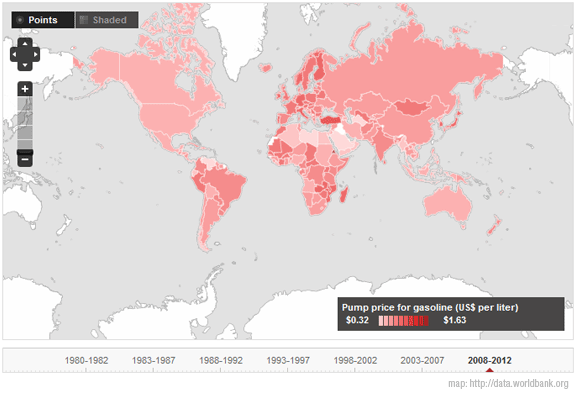
The World Bank publishes one of the most comprehensive pump price lists around, but it takes time to add up all those gas station receipts. Here’s what they’ve compiled for 2010, the most recent global data available.

Source: World Bank, 2010 data (most recent available).

It should come as no surprise that 12 of the 15 most expensive countries in this chart are European. Eritrea topped the list at $9.61 per gallon in 2010, while Venezuela brought up the rear with the near-negligible $0.08 pump price. The U.S. had the cheapest gasoline of any developed country in this chart of 2010 data, and came in 23rd place overall for cheapest gas ($2.88/gallon).

Today versus 2010
In the past three years, the world economy pulled itself out of the ditch, brent crude oil prices shot up 37% to $108 per barrel, and Justin Bieber sold more than 11.3 million albums worldwide. Gas prices are higher almost everywhere, but the trends remain the same. According to a recent Bloomberg report, Turkey now tops the list at $9.89 per gallon, followed by nine European countries. Of the 60 countries analyzed by Bloomberg, the United States has the seventh-cheapest gas ($3.29 per gallon). Venezuela ranked No. 60 at $0.06.

And, just like in 2010, oil-rich countries are keeping costs low for their own citizens. U.A.E. residents pay $1.77 per gallon, while Kuwaitis dole out just $0.81.

Starting in 2013, slowing demand pushed U.S. refineries to pull back on gasoline production, causing energy prices to shoot up and increasing producer costs for the overall economy. Should we be paying more at the pump, pushing people to get serious about energy efficiency and alternative options? Or should Uncle Sam subsidize Big Oil and energize our aching economy? Comment below!

If you’re on the lookout for some currently intriguing energy plays, check out The Motley Fool’s “3 Stocks for $100 Oil.” For FREE access to this special report, simply click here now.

The article 1 Graph to Put Gas Prices in Perspective originally appeared on Fool.com.

Y
ou can follow Justin Loiseau on Twitter, @TMFJLo, and on Motley Fool CAPS, @TMFJLo.
Try any of our Foolish newsletter services free for 30 days. We Fools may not all hold the same opinions, but we all believe that considering a diverse range of insights makes us better investors. The Motley Fool has …read more
Source: FULL ARTICLE at DailyFinance

The Dow's Big Shift and the Next Generation of Big Oil

By Alex Planes, The Motley Fool

Filed under:

On this day in economic and financial history …

The Dow Jones Industrial Average made a big change on March 17, 1997. Four companies exited that no longer exist in the same form today — Texaco (absorbed), Woolworth (changed name and business model), Westinghouse (also changed name and business model), and Bethlehem Steel (went bankrupt) — were removed. All four were longtime components. Bethlehem Steel, the “newcomer,” had been a member since 1928, and gray-haired Texaco was the earliest of the foursome to join, becoming the last addition of the 12-member Dow in 1915. In place of these stalwarts, the Dow’s overseers added Hewlett-Packard , Johnson & Johnson, Travelers, and Wal-Mart.

Three of the four new additions have remained in the Dow ever since. Travelers was out in the next Dow shift as a consequence of its historic merger with Citigroup , which brought Citi into the index as a replacement. Travelers managed to regain its spot on the Dow in 2009, after Citi spun off the insurance giant in 2002 and then nearly collapsed during the financial crisis. Here’s how the foursome has performed in the 15 years since they were first added, against the performance of the Dow itself:

  • Dow Jones Industrial Average: 109%
  • HP total return: 23%
  • Wal-Mart total return: 523%
  • Johnson & Johnson total return: 291%
  • Dow return until Citigroup removal: 26%
  • Citigroup total return (to 2009 removal): (71%)
  • Dow return, Travelers reinstatement to 15-year anniversary: 66%
  • Travelers total return since 2009 reinstatement: 107%
  • Travelers hypothetical 15-year total return: 262%

The 1997 shift turned out to be rather hit and miss, but the Dow rarely has perfect timing. The 1997 replacements have more going for them, thanks to Wal-Mart and J&J’s outperformance, than an ill-considered tech-heavy shift made in 1999 at the very height of the dot-com bubble.

HP joins the Big Board
Hewlett-Packard moved on up in a different way decades before it joined the Dow, as its stock began trading on the New York Stock Exchange on March 17, 1961. This was four years after the company’s successful IPO and was later recounted by co-founder David Packard in his book The HP Way:

The first day of our public listing on the New York Stock Exchange did not start smoothly. A few of us flew to New York the day before the event and stayed uptown at the Essex House. Early the next morning, we set off for Wall Street. It never occurred to me to take a taxi; instead, we jumped on the BMT subway and headed downtown. Unfortunately, I wasn’t much of a subway navigator; after much debate, we made the wrong connection at Times Square. We arrived at Wall Street several minutes late and were immediately ushered into a huge corner office and greeted by the chairman of the exchange, Keith Funston. He chuckled when I explained that we’d gotten lost on the subway. I …read more
Source: FULL ARTICLE at DailyFinance

Who Released The Climategate Emails And Why

By Larry Bell, Contributor

No, it wasn’t a conspiracy plotted by Big Oil or Republican operatives using mercenary hackers after all. And unless you happen to get all your news from the mainstream media, you will undoubtedly recognize that by “Climategate”, I’m referring here to the thousands of leaked email communications between prominent international researchers within the U.K.’s University of East Anglia Climate Research Unit (CRU) network. That person (yes, single individual) has come forth to shed light on a real conspiracy…one to spread false alarm about a concocted global warming crisis. …read more
Source: FULL ARTICLE at Forbes Latest

It's Getting More Expensive to Grow for Big Oil

By Taylor Muckerman and Joel South, The Motley Fool

Filed under:

For companies like ExxonMobil  and Royal Dutch Shell , maintaining or growing energy reserves is easier said than done these days. Oil fields are moving further offshore and into harder to reach places underground. Due to these changing dynamics, capital expenditures are on the rise. Each of these two companies are planning to spend over $35 billion in 2013 to sustain existing growth projects and initiate new ones. 

To find oil, these companies are setting sail
One key theme here is that offshore drilling will continue to grow. This clearly benefits two of the largest fish in the sea, Ensco  and Seadrill , who have been expanding operations at a record pace to keep up with demand. The need for more drillships has never been higher, and that is reflected in the increasing day rates these drillers are able to charge. To dig deeper, check out the video below. 

Drilling offshore is increasing around the globe
If you’re an energy investor looking for exciting opportunities, then you should look into one of the more intriguing plays in the space: Seadrill. To learn more about the strengths and weaknesses of this company, as well as what to expect from Seadrill going forward, be sure to check out this brand-new premium report put together by one of our top Stock Advisor analysts. Click here to get started.

var FoolAnalyticsData = FoolAnalyticsData || []; FoolAnalyticsData.push({ eventType: “TickerReportPitch”, contentByline: “Taylor Muckerman and Joel South“, contentId: “cms.23998”, contentTickers: “NYSE:RDS-A, NYSE:XOM, NYSE:BP, NYSE:ESV, NYSE:SDRL”, contentTitle: “It’s Getting More Expensive to Grow for Big Oil“, …read more
Source: FULL ARTICLE at DailyFinance

GMO Giant Monsanto Joins Big Business Coalition For UN Agenda 21

By Breaking News

United Nations logo SC GMO Giant Monsanto Joins Big Business Coalition for UN Agenda 21

Corporate giant Monsanto, known for its controversial business model, lobbying, and its widely criticized genetically modified organisms (GMOs), has officially joined the World Business Council for Sustainable Development, a group of powerful interests including major banks and Big Oil backing the United Nations “Agenda 21” scheme for so-called “sustainable development.” Critics, however, expressed alarm over the announcement, saying the global “sustainability” push is really a transparent plot to centralize power in the UN and enrich special interests at the expense of private property rights, national sovereignty, and individual liberty.

Despite the widespread suspicion and criticism plaguing both Monsanto and the global Big Business alliance pushing the UN’s Agenda 21, the company and the coalition celebrated the move in a recent press release. According to the announcement late last month, the biotech behemoth will be rolling out a “sustainability” course for its employees all over the world. Chairman and CEO Hugh Grant will represent the GMO company as a “Council Member” in the global “sustainable development” coalition.

Even though Monsanto has become probably one of the most controversial companies in the world, it is extraordinarily well connected in the halls of power, and the global business alliance for “sustainable development” celebrated the firm’s decision to sign up. “In joining the WBCSD, Monsanto is taking an important step along a continuum towards developing a more sustainable agriculture system — one that improves our daily lives, respects our global environment and recognizes the importance of the world’s small-holder farmers,” claimed council President Peter Bakker in a statement posted on the group’s website.

Farming and global agriculture must change, the WBCSD continued. “We must find new ways to protect soils, enhance ecosystems and optimize land use in ways that are environmentally sound,” Bakker added in the press release. “And we must move towards a future vision for agriculture where absolutes become as out of place as a one-size-fits-all approach to farming.”

Indeed, the WBCSD’s website is rather candid about its aims and its “One World vision,” explicitly touting the UN Agenda 21 and its radical plan for transforming human civilization. “The One World vision is the ultimate stage of a conceptual evolution that started decades ago,” the council notes on its site. “This evolution produced several paradigm shifts that combine how we comprehend our world, and, as a result, how we try to deal with it.”

Read More at The New American . By Alex Newman.

Source: FULL ARTICLE at Western Journalism

Exxon, Chevron And Why The Future Of Big Oil Should Include Refining And Chemicals

By Agustino Fontevecchia, Forbes Staff It seems like Big Oil can weather most economic storms.  In a difficult fourth quarter, with flat oil prices and a shale boom in the U.S. keeping natural gas in place, with the world’s largest economy contracting and China slowing, Exxon Mobil and Chevron handily beat profit expectations, despite mediocre revenue numbers and decent production figures.  With mixed upstream results, both U.S. oil behemoths derived downstream strength from previously troubling refining margins coupled with asset sales; and, as has been the case for some time, chemicals continue to deliver.
Source: FULL ARTICLE at Forbes Latest