Tag Archives: Fifth Third Bancorp

9 Critical Numbers About Regions Financial

By John Maxfield, The Motley Fool

Filed under:

Given that you clicked on this article, it seems safe to assume you either own shares of Regions Financial or are considering buying them in the near future. If so, then you’ve come to the right place. The table below reveals the nine most critical numbers that investors need to know about Regions before deciding whether to buy, sell, or hold its stock.

But before getting to that, a brief introduction is in order. Regions was formed in 1971 as First Alabama Bancshares, a bank holding company for three previously independent banks. While it began with only $543 million in assets and 40 banking locations, it has since grown into one of the nation’s largest regional banks — it took on its present name in 1994 to “better reflect its growing presence throughout the South.” Based in Birmingham, Alabama, it currently operates approximately 1,700 branches across 16 states. And as of the end of 2012, it had $121 billion of assets on its balance sheet, ranking it in size between Fifth Third Bancorp at $122 billion and KeyCorp at $89 billion.

As you can see in the table above, from a shareholder’s perspective, Regions still has considerable progress to make before it can be considered a first-rate investment, as the majority of its primary metrics are either at or below the industry average. That being said, its best showings are its noninterest income, which currently makes up 40% of the bank’s total revenue and thereby helps to hedge during periods of low interest rates, and its efficiency ratio, which comes in at one percentage point better than the industry overall.

With this in mind, it’s much easier to identify Regions’ areas of opportunity. In the first case, its net interest margin is woefully low, coming in nearly 60 basis points lower than the average. In the second case, its nonperforming loans ratio is far too high, thanks to its residual hangover from the financial crisis. And finally, its dividend payout ratio is abysmal, at only 9% of net income in all of 2012. To add insult to injury, moreover, it trades for 1.17 times tangible book value. That’s a dear price for a bank with so many issues.

Want to learn more about Regions Financial?
With big finance firms still trading at deep discounts to their historic norms, investors everywhere are wondering if this is the new normal, or whether finance stocks are a screaming buy today. The answer depends on the company, so to help figure out whether Regions Financial is a buy today, I invite you to read our premium research report on the company today. Click here now for instant access!

…read more

Source: FULL ARTICLE at DailyFinance

9 Critical Numbers About Fifth Third Bancorp

By John Maxfield, The Motley Fool

Filed under:

Given that you clicked on this article, it seems safe to assume you either own shares of Fifth Third Bancorp or are considering buying them in the near future. If so, then you’ve come to the right place. The table below reveals the nine most critical numbers that investors need to know about Fifth Third before deciding whether to buy, sell, or hold its stock.

But before getting to that, a brief introduction is in order. Tracing its roots back to pre-Civil War Ohio, Fifth Third has since transformed into one of the nation’s largest regional banks. Based in Cincinnati, it operates more than 1,325 full-service banking centers branches across 12 predominantly Midwestern states. As of the end of 2012, it had $122 billion of assets on its balance sheet, ranking it in size between Georgia’s SunTrust Banks at $173 billion and Birmingham, Alabama’s Regions Financial at $121 billion.

As you can see in the table above, Fifth Third outperforms the industry average on a number of fronts. Among other things, its non-performing loan ratio is 62 basis points less than the average and its efficiency ratio — of which a lower number is preferable — beat its typical competitor by nine percentage points. In addition, it’s less leveraged than most of its competitors, and the bank’s return on equity is considerably higher than the industry at 11.7% for the final quarter of 2012.

Alternatively, Fifth Third‘s primary weaknesses are its below-average net interest margin and its similarly substandard dividend payout ratio. With respect to the former, its 3.55% margin is a non-negligible 15 basis points less than the industry’s 3.7%. And with respect to the latter, Fifth Third only pays out roughly a fifth of its earnings to shareholders via dividends — though, it’s important to note here that the company’s board will vote in June on whether or not to increase its quarterly payout after getting approval to do so from the Federal Reserve in the middle of March.

Invest in Warren Buffett’s favorite bank stock
Many investors are scared about investing in big banking stocks after the crash, but the sector has one notable stand out. In a sea of mismanaged and dangerous peers, it rises above as “The Only Big Bank Built to Last.” You can uncover the top pick that Warren Buffett loves in The Motley Fool’s new report. It’s free, so click here to access it now.

The article 9 Critical Numbers About Fifth Third Bancorp originally appeared on Fool.com.


John Maxfield has no position in any stocks mentioned. The Motley Fool owns shares of Fifth Third Bancorp. Try any of our Foolish newsletter services free for 30 days. We Fools may not all hold the same opinions, but we all believe that considering a diverse range of insights …read more
Source: FULL ARTICLE at DailyFinance

Fifth Third Bancorp Announces Ten Percent Increase in Quarterly Cash Dividend on its Common Stock

By Business Wirevia The Motley Fool

Filed under:

Fifth Third Bancorp Announces Ten Percent Increase in Quarterly Cash Dividend on its Common Stock


Board Increases Share Repurchase Authorization to 100 million shares

CINCINNATI–(BUSINESS WIRE)– Fifth Third Bancorp (NAS: FITB) today declared a cash dividend on its common shares of $0.11 for the first quarter of 2013. The dividend is payable on Thursday, April 18, 2013 to shareholders of record as of Friday, March 29, 2013. This dividend is consistent with Fifth Third‘s proposed potential dividends as submitted to the Federal Reserve in its 2012 Comprehensive Capital Analysis & Review (“CCAR“) plan for the CCAR process covering the period ending March 31, 2013.

Fifth Third‘s 2013 CCAR plan included the potential increase in the quarterly dividend to $0.12 per share in the second quarter of 2013 through the first quarter of 2014. As noted last week, Fifth Third‘s Board will consider the potential to increase the dividend under the 2013 CCAR process at its scheduled quarterly meeting in June.

Fifth Third also announced that its Board of Directors approved a new share repurchase authorization of up to 100 million shares, which replaces the previous authorization from 2012 under which approximately 54 million shares remain. Fifth Third‘s capital plan included potential common share repurchases of up to $984 million through the first quarter of 2014, in addition to any incremental repurchases related to any after-tax gains from the sale of Vantiv, Inc. (“Vantiv”) stock.

Any capital distributions, including those contemplated in the above announced actions, are subject to evaluation and approval by the Board of Directors at any given time, Fifth Third‘s performance, the state of the economic environment, market conditions, regulatory factors, and other risks and uncertainties. Fifth Third has no current information and makes no representations as to whether, when or in what amounts there may be future gains from the sale of Vantiv stock. The new repurchase authorization does not have an expiration date, does not include specific price targets, may be executed through open market purchases or one or more private negotiated transactions, including Rule 10b5-1 programs, and may be suspended at any time.

Fifth Third Bancorp is a diversified financial services company headquartered in Cincinnati, Ohio. The Company has $122 billion in assets and operates 18 affiliates with 1,320 full-service Banking Centers, including 104 Bank Mart® locations …read more
Source: FULL ARTICLE at DailyFinance

Fifth Third Bancorp to Announce First Quarter 2013 Results, Host Conference Call on Thursday, April

By Business Wirevia The Motley Fool

Filed under:

Fifth Third Bancorp to Announce First Quarter 2013 Results, Host Conference Call on Thursday, April 18, 2013 at 9:30 AM

CINCINNATI–(BUSINESS WIRE)– Fifth Third Bancorp (NAS: FITB) is scheduled to report first quarter 2013 financial results on Thursday, April 18, 2013. The announcement will be available at www.53.com at approximately 6:30 AM ET. The Company will host a conference call at 9:30 AM ET to discuss results.

This conference call will be webcast live by Thomson Financial and may be accessed through the Fifth Third Investor Relations website at www.53.com (click on “About Fifth Third” then “Investor Relations”). The webcast also is being distributed over Thomson Financial‘s Investor Distribution Network to both institutional and individual investors. Individual investors can listen to the call through Thomson Financial‘s individual investor center at www.earnings.com or by visiting any of the investor sites in Thomson Financial‘s Individual Investor Network. Institutional investors can access the call via Thomson Financial‘s password-protected event management site, StreetEvents (www.streetevents.com).

Those unable to listen to the live call may access a webcast replay through the Fifth Third Investor Relations website. Additionally, a telephone replay of the conference call will be available until approximately Thursday, May 2, 2013 by dialing (800) 585-8367 for domestic access or (404) 537-3406 for international access (passcode 24633234#).

Fifth Third Bancorp is a diversified financial services company headquartered in Cincinnati, Ohio. The Company has $122 billion in assets and operates 18 affiliates with 1,321 full-service Banking Centers, including 104 Bank Mart® locations open seven days a week inside select grocery stores and 2,413 ATMs in Ohio, Kentucky, Indiana, Michigan, Illinois, Florida, Tennessee, West Virginia, Pennsylvania, Missouri, Georgia and North Carolina. Fifth Third operates four main businesses: Commercial Banking, Branch Banking, Consumer Lending, and Investment Advisors. Fifth Third also has a 33% interest in Vantiv Holding, LLC. Fifth Third is among the largest money managers in the Midwest and, as of December 31, 2012, had $308 billion in assets under care, of which it managed $27 billion for individuals, corporations and not-for-profit organizations. Investor information and press releases can be viewed at www.53.com. Fifth Third‘s common stock is traded on the NASDAQ® National Global Select Market under the symbol “FITB.”

Fifth Third Bancorp
Jim Eglseder (Investors), 513-534-8424
Debra DeCourcy, APR (Media), 513-534-4153

KEYWORDS:   United States  North America  Ohio

INDUSTRY KEYWORDS:

…read more
Source: FULL ARTICLE at DailyFinance

Fifth Third Bancorp Investors Could See a Higher Dividend

By Robert Eberhard, The Motley Fool

Filed under:

Ohio-based Fifth Third Bancorp experienced some mixed results last year after the Fed’s stress test, despite its strong performance. Though the Fed felt the bank was well-capitalized enough to initiate some share-repurchases, Fifth Third was denied in its dividend increase request. Though it was later able to increase its dividend, other banks got to boost their payouts almost immediately.

In part one of this year’s stress test, the Dodd-Frank Stress Test (DFAST), Fifth Third again exceeded the standard, with its Tier 1 common capital ratio only declining 1% after the Fed’s tested “doomsday” scenario. While this result was pleasant news for Fifth Third investors, most were waiting for the release of the Comprehensive Capital Analysis and Review (CCAR) results, which would hopefully shed some light on the bank’s ability to return capital to investors.

On Thursday afternoon, the Fed released the results, and Fifth Third investors should remain pleased:

Source: Comprehensive Capital Analysis and Review 2013: Assessment Framework and Results.

Just another 1% is all
With the CCAR, a bank submits a plan to the Fed requesting a larger return to shareholders in the form of a larger dividend or share repurchases. Fifth Third remained well above the minimum Tier 1 common capital ratio of 5% required to pass the test, proving that it can remain well-capitalized even it boosts its shareholders’ returns.

What was the plan?
As I noted earlier this week, Fifth Third is already fairly close to the Fed’s 30% payout ratio “ceiling,” so there may not be that much room to increase its dividend. Nevertheless, the bank has requested a higher dividend, though the actual amount will be decided at a meeting of its board of directors in June. Nevertheless, most analysts expect the bank to raise its dividend by at least 20%, which would boost its annual dividend to $0.48 per share.


Source: Analyst projections; *Actual amount will be known after quarterly board meeting in June.

With projected earnings of $1.64 per share for 2013, this projected dividend increase would push the bank’s payout ratio to 29%, right at the Fed’s implied maximum. Investors will enjoy a dividend yield near 3% from a bank like Fifth Third, but the bank is planning on returning even more capital to shareholders in the form of share repurchases:


Source: Fifth Third Press Release. 

Of this $1.7 billion, $750 million would be from the potential repurchase of trust preferred securities, which would be replaced by a similar amount of new debt. Another $984 million is part of a new authorization to repurchase common shares, which could potentially reduce the outstanding share count by over 50 million shares. This would result in common shareholders receiving a larger portion of per share earnings.

What now?
CEO Kevin Kabat stated the bank is focused on the multi-tier mission of returning capital to shareholders while “retaining more than sufficient capital to …read more
Source: FULL ARTICLE at DailyFinance

Federal Reserve Approves Huge Increase in Capital One's Dividend

By John Maxfield, The Motley Fool

Filed under:

To say it’s been a busy two weeks for banks would be an understatement. At the end of last week, the Federal Reserve released the results of this year’s stress tests, which are designed to determine whether the nation’s 18 largest banks have enough capital to survive a severe economic downturn akin to the financial crisis. On the heels of that, the central bank announced yesterday which of these lending giants would be allowed to increase the amount of capital they return to shareholders via dividends and/or share buybacks.

For most of the nation’s banks, the news was relatively positive. With regard to the stress tests, 17 of the 18 banks made it through the Fed’s “severely adverse” economic gauntlet in one piece — Capital One Financial being among them. In addition, many of these same institutions had their requested capital plans for the upcoming year approved as well — Capital One, again, being among the banks to obtain permission. The two most notable exceptions in this regard were the auto-lending giant Ally Financial and Winston-Salem, North Carolina-based BB&Tclick here to learn why BB&T’s request was denied.

In Capital One‘s case, this translates into a six-fold increase in the company’s dividend. As it noted in a press release shortly after the CCAR results were announced: “Capital One’s submission included a planned increase in the quarterly dividend on its common stock from the current level of $0.05 per share to $0.30 per share.” Once implemented, the move will ratchet up the yield on Capital One‘s common stock to 2.2% from 0.4% now.

Equally encouraging from the perspective of an investor in Capital One is how well its capital base held up under the hypothetical stressed scenarios, both with the aforementioned capital return included and without it. As you can see in the figure below, going into last week’s stress tests, the bank had a Basel I tier 1 common capital ratio of 10.7% at the end of the third quarter of 2012. This was worse than the 18-bank average of 11.1%, but nevertheless better than many of its regional competitors. For instance, the analogous ratios at SunTrust Banks , Fifth Third Bancorp , and PNC Financial came in at 9.8%, 9.7%, and 9.5%, respectively.

Source: Comprehensive Capital Analysis and Review 2013: Assessment Framework and Results.

While this base eroded by 330 basis points to 7.4% after the Fed’s apocalyptic economic assumptions were factored into the equation, and a further 70 basis points once the now-approved dividend increase was included, the resulting 6.7% was still comfortably in excess of the 5% regulatory minimum. This is particularly impressive when you consider the size of Capital One‘s credit card portfolio — which by their nature are typically riskier than other types of loan holdings.

Following this news, shares of the McLean, Virginia-based bank are trading up by nearly 1%, outperforming …read more
Source: FULL ARTICLE at DailyFinance

Fifth Third Announces 2013 CCAR Capital Plan

By Business Wirevia The Motley Fool

Filed under:

Fifth Third Announces 2013 CCAR Capital Plan

No Objection from Federal Reserve to Company’s Capital Plan

CINCINNATI–(BUSINESS WIRE)– Fifth Third Bancorp (NAS: FITB) announced today that the Board of Governors of the Federal Reserve System (“the Federal Reserve“) did not object to the proposed potential capital actions from April 1, 2013 through March 31, 2014 (the “CCAR period”) included in Fifth Third‘s capital plan submitted in January under the Comprehensive Capital Analysis and Review (“CCAR“) process. Fifth Third also announced that its company-run internal stress test results under the Dodd-Frank Act stress testing rules are being disclosed on a Form 8-K published contemporaneously with this release.

In comments related to Fifth Third‘s announcement regarding its 2013 capital plan under CCAR, Kevin Kabat, CEO of Fifth Third Bancorp, said, “Our capital plan reflects our strong capital base, profitability and earnings generation, which enable us to return excess capital generation to shareholders while retaining more than sufficient capital to support ongoing business opportunities and balance sheet growth. The plan included a number of potential actions which were designed and intended to maintain a strong capital position, while moving our capital structure further toward new Basel III standards and reducing our overall cost of capital and common shares outstanding. We believe our plan for capital management and retention is balanced and prudent given our expectations, our capital position under current and proposed regulatory capital rules, and the current economic outlook.”

2013 CCAR Capital Plan

Fifth Third included in its capital plan the following potential capital actions for the period beginning April 1, 2013 and ending March 31, 2014, subject to Board approval and other factors including regulatory developments and market conditions.

  • The potential increase in the quarterly common stock dividend, which will be considered by the Board at its scheduled quarterly meeting in June
  • The potential repurchase of up to $750 million in trust preferred securities (TruPS), subject to the determination of a regulatory capital event, and replacement with the issuance of a similar amount of Tier 2-qualifying subordinated debt
  • The potential conversion of the $398 million in outstanding Series G 8.5 percent convertible preferred stock into approximately 35.5 million common shares issued to …read more
    Source: FULL ARTICLE at DailyFinance

Will Fifth Third Reward Investors With a Higher Dividend?

By Robert Eberhard, The Motley Fool

Filed under:

Banks truly have made an amazing recovery since the financial crisis of five years ago, and the proof is in the Fed stress test pudding. Wells Fargo rode its strong performance in the Dodd-Frank Stress Test (DFAST) to a new 52-week high last week, with other banks, including much-maligned Bank of America , also performing well in the DFAST.

But the DFAST is only part one of the now two-part Fed stress tests. Part two — the Comprehensive Capital Analysis and Review (CCAR) — will release results on Thursday. In this test, a bank submits a potential increase to its dividend and/or share buyback plans to the Fed, who then tests to see if the bank is capitalized well enough to meet the obligation. Last year, Fifth Third Bancorp was among the best performers in the Federal Reserve-mandated stress tests, and it is off to a great start this year as well.

Source: Dodd-Frank Act Stress Test 2013: Supervisory Stress Test Methodology and Results.

Should Fifth Third ask for a dividend increase or share repurchase?
As Fool Analyst David Hanson recently noted, Fifth Third showed strong capital ratios during the DFAST, ticking down just over 1% in the Fed’s scenario. The results show that the bank will remain well-capitalized if it maintains the same dividend payout over the coming year. However, like most other banks that are part of the stress tests, Fifth Third will be seeking permission to raise its dividend above its current level.

Last year, despite its strong performance with the stress test, Fifth Third‘s request for an increased dividend was initially denied by the Fed, though the bank was allowed to increase its dividend later in the year. If its performance in the DFAST is any indication, the bank should be in position to not only boost its dividend again, but also return value to shareholders by repurchasing shares.

How much?
As a result of the CCAR last year, Fifth Third‘s board authorized the repurchase of up to 100 million shares without an expiration date. As of December 31, the bank had over 63 million shares of this authorization still available for repurchase, or they could simply issue a new authorization replacing the previous one. Even if the bank just continues to purchase shares from the previous authorization, shareholders will be rewarded as their share of income increases.

Fifth Third already boasts a pretty sizable dividend — at least when compared to some other banks — paying out just over 21% of its earnings as dividends during the past 12 months. With the Fed looking less favorably on payout ratios over 30%, I would expect only a modest dividend increase from the bank. Nevertheless, a 30% payout based on last year’s earnings would represent an annual dividend of about $0.50 per share, boosting its current yield to around 3%. This, combined with even a modest share repurchase plan, could lead more …read more
Source: FULL ARTICLE at DailyFinance

Fifth Third Bancorp Announces Quarterly Cash Dividend on its Series G Preferred Stock

By Business Wirevia The Motley Fool

Filed under:

Fifth Third Bancorp Announces Quarterly Cash Dividend on its Series G Preferred Stock

CINCINNATI–(BUSINESS WIRE)– Fifth Third Bancorp announced that on March 12, 2013, the board of directors declared a quarterly cash dividend on its 8.50% Non-Cumulative Perpetual Convertible Preferred Stock, Series G (NAS: FITBP) , at the rate of $531.25 per share, which equates to approximately $2.125 for each depositary share. Each depositary share represents a 1/250th ownership interest in a share of Series G Preferred Stock. The Series G dividend is payable on Monday, April 1, 2013 to shareholders of record as of Friday, March 22, 2013.

Fifth Third Bancorp is a diversified financial services company headquartered in Cincinnati, Ohio. The Company has $122 billion in assets and operates 18 affiliates with 1,321 full-service Banking Centers, including 104 Bank Mart® locations open seven days a week inside select grocery stores and 2,412 ATMs in Ohio, Kentucky, Indiana, Michigan, Illinois, Florida, Tennessee, West Virginia, Pennsylvania, Missouri, Georgia and North Carolina. Fifth Third operates four main businesses: Commercial Banking, Branch Banking, Consumer Lending, and Investment Advisors. Fifth Third also has a 33% interest in Vantiv Holding, LLC. Fifth Third is among the largest money managers in the Midwest and, as of December 31, 2012, had $308 billion in assets under care, of which it managed $27 billion for individuals, corporations and not-for-profit organizations. Investor information and press releases can be viewed at www.53.com. Fifth Third‘s common stock is traded on the NASDAQ® National Global Select Market under the symbol “FITB.”

Fifth Third Bancorp
Jim Eglseder (Investors), 513-534-8424

KEYWORDS:   United States  North America  Ohio

INDUSTRY KEYWORDS:

The article Fifth Third Bancorp Announces Quarterly Cash Dividend on its Series G Preferred Stock originally appeared on Fool.com.

Try any of our Foolish newsletter services free for 30 days. We Fools may not all hold the same opinions, but we all believe that considering a diverse range of insights makes us better investors. The Motley Fool has a disclosure policy.

Copyright © 1995 – 2013 The Motley Fool, LLC. All rights reserved. The Motley Fool has a disclosure policy.

(function(c,a){window.mixpanel=a;var b,d,h,e;b=c.createElement(“script”);
b.type=”text/javascript”;b.async=!0;b.src=(“https:”===c.location.protocol?”https:”:”http:”)+
‘//cdn.mxpnl.com/libs/mixpanel-2.2.min.js’;d=c.getElementsByTagName(“script”)[0];
…read more
Source: FULL ARTICLE at DailyFinance

Here's How Fifth Third Fared in the Stress Tests

By David Hanson, The Motley Fool

Filed under:

Last year, Fifth Third Bancorp experienced a roller-coaster stress test season. Based on the results of the Dodd-Frank annual stress tests that were revealed Thursday evening, the Cincinnati-based bank seems to still be standing on solid ground.

Good, but not good enough
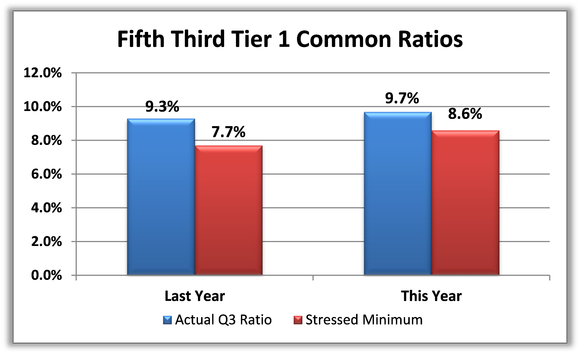
At the end of 2011, Fifth Third marched into the Federal Reserve‘s stress tests sporting a robust 9.3% Tier 1 common ratio. Under the Fed’s “severely adverse scenario,” the bank saw that ratio trickle down to a minimum level of 7.7%, which put the bank in the top 25% of the 19 participating bank holding companies. However in March 2012, the Fed rejected Fifth Third‘s request to increase its quarterly dividend, disappointing investors who were expecting a boost in payout. The bank would later be given approval to increase its quarterly dividend in September, but the sting of the rejection remained.

Sources: Dodd-Frank Act Stress Test 2013: Supervisory Stress Test Methodology and Results. Comprehensive Capital Analysis and Review 2012.

Yesterday’s results again showed strong actual capital ratios; however, unlike last year, the bank’s projected minimum ratio under the Fed’s doomsday scenario only trickled down to a robust minimum of 8.6%. The stressed ratios revealed in these tests assume that the institutions keep dividend payouts constant based on current levels and do not consider any proposed capital plans.

Weathering the storm
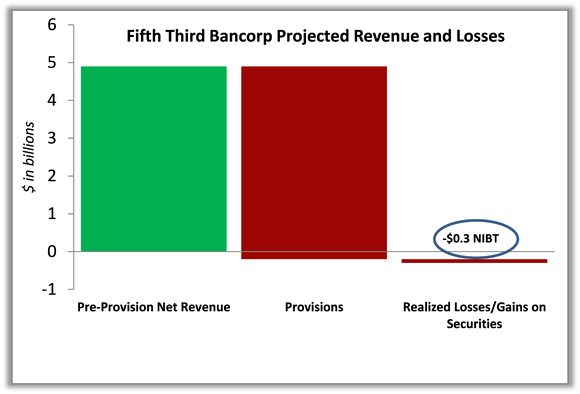
Next Thursday, the Fed will release Comprehensive Capital Analysis and Review (CCAR) results, which will look very similar to these results but will take into consideration each institution’s proposed increased in dividends or share repurchases. Contributing to Fifth Third‘s strong capital ratios was the modest loss the bank would theoretically experience over the span of the nine-quarter test. Despite the drastic conditions in the severely adverse scenario, the Fed estimated the bank would only post a pre-tax loss of $300 million over the course of the scenario.

Source: Dodd-Frank Act Stress Test 2013: Supervisory Stress Test Methodology and Results.

Expecting another boost?
Considering Fifth Third‘s Tier 1 common capital ratio only dropped to 8.6% in a hypothetical scenario that included more than 12% unemployment and 20%-plus declines in real estate values, the bank should have ample evidence to suggest it is possibly ready to increase its dividend payout ratio from its current of 21.8% level. Although the bank grew revenue year over year and strengthened capital ratios, Fifth Third still trades only slightly above its tangible book value and may be well-positioned to continually return capital to shareholders.

The article Here’s How Fifth Third Fared in the Stress Tests originally appeared on Fool.com.


David Hanson has no position in any stocks mentioned. The Motley Fool owns shares of Fifth Third Bancorp. Try any of our Foolish newsletter services free for 30 days. We Fools may not all hold the same opinions, but we all believe that considering a diverse range of insights makes us better …read more
Source: FULL ARTICLE at DailyFinance

Citi Emerges Victorious

By Amanda Alix, The Motley Fool

Filed under:

All eyes have been on bank stocks this week as investors waited to hear of the results of the Fed’s stress test results. While much of the excitement centered on Bank of America and its nicely padded capital cushion, Citigroup , a stress-test loser last year, surfaced as a clear winner, showing up fellow big banks B of A, JPMorgan Chase , Goldman Sachs , Morgan Stanley, and Wells Fargo in the post-test, Tier 1 common capital category.

Playing it safe
Citi came out of the test — which required a minimum post-test 5% capital reserve — with an 8.3% capital ratio, higher than Wells’ 7%, B of A’s 6.8%, and JPMorgan’s 6.3%. Both Goldman and Morgan Stanley emerged with ratios under 6%.

The super-charged stress scenario, reserved for the six largest banks, entailed an economic climate that featured 12% unemployment, a drop in real estate prices of 20%, and a general weakening of GDP by nearly 5%. In other parts of the world, the toughest scenario envisioned nasty recessions in Europe and Japan, with stalled economies in developing nations.

Despite going into the test with a Tier 1 ratio of 12.7% — the highest of any other bank — Citi choose to be conservative in its capital requests from the Fed. In an early release of this information, the bank revealed that it had asked for a $1.2 billion stock repurchase, and the maintenance of its current $0.01 per share quarterly dividend.

While some analysts expected Citi to increase its shareholder payout, it appears that new CEO Michael Corbat elected to play it safe. Along with SunTrust  and Fifth Third Bancorp, Citi was stung last year by having its capital plan denied by the Fed. Although it submitted a revision that was eventually accepted, this particular incident has been considered key in the downfall of Vikram Pandit last fall.

What’s next for Citi?
Corbat has already announced where he wants to take Citi, underlining the fact that the bank must make it or break it in over 20 markets within the next two years. He plans to improve return on assets from 0.6% in 2012 to at least 0.9% by 2015, as well as a minimum 10% return on tangible common equity by that year, as well.

Much like Bank of America’s Project New BAC, Corbat will trim the bank holding company by selling off much of its Citi Holdings, which has been a drag on the bottom line.

With such a plan in place, Citi should be on its way. Investors are rallying, having pushed the share price to a $45 closing yesterday — something the bank hasn’t seen in a while. Is Corbat the one that will turn Citi around? It’s looking good so far.

Citigroup’s stock looks tantalizingly cheap, and, despite the progress made and the stress-test triumph, the bank’s balance sheet is still in need of more repair, and there’s a considerable amount of uncertainty after a shocking management shakeup. Should investors …read more
Source: FULL ARTICLE at DailyFinance

There's No Reason to Stress About Wells Fargo

By John Maxfield, The Motley Fool

Filed under:

If you invest in banks, you probably already know that the Federal Reserve releases the results of the 2013 stress tests tomorrow. As I discussed earlier today when noting that Bank of America will likely pass the test with flying colors, how banks perform during this stage in their annual regulatory cycle largely dictates whether or not they’ll be able to increase the amount of capital they return to shareholders via dividends and/or share buybacks for the remainder of the year. This is why the stress tests are so important.

That being said, with respect to at least some banks, the term “stress test” is a bit of a misnomer. In other words, there’s little question that certain banks will sail through the process without anything to worry about. If the title of this article didn’t already give it away, Wells Fargo , the nation’s fourth largest bank by assets, is one such bank.

A brief introduction to stress tests
As I discussed earlier:

In the wake of the financial crisis, Congress enacted the Dodd-Frank Act, which requires the Federal Reserve to conduct stress tests of banks and other financial concerns with assets in excess of $50 billion. The purpose is to evaluate whether these so-called too-big-to-fail institutions have, as the Fed describes it, “sufficient capital, on a total consolidated basis, to absorb losses as a result of adverse economic conditions.”

The process seeks to simulate the impact on a bank’s regulatory capital levels under three hypothetical and increasingly severe economic scenarios. The most arduous assumes that real GDP declines an average of 4% this year, the unemployment rate ticks up to 12.1% in the second quarter of next year, and that home prices fall by more than 20% by the end of 2014. Suffice it to say, this is an extreme case. As the Fed notes, at least with respect to unemployment, the designated rate remains “above any level experienced over the last 70 years” — that is, since the Great Depression.

When subjected to a similar set of assumptions last year, the vast majority of banks passed the test with ease. In Wells Fargo‘s case, its Tier 1 common capital ratio fell from 9.34% of risk-weighted assets down to 6.6%, well in excess of the required 5% rate. As you can see here, this placed it in the middle of its peer group, or 8th out of the 19 banks tested. While it was the best-performing of the four so-called too-big-to-fail banks, it was beaten out by American Express, the custodial banks State Street and Bank of New York Mellon, and a smattering of regional lenders including Fifth Third Bancorp , U.S. Bancorp , and BB&T . The latter three, for instance, ended up with Tier 1 common capital ratios of 7.7%, 7.7%, and 7.3%, respectively.

Given that Wells Fargo‘s capital levels have since increased, it seems safe to assume that it’ll sail past the tests …read more
Source: FULL ARTICLE at DailyFinance

Fifth Third Bancorp to Present at the Citi 2013 Financial Services Conference

By Business Wirevia The Motley Fool

Filed under:

Fifth Third Bancorp to Present at the Citi 2013 Financial Services Conference

CINCINNATI–(BUSINESS WIRE)– Daniel T. Poston, executive vice president and chief financial officer of Fifth Third Bancorp will present at the Citi Financial Services Conference in Boston on Tuesday, March 5, 2013 at approximately 9:40 AM EST.

The webcast may be accessed live and for approximately 14 days after the conference through http://ir.53.com. Presentation slides will be made separately available in a printer-friendly format on the Company’s website.

Fifth Third Bancorp is a diversified financial services company headquartered in Cincinnati, Ohio. The Company has $122 billion in assets and operates 18 affiliates with 1,322 full-service Banking Centers, including 105 Bank Mart® locations open seven days a week inside select grocery stores and 2,413 ATMs in Ohio, Kentucky, Indiana, Michigan, Illinois, Florida, Tennessee, West Virginia, Pennsylvania, Missouri, Georgia and North Carolina. Fifth Third operates four main businesses: Commercial Banking, Branch Banking, Consumer Lending, and Investment Advisors. Fifth Third also has a 33% interest in Vantiv Holding, LLC. Fifth Third is among the largest money managers in the Midwest and, as of December 31, 2012, had $308 billion in assets under care, of which it managed $27 billion for individuals, corporations and not-for-profit organizations. Investor information and press releases can be viewed at www.53.com. Fifth Third‘s common stock is traded on the NASDAQ® National Global Select Market under the symbol “FITB.”

Fifth Third Bancorp
Jim Eglseder (Analysts), 513-534-8424

KEYWORDS:   United States  North America  Massachusetts  Ohio

INDUSTRY KEYWORDS:

The article Fifth Third Bancorp to Present at the Citi 2013 Financial Services Conference originally appeared on Fool.com.

Try any of our Foolish newsletter services free for 30 days. We Fools may not all hold the same opinions, but we all believe that considering a diverse range of insights makes us better investors. The Motley Fool has a disclosure policy.

Copyright © 1995 – 2013 The Motley Fool, LLC. All rights reserved. The Motley Fool has a disclosure policy.

(function(c,a){window.mixpanel=a;var b,d,h,e;b=c.createElement(“script”);
b.type=”text/javascript”;b.async=!0;b.src=(“https:”===c.location.protocol?”https:”:”http:”)+
‘//cdn.mxpnl.com/libs/mixpanel-2.2.min.js’;d=c.getElementsByTagName(“script”)[0];
d.parentNode.insertBefore(b,d);a._i=[];a.init=function(b,c,f){function d(a,b){
var c=b.split(“.”);2==c.length&&(a=a[c[0]],b=c[1]);a[b]=function(){a.push([b].concat(
Array.prototype.slice.call(arguments,0)))}}var g=a;”undefined”!==typeof f?g=a[f]=[]:
f=”mixpanel”;g.people=g.people||[];h=[‘disable’,’track’,’track_pageview’,’track_links’,
‘track_forms’,’register’,’register_once’,’unregister’,’identify’,’alias’,’name_tag’,
‘set_config’,’people.set’,’people.increment’];for(e=0;e<h.length;e++)d(g,h[e]);
a._i.push([b,c,f])};a.__SV=1.2;})(document,window.mixpanel||[]);
mixpanel.init("9659875b92ba8fa639ba476aedbb73b9");

…read more
Source: FULL ARTICLE at DailyFinance