Tag Archives: Regions Financial

M&T Bank Stock: 9 Critical Numbers

By John Maxfield, The Motley Fool

Filed under:

Given that you clicked on this article, it seems safe to assume you either own stock in M&T Bank or are considering buying shares in the near future. If so, then you’ve come to the right place. The table below reveals the nine most critical numbers that investors need to know about M&T Bank stock before deciding whether to buy, sell, or hold it.

But before getting to that, a brief introduction is in order. Established in 1856 as Manufacturers and Traders Bank, M&T Bank is today one of the 20 largest commercial banks in the United States. Headquartered in Buffalo, New York, it operates more than 700 branches and over 2,000 ATMs across eight states, the District of Columbia, and in Toronto, Canada. As of the end of 2012, it had $83 billion of assets on its balance sheet, ranking it in size between Alabama’s Regions Financial and Texas’ Comerica.

As you can see in the table above, from a shareholder’s perspective, M&T Bank exhibits a number of attractive characteristics. Its net interest margin is above average, as are its return on equity and payout ratio. In addition, both of its non-performing loans ratio and its efficiency ratio are lower than average, evidencing a well-run bank that manages credit risk more effectively than its peers. It accordingly follows that the biggest downside is its valuation. Trading at 2.33 times tangible book value, M&T Bank stock is one of the most dearly priced regional lenders in the market today.

The one thing M&T Bank stock investors should be wary about is its recent acquisition of Hudson City Bancorp . To say that this is a transformative deal for M&T Bank is an understatement. With $40 billion in assets, Hudson City will increase M&T’s size by 50% in one fell swoop. But while this sounds good in theory, acquisitions like this rarely work out for shareholders. A perfect example of this is First Niagara Financial‘s recent transformative acquisition of HSBC‘s branch network in the Northeastern United States, which led the CEO of First Niagara to relinquish his post last month.

Discover the “only big bank built to last”
Many investors are scared about investing in big banking stocks after the crash, but the sector has one notable standout. In a sea of mismanaged and dangerous peers, it rises above as “The Only Big Bank Built to Last.” You can uncover the top pick that Warren Buffett loves in The Motley Fool’s new report. It’s free, so click here to access it now.

The article M&T Bank Stock: 9 Critical Numbers originally appeared on Fool.com.


John Maxfield has no position in any stocks mentioned. The Motley Fool has no position in any of the stocks mentioned. Try any of our Foolish newsletter services free for 30 days. …read more

Source: FULL ARTICLE at DailyFinance

9 Critical Numbers About Regions Financial

By John Maxfield, The Motley Fool

Filed under:

Given that you clicked on this article, it seems safe to assume you either own shares of Regions Financial or are considering buying them in the near future. If so, then you’ve come to the right place. The table below reveals the nine most critical numbers that investors need to know about Regions before deciding whether to buy, sell, or hold its stock.

But before getting to that, a brief introduction is in order. Regions was formed in 1971 as First Alabama Bancshares, a bank holding company for three previously independent banks. While it began with only $543 million in assets and 40 banking locations, it has since grown into one of the nation’s largest regional banks — it took on its present name in 1994 to “better reflect its growing presence throughout the South.” Based in Birmingham, Alabama, it currently operates approximately 1,700 branches across 16 states. And as of the end of 2012, it had $121 billion of assets on its balance sheet, ranking it in size between Fifth Third Bancorp at $122 billion and KeyCorp at $89 billion.

As you can see in the table above, from a shareholder’s perspective, Regions still has considerable progress to make before it can be considered a first-rate investment, as the majority of its primary metrics are either at or below the industry average. That being said, its best showings are its noninterest income, which currently makes up 40% of the bank’s total revenue and thereby helps to hedge during periods of low interest rates, and its efficiency ratio, which comes in at one percentage point better than the industry overall.

With this in mind, it’s much easier to identify Regions’ areas of opportunity. In the first case, its net interest margin is woefully low, coming in nearly 60 basis points lower than the average. In the second case, its nonperforming loans ratio is far too high, thanks to its residual hangover from the financial crisis. And finally, its dividend payout ratio is abysmal, at only 9% of net income in all of 2012. To add insult to injury, moreover, it trades for 1.17 times tangible book value. That’s a dear price for a bank with so many issues.

Want to learn more about Regions Financial?
With big finance firms still trading at deep discounts to their historic norms, investors everywhere are wondering if this is the new normal, or whether finance stocks are a screaming buy today. The answer depends on the company, so to help figure out whether Regions Financial is a buy today, I invite you to read our premium research report on the company today. Click here now for instant access!

…read more

Source: FULL ARTICLE at DailyFinance

9 Critical Numbers about KeyCorp

By John Maxfield, The Motley Fool

Filed under:

Given that you clicked on this article, it seems safe to assume you either own shares of KeyCorp or are considering buying them in the near future. If so, then you’ve come to the right place. The table below reveals the nine most critical numbers that investors need to know about KeyCorp before deciding whether to buy, sell, or hold its stock.

But before getting to that, a brief introduction is in order. Tracing its roots back more than 160 years, KeyCorp today is one of the nation’s largest bank-based financial services companies. Headquartered in Cleveland, Ohio, it operates more than 1,083 full service branches across 14 states. As of the end of 2012, it had $89 billion of assets on its balance sheet, ranking it in size between Alabama’s Regions Financial at $121 billion in assets and M&T Bank at $83 billion.

As you can see in the table above, from a shareholder’s perspective, KeyCorp exhibits a handful of positive characteristics. Its nonperforming loans ratio is currently much better than the industry average, coming in at 1.3% versus 1.84%, respectively. In addition, it generates roughly half of its revenue from noninterest-based sources such as account fees and mortgage banking income; this helps to stymie the impact on its bottom line in periods of low interest rates. And finally, its return on equity is 30 basis points higher than the average.

On the other hand, KeyCorp’s figures also point to a number of opportunities. In the first case, its net interest margin is almost 50 basis points lower than its typical competitor. In the second case, its efficiency ratio is higher — meaning it costs KeyCorp more to generate each dollar of revenue than it should. And last but not least, it distributes only 22% of its earnings via dividends, leaving much to be desired. It’s likely for these reasons KeyCorp’s shares trade for a relative discount at 1.05 times tangible book value.

Discover what analysts are calling the “only big bank built to last”
Many investors are scared about investing in big banking stocks after the crash, but the sector has one notable stand out. In a sea of mismanaged and dangerous peers, it rises above as “The Only Big Bank Built to Last.” You can uncover the top pick that Warren Buffett loves in The Motley Fool’s new report. It’s free, so click here to access it now.

The article 9 Critical Numbers about KeyCorp originally appeared on Fool.com.


John Maxfield has no position in any stocks mentioned. The Motley Fool owns shares of KeyCorp. Try any of our Foolish newsletter services free for 30 days. We Fools may not all hold the same opinions, but we all believe that considering a diverse range of insights makes us better investors. The Motley Fool …read more

Source: FULL ARTICLE at DailyFinance

9 Critical Numbers About Fifth Third Bancorp

By John Maxfield, The Motley Fool

Filed under:

Given that you clicked on this article, it seems safe to assume you either own shares of Fifth Third Bancorp or are considering buying them in the near future. If so, then you’ve come to the right place. The table below reveals the nine most critical numbers that investors need to know about Fifth Third before deciding whether to buy, sell, or hold its stock.

But before getting to that, a brief introduction is in order. Tracing its roots back to pre-Civil War Ohio, Fifth Third has since transformed into one of the nation’s largest regional banks. Based in Cincinnati, it operates more than 1,325 full-service banking centers branches across 12 predominantly Midwestern states. As of the end of 2012, it had $122 billion of assets on its balance sheet, ranking it in size between Georgia’s SunTrust Banks at $173 billion and Birmingham, Alabama’s Regions Financial at $121 billion.

As you can see in the table above, Fifth Third outperforms the industry average on a number of fronts. Among other things, its non-performing loan ratio is 62 basis points less than the average and its efficiency ratio — of which a lower number is preferable — beat its typical competitor by nine percentage points. In addition, it’s less leveraged than most of its competitors, and the bank’s return on equity is considerably higher than the industry at 11.7% for the final quarter of 2012.

Alternatively, Fifth Third‘s primary weaknesses are its below-average net interest margin and its similarly substandard dividend payout ratio. With respect to the former, its 3.55% margin is a non-negligible 15 basis points less than the industry’s 3.7%. And with respect to the latter, Fifth Third only pays out roughly a fifth of its earnings to shareholders via dividends — though, it’s important to note here that the company’s board will vote in June on whether or not to increase its quarterly payout after getting approval to do so from the Federal Reserve in the middle of March.

Invest in Warren Buffett’s favorite bank stock
Many investors are scared about investing in big banking stocks after the crash, but the sector has one notable stand out. In a sea of mismanaged and dangerous peers, it rises above as “The Only Big Bank Built to Last.” You can uncover the top pick that Warren Buffett loves in The Motley Fool’s new report. It’s free, so click here to access it now.

The article 9 Critical Numbers About Fifth Third Bancorp originally appeared on Fool.com.


John Maxfield has no position in any stocks mentioned. The Motley Fool owns shares of Fifth Third Bancorp. Try any of our Foolish newsletter services free for 30 days. We Fools may not all hold the same opinions, but we all believe that considering a diverse range of insights …read more
Source: FULL ARTICLE at DailyFinance

Here's What This Annual 20% Gainer Has Been Buying

By Selena Maranjian, The Motley Fool

Filed under:

Every quarter, many money managers have to disclose what they’ve bought and sold, via “13F” filings. Their latest moves can shine a bright light on smart stock picks.

Today, let’s look at Caxton Associates, founded in 1983 by Bruce Kovner. The investment company is known for relatively few years of negative returns and for average annual gains of about 20% since its inception nearly 30 years ago (per a Wall Street Journal article). That’s a powerful record.

Caxton is also known for charging clients dearly for the privilege of going along for the ride. In an industry known for routinely charging 2% of assets annually while also taking 20% of profits, Caxton had long charged 3% and 30%, though that was shaved down to 2.6% and 27.5% last year — still very steep. (It’s not the only one with such above-average fees.)

The company’s reportable stock portfolio totaled $2.4 billion in value as of Dec. 31, 2012.

Interesting developments
So what does Caxton Associates‘ latest quarterly 13F filing tell us? Here are a few interesting details:

The biggest new holdings are Williams and puts on the iShares Russell 2000 ETF , which focuses on small-cap companies. Other new holdings of interest include R.R. Donnelley & Sons and Northstar Realty Finance . Commercial printer Donnelley provides labels, packaging, and more to the private and public sector. It prints many thousands of forms for the SEC and bought Edgar Online. Bears worry about its steep debt load and a possible reduction of its massive dividend, which recently yielded 9.4%. To succeed, the company needs to do more digital business.

NorthStar Realty Finance is another strong dividend payer, recently yielding 7.5%. It has been growing its revenue at a double-digit clip over the past few years, and offers the benefit of being diversified between real estate debt, mortgage-backed securities, and the old-fashioned leasing of owned properties. While many mortgage-related real estate investment trusts (REITs) have been cutting their dividends, NorthStar recently upped its payout.

Among holdings in which Caxton increased its stake was Melco Crown Entertainment , which operates casinos in gaming Mecca Macau. The company has been performing well lately, racking up revenue and earnings gains and more than doubling its EBITDA margin over the past few years. It’s expanding with properties in the Philippines and elsewhere, too. (The Philippines is expected by some analysts to become a $3 billion gambling market by 2015.)

Caxton reduced its stake in lots of companies, including Regions Financial . The bank is attractive on many counts. It’s repaid its TARP obligation, is posting improving net interest margin and asset quality, and has a powerful presence in the growing Southeast region. Its recent quarter featured a swing from a big loss to a big gain, among other achievements, and a recent stress test revealed improvement in its financial condition, with dividend hikes on the way.

Finally, Caxton Associates …read more
Source: FULL ARTICLE at DailyFinance

PNC Names New Mortgage Chief

By Eric Volkman, The Motley Fool

Filed under:

PNC Financial Services Group has appointed a new chief executive officer of its PNC Mortgage division. E. Todd Chamberlain is to take up the position, replacing Saiyid Naqvi following the latter’s retirement at the end of April. Like Naqvi, he will also join the banking conglomerate’s executive committee.

Chamberlain joined PNC in 2011 and has served as the mortgage division’s president and chief operating officer. Before that, he occupied executive positions in Regions Financial and insurance giant American International Group.

Naqvi had been the head of PNC‘s mortgage operations until 2001, when the company divested that business. He returned in 2009 following the bank’s acquisition of National City Mortgage, which subsequently became PNC Mortgage.

The article PNC Names New Mortgage Chief originally appeared on Fool.com.

Fool contributor Eric Volkman has no position in any stocks mentioned. The Motley Fool recommends AIG, owns shares of AIG and PNC Financial Services, and has options on AIG. Try any of our Foolish newsletter services free for 30 days. We Fools don’t all hold the same opinions, but we all believe that considering a diverse range of insights makes us better investors. The Motley Fool has a disclosure policy.

Copyright © 1995 – 2013 The Motley Fool, LLC. All rights reserved. The Motley Fool has a disclosure policy.

(function(c,a){window.mixpanel=a;var b,d,h,e;b=c.createElement(“script”);
b.type=”text/javascript”;b.async=!0;b.src=(“https:”===c.location.protocol?”https:”:”http:”)+
‘//cdn.mxpnl.com/libs/mixpanel-2.2.min.js’;d=c.getElementsByTagName(“script”)[0];
d.parentNode.insertBefore(b,d);a._i=[];a.init=function(b,c,f){function d(a,b){
var c=b.split(“.”);2==c.length&&(a=a[c[0]],b=c[1]);a[b]=function(){a.push([b].concat(
Array.prototype.slice.call(arguments,0)))}}var g=a;”undefined”!==typeof f?g=a[f]=[]:
f=”mixpanel”;g.people=g.people||[];h=[‘disable’,’track’,’track_pageview’,’track_links’,
‘track_forms’,’register’,’register_once’,’unregister’,’identify’,’alias’,’name_tag’,
‘set_config’,’people.set’,’people.increment’];for(e=0;e<h.length;e++)d(g,h[e]);
a._i.push([b,c,f])};a.__SV=1.2;})(document,window.mixpanel||[]);
mixpanel.init("9659875b92ba8fa639ba476aedbb73b9");

function addEvent(obj, evType, fn, useCapture){
if (obj.addEventListener){
obj.addEventListener(evType, fn, useCapture);
return true;
} else if (obj.attachEvent){
var r = obj.attachEvent("on"+evType, fn);
return r;
}
}

addEvent(window, "load", function(){new FoolVisualSciences();})
addEvent(window, "load", function(){new PickAd();})

var themeName = 'dailyfinance.com';
var _gaq = _gaq || [];
_gaq.push(['_setAccount', 'UA-24928199-1']);
_gaq.push(['_trackPageview']);

(function () {

var ga = document.createElement('script');
ga.type = 'text/javascript';
ga.async = true;
ga.src = ('https:' == document.location.protocol ? 'https://ssl' : 'http://www') + '.google-analytics.com/ga.js';

var s = document.getElementsByTagName('script')[0];
s.parentNode.insertBefore(ga, s);
})();

Read | Permalink | Email this | Linking Blogs | Comments

…read more
Source: FULL ARTICLE at DailyFinance

2 Banks You Don't Want to Overlook Today

By Matt Koppenheffer and David Hanson, The Motley Fool

Filed under:

In the following video, Motley Fool financial analysts Matt Koppenheffer and David Hanson lament the flurry of coverage that the nation’s biggest banks have been getting during this stress test season, and bring two lesser-mentioned banks to investors’ attention that they may have overlooked.

We hear about Regions Financial and how far it has come since last year’s stress tests. Matt also takes a look at KeyCorp , another bank off many investors’ radars. Matt discusses the big new capital allocation plans both of these banks have in store this year, and why investors should be interested. 

With big finance firms still trading at deep discounts to their historic norms, investors everywhere are wondering if this is the new normal, or whether finance stocks are a screaming buy today. The answer depends on the company, so to help figure out whether Regions Financial is a buy today, I invite you to read our premium research report on the company today. Click here now for instant access!

var FoolAnalyticsData = FoolAnalyticsData || []; FoolAnalyticsData.push({ eventType: “TickerReportPitch”, contentByline: “Matt Koppenheffer and David Hanson“, contentId: “cms.24291”, contentTickers: “NYSE:RF, NYSE:KEY”, contentTitle: “2 Banks You Don’t Want to Overlook Today”, hasVideo: “True”, pitchId: “82”, pitchTickers: “NYSE:RF”, …read more
Source: FULL ARTICLE at DailyFinance

The Federal Reserve Weighs In: Which Banks Can Pay Bigger Dividends?

By Matt Koppenheffer, The Motley Fool

Filed under:

This time last week, bank investors were reveling in the results of the Dodd-Frank stress tests, which showed that most major U.S. banks have solid, recession-resistant balance sheets. This week, the Federal Reserve took the stress testing process to the next level and evaluated which banks can proceed with their capital plans.

While the specifics of the individual banks’ capital plans can vary considerably, what most investors are focused on is the banks’ requests to pay higher dividends and launch share buyback plans. 

Citigroup  ruined much of the suspense last week when it pre-emptively announced that it wouldn’t be seeking a higher dividend, but would ask for a small-ish share buyback authorization. There wasn’t much suspense around Ally Financial, either. The former GMAC was hopping mad after the Fed flunked it during the Dodd-Frank round of tests.

For most banks though, yesterday was the day to find out — in most cases — exactly what kind of capital distributions they could hope for in the year ahead. For Bank of America  shareholders, the answer was up to $5 billion in share buybacks. For Wells Fargo , it’s a potential 20% dividend bump and more share buybacks. And while the news was good for most banks, the answer for BB&T  was a thumbs-down from the Fed as it rejected the bank’s capital plan.

To help you get the inside view on how each company fared, we’ve put together a comprehensive run-down on each company (aside from Ally) that participated in the tests. Click the links below to find out which banks passed and what their shareholders can look forward to in 2013.

The Big Four Regional Banks Others
Bank of America BB&T  American Express 
Citigroup Fifth Third  Bank of New York Mellon 
JPMorgan Chase KeyCorp  Capital One  
Wells Fargo  PNC Financial Goldman Sachs 
  Regions Financial  Morgan Stanley 
  SunTrust  State Street 
  U.S. Bancorp   

Buybacks ahead for B of A!
Bank of America’s stock doubled in 2012. Is there more yet to come? With significant challenges still ahead, it’s critical to have a solid understanding of this megabank before adding it to your portfolio. In The Motley Fool’s premium research report on B of A, analysts Anand Chokkavelu, CFA, and Matt Koppenheffer, Financials bureau chief, lift the veil on the bank’s operations, including detailing three reasons to buy and three reasons to sell. Click here now to claim your copy.

var FoolAnalyticsData = FoolAnalyticsData || []; …read more
Source: FULL ARTICLE at DailyFinance

Preview: Another Week, Another Banking Stress Test

By David Hanson, The Motley Fool

Filed under:

During the boom of the U.S. banking system during the previous decade, investors were rewarded with hefty capital gains and massive chunks of cash in the form of common stock dividends.

As we fast forward to the present, shareholders of these banks are yearning and thirsty for a return to the cash-rich days. With the release of the Federal Reserve’s Comprehensive Capital Analysis and Review (CCAR) results on Thursday afternoon, investors will learn if the largest U.S. banks will be allowed to return more capital to shareholders. Despite the upward trajectory of bank profits in recent years, banks and regulators are still haunted by memories of the massive liquidity crisis almost five years ago.

The CCAR results will detail each bank’s capital positions assuming no additional capital actions plans (just like last week’s Dodd-Frank stress test results), as well as account for the impact of any proposed capital action plans (increases in dividends or share repurchase) that each bank has submitted for approval. Given the stigma of banks having to cut dividends, the Fed will only approve capital plans that do not bring the bank’s capital levels to a dangerously low level under a global economic downturn.

After last week’s Dodd-Frank stress test results showed consistent capital ratio improvement year over year for almost every bank, investors’ expectations for dividend growth and increased share repurchase capacity have crept higher. Here is a breakdown of what each bank proposed during last year’s CCAR process:

Click on the name of each company to see a preview of this year’s results:

                                                           The Big Four
Company Name 2012 CCAR Capital Actions
Bank of America Did not request a dividend increase or new buyback approval.
Wells Fargo Approved: Increased dividend and share buybacks.
JPMorgan Chase Approved: Increased dividend and share buybacks.
Citigroup  Denied: Increased dividend.
                                                           Regional Banks
Company Name 2012 CCAR Capital Actions
BB&T Approved: Increased dividend and redeemed trust preferred securities.
Regions Financial  Approved: Repurchase of preferred stock from TARP.
Fifth Third 

Denied: Increased dividend.
Approved: Share buybacks.

KeyCorp Approved: Share buybacks. Later increased dividend.
SunTrust  Did not request a dividend increase or new buyback approval.
PNC Financial Approved: Increased dividend and share buybacks.
U.S. Bancorp  Approved: Increased dividend and share buybacks.
                                                                  Others 
Company Name 2012 CCAR Capital Actions
Goldman Sachs  Approved: Increased dividend and share buybacks.
Morgan Stanley Approved: Use of cash on acquisition of Morgan Stanley Smith Barney.
Approved: Increased dividend and share buybacks.
Bank of New …read more
Source: FULL ARTICLE at DailyFinance

Will Regions Financial Increase Its Dividend?

By Matt Koppenheffer, The Motley Fool

Filed under:

Last week, the Federal Reserve released the first part of the annual banking industry stress test results, which examined the impact of a severe economic downturn on the largest U.S. banks. All but one bank passed the tests, but, at least in this Fool’s view, Regions Financial‘s results made the bank stand out as a “most improved” candidate.

With that in mind, and the Fed’s Comprehensive Capital Analysis and Review (CCAR) results set to be released this week, Regions investors may be itching to find out if the bank will be able to raise its dividend.

How it fared last week
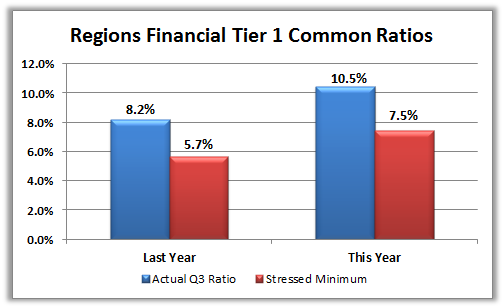
This year was the first year that the Fed ran through the Dodd-Frank portion of the stress tests, so we don’t have an exact comparison from last year. However, stacking Dodd-Frank results against last year’s CCAR — excluding the proposed capital actions — is a reasonable comparison. On that basis, Regions’ minimum stressed tier 1 common ratio of 7.5% compares very well to last year’s 5.7% from the CCAR

While that makes the prospect of capital distributions look promising, investors will still have to wait until Thursday to see how those capital plans shake out. To be sure, even if the bank has room to pay a higher dividend, that doesn’t mean its management team will ask for one. 

Source: Dodd-Frank Act Stress Test 2013: Supervisory Stress Test Methodology and Results.

Should Regions request a dividend bump?
This time last year, Regions Financial still had the government’s TARP investment sitting on its balance sheet. When the CCAR rolled around, instead of asking for a higher dividend or share buybacks, management focused its capital plan on raising additional capital through a $900 million stock offering so it could finally pay down TARP.

This time around, Regions appears to be much better positioned to ask for capital distributions. Though I’m a big proponent of dividends, considering that Regions is trading at a steep discount to its book value and only a slight premium to tangible book value, asking for a share buyback could be beneficial for shareholders.

That said, with the bank just one year out from paying down TARP and continuing to improve its balance sheet — at year end, nonperforming loans were still 2.4% of total loans — I couldn’t blame management for holding off on a distribution request altogether. 

How much?
I think slow and steady wins the race here for Regions. As I noted above, I wouldn’t be too surprised if management waited on asking for distributions. If it does, the best approach in my view would be to inch up its dividend, and perhaps combine that with a modest buyback.

For investors getting in on Regions today, the opportunity lies in the stock‘s low valuation and the bank’s ability to rebuild and grow over the long term, not a breakneck rush to push up the dividend.

Digging deeper on Regions
The CCAR results will be a big …read more
Source: FULL ARTICLE at DailyFinance

Make Money in "Strong Buy" Stocks the Easy Way

By Selena Maranjian, The Motley Fool

Filed under:

Exchange-traded funds offer a convenient way to invest in sectors or niches that interest you. If you’d like to add some highly rated stocks to your portfolio, the Guggenheim Raymond James SB-1 Equity ETF  could save you a lot of trouble. Instead of trying to figure out which companies will perform best, you can use this ETF to invest in lots of them simultaneously. It focuses on companies rated as “strong buys” by analysts at Raymond James.

The basics
ETFs often sport lower expense ratios than their mutual fund cousins. The Guggenheim ETF‘s expense ratio — its annual fee — is 0.75%, which is on the steep side for an ETF but still cheaper than a typical stock mutual fund. The fund is fairly small, so if you’re thinking of buying, beware of possibly large spreads between its bid and ask prices. Consider using a limit order if you want to buy in.

This ETF has performed reasonably, outpacing the S&P 500 over the past three and five years. As with most investments, of course, we can’t expect outstanding performances in every quarter or year. Investors with conviction need to wait for their holdings to deliver.

Why “strong buy” stocks?
Stocks deemed strong buys merit some consideration because savvy financial professionals have apparently found some appealing factors in them — though, of course, they’re not always right. (Indeed, my colleague Dan Dzombak has pointed out a blind spot they typically have.)

More than a handful of companies  that have sported a “strong buy” rating recently have performed well over the past year. Valero Energy surged 63%, for example, profiting by processing cheap U.S. oil and then selling it at higher prices in Latin America and Europe — thereby helping keep fuel prices in the U.S. high. It stands to benefit from the proposed and controversial Keystone XL Pipeline, and has been investing in railcars to boost profits from the Bakken shale fields.

Regions Financial gained 42% and is attractive on many counts, having repaid its TARP obligation, posted improving net interest margin and asset quality, and had a powerful presence in the growing Southeast region. Its recent quarter featured a swing from a big loss to a big gain, among other achievements. My colleague Sean Williams has nominated the company’s leader for CEO of the year.

Swift Transportation , a trucking company, climbed 22%. Its fourth-quarter earnings surged 27% over year-ago levels as the trucking industry enjoys a resurgence, with January tonnage having been the highest in five years. Its Moody’s credit rating has been hiked recently, and analysts at TheStreet.com upped its rating from sell to hold.

Other companies didn’t do quite as well last year, but could see their fortunes change in the coming years. Micron Technology , for example, advanced 10%, as its believers expect that growth in tablets and smartphones, …read more
Source: FULL ARTICLE at DailyFinance
A Stress-Test Sleeper Stock to Watch

By Matt Koppenheffer and David Hanson, The Motley Fool

Filed under:

In the following video, Motley Fool financials analysts Matt Koppenheffer and David Hanson discuss one dark horse in the Dodd-Frank stress test results that came out yesterday: Regions Financial . Matt gives investors the numbers for how the bank fared in this test vs. last year’s CCAR results, and tells us why he sees the bank as well positioned. 

With big finance firms still trading at deep discounts to their historic norms, investors everywhere are wondering if this is the new normal, or whether finance stocks are a screaming buy today. The answer depends on the company, so to help figure out whether Regions Financial is a buy today, I invite you to read our premium research report on the company. Click here now for instant access!

var FoolAnalyticsData = FoolAnalyticsData || []; FoolAnalyticsData.push({ eventType: “TickerReportPitch”, contentByline: “Matt Koppenheffer and David Hanson“, contentId: “cms.22507”, contentTickers: “NYSE:BAC, NYSE:C, NYSE:RF”, contentTitle: “A Stress-Test Sleeper Stock to Watch”, hasVideo: “True”, pitchId: “82”, pitchTickers: “NYSE:RF”, pitchTitle: “RF Ticker Report” …read more
Source: FULL ARTICLE at DailyFinance

Here's How Regions Financial Fared in the Stress Tests

By Matt Koppenheffer, The Motley Fool

Filed under:

If the Federal Reserve were handing out report cards for the Dodd-Frank stress tests, I think Regions Financial‘s  performance is worthy of a B-. Make no mistake about it, Regions is still far from as strong as the top banks out there. But the bank has made some great strides from last year and its stressed capital levels were well above required minimums.

Unlike the Federal Reserve‘s Comprehensive Capital Analysis and Review — which comes out next week — the Dodd-Frank stress tests do not determine whether or not the banks involved can pay higher dividends or pay out stock. But since they use essentially the same modeling and stress-case scenarios, they’re a good way for investors to get a sense for how the banks will perform in the CCAR and whether they’ll be able to increase capital distributions.

Capital ratios
Perhaps the key metric that the Fed and investors are looking at in the results of the stress tests is the tier 1 common capital ratio and, in particular, how low that ratio falls under the hypothetical stressed conditions. 

Here’s a look at how that ratio looked for Regions — both pre-test actual and under stressed conditions — as compared to similar numbers during last year’s CCAR tests.

Source: Federal Reserve.

As you can easily see from that chart, it appears that Regions has significantly improved its balance sheet since this time last year.

Projected net loss
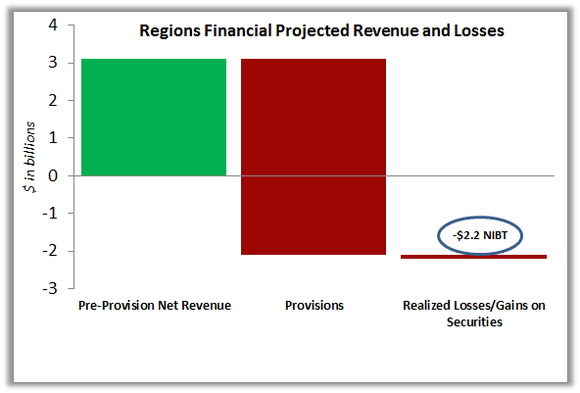
How do the regulators get to the stressed capital ratios? A big piece of the puzzle is using the stress-scenario inputs to estimate how much of a profit — or, in most cases, a loss — the bank will register over the nine-quarter test period.

In Regions’ case, the answer is a $2.2 billion loss on $3.1 billion of pre-provision net revenue — that is, revenue before loan-loss provisions less operating expenses. 

Source: Federal Reserve.

The loan losses estimated for Regions come to 7.6% of average loan balances. That’s above the 6.6% median of the entire group, but far from the worst.

One step further…
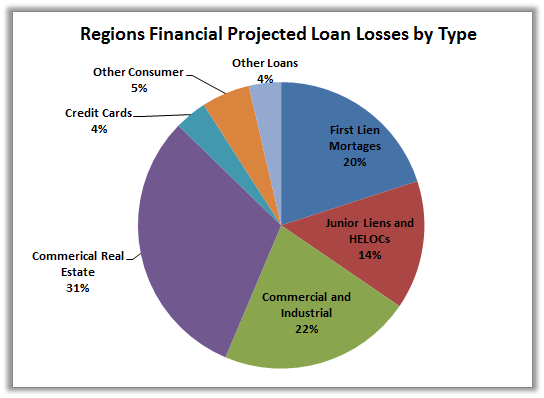
Finally, if we break down those loan losses, we can see where the Fed projects that Regions would take the biggest balance-sheet hits in the hypothetical stressed scenario.

Source: Federal Reserve.

It shouldn’t be too surprising that much of Regions’ losses were projected to come from commercial real estate. Not only is its CRE exposure greater than its residential mortgage exposure, but it also has a good chunk of it in CRE investor/developer loans, which are riskier than average. Overall, Regions’ CRE loss rate was above the 7.8% median of the group.

Now what?
Going into the stress tests, I was hopeful that Regions would do well. On the other end of this first round of tests, I think we can safely say it did. Considering that Regions’ stock is valued below the average bank stock, that alone is a win for investors.

As …read more
Source: FULL ARTICLE at DailyFinance
Should Investors in This Bank Be Stressing?

By David Hanson, The Motley Fool

BBT Price / Tangible Book Value Chart

Filed under:

In the banking world, sometimes boring is better.

Headquartered in quiet Winston Salem, North Carolina, BB&T avoided many of the pitfalls that ultimately plagued numerous regional banks across the country during the financial crisis. As investors in formerly troubled banks like SunTrust or Citigroup toss and turn in their beds tonight in anticipation of the Federal Reserve‘s announcement of the annual stress test results, BB&T shareholders will sleep peacefully knowing the bank is executing its strategy, and building sustainable capital ratios.

What to expect
Last year, the Federal Reserve‘s stress test and Comprehensive Capital Analysis and Review results validated BB&T’s financial strength, and the bank raised its dividend 25%. Although evaluation of the nation’s 19 largest banks’ future dividends and capital policies won’t be public until CCAR results are reported next Thursday, tomorrow’s Dodd-Frank stress test results will give investors a point of comparison across the financial institutions. The results, scheduled to be released tomorrow at 4:30 pm, will evaluate the impact of a hypothetical economic downturn on banks’ earning potential and balance sheet strength. Some of the factors in the Federal Reserve‘s “severely adverse scenario” include:

  • Real GDP decline of between 4%-5% by the end of 2013
  • Unemployment rises another 4% from current levels
  • Housing and commercial real estate prices decline more than 20%
  • 50% decline in equity prices over the course of the hypothetical recession

Not apples to apples
Although BB&T’s balance sheet held up well during previous stress tests and capital reviews, investors should note the significant changes to the bank’s balance sheet and business from the acquisitions of Crump Insurance in April 2012, and Bank Atlantic in July 2012. While these acquisitions greatly increased BB&T’s presence in the U.S. wholesale insurance and Florida markets, the moves negatively impact the calculation of Tier 1 common equity ratios as a result of the increase in intangible assets connected to the deals. Given the fact that the deals required Fed approval, investors shouldn’t be too concerned with the adverse impact on capital levels. 

Source: S&P Capital IQ

BB&T CEO Kelly King has spent over 40 years of his career at the bank, and led the company to a record year in 2012, while bolstering its presence in new markets. Investors have not allowed King’s progress to go unnoticed, as the market has consistently valued BB&T at a premium compared to its peers SunTrust, Regions Financial , and Fifth Third

While current BB&T shareholders will want to pay close attention to the bank’s results, investors interested in adding exposure to the large, regional banking sector may be better served keeping a close eye on BB&T’s lesser-valued competitors.

With big finance firms still trading at deep discounts to their historic norms, investors everywhere are wondering if this is the new normal, or whether finance stocks are a screaming buy today. The answer depends on the company, so to help figure out whether Regions Financial is a buy today, I invite you to read our …read more
Source: FULL ARTICLE at DailyFinance
Here's What Tomorrow's Stress Tests Mean for Regions Financial

By Matt Koppenheffer, The Motley Fool

Filed under:

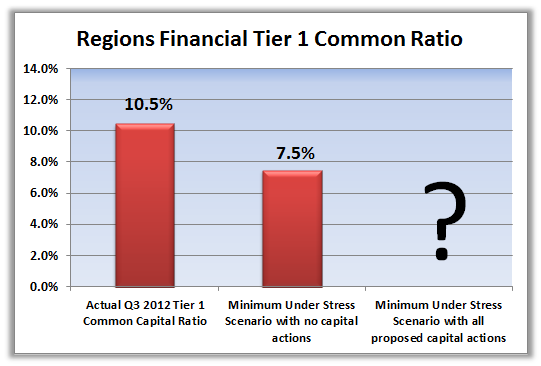
The Regions Financial  of today is in a very different place than the Regions Financial of just a year ago. And that’s good news for investors as they prepare to tune into the release of the Dodd-Frank stress tests tomorrow afternoon.

To be clear, tomorrow’s stress tests are not the much-awaited Comprehensive Capital Analysis and Review (CCAR). Some confusion on that point is understandable — the CCAR is also referred to generically as “bank stress tests.” Also, both the CCAR and the Dodd-Frank stress tests are run by the Federal Reserve. And the testing criteria are very similar across both tests as well.

However, a key difference is the fact that it’s with the CCAR that the Fed approves or gives a thumbs-down on tested banks’ capital plans. So investors wondering whether Regions might be raising its dividend or buying back stock will have to wait another week until the CCAR comes out.

That said, the Dodd-Frank tests will give investors some insight into what the CCAR is going to reveal next week, so there’s very good reason to tune in.

In Regions’ case, there doesn’t appear to be a whole lot to worry about in the Dodd-Frank test results. When compared to last year, Regions is on steadier footing. 

Source: Company and regulatory filings.

Notable here is the fact that year over year, Regions’ tier 1 common ratio — arguably the most important of a bank’s capital measures — is up markedly. The bank’s stressed capital ratios were also above average during last year’s CCAR tests.

Given the pummeling that Regions took during the financial crisis, it may seem surprising to see its CCAR results above the likes of US Bancorp  and Wells Fargo  — two banks that are seen as very conservative lenders and that performed quite well through the crisis. But the comparison is hardly fair. While the capital plans of both Wells and USB included hefty dividend increases and share buybacks, Regions’ included a big share sale so that it could repurchase the government’s TARP preferred stock (yeah, that TARP).

But, hey, that was then. Fast-forward to today and Regions has paid down TARP — all $3.5 billion of it — and can still boast strong capital ratios.

Because these are ratios based on risk-based assets, it helps this time around that Regions’ total assets are down 6% year over year (based on Q3 2012). But the mix of assets also makes a difference because Regions was among the banks that the Fed expected would see higher-than-average loan losses based on last year’s CCAR scenario.

Some of Regions’ riskier loan exposures have fallen since the last round of stress tests — loans to real estate developers and home equity loans both declined. At the same time, impaired loans at Regions have dropped.

Source: Company filings.

Add this all up, and I don’t think there’s much for Regions investors to worry about when the Dodd-Frank stress …read more
Source: FULL ARTICLE at DailyFinance
Bank Investors: No Need to Stress Out Yet

By Matt Koppenheffer and David Hanson, The Motley Fool

Filed under:

The results from the new banking stress test put in place by the Dodd-Frank Act will be coming out on March 7, with Bank of America , BB&T Regions Financial , Wells Fargo , and JPMorgan Chase  as several of the large banks likely participating. In this video, Motley Fool financial analysts Matt Koppenheffer and David Hanson discuss what to look for from the test results, and how banking investors should react. 

Bank of America’s stock doubled in 2012. Is there more yet to come? With significant challenges still ahead, it’s critical to have a solid understanding of this megabank before adding it to your portfolio. In The Motley Fool‘s premium research report on B of A, analysts Anand Chokkavelu, CFA, and Matt Koppenheffer, Financials bureau chief, lift the veil on the bank’s operations, including detailing three reasons to buy and three reasons to sell. Click here now to claim your copy, and as an added bonus, you’ll receive a full year of FREE updates and expert guidance as key news breaks.

var FoolAnalyticsData = FoolAnalyticsData || []; FoolAnalyticsData.push({ eventType: “TickerReportPitch”, contentByline: “Matt Koppenheffer and David Hanson”, contentId: “cms.21508”, contentTickers: “NYSE:BAC, NYSE:JPM, NYSE:WFC, NYSE:RF, NYSE:BBT”, contentTitle: “Bank Investors: No Need to Stress Out Yet”, hasVideo: “True”, pitchId: “29”, …read more
Source: FULL ARTICLE at DailyFinance