Tag Archives: Source Dodd Frank Act Stress Test

How Morgan Stanley's Fed-Approved Plan Will Pay Out

By Jessica Alling, The Motley Fool
Source:  Dodd-Frank Act Stress Test 2013: Supervisory Stress Test Methodology and Results.

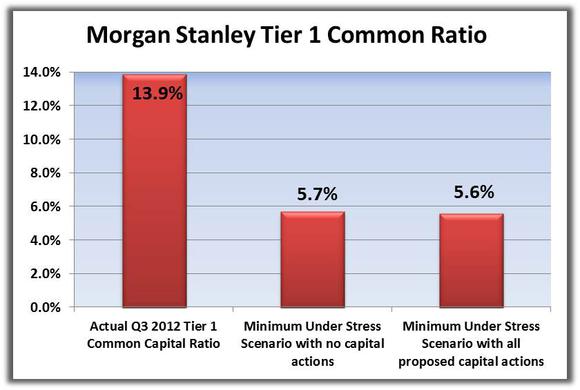
Even with the potential cash outflow of $4.7 billion, Morgan Stanley‘s Tier 1 common ratio was only reduced by 0.1% under the Fed’s stressed scenarios. This is a great showing for Morgan Stanely, especially after both Goldman and JPM were required to submit further plans to correct weaknesses in their capital plans that were “significant enough to require immediate action.” So far in after-hours trading, Morgan Stanley is up 2%.

Moving forward
So, with no objections to its capital plans, Morgan Stanley can get to work.

Source: Dodd-Frank Act Stress Test 2013: Supervisory Stress Test Methodology and Results.

The next step toward its full ownership of Smith Barney could initiate as soon as next month, propelling Morgan Stanley further along its path to becoming the top-notch wealth manager it has aimed to be. With the addition of the remaining Smith Barney ownership, Morgan Stanley‘s revenues will be bolstered, allowing the bank to provide valuable capital to its shareholders at a later date. Though investors are not getting an immediate payout, some may be disappointed — but Morgan Stanley‘s plan is truly aimed at adding great value for long-term investors looking for growth.

The other side of investment banking
As mentioned above, some investment-heavy banks weren’t as happy with the Fed’s results as Morgan Stanley. With weaknesses highlighted in its capital plan, how with Goldman Sachs fare going forward? 

To help you figure out 

Filed under:

The release of the Fed’s second Comprehensive Capital Analysis and Review test was a positive note for investment bank Morgan Stanley . Though the bank had a small margin to work with following the initial round of stress tests, it received no objections to its 2013 capital plan. Some of Morgan Stanley‘s closest rivals did not receive the same confidence, so let’s take a look at MS‘s results, how it stacked up, and where it goes from here.

The results
As noted in the preview to this week’s results, Morgan Stanley had one of the lower Tier 1 common capital ratios under the Fed’s stressed scenarios, but its results had been expected since it does not operate the same large depository arms as rival JPMorgan Chase  does. Both Morgan and Goldman Sachs were largely more affected by the negative scenarios designed by the Fed, but both passed the initial round.

On to round two. Morgan Stanley submitted its 2013 capital plan, which closely mirrored its 2012 plan and included the cash acquisition of Citigroup‘s remaining 35% stake in Smith Barney. The $4.7 billion acquisition is still subject to further regulatory approval, but the bank’s second round test results will not stand in its way.

Source:  Dodd-Frank Act Stress Test 2013: Supervisory Stress Test Methodology and Results.

Even with the potential cash outflow of $4.7 billion, Morgan Stanley‘s Tier 1 common ratio was only reduced by 0.1% under the Fed’s stressed scenarios. This is a great showing for Morgan Stanely, especially after both Goldman and JPM were required to submit further plans to correct weaknesses in their capital plans that were “significant enough to require immediate action.” So far in after-hours trading, Morgan Stanley is up 2%.

Moving forward
So, with no objections to its capital plans, Morgan Stanley can get to work.

Source: Dodd-Frank Act Stress Test 2013: Supervisory Stress Test Methodology and Results.

The next step toward its full ownership of Smith Barney could initiate as soon as next month, propelling Morgan Stanley further along its path to becoming the top-notch wealth manager it has aimed to be. With the addition of the remaining Smith Barney ownership, Morgan Stanley‘s revenues will be bolstered, allowing the bank to provide valuable capital to its shareholders at a later date. Though investors are not getting an immediate payout, some may be disappointed — but Morgan Stanley‘s plan is truly aimed at adding great value for long-term investors looking for growth.

The other side of investment banking
As mentioned above, some investment-heavy banks weren’t as happy with the Fed’s results as Morgan Stanley. With weaknesses highlighted in its capital plan, how with Goldman Sachs fare going forward? 

To help you figure out whether Goldman Sachs is a buy today, I invite you to read our premium research report on the company. Click here now for instant access!

…read more
Source: FULL ARTICLE at DailyFinance

Will Fifth Third Reward Investors With a Higher Dividend?

By Robert Eberhard, The Motley Fool

Filed under:

Banks truly have made an amazing recovery since the financial crisis of five years ago, and the proof is in the Fed stress test pudding. Wells Fargo rode its strong performance in the Dodd-Frank Stress Test (DFAST) to a new 52-week high last week, with other banks, including much-maligned Bank of America , also performing well in the DFAST.

But the DFAST is only part one of the now two-part Fed stress tests. Part two — the Comprehensive Capital Analysis and Review (CCAR) — will release results on Thursday. In this test, a bank submits a potential increase to its dividend and/or share buyback plans to the Fed, who then tests to see if the bank is capitalized well enough to meet the obligation. Last year, Fifth Third Bancorp was among the best performers in the Federal Reserve-mandated stress tests, and it is off to a great start this year as well.

Source: Dodd-Frank Act Stress Test 2013: Supervisory Stress Test Methodology and Results.

Should Fifth Third ask for a dividend increase or share repurchase?
As Fool Analyst David Hanson recently noted, Fifth Third showed strong capital ratios during the DFAST, ticking down just over 1% in the Fed’s scenario. The results show that the bank will remain well-capitalized if it maintains the same dividend payout over the coming year. However, like most other banks that are part of the stress tests, Fifth Third will be seeking permission to raise its dividend above its current level.

Last year, despite its strong performance with the stress test, Fifth Third‘s request for an increased dividend was initially denied by the Fed, though the bank was allowed to increase its dividend later in the year. If its performance in the DFAST is any indication, the bank should be in position to not only boost its dividend again, but also return value to shareholders by repurchasing shares.

How much?
As a result of the CCAR last year, Fifth Third‘s board authorized the repurchase of up to 100 million shares without an expiration date. As of December 31, the bank had over 63 million shares of this authorization still available for repurchase, or they could simply issue a new authorization replacing the previous one. Even if the bank just continues to purchase shares from the previous authorization, shareholders will be rewarded as their share of income increases.

Fifth Third already boasts a pretty sizable dividend — at least when compared to some other banks — paying out just over 21% of its earnings as dividends during the past 12 months. With the Fed looking less favorably on payout ratios over 30%, I would expect only a modest dividend increase from the bank. Nevertheless, a 30% payout based on last year’s earnings would represent an annual dividend of about $0.50 per share, boosting its current yield to around 3%. This, combined with even a modest share repurchase plan, could lead more …read more
Source: FULL ARTICLE at DailyFinance

Will Regions Financial Increase Its Dividend?

By Matt Koppenheffer, The Motley Fool

Filed under:

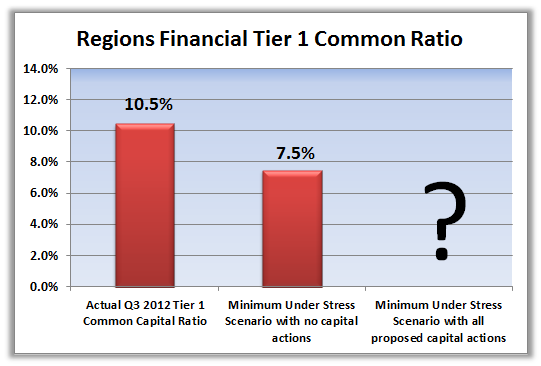
Last week, the Federal Reserve released the first part of the annual banking industry stress test results, which examined the impact of a severe economic downturn on the largest U.S. banks. All but one bank passed the tests, but, at least in this Fool’s view, Regions Financial‘s results made the bank stand out as a “most improved” candidate.

With that in mind, and the Fed’s Comprehensive Capital Analysis and Review (CCAR) results set to be released this week, Regions investors may be itching to find out if the bank will be able to raise its dividend.

How it fared last week
This year was the first year that the Fed ran through the Dodd-Frank portion of the stress tests, so we don’t have an exact comparison from last year. However, stacking Dodd-Frank results against last year’s CCAR — excluding the proposed capital actions — is a reasonable comparison. On that basis, Regions’ minimum stressed tier 1 common ratio of 7.5% compares very well to last year’s 5.7% from the CCAR

While that makes the prospect of capital distributions look promising, investors will still have to wait until Thursday to see how those capital plans shake out. To be sure, even if the bank has room to pay a higher dividend, that doesn’t mean its management team will ask for one. 

Source: Dodd-Frank Act Stress Test 2013: Supervisory Stress Test Methodology and Results.

Should Regions request a dividend bump?
This time last year, Regions Financial still had the government’s TARP investment sitting on its balance sheet. When the CCAR rolled around, instead of asking for a higher dividend or share buybacks, management focused its capital plan on raising additional capital through a $900 million stock offering so it could finally pay down TARP.

This time around, Regions appears to be much better positioned to ask for capital distributions. Though I’m a big proponent of dividends, considering that Regions is trading at a steep discount to its book value and only a slight premium to tangible book value, asking for a share buyback could be beneficial for shareholders.

That said, with the bank just one year out from paying down TARP and continuing to improve its balance sheet — at year end, nonperforming loans were still 2.4% of total loans — I couldn’t blame management for holding off on a distribution request altogether. 

How much?
I think slow and steady wins the race here for Regions. As I noted above, I wouldn’t be too surprised if management waited on asking for distributions. If it does, the best approach in my view would be to inch up its dividend, and perhaps combine that with a modest buyback.

For investors getting in on Regions today, the opportunity lies in the stock‘s low valuation and the bank’s ability to rebuild and grow over the long term, not a breakneck rush to push up the dividend.

Digging deeper on Regions
The CCAR results will be a big …read more
Source: FULL ARTICLE at DailyFinance

Will Bank of New York Mellon Increase Its Dividend?

By David Hanson, The Motley Fool

Filed under:

Last week, the Federal Reserve released the first part of the annual banking stress test results, which examined the impact of a severe economic downturn on the largest U.S. banks. While it stood out as one of the strongest banks during last year’s stress tests, Bank of New York Mellon posted perhaps the strongest results among the participants institutions. The results highlighted the strength and sustainability of Bank of New York Mellon’s custodial operations.

How it fared last week
In addition to posting a higher actual Tier 1 common ratio in Q3 in 2012 compared to 2011, Bank of NY Mellon posted an impressive minimum Tier 1 common ratio of 13.2% under the severely adverse scenario. During the previous year’s tests, the bank’s minimum Tier 1 common in the doom-and-gloom scenario was a staggering 13.3%. Regardless of some investors clamoring about the ease of the tests this year, it is hard to deny Bank of NY Mellon’s ability to withstand economic turmoil.

These strong results have driven investors to tune into the Comprehensive Capital Analysis and Review results, which will be released on Thursday afternoon. Within this release from the Fed, investors will know if the participating banks sought and received approval for any increases in dividends or share buyback programs. Investors will also get to see the impact of any new capital plans on stressed ratios.

Source:  Dodd-Frank Act Stress Test 2013: Supervisory Stress Test Methodology and Results.

Should Bank of New York Mellon request a bump?
Last year, the bank did not request approval of an increase of its $0.13 quarterly dividend payment. However, the Fed approved the company’s proposal for a new common stock repurchase program authorizing the purchase of up to $1.16 billion of stock. Bank of NY Mellon ultimately repurchased roughly 50 million shares of common stock in 2012 for $1.12 billion, around $500 million more than it distributed in the form of common stock dividends. Given the substantial strength of its balance sheet under a stressed scenario, the bank seems to have plenty of leverage in negotiating any additional actions to return more capital to shareholders.

How much?
While it seems that Bank of NY Mellon is strong enough to request a substantial increase in dividend, I believe investors should expect a modest dividend increase coupled with additional stock buyback capacity. The Fed has explicitly said that dividend payout ratios above 30% will receive “particularly close scrutiny.” Bank of NY Mellon’s dividend payout ratio was around the 26% level in 2012, suggesting room for marginal growth. If the Fed and the bank cannot agree on a substantial dividend increase, the bank will likely request an boost of share repurchases, which was its more significant capital action in 2012.

While some big banks continue to limp through their post-crisis recovery, Bank of New York Mellon has bounced right back. Though the bank is an 800-pound gorilla in the custody and asset management …read more
Source: FULL ARTICLE at DailyFinance

Will Capital One Increase Its Dividend?

By David Hanson, The Motley Fool

Filed under:

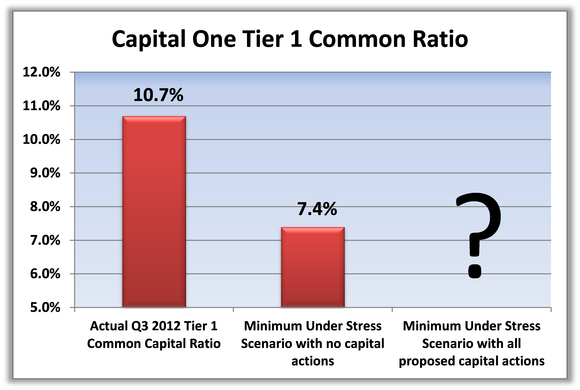
Last week, the Federal Reserve released the first part of the annual banking stress test results, which examined the impact of a severe economic downturn on the largest U.S. banks. While it did not stand out as one of the strongest participants during last year’s stress tests, Capital One posted improved and fairly solid results. The results highlighted the bank’s relatively robust credit card portfolio and its ability to weather a global economic downturn.

How it fared last week
In addition to posting a higher actual Tier 1 common ratio in Q3 in 2012 compared to 2011, Capital One posted an improved minimum Tier 1 common ratio of 7.4% under the severely adverse scenario. During the previous year’s tests, Capital One‘s minimum Tier 1 common in the doom-and-gloom scenario was 7.2%. One of the main drivers of Capital One‘s enhanced outlook was the less-severe U.S.-based stress scenario, compared to last year’s tests.

These stronger results have driven investors to tune into the Comprehensive Capital Analysis and Review results, which will be released on Thursday afternoon. Within this release from the Fed, investors will know if the participating banks sought and received approval for any increases in dividends or share buyback programs. Investors will also get to see the impact of any new capital plans on stressed ratios.

Source: Dodd-Frank Act Stress Test 2013: Supervisory stress Test Methodology and Results.

Should Capital One finally request a bump?
Last year, Capital One did not request approval for any increase in quarterly dividend payment or initiation of any share repurchase program. The bank has not increased its quarterly dividend of $0.05 since the onset of the financial crisis. Given the marginal improvement of its capital ratios under a stressed scenario, Capital One does not seem to have ample leverage in negotiating any additional actions to return more cash to shareholders.

Will shareholders get anything?
While it seems that Capital One is on the right path to increase its dividend, I believe investors may want to temper their expectations. If the Fed and the bank cannot agree on a dividend increase, Capital One may request to ramp up share repurchases. With the bank’s shares are trading at a 20% discount to book value, initiating a share repurchase may be the preferred capital action plan to generate additional value for shareholders. Therefore, I expect Capital One to ask and receive approval for a small share buyback program.

Bank of America is also a major player in the credit card business. With significant challenges still ahead, it’s critical to have a solid understanding of this megabank before adding it to your portfolio. In The Motley Fool’s premium research report on B of A, analysts Anand Chokkavelu, CFA, and Matt Koppenheffer, Financials bureau chief, lift the veil on the bank’s operations, including detailing three reasons to buy and three reasons to sell. Click here now to claim your copy.

…read more
Source: FULL ARTICLE at DailyFinance

Can SunTrust Investors Expect a Higher Dividend?

By Robert Eberhard, The Motley Fool

Filed under:

It’s March, and along with the return of spring (hopefully), we also get the results of the latest round of Federal Reserve stress tests. Last year, SunTrust was among the worst performers among the banks put to the test, but this year, if its Dodd-Frank Stress Test (DFAST) results are an indicator of what’s to come, the regional bank has shown marked improvement.

Banks truly have made an amazing recovery since the financial crisis, and the proof is in the Fed’s stress-test pudding. Wells Fargo rode its strong performance in the DFAST to a new 52-week high last week, with other banks, including much-maligned Bank of America, also performing well in the DFAST. But the DFAST is only part one of the now two-part Fed stress tests.

Part two — the Comprehensive Capital Analysis and Review (CCAR) — will release results on Thursday afternoon. In this test, a bank submits a potential increase to its dividend and/or share buyback plans to the Fed, who then tests to see if the bank is capitalized well enough to meet the obligation. Though the DFAST wasn’t part of the stress test last year, we can compare the results from last year’s CCAR to see if a bank is looking better or worse.

Source: Dodd-Frank Act Stress Test 2013: Supervisory stress Test Methodology and Results.

Should SunTrust investors bank on a dividend increase?
Last year, because of its poor performance in the CCAR, SunTrust was not allowed to raise its dividend or return additional capital to shareholders. However, upon the release of last year’s results, CFO Aleem Gillani stated that he felt the bank was better capitalized than the Fed’s tests had shown, and that the bank would report first-quarter earnings that exceeded expectations. The bank proved him right, beating analysts’ expectations by nearly 40% the following month, primarily on the strength of improved asset quality.

As Fool Analyst Matt Koppenheffer recently noted, SunTrust’s capital ratios compared to last year are night and day. Not only did it increase its pre-test Tier 1 common capital ratio, but it also demonstrated that even after the Fed’s “doomsday” scenario, SunTrust remained capitalized well above the 5% minimum required to pass the test. We’ll get a clearer picture after Thursday’s CCAR results, but I personally think SunTrust investors could see a slight dividend increase going forward.

How much of an increase?
As a result of the CCAR last year, SunTrust was not allowed to increase its dividend beyond its current $0.05 per quarter, or return additional capital to shareholders. SunTrust’s current payout ratio is only around 5.5%, though this number is depressed slightly due to the sizable gain SunTrust experienced when it sold of some legacy Coca-Cola shares during the third quarter. Nevertheless, there is plenty of room for the bank to grow its dividend. Analysts expect SunTrust to earn $2.69 per share during 2013; if it …read more
Source: FULL ARTICLE at DailyFinance

Why Morgan Stanley Shouldn't Pay Its Shareholders

By Jessica Alling, The Motley Fool

Source:  Dodd-Frank Act Stress Test 2013: Supervisory Stress Test Methodology and Results.

Should Morgan Stanley ask for a dividend increase or share buyback?
In short, no. While the bank does have some room before it’s Tier 1 common capital ratio reaches the Fed’s 5% minimum, any dividend increase or share buyback would not be substantial enough to make a big difference for its investors. With its current payout of 0.2%, Morgan Stanley will have no problem getting its current dividend approved by the Fed, and though that may not be appreciated by investors now, it has another opportunity to use its capital for another purpose that can potentially add much more value.

Taking a cue from last year’s capital plan, Morgan Stanley should avoid increasing its dividend or initiating share buyback programs in favor of escalating its acquisition of Morgan Stanley Smith Barney. The joint venture with Citigroup has already bolstered Morgan Stanley‘s operations with increased exposure to wealth management. The bank currently has an agreement with Citi that it will purchase the remaining 35% stake in Smith Barney by 2015.

Not only has the purchase of Smith Barney provided increased revenue to Morgan Stanley, but the acquisition price is heavily favoring the purchaser — giving ample opportunity for MS to realize increased gains from the purchase.

If not now, when?
Once Morgan Stanley has some more breathing room under stress test conditions, and has made substantial progress on purchasing the remainder of Smith Barney, it should request authorization to increase its dividend and/or share buybacks. The bank would be serving its shareholder’s long-term interests by putting off capital distributions in favor of the acquisition that places it firmly in the wealth management sphere — a direction Morgan Stanley is favoring.

But once Smith Barney is largely owned by Morgan Stanley, and integrated into the bank’s operations, its investors deserve a capital boost from the paltry level of distributions they receive now.

Morgan Stanley isn’t the only investment bank that got the short end of the Fed’s CCAR stick — but like MS, Goldman Sachs fared well regardless.

With big finance firms still trading at deep discounts to their historic norms, investors everywhere are wondering if this is the new normal, or if finance stocks are a screaming buy today. The answer depends on the company, so to help figure out 

Filed under:

Last week’s release from the Federal Reserve from part one of its Comprehensive Capital Analysis and Review (aka, stress tests) was a big day for the nation’s banks. But tomorrow may be even bigger for bank investors. Most are anticipating signs of increased dividends or share buybacks, but Morgan Stanley investors may be waiting a bit longer.

A quick recap
Morgan Stanley‘s results last week weren’t bad, but also not the greatest. Though the bank had an admirable 13.9% Tier 1 common ratio, the Fed’s stressed scenario reduced the ratio by a huge 8.2%. Because Morgan Stanley and its compatriot Goldman Sachs operations are vastly different from the large depository institutions with trading arms, like Bank of America and JPMorgan Chase, the Fed’s stress test produced harsher effects for the investment banks.

But despite the larger effects, Morgan Stanley passed the first round of tests, and may have some wiggle room in the second round.

Source:  Dodd-Frank Act Stress Test 2013: Supervisory Stress Test Methodology and Results.

Should Morgan Stanley ask for a dividend increase or share buyback?
In short, no. While the bank does have some room before it’s Tier 1 common capital ratio reaches the Fed’s 5% minimum, any dividend increase or share buyback would not be substantial enough to make a big difference for its investors. With its current payout of 0.2%, Morgan Stanley will have no problem getting its current dividend approved by the Fed, and though that may not be appreciated by investors now, it has another opportunity to use its capital for another purpose that can potentially add much more value.

Taking a cue from last year’s capital plan, Morgan Stanley should avoid increasing its dividend or initiating share buyback programs in favor of escalating its acquisition of Morgan Stanley Smith Barney. The joint venture with Citigroup has already bolstered Morgan Stanley‘s operations with increased exposure to wealth management. The bank currently has an agreement with Citi that it will purchase the remaining 35% stake in Smith Barney by 2015.

Not only has the purchase of Smith Barney provided increased revenue to Morgan Stanley, but the acquisition price is heavily favoring the purchaser — giving ample opportunity for MS to realize increased gains from the purchase.

If not now, when?
Once Morgan Stanley has some more breathing room under stress test conditions, and has made substantial progress on purchasing the remainder of Smith Barney, it should request authorization to increase its dividend and/or share buybacks. The bank would be serving its shareholder’s long-term interests by putting off capital distributions in favor of the acquisition that places it firmly in the wealth management sphere — a direction Morgan Stanley is favoring.

But once Smith Barney is largely owned by Morgan Stanley, and integrated into the bank’s operations, its investors deserve a capital boost from the paltry level of distributions they receive now.

Morgan Stanley isn’t the only investment bank that …read more
Source: FULL ARTICLE at DailyFinance

Citigroup's Surprising Post Stress-Test Move

By John Grgurich, The Motley Fool

Filed under:

Last Thursday, the Federal Reserve announced the results from part one of its Comprehensive Capital Analysis and Review, known informally as “stress tests.” For Citigroup investors there were two surprises: one sure to please, and one almost surely not to.

Surprise #1: Great stress-test performance
But just in case you missed the breaking Citi stress-test news from last week, here’s a quick recap:

Source: Dodd-Frank Act Stress Test 2013: Supervisory Stress Test Methodology and Results.

In the Fed’s simulated, severe economic downturn, Citigroup — which had an excellent capital position of 12.7% going into the test — would lose 4.4% off its Tier 1 common capital ratio, still leaving it at 8.3%: strong in absolute terms, as well as in relation to its peers.

The median Tier 1 common capital ratio performance for the banks this year was 7.7%. The minimum regulatory standard the Fed requires is 5%. A stressed 8.3% common ratio easily surpasses the Fed’s minimum, and comfortably surpasses the average. There’s no arguing Citi’s performance on the test itself.

Nor is there much arguing to be done regarding how well Citi did up against its big-banking peers: The superbank easily outperformed many of them. JPMorgan Chase‘s stressed common ratio was only 6.3% versus Citi’s 8.3%. The normally indefatigable Wells Fargo only emerged with a 7% common ratio , and Bank of America came in with a 6.8% stressed common ratio. Well done all around, Citi.

Surprise #2: No dividend for you
Citi has already announced it will not seek a post stress-test dividend increase from the Fed. This will come as an unexpected surprise to the bank’s investors; given how well it did in the 2013 CCAR, it could almost certainly have gotten one (versus last year, when Citi failed its stress test and was unable to raise its dividend).

The Fed had recently indicated it wouldn’t look kindly on any dividend increase that would cause a bank to go beyond a 30% payout ratio. But Citi’s is currently 2%, so from the Fed’s perspective, there’s obviously excessive room for maneuver there. To the best of my knowledge, CEO Michael Corbat hasn’t commented on why his bank isn’t seeking a dividend increase, but here’s my best guess.

Having failed its stress test last year, and being the biggest bank outside of B of A still having the most trouble extricating itself from financial-crisis difficulties, Corbat wants to play things coolly and conservatively. The bank is hard at work repairing its balance sheet and has made great strides in piling on the capital already.

This move to not return money to shareholders (except for a possible, very-small share buyback) is right in line with that kind of thinking.

Foolish bottom line
Also, I’ll echo something The Motley Fool’s Financials Bureau Chief Matt Koppenheffer said on this surprise move by Citi: Corbat has been CEO for such a short time — and he sells himself as such …read more
Source: FULL ARTICLE at DailyFinance

Will State Street Increase Its Dividend?

By David Hanson, The Motley Fool

Filed under:

Last week, the Federal Reserve released the first part of the annual banking stress test results, which examined the impact of a severe economic downturn on the largest U.S. banks. While it stood out as one of the strongest banks during last year’s stress tests, State Street again posted especially encouraging results. The results highlighted the strength and sustainability of State Street’s institutional client-focused business.

How it fared last week
In addition to posting a higher actual Tier 1 common ratio in Q3 in 2012 compared to 2011, State Street posted an impressive minimum Tier 1 common ratio of 12.8% under the severely adverse scenario. During the previous year’s tests, State Street‘s minimum Tier 1 common in the doom-and-gloom scenario was a staggering 15.1% without its proposed 33% dividend increase included. This year’s test assumed that elevated dividend remained constant through the nine-quarter stress period, making the 12.8% ratio equally impressive. Regardless of some investors clamoring about the ease of the tests this year, it’s hard to deny State Street‘s balance sheet strength and business prospects.

These strong results have driven investors to tune into the Comprehensive Capital Analysis and Review results, which will be released on Thursday afternoon. Within this release from the Fed, investors will know if the participating banks sought and received approval for any increases in dividends or share buyback programs. Investors will also get to see the impact of any new capital plans on stressed ratios.

Source: Dodd-Frank Act Stress Test 2013: Supervisory Stress Test Methodology and Results.

Should State Street request another bump?
Last year, State Street asked and received approval for a 33% increase of quarterly dividend payments. Additionally, the Fed did not reject the company’s proposal for a new common stock repurchase program authorizing the purchase of up to $1.8 billion of stock though Q1 2013. State Street ultimately repurchased 33.4 million shares of common stock in 2012 for roughly $1.44 billion, almost $1 billion more than it distributed in the form of common stock dividends. Given the substantial improvement of its balance sheet under a stressed scenario, State Street seems to have ample leverage in negotiating any additional actions to return more cash to shareholders.

How much?
State Street is strong enough to request a substantial increase in dividend, and I believe investors are anticipating a dividend increase and additional stock buyback capacity. The Fed has explicitly said that dividend payout ratios above 30% will receive “particularly close scrutiny.” State Street‘s dividend payout ratio was around 22.5% in 2012, suggesting room for growth. If the Fed and the bank cannot agree on a substantial dividend increase, State Street will likely request an increase of share repurchases, which was its more significant capital action plan in 2012.

State Street competitor Bank of New York Mellon is another 800-pound gorilla in the custody and asset management business, and likewise well positioned to perform through a range of economic environments. But …read more
Source: FULL ARTICLE at DailyFinance

Will BB&T Increase Its Dividend?

By David Hanson, The Motley Fool

Filed under:

Last week, the Federal Reserve released the first part of the annual banking stress tests results, which examined the impact of a severe economic downturn on the largest U.S. banks. While almost every bank showed improvement year over year, BB&T posted especially encouraging results. The results highlighted the strength and sustainability of BB&T’s balance sheet and loan portfolio.

How it fared last week
Despite posting a lower actual Tier 1 common ratio in Q3 in 2012 compared to 2011 because of its acquisition of Bank Atlantic and Crump Insurance, BB&T posted an impressive minimum Tier 1 common ratio of 9.4% under the severely adverse scenario. During the previous year’s tests, BB&T’s minimum Tier 1 common in the doom-and-gloom scenario was 7.3%. Regardless of some investors clamoring about the ease of the tests this year, it’s hard to deny the improvements BB&T has made to its balance sheet and business prospects.

These strong results have driven investors to tune into the Comprehensive Capital Analysis and Review results, which will be released on Thursday afternoon. Within this release from the Fed, investors will see if the participating banks sought and received approval for any increases in dividends or share buyback programs. Investors will also get to see the impact of any new capital plans on stressed ratios.

Source: Dodd-Frank Act Stress Test 2013: Supervisory Stress Test Methodology and Results.

Should BB&T request another bump?
Last year, BB&T asked and received approval for a 25% increase in quarterly dividend payments. Additionally, the Fed did not reject the company’s proposal to redeem $3.2 billion of trust preferred securities. Given the substantial improvement of its balance sheet under a stressed scenario, BB&T seems to have ample leverage in negotiating any additional actions to return more cash to shareholders. The market recognizes the value of BB&T’s balance sheet as shares currently trade at almost 2 times its tangible book value, well above the average in the U.S. banking industry.

How much?
While it seems that BB&T is strong enough to request a substantial increase of its dividend, I believe investors may want to temper their expectations. The Fed has explicitly said that dividend payout ratios above 30% will receive “particularly close scrutiny”; BB&T’s current dividend payout ratio is hovering around the 30% level. If the Fed and the bank cannot agree on a substantial dividend increase, BB&T may request additional share buybacks, an action  much easier to scale back compared to the scrutiny of cutting a dividend. Therefore, I expect BB&T to ask and receive approval for a slight dividend increase, as well as additional share repurchases.

With big finance firms still trading at deep discounts to their historic norms, investors everywhere are wondering if this is the new normal, or if finance stocks are a screaming buy today. The answer depends on the company, so to help you figure out whether BB&T should be on you radar, I invite you to …read more
Source: FULL ARTICLE at DailyFinance

Will PNC Increase Its Dividend?

By David Hanson, The Motley Fool

Filed under:

Last week, the Federal Reserve released the first part of the annual banking stress tests results, which examined the impact of a severe economic downturn on the largest U.S. banks. While almost every bank showed improvement year over year, PNC Financial Services posted especially encouraging results. The results highlighted the strength and sustainability of PNC’s balance sheet and loan portfolio.

How it fared last week
Despite posting a lower actual Tier 1 common ratio in Q3 in 2012 compared to 2011 because of its acquisition of RBC Bank, PNC posted an impressive minimum Tier 1 common ratio of 8.7% under the severely adverse scenario. During the previous year’s tests, PNC‘s minimum Tier 1 common in the doom-and-gloom scenario was 6.6%. Regardless of some investors clamoring about the ease of the tests this year, it is hard to deny the improvements PNC has made to its balance sheet and business prospects.

These strong results have driven investors to tune into the Comprehensive Capital Analysis and Review results, which will be released on Thursday afternoon. Within this release from the Fed, investors will know if the participating banks sought and received approval for any increases in dividends or share buyback programs. Investors will also get to see the impact of any new capital plans on stressed ratios.

Source: Dodd-Frank Act Stress Test 2013: Supervisory Stress Test Methodology and Results.

Should PNC request another bump?
Last year, PNC asked and received approval for an increase in its quarterly dividend payment, and later, it bumped its quarterly dividend up by roughly 14%. Additionally, the Fed did not reject the company’s proposal for a modest share repurchase program. PNC ultimately purchased $190 million of common stock in 2012 under a $250 million authorization. Given the substantial improvement of its balance sheet under a stressed scenario, PNC seems to have ample leverage in negotiating any additional actions to return more cash to shareholders.

How much?
While it seems that PNC is strong enough to request a substantial increase in dividend, I believe investors may want to temper their expectations. The Fed has explicitly said that dividend payout ratios above 30% will receive “particularly close scrutiny.” PNC‘s current dividend payout ratio is hovering around the 30% level. If the Fed and the bank cannot agree on a substantial dividend increase, PNC may request additional share buybacks, an action that could be scaled back and would receive much less scrutiny than cutting a dividend. Therefore, I expect PNC to ask and receive approval for a slight dividend increase, as well as a share buyback program.

The big banks may be rushing to renew their focus on traditional banking, but well-run regional banks like PNC Financial are already there. PNC saw its share of hardships during the financial meltdown, but its management team thinks the bank is now back on track and ready to deliver for investors. Does this mean it’s time to buy PNC? …read more
Source: FULL ARTICLE at DailyFinance

Will U.S. Bancorp Increase Its Dividend?

By David Hanson, The Motley Fool

Filed under:

Last week, the Federal Reserve released the first part of the annual banking stress tests results, which examined the impact of a severe economic downturn on the largest U.S. banks. While it stood out as one of the strongest banks during last year’s stress tests, U.S. Bancorp again posted especially encouraging results. The results highlighted the strength and sustainability of U.S. Bancorp’s balance sheet and profit engine.

How it fared last week
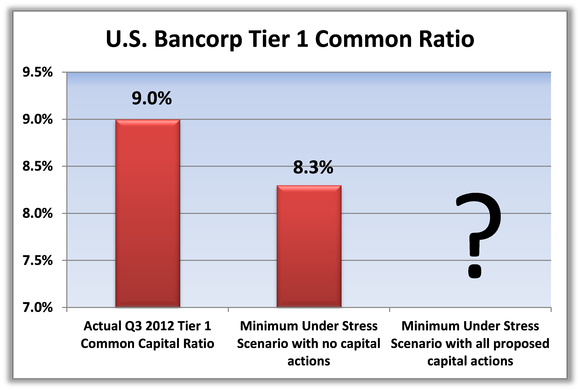
In addition to posting a higher actual Tier 1 common ratio in Q3 in 2012 compared to 2011, U.S. Bancorp posted an impressive minimum Tier 1 common ratio of 8.3% under the severely adverse scenario. During the previous year’s tests, USB‘s minimum Tier 1 common in the doom-and-gloom scenario was 7.7% without the proposed 56% dividend increase included. This year’s test assumes that elevated dividend remains constant through the nine-quarter stress period, making the 8.3% ratio that much more impressive. Regardless of some investors clamoring about the ease of the tests this year, it is hard to deny the improvements U.S. Bancorp has made to its balance sheet and business prospects.

These strong results have driven investors to tune into the Comprehensive Capital Analysis and Review results, which will be released on Thursday afternoon. Within this release from the Fed, investors will know if the participating banks sought and received approval for any increases in dividends or share buyback programs. Investors will also get to see the impact of any new capital plans on stressed ratios.

Source: Dodd-Frank Act Stress Test 2013: Supervisory Stress Test Methodology and Results.

Should US Bancorp request another bump?
Last year, U.S. Bancorp asked and received approval for a 56% increase in quarterly dividend payment. Additionally, the Fed did not reject the company’s proposal for a new 100 million share repurchase program. USB ultimately repurchased 59 million shares of common stock in 2012 for roughly $1.9 billion, around $500 million more than it returned in the form of common stock dividends. Given the substantial improvement of its balance sheet under a stressed scenario, U.S. Bancorp seems to have ample leverage in negotiating any additional actions to return more cash to shareholders.

How much?
While it seems U.S. Bancorp is strong enough to request a substantial increase in its dividend, I believe investors may want to temper their expectations. The Fed has explicitly said that dividend payout ratios above 30% will receive “particularly close scrutiny.” U.S. Bancorp’s dividend payout ratio has hovered around the 30% level for the last three quarters. If the Fed and the bank cannot agree on a substantial dividend increase, U.S. Bancorp may request to ramp up share repurchases. Therefore, I expect USB to ask and receive approval for a slight dividend increase, as well as a share buyback program.

With big finance firms still trading at deep discounts to their historic norms, investors everywhere are wondering if this is the new normal, or if finance stocks …read more
Source: FULL ARTICLE at DailyFinance

The Time Is Here: Will Bank of America Raise Its Dividend?

By John Maxfield, The Motley Fool

Filed under:

Investors in the nation’s second largest lender, Bank of America , have patiently waited for tangible evidence of the bank’s hard work over the last three years. Its capital ratios are first rate, it has slayed billions of dollars in legacy legal liabilities, and the bank even recently announced a new marketing campaign designed to repair its tarnished image.

Throughout all of this, however, B of A’s dividend has remained at a token $0.01 per share. Is this the year that will change? My guess is “yes,” though it must first get the Federal Reserve‘s approval to do so. On Thursday, we find out if it has.

Will the Fed let B of A raise its dividend?
Of course, the first issue is whether B of A has even asked the Fed for permission to return more capital to shareholders. Since having its 2011 request denied — humiliatingly, I might add, as its CEO Brian Moynihan had publically stated that the bank would request an increase prior to its denial — executives at B of A have steadfastly refused to discuss the issue.

The closest Moynihan has come is saying last October that boosting the payout “will be on the table” following this year’s stress tests. And as a side note, he went on to state an unequivocal commitment to generous distributions once they are allowed.

“All of the capital we have above the level we need, which is 9 percent, will go back to the shareholders at some point,” Moynihan said. “We are done with where we are supposed to be in six years today. If we did not earn a dollar, we would not have to raise another dollar of capital.”

Assuming it does ask, in turn, what’s the chance that B of A’s request will be approved? At first glance, I’d say the chances are good — assuming, of course, the request is reasonable.

For a bank to obtain approval, according to the Fed, it must demonstrate the “ability to maintain capital above each minimum regulatory capital ratio and above a tier 1 common ratio of 5 percent on a pro forma basis under expected and stressful conditions throughout the planning horizon.”

B of A satisfies this handily. As you can see in the chart below, its tier 1 common capital ratio in the third quarter of last year came in at an impressive 11.4%, more than twice the requisite 5% rate. And even after being subjected to the Fed’s “severely adverse” economic scenario, in which unemployment spikes to 12.1% by the middle of next year, B of A’s core capital remains above the mandatory minimum, coming in at 6.8%.

Source: Dodd-Frank Act Stress Test 2013: Supervisory Stress Test Methodology and Results.

Putting it somewhat differently, on a dollars-and-cents basis, B of A had $76.6 billion of capital above and beyond regulatory minimums at the end of the third quarter. While the excess dropped under the Fed’s stressed …read more
Source: FULL ARTICLE at DailyFinance

Should JPMorgan Ask for Share Buybacks or a Bigger Dividend?

By John Grgurich, The Motley Fool

Filed under:

Last Thursday, the Federal Reserve announced the results from part one of its Comprehensive Capital Analysis and Review, known informally as “stress tests.” While there were a few big surprises to emerge for America’s too-big-to-fail financial institutions, for JPMorgan Chase it was more of the same as last year — which might be turn out to be a good thing for investors.

Stress-test catch-up
Just in case you missed the breaking JPMorgan news from last week, here’s a quick recap:


Source: Dodd-Frank Act Stress Test 2013: Supervisory Stress Test Methodology and Results.

In the Fed’s simulated, severe economic downturn, JPMorgan — which had the relatively strong capital position of 10.4% going into the test — would lose a significant 4.1% off its Tier 1 common capital ratio, leaving it at 6.3%.  

And 6.3% is without the implementation of any of JPMorgan’s proposed capital actions: dividend increases or share buybacks. Where the superbank’s common ratio might end up after those numbers are thrown into the Fed’s equation remains to be seen, but it will officially be made public on Thursday.

Can — and should — JPMorgan request a dividend increase or share buybacks?
The median Tier 1 common capital ratio performance for the banks this year was 7.7%. The minimum regulatory standard the Fed requires is 5%. JPMorgan’s 6.3% isn’t stellar, but it probably isn’t low enough for the Fed to turn down a request for an increased dividend or share buybacks.

In fact, JPMorgan’s 2013 CCAR numbers are very close to its 2012 CCAR numbers: an actual Q3 2011 common ratio of 9.9% and a stressed ratio of 6.3%. After those results, the bank asked and got approval for $15 billion in share buybacks. So there’s no reason to think the Fed wouldn’t approve a similar capital-return scheme this year, and there’s no reason the bank shouldn’t ask for something.

However, although JPMorgan hasn’t officially announced anything — like the bank did last year, causing quite a stir in the financial community when it preemptively announced its share-repurchase plan — according to Financial Times JPMorgan is only planning on asking for about half that amount this time around.

If that’s the case, my guess would be the bank is being conservative after a tumultuous 2012 that saw it lose more than $6 billion in the London Whale trading debacle. After all, $6 billion is about halfway to the $15 billion mark.

What about a dividend increase?
The Fed has already indicated it won’t look kindly on any dividend increases that cause a bank to go beyond a 30% payout ratio; JPMorgan’s is currently 22%, so from the Fed’s perspective, there’s theoretically some room for maneuver.

But if Financial Times is correct, the bank isn’t angling for a dividend increase anyway. And from an investor perspective, JPMorgan already pays a healthy dividend — 2.4% — at least in comparison to its peers.

Goldman Sachs pays a paltry 1.3%, and even Bank of …read more
Source: FULL ARTICLE at DailyFinance

Will American Express Hike Its Dividend?

By Amanda Alix, The Motley Fool

Filed under:

Stress-test results have been saturating the media this week as the big banks show off their hearty capital reserves and ability to withstand an economic pseudo-armageddon. Though this was the third annual test, the Fed added some of Dodd-Frank’s regulations into the mix, prompting the announcement of the first phase, the stress test, on March 7 — to be followed by the Comprehensive Capital Analysis and Review results this Thursday.

Although banks — particularly big banks — have been the focus of media attention, any entity considered a bank holding company is subject to this yearly scrutiny. Two institutions that fit this description are Capital One Financial and American Express , though both are often thought of as primarily credit card issuers. Both of these companies passed the recent stress test easily, though American Express bested Capital One‘s 7.4% projected minimum Tier 1 common ratio with an 11.1% post-severely adverse-scenario capital cushion.

Source: Dodd-Frank Act Stress Test 2013: Supervisory Stress Test Methodology and Results.

Should American Express ask for a dividend increase or share buyback?
With such an impressive showing on the stress test, it seems almost certain that American Express will request — and will be allowed to bestow — a larger dividend, as well as institute a share buyback program. Indeed, only the two large custody banks, Bank of New York Mellon and State Street had higher common ratios than American Express. Considering that big regional bank BB&T , which analysts had pegged as one of the more highly capitalized institutions, scored a 9.4% ratio, AmEx’s results are all the more impressive.

Following the stress test last year, AmEx embarked upon a share repurchase program to the tune of $4 billion in 2012, reserving another $1 billion in buybacks for the current quarter. The company also announced a boost in the quarterly dividend to $0.20 from $0.18 per share.

How much will AmEx share with investors?
Will American Express be a little more generous this year? It certainly seems like it could afford to be. The company has many irons in the fire, and has recently begun exploring the social media side of credit card purchasing through a new deal with Twitter. As Fool analyst Dan Caplinger has noted, the company could easily bump up that payout quite a bit without feeling a pinch.

Certainly, with such a stellar financial checkup under its belt, AmEx could afford to be magnanimous with its investors — provided it stays under the Fed’s comfort level of less than 30% of estimated after-tax net income. Soon, we’ll know just how benevolent they plan to be.

With big finance firms still trading at deep discounts to their historic norms, investors everywhere are wondering if this is the new normal, or if finance stocks are a screaming buy today. The answer depends on the company, so to help you figure out whether BB&T should be …read more
Source: FULL ARTICLE at DailyFinance

Why Wells Fargo Will Increase Its Dividend

By John Maxfield, The Motley Fool

Filed under:

This Thursday is arguably the biggest day of the year for bank investors. It’s the day they learn which banks received regulatory approval to increase quarterly dividend payouts.

While this may seem like a no-brainer considering the bumper year most banks had in 2012, over the past two years, we’ve seen that nothing could be further from the truth. In 2011, the Federal Reserve sent Bank of America scurrying off with its tail between its legs after having its request denied. And Citigroup‘s analogous experience in 2012 contributed to the ousting of its now-former CEO Vikram Pandit.

There are nevertheless a handful of lenders that stand a better chance than others of gaining the requisite approval. And Wells Fargo falls squarely into this category.

Will the Fed approve Wells Fargo’s dividend request?
If you haven’t been following Wells Fargo as closely as, say, a bank analyst has been over the past few months, this may seem like a presumptuous question, because it presupposes that Wells Fargo has asked for approval in the first place. Rest assured, however: There’s little question that it’s done so.

Speaking at a conference in December, Wells Fargo‘s CEO John Stumpf said specifically that the nation’s largest home lender will ask regulators for permission to return more capital to shareholders.

While this could theoretically be limited to share buybacks, that interpretation seems unlikely. Prior to the financial crisis, Wells Fargo paid out anywhere between 35% and 50% of its earnings to shareholders via dividends. Since then, its payout ratio dropped dramatically and has only recently made its way back to the mid to high 20% range. Coupled with Stumpf’s statement, in turn, it seems safe to assume that Wells Fargo is looking to move its payout ratio back to its historical norm.

This leaves the question of whether the Fed will approve the bank’s presupposed request. And I believe the answer to this is also “yes.”

According to the central bank, petitioners seeking to return capital to shareholders must demonstrate the “ability to maintain capital above each minimum regulatory capital ratio and above a tier 1 common ratio of 5 percent on a pro forma basis under expected and stressful conditions throughout the planning horizon.”

The ability of the nation’s largest banks to do so was just tested as a part of the 2013 Dodd-Frank stress tests, the results of which were released last Thursday — click here to learn everything you need to know about how each of the nation’s largest banks performed. And if you’re a shareholder in Wells Fargo, then you’ll be happy to hear that it made its way through the Fed’s hypothetical economic gauntlet with ease.

Source: Dodd-Frank Act Stress Test 2013: Supervisory Stress Test Methodology and Results.

As you can see in the chart above, while Wells Fargo‘s tier 1 common capital ratio fell by 290 basis points under the Fed’s “severely adverse” economic scenario, it …read more
Source: FULL ARTICLE at DailyFinance

Here's How Keycorp Fared in the Stress Tests

By David Hanson, The Motley Fool

Filed under:

Small bank, stronger bank.

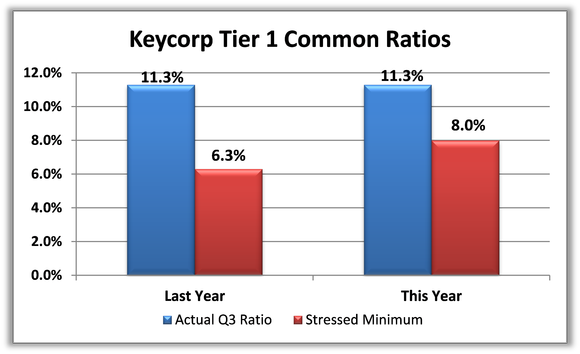
While banks like Bank of America and Citigroup dominate the headlines when it comes to the release of yesterday’s stress test results, the smaller but more traditional consumer and commercial bank Keycorp posted a robust Q3 2012 Tier 1 common capital ratio of 11.3, flat its 2011 level.

The main purpose of the Fed’s stress tests is not to look at actual capital levels, but rather to examine the how these institutions would fare if the domestic and global economy experienced another downturn similar to several years ago. In the “severely adverse” economic scenario, which included a sharp contraction in U.S. GDP coupled with 12% unemployment and a 20% decline in real estate values, Keycorp’s Tier 1 common ratio only fell to a minimum of 8%, an improvement of 170 basis points from last year’s stressed ratios.

Sources: Dodd-Frank Act Stress Test 2013: Supervisory Stress Test Methodology and Results. Comprehensive Capital Analysis and Review 2012.

While banks with significant capital markets operations are exposed to large counterparty risks, the impact of an economic deterioration on a traditional lender like Keycorp is much more straightforward. Over the nine-quarter doomsday scenario, the Fed projected Keycorp to see its Pre-Provision Net Revenue (essentially a measure of operating profit) fall to $2.5 billion and Provision for losses to creep up to $4.3 billion.

Source: Dodd-Frank Act Stress Test 2013: Supervisory Stress Test Methodology and Results.

As an American lender, Keycorp remains very closely tied to both the American consumer and domestic business climate. Because of the bank’s heavy exposure to real estate, the hypothetical decline in real estate values is one of the main drivers of the simulated losses.

Source: Dodd-Frank Act Stress Test 2013: Supervisory Stress Test Methodology and Results.

Although the bank been profitable for three straight years and strengthened its capital ratios, Keycorp still trades slightly below its tangible book value and may be well-positioned to continually return capital to shareholders.

With big finance firms still trading at deep discounts to their historic norms, investors everywhere are wondering if this is the new normal, or whether finance stocks are a screaming buy today. The answer depends on the company, so to help you figure out whether fellow regional bank BB&T should be on your radar, I invite you to read our premium research report on the company today. We’ll fill you in on both reasons to buy and reasons to sell BB&T, and what areas BB&T investors need to watch going forward. Click here now for instant access!

var FoolAnalyticsData = FoolAnalyticsData || []; …read more
Source: FULL ARTICLE at DailyFinance

Here's How Fifth Third Fared in the Stress Tests

By David Hanson, The Motley Fool

Filed under:

Last year, Fifth Third Bancorp experienced a roller-coaster stress test season. Based on the results of the Dodd-Frank annual stress tests that were revealed Thursday evening, the Cincinnati-based bank seems to still be standing on solid ground.

Good, but not good enough
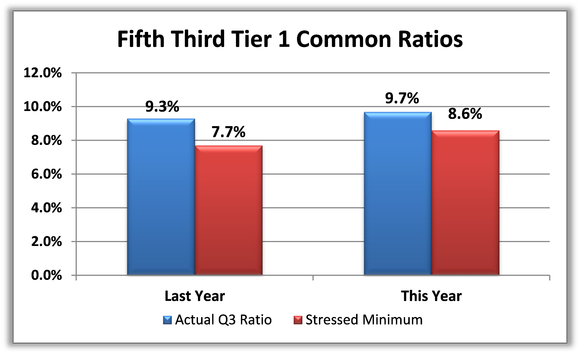
At the end of 2011, Fifth Third marched into the Federal Reserve‘s stress tests sporting a robust 9.3% Tier 1 common ratio. Under the Fed’s “severely adverse scenario,” the bank saw that ratio trickle down to a minimum level of 7.7%, which put the bank in the top 25% of the 19 participating bank holding companies. However in March 2012, the Fed rejected Fifth Third‘s request to increase its quarterly dividend, disappointing investors who were expecting a boost in payout. The bank would later be given approval to increase its quarterly dividend in September, but the sting of the rejection remained.

Sources: Dodd-Frank Act Stress Test 2013: Supervisory Stress Test Methodology and Results. Comprehensive Capital Analysis and Review 2012.

Yesterday’s results again showed strong actual capital ratios; however, unlike last year, the bank’s projected minimum ratio under the Fed’s doomsday scenario only trickled down to a robust minimum of 8.6%. The stressed ratios revealed in these tests assume that the institutions keep dividend payouts constant based on current levels and do not consider any proposed capital plans.

Weathering the storm
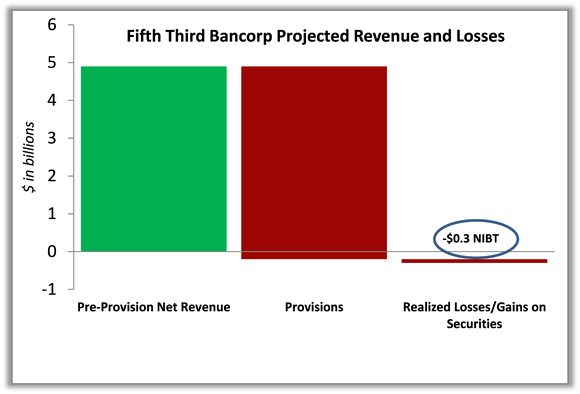
Next Thursday, the Fed will release Comprehensive Capital Analysis and Review (CCAR) results, which will look very similar to these results but will take into consideration each institution’s proposed increased in dividends or share repurchases. Contributing to Fifth Third‘s strong capital ratios was the modest loss the bank would theoretically experience over the span of the nine-quarter test. Despite the drastic conditions in the severely adverse scenario, the Fed estimated the bank would only post a pre-tax loss of $300 million over the course of the scenario.

Source: Dodd-Frank Act Stress Test 2013: Supervisory Stress Test Methodology and Results.

Expecting another boost?
Considering Fifth Third‘s Tier 1 common capital ratio only dropped to 8.6% in a hypothetical scenario that included more than 12% unemployment and 20%-plus declines in real estate values, the bank should have ample evidence to suggest it is possibly ready to increase its dividend payout ratio from its current of 21.8% level. Although the bank grew revenue year over year and strengthened capital ratios, Fifth Third still trades only slightly above its tangible book value and may be well-positioned to continually return capital to shareholders.

The article Here’s How Fifth Third Fared in the Stress Tests originally appeared on Fool.com.


David Hanson has no position in any stocks mentioned. The Motley Fool owns shares of Fifth Third Bancorp. Try any of our Foolish newsletter services free for 30 days. We Fools may not all hold the same opinions, but we all believe that considering a diverse range of insights makes us better …read more
Source: FULL ARTICLE at DailyFinance

Here's How Goldman Sachs Fared in the Stress Tests

By David Hanson, The Motley Fool

Filed under:

Yesterday, the release of the results from the Federal Reserve’s annual stress tests highlighted the impact of the changing regulatory and operating environment on firms like Goldman Sachs and Morgan Stanley.

While these capital markets-focused firms undergo the same tests as the large depository institutions like Bank of America and Wells Fargo, investors cannot use these stress tests results as an apples-to-apples comparison for these bank holding companies.

Ranging from high to low
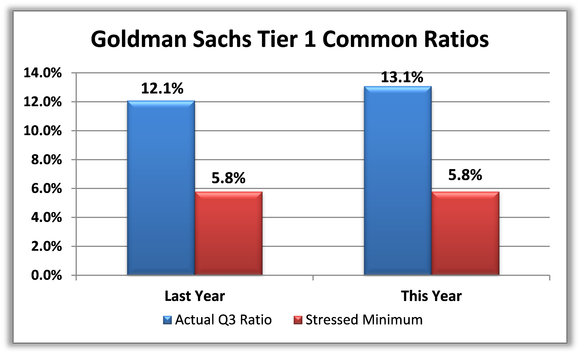
Despite posting strong operational results through 2012, Goldman Sachs entered this year’s stress tests with a very similar capital position compared to last year. The megainvestment bank increased its Q3 Tier 1 common ratio 100 basis to 13.1% in the 2012. The main purpose of the Fed’s stress tests is to examine the how these institutions would fare if the domestic and global economy experienced another scenario similar to 2008 and 2009. In the “severely adverse” economic scenario, which included a sharp contraction in Europe and developing Asian markets, Goldman’s Tier 1 common ratio crippled to a minimum of 5.8%, the same levels it fell to in last year’s tests.

Sources: Dodd-Frank Act Stress Test 2013: Supervisory Stress Test Methodology and Results. Comprehensive Capital Analysis and Review 2012.

Risky business
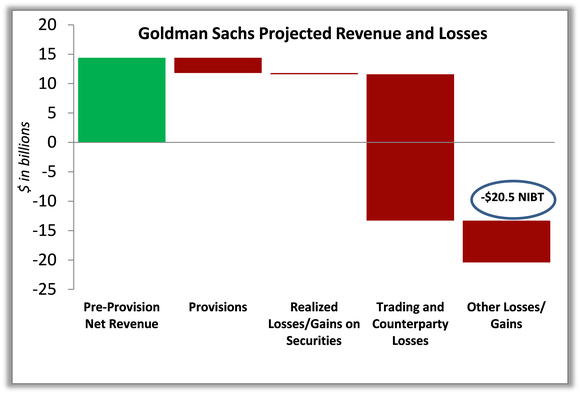
The six bank holding companies with significant trading operations, including Goldman, were subject to scenarios that exposed additional counterparty risk and markdowns on assets. The Fed’s scenario projected Goldman’s performance over a nine-quarter period and projected a total loss of over $20 billion under the severely adverse conditions. While this additional stressor negatively impacts the behemoths with trading arms like JPMorgan Chase and Bank of America, the firms without large consumer bases are likely to feel this impact to a greater extent.

Source: Dodd-Frank Act Stress Test 2013: Supervisory Stress Test Methodology and Results

Another increase?
Despite the drastic deterioration of capital levels in the Fed’s doomsday scenario, investors should note that although Goldman posted similarly depressed capital levels last year, the stock more than doubled the return of the S&P 500 since the release of the previous stress tests. In 2012, Goldman Sachs increased its dividend for the first time since 2005, despite the stress tests’ results. Next Thursday, the Fed will release Comprehensive Capital Analysis and Review (CCAR) results, which will look very similar to these results but will take into consideration any of Goldman’s proposed increases in dividends or share repurchases.

With big finance firms still trading at deep discounts to their historic norms, investors everywhere are wondering if this is the new normal, or whether finance stocks are a screaming buy today. The answer depends on the company, so to help figure out whether Goldman Sachs is a buy today, I invite you to read our premium research report on the company. Click here now for instant access!

…read more
Source: FULL ARTICLE at DailyFinance

Here's How Morgan Stanley Fared in the Stress Tests

By David Hanson, The Motley Fool

Filed under:

Yesterday, the release of the results from the Federal Reserve‘s annual stress tests highlighted the impact of the changing regulatory and operating environment on firms like Morgan Stanley and Goldman Sachs.

While these capital markets-focused firms undergo the same assessments as the large depository institutions with trading arms like JPMorgan Chase and Bank of America, the instability of the business segments that rely on the activity of institutional clients results in more volatile capital ratios during turbulent times.

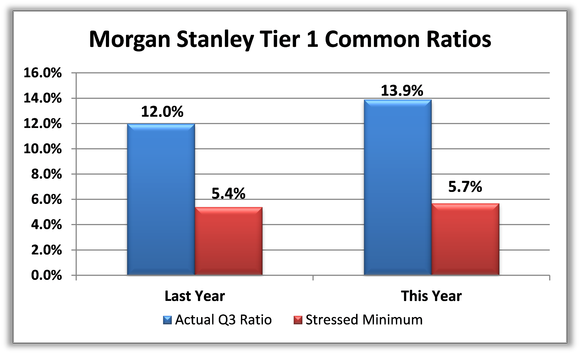
Despite a slightly tarnished reputation and sharp decline in its trading business year over year, Morgan Stanley entered this year’s stress tests with an even stronger capital position compared to last year. The investment bank increased its Q3 Tier 1 common ratio 190 basis to 13.9% in the 2012.

Although posting strong actual ratios is favorable, the main purpose of the Fed’s stress tests is to examine the how these institutions would fare if the domestic and global economy experienced another crisis similar to what happened in 2008. In the “severely adverse” economic scenario, which included a sharp contraction in Europe and developing Asian market, Morgan Stanley‘s Tier 1 common ratio crippled to 5.7%, only 30 basis points better than last year’s tests.

Sources: Dodd-Frank Act Stress Test 2013: Supervisory Stress Test Methodology and Results. Comprehensive Capital Analysis and Review 2012

The six bank holding companies with significant trading operations, including Morgan Stanley, were subject to scenarios that exposed additional counterparty risk and markdowns on assets. While this additional stressor negatively impacts the behemoths with trading arms like JPMorgan Chase and Bank of America, the firms without large consumer bases are likely to feel this impact to a greater extent. The Fed’s doomsday scenario projected Morgan Stanley‘s performance over a nine-quarter period with a total loss of almost $20 billion under the severely adverse conditions.

Source: Dodd-Frank Act Stress Test 2013: Supervisory Stress Test Methodology and Results.

Despite the drastic deterioration of capital levels in the Fed’s harshest scenario, investors should note that although Morgan Stanley posted similarly depressed capital levels last year, the stock still beat the return of the S&P 500 since the release of the previous stress tests.

Next Thursday, the Fed will release Comprehensive Capital Analysis and Review (CCAR) results which will look very similar to these results but will take into consideration any potential proposed increases in dividends or share repurchases. Last year, Morgan Stanley did not request to increase its dividend, and given the performance of its market-based businesses in 2012 and stress test results, shareholders may not be expecting this year to be any different.

With big finance firms still trading at deep discounts to their historic norms, investors everywhere are wondering if this is the new normal, or whether finance stocks are a screaming buy today. The answer depends on the company, so to help figure out whether big-baking fellow Goldman Sachs is a buy today, I invite you to read our premium research report on the company. Click …read more
Source: FULL ARTICLE at DailyFinance