Tag Archives: Dodd Frank Act

The SEC Needs Funding

By Andrew Marder, The Motley Fool

Filed under:

The Securities and Exchange Commission gets funding in a way that should make everyone happy. Instead of being funded by tax revenues, its funding comes from a fee levied on transactions made by the entities that it oversees. Last year, that fee was $0.02 for every $1,000 in transactions. In addition, the SEC can’t generate extra cash or overcharge, because as of last year, it has to make the amount it collects match an amount designated by Congress. 

So it may come as some surprise to see that politicians are fighting over how much it should be allowed to raise in order to fund itself next year — maybe that’s not surprising as politicians are natural born fighters. Right now, the SEC‘s battle for funding is playing out on a small scale between the members of the House Committee on Financial Services. One side says one thing, and one says the opposite, but the summary is this: The SEC is going to be underfunded.

What the SEC wants
The SEC is asking for a 15% increase in funding that will add 560 full-time equivalent employees to help take on the tasks at hand. Those tasks include overseeing 1,400 new advisors that are required to register with the SEC along with its usual duties — you know, keeping an eye on the 10,000 investment professionals with $44 trillion in assets under management. 

That increase just isn’t going to come. In fact, the agency will be lucky just to have the level of funding it saw last year — keeping in mind, that funding has no impact on the deficit.

Ideology gone mad
The clash on Capitol Hill comes down to the disagreement on the level of regulation that should exist. Those in favor of cutting funding to the SEC argue that its rules make it harder for small banks, and increase the amount of paperwork and bureaucracy that little guys are subject to. Those in favor of increasing funding argue that the world is getting bigger and more complicated, and that regulation protects individuals.

Both sides have valid points, and the SEC is anything but perfect. Just this week, a federal judge admonished the SEC for its “regrettable inaction” in the Madoff case . But the commission isn’t going to get better by not having the people or resources that it needs.

The past failures of the SEC don’t mean that it’s a worthless part of the U.S. regulatory landscape. While its detractors call for more focus on the JOBS Act and less on the Dodd-Frank Act, that’s not really up to the agency. Those laws were passed by Congress, and handing them to an underfunded commission isn’t going to make them go away or become a perfect piece of legislation.

The SEC is dealing with increased oversight and increasingly sophisticated financial instruments. On top of that, the institutions under the SEC‘s gaze are increasingly powerful. Banks like JPMorgan Chase and Bank of America

From: http://www.dailyfinance.com/2013/04/11/the-sec-needs-funding/

Sapient Global Markets Facilitates Compliance Reporting with DTCC's Swap Data Repository

By Business Wirevia The Motley Fool

Filed under:

Sapient Global Markets Facilitates Compliance Reporting with DTCC’s Swap Data Repository

Sapient’s Compliance Management and Reporting System Drives Efficiencies across all Asset Classes for Required SDR Reporting

BOSTON–(BUSINESS WIRE)– Sapient Global Markets has today announced its Compliance Management and Reporting System (CMRS) will be offered for customers connecting to The Depository Trust & Clearing Corporation (DTCC) Swap Data Repository (SDR) reporting. CMRS provides firms with a complete solution for more efficiently and effectively meeting regulatory reporting commitments.

Regulations, such as the Dodd-Frank Act, European Market Infrastructure Regulation (EMIR) and the Regulation on Energy Market Integrity and Transparency (REMIT), are increasing reporting requirements for firms in the capital and commodity markets. Sapient’s CMRS allows firms to collate vast amounts of data from disparate systems, translate it into the destination message format, deliver it directly to regulators and receive acknowledgement messages back from DTCC. Additionally, it provides a single view of compliance regardless of operating model and required reporting venue.

DTCC is focused on delivering to our clients world-wide effective solutions that bring greater cost efficiency, transparency and risk mitigation to the OTC derivatives market. Our global trade reporting platform is designed with an open architecture which allows a wide universe of market participants to gain seamless access to our services which help them meet their regulatory reporting requirements around the world,” said Chris Childs, managing director, Deriv/SERV. “Working with complementary solution providers such as Sapient Global Markets and connecting with CMRS is a prime example of how we look to accomplish just that and jointly help our mutual clients face the challenges of an evolving regulatory landscape.”

Designed for firms doing business across borders, CMRS connects to all major trading and risk management systems that process high volumes of swaps and other OTC products. It is SDR agnostic and is the only system to date that collects and normalizes data from multiple sources before transforming it into formats accepted by regulatory reporting destinations. It is this end-to-end capability that ensures firms concerned with swap data reporting have a single view of compliance regardless of operating model and required reporting venue.

“As regulatory reporting deadlines approach, firms must achieve a single view of their compliance status and a streamlined method of translating data from multiple sources into the format required by regulators,” said Arun Karur, vice president, Sapient Global Markets. “With connection to the DTCC, we are offering our …read more

Source: FULL ARTICLE at DailyFinance

Fifth Third Announces 2013 CCAR Capital Plan

By Business Wirevia The Motley Fool

Filed under:

Fifth Third Announces 2013 CCAR Capital Plan

No Objection from Federal Reserve to Company’s Capital Plan

CINCINNATI–(BUSINESS WIRE)– Fifth Third Bancorp (NAS: FITB) announced today that the Board of Governors of the Federal Reserve System (“the Federal Reserve“) did not object to the proposed potential capital actions from April 1, 2013 through March 31, 2014 (the “CCAR period”) included in Fifth Third‘s capital plan submitted in January under the Comprehensive Capital Analysis and Review (“CCAR“) process. Fifth Third also announced that its company-run internal stress test results under the Dodd-Frank Act stress testing rules are being disclosed on a Form 8-K published contemporaneously with this release.

In comments related to Fifth Third‘s announcement regarding its 2013 capital plan under CCAR, Kevin Kabat, CEO of Fifth Third Bancorp, said, “Our capital plan reflects our strong capital base, profitability and earnings generation, which enable us to return excess capital generation to shareholders while retaining more than sufficient capital to support ongoing business opportunities and balance sheet growth. The plan included a number of potential actions which were designed and intended to maintain a strong capital position, while moving our capital structure further toward new Basel III standards and reducing our overall cost of capital and common shares outstanding. We believe our plan for capital management and retention is balanced and prudent given our expectations, our capital position under current and proposed regulatory capital rules, and the current economic outlook.”

2013 CCAR Capital Plan

Fifth Third included in its capital plan the following potential capital actions for the period beginning April 1, 2013 and ending March 31, 2014, subject to Board approval and other factors including regulatory developments and market conditions.

  • The potential increase in the quarterly common stock dividend, which will be considered by the Board at its scheduled quarterly meeting in June
  • The potential repurchase of up to $750 million in trust preferred securities (TruPS), subject to the determination of a regulatory capital event, and replacement with the issuance of a similar amount of Tier 2-qualifying subordinated debt
  • The potential conversion of the $398 million in outstanding Series G 8.5 percent convertible preferred stock into approximately 35.5 million common shares issued to …read more
    Source: FULL ARTICLE at DailyFinance

Northern Trust Enhances Operational Support for Central Counterparty Clearing of OTC Derivatives

By Business Wirevia The Motley Fool

Filed under:

Northern Trust Enhances Operational Support for Central Counterparty Clearing of OTC Derivatives

CHICAGO–(BUSINESS WIRE)– To help clients comply with new regulations intended to manage risk in the financial derivatives markets, Northern Trust has enhanced its systems to provide operational support for central clearing of certain over-the-counter (OTC) derivatives.

New capabilities allow Northern Trust to electronically capture trade information on swaps, a widely used type of OTC derivative, and connect with external parties to route trades to electronic matching platforms, clearing firms and exchanges. The enhancements to Northern Trust‘s custody and middle-office platform will support compliance with the Dodd-Frank Act in the United States and the European Markets Infrastructure Regulation (EMIR), which require investors to clear OTC derivatives through centralized exchanges, rather than on a bilateral basis.

“As the infrastructure for derivatives transactions moves toward central counterparty (CCP) clearing, we have developed processing efficiencies that allow us to electronically capture and confirm CCP trades, interface with the exchanges and clearing firms, and offer margin management,” said Judson Baker, Product Manager for Derivatives and Collateral Management at Northern Trust. “Our ability to provide these services saves our clients from having to make costly investments in systems and operational support needed to meet regulatory requirements.”

Available on a global basis to investment managers, institutional investors and other asset servicing clients, the new capabilities are integrated with Northern Trust‘s Investment Operations Outsourcing, global custody and collateral management systems to support all aspects of post-trade processing.

“The regulatory environment continues to evolve, bringing greater demand for derivatives services,” said Peter Cherecwich, Head of Global Fund Services at Northern Trust. “We are committed to investing in automation and increased product coverage to fully support derivatives processing, including margin management, in support of our back and middle office outsourcing clients.”

Northern Trust offers an active collateral management service for clients that trade futures and listed options, OTC and cleared swaps. Northern Trust provides this service for an array of derivative participants including asset managers, corporations, pension funds and family offices located around the globe. In addition, Northern Trust will continue to invest in operational capabilities in support of margin management to help clients optimize their pledged assets.

About Northern Trust

Northern Trust Corporation (NAS: NTRS) is a leading provider of investment management, asset and fund administration, banking solutions and fiduciary services for corporations, institutions and affluent individuals worldwide. …read more
Source: FULL ARTICLE at DailyFinance

Why Boeing and Financials Are Leading Stocks Higher

By John Maxfield, The Motley Fool

Filed under:

Stocks are positioned to extend their winning streak today despite disappointing news out of both Europe and China. The Dow Jones Industrial Average has now closed higher on every day in March, up a cumulative 2.7%. If the blue-chip index finishes up once again, it will have done so for seven consecutive days, setting records throughout the run.

Today’s rally is fighting against growing economic headwinds. At the end of last week, ratings agency Fitch Ratings downgraded Italy‘s credit rating to three steps above junk status. And today, data showed that the country’s gross domestic product contracted by 0.9% in the final three months of last year. On a year-over-year basis, the figure was 2.8% down from the final quarter of 2011.

“I think the Italian downgrade is acting as a bit of a wake-up call,” a London-based economist told Reuters.

In China, data revealed that inflation is rising while growth in industrial production and retail sales came in below expectations. As my colleague Dan Dzombak discussed in more detail, inflation in February increased to 3.2%. Meanwhile, the growth rates of industrial production and retail sales fell to 9.9% and 12.3%, respectively. With respect to the latter figure, economists had forecast growth of 13.8%.

On the heels of this news, the Dow is up by 38 points, or 0.26%, with about an hour left in the trading session.

In terms of the index’s best-performing individual components, Boeing is leading the way. Shares in the company are 1.9% higher after the aerospace giant announced that it has finally identified the problem with its flagship 787 Dreamliner. Two months ago global aviation authorities grounded all 50 of the aircraft then in use after lithium-ion batteries on two separate planes caught on fire.

Speaking at a conference of aviation financiers today, Boeing’s marketing vice president Randy Tinseth said, “It is a solution that we believe provides three levels of protection for the airplane and it’s a solution that we’re confident will ensure safe and reliable service for the 787 in the future.”

Shares of both JPMorgan Chase and Bank of America are also rallying today after the banks discovered last week that they had passed the Federal Reserve‘s annual stress test mandated by the Dodd-Frank Act. At the end of this week, in turn, investors should know whether the banks have also gotten approval to increase dividend payouts and/or initiate share buyback programs.

Last week, fellow too-big-to-fail bank Citigroup announced that it will ask the Fed for permission to buy back $1.2 billion in shares. The bank is still smarting from having a similar request denied last year — many even believe the denial was a major contributing factor in former CEO Vikram Pandit’s forced resignation. As a result, the planned repurchase this time around is designed only to “offset estimated dilution created by annual incentive compensation grants.”

In addition, the Financial Times reported that JPMorgan has “requested a share buyback of …read more
Source: FULL ARTICLE at DailyFinance

Commodity Alchemy: Turning Gold into Lead

By 24/7 Wall St.

close-up of red hot iron beams

Filed under:

When the commodity traders at Goldman Sachs Group Inc. (NYSE: GS) say that commodities may be oversold right now they exclude gold from the rest of the asset class. In the near term, the Goldman analysts think that commodities will rise 2% to 6% although the firm remains neutral on commodities’ 12-month outlook, expecting a return of 3%.

We’ve already gone over some of the issues with investing in gold, either in mining companies like Barrick Gold Corp. (NYSE: ABX) and Kinross Gold Corp. (NYSE: KGC) or in ETFs like the SPDR Gold Trust (NYSEMKT: GLD). Goldman thinks that petroleum and copper are the short-term winners. Petroleum due to the lack of spare capacity and increased demand from emerging markets, and copper because the pull back in pricing last year was driven by concerns about China that no longer apply.

To which we say, “Maybe.” Petroleum, at least in the form of crude oil, costs more on the spot market now than it does on the futures market. That backwardation could be a buying opportunity if the global economy is in fact accelerating and will continue to do so in the second half of this year. The suggestion is that a “buy and hold” strategy will pay off because crude oil supplies will come under pressure.

That’s what happened (to some extent) in 2008 when crude went to $147 a barrel. How well do the conditions from 2008 fit the conditions of the crude market in 2013? Perhaps not all that well.

As for copper, the Chinese government has recently said it will soak up some of the liquidity in the country’s banks in an effort to keep inflation under control. New rules related to real estate and housing could cool some of the exuberance in the construction sector in China, too. On one hand, we could be in for a repeat of 2008 when commodity prices went on an upward tear. On the other hand, commodity producers will continue to overproduce, keeping prices low.

Where does this leave the big banks like Goldman, J.P. Morgan Chase & Co. (NYSE: JPM) and Morgan Stanley (NYSE: MS), all of which reported double-digit declines in their commodities business last year? Lower market volatility plus restrictions imposed on trading by the Dodd-Frank Act have hit the banks’ trading operations hard. The banks could try to divest their commodity arms or spin them off into separate companies, but none has said much at all about its plans.

And that lead into gold bit? Last year Glencore International plc and Trafigura, two of the world’s largest commodities trading houses, kept large supplies of lead in storage and off the market in an effort to raise the price, which had fallen to a 52-week low of around $0.72 a pound. Today lead sells for about $1.00 a pound. Gold is up about 3% in the same period.

Filed under: 24/7 Wall St. Wire, China, Commodities & Metals Tagged: ABX, GLD, GS, JPM, KGC, MS<p style="clear: both;padding: …read more
Source: FULL ARTICLE at DailyFinance

Will This Bank's Reputation Take Another Hit?

By David Hanson, The Motley Fool

Tomorrow afternoon, when the Federal Reserve announces the results of stress tests related to the Dodd-Frank Act, one thing important to every big bank CEO will be on the line: Reputation. For any of the largest U.S. banks, reputation of its brand and balance sheet quality impact borrowing costs and operational success.

The last 12 months have been somewhat of a rollercoaster ride for Jamie Dimon and the reputation of JPMorgan Chase . In March 2012, while still holding the title of “Obama‘s favorite banker,” Dimon successfully guided the bank through the Federal Reserve‘s annual stress tests. In typical Dimon-fashion, the charismatic CEO announced the bank’s intention to raise its dividend and initiate $15 billion of share buy-backs before the institution had been given official approval from the Fed. Some saw this as miscommunication; others saw Dimon marching to the beat of his own drum.

From confident to incompetent
After escaping the 2008-2009 financial crisis with one of the strongest balance sheet compared to its troubled peers Bank of America and Citigroup , investors were not surprised JPMorgan’s assets fared well in the Fed’s hypothetically adverse economic scenario, a simulation of a sharp rise in unemployment and 20% decline in housing prices. A very similar scenario was used in this year’s tests, including 4% GDP contraction, +12% unemployment, and +20% drop in home prices. However, the major surprise came in May of 2012, when Dimon held an emergency call to disclose losses of around $2 billion in the firm’s central investing unit which ultimately ballooned to over $6 billion. Investors began to question Dimon’s competence.

Battling back
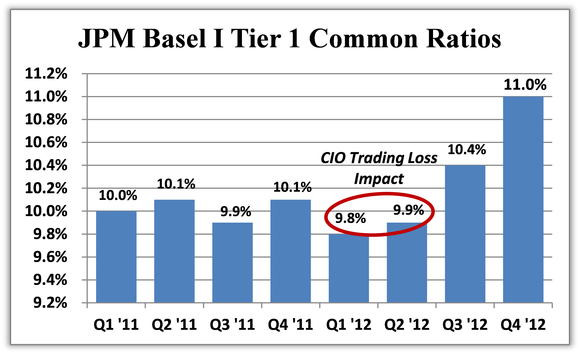
Despite the embarrassing loss and ongoing inquiries from Congress, few expect tomorrow’s results to highlight any deficiencies in Dimon’s “fortress balance sheet.” Continual improvement across wholesale and credit card loan portfolios has allowed JPMorgan, along with its peers, to consistently improve capital ratios throughout the year.

The results set to be released tomorrow are based on how the institution would fare under the adverse scenario based on its current capital deployment plan. While investors will surely use these stress tests results as a proxy for a relatively consistent snapshot-comparison across banks, forward-looking shareholders will undoubtedly be placing a greater emphasis on the Fed’s release of the Comprehensive Capital Analysis and Review (CCAR) results next Thursday, the 14th. Banks’ submissions for the CCAR incorporated planned strategies to return capital to shareholders. As a forward-looking mechanism, the market responds to future strategy changes. Following Dimon‘s declaration of increases in dividend payouts and share repurchases in March 2012, shares of JPMorgan climbed higher.

Comparing the two above graphs, the market has shown the tendency to value the bank in line with its capital strength. When capital ratios have weakened, share price has followed suit.

Back and ready for more
Although events in 2012 undoubtedly damaged the reputation of both Dimon and his management team, they have attacked the situation proactively and realigned the bank to …read more
Source: FULL ARTICLE at DailyFinance

There's No Reason to Stress About Wells Fargo

By John Maxfield, The Motley Fool

Filed under:

If you invest in banks, you probably already know that the Federal Reserve releases the results of the 2013 stress tests tomorrow. As I discussed earlier today when noting that Bank of America will likely pass the test with flying colors, how banks perform during this stage in their annual regulatory cycle largely dictates whether or not they’ll be able to increase the amount of capital they return to shareholders via dividends and/or share buybacks for the remainder of the year. This is why the stress tests are so important.

That being said, with respect to at least some banks, the term “stress test” is a bit of a misnomer. In other words, there’s little question that certain banks will sail through the process without anything to worry about. If the title of this article didn’t already give it away, Wells Fargo , the nation’s fourth largest bank by assets, is one such bank.

A brief introduction to stress tests
As I discussed earlier:

In the wake of the financial crisis, Congress enacted the Dodd-Frank Act, which requires the Federal Reserve to conduct stress tests of banks and other financial concerns with assets in excess of $50 billion. The purpose is to evaluate whether these so-called too-big-to-fail institutions have, as the Fed describes it, “sufficient capital, on a total consolidated basis, to absorb losses as a result of adverse economic conditions.”

The process seeks to simulate the impact on a bank’s regulatory capital levels under three hypothetical and increasingly severe economic scenarios. The most arduous assumes that real GDP declines an average of 4% this year, the unemployment rate ticks up to 12.1% in the second quarter of next year, and that home prices fall by more than 20% by the end of 2014. Suffice it to say, this is an extreme case. As the Fed notes, at least with respect to unemployment, the designated rate remains “above any level experienced over the last 70 years” — that is, since the Great Depression.

When subjected to a similar set of assumptions last year, the vast majority of banks passed the test with ease. In Wells Fargo‘s case, its Tier 1 common capital ratio fell from 9.34% of risk-weighted assets down to 6.6%, well in excess of the required 5% rate. As you can see here, this placed it in the middle of its peer group, or 8th out of the 19 banks tested. While it was the best-performing of the four so-called too-big-to-fail banks, it was beaten out by American Express, the custodial banks State Street and Bank of New York Mellon, and a smattering of regional lenders including Fifth Third Bancorp , U.S. Bancorp , and BB&T . The latter three, for instance, ended up with Tier 1 common capital ratios of 7.7%, 7.7%, and 7.3%, respectively.

Given that Wells Fargo‘s capital levels have since increased, it seems safe to assume that it’ll sail past the tests …read more
Source: FULL ARTICLE at DailyFinance

Bank Investors: No Need to Stress Out Yet

By Matt Koppenheffer and David Hanson, The Motley Fool

Filed under:

The results from the new banking stress test put in place by the Dodd-Frank Act will be coming out on March 7, with Bank of America , BB&T Regions Financial , Wells Fargo , and JPMorgan Chase  as several of the large banks likely participating. In this video, Motley Fool financial analysts Matt Koppenheffer and David Hanson discuss what to look for from the test results, and how banking investors should react. 

Bank of America’s stock doubled in 2012. Is there more yet to come? With significant challenges still ahead, it’s critical to have a solid understanding of this megabank before adding it to your portfolio. In The Motley Fool‘s premium research report on B of A, analysts Anand Chokkavelu, CFA, and Matt Koppenheffer, Financials bureau chief, lift the veil on the bank’s operations, including detailing three reasons to buy and three reasons to sell. Click here now to claim your copy, and as an added bonus, you’ll receive a full year of FREE updates and expert guidance as key news breaks.

var FoolAnalyticsData = FoolAnalyticsData || []; FoolAnalyticsData.push({ eventType: “TickerReportPitch”, contentByline: “Matt Koppenheffer and David Hanson”, contentId: “cms.21508”, contentTickers: “NYSE:BAC, NYSE:JPM, NYSE:WFC, NYSE:RF, NYSE:BBT”, contentTitle: “Bank Investors: No Need to Stress Out Yet”, hasVideo: “True”, pitchId: “29”, …read more
Source: FULL ARTICLE at DailyFinance