Tag Archives: Capital One

Will Schwab's Recent Moves Pay Off?

By Dan Caplinger, The Motley Fool

Filed under:

Earnings season has begun, and next Monday, Charles Schwab will release its latest quarterly results. The key to making smart investment decisions on stocks reporting earnings is to anticipate how they’ll do before they announce results, leaving you fully prepared to respond quickly to whatever inevitable surprises arise. That way, you’ll be less likely to make an uninformed kneejerk reaction to news that turns out to be exactly the wrong move.

Schwab has been a longtime leader in the discount brokerage space, taking advantage of the rise of the Internet to offer a wide array of services to customers. Yet the market meltdown hurt its core business in several ways, and the company has had to work hard to recover ever since. Let’s take an early look at what’s been happening with Schwab over the past quarter and what we’re likely to see in its quarterly report.

Stats on Schwab

Analyst EPS Estimate

$0.16

Change From Year-Ago EPS

6.7%

Revenue Estimate

$1.27 billion

Change From Year-Ago Revenue

6.5%

Earnings Beats in Past 4 Quarters

2

Source: Yahoo! Finance.

Will Schwab benefit from market records this quarter?
Analysts have had mixed views on Schwab’s earnings lately. In the past month, they’ve cut their consensus for the just-ended quarter by $0.01 per share, but they boosted their full-year 2013 calls by a penny per share as well. Investors have gotten more optimistic lately, with the stock up 13% since early January.

Schwab has done its best to capitalize on increased interest in investing in light of the big run-up in the stock market. In January, the company topped $2 trillion in total client assets for the first time ever, and as of February, it had seen a 13% jump in assets. Yet trading activity remains muted, with just a 1% year-over-year increase in daily average trades.

In order to encourage greater investor participation, Schwab recently boosted its presence in the red-hot exchange-traded fund market. Schwab pioneered commission-free ETF investing more than three years ago, but since then, rivals had cut into Schwab’s minimalist lineup of proprietary ETFs with broader deals. TD AMERITRADE  had issued a lineup of more than 100 no-commission ETFs from various fund families, drawing investors interested in greater variety of funds. In response, Schwab came out with its ETF OneSource platform, topping TD Ameritrade with 105 ETFs.

The big potential for Schwab lies in going after 401(k) accounts. Currently, mutual funds dominate 401(k) plan investment options, but ETFs are making inroads into the multitrillion-dollar industry. Despite existing competition from TD AMERITRADE and Capital One‘s ShareBuilder — and with Fidelity’s recent expansion of its ETF partnership with BlackRock‘s iShares unit signaling another potential entrant to the space — Schwab’s plans to launch an all-ETF 401(k) plan next year could tap a larger part of a lucrative market.

In Schwab’s quarterly report, look for more

From: http://www.dailyfinance.com/2013/04/11/will-schwabs-recent-moves-pay-off/

American Apparel Successfully Completes Refinancing of Secured Debt

By Business Wirevia The Motley Fool

Filed under:

American Apparel Successfully Completes Refinancing of Secured Debt

LOS ANGELES–(BUSINESS WIRE)– American Apparel, Inc. (NYSE MKT:APP), a vertically integrated manufacturer, distributor, and retailer of branded fashion basic apparel, today announced that it has successfully closed a private offering of $206 million principal amount of its 13% senior secured notes due 2020 and has entered into a new $35 million five-year asset-backed revolving credit facility with Capital One Bank. The Company used the net proceeds from the offering of the notes, together with borrowings under the new revolving credit facility, to repay in full and terminate its prior credit facilities with Lion Capital, LLC and Crystal Financial LLC.

“Our new debt arrangements, coupled with improved financial performance, will provide added flexibility in delivering upon our operating plan for 2013 and beyond,” said Dov Charney, American Apparel‘s chairman and chief executive officer. “We appreciate the vote of confidence from Capital One and the purchasers of the notes and the completion of this financing effort will allow us to further focus our efforts in driving profitability for the benefit of all of our stakeholders.

“I would like to personally thank Lyndon Lea of Lion Capital for his unwavered support as a lender during the last four years, even when others doubted American Apparel‘s ‘Made in USA‘ sweatshop-free mission,” stated Mr. Charney. “Also a special thank you is due to Michael Serruya and to Andy De Francesco of Delavaco Capital, Inc. in Toronto, for their initial investment which came at a critical time in 2011, and their continued support and friendship. At American Apparel we are focused on leveraging art, design and innovation to advance our business process, rather than relentlessly pursuing off shore cheap labor. We welcome bondholders to our family of stakeholders, and re-emphasize that it is our mission to ensure that all stakeholders—customers, workers, shareholders, suppliers, and now bondholders—have a positive experience when touched by our business. We also welcome Capital One as our new bank, under our new five year agreement with them, which will greatly reduce our first lien borrowing costs. At this juncture it’s time to roll up our sleeves and build American Apparel‘s future.”

Capital One Bank is pleased to work with American Apparel, a leading manufacturer, distributor, and retailer of branded fashion basic apparel, to support the company’s recapitalization and growth strategy,” said Michael Burns, Senior Vice President and Asset Based Lending Regional Manager, Capital One Bank. “We look forward to building our relationship with American Apparel to help position the company for continued market leadership, growth and success.”

…read more

Source: FULL ARTICLE at DailyFinance

ATM Viruses Are Out to Steal Your Cash

By Credit.com

Filed under: , ,

Eliot J. Schechter/ Bloomberg News

By Credit.com Staff

These days, consumers are often on the lookout for identity theft scams that may end up compromising many aspects of their finances, but now criminals are doing even more to rip them off, including targeting their banks with malicious software.

A new type of malware that targets point-of-sale systems and ATM card readers known as “Dump Memory Grabber” scans those devices for payment card data and is beginning to infect a large number of the nation’s largest banks, according to a report from SecurityWeek. The list of victims of this new software already includes Chase, Capital One, and Citibank, as well as Union Bank of California. In addition, it seems possible that store-branded credit cards may have also been compromised, because a video of the malware in action, which was posted to a Russian hacker forum, showed a number of Nordstrom’s cards potentially having been exposed.

The malware itself collects data stored in a card reader’s log files, filters the data quickly for credit card information, and then compiles all of it to a simple text file, the report said. That file can in turn be set to download straight to a hacker’s server, or even be sent via email.

Sponsored Linksadsonar_placementId=1505951;adsonar_pid=1990767;adsonar_ps=-1;adsonar_zw=242;adsonar_zh=252;adsonar_jv=’ads.tw.adsonar.com’;

Information gathered about the creator of the Dump Memory Grabber malware seems to indicate that he is well-known in the Russian hacking community and has been involved with a large cybercriminal collective – potentially as its administrator – that engages in this type of activity, as well as attacks against a number of well-known security entities, the report said. Further, at least several of the group’s members are also active in Anonymous, and most are younger than 23 years old.

This is certainly not the first type of malware targeted directly at point of sale card readers and ATMs in the last few months, as a program known as “Dexter” may have recently stolen as many as 80,000 credit card numbers from Subway restaurants in 2012, the report said. In all, 42 percent of Dexter infections worldwide were located in the U.S.

The best way consumers can make sure they are not affected by these scams is to pay with cash whenever possible, and also keep close tabs on their financial documents for any suspicious charges that they may not recognize. These may be a sign that an account has been compromised.

More from Credit.com:

%Gallery-184402%

Permalink | Email this | Linking Blogs | <a target=_blank href="http://www.dailyfinance.com/2013/04/01/atm-virus-cybercrime-identity-theft/#comments" title="View …read more
Source: FULL ARTICLE at DailyFinance

Capital One Financial Corporation to Webcast Conference Call on First Quarter 2013 Earnings

By Business Wirevia The Motley Fool

Filed under:

Capital One Financial Corporation to Webcast Conference Call on First Quarter 2013 Earnings

MCLEAN, Va.–(BUSINESS WIRE)– On Thursday, April 18, 2013, at approximately 4:05 p.m. Eastern time, Capital One Financial Corporation (NYS: COF) will release its First Quarter 2013 earnings results. Additionally, the company will host a conference call at 5:00 p.m. Eastern time to review financial and operating performance for the quarter ending March 31, 2013.

The call will be webcast live and the earnings release will be available on the company’s homepage at www.capitalone.com. A replay of the webcast will be available 24 hours a day, beginning 2 hours after the conference call, until 5:00 p.m. Eastern time on May 2, 2013, through the company’s homepage.

About Capital One

Capital One Financial Corporation (www.capitalone.com) is a financial holding company whose subsidiaries, which include Capital One, N.A., and Capital One Bank (USA), N.A., had $212.5 billion in deposits and $312.9 billion in total assets outstanding as of December 31, 2012. Headquartered in McLean, Virginia, Capital One offers a broad spectrum of financial products and services to consumers, small businesses and commercial clients through a variety of channels. Capital One, N.A. has more than 900 branch locations primarily in New York, New Jersey, Texas, Louisiana, Maryland, Virginia and the District of Columbia. A Fortune 500 company, Capital One trades on the New York Stock Exchange under the symbol “COF” and is included in the S&P 100 index.

Capital One Financial Corporation
Investor Relations
Jeff Norris, 703-720-2455
or
Danielle Dietz, 703-720-2455
or
Media Relations
Tatiana Stead, 703-720-2352
or
Julie Rakes, 804-284-5800

KEYWORDS:   United States  North America  Virginia

INDUSTRY KEYWORDS:

The article Capital One Financial Corporation to Webcast Conference Call on First Quarter 2013 Earnings originally appeared on Fool.com.

Try any of our Foolish newsletter services free for 30 days. We Fools may not all hold the same opinions, but we all believe that considering a diverse range of insights makes us better investors. The Motley Fool has a disclosure policy.

Copyright © 1995 – 2013 The Motley Fool, LLC. All rights reserved. The Motley Fool has a disclosure policy.

…read more
Source: FULL ARTICLE at DailyFinance

Which Brand Will Win The 2013 NCAA Tournament?

By Darren Heitner, Contributor

There are three NCAA Corporate Champions sponsors: Capital One, Coca-Cola and AT&T.  Each use their status to infiltrate their target markets through the NCAA Tournament, hoping to capitalize off of an enhanced ability to access and reach the potential consumer and use NCAA logos, marks and designations in the process.  As FORBES highlighted last week, Capital One has gone all-in on its television and digital campaign using Alec Baldwin and Charles Barkley as spokespersons, along with an emphasis on its Twitter hashtag, #rallycry.  It hopes that its campaign will push Capital One to first place among brands participating in the NCAA Tournament. …read more
Source: FULL ARTICLE at Forbes Latest

BankUnited Announces Leadership Team in New York

By Business Wirevia The Motley Fool

Filed under:

BankUnited Announces Leadership Team in New York

Former Capital One, North Fork Execs Join BankUnited

MIAMI LAKES, Fla.–(BUSINESS WIRE)– BankUnited today announced the hiring of a top executive to head New York banking operations, as well as its team leader of commercial private banking in New York, according to Chairman, President and CEO John Kanas.

Joe Roberto, president of New York banking operations and senior executive vice president of BankUnited. (Photo: Business Wire)

Joe Roberto will serve as president of New York banking operations and senior executive vice president of BankUnited. Roberto held leadership positions at North Fork Bank for eight years before the bank was acquired by Capital One. Most recently he was responsible for the management of Capital One‘s New York City deposit portfolio as senior vice president. In addition, Roberto had seven commercial real estate teams reporting to him in the New York, Boston, Mid-Atlantic and South-Central markets.

Roberto is a founding board member of the Huntington/East Farmingdale Chamber of Commerce and has chaired or served on committees for AHRC-Suffolk County, Southampton Youth Services, Brookhaven Memorial Hospital, Great South Bay YMCA, Special Olympics, United Cerebral Palsy, American Cancer Society, American Heart Association, and Long Island Hispanic Chamber of Commerce. He was awarded the Distinguished Citizen Award by the 23rd Street Association in 2007 for outstanding community service. Roberto currently serves as a community board member at North Shore LIJ-South Side Hospital in Bay Shore. He is a graduate of Long Island University – C.W. Post Campus and resides with his family in Bay Shore, NY.

Kelly Sheehan joins BankUnited from Capital One, and will serve as team leader of commercial private banking in New York and senior vice president. Sheehan has worked in retail and commercial banking for the past 10 years, most recently as senior vice president of Capital One‘s commercial real estate group. She was responsible for managing a team of eight professionals providing cash management solutions to some of New York City’s largest real estate owners. Sheehan began her career with North Fork Bank in 2002. She earned a bachelor’s degree in business management from Quinnipiac University in Hamden, Connecticut.


About …read more
Source: FULL ARTICLE at DailyFinance

Capital One's March Madness Campaign Banks On Baldwin, Barkley And Hashtags

By Darren Heitner, Contributor

Capital One, the official banking and credit card of NCAA, has long been heavily invested in college sports.  It organizes the annual Capital One Cup, which recognizes the best in college sports and awards $400,00 in student-athlete scholarships, and is one of three corporations with the unique distinction of being an NCAACorporate Champion.”  As a result of attaining its status as a Corporate Champion (along with AT&T and Coca-Cola), Capital One is granted with certain category exclusivity in the use of NCAA logos, marks and designations.  Capital One will take advantage of its special status with the NCAA over the coming weeks, and will be highly visible to consumers who turn in to the compelling NCAA Tournament.  It hopes that its message is memorable, and has come to agreements with Alec Baldwin and Charles Barkley in an effort to create lasting brand impressions. …read more
Source: FULL ARTICLE at Forbes Latest

Federal Reserve Approves Huge Increase in Capital One's Dividend

By John Maxfield, The Motley Fool

Filed under:

To say it’s been a busy two weeks for banks would be an understatement. At the end of last week, the Federal Reserve released the results of this year’s stress tests, which are designed to determine whether the nation’s 18 largest banks have enough capital to survive a severe economic downturn akin to the financial crisis. On the heels of that, the central bank announced yesterday which of these lending giants would be allowed to increase the amount of capital they return to shareholders via dividends and/or share buybacks.

For most of the nation’s banks, the news was relatively positive. With regard to the stress tests, 17 of the 18 banks made it through the Fed’s “severely adverse” economic gauntlet in one piece — Capital One Financial being among them. In addition, many of these same institutions had their requested capital plans for the upcoming year approved as well — Capital One, again, being among the banks to obtain permission. The two most notable exceptions in this regard were the auto-lending giant Ally Financial and Winston-Salem, North Carolina-based BB&Tclick here to learn why BB&T’s request was denied.

In Capital One‘s case, this translates into a six-fold increase in the company’s dividend. As it noted in a press release shortly after the CCAR results were announced: “Capital One’s submission included a planned increase in the quarterly dividend on its common stock from the current level of $0.05 per share to $0.30 per share.” Once implemented, the move will ratchet up the yield on Capital One‘s common stock to 2.2% from 0.4% now.

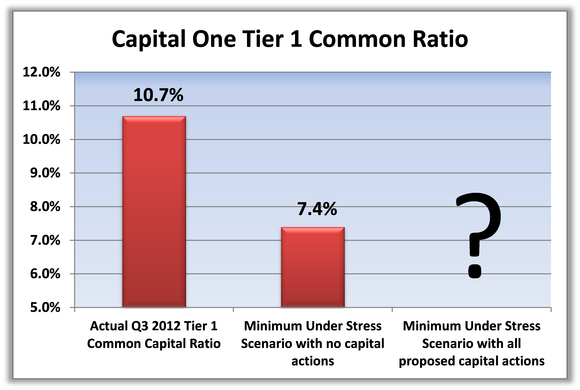
Equally encouraging from the perspective of an investor in Capital One is how well its capital base held up under the hypothetical stressed scenarios, both with the aforementioned capital return included and without it. As you can see in the figure below, going into last week’s stress tests, the bank had a Basel I tier 1 common capital ratio of 10.7% at the end of the third quarter of 2012. This was worse than the 18-bank average of 11.1%, but nevertheless better than many of its regional competitors. For instance, the analogous ratios at SunTrust Banks , Fifth Third Bancorp , and PNC Financial came in at 9.8%, 9.7%, and 9.5%, respectively.

Source: Comprehensive Capital Analysis and Review 2013: Assessment Framework and Results.

While this base eroded by 330 basis points to 7.4% after the Fed’s apocalyptic economic assumptions were factored into the equation, and a further 70 basis points once the now-approved dividend increase was included, the resulting 6.7% was still comfortably in excess of the 5% regulatory minimum. This is particularly impressive when you consider the size of Capital One‘s credit card portfolio — which by their nature are typically riskier than other types of loan holdings.

Following this news, shares of the McLean, Virginia-based bank are trading up by nearly 1%, outperforming …read more
Source: FULL ARTICLE at DailyFinance

Will Capital One Increase Its Dividend?

By David Hanson, The Motley Fool

Filed under:

Last week, the Federal Reserve released the first part of the annual banking stress test results, which examined the impact of a severe economic downturn on the largest U.S. banks. While it did not stand out as one of the strongest participants during last year’s stress tests, Capital One posted improved and fairly solid results. The results highlighted the bank’s relatively robust credit card portfolio and its ability to weather a global economic downturn.

How it fared last week
In addition to posting a higher actual Tier 1 common ratio in Q3 in 2012 compared to 2011, Capital One posted an improved minimum Tier 1 common ratio of 7.4% under the severely adverse scenario. During the previous year’s tests, Capital One‘s minimum Tier 1 common in the doom-and-gloom scenario was 7.2%. One of the main drivers of Capital One‘s enhanced outlook was the less-severe U.S.-based stress scenario, compared to last year’s tests.

These stronger results have driven investors to tune into the Comprehensive Capital Analysis and Review results, which will be released on Thursday afternoon. Within this release from the Fed, investors will know if the participating banks sought and received approval for any increases in dividends or share buyback programs. Investors will also get to see the impact of any new capital plans on stressed ratios.

Source: Dodd-Frank Act Stress Test 2013: Supervisory stress Test Methodology and Results.

Should Capital One finally request a bump?
Last year, Capital One did not request approval for any increase in quarterly dividend payment or initiation of any share repurchase program. The bank has not increased its quarterly dividend of $0.05 since the onset of the financial crisis. Given the marginal improvement of its capital ratios under a stressed scenario, Capital One does not seem to have ample leverage in negotiating any additional actions to return more cash to shareholders.

Will shareholders get anything?
While it seems that Capital One is on the right path to increase its dividend, I believe investors may want to temper their expectations. If the Fed and the bank cannot agree on a dividend increase, Capital One may request to ramp up share repurchases. With the bank’s shares are trading at a 20% discount to book value, initiating a share repurchase may be the preferred capital action plan to generate additional value for shareholders. Therefore, I expect Capital One to ask and receive approval for a small share buyback program.

Bank of America is also a major player in the credit card business. With significant challenges still ahead, it’s critical to have a solid understanding of this megabank before adding it to your portfolio. In The Motley Fool’s premium research report on B of A, analysts Anand Chokkavelu, CFA, and Matt Koppenheffer, Financials bureau chief, lift the veil on the bank’s operations, including detailing three reasons to buy and three reasons to sell. Click here now to claim your copy.

…read more
Source: FULL ARTICLE at DailyFinance

Will American Express Hike Its Dividend?

By Amanda Alix, The Motley Fool

Filed under:

Stress-test results have been saturating the media this week as the big banks show off their hearty capital reserves and ability to withstand an economic pseudo-armageddon. Though this was the third annual test, the Fed added some of Dodd-Frank’s regulations into the mix, prompting the announcement of the first phase, the stress test, on March 7 — to be followed by the Comprehensive Capital Analysis and Review results this Thursday.

Although banks — particularly big banks — have been the focus of media attention, any entity considered a bank holding company is subject to this yearly scrutiny. Two institutions that fit this description are Capital One Financial and American Express , though both are often thought of as primarily credit card issuers. Both of these companies passed the recent stress test easily, though American Express bested Capital One‘s 7.4% projected minimum Tier 1 common ratio with an 11.1% post-severely adverse-scenario capital cushion.

Source: Dodd-Frank Act Stress Test 2013: Supervisory Stress Test Methodology and Results.

Should American Express ask for a dividend increase or share buyback?
With such an impressive showing on the stress test, it seems almost certain that American Express will request — and will be allowed to bestow — a larger dividend, as well as institute a share buyback program. Indeed, only the two large custody banks, Bank of New York Mellon and State Street had higher common ratios than American Express. Considering that big regional bank BB&T , which analysts had pegged as one of the more highly capitalized institutions, scored a 9.4% ratio, AmEx’s results are all the more impressive.

Following the stress test last year, AmEx embarked upon a share repurchase program to the tune of $4 billion in 2012, reserving another $1 billion in buybacks for the current quarter. The company also announced a boost in the quarterly dividend to $0.20 from $0.18 per share.

How much will AmEx share with investors?
Will American Express be a little more generous this year? It certainly seems like it could afford to be. The company has many irons in the fire, and has recently begun exploring the social media side of credit card purchasing through a new deal with Twitter. As Fool analyst Dan Caplinger has noted, the company could easily bump up that payout quite a bit without feeling a pinch.

Certainly, with such a stellar financial checkup under its belt, AmEx could afford to be magnanimous with its investors — provided it stays under the Fed’s comfort level of less than 30% of estimated after-tax net income. Soon, we’ll know just how benevolent they plan to be.

With big finance firms still trading at deep discounts to their historic norms, investors everywhere are wondering if this is the new normal, or if finance stocks are a screaming buy today. The answer depends on the company, so to help you figure out whether BB&T should be …read more
Source: FULL ARTICLE at DailyFinance

Capital One Clears Fed-Administered Stress Test

By John Maxfield, The Motley Fool

Filed under:

Yesterday, the Federal Reserve released the results from its most recent round of stress tests. For investors in Capital One , its performance demonstrated the lender’s ability to sustain adequate capital levels in the face of an extreme economic shock. The charts and discussion below examine how the company’s capital and earnings held up under the Fed’s “severely adverse” economic scenario.

The purpose of the stress tests is to gauge how the capital bases of the nation’s largest financial institutions hold up in the face of economic and financial turmoil. Among other things, the most extreme case assumes that real GDP declines an average of 4% this year, unemployment ratchets up to 12.1% by the second quarter of next year, and that home prices plummet by 20% over the next 24 months.

As you can see in the chart below, Capital One‘s Tier 1 common capital ratio held up well in light of these assumptions. Starting from 10.7% at the end of last September, it bottomed out at 7.4% over the hypothetical time period extending from the fourth quarter of last year through the end of 2014. While that equates to a 31% decline, the ending figure nevertheless comfortably exceeded the Fed’s 5% reference rate. By comparison, the average Tier 1 common capital ratio of the 18 institutions tested fell by a third, down to 7.4% — almost exactly as Capital One did.

Source: Federal Reserve.

With respect to net income, the regional lender and credit card giant fared even better on a relative basis. Its hypothetical pre-tax loss for the nine-quarter time period came in at $8 billion, beating out the 18-institution average loss of $10.8 billion. The worst performing financial institution in this regard was Bank of America, with a whopping $51.8 billion in estimated losses. Conversely, the Bank of New York Mellon fared the best, with $5.5 billion in positive earnings despite the assumed economic Armageddon.

Source: Federal Reserve.

Breaking this down a bit further, as you can see in the figure above, Capital One‘s $18.7 billion in pre-provision net revenue was more than consumed by loan loss provisions — that is, money set aside to cover future losses from soured loans. These accounted for $26.4 billion in losses. Estimated losses from securities added another $300 million.

And digging into the loan losses specifically, it should be no surprise that the lion’s share, or 70% of Capital One‘s hypothetically soured loans derived from its credit card operations. Roughly 20% of the remaining losses were associated with its non-credit card consumer loan portfolio, and the final 10% were related to commercial borrowers.

Source: Federal Reserve.

At the end of the day, the stress tests are meant to do exactly what the name implies: stress you out. And while this year is no exception, investors in Capital One can rest easy thanks to its more-than-abundant capital base. The question …read more
Source: FULL ARTICLE at DailyFinance

Saving, Spending, Investing: New Games Teach Kids About Money

By CNBC

JA Finance Park Virtual

Filed under: , , ,

You scrimped and saved, built a business, managed your growing fortune wisely. Now, according to studies of the super-rich and the merely wealthy alike, you have one overwhelming concern: How do get your well-off children or grandchildren to think more like you?

Relax: Your kids are probably getting these financial lessons of life on the Internet.

A host of digital entrepreneurs, banks and investment firms are building web and mobile platforms that educate youngsters about money-teaching grade-schoolers how to earn and save for things they want, middle-schoolers how to pay rent and college students how to trade stocks.

The trend is known as “gamification” because the learning comes through computer-game simulations of real-world financial events. Children adopt the personas of college grads getting their first apartment, young moms on a tight budget or small business owners. They pay for groceries and clothes, balance checking accounts and save for big-ticket items.

According to financial educators, gamification is designed not only to teach basic concepts but also to start conversations that let parents instill financial values in their offspring-or, often, to catch up with what kind of economic decisions their kids are already making.

“They have money already,” said Eileen Reid, a middle-school family and consumer science teacher in Howard County, Md. “They are getting cellphones and dealing with which plan costs what. They are very aware of their lifestyle.” Their parents are the ones who are uncomfortable talking about money, said Reid, whose own financial upbringing was of the “Do you think money grows on trees?” variety.

In her classroom, Reid uses a computer program called JA Finance Park Virtual, a collaboration of Capital One and the nonprofit organization Junior Achievement, to cement lessons she teaches from the blackboard.

JA Finance Park Virtual

“It’s an eye-opener for them,” she said. “They realize they can’t afford what they want their [virtual] children to have. They want $120 tennis shoes, so they have to figure out how to pay for it.”

Questions about sneakers quickly become discussions about how money represents priorities, Reid said. “What do you value? Is it really important to give to a charity? Should I continue with my education?” she said. “It’s fascinating to watch them come to life when we get to the virtual experience.”

The game, used in 468 schools nationwide, has been part of the curriculum at Maryland schools since 2010, after the financial crisis had made business leaders aware of the widespread ignorance about how mortgages, credit cards and other basic financial instruments work.

JA Finance Park Virtual

“The business community started going to the state legislature and said , ‘We have to get people more literate,’ ” Reid said.

Other parents aren’t waiting for schools to start the conversation.<br …read more
Source: FULL ARTICLE at DailyFinance

This Bull Market Is Over For Capital One

By Zacks.com, Contributor

This might be the right credit card for your wallet, but the stock should be strongly re-evaluated if it’s in your portfolio. Capital One Financial (COF) slipped to a Zacks #5 Rank (Strong Sell) last week after a continued deluge of downward earnings estimate revisions. This is happening in the aftermath of a mixed earnings report that took the stock down sharply last month from its 52-week high. The company reported fourth quarter 2012 earnings of $1.41 per share which significantly lagged the Zacks Consensus Estimate of $1.62. This was a big improvement from the prior-year quarter’s 88 cents, but investors and analysts are still looking for the bright spots. Before we look at some of the details of that report, let’s take a look at the Zacks Price & Consensus chart which gives us a great visual on which way estimates are headed and if price may soon follow. Rising Costs, Fees, and Interest Rates For 2012, Capital One reported earnings of $6.16 per share. This was below the Zacks Consensus Estimate of $6.43 and prior-year earnings of $6.80. Capital One‘s net revenues for the reported quarter stood at $5.62 billion, jumping 38.9% year over year. Yet, revenues were below the Zacks Consensus Estimate of $5.78 billion. Net revenues for 2012 were $21.40 billion, surging 31.4% from $16.28 billion in 2011. Also, revenues were above the Zacks Consensus Estimate of $20.86 billion. Net interest income for the quarter grew 42.3% from the previous-year quarter to $4.53 billion. However, net interest margin decreased 70 basis points (bps) year over year to 6.52%. Non-interest income surged 26.3% from $868 million in the prior-year quarter to $1.10 billion in the reported quarter. The increase was mainly driven by higher service charges and other customer-related fees as well as rise in interchange fees. Special Offer: Stocks recommended in Forbes Dividend Investor are up 12.6% since July 11, 2011, versus 7.3% for the S&P 500.  Click here for a trial subscription with instant access to all picks and the Top 25 portfolio.  Average yield is 5.7%. Capital One‘s operating expenses rose 24.3% from the prior-year quarter to $3.26 billion. The increase was largely attributable to higher salaries and associate benefits costs and merger-related expenses, partially offset by lower marketing expenses. If you are a COF investor, it may be a good time do some further research on what’s going on inside their business. It’s quite possible that analysts see something in rising costs or interest rates, or in the company’s credit quality and delinquencies that is driving this new trend of lowered expectations. Kevin Cook is a Senior Stock Strategist with Zacks.com …read more
Source: FULL ARTICLE at Forbes Latest

Cyber-Attacks Against Banks Continue: Wall Street, We Have A Problemo, Bro

By Derek Klobucher, AdVoice Iran may be behind a massive and sustained campaign of cyber-attacks against numerous Western financial institutions, including Citigroup, Capital One and HSBC, we learned last week. The strikes exploit banks’ Web site encryption, which encode customers’ online transactions to keep them secure, but it also increases traffic volume.
Source: FULL ARTICLE at Forbes Latest

Capital One's more than doubles in 4Q

Capital One Financial Corp. says its fourth-quarter net income grew more than twofold, as revenue for the lender rose by 38 percent from a year earlier.

McLean, Virginia-based Capital One said Thursday that net income rose to $825 million, or $1.41 per share. That compares with $381 million, or 88 cents per share, in the same period a year ago.

Revenue rose to $5.62 billion from $4.05 billion.

The results fell short of Wall Street expectations. Analysts polled by FactSet expected earnings of $1.58 per share on revenue of $5.76 billion.

Capital One shares fell $3.69, or 6 percent, to $57.90 in after-hours trading.

Source: FULL ARTICLE at Fox US News