Tag Archives: Fifth Third

Fifth Third Announces First Quarter 2013 Net Income to Common Shareholders of $413 Million or $0.46

By Business Wirevia The Motley Fool

Filed under:

Fifth Third Announces First Quarter 2013 Net Income to Common Shareholders of $413 Million or $0.46 Per Share

  • 1Q13 net income available to common shareholders of $413 million, or $0.46 per diluted common share, vs. $390 million or $0.43 per share in 4Q12, up 7% and $421 million or $0.45 per share in 1Q12, up 2%
  • 1Q13 results included a benefit of $34 million pre-tax (~$22 million after-tax, or ~$0.02 per share) on the valuation of the warrant Fifth Third holds in Vantiv
    • Significant items in 4Q12 included a positive net pre-tax impact related to Vantiv shares and warrants of $138 million (~$90 million after tax, or ~$0.10 per share) and pre-tax expense for FHLB debt extinguishment of $134 million (~$87 million after-tax, or ~$0.09 per share); significant 1Q12 items included a positive net pre-tax impact related to Vantiv shares and warrants of $127 million (~$83 million after-tax, or ~$0.09 per share)
    • Excluding these items, earnings per diluted common share of $0.44^ increased $0.08, or 22%, from 1Q12
  • 1Q13 return on assets (ROA) of 1.41%; return on average common equity of 12.5%; return on average tangible common equity** of 15.4%
  • Pre-provision net revenue (PPNR)** of $653 million in 1Q13
    • Net interest income (FTE) of $893 million, down 1% sequentially due primarily to lower day count; net interest margin 3.42%; average portfolio loans up 2% sequentially driven by 6% sequential growth in C&I loans
    • Noninterest income of $743 million included $34 million gain on Vantiv warrant and $17 million in investment securities gains; compared with $880 million in prior quarter which included net gains of $138 million related to Vantiv shares and warrant
    • Noninterest expense of $978 million, down 16% from 4Q12 which included FHLB debt termination charge
  • 1Q13 effective tax rate of 30.4% compared with 26.8% in 4Q12 and 28.6% in 1Q12; 1Q13 income taxes included seasonal increase of $12 million related to expiration of stock options; 4Q12 income taxes included $10 million benefit from the termination of certain leases
  • Credit trends remain favorable
    • 1Q13 net charge-offs of $133 million (0.63% of loans and leases) vs. 4Q12 NCOs of $147 million and 1Q12 NCOs of $220 million; lowest NCO level since 2Q07; 1Q13 provision expense of $62 million compared with 4Q12 provision of $76 million and 1Q12 provision of $91 million
    • Loan loss allowance decreased $71 million sequentially reflecting continued improvement in credit trends; allowance to loan ratio of 2.08%, 147% of nonperforming assets, 187% of nonperforming loans and leases, and

      From: http://www.dailyfinance.com/2013/04/18/fifth-third-announces-first-quarter-2013-net-incom/

9 Critical Numbers About Fifth Third Bancorp

By John Maxfield, The Motley Fool

Filed under:

Given that you clicked on this article, it seems safe to assume you either own shares of Fifth Third Bancorp or are considering buying them in the near future. If so, then you’ve come to the right place. The table below reveals the nine most critical numbers that investors need to know about Fifth Third before deciding whether to buy, sell, or hold its stock.

But before getting to that, a brief introduction is in order. Tracing its roots back to pre-Civil War Ohio, Fifth Third has since transformed into one of the nation’s largest regional banks. Based in Cincinnati, it operates more than 1,325 full-service banking centers branches across 12 predominantly Midwestern states. As of the end of 2012, it had $122 billion of assets on its balance sheet, ranking it in size between Georgia’s SunTrust Banks at $173 billion and Birmingham, Alabama’s Regions Financial at $121 billion.

As you can see in the table above, Fifth Third outperforms the industry average on a number of fronts. Among other things, its non-performing loan ratio is 62 basis points less than the average and its efficiency ratio — of which a lower number is preferable — beat its typical competitor by nine percentage points. In addition, it’s less leveraged than most of its competitors, and the bank’s return on equity is considerably higher than the industry at 11.7% for the final quarter of 2012.

Alternatively, Fifth Third‘s primary weaknesses are its below-average net interest margin and its similarly substandard dividend payout ratio. With respect to the former, its 3.55% margin is a non-negligible 15 basis points less than the industry’s 3.7%. And with respect to the latter, Fifth Third only pays out roughly a fifth of its earnings to shareholders via dividends — though, it’s important to note here that the company’s board will vote in June on whether or not to increase its quarterly payout after getting approval to do so from the Federal Reserve in the middle of March.

Invest in Warren Buffett’s favorite bank stock
Many investors are scared about investing in big banking stocks after the crash, but the sector has one notable stand out. In a sea of mismanaged and dangerous peers, it rises above as “The Only Big Bank Built to Last.” You can uncover the top pick that Warren Buffett loves in The Motley Fool’s new report. It’s free, so click here to access it now.

The article 9 Critical Numbers About Fifth Third Bancorp originally appeared on Fool.com.


John Maxfield has no position in any stocks mentioned. The Motley Fool owns shares of Fifth Third Bancorp. Try any of our Foolish newsletter services free for 30 days. We Fools may not all hold the same opinions, but we all believe that considering a diverse range of insights …read more
Source: FULL ARTICLE at DailyFinance

Fifth Third Bancorp Announces Ten Percent Increase in Quarterly Cash Dividend on its Common Stock

By Business Wirevia The Motley Fool

Filed under:

Fifth Third Bancorp Announces Ten Percent Increase in Quarterly Cash Dividend on its Common Stock


Board Increases Share Repurchase Authorization to 100 million shares

CINCINNATI–(BUSINESS WIRE)– Fifth Third Bancorp (NAS: FITB) today declared a cash dividend on its common shares of $0.11 for the first quarter of 2013. The dividend is payable on Thursday, April 18, 2013 to shareholders of record as of Friday, March 29, 2013. This dividend is consistent with Fifth Third‘s proposed potential dividends as submitted to the Federal Reserve in its 2012 Comprehensive Capital Analysis & Review (“CCAR“) plan for the CCAR process covering the period ending March 31, 2013.

Fifth Third‘s 2013 CCAR plan included the potential increase in the quarterly dividend to $0.12 per share in the second quarter of 2013 through the first quarter of 2014. As noted last week, Fifth Third‘s Board will consider the potential to increase the dividend under the 2013 CCAR process at its scheduled quarterly meeting in June.

Fifth Third also announced that its Board of Directors approved a new share repurchase authorization of up to 100 million shares, which replaces the previous authorization from 2012 under which approximately 54 million shares remain. Fifth Third‘s capital plan included potential common share repurchases of up to $984 million through the first quarter of 2014, in addition to any incremental repurchases related to any after-tax gains from the sale of Vantiv, Inc. (“Vantiv”) stock.

Any capital distributions, including those contemplated in the above announced actions, are subject to evaluation and approval by the Board of Directors at any given time, Fifth Third‘s performance, the state of the economic environment, market conditions, regulatory factors, and other risks and uncertainties. Fifth Third has no current information and makes no representations as to whether, when or in what amounts there may be future gains from the sale of Vantiv stock. The new repurchase authorization does not have an expiration date, does not include specific price targets, may be executed through open market purchases or one or more private negotiated transactions, including Rule 10b5-1 programs, and may be suspended at any time.

Fifth Third Bancorp is a diversified financial services company headquartered in Cincinnati, Ohio. The Company has $122 billion in assets and operates 18 affiliates with 1,320 full-service Banking Centers, including 104 Bank Mart® locations …read more
Source: FULL ARTICLE at DailyFinance

Fifth Third Bancorp to Announce First Quarter 2013 Results, Host Conference Call on Thursday, April

By Business Wirevia The Motley Fool

Filed under:

Fifth Third Bancorp to Announce First Quarter 2013 Results, Host Conference Call on Thursday, April 18, 2013 at 9:30 AM

CINCINNATI–(BUSINESS WIRE)– Fifth Third Bancorp (NAS: FITB) is scheduled to report first quarter 2013 financial results on Thursday, April 18, 2013. The announcement will be available at www.53.com at approximately 6:30 AM ET. The Company will host a conference call at 9:30 AM ET to discuss results.

This conference call will be webcast live by Thomson Financial and may be accessed through the Fifth Third Investor Relations website at www.53.com (click on “About Fifth Third” then “Investor Relations”). The webcast also is being distributed over Thomson Financial‘s Investor Distribution Network to both institutional and individual investors. Individual investors can listen to the call through Thomson Financial‘s individual investor center at www.earnings.com or by visiting any of the investor sites in Thomson Financial‘s Individual Investor Network. Institutional investors can access the call via Thomson Financial‘s password-protected event management site, StreetEvents (www.streetevents.com).

Those unable to listen to the live call may access a webcast replay through the Fifth Third Investor Relations website. Additionally, a telephone replay of the conference call will be available until approximately Thursday, May 2, 2013 by dialing (800) 585-8367 for domestic access or (404) 537-3406 for international access (passcode 24633234#).

Fifth Third Bancorp is a diversified financial services company headquartered in Cincinnati, Ohio. The Company has $122 billion in assets and operates 18 affiliates with 1,321 full-service Banking Centers, including 104 Bank Mart® locations open seven days a week inside select grocery stores and 2,413 ATMs in Ohio, Kentucky, Indiana, Michigan, Illinois, Florida, Tennessee, West Virginia, Pennsylvania, Missouri, Georgia and North Carolina. Fifth Third operates four main businesses: Commercial Banking, Branch Banking, Consumer Lending, and Investment Advisors. Fifth Third also has a 33% interest in Vantiv Holding, LLC. Fifth Third is among the largest money managers in the Midwest and, as of December 31, 2012, had $308 billion in assets under care, of which it managed $27 billion for individuals, corporations and not-for-profit organizations. Investor information and press releases can be viewed at www.53.com. Fifth Third‘s common stock is traded on the NASDAQ® National Global Select Market under the symbol “FITB.”

Fifth Third Bancorp
Jim Eglseder (Investors), 513-534-8424
Debra DeCourcy, APR (Media), 513-534-4153

KEYWORDS:   United States  North America  Ohio

INDUSTRY KEYWORDS:

…read more
Source: FULL ARTICLE at DailyFinance

The Federal Reserve Weighs In: Which Banks Can Pay Bigger Dividends?

By Matt Koppenheffer, The Motley Fool

Filed under:

This time last week, bank investors were reveling in the results of the Dodd-Frank stress tests, which showed that most major U.S. banks have solid, recession-resistant balance sheets. This week, the Federal Reserve took the stress testing process to the next level and evaluated which banks can proceed with their capital plans.

While the specifics of the individual banks’ capital plans can vary considerably, what most investors are focused on is the banks’ requests to pay higher dividends and launch share buyback plans. 

Citigroup  ruined much of the suspense last week when it pre-emptively announced that it wouldn’t be seeking a higher dividend, but would ask for a small-ish share buyback authorization. There wasn’t much suspense around Ally Financial, either. The former GMAC was hopping mad after the Fed flunked it during the Dodd-Frank round of tests.

For most banks though, yesterday was the day to find out — in most cases — exactly what kind of capital distributions they could hope for in the year ahead. For Bank of America  shareholders, the answer was up to $5 billion in share buybacks. For Wells Fargo , it’s a potential 20% dividend bump and more share buybacks. And while the news was good for most banks, the answer for BB&T  was a thumbs-down from the Fed as it rejected the bank’s capital plan.

To help you get the inside view on how each company fared, we’ve put together a comprehensive run-down on each company (aside from Ally) that participated in the tests. Click the links below to find out which banks passed and what their shareholders can look forward to in 2013.

The Big Four Regional Banks Others
Bank of America BB&T  American Express 
Citigroup Fifth Third  Bank of New York Mellon 
JPMorgan Chase KeyCorp  Capital One  
Wells Fargo  PNC Financial Goldman Sachs 
  Regions Financial  Morgan Stanley 
  SunTrust  State Street 
  U.S. Bancorp   

Buybacks ahead for B of A!
Bank of America’s stock doubled in 2012. Is there more yet to come? With significant challenges still ahead, it’s critical to have a solid understanding of this megabank before adding it to your portfolio. In The Motley Fool’s premium research report on B of A, analysts Anand Chokkavelu, CFA, and Matt Koppenheffer, Financials bureau chief, lift the veil on the bank’s operations, including detailing three reasons to buy and three reasons to sell. Click here now to claim your copy.

var FoolAnalyticsData = FoolAnalyticsData || []; …read more
Source: FULL ARTICLE at DailyFinance

Fifth Third Bancorp Investors Could See a Higher Dividend

By Robert Eberhard, The Motley Fool

Filed under:

Ohio-based Fifth Third Bancorp experienced some mixed results last year after the Fed’s stress test, despite its strong performance. Though the Fed felt the bank was well-capitalized enough to initiate some share-repurchases, Fifth Third was denied in its dividend increase request. Though it was later able to increase its dividend, other banks got to boost their payouts almost immediately.

In part one of this year’s stress test, the Dodd-Frank Stress Test (DFAST), Fifth Third again exceeded the standard, with its Tier 1 common capital ratio only declining 1% after the Fed’s tested “doomsday” scenario. While this result was pleasant news for Fifth Third investors, most were waiting for the release of the Comprehensive Capital Analysis and Review (CCAR) results, which would hopefully shed some light on the bank’s ability to return capital to investors.

On Thursday afternoon, the Fed released the results, and Fifth Third investors should remain pleased:

Source: Comprehensive Capital Analysis and Review 2013: Assessment Framework and Results.

Just another 1% is all
With the CCAR, a bank submits a plan to the Fed requesting a larger return to shareholders in the form of a larger dividend or share repurchases. Fifth Third remained well above the minimum Tier 1 common capital ratio of 5% required to pass the test, proving that it can remain well-capitalized even it boosts its shareholders’ returns.

What was the plan?
As I noted earlier this week, Fifth Third is already fairly close to the Fed’s 30% payout ratio “ceiling,” so there may not be that much room to increase its dividend. Nevertheless, the bank has requested a higher dividend, though the actual amount will be decided at a meeting of its board of directors in June. Nevertheless, most analysts expect the bank to raise its dividend by at least 20%, which would boost its annual dividend to $0.48 per share.


Source: Analyst projections; *Actual amount will be known after quarterly board meeting in June.

With projected earnings of $1.64 per share for 2013, this projected dividend increase would push the bank’s payout ratio to 29%, right at the Fed’s implied maximum. Investors will enjoy a dividend yield near 3% from a bank like Fifth Third, but the bank is planning on returning even more capital to shareholders in the form of share repurchases:


Source: Fifth Third Press Release. 

Of this $1.7 billion, $750 million would be from the potential repurchase of trust preferred securities, which would be replaced by a similar amount of new debt. Another $984 million is part of a new authorization to repurchase common shares, which could potentially reduce the outstanding share count by over 50 million shares. This would result in common shareholders receiving a larger portion of per share earnings.

What now?
CEO Kevin Kabat stated the bank is focused on the multi-tier mission of returning capital to shareholders while “retaining more than sufficient capital to …read more
Source: FULL ARTICLE at DailyFinance

Fifth Third Announces 2013 CCAR Capital Plan

By Business Wirevia The Motley Fool

Filed under:

Fifth Third Announces 2013 CCAR Capital Plan

No Objection from Federal Reserve to Company’s Capital Plan

CINCINNATI–(BUSINESS WIRE)– Fifth Third Bancorp (NAS: FITB) announced today that the Board of Governors of the Federal Reserve System (“the Federal Reserve“) did not object to the proposed potential capital actions from April 1, 2013 through March 31, 2014 (the “CCAR period”) included in Fifth Third‘s capital plan submitted in January under the Comprehensive Capital Analysis and Review (“CCAR“) process. Fifth Third also announced that its company-run internal stress test results under the Dodd-Frank Act stress testing rules are being disclosed on a Form 8-K published contemporaneously with this release.

In comments related to Fifth Third‘s announcement regarding its 2013 capital plan under CCAR, Kevin Kabat, CEO of Fifth Third Bancorp, said, “Our capital plan reflects our strong capital base, profitability and earnings generation, which enable us to return excess capital generation to shareholders while retaining more than sufficient capital to support ongoing business opportunities and balance sheet growth. The plan included a number of potential actions which were designed and intended to maintain a strong capital position, while moving our capital structure further toward new Basel III standards and reducing our overall cost of capital and common shares outstanding. We believe our plan for capital management and retention is balanced and prudent given our expectations, our capital position under current and proposed regulatory capital rules, and the current economic outlook.”

2013 CCAR Capital Plan

Fifth Third included in its capital plan the following potential capital actions for the period beginning April 1, 2013 and ending March 31, 2014, subject to Board approval and other factors including regulatory developments and market conditions.

  • The potential increase in the quarterly common stock dividend, which will be considered by the Board at its scheduled quarterly meeting in June
  • The potential repurchase of up to $750 million in trust preferred securities (TruPS), subject to the determination of a regulatory capital event, and replacement with the issuance of a similar amount of Tier 2-qualifying subordinated debt
  • The potential conversion of the $398 million in outstanding Series G 8.5 percent convertible preferred stock into approximately 35.5 million common shares issued to …read more
    Source: FULL ARTICLE at DailyFinance

Preview: Another Week, Another Banking Stress Test

By David Hanson, The Motley Fool

Filed under:

During the boom of the U.S. banking system during the previous decade, investors were rewarded with hefty capital gains and massive chunks of cash in the form of common stock dividends.

As we fast forward to the present, shareholders of these banks are yearning and thirsty for a return to the cash-rich days. With the release of the Federal Reserve’s Comprehensive Capital Analysis and Review (CCAR) results on Thursday afternoon, investors will learn if the largest U.S. banks will be allowed to return more capital to shareholders. Despite the upward trajectory of bank profits in recent years, banks and regulators are still haunted by memories of the massive liquidity crisis almost five years ago.

The CCAR results will detail each bank’s capital positions assuming no additional capital actions plans (just like last week’s Dodd-Frank stress test results), as well as account for the impact of any proposed capital action plans (increases in dividends or share repurchase) that each bank has submitted for approval. Given the stigma of banks having to cut dividends, the Fed will only approve capital plans that do not bring the bank’s capital levels to a dangerously low level under a global economic downturn.

After last week’s Dodd-Frank stress test results showed consistent capital ratio improvement year over year for almost every bank, investors’ expectations for dividend growth and increased share repurchase capacity have crept higher. Here is a breakdown of what each bank proposed during last year’s CCAR process:

Click on the name of each company to see a preview of this year’s results:

                                                           The Big Four
Company Name 2012 CCAR Capital Actions
Bank of America Did not request a dividend increase or new buyback approval.
Wells Fargo Approved: Increased dividend and share buybacks.
JPMorgan Chase Approved: Increased dividend and share buybacks.
Citigroup  Denied: Increased dividend.
                                                           Regional Banks
Company Name 2012 CCAR Capital Actions
BB&T Approved: Increased dividend and redeemed trust preferred securities.
Regions Financial  Approved: Repurchase of preferred stock from TARP.
Fifth Third 

Denied: Increased dividend.
Approved: Share buybacks.

KeyCorp Approved: Share buybacks. Later increased dividend.
SunTrust  Did not request a dividend increase or new buyback approval.
PNC Financial Approved: Increased dividend and share buybacks.
U.S. Bancorp  Approved: Increased dividend and share buybacks.
                                                                  Others 
Company Name 2012 CCAR Capital Actions
Goldman Sachs  Approved: Increased dividend and share buybacks.
Morgan Stanley Approved: Use of cash on acquisition of Morgan Stanley Smith Barney.
Approved: Increased dividend and share buybacks.
Bank of New …read more
Source: FULL ARTICLE at DailyFinance

Will Fifth Third Reward Investors With a Higher Dividend?

By Robert Eberhard, The Motley Fool

Filed under:

Banks truly have made an amazing recovery since the financial crisis of five years ago, and the proof is in the Fed stress test pudding. Wells Fargo rode its strong performance in the Dodd-Frank Stress Test (DFAST) to a new 52-week high last week, with other banks, including much-maligned Bank of America , also performing well in the DFAST.

But the DFAST is only part one of the now two-part Fed stress tests. Part two — the Comprehensive Capital Analysis and Review (CCAR) — will release results on Thursday. In this test, a bank submits a potential increase to its dividend and/or share buyback plans to the Fed, who then tests to see if the bank is capitalized well enough to meet the obligation. Last year, Fifth Third Bancorp was among the best performers in the Federal Reserve-mandated stress tests, and it is off to a great start this year as well.

Source: Dodd-Frank Act Stress Test 2013: Supervisory Stress Test Methodology and Results.

Should Fifth Third ask for a dividend increase or share repurchase?
As Fool Analyst David Hanson recently noted, Fifth Third showed strong capital ratios during the DFAST, ticking down just over 1% in the Fed’s scenario. The results show that the bank will remain well-capitalized if it maintains the same dividend payout over the coming year. However, like most other banks that are part of the stress tests, Fifth Third will be seeking permission to raise its dividend above its current level.

Last year, despite its strong performance with the stress test, Fifth Third‘s request for an increased dividend was initially denied by the Fed, though the bank was allowed to increase its dividend later in the year. If its performance in the DFAST is any indication, the bank should be in position to not only boost its dividend again, but also return value to shareholders by repurchasing shares.

How much?
As a result of the CCAR last year, Fifth Third‘s board authorized the repurchase of up to 100 million shares without an expiration date. As of December 31, the bank had over 63 million shares of this authorization still available for repurchase, or they could simply issue a new authorization replacing the previous one. Even if the bank just continues to purchase shares from the previous authorization, shareholders will be rewarded as their share of income increases.

Fifth Third already boasts a pretty sizable dividend — at least when compared to some other banks — paying out just over 21% of its earnings as dividends during the past 12 months. With the Fed looking less favorably on payout ratios over 30%, I would expect only a modest dividend increase from the bank. Nevertheless, a 30% payout based on last year’s earnings would represent an annual dividend of about $0.50 per share, boosting its current yield to around 3%. This, combined with even a modest share repurchase plan, could lead more …read more
Source: FULL ARTICLE at DailyFinance

Fifth Third Bancorp Announces Quarterly Cash Dividend on its Series G Preferred Stock

By Business Wirevia The Motley Fool

Filed under:

Fifth Third Bancorp Announces Quarterly Cash Dividend on its Series G Preferred Stock

CINCINNATI–(BUSINESS WIRE)– Fifth Third Bancorp announced that on March 12, 2013, the board of directors declared a quarterly cash dividend on its 8.50% Non-Cumulative Perpetual Convertible Preferred Stock, Series G (NAS: FITBP) , at the rate of $531.25 per share, which equates to approximately $2.125 for each depositary share. Each depositary share represents a 1/250th ownership interest in a share of Series G Preferred Stock. The Series G dividend is payable on Monday, April 1, 2013 to shareholders of record as of Friday, March 22, 2013.

Fifth Third Bancorp is a diversified financial services company headquartered in Cincinnati, Ohio. The Company has $122 billion in assets and operates 18 affiliates with 1,321 full-service Banking Centers, including 104 Bank Mart® locations open seven days a week inside select grocery stores and 2,412 ATMs in Ohio, Kentucky, Indiana, Michigan, Illinois, Florida, Tennessee, West Virginia, Pennsylvania, Missouri, Georgia and North Carolina. Fifth Third operates four main businesses: Commercial Banking, Branch Banking, Consumer Lending, and Investment Advisors. Fifth Third also has a 33% interest in Vantiv Holding, LLC. Fifth Third is among the largest money managers in the Midwest and, as of December 31, 2012, had $308 billion in assets under care, of which it managed $27 billion for individuals, corporations and not-for-profit organizations. Investor information and press releases can be viewed at www.53.com. Fifth Third‘s common stock is traded on the NASDAQ® National Global Select Market under the symbol “FITB.”

Fifth Third Bancorp
Jim Eglseder (Investors), 513-534-8424

KEYWORDS:   United States  North America  Ohio

INDUSTRY KEYWORDS:

The article Fifth Third Bancorp Announces Quarterly Cash Dividend on its Series G Preferred Stock originally appeared on Fool.com.

Try any of our Foolish newsletter services free for 30 days. We Fools may not all hold the same opinions, but we all believe that considering a diverse range of insights makes us better investors. The Motley Fool has a disclosure policy.

Copyright © 1995 – 2013 The Motley Fool, LLC. All rights reserved. The Motley Fool has a disclosure policy.

(function(c,a){window.mixpanel=a;var b,d,h,e;b=c.createElement(“script”);
b.type=”text/javascript”;b.async=!0;b.src=(“https:”===c.location.protocol?”https:”:”http:”)+
‘//cdn.mxpnl.com/libs/mixpanel-2.2.min.js’;d=c.getElementsByTagName(“script”)[0];
…read more
Source: FULL ARTICLE at DailyFinance

Here's How Fifth Third Fared in the Stress Tests

By David Hanson, The Motley Fool

Filed under:

Last year, Fifth Third Bancorp experienced a roller-coaster stress test season. Based on the results of the Dodd-Frank annual stress tests that were revealed Thursday evening, the Cincinnati-based bank seems to still be standing on solid ground.

Good, but not good enough
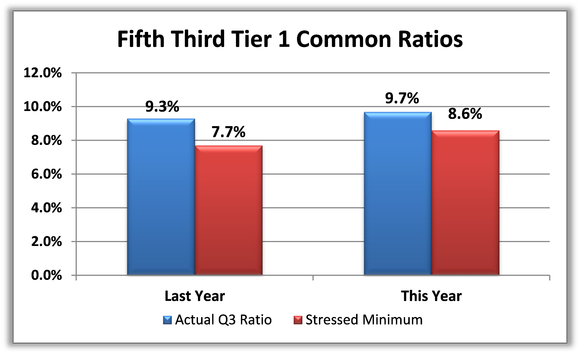
At the end of 2011, Fifth Third marched into the Federal Reserve‘s stress tests sporting a robust 9.3% Tier 1 common ratio. Under the Fed’s “severely adverse scenario,” the bank saw that ratio trickle down to a minimum level of 7.7%, which put the bank in the top 25% of the 19 participating bank holding companies. However in March 2012, the Fed rejected Fifth Third‘s request to increase its quarterly dividend, disappointing investors who were expecting a boost in payout. The bank would later be given approval to increase its quarterly dividend in September, but the sting of the rejection remained.

Sources: Dodd-Frank Act Stress Test 2013: Supervisory Stress Test Methodology and Results. Comprehensive Capital Analysis and Review 2012.

Yesterday’s results again showed strong actual capital ratios; however, unlike last year, the bank’s projected minimum ratio under the Fed’s doomsday scenario only trickled down to a robust minimum of 8.6%. The stressed ratios revealed in these tests assume that the institutions keep dividend payouts constant based on current levels and do not consider any proposed capital plans.

Weathering the storm
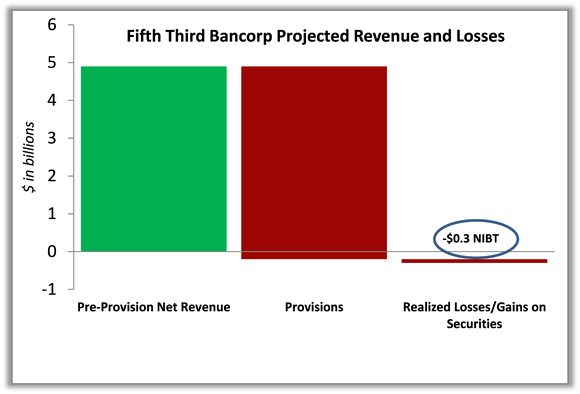
Next Thursday, the Fed will release Comprehensive Capital Analysis and Review (CCAR) results, which will look very similar to these results but will take into consideration each institution’s proposed increased in dividends or share repurchases. Contributing to Fifth Third‘s strong capital ratios was the modest loss the bank would theoretically experience over the span of the nine-quarter test. Despite the drastic conditions in the severely adverse scenario, the Fed estimated the bank would only post a pre-tax loss of $300 million over the course of the scenario.

Source: Dodd-Frank Act Stress Test 2013: Supervisory Stress Test Methodology and Results.

Expecting another boost?
Considering Fifth Third‘s Tier 1 common capital ratio only dropped to 8.6% in a hypothetical scenario that included more than 12% unemployment and 20%-plus declines in real estate values, the bank should have ample evidence to suggest it is possibly ready to increase its dividend payout ratio from its current of 21.8% level. Although the bank grew revenue year over year and strengthened capital ratios, Fifth Third still trades only slightly above its tangible book value and may be well-positioned to continually return capital to shareholders.

The article Here’s How Fifth Third Fared in the Stress Tests originally appeared on Fool.com.


David Hanson has no position in any stocks mentioned. The Motley Fool owns shares of Fifth Third Bancorp. Try any of our Foolish newsletter services free for 30 days. We Fools may not all hold the same opinions, but we all believe that considering a diverse range of insights makes us better …read more
Source: FULL ARTICLE at DailyFinance

Should Investors in This Bank Be Stressing?

By David Hanson, The Motley Fool

BBT Price / Tangible Book Value Chart

Filed under:

In the banking world, sometimes boring is better.

Headquartered in quiet Winston Salem, North Carolina, BB&T avoided many of the pitfalls that ultimately plagued numerous regional banks across the country during the financial crisis. As investors in formerly troubled banks like SunTrust or Citigroup toss and turn in their beds tonight in anticipation of the Federal Reserve‘s announcement of the annual stress test results, BB&T shareholders will sleep peacefully knowing the bank is executing its strategy, and building sustainable capital ratios.

What to expect
Last year, the Federal Reserve‘s stress test and Comprehensive Capital Analysis and Review results validated BB&T’s financial strength, and the bank raised its dividend 25%. Although evaluation of the nation’s 19 largest banks’ future dividends and capital policies won’t be public until CCAR results are reported next Thursday, tomorrow’s Dodd-Frank stress test results will give investors a point of comparison across the financial institutions. The results, scheduled to be released tomorrow at 4:30 pm, will evaluate the impact of a hypothetical economic downturn on banks’ earning potential and balance sheet strength. Some of the factors in the Federal Reserve‘s “severely adverse scenario” include:

  • Real GDP decline of between 4%-5% by the end of 2013
  • Unemployment rises another 4% from current levels
  • Housing and commercial real estate prices decline more than 20%
  • 50% decline in equity prices over the course of the hypothetical recession

Not apples to apples
Although BB&T’s balance sheet held up well during previous stress tests and capital reviews, investors should note the significant changes to the bank’s balance sheet and business from the acquisitions of Crump Insurance in April 2012, and Bank Atlantic in July 2012. While these acquisitions greatly increased BB&T’s presence in the U.S. wholesale insurance and Florida markets, the moves negatively impact the calculation of Tier 1 common equity ratios as a result of the increase in intangible assets connected to the deals. Given the fact that the deals required Fed approval, investors shouldn’t be too concerned with the adverse impact on capital levels. 

Source: S&P Capital IQ

BB&T CEO Kelly King has spent over 40 years of his career at the bank, and led the company to a record year in 2012, while bolstering its presence in new markets. Investors have not allowed King’s progress to go unnoticed, as the market has consistently valued BB&T at a premium compared to its peers SunTrust, Regions Financial , and Fifth Third

While current BB&T shareholders will want to pay close attention to the bank’s results, investors interested in adding exposure to the large, regional banking sector may be better served keeping a close eye on BB&T’s lesser-valued competitors.

With big finance firms still trading at deep discounts to their historic norms, investors everywhere are wondering if this is the new normal, or whether finance stocks are a screaming buy today. The answer depends on the company, so to help figure out whether Regions Financial is a buy today, I invite you to read our …read more
Source: FULL ARTICLE at DailyFinance

Fifth Third Bancorp to Present at the Citi 2013 Financial Services Conference

By Business Wirevia The Motley Fool

Filed under:

Fifth Third Bancorp to Present at the Citi 2013 Financial Services Conference

CINCINNATI–(BUSINESS WIRE)– Daniel T. Poston, executive vice president and chief financial officer of Fifth Third Bancorp will present at the Citi Financial Services Conference in Boston on Tuesday, March 5, 2013 at approximately 9:40 AM EST.

The webcast may be accessed live and for approximately 14 days after the conference through http://ir.53.com. Presentation slides will be made separately available in a printer-friendly format on the Company’s website.

Fifth Third Bancorp is a diversified financial services company headquartered in Cincinnati, Ohio. The Company has $122 billion in assets and operates 18 affiliates with 1,322 full-service Banking Centers, including 105 Bank Mart® locations open seven days a week inside select grocery stores and 2,413 ATMs in Ohio, Kentucky, Indiana, Michigan, Illinois, Florida, Tennessee, West Virginia, Pennsylvania, Missouri, Georgia and North Carolina. Fifth Third operates four main businesses: Commercial Banking, Branch Banking, Consumer Lending, and Investment Advisors. Fifth Third also has a 33% interest in Vantiv Holding, LLC. Fifth Third is among the largest money managers in the Midwest and, as of December 31, 2012, had $308 billion in assets under care, of which it managed $27 billion for individuals, corporations and not-for-profit organizations. Investor information and press releases can be viewed at www.53.com. Fifth Third‘s common stock is traded on the NASDAQ® National Global Select Market under the symbol “FITB.”

Fifth Third Bancorp
Jim Eglseder (Analysts), 513-534-8424

KEYWORDS:   United States  North America  Massachusetts  Ohio

INDUSTRY KEYWORDS:

The article Fifth Third Bancorp to Present at the Citi 2013 Financial Services Conference originally appeared on Fool.com.

Try any of our Foolish newsletter services free for 30 days. We Fools may not all hold the same opinions, but we all believe that considering a diverse range of insights makes us better investors. The Motley Fool has a disclosure policy.

Copyright © 1995 – 2013 The Motley Fool, LLC. All rights reserved. The Motley Fool has a disclosure policy.

(function(c,a){window.mixpanel=a;var b,d,h,e;b=c.createElement(“script”);
b.type=”text/javascript”;b.async=!0;b.src=(“https:”===c.location.protocol?”https:”:”http:”)+
‘//cdn.mxpnl.com/libs/mixpanel-2.2.min.js’;d=c.getElementsByTagName(“script”)[0];
d.parentNode.insertBefore(b,d);a._i=[];a.init=function(b,c,f){function d(a,b){
var c=b.split(“.”);2==c.length&&(a=a[c[0]],b=c[1]);a[b]=function(){a.push([b].concat(
Array.prototype.slice.call(arguments,0)))}}var g=a;”undefined”!==typeof f?g=a[f]=[]:
f=”mixpanel”;g.people=g.people||[];h=[‘disable’,’track’,’track_pageview’,’track_links’,
‘track_forms’,’register’,’register_once’,’unregister’,’identify’,’alias’,’name_tag’,
‘set_config’,’people.set’,’people.increment’];for(e=0;e<h.length;e++)d(g,h[e]);
a._i.push([b,c,f])};a.__SV=1.2;})(document,window.mixpanel||[]);
mixpanel.init("9659875b92ba8fa639ba476aedbb73b9");

…read more
Source: FULL ARTICLE at DailyFinance