
By Daniel Sparks, The Motley Fool

Filed under: Investing
“Turns out, we spoke too soon,” begins an email Apple sent out on Friday, March 22. It is the second fusillade in a new marketing campaign that outlines the main reasons consumers love the iPhone 5. In the Friday email, the company set the record straight: As of last Thursday, Apple has bragging rights to nine — not eight — straight J.D. Power and Associates awards for “Highest Customer Satisfaction with Consumer Smartphones.”
iPhone 5. Source: Apple press product images.
Signs of a new marketing approach
The first round of the well-timed campaign came just two days after Samsung launched its flagship Galaxy S4. The campaign is great news for Apple investors, after Samsung dramatically stepped up its advertising in 2012, even outspending Apple.
Samsung’s increased advertising spending during 2012 is nothing short of massive. Samsung spent more on advertising than HTC, BlackBerry , and Nokia combined. Even more mind-boggling, the company more than quadrupled its 2011 spending on advertising.
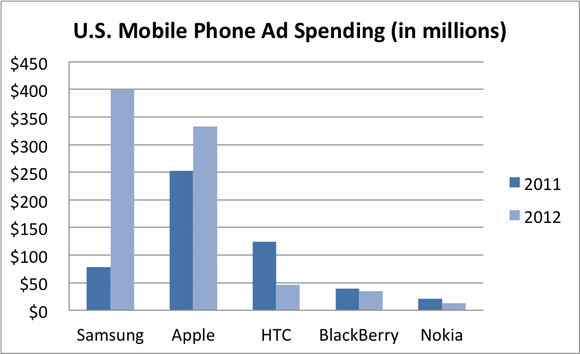
Source: Kantar Media.
Marketing experts — like ex-Apple ad executive Ken Segall, the man behind Apple’s legendary “Think Different” campaign — have suggested that Apple is losing some of its cool factor.
While Apple continues to stick to its traditional product-based ads, Samsung has spent a fortune on people-based ads featuring celebrities. And Samsung’s approach is working, Segall asserted several weeks ago. The premise behind the ads is to show consumers exactly what there is to love about the Galaxy line. According to Segall, Apple needs to step up its marketing in order to counter Samsung.
Apple’s new “Why iPhone” campaign “appears to be trying to bridge that divide somewhat by focusing on how the iPhone experience has drawn so many loyal and happy customers,” MacRumors’ Eric Slivka explains.
Will the mobile ad war heat up in 2013?
There’s no doubt Apple’s top management team is keenly aware of Samsung’s remarkable inroads in the mobile market in 2013 — in both smartphones and tablets.
According to estimates from Gartner, Google‘s Android-powered smartphones grew 88% year over year from 2011 to 2012 while iOS smartphone sales grew just 23%. This brings the Android OS share of total smartphone market share to 70% in the fourth quarter of 2012, up from 51% in the fourth quarter of 2011. Meanwhile, iOS market share fell from 24% to 21%.
To be fair, Android is spread out across a whole spectrum of smartphone brands and models, with a far lower average selling price. Even so, Samsung’s Galaxy line represents the largest portion of Android sales.
Samsung’s made inroads in tablets, too. The company shipped 7.6 million tablets in the fourth quarter of 2012, according to Canalys — that’s a 226% increase from the year-ago quarter, far more than Apple’s 48% increase.
Samsung’s gains are undoubtedly at least partly due to the quadrupling of its ad spending. The evidence goes both ways. BlackBerry and Nokia, two companies that reduced their already minuscule advertising budgets in 2012, saw smartphone …read more
Source: FULL ARTICLE at DailyFinance