Tag Archives: Google Search

3 Companies Set to Dominate the World by 2020

By Steve Heller, The Motley Fool

Filed under:

“For every one person online, there are two who are not. By the end of the decade, everyone on Earth will be connected.”
Eric Schmidt, chairman of Google

If you think the Internet is powerful now with just 2 billion users, think again. When the next 5 billion Internet users come online, it’s going to empower the world in an unimaginable way. Although Eric Schmidt‘s claim may be a bit exaggerated, there’s no denying that the world is becoming more connected with each passing year. The International Telecommunication Union estimates that 38% of the world’s population will use the Internet in 2013, which represents a 3% increase from 2012. Undoubtedly, the key enabler to such growth hinges on the proliferation of smartphones across the world.

For investors, there are three major areas to consider resulting from the rise of increased Internet users.

Search
Naturally, as more Internet users come online, more search queries will be conducted. Considering that Android commands a 70.1% smartphone market share, it puts Google in an excellent position to benefit from mobile search queries. However, mobile search may not be as profound for Google as once thought. The open-source nature of Android gives other businesses the opportunity to modify the Android experience so that it no longer benefits Google. Companies such as Baidu and Amazon.com have modified the Android shell, effectively undermining Google Search.

To help mitigate this threat, Google has established the Google Free Zone in emerging-market countries, allowing users to use Google Search, Gmail, and Google+ without the need for a data plan. It’s currently available in three countries but ultimately aims to captivate a base of one billion Internet users. In theory, this approach should drive mind share to Google’s brand, which over the long term could prove extremely valuable to Google’s business.

Commerce
Thanks to the rise of smartphones and tablets, John Donahoe, the CEO of eBay , believes another 2 billion Internet users will come online in the next three to five years. He also believes that the nature of commerce will change more in the coming three years than it has over the past 15. As a global commerce platform equipped with a thriving PayPal business, eBay expects that it will enable more than $300 billion of global commerce by 2015. For those keeping track at home, this represents an increase of $125 billion from 2012 levels. The smartphone has completely reshaped the world of commerce, and eBay is in excellent position to benefit from the fact that more users will begin shopping on the world’s marketplace.

Communication
Over 1 billion strong, Facebook is already a thriving platform for communication. Like Google, Facebook has taken a “Google Free Zone” approach to capture the mind share of users in areas of the world where Internet usage (and Facebook usage) remains low. The company has begun offering free or discounted access

From: http://www.dailyfinance.com/2013/04/18/3-internet-companies-set-to-dominate-the-world-by/

Black Menu for Chrome puts all your Google services a click away

If you rely heavily on Google services, as so many small-business users do these days, you’re probably familiar with the black toolbar that spans the top of various Google services. It provides quick and convenient access to apps like Search, Gmail, Calendar, and so on.

Ah, but what happens when you’re viewing a non-Google site? No toolbar, that’s what.

Black Menu for Chrome puts all Google services just a click away. Once installed, this extension adds a button to your browser that reveals an attractive drop-down menu for all Google’s best stuff: Search, Google+, Translate, Maps, Gmail, Calendar, and the like.

Even better, when you mouse over any of these items, you get an interactive window for using them. For example, mouse over Search and you’ve got a Google Search field ready for your terms. Mouse over Gmail and you’ll see your inbox, where you can read and respond to messages, compose new ones, and even access your search filters.

To read this article in full or to leave a comment, please click here

From: http://www.pcworld.com/article/2034651/black-menu-for-chrome-puts-all-your-google-services-a-click-away.html#tk.rss_all

Don't Underestimate the Power of a $200 Windows 8 Tablet

By Steve Heller, The Motley Fool

Filed under:

Thanks to a recent announcement to reduce tablet screen specifications, Microsoft has effectively green-lighted Windows 8 tablets to be made in the in the 7- to 8-inch form factor. This is a major development for investors since about half of all tablets shipped today are of the 7- to 8-inch variety. Besides the added portability, a smaller-sized tablet is bound to make Windows 8 tablets more price-competitive against the sea of low-cost Google Android tablets.

What Android never was
Until now, Android hasn’t seen much in the way of competition in the low-end tablet segment, allowing it to capture nearly 49% of the market last quarter. Since Android wasn’t originally intended to be a tablet operating system in the first place, affordable Windows 8 tablets could easily be perceived as more productive mobile computing devices that better suit users’ needs.

The icing on the cake
For all intents and purposes, Windows RT is a bridge product until Intel releases a processor that’s better suited for mobile computing. When Chipzilla releases its quad-core Bay Trail processor later this year, not only will it be the world’s first 22-nanometer tablet computing processor on the market, it will allow Microsoft and its OEM partners to offer tablets with the full version of Windows 8- in a 7 to 8-inch form factor. In other words, it’s all but certain that $200-$300 full-blown Windows 8 tablets become a reality. In fact, such a device would likely score very high on the “price versus function” scale against conventional tablet operating systems, potentially mitigating the threat from mobile computing.

Searching for hidden threats
Google Search has largely benefited from increased mobile computing usage, which has inadvertently driven higher volumes of search. If Microsoft and its partners can successfully infiltrate the low-end tablet market, Bing would become poised to steal search queries away from Google Search. With the prospect of a $200 Window 8 tablet now in the mix, it’s entirely possible that Google’s search growth in the mobile realm may not prove to be as robust as it once was.

If consumers were presented with a $200 to $300 tablet that runs the full version of Windows 8, would they opt for it over a similar Android device? I wager Android wouldn’t stand much of a chance.

It’s been a frustrating path for Microsoft investors, who’ve watched the company fail to capitalize on the incredible growth in mobile over the past decade. However, with the release of its own tablet, along with the widely anticipated Windows 8 operating system, the company is looking to make a splash in this booming market. In this brand-new premium report on Microsoft, our analyst explains that while the opportunity is huge, the challenges are many. He’s also providing regular updates as key events occur, so make sure to claim a copy of this report now by clicking here.

…read more
Source: FULL ARTICLE at DailyFinance

Review: Enjoy slick Web apps on your desktop with Cubiez

Web apps are great when you’re on your PC, but they require a browser. Mobile apps, on the other hand, require nothing but a smartphone, but are not very convenient to use while working on your computer. So why choose? A new platform called Cubiez (currently in public beta) offers the best of both worlds: Light and responsive apps that feel almost like mobile ones, don’t require a browse, and run on your computer. Very similar to the better-known Pokki, Cubiez is an online marketplace for apps through which you install and then run a variety of apps.

Cubiez’s app icons sit in your tray—the more apps you install the more icons you have.

Cubiez is fairly new in its field, and therefore doesn’t offer many apps yet. While its biggest rival Pokki includes hundreds of different apps, Cubiez has only a few dozen at the moment. There’s no way to view Cubiez apps online, but you can check them all out by installing Cubiez and clicking on its taskbar icon. You can look at all available apps, only new apps, or apps you have installed. There is no way to view apps by category, but since not many apps are available, this doesn’t make much of a difference.

Cubiez sits on the leftmost side of your taskbar—right next to the Start button (if you still have one)—and each app you install adds an icon on the taskbar as well. This is nice at first, but when you’ve installed seven apps, it starts to get crowded, and there’s no way to put Cubiez to sleep or collapse all the icons into one. Installing apps is a breeze: After choosing an app from the marketplace and clicking the install button, you can’t even count to five before the app is installed and available for use. Cubiez and its apps are all highly responsive, and there were no unexplained lags, sluggishness or unresponsiveness in any that I’ve tried.

Installing apps takes virtually seconds, and only one click.

Of all the apps Cubiez offers, about half are games. Among these, you’ll find some big names such as Kingdom Rush, Little Alchemy, and Plants vs. Zombies, some classics such as Pacman, and some super-addictive ones such as Unicorn Robot Attack. Aside from games, you’ll find useful apps such as Calculator, Facebook, Google Maps, Google Search, NewsHub (an RSS reader), and Weather. If you’re looking for a specific app, you can use the search box to find it quickly, but note that search strings are case sensitive, so searching for “facebook” will yield no results. The apps all run in a small window that can be moved around the screen, but cannot be resized.

To read this article in full or to leave a comment, please click here

…read more
Source: FULL ARTICLE at PCWorld

3 Ways Facebook Can Make Money With Mobile

By Chris Neiger, The Motley Fool

Filed under:

The tech world is shifting toward mobile more every day and companies like Facebook have adjusted strategies in attempt to monetize on the fast-moving trend. The social media dominator may have been slow to get started in mobile, but it’s doing these three things just right.

Users, glorious users
For mobile users, four out of every five minutes spent using mobile content is done through an app ­– luckily Facebook is No. 1 in app reach. Facebook’s app reached 76% of all smartphone and tablet users in the U.S., beating out Google‘s Search, Play, Maps, Gmail and YouTube. It’s the second most used app for iOS users, behind iTunes, and the fourth most used app on Android devices, according to a report by comScore.

Facebook sees about 680 million users each month from mobile, and that’s an irresistible number to advertisers. The mobile advertising spending hit $4 billion last year ­– this year it’s expected to reach $7 billion. With the massive amount of active mobile Facebook users, and their engagement with its app, Facebook has enormous advertising potential this year.

Gaming’s gone, but app installs are here
One of Facebook’s problems with its switch to mobile was having to leave behind the money it makes from games on its desktop version. Facebook can’t make money from games within its app, but it’s come up an alternative way use those old gaming relationships.

Facebook offers app installs for companies who want to sell games or other apps to Facebook users. Companies pay to display ads in Facebook’s mobile feed that link straight to an app for downloading. In Facebook’s earnings call at the end of January, the company’s COO, Sheryl Sandberg, said one-fifth of the top iOS developers were testing out Facebook app installs. The app install ads use the same mountain of information that advertisers use to target users, and lets advertisers track clicks and installs of the advertised apps. Some have speculated that Facebook app installs could become a $500 million a year business for the company.

Engaging with brands
Not only does Facebook’s app have an enormous amount of users and massive potential for app install ads, but the company has another trend working in its favor — brand engagement. About 39% of smartphone users read posts from brands in their social media apps, and 47% do the same on tablets. To put those numbers in context, engaging with brands is the fourth most popular activity in social media apps. The graph below shows the distribution.
 

Source: comScore.

Brand and product engagement comes in fourth place behind reading a friend’s status, accessing a picture/video, and posting a status.

Facebook is constantly tweaking how companies can advertise through its app and with its recent updates to the News Feed and Graph Search, investors can expect that Facebook will continues to make updates and changes with advertisers in mind.

Slow going, but in the right direction
…read more
Source: FULL ARTICLE at DailyFinance

2013: The Year of Evolved Mobile Search Ads

By Chris Neiger, The Motley Fool

Filed under:

Just last month, Google launched its “enhanced campaigns” to meld desktop search ads with mobile search ads, removing the option for advertisers to opt out of using mobile ads in their campaign. It was a bold move by the company and showed that Google is moving its advertisers quickly into the mobile world, where competition is heating up.

Mobile search, the traditional way
Right now, Google enjoys about 95% of global mobile searches. In the U.S. alone, the market for mobile search advertising is expected to hit $3.36 billion this year, and eMarketer expects Google to snag 92.4% share of that. Google’s new, enhanced campaign strategy will help the company to acquire that market share by moving advertisers away from desktop-only campaigns and essentially forcing them to create ads around content rather than a specific platform .

Source: Google.

Google’s move comes at a strategic time in the mobile advertising space. Desktop search is on the decline while mobile search is skyrocketing. The latter now accounts for 25% of all Internet searches, and search marketing agency Covario estimates that mobile search will reach one in every three searches by the end of this year .

Google’s most vocal contender is Microsoft and its Bing search engine. Bing is the default search engine on the Windows Phone OS, but the operating system currently takes less than 3% of smartphone market share, and in 2011 Bing only took 2% of the mobile search market. Even if Windows Phone sales took off and Bing’s mobile search doubled or tripled its current percentage — both a difficult feat — Google would still own the market.

Searching without searching
It may not be Microsoft that Google needs to watch out for, though. Mobile search through apps is on the rise. Many apps utilize smartphone location-based features to integrate search results within apps, which bypass Google or Bing.

On Android devices, the Google Search app is currently the second most frequently used app, behind Google Play. But in Apple‘s iPhone, the Google Search app didn’t even make it in the top 10 for most-used app. It’s not that iPhone users don’t use Google search in their browser, but they don’t use the actual Google Search app like Android users do.


Source: Apple.

Apple’s place in the search market is an odd one. Back in 2010, Steve Jobs said, “On the desktop search is where it’s at; that’s where the money is. But on a mobile device search hasn’t happened. Search is not where it’s at, people are not searching on a mobile device like they do on the desktop.” Fast-forward three years and Apple’s Siri performs many search functions for mobile users. Siri consults Google for some results, but also taps Bing, Yahoo, Wolfram Alpha, Wikipedia, and other sites for queries. Although Siri doesn’t bring in any mobile search revenue for the Cupertino company, Siri could take up more mobile searches over …read more
Source: FULL ARTICLE at DailyFinance

Brace Yourself: The $100 Smartphone Is Near

By Steve Heller, The Motley Fool

Filed under:

Although smartphones have seen explosive growth within developed markets, smartphones as a whole only represent about 25% of all mobile phones worldwide. With the prospect of $100 unsubsidized smartphones on the horizon, the industry is nearing its next growth phase, which will be largely driven by increasing rates of adoption within emerging markets. The Times of India is reporting that Samsung has partnered up with Indian mobile carrier Reliance Industries to bring a $100 4G-powered smartphone to the Indian market later this year. Not only are the implications of $100 smartphone tremendous for the world, the race to the bottom among device makers has officially begun.

Blurring lines
Over the years, the price gap between the feature phone and the smartphone has become increasingly narrowed, and we’re nearing the point where the feature phone loses almost all of its credibility. Nokia , which has one foot stuck in the feature phone past, is about to face increased pressure from the prospect of a $100 smartphone. Last quarter, feature phones proved to be more profitable for Nokia on a gross margin basis than its smartphone business. During the period, feature phone shipments declined by 15% year over year, forcing the company to adopt an aggressive pricing approach within its smartphone business. Until now, it appeared that Nokia was muscling the smartphone competition on price relative to features with its Lumia 620 Google Android-killer. Now that Samsung has thrown a rather large wrench into the mix, Nokia’s growth efforts may be met with stronger resistance.

Clear victor
As smartphone manufacturers continue to battle it out by offering more technology for a better price, the clear victor to this battle is the ecosystem. At this time, it’s unclear if Samsung will be using Google Android for its $100 smartphone or its homegrown Tizen ecosystem, and for the time being, it doesn’t necessarily matter. In the grand scheme of things, the ecosystem that gets adopted the most over the long term will win, since it’s the ecosystem that has the opportunity to capitalize on recurring revenues over the life of the device. Not to mention, it’s little, if any skin off an ecosystem’s back if smartphone OEMs battle it out in a race-to-the-bottom showdown. Considering Android‘s 70.1% global market share at the end of 2012, it’s clear that Android’s OEM-driven model has given Google Search and its app store a tremendous business opportunity.

Missing out
In a world where average selling pricings of smartphones continue their precipitous decline and OEMs are largely responsible for driving worldwide smartphone adoption rates, one must wonder if Apple has really missed the mark. Save for a slight adjustment in strategy in emerging markets, Team Cupertino has yet to announce a meaningful product to address this gargantuan opportunity. Apple has on many occasions made clear that it doesn’t fear cannibalization, so what’s the hold up? It’s almost a given …read more
Source: FULL ARTICLE at DailyFinance

Android Mobile Usage (Finally) Surpasses Apple

By Steve Heller, The Motley Fool

Filed under:

Despite Google Android’s market domination, Android has had a difficult time converting its market share into smartphone usage. It wasnn’t until near the end of 2012 before Android really began surpassing Apple‘s smartphone usage share in terms of web traffic. Fast-forward a few months later and Android’s usage share has reached 37%, far above Apple’s approximate 25% share. Earlier this year, Apple senior VP Phil Schiller boasted how Apple controls 75% of the profit with just 20% of the share. Is Apple about to eat Schiller’s words?

Key differences
Before we proclaim that Apple is flat-out losing to Android in nearly all aspects, there’s an obvious difference between the businesses. For one, Apple is primarily engaged in selling high-end devices for a ridiculous markup and Google is more entrenched in the usage business above anything else. Although Android devices have begun to be collectively “used” more than Apple devices, it doesn’t necessarily mean that Apple’s profit share is drastically waning. It simply means that Android’s existing users have begun to utilize their devices more as mobile computing devices. Naturally, that’s a great thing for Google, which is banking on Google Search and its resulting mobile ad business to continue flourishing without the help of overly demanding partners.

Chicken or the egg
What came first: iOS developers or iOS users? To this day, the App Store remains more profitable per user than the Google Play Store, indicating that Apple developers aren’t likely to immediately migrate over to Android. However, should Android continue to show evidence of increased usage, and its app revenue per capita starts rising, Apple may be at the mercy of developer attrition. Under this scenario, developers would be likely to prove most loyal to the ecosystem where they have the greatest chances of making the largest potential profit.

Turning a corner?
The running joke of Android has been that its users don’t use their smartphone for smartphone purposes. Contrary to comedy, the evidence is beginning to suggest otherwise, indicating that Android users have become more acclimated with using their devices for mobile computing. I do, however, find it humorous to think it took Android needed nearly three times as many users than Apple, but I suppose it’s always better to be late than never.

It’s more important than ever to understand each piece of Google’s sprawling empire. In The Motley Fool’s new premium research report on Google, we break down the risks and potential rewards for Google investors. Simply click here now to unlock your copy of this invaluable resource.

var FoolAnalyticsData = FoolAnalyticsData || []; …read more
Source: FULL ARTICLE at DailyFinance

Google tests integrating Gmail activities into search results

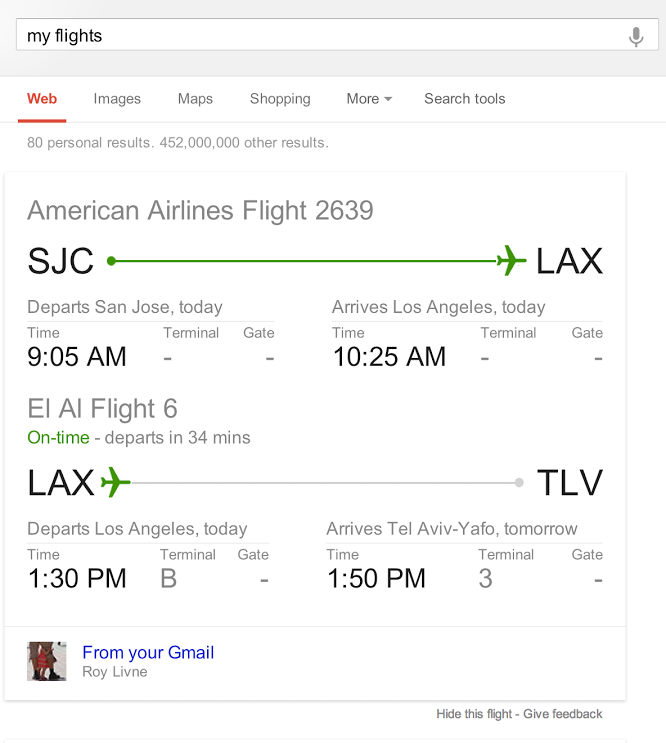
Some of the technology used for Google’s Android-based virtual assistant technology called Google Now is making its way to the Web. Google will now unearth relevant information from your inbox on flights, restaurant bookings, or purchases directly into search results, as long as you’re logged in.

google nowGoogle can retrieve itineraries (click to enlarge)

The new features are part of Google’s search “field trials” that began earlier this year, and are limited to @gmail.com users in the U.S. You can sign up for it here, and you should be able to use the new features after you receive a confirmation email.

So how does it work? When you are logged in to your Google account, from the main Google Search page you can perform some specific search queries that will look through your emails and display the information in a card-like interface, similar to the Google Now service that debuted on Android.

For example, a search for [my flights] will bring up a card with your upcoming flight reservation information, pulled from your emails, along with the latest flight information on gates and departure times. You can also see relevant emails from your inbox depending on your Web search, or look for files from your Google Drive with queries such as [Summer holiday docs].

To read this article in full or to leave a comment, please click here

Source: PCWorld

Google embeds indoor Street Views in search results

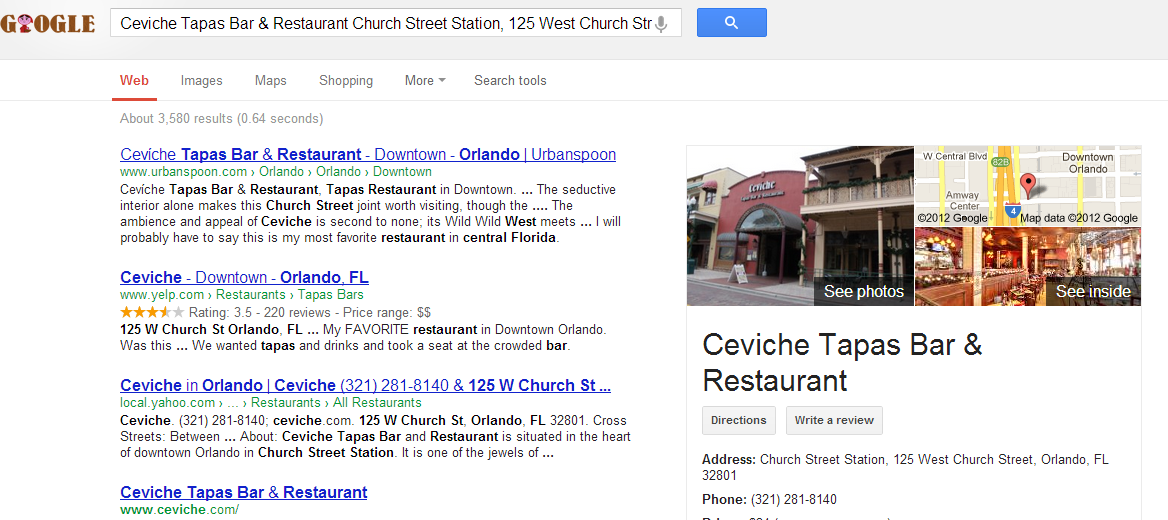
Google has added indoor Street View results to general searches, allowing you to see if the ambiance of that downtown restaurant matches the online review. Google began mixing indoor business Street Views in search results this week for those companies that have supplied the Google with panoramic interior imagery.

The 360-degree tours inside businesses and shops are not actually taken with Google Street View cameras. They are panoramic photos taken by “Google Trusted Photographers,” who charge businesses to take them, stitch imagery together, and publish the virtual tours on Google Maps.

These indoor Street Views use the same controls as their roadside counterpart, but are so far only available in the U.S., U.K, Australia, New Zealand, France, Ireland, the Netherlands and Canada.

The tours were available since September through Google Maps, and now they will also show in Google Search results. When you search for a business, you will see on the right side a panel with photos of the business, its location on a map and a new “See inside” tag that takes you to the 360-degree tour of the premises.

To read this article in full or to leave a comment, please click here

Source: PCWorld