Tag Archives: Ken Segall

Apple's iPhone Claims the Consumer Satisfaction Crown Yet Again

By Daniel Sparks, The Motley Fool

Filed under:

“Turns out, we spoke too soon,” begins an email Apple sent out on Friday, March 22. It is the second fusillade in a new marketing campaign that outlines the main reasons consumers love the iPhone 5. In the Friday email, the company set the record straight: As of last Thursday, Apple has bragging rights to nine — not eight — straight J.D. Power and Associates awards for “Highest Customer Satisfaction with Consumer Smartphones.”

iPhone 5. Source: Apple press product images.

Signs of a new marketing approach
The first round of the well-timed campaign came just two days after Samsung launched its flagship Galaxy S4. The campaign is great news for Apple investors, after Samsung dramatically stepped up its advertising in 2012, even outspending Apple.

Samsung’s increased advertising spending during 2012 is nothing short of massive. Samsung spent more on advertising than HTC, BlackBerry , and Nokia combined. Even more mind-boggling, the company more than quadrupled its 2011 spending on advertising.
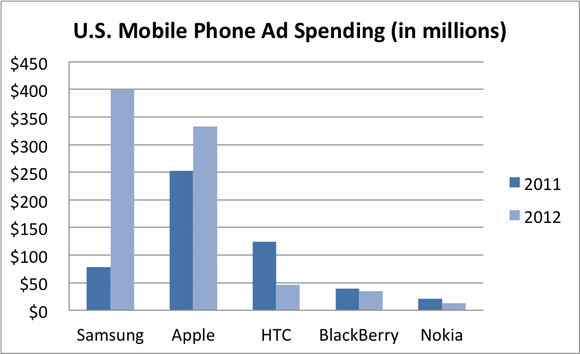
Source: Kantar Media.

Marketing experts — like ex-Apple ad executive Ken Segall, the man behind Apple’s legendary “Think Different” campaign — have suggested that Apple is losing some of its cool factor.

While Apple continues to stick to its traditional product-based ads, Samsung has spent a fortune on people-based ads featuring celebrities. And Samsung’s approach is working, Segall asserted several weeks ago. The premise behind the ads is to show consumers exactly what there is to love about the Galaxy line. According to Segall, Apple needs to step up its marketing in order to counter Samsung.

Apple’s new “Why iPhone” campaign “appears to be trying to bridge that divide somewhat by focusing on how the iPhone experience has drawn so many loyal and happy customers,” MacRumors’ Eric Slivka explains. 

Will the mobile ad war heat up in 2013?
There’s no doubt Apple’s top management team is keenly aware of Samsung’s remarkable inroads in the mobile market in 2013 — in both smartphones and tablets.

According to estimates from Gartner, Google‘s Android-powered smartphones grew 88% year over year from 2011 to 2012 while iOS smartphone sales grew just 23%. This brings the Android OS share of total smartphone market share to 70% in the fourth quarter of 2012, up from 51% in the fourth quarter of 2011. Meanwhile, iOS market share fell from 24% to 21%.

To be fair, Android is spread out across a whole spectrum of smartphone brands and models, with a far lower average selling price. Even so, Samsung’s Galaxy line represents the largest portion of Android sales. 

Samsung’s made inroads in tablets, too. The company shipped 7.6 million tablets in the fourth quarter of 2012, according to Canalys — that’s a 226% increase from the year-ago quarter, far more than Apple’s 48% increase.

Samsung’s gains are undoubtedly at least partly due to the quadrupling of its ad spending. The evidence goes both ways. BlackBerry and Nokia, two companies that reduced their already minuscule advertising budgets in 2012, saw smartphone …read more
Source: FULL ARTICLE at DailyFinance

Apple's New Web Campaign Is Great News for Investors

By Daniel Sparks, The Motley Fool

Filed under:

Samsung has outspent Apple in marketing over the last 12 months, and some experts — like former Apple ad exec Ken Segall — believe that Apple could be losing in the marketing battle against Samsung. Apple’s new “Why You’ll Love an iPhone” web campaign, however, could signal a shift in the winds, as Apple responds to the fact that it needs to change its approach.

There’s no doubt that Apple is at the center of technology’s largest revolution ever, and that longtime shareholders have been handsomely rewarded with over 1,000% gains. However, there is a debate raging as to whether Apple remains a buy. The Motley Fool’s senior technology analyst and managing bureau chief, Eric Bleeker, is prepared to fill you in on both reasons to buy and reasons to sell Apple, and what opportunities are left for the company (and your portfolio) going forward. To get instant access to his latest thinking on Apple, simply click here now.

var FoolAnalyticsData = FoolAnalyticsData || []; FoolAnalyticsData.push({ eventType: “TickerReportPitch”, contentByline: “Daniel Sparks”, contentId: “cms.25148”, contentTickers: “NASDAQ:AAPL”, contentTitle: “Apple’s New Web Campaign Is Great News for Investors”, hasVideo: “True”, pitchId: “1”, pitchTickers: “NASDAQ:AAPL”, …read more
Source: FULL ARTICLE at DailyFinance

Your iPhone Could Have Been the … Telepod

By Neal Colgrass Would you have bought a Telepod? Or a Mobi? Turns out those are two names Apple considered for its original iPhone, 9to5Mac reports. Ken Segall, former chief of Apple advertising, revealed the names to a marketing crowd at the University of Arizona last week. Apple’s reasoning: Telepod : It sounded like… …read more
Source: FULL ARTICLE at Newser – Home

How Much Lower Could Apple Go?

By Daniel Sparks, The Motley Fool

Filed under:

Apple set another 52-week low yesterday, hitting $419. The company’s journey from a 52-week intraday high of $705 to today’s low only took about six months. The market has been ruthless: Whenever a bottom seemed in sight, shares just kept sliding. To add perspective, the Dow Jones actually rose almost 4% during the same period. This leaves investors with two pressing questions: What is driving Apple’s decline, and how much lower could the company go?

A hardware-dependent business model
In an unusual turn of events, Apple’s close rival, Google , has risen about 19% during the last six months, in stark contrast to Apple’s 40% decline. In fact, yesterday Google set another all-time high, at $820. Google’s favor with Wall Street provides insights for understanding Apple’s decline.

Unlike Google, Apple’s revenue relies heavily on unpredictable blockbuster products. Yes, Apple has iTunes, software, and services as well — all more consistent and predictable forms of revenue. But most of its revenue comes from iPhones, iPads, or Macs. Together, these three segments make up 86% of Apple’s revenue; iPhone sales alone make up 56%.

As the world’s leader in online search, Google attracts investors who are betting heavily on continued growth in revenue from advertising on its own sites, and from Google’s partner sites, as news, media, and shopping continue to bring more business online. This revenue stream is much more predictable and reliable than Apple’s product sales — hence Google’s consistently higher P/E ratio.

But Apple leaves investors worried about the future. They wonder: Could Apple end up losing favor with consumers over the next five years? If it does, Apple could lose significant momentum, or even experience year-over-year declines in sales in major product categories.

Some experts have suggested that Apple is already losing ground with consumers. The creative director behind Apple’s successful “Think Different” campaign, Ken Segall, notes that Samsung is making “remarkable inroads in a very short time.” He explains that Samsung spends far more money on advertising that goes against Apple’s product-based approach, with a people-based approach that plays off “growing negative perceptions about Apple.”

Given Apple‘s dependence on blockbuster product launches, a negative perception is a definite threat to Apple’s cash flow. Meanwhile, investors are confident that Google will remain a substantial player in the worldwide online search market for years to come.

Apple’s missing premium
In short, three factors ultimately determine a stock‘s premium:

  1. Growth prospects
  2. Risk
  3. Profitability

In all three of these areas, Apple is facing significant headwinds.

Apple’s growth prospects are uncertain. In the fourth quarter of 2012, Samsung sold 62 million smartphones, compared to Apple’s 47.8 million iPhones, and surpassed Apple for the first time. Furthermore, Apple’s growth has slowed significantly. Revenue in the first quarter increased just 18% from the year-ago quarter. Year-over-year revenue in the first quarter of 2012, on the other hand, grew 73%.

Even Apple’s renowned leadership in tablets is slipping. According to a Feb. 7 research report from Canalys, …read more
Source: FULL ARTICLE at DailyFinance