Tag Archives: Source Federal Reserve

Could This Risk "Spoil the Party" on the Stock Market?

By Matt Koppenheffer, The Motley Fool

Filed under:

The StressTest column appears every Thursday on Fool.com. Check back weekly and follow @TMFStressTest on Twitter.

Who would have thought that profits could be putting fear in the hearts of market watchers? 

Just yesterday, Robert Lenzner at Forbes wrote that the current rate of corporate profits “will eventually revert to the mean, spoiling the party.” Lenzner isn’t alone. And many of those not focused on mean-reverting corporate profits torpedoing the markets and economy are bemoaning the fact that wages haven’t kept up with the jump in profits. On Fool.com, Morgan Housel took a look at just that earlier this week.

On its face, the case for high profits being worrisome makes sense. Based on numbers from the Federal Reserve, corporate profits were 11.2% of U.S. GDP as of October 2012. That compares to an average of 6.1% going back to 1950. Some of that may reflect a shift in dominant industries — today, manufacturing companies account for a lower share of the economy while financial and service businesses have a higher one. But considering those numbers, it seems almost silly to think that the corporate profit share won’t fall in the years ahead.

So let’s assume for a moment that it’s not a question of whether corporate profits will fall — let’s just assume they will. Now we can focus on the more important question for investors: Would a fall in corporate profits hurt the stock market

Let’s consider some more numbers.

Source: Federal Reserve and YahooFinance. Analysis performed with Statwing.

If the plots look random, it’s because they are. Based on this data — which goes back to 1950 — there’s no statistically significant relationship between past corporate profit levels and the performance of the S&P 500  over the next year. But a year is like the blink of an eye on the stock market. Let’s take a look at forward five-year S&P 500 performance.

Source: Federal Reserve and YahooFinance. Analysis performed with Statwing.

This time, the data looks like it has more going on. As the Statwing analysis describes it, the two sets of data are “weakly negatively correlated.” In plain English, the higher corporate profits are, the worse the S&P 500 tends to perform over the following five years.

Let’s extend it out to 10 years.

Source: Federal Reserve and YahooFinance. Analysis performed with Statwing.

Once again, Statwing tells us that there is a weak, but significant negative correlation between corporate profit levels and the performance of the S&P 500 over the next decade. However, when we move out to 10 years, the relationship actually weakens, and starting corporate profit levels could be said to “explain” less of the change in the stock market.

So if we go back to the logical story that we started with — that when corporate profits are high, they’re in a position to fall, and therefore will

From: http://www.dailyfinance.com/2013/04/11/could-this-risk-spoil-the-party-on-the-stock-marke/

The Fight Between Wages and Profits: When Will It End?

By Morgan Housel, The Motley Fool

Filed under:

Wages and salaries have been growing slower than the overall economy for decades. After-tax profits have been growing much faster than the economy. 

It’s time for an update of a chart we’ve posted before:

Source: Federal Reserve, Bureau of Labor Statistics, Bureau of Economic Analysis.

The drift between these two adds up to an enormous sum. Peter Orszag wrote last year: “If labor compensation hadn’t fallen so much as a share of national income, American workers would be enjoying about $750 billion more in take-home pay.”

Now, this chart isn’t as simple as it looks. Part of the reason wages take up a smaller share of the economy is because benefits like health insurance take up a larger share of workers’ total compensation. And part of the reason corporate profits have grown as a share of the economy is because of a shift from industrial-commodity corporations to technology firms that naturally have higher margins.

But there is no doubt that part of the swing between wages and profits is explained by one growing at the expense of the other. This is natural — we’ve been through two other cycles since 1900 — but I wonder how long the current cycle can last. Take this recent story about Wal-Mart :

Walmart, the nation’s largest retailer and grocer, has cut so many employees that it no longer has enough workers to stock its shelves properly, according to some employees and industry analysts. Internal notes from a March meeting of top Walmart managers show the company grappling with low customer confidence in its produce and poor quality. “Lose Trust,” reads one note, “Don’t have items they are looking for — can’t find it.”

There comes a point where it is in capital’s best interest to increase labor’s share of output. If Wal-Mart is any indication, we’re probably pretty close to that point. 

The article The Fight Between Wages and Profits: When Will It End? originally appeared on Fool.com.

Morgan Housel has no position in any stocks mentioned. The Motley Fool has no position in any of the stocks mentioned. Try any of our Foolish newsletter services free for 30 days. We Fools may not all hold the same opinions, but we all believe that considering a diverse range of insights makes us better investors. The Motley Fool has a disclosure policy.

Copyright © 1995 – 2013 The Motley Fool, LLC. All rights reserved. The Motley Fool has a disclosure policy.

(function(c,a){window.mixpanel=a;var b,d,h,e;b=c.createElement(“script”);
b.type=”text/javascript”;b.async=!0;b.src=(“https:”===c.location.protocol?”https:”:”http:”)+
‘//cdn.mxpnl.com/libs/mixpanel-2.2.min.js’;d=c.getElementsByTagName(“script”)[0];
d.parentNode.insertBefore(b,d);a._i=[];a.init=function(b,c,f){function d(a,b){
var c=b.split(“.”);2==c.length&&(a=a[c[0]],b=c[1]);a[b]=function(){a.push([b].concat(
Array.prototype.slice.call(arguments,0)))}}var g=a;”undefined”!==typeof f?g=a[f]=[]:
f=”mixpanel”;g.people=g.people||[];h=[‘disable’,’track’,’track_pageview’,’track_links’,
‘track_forms’,’register’,’register_once’,’unregister’,’identify’,’alias’,’name_tag’,
‘set_config’,’people.set’,’people.increment’];for(e=0;e<h.length;e++)d(g,h[e]);
a._i.push([b,c,f])};a.__SV=1.2;})(document,window.mixpanel||[]);
mixpanel.init("9659875b92ba8fa639ba476aedbb73b9");

function addEvent(obj, evType, fn, useCapture){
…read more

Source: FULL ARTICLE at DailyFinance

Housing's Labor Shortage

By Morgan Housel, The Motley Fool

Source: Federal Reserve.

Neil Irwin of The Washington Post

Filed under:

Late last year, Richard Dugas of homebuilder Pulte  noted that his company was having trouble hiring enough workers to keep up with demand. “The number of markets feeling some degree of labor pressure is growing,” he said. “In fact, almost all of our markets have now reached a point where labor pressures are being experienced to some degree.”

Yesterday, Catherine Rampell of The New York Times detailed a similar problem: 

In many areas, builders are scrambling to ramp up production but face delays because of the difficulty of finding construction workers and in obtaining permits from suddenly overwhelmed local authorities.

This makes sense. Homebuilders laid off a ton of workers during the housing bust. And while rebounding customers can put in orders for new homes quickly, hiring a crew of skilled construction workers takes time.

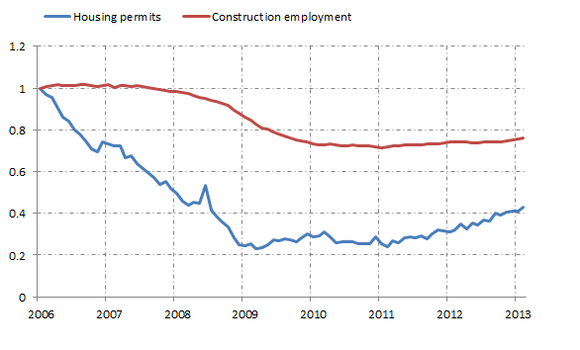
But this story is more complicated than it looks. Compared with the drop in construction permits, homebuilders actually didn’t lay off as many construction workers during the bust as you might think:

Source: Federal Reserve.

Neil Irwin of The Washington Post explains:

Key to understanding the sluggish growth in construction jobs is a concept called “labor hoarding.” That’s what happens during a recession when companies don’t fire as many workers as the decline in business would seem to have justified. Firms don’t want to lose all their quality workers and then be unable to keep up with demand when business finally turns around, so they keep people on staff even when there is not enough work to keep them fully busy.

This seems to have happened on a large scale in construction in the last few years. Kris Dawsey and Hui Shan at Goldman’s economics research group calculated that the economic value added per construction worker fell from $80,000 in 2006 to under $60,000 at the end of 2012. That is labor hoarding in a nutshell.

Construction can now rise much faster than employment because we’re coming off of a period when construction fell much faster than employment. Last year, Lennar CEO Stuart Miller said, “The homebuilding business is beginning to revert to normal, and that’s positive for the U.S. economy in general.” Jeff Mezger of KB Home said, “We’re on offense and pursuing our growth targets.” This is great for news for homebuilders! But it doesn’t necessarily mean they need legions of new construction workers. 

But how does that fit in with stories about a tight labor market? Here’s the key, from Rampell:

Many workers in the immigrant-heavy industry have left the area [California], returning to Mexico and other points south. Others pursued work in Texas’s energy boom, where both drilling and construction jobs have become more plentiful. Those who stayed in the local area often switched to medical data entry, U.P.S. delivery services, or anything else that they could find. Or they filed for disability and dropped out the labor force altogether.

So, it seems homebuilders are looking to hire a small number of workers — not …read more
Source: FULL ARTICLE at DailyFinance

Citigroup Passes Stress Test, but Won't Raise Dividend

By John Maxfield, The Motley Fool

Filed under:

If you’re an investor in Citigroup , the Federal Reserve‘s most recent round of stress tests should come as a relief. Released yesterday, the nation’s third largest bank by assets emerged from the central bank’s gauntlet in markedly better shape than it did last year. The charts and discussion below examine how the company’s capital and earnings held up under the Fed’s “severely adverse” economic scenario.

The purpose of the stress tests is to gauge how the capital bases of the nation’s largest financial institutions hold up in the face of economic and financial turmoil. Among other things, the most extreme case assumes that real GDP declines an average of 4% this year, unemployment ratchets up to 12.1% by the second quarter of next year, and that home prices plummet by 20% over the next 24 months.

As you can see in the chart below, Citigroup’s Tier 1 common capital ratio held up respectably in light of these assumptions. Starting from 12.7% at the end of last September, it bottomed out at 8.3% over the hypothetical time period extending from the fourth quarter of last year through the end of 2014. While that equates to a 35% decline, the ending figure nevertheless exceeded the Fed’s 5% reference rate. By comparison, the average Tier 1 common capital ratio of the 18 institutions tested fell by a third, down to 7.4%.

Source: Federal Reserve.

With respect to net income, Citigroup didn’t fare as well. Its hypothetical pre-tax loss for the nine-quarter time period came in at $28.6 billion. This was nearly triple the 18-institution average loss of $10.8 billion, and made Citigroup the worst performer in this regard after only Bank of America and JPMorgan Chase. Conversely, the Bank of New York Mellon fared the best, with $5.5 billion in positive earnings despite the assumed economic Armageddon.

Source: Federal Reserve.

Breaking this down a bit further, as you can see in the figure above, Citigroup’s $44 billion in pre-provision net revenue was more than consumed by loan loss provisions — that is, money set aside to cover future losses from soured loans. These accounted for $49.4 billion in losses. In addition, estimated losses from trading added up to $15.9 billion, and other losses ate up an additional $7.1 billion.

And digging into the loan losses specifically, Citigroup’s were anchored in its credit card division, which accounted for 43% of the losses. This was followed by residential real estate loans at 24%, and commercial loans of 16%.

Source: Federal Reserve.

At the end of the day, the stress tests are meant to do exactly what the name implies: stress you out. And while this year is no exception, investors in Citigroup, like those at Bank of America and others, should take comfort in the increasingly massive capital hoard sitting on the bank’s balance sheet. The difference being, we already know Citigroup won’t raise …read more
Source: FULL ARTICLE at DailyFinance

More Proof Wells Fargo Is Solid As a Rock

By John Maxfield, The Motley Fool

Filed under:

The nation’s fourth largest bank by assets has proven itself again. Yesterday, the Federal Reserve released its most recent round of stress tests showing that Wells Fargo has once again outperformed its too-big-to-fail brethren, JPMorgan Chase, Bank of America, and Citigroup. The charts and discussion below examine how the company’s capital and earnings held up under the Fed’s “severely adverse” economic scenario.

The purpose of the stress tests is to gauge how the capital bases of the nation’s largest financial institutions hold up in the face of economic and financial turmoil. Among other things, the most extreme case assumes that real GDP declines an average of 4% this year, unemployment ratchets up to 12.1% by the second quarter of next year, and that home prices plummet by 20% over the next 24 months.

As you can see in the chart below, Wells Fargo‘s Tier 1 common capital ratio held up well in light of these assumptions. Starting from 9.9% at the end of last September, it bottomed out at 7% over the hypothetical time period extending from the fourth quarter of last year through the end of 2014. While that equates to a 29% decline, the ending figure nevertheless far exceeded the Fed’s 5% reference rate. By comparison, the average Tier 1 common capital ratio of the 18 institutions tested fell by a third, down to 7.4%.

Source: Federal Reserve.

With respect to net income, Wells Fargo didn’t fare quite as well — though it still outperformed the three other megabanks. Its hypothetical pre-tax loss for the nine-quarter time period came in at $25.7 billion. This was more than double the 18-institution average loss of $10.8 billion, but roughly half the hypothetical $51.7 billion loss at Bank of America. Conversely, the Bank of New York Mellon fared the best, with $5.5 billion in earnings despite the assumed economic Armageddon.

Source: Federal Reserve.

Breaking this down a bit further, as you can see in the figure above, Wells Fargo‘s $45.9 billion in pre-provision net revenue was more than consumed by loan loss provisions — that is, money set aside to cover future losses from soured loans. These accounted for $58.8 billion in losses. In addition, estimated losses from trading added up to $6.9 billion, and other losses ate up an additional $5.9 billion.

And digging into the loan losses specifically, Wells Fargo‘s were widely dispersed among customer and product types. A full 45% derived from residential real estate, 19% from other types of consumer loans, and a total of 36% from various types of commercial lending.

Source: Federal Reserve.

At the end of the day, the stress tests are meant to do exactly what the name implies: stress you out. The good news, however, is that once again, Wells Fargo has demonstrated that it is perhaps truly the only big bank built to last.

Want to learn more about …read more
Source: FULL ARTICLE at DailyFinance

Here's How SunTrust Fared in the Stress Tests

By Matt Koppenheffer, The Motley Fool

Filed under:

For SunTrust , what a difference a year makes.

During last year’s stress tests, SunTrust got a bit of a black eye as its capital plans were rejected by the Federal Reserve. Fast forward to this year, and the bank looks like it’s in a much better position.

Unlike the Fed’s Comprehensive Capital Analysis and Review — which comes out next week — the Dodd-Frank stress tests do not determine whether or not the banks involved can pay higher dividend or pay out stock. But since they use essentially the same modeling and stress-case scenarios, they’re a good way for investors to get a sense for how the banks will perform in the CCAR, and whether they’ll be able to increase capital distributions.

Capital ratios
Perhaps the key metric that the Fed and investors are looking at in the results of the stress tests is the Tier 1 common capital ratio, and, in particular, how that low that ratio falls under the hypothetical stressed conditions. 

Here’s a look at how that ratio looked for SunTrust — both pre-test actual and under stressed conditions — as compared to similar numbers during last year’s CCAR tests.

Source: Federal Reserve.

The outcome of the tests is practically night and day when compared to last year. What accounts for the change? Part of it was the bank’s lower projected loss. In last year’s CCAR, the Fed projected that SunTrust would lose nearly $6 billion under the stress scenario. This year, that loss fell to just $4 billion.

But let’s dig in a bit further on that loss projection.

Projected net loss
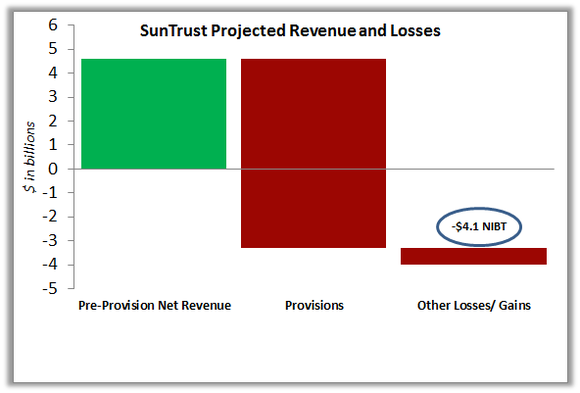
How do the regulators get to the stressed capital ratios? A big piece of the puzzle is using the stress-scenario inputs to estimate how much of a profit — or, in most cases, a loss — the bank will register over the nine-quarter test period.

In SunTrust’s case, the answer is a $4 billion loss on $4.6 billion of pre-provision net revenue — that is, revenue before loan-loss provisions less operating expenses. 

Source: Federal Reserve.

Compared to the CCAR results last year, SunTrust was projected to have both lower loan-loss provisions — $7.9 billion versus $8.5 billion — and markedly higher PPNR — $4.6 billion versus $2.7 billion.

One step further…
Finally, if we break down those loan losses, we can see where the Fed projects that SunTrust would take the biggest balance-sheet hits in the hypothetical stressed scenario.

Source: Federal Reserve.

Thanks to SunTrust’s asset mix — which is lighter on some higher-loss loan types like credit cards — its overall loss rate as a percentage of its loans was 6.4%, which was slightly below the median across all of the tested banks.

Now what?
With SunTrust’s stock up close to 3% today, investors may be looking at the stress test results expecting redemption for last year when the CCAR rolls around next week. And I couldn’t blame …read more
Source: FULL ARTICLE at DailyFinance

Why Bank of America's Investors Can Breathe a Sigh of Relief

By John Maxfield, The Motley Fool

Filed under:

If you’re an investor in Bank of America , the Federal Reserve‘s most recent round of stress tests should serve as a partial affirmation of your patience in the company. Released yesterday, the nation’s second largest bank by assets emerged from the central bank’s gauntlet in markedly better shape than it did last year. The charts and discussion below examine how the company’s capital and earnings held up under the Fed’s “severely adverse” economic scenario.

The purpose of the stress tests is to gauge how the capital bases of the nation’s largest financial institutions hold up in the face of economic and financial turmoil. Among other things, the most extreme case assumes that real GDP declines an average of 4% this year, unemployment ratchets up to 12.1% by the second quarter of next year, and home prices plummet by 20% over the next 24 months.

As you can see in the chart below, B of A’s Tier 1 common capital ratio held up admirably in light of these assumptions. Starting from 11.4% at the end of last September, it bottomed out at 6.8% over the hypothetical time period extending from the fourth quarter of last year through the end of 2014. While that equates to a 40% decline, the ending figure nevertheless comfortably exceeded the Fed’s 5% reference rate. By comparison, the average Tier 1 common capital ratio of the 18 institutions tested fell by a third, down to 7.4%.

Source: Federal Reserve.

With respect to net income, B of A didn’t fare as well. Its hypothetical pre-tax loss for the nine-quarter time period came in at $51.8 billion. This greatly exceeded the 18-institution average loss of $10.8 billion, and made B of A the worst performer in this regard. Conversely, the Bank of New York Mellon fared the best, with $5.5 billion in earnings despite the assumed economic Armageddon.

Source: Federal Reserve.

Breaking this down a bit further, as you can see in the figure above, B of A’s $24.1 billion in pre-provision net revenue was more than consumed by loan loss provisions — that is, money set aside to cover future losses from soured loans. These accounted for $49.7 billion in losses. In addition, estimated losses from trading added up to $14.1 billion, and “other losses” ate up an additional $13 billion.

And digging into the loan losses specifically, B of A’s were widely dispersed among customer and product types. A full 43% derived from residential real estate, 27% from its credit card operations, and a total of 23% from various types of commercial lending.

Source: Federal Reserve.

At the end of the day, the stress tests are meant to do exactly what the name implies: stress you out. And while this year is no exception, investors in B of A should take comfort in the increasingly massive capital hoard sitting on the bank’s balance sheet.

Want to …read more
Source: FULL ARTICLE at DailyFinance

Capital One Clears Fed-Administered Stress Test

By John Maxfield, The Motley Fool

Filed under:

Yesterday, the Federal Reserve released the results from its most recent round of stress tests. For investors in Capital One , its performance demonstrated the lender’s ability to sustain adequate capital levels in the face of an extreme economic shock. The charts and discussion below examine how the company’s capital and earnings held up under the Fed’s “severely adverse” economic scenario.

The purpose of the stress tests is to gauge how the capital bases of the nation’s largest financial institutions hold up in the face of economic and financial turmoil. Among other things, the most extreme case assumes that real GDP declines an average of 4% this year, unemployment ratchets up to 12.1% by the second quarter of next year, and that home prices plummet by 20% over the next 24 months.

As you can see in the chart below, Capital One‘s Tier 1 common capital ratio held up well in light of these assumptions. Starting from 10.7% at the end of last September, it bottomed out at 7.4% over the hypothetical time period extending from the fourth quarter of last year through the end of 2014. While that equates to a 31% decline, the ending figure nevertheless comfortably exceeded the Fed’s 5% reference rate. By comparison, the average Tier 1 common capital ratio of the 18 institutions tested fell by a third, down to 7.4% — almost exactly as Capital One did.

Source: Federal Reserve.

With respect to net income, the regional lender and credit card giant fared even better on a relative basis. Its hypothetical pre-tax loss for the nine-quarter time period came in at $8 billion, beating out the 18-institution average loss of $10.8 billion. The worst performing financial institution in this regard was Bank of America, with a whopping $51.8 billion in estimated losses. Conversely, the Bank of New York Mellon fared the best, with $5.5 billion in positive earnings despite the assumed economic Armageddon.

Source: Federal Reserve.

Breaking this down a bit further, as you can see in the figure above, Capital One‘s $18.7 billion in pre-provision net revenue was more than consumed by loan loss provisions — that is, money set aside to cover future losses from soured loans. These accounted for $26.4 billion in losses. Estimated losses from securities added another $300 million.

And digging into the loan losses specifically, it should be no surprise that the lion’s share, or 70% of Capital One‘s hypothetically soured loans derived from its credit card operations. Roughly 20% of the remaining losses were associated with its non-credit card consumer loan portfolio, and the final 10% were related to commercial borrowers.

Source: Federal Reserve.

At the end of the day, the stress tests are meant to do exactly what the name implies: stress you out. And while this year is no exception, investors in Capital One can rest easy thanks to its more-than-abundant capital base. The question …read more
Source: FULL ARTICLE at DailyFinance

BB&amp;T's Southern Charm (and Prudent Risk Management) Wins Over Regulators

By John Maxfield, The Motley Fool

Filed under:

If you’re an investor in BB&T , then the Federal Reserve‘s most recent round of stress tests is arguably a cause for celebration. Released yesterday, the popular regional lender emerged from the central bank’s gauntlet in some of the best shape of its peers. The charts and discussion below examine how the company’s capital and earnings held up under the Fed’s “severely adverse” economic scenario.

The purpose of the stress tests is to gauge how the capital bases of the nation’s largest financial institutions hold up in the face of economic and financial turmoil. Among other things, the most extreme case assumes that real GDP declines an average of 4% this year, unemployment ratchets up to 12.1% by the second quarter of next year, and that home prices plummet by 20% over the next 24 months.

As you can see in the chart below, BB&T’s Tier 1 common capital ratio hardly budged despite these assumptions. Starting from 9.5% at the end of last September, it bottomed out at 9.4% over the hypothetical time period extending from the fourth quarter of last year through the end of 2014. This hardly perceptible decline not only far exceeds the Fed’s 5% reference rate, but it also makes BB&T one of the best performing banks in this regard, behind only the Bank of New York Mellon. By comparison, the average Tier 1 common capital ratio of the 18 institutions tested fell by a third, down to 7.4%.

Source: Federal Reserve.

With respect to net income, BB&T fared equally as well. Its hypothetical pre-tax earnings for the nine-quarter time period came in at $600 million. This greatly exceeded the 18-institution average loss of $10.8 billion. As above, the Bank of New York Mellon fared the best, with $5.5 billion in earnings despite the assumed economic Armageddon.

Source: Federal Reserve.

Breaking this down a bit further, as you can see in the figure above, BB&T’s $7.1 billion in pre-provision net revenue was largely consumed by loan loss provisions — that is, money set aside to cover future losses from soured loans. These accounted for $6.4 billion in losses, while estimated losses from other sources ate up an additional $100 million.

And digging into the loan losses specifically, BT&T’s were almost equally distributed between commercial and consumer customers. The former accounted for an estimated 53% of the loan losses, while the latter made up the remaining 47%.

Source: Federal Reserve.

At the end of the day, the stress tests are meant to do exactly what the name implies: stress you out. For investors in BT&T, however, there’s literally no reason to feel this way, as the bank has proven again that it’s one of the best-run regional lenders in the country.

Want to learn more about BB&T?
With big finance firms still trading at deep discounts to their historic norms, investors everywhere are wondering if this is …read more
Source: FULL ARTICLE at DailyFinance

How American Express Dominated the Stress Tests

By John Maxfield, The Motley Fool

Filed under:

If you’re an investor in American Express , then you have nothing to fear from the Federal Reserve’s most recent round of stress tests. Released yesterday, the iconic credit card company emerged from the central bank’s gauntlet in markedly better shape than the majority of its financial brethren. In the charts and discussion below, I examine how the company’s capital and earnings held up under the Fed’s “severely adverse” economic scenario.

American Express passed the tests with flying colors
The purpose of the stress tests is to gauge how the capital bases of the nation’s largest financial institutions hold up in the face of economic and financial turmoil. Among other things, the most extreme case assumes that real GDP declines an average of 4% this year, unemployment ratchets up to 12.1% by the second quarter of next year, and that home prices plummet by 20% over the next 24 months.

As you can see in the chart below, American Express’ Tier 1 common capital ratio held up remarkably well in light of these assumptions. Starting from 12.7% at the end of last September, it bottomed out at 11.1% over the hypothetical time period from the fourth quarter of last year through the end of 2014. That equates to a 12.6% decline. By comparison, the average Tier 1 common capital ratio of the 18 institutions tested fell by a third, down to 7.4%.

Source: Federal Reserve.

With respect to net income, American Express’ hypothetical pre-tax earnings for the nine-quarter time period came in at $800 million. While this may not sound like much, it greatly exceeded the average, which came out to be a $10.8 billion loss. Bank of America led the way down in this regard with a staggering $51.8 billion hypothetical loss. Conversely, the Bank of New York Mellon fared the best, with $5.5 billion in earnings despite the assumed economic Armageddon.

Source: Federal Reserve.

Breaking this down a bit further, as you can see in the figure above, the vast majority of American Express’ $15.4 billion in pre-provision net revenue was consumed by loan loss provisions — that is, money set aside to cover future losses from soured credit card loans. These accounted for $14.2 billion in losses, while “other losses” ate up an additional $400 million.

And digging into the loan losses specifically, it should come as no surprise that American Express’ were largely a function of its credit card lending operations, which accounted for 75% of provisions versus the remaining 25% related to commercial and industrial loans.

Source: Federal Reserve.

At the end of the day, the stress tests are meant to do exactly what the name implies: stress you out. At least for investors in American Express, however, there’s no need for this, as the company outperformed the majority of its stress-tested peers in terms of both capital erosion and earnings ability.

Discover the “only …read more
Source: FULL ARTICLE at DailyFinance

Here's How State Street Fared in the Stress Tests

By Matt Koppenheffer, The Motley Fool

Filed under:

Going into the Federal Reserve’s first round of stress tests, there seemed little for State Street  investors to worry about. And they were absolutely right. Even under the “severe” stress case, State Street’s projected capital levels were nowhere near worrisome.

Unlike the Federal Reserve’s Comprehensive Capital Analysis and Review — which comes out next week — the Dodd-Frank stress tests do not determine whether or not the banks involved can pay higher dividend or pay out stock. But since they use essentially the same modeling and stress-case scenarios, they’re a good way for investors to get a sense for how the banks will perform in the CCAR and whether they’ll be able to increase capital distributions.

Capital ratios
Perhaps the key metric that the Fed and investors are looking at in the results of the stress tests is the Tier 1 common capital ratio, and, in particular, how that low that ratio falls under the hypothetical stressed conditions. 

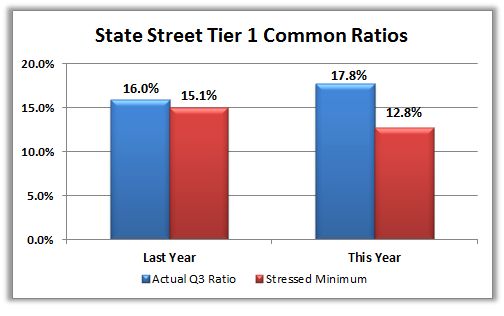
Here’s a look at how that ratio looked for State Street — both pre-test actual and under stressed conditions — as compared to similar numbers during last year’s CCAR tests.

Source: Federal Reserve.

If I wanted to get picky, I could point out that State Street’s Tier 1 common ratio fell more under the stress scenario this year versus last year. But given that State Street’s minimum Tier 1 common ratio under the stressed conditions is the second highest — after Bank of New York Mellon — I’m not going to bother getting too picky.

Projected net income
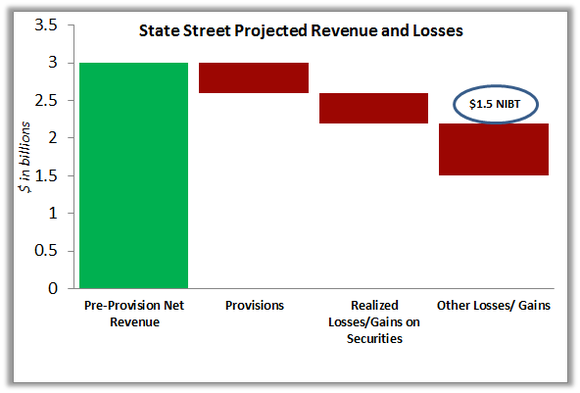
How do the regulators get to the stressed capital ratios? A big piece of the puzzle is using the stress-scenario inputs to estimate how much of a profit the bank will register over the nine-quarter test period.

It’s actually unusual that we can look at State Street’s net income under stressed conditions. Most banks included in the tests reported a net loss under the Fed’s stress scenario. In fact, overall, the group produced a collective $194 billion loss over the nine-quarter period.

However, a few banks like State Street — and again, BoNY — were able to pull off a projected profit. Here’s what the breakdown looked like:

Source: Federal Reserve.

Because State Street is more of a bank for banks, as opposed to lending to consumers and businesses, its exposures are far more to the investments securities on its books than residential or commercial loans. And since the bank maintains such a low-risk portfolio, even a significantly stressed economic environment isn’t expected to put a crippling hit on its books.

Now what?
There shouldn’t have been too many sleepless nights for State Street investors leading up to these stress tests. With the results out, we can see that it does indeed have one of the most stable balance sheets of the major U.S. banks.

Following last year’s CCAR results, State Street both boosted its dividend and announced a new share buyback program. Is that in the cards …read more
Source: FULL ARTICLE at DailyFinance

BNY Mellon Proves It's No Ordinary Bank

By John Maxfield, The Motley Fool

If you had any doubt about whether the Bank of New York Mellon was an ordinary bank, with its first-in-class custodial operations, then doubt no more. Yesterday, the Federal Reserve released the results of its most recent round of stress tests, and BNY Mellon came out on top. The charts and discussion below examine how the company’s capital and earnings held up under the Fed’s “severely adverse” economic scenario.

The purpose of the stress tests is to gauge how the capital bases of the nation’s largest financial institutions hold up in the face of economic and financial turmoil. Among other things, the most extreme case assumes that real GDP declines an average of 4% this year, unemployment ratchets up to 12.1% by the second quarter of next year, and that home prices plummet by 20% over the next 24 months.

As you can see in the chart below, BNY Mellon’s Tier 1 common capital ratio was hardly varnished despite the extreme assumptions. Starting from 13.3% at the end of last September, it bottomed out at 13.2% over the hypothetical time period extending from the fourth quarter of last year through the end of 2014. By comparison, the average Tier 1 common capital ratio of the 18 institutions tested fell by a third, from 11.1% down to 7.4%.

Source: Federal Reserve.

The asset-management giant fared equally well when it came to net income. Its hypothetical pre-tax earnings for the nine-quarter time period came in at $5.5 billion. This greatly exceeded the 18-institution average loss of $10.8 billion, and made BNY Mellon the most profitable institution tested in this regard.

Source: Federal Reserve.

Breaking this down a bit further, as you can see in the figure above, BNY Mellon’s $6.8 billion in pre-provision net revenue was hit by $1.1 billion in loan loss provisions — that is, money set aside to cover future losses from soured loans — and $200 million in losses associated with securities holdings.

Suffice it to say, BNY Mellon’s performance on the stress tests is a testament more to its business model than anything else. As I touched on here, unlike, say, a USB or Bank of America, both of which hold massive amounts of loans on their balance sheets, BNY Mellon’s principal function is to serve as a custodian and/or asset manager for others. As a result, any decline in asset prices is felt by the owners of the underlying assets as opposed to BNY Mellon.

At the end of the day, the stress tests are meant to do exactly what the name implies: stress you out. And while this year may be no exception for many, investors in BNY Mellon certainly needn’t be among those with any fears.

Want to learn more about BNY Mellon?
While some big banks continue to limp through their post-crisis recovery, Bank of New York Mellon has bounced right back. Though the bank is an 800-pound gorilla in …read more
Source: FULL ARTICLE at DailyFinance

Here's How Regions Financial Fared in the Stress Tests

By Matt Koppenheffer, The Motley Fool

Filed under:

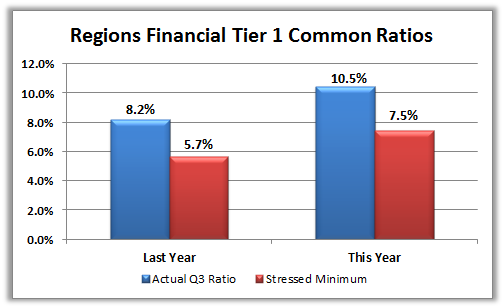
If the Federal Reserve were handing out report cards for the Dodd-Frank stress tests, I think Regions Financial‘s  performance is worthy of a B-. Make no mistake about it, Regions is still far from as strong as the top banks out there. But the bank has made some great strides from last year and its stressed capital levels were well above required minimums.

Unlike the Federal Reserve‘s Comprehensive Capital Analysis and Review — which comes out next week — the Dodd-Frank stress tests do not determine whether or not the banks involved can pay higher dividends or pay out stock. But since they use essentially the same modeling and stress-case scenarios, they’re a good way for investors to get a sense for how the banks will perform in the CCAR and whether they’ll be able to increase capital distributions.

Capital ratios
Perhaps the key metric that the Fed and investors are looking at in the results of the stress tests is the tier 1 common capital ratio and, in particular, how low that ratio falls under the hypothetical stressed conditions. 

Here’s a look at how that ratio looked for Regions — both pre-test actual and under stressed conditions — as compared to similar numbers during last year’s CCAR tests.

Source: Federal Reserve.

As you can easily see from that chart, it appears that Regions has significantly improved its balance sheet since this time last year.

Projected net loss
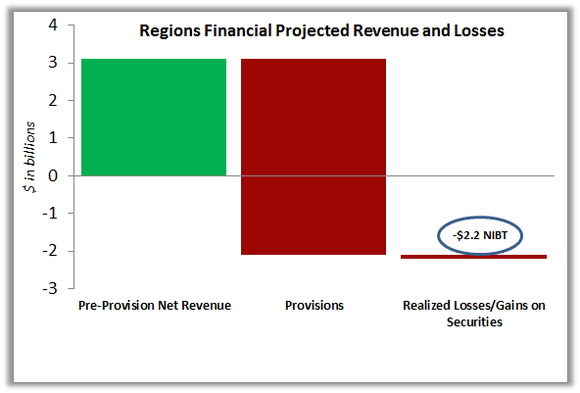
How do the regulators get to the stressed capital ratios? A big piece of the puzzle is using the stress-scenario inputs to estimate how much of a profit — or, in most cases, a loss — the bank will register over the nine-quarter test period.

In Regions’ case, the answer is a $2.2 billion loss on $3.1 billion of pre-provision net revenue — that is, revenue before loan-loss provisions less operating expenses. 

Source: Federal Reserve.

The loan losses estimated for Regions come to 7.6% of average loan balances. That’s above the 6.6% median of the entire group, but far from the worst.

One step further…
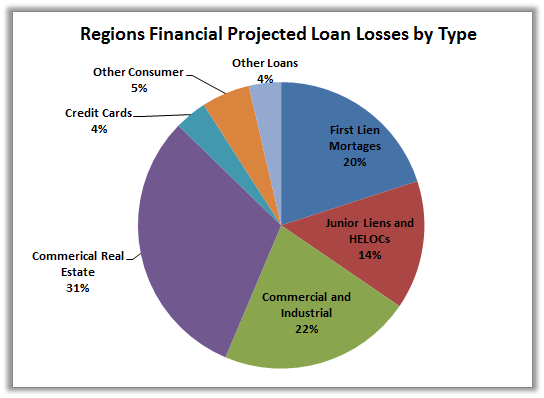
Finally, if we break down those loan losses, we can see where the Fed projects that Regions would take the biggest balance-sheet hits in the hypothetical stressed scenario.

Source: Federal Reserve.

It shouldn’t be too surprising that much of Regions’ losses were projected to come from commercial real estate. Not only is its CRE exposure greater than its residential mortgage exposure, but it also has a good chunk of it in CRE investor/developer loans, which are riskier than average. Overall, Regions’ CRE loss rate was above the 7.8% median of the group.

Now what?
Going into the stress tests, I was hopeful that Regions would do well. On the other end of this first round of tests, I think we can safely say it did. Considering that Regions’ stock is valued below the average bank stock, that alone is a win for investors.

As …read more
Source: FULL ARTICLE at DailyFinance