
By Morgan Housel, The Motley Fool
Source: Federal Reserve.
Neil Irwin of The Washington Post
Filed under: Investing
Late last year, Richard Dugas of homebuilder Pulte noted that his company was having trouble hiring enough workers to keep up with demand. “The number of markets feeling some degree of labor pressure is growing,” he said. “In fact, almost all of our markets have now reached a point where labor pressures are being experienced to some degree.”
Yesterday, Catherine Rampell of The New York Times detailed a similar problem:
In many areas, builders are scrambling to ramp up production but face delays because of the difficulty of finding construction workers and in obtaining permits from suddenly overwhelmed local authorities.
This makes sense. Homebuilders laid off a ton of workers during the housing bust. And while rebounding customers can put in orders for new homes quickly, hiring a crew of skilled construction workers takes time.
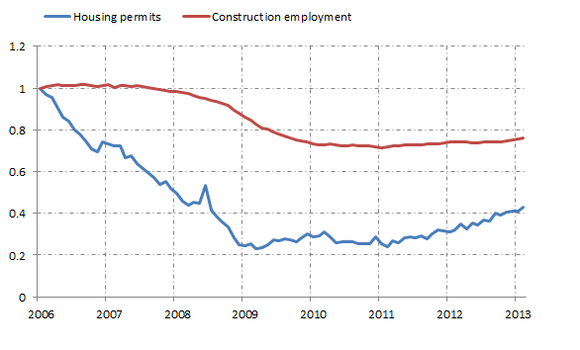
But this story is more complicated than it looks. Compared with the drop in construction permits, homebuilders actually didn’t lay off as many construction workers during the bust as you might think:
Source: Federal Reserve.
Neil Irwin of The Washington Post explains:
Key to understanding the sluggish growth in construction jobs is a concept called “labor hoarding.” That’s what happens during a recession when companies don’t fire as many workers as the decline in business would seem to have justified. Firms don’t want to lose all their quality workers and then be unable to keep up with demand when business finally turns around, so they keep people on staff even when there is not enough work to keep them fully busy.
This seems to have happened on a large scale in construction in the last few years. Kris Dawsey and Hui Shan at Goldman’s economics research group calculated that the economic value added per construction worker fell from $80,000 in 2006 to under $60,000 at the end of 2012. That is labor hoarding in a nutshell.
Construction can now rise much faster than employment because we’re coming off of a period when construction fell much faster than employment. Last year, Lennar CEO Stuart Miller said, “The homebuilding business is beginning to revert to normal, and that’s positive for the U.S. economy in general.” Jeff Mezger of KB Home said, “We’re on offense and pursuing our growth targets.” This is great for news for homebuilders! But it doesn’t necessarily mean they need legions of new construction workers.
But how does that fit in with stories about a tight labor market? Here’s the key, from Rampell:
Many workers in the immigrant-heavy industry have left the area [California], returning to Mexico and other points south. Others pursued work in Texas’s energy boom, where both drilling and construction jobs have become more plentiful. Those who stayed in the local area often switched to medical data entry, U.P.S. delivery services, or anything else that they could find. Or they filed for disability and dropped out the labor force altogether.
So, it seems homebuilders are looking to hire a small number of workers — not …read more
Source: FULL ARTICLE at DailyFinance