Tag Archives: PPNR

Fifth Third Announces First Quarter 2013 Net Income to Common Shareholders of $413 Million or $0.46

By Business Wirevia The Motley Fool

Filed under:

Fifth Third Announces First Quarter 2013 Net Income to Common Shareholders of $413 Million or $0.46 Per Share

  • 1Q13 net income available to common shareholders of $413 million, or $0.46 per diluted common share, vs. $390 million or $0.43 per share in 4Q12, up 7% and $421 million or $0.45 per share in 1Q12, up 2%
  • 1Q13 results included a benefit of $34 million pre-tax (~$22 million after-tax, or ~$0.02 per share) on the valuation of the warrant Fifth Third holds in Vantiv
    • Significant items in 4Q12 included a positive net pre-tax impact related to Vantiv shares and warrants of $138 million (~$90 million after tax, or ~$0.10 per share) and pre-tax expense for FHLB debt extinguishment of $134 million (~$87 million after-tax, or ~$0.09 per share); significant 1Q12 items included a positive net pre-tax impact related to Vantiv shares and warrants of $127 million (~$83 million after-tax, or ~$0.09 per share)
    • Excluding these items, earnings per diluted common share of $0.44^ increased $0.08, or 22%, from 1Q12
  • 1Q13 return on assets (ROA) of 1.41%; return on average common equity of 12.5%; return on average tangible common equity** of 15.4%
  • Pre-provision net revenue (PPNR)** of $653 million in 1Q13
    • Net interest income (FTE) of $893 million, down 1% sequentially due primarily to lower day count; net interest margin 3.42%; average portfolio loans up 2% sequentially driven by 6% sequential growth in C&I loans
    • Noninterest income of $743 million included $34 million gain on Vantiv warrant and $17 million in investment securities gains; compared with $880 million in prior quarter which included net gains of $138 million related to Vantiv shares and warrant
    • Noninterest expense of $978 million, down 16% from 4Q12 which included FHLB debt termination charge
  • 1Q13 effective tax rate of 30.4% compared with 26.8% in 4Q12 and 28.6% in 1Q12; 1Q13 income taxes included seasonal increase of $12 million related to expiration of stock options; 4Q12 income taxes included $10 million benefit from the termination of certain leases
  • Credit trends remain favorable
    • 1Q13 net charge-offs of $133 million (0.63% of loans and leases) vs. 4Q12 NCOs of $147 million and 1Q12 NCOs of $220 million; lowest NCO level since 2Q07; 1Q13 provision expense of $62 million compared with 4Q12 provision of $76 million and 1Q12 provision of $91 million
    • Loan loss allowance decreased $71 million sequentially reflecting continued improvement in credit trends; allowance to loan ratio of 2.08%, 147% of nonperforming assets, 187% of nonperforming loans and leases, and

      From: http://www.dailyfinance.com/2013/04/18/fifth-third-announces-first-quarter-2013-net-incom/

Does Bank of America Want to Fight the Federal Reserve?

By Matt Koppenheffer and David Hanson, The Motley Fool

Filed under:

In the following video, Motley Fool financials analysts Matt Koppenheffer and David Hanson discuss Bank of America and its recent stress test results. In particular, they discuss a form of projected banking operating earnings called the pre-provision net revenue, or PPNR. While the model that Bank of America ran for this number over the stress test period came in very similar to where it came out last year in the CCAR stress test, the Fed’s calculation came in dramatically lower. Matt tells us how this affects the bank, and why B of A executives must be hopping mad behind the scenes. 

Bank of America’s stock doubled in 2012. Is there more yet to come? With significant challenges still ahead, it’s critical to have a solid understanding of this megabank before adding it to your portfolio. In The Motley Fool‘s premium research report on B of A, analysts Anand Chokkavelu, CFA, and Matt Koppenheffer, Financials bureau chief, lift the veil on the bank’s operations, including detailing three reasons to buy and three reasons to sell. Click here now to claim your copy.

var FoolAnalyticsData = FoolAnalyticsData || []; FoolAnalyticsData.push({ eventType: “TickerReportPitch”, contentByline: “Matt Koppenheffer and David Hanson“, contentId: “cms.22479”, contentTickers: “NYSE:C, NYSE:BAC, NYSE:JPM”, contentTitle: “Does Bank of America Want to Fight the Federal Reserve?”, hasVideo: “True”, pitchId: “29”, …read more
Source: FULL ARTICLE at DailyFinance

Here's How SunTrust Fared in the Stress Tests

By Matt Koppenheffer, The Motley Fool

Filed under:

For SunTrust , what a difference a year makes.

During last year’s stress tests, SunTrust got a bit of a black eye as its capital plans were rejected by the Federal Reserve. Fast forward to this year, and the bank looks like it’s in a much better position.

Unlike the Fed’s Comprehensive Capital Analysis and Review — which comes out next week — the Dodd-Frank stress tests do not determine whether or not the banks involved can pay higher dividend or pay out stock. But since they use essentially the same modeling and stress-case scenarios, they’re a good way for investors to get a sense for how the banks will perform in the CCAR, and whether they’ll be able to increase capital distributions.

Capital ratios
Perhaps the key metric that the Fed and investors are looking at in the results of the stress tests is the Tier 1 common capital ratio, and, in particular, how that low that ratio falls under the hypothetical stressed conditions. 

Here’s a look at how that ratio looked for SunTrust — both pre-test actual and under stressed conditions — as compared to similar numbers during last year’s CCAR tests.

Source: Federal Reserve.

The outcome of the tests is practically night and day when compared to last year. What accounts for the change? Part of it was the bank’s lower projected loss. In last year’s CCAR, the Fed projected that SunTrust would lose nearly $6 billion under the stress scenario. This year, that loss fell to just $4 billion.

But let’s dig in a bit further on that loss projection.

Projected net loss
How do the regulators get to the stressed capital ratios? A big piece of the puzzle is using the stress-scenario inputs to estimate how much of a profit — or, in most cases, a loss — the bank will register over the nine-quarter test period.

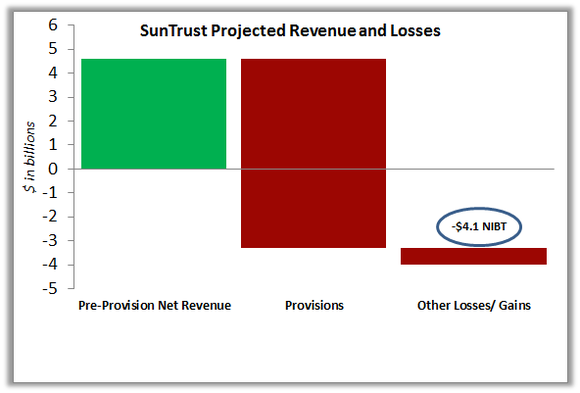
In SunTrust’s case, the answer is a $4 billion loss on $4.6 billion of pre-provision net revenue — that is, revenue before loan-loss provisions less operating expenses. 

Source: Federal Reserve.

Compared to the CCAR results last year, SunTrust was projected to have both lower loan-loss provisions — $7.9 billion versus $8.5 billion — and markedly higher PPNR — $4.6 billion versus $2.7 billion.

One step further…
Finally, if we break down those loan losses, we can see where the Fed projects that SunTrust would take the biggest balance-sheet hits in the hypothetical stressed scenario.

Source: Federal Reserve.

Thanks to SunTrust’s asset mix — which is lighter on some higher-loss loan types like credit cards — its overall loss rate as a percentage of its loans was 6.4%, which was slightly below the median across all of the tested banks.

Now what?
With SunTrust’s stock up close to 3% today, investors may be looking at the stress test results expecting redemption for last year when the CCAR rolls around next week. And I couldn’t blame …read more
Source: FULL ARTICLE at DailyFinance

Bank of America: Biggest Stress Test Disappointment

By Matt Koppenheffer and David Hanson, The Motley Fool

Filed under:

In the following video, Motley Fool financials analysts Matt Koppenheffer and David Hanson talk about one surprising — and disappointing — metric from Bank of America‘s stress test results: its pre-provision net revenue, or PPNR, as projected by the Fed out over the stress test period. Matt tells investors how far this little number has fallen since last year, why it matters, and what the silver lining might be. 

Bank of America’s stock doubled in 2012. Is there more yet to come? With significant challenges still ahead, it’s critical to have a solid understanding of this megabank before adding it to your portfolio. In The Motley Fool‘s premium research report on B of A, analysts Anand Chokkavelu, CFA, and Matt Koppenheffer, Financials bureau chief, lift the veil on the bank’s operations, including detailing three reasons to buy and three reasons to sell. Click here now to claim your copy.

var FoolAnalyticsData = FoolAnalyticsData || []; FoolAnalyticsData.push({ eventType: “TickerReportPitch”, contentByline: “Matt Koppenheffer and David Hanson“, contentId: “cms.22454”, contentTickers: “NYSE:C, NYSE:BAC”, contentTitle: “Bank of America: Biggest Stress Test Disappointment”, hasVideo: “True”, pitchId: “29”, pitchTickers: “NYSE:BAC”, …read more
Source: FULL ARTICLE at DailyFinance

Here's How JPMorgan Fared in the Stress Tests

By David Hanson, The Motley Fool

Filed under:

The last 12 months have been somewhat of a roller-coaster ride for Jamie Dimon and JPMorgan Chase . Yesterday, the Federal Reserve released the results of the annual Dodd-Frank stress tests. The release of the results surely conjured up some mixed emotions for JPMorgan shareholders.

In March 2012, Dimon successfully guided the bank through the annual stress tests, and the charismatic CEO proceeded to announce the bank’s intention to raise its dividend and initiate $15 billion of share buybacks before the institution had been given official approval from the Fed. Shares marched higher until the public was blindsided by the revelation of the losses in the bank’s centralized investment unit by the now infamous London Whale.

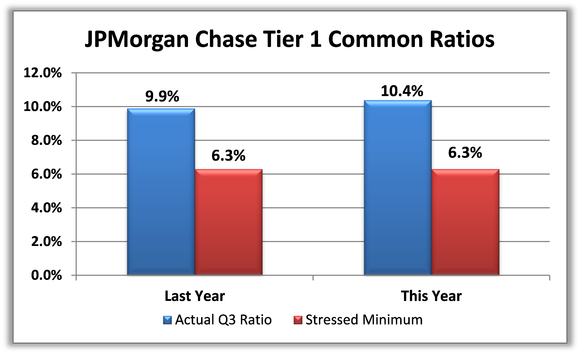
After taking his punches and a drastic pay cut, Dimon led the bank into the current stress test season with a Q3 2012 Tier 1 common capital ratio of 10.4%, around 50 basis higher than the previous year. Despite the higher actual ratio, under the Fed’s “severely adverse” scenario, the Wall Street behemoth saw its Tier 1 common ratio fall to a minimum level of 6.3%, the same level as last year’s test.

Sources: Dodd-Frank Act Stress Test 2013: Supervisory Stress Test Methodology and Results. Comprehensive Capital Analysis and Review 2012.

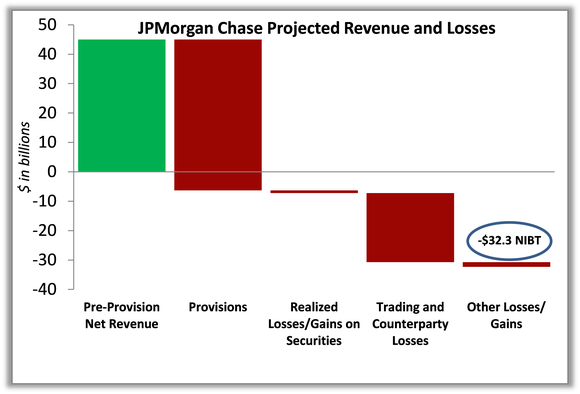
Compared to the 2011 projections for the nine-quarter severely adverse scenario, JPMorgan saw the Fed’s estimate of its Pre-Provision Net Revenue (essentially a measure of operating profit) fall from $59.3 billion to $45 billion, and its Provisions for loss climb from $48.9 billion to $51.3 billion. Investors should note that these are not in any way a forecast of expectations, but rather the Fed’s view of the bank if the global economy was to rapidly crumble. JPMorgan issued its own projections that posted higher PPNR and lower Provisions under the same scenario.

Source: Dodd-Frank Act Stress Test 2013: Supervisory Stress Test Methodology and Results.

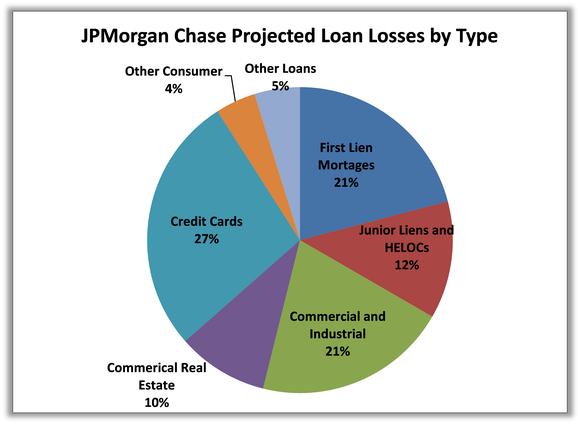
While the test results do not give granular details of the PPNR composition, they do provide a breakdown of estimated loan losses by type. Despite its global reach and capital markets activities, JPMorgan remains very closely tied to the American consumer, with around 65% of its loan losses in the adverse scenario relating to consumer products.

Source: Dodd-Frank Act Stress Test 2013: Supervisory Stress Test Methodology and Results.

Although events in 2012 undoubtedly damaged Dimon’s once-sterling reputation, he realigned the bank to continue marching toward higher capital ratios while continuing to grow revenue. Investors now look to next Thursday’s CCAR results, which determine if these banks can increase dividends and share repurchases, to see if Dimon will continue his habit of returning capital to shareholders.

With big finance firms still trading at deep discounts to their historic norms, investors everywhere are wondering if this is the new normal, or whether finance stocks are a screaming buy today. The answer depends on the company, so to help figure out whether JPMorgan is a buy today, I invite you to read our premium research report …read more
Source: FULL ARTICLE at DailyFinance