Tag Archives: UI

CES: Lenovo Displays the Next Generation of Table Computing

PC manufacturer Lenovo lifted the lid on its new IdeaCentre Horizon at CES 2013, getting consumers one step closer to truly affordable table computing.

Microsoft’s PixelSense interactive surface computing platform (previously just known as Microsoft Surface, before the company released a tablet with the same name) has generated a lot of buzz and attention over the years thanks to its intuitive UI and emphasis on object recognition and direct interaction. But the problem has always been price. Most people agree these table computers are cool, but how many end users will pay thousands of dollars for one?

Continue reading…

Source: FULL ARTICLE at IGN Tech

Viewsonic puts Nvidia inside

LAS VEGAS—PC displays are rarely sexy, but Viewsonic showed off several decidedly cool displays on the CES show floor Tuesday.

One of the more intriguing monitors is their new VSD240 smart display. Whether it’s a “smart display” or an Android Jelly  Bean-powered All-in-One PC is arguable, since the Tegra 3 processor offers pretty robust CPU and graphics performance in its own right. You can just run the VSD240 as an Android-based computer or connect it to a Windows based PC. This isn’t Viewsonic’s first smart display, but it’s the first to use Tegra 3. Earlier models used TI’s OMAP 4 processor.

You can just run the VSD240 as an Android-based computer or connect it to a Windows based PC.

The VSD240 is also a capable 1080p monitor when connected to a PC. As you’d expect from a computer, the monitor includes USB ports, SD card slots, an Ethernet jack and support for 802.11n Wi-fi. If you connect the display to a Windows 8 system, you have limited touch capability—mostly basic swipes and UI gestures since the VSD240 only supports 2-point touch, rather than the 10-point touch required to be fully Windows 8 certified.

The VSD240 will be shipping in April, with a suggested retail price of $499.

To read this article in full or to leave a comment, please click here

Source: FULL ARTICLE at PCWorld

Update on Work

As some of you know, I work for Pelagicore. We do in-vehicle infotainment using open source, Linux and Qt. I’m not in Las Vegas right now, but a whole bunch of colleagues are there, showing of at CES. This year, we’re doing loads of demos together with various partners. We demo together with Visteon (makes infotainment hardware, and more), Digia (makers of Qt), GENIVI (infotainment platform standardization organization), Cinemo (media indexing, rendering and streaming) and Rightware (cool 3D UIs).

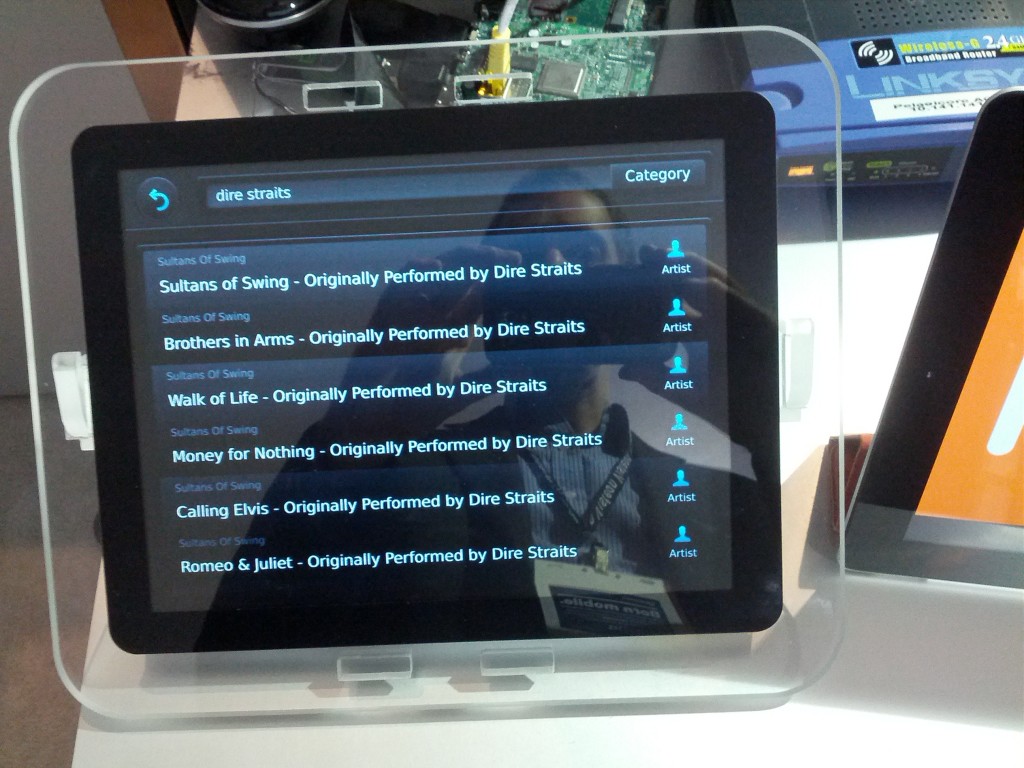
IMG_20130108_111108

One of the fun parts of working at Pelagicore is that you get to see cool hardware. I’ve personally worked with Qt on Intel prototype systems, Freescale iMXs, TI’s OMAPs and more stuff that I can’t mention. This year’s demo setup for CES is based on iMX6. The UI has been developed with DesignIt, our design partner company. Let’s face it, those who enjoy coding generally do not excel at polishing pixels. With their help, we’ve been able to make something really beautiful. The picture I’ve got of the UI itself does not say much of the look and feel, but it has a nice reflection of my kind colleague taking the photos, so I’ll use it to say thanks to him and give some credits ;-).

IMG_20130108_111352

The demo is built around Qt and QtQuick (what else is there :-P) on a Linux platform. It integrates our core platform with all the services you might need. For CES, we have some new stuff in there. I have been involved in the integration of technologies from two other companies.

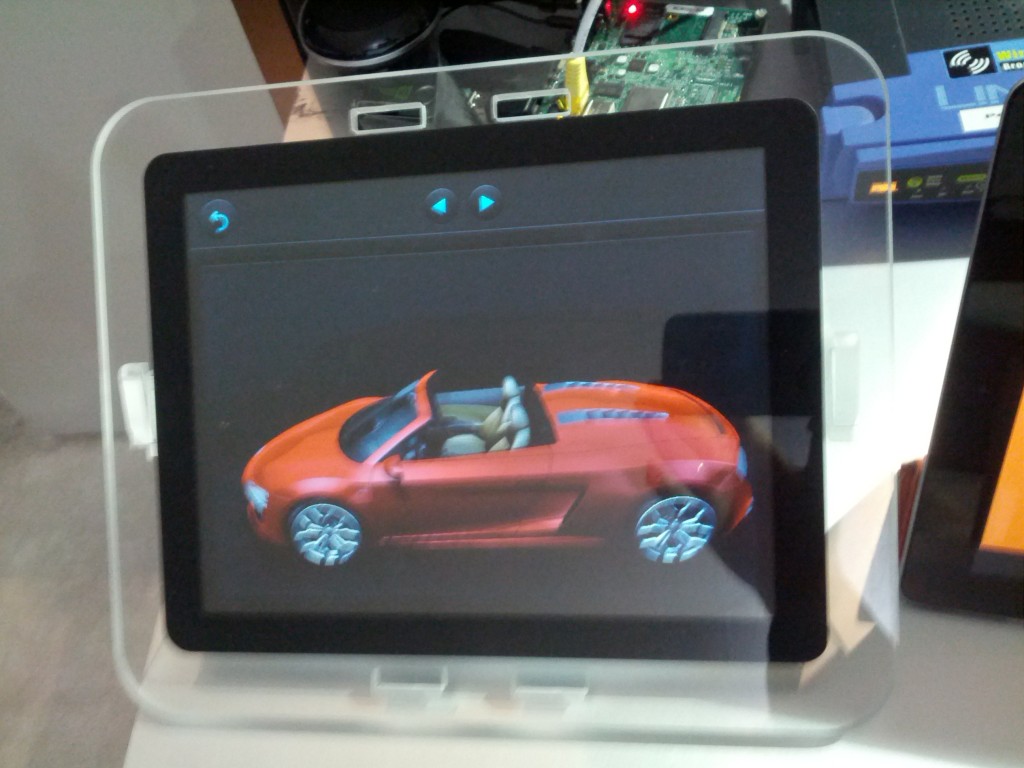
First, we have Righware and Kanzi, a nice 3D engine with an easy to use studio to create the scenes. The car shown below spins around as you change position with nice lighting and material effects. The demo is integrated as an element in the QML scene, and it is possible to bind to and from Kanzi properties, as well as hook into events from Kanzi UI elements, e.g. 3D slides and buttons.

IMG_20130108_111440

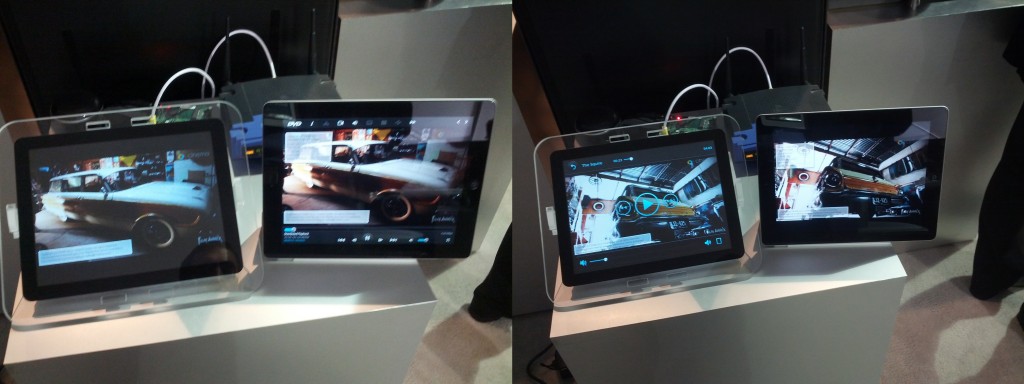
The second piece of technology is Cinemo’s media platform. It indexes, renders and streams video and audio. For instance, you can sync multiple devices showing the same video stream, so that you can share the audio through the main speakers. Again, the video stream is integrated into the QML scene, so you can do all sorts of fancy things with it. The images below show an iPad and our demo system sharing a video stream. As you can see, you can control it from either device, and they are always in perfect frame sync.

IMG_20130108_111136+7

From a business standpoint, I guess CES is one of the highlights of the year. We really get to show our stuff to a large audience. However, since I’m not in sales, to me it means overtime, but also having a chance to work with companies making awesome technology. Also, as an added bonus this year, we got to work closely with our team of former Trolls based in Munich, which always is good fun.

So, to all of you at CES. Come visit our demos! To the rest of you, look our for our platform in your next car!

Source: FULL ARTICLE at Planet KDE

Dropbox for Windows 8 arrives missing some key features

The official Dropbox app has arrived for Windows 8. It’s been close to two months since Microsoft announced at the Build developer conference that the online file storage and sharing app was coming.

Dropbox for the Windows UI is almost what you’d expect from a Dropbox mobile-style application. You can use Dropbox for Windows 8 to browse and view your files; open, edit, and save files from other Windows 8 apps; and search for files and folders using the Windows 8 search charm.

However, you can’t upload new files using the Dropbox app or the Share charm inside other Windows 8 apps. Dropbox for Windows 8 runs on both Windows 8 and Windows RT devices. The app also supports Dropbox’s two-factor authentication.

dropbox
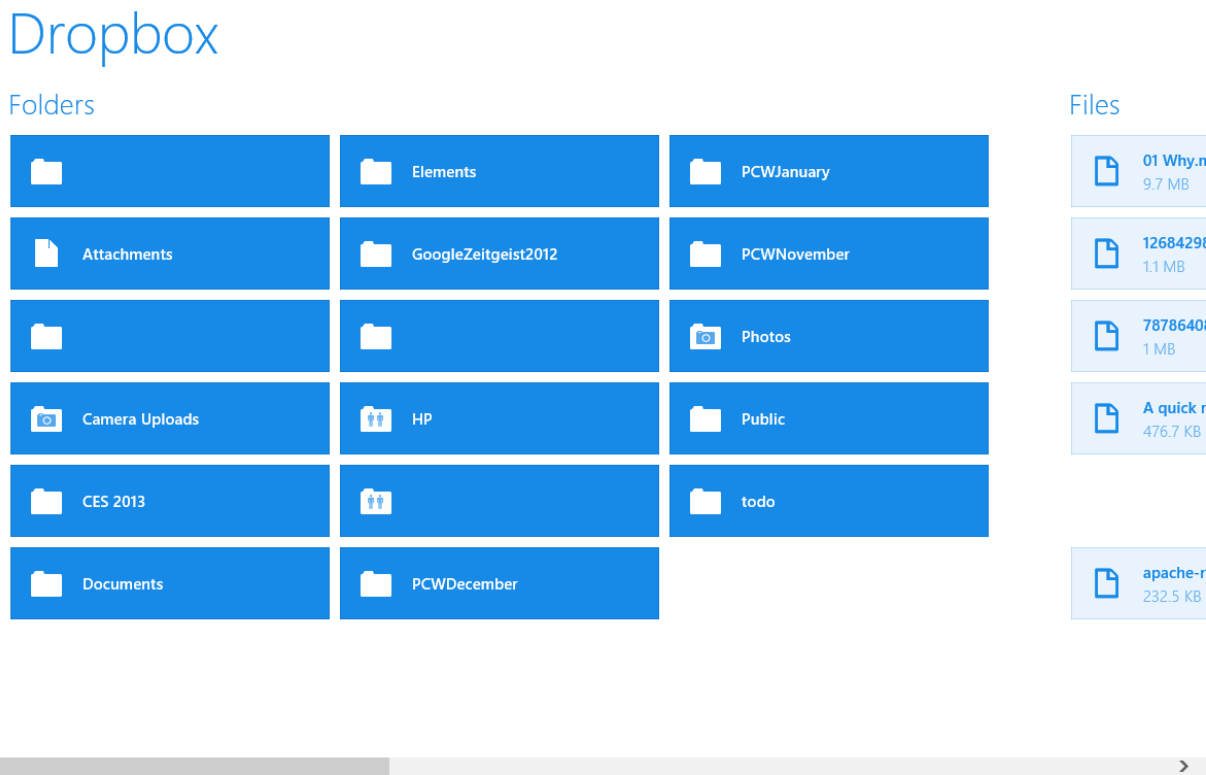
Dropbox for Windows 8 (click to enlarge)

The new Dropbox app adheres to the style of Microsoft’s Windows 8 UI and lets you scroll horizontally to view your files and folders. Folders are indicated by a bold blue tile with a folder icon and the folder name; files use a thumbnail icon, the file name, and appear in a lighter blue. Clicking on a file will allow you to open it in the app of your choice, although photo previews open automatically inside the Dropbox app.

To read this article in full or to leave a comment, please click here

Source: FULL ARTICLE at PCWorld

Why Windows To Go is perfect for BYOD

Is your business still using Windows XP? If so, you’re not alone. But, you should also seriously consider moving to a newer operating system. You could just step up to Windows 7, but there’s also a pretty strong case to be made for moving to Windows 8—particularly Windows 8 Enterprise.

It’s a bit cliché at this point to talk about what a dramatic change Windows 8 is compared with previous versions of Windows. Microsoft gave the UI a complete overhaul and reengineered the Windows operating system with tablets and touchscreens in mind. Beneath the veneer, though, it’s still Windows, and once you get accustomed to navigating the new OS, Windows 8 is pretty slick.

Windows To Go is great for BYOD.

Assuming you want to move to Windows 8, you then have to decide which version. There are a handful of features that are only available in Windows 8 Enterprise—like Windows To Go—that make it an ideal operating system for organizations that have already embraced, or plan to adopt a BYOD (Bring Your Own Device) policy.

There are pros and cons to BYOD in general for both the business and the employees. The business is exposing its data and network resources to rogue computers that may contain malware, or could end up lost or stolen and potentially expose sensitive information. The employee is cluttering up their personal PC with software and data they don’t own, and have no desire to use outside of a work environment. And, that’s just scratching the surface.

To read this article in full or to leave a comment, please click here

Source: PCWorld

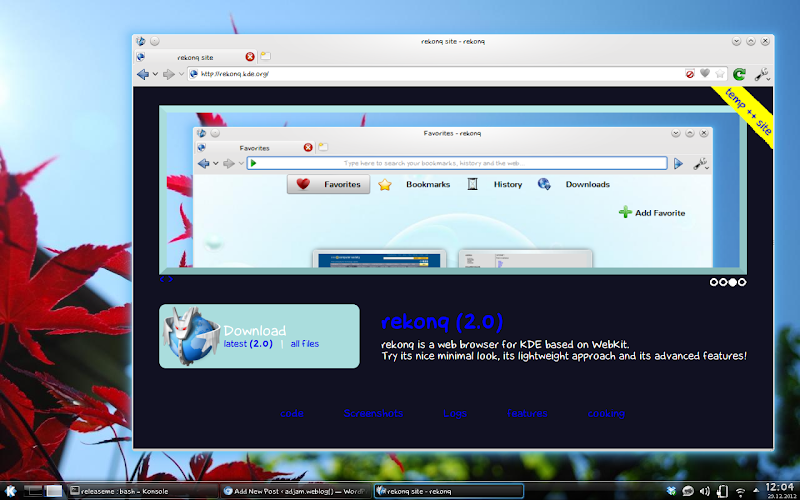
rekonq 2.0 first stable

It’s that time again, the time for a stable release! And I’m really excited this time as this 2.0 marks the beginning of a real new era for my pet project… But let’s try do things slowly and in the right order!

First, in case you don’t know about (there are some yet?), rekonq is small project about realizing a light browser for KDE based on webkit.
The 2.0 release happening today brings some new features you’ll notice at first shot and some changes under the hood you’ll be going to appreciate (or at least, I hope so).
The main idea behind is to realize a “central component” able to browser the web :) and to be used in all our use cases. This is called “WebTab” in rekonq code and it is now responsible for filling each tab in rekonq main UI as well as implementing the so called “webapp” mode.
Mandatory screenshots:

rekonq 2.0 with tabs up

rekonq 2.0 with tabs up

rekonq 2.0 in “webapp” mode

oops… you may have noticed the new UI with tabs up. This is another change I would really implement because I think this is the right UI (at least now) to browse the web. I have some ideas about the possibilities this change gives us and I’ll be going explore them with the next releases. Love it or hate it, rekonq will be tabs up since now. I’m aware this is a big change, compared with other KDE apps UI. We’ll see if people like it or not.

Other new features for the 2.X series are (in sparse order):
– inline spellcheck (when used against QtWebkit 2.3)
– new incognito mode (similar to the chrome one)
– new startup option: rekonq –incognito URL
– new startup option: rekonq –webapp URL
– pinning tabs
– improved error page
– simplified rekonq pages
I just talked about these ones here and prepared also a video, testing my kdenlive (awful) skills.

That’s it! Enjoy rekonq ;)

Filed under: international, rekonq, webkit
Source: Planet KDE

rekonq Web Browser 2.0 (KDE Web Application)

Thumbnailrekonq Web Browser 2.0
(KDE Web Application)
rekonq is a web browser for KDE based on WebKit.

changelog:
rekonq 2.0
– new UI (with tabs up)
– new incognito mode
– pinning tabs
– new startup options
– inline spellcheck
– network error management

rekonq 1.x
– fixes

rekonq 1.0
– sync: sync bookmarks with google and with opera services.
– Fancy bookmarking: store (and share) infos about bookmarks via nepomuk.
– rekonq pages visual improvements
– Favorites page: drag & drop added
– Favorites page: ability to reload preview
– Bookmarks page: rewamped
– History page: faster load showing just 2 days as default
– History page: search feature
– Downloads page: initial notifications on what is happening to the downloaded file
– Downloads page: search feature
– Settings improvements: added “privacy” and “advanced” widgets + options about.
– If user has not a default search engine set, rekonq inform him.
– Included tab history when cloning a tab via the “clone tab” action
– adblock improvements: let users decide with 1 click what adblock subscriptions use
– adblock icon in the urlbar triggering a new dialog to unblock/show blocked/hided elements
– new action to block (and hide) images

[read more]

job recommendations:
Sales Engineer full time employee
ownCloud Inc. United States of America, Boston more about this offer
[more jobs]

Source: KDE Apps

Introducing: Stitchy

To cross stitch hobbyists: Is there any cross stitch pattern design software which supports every major operating systems (Windows, Mac OS X and of course Linux) and even is open source? Well, apparently not. I’ve searched for it but unfortunately there is none. So I decided – Make it by myself!…and after a few weeks I hereby introduce a new kid – Stitchy. It features nifty UI (yeah I think so) and basic functions such as drawing, erasing, undo/redoing and cut-copy-pasting.The whole development was rushed. Basic functions are okay. But it could be crash-prone and the code is silly (I admit it) and even there are still a bunch of things out there to be done. But hey, this is just the beginning. We can improve this further by the power of open source!Have a look if you are interested. The project is hosted at Github (https://github.com/segfault87/stitchy). At this point I don’t have any releases so you must build and run it by yourself. Any helps/feedback/contributions are greatly appreciated. 🙂
Source: Planet KDE

Danbooru Client 1.0.4 (KDE Graphic Tool)

ThumbnailDanbooru Client 1.0.4 (KDE Graphic Tool)Danbooru Client is an application to access Danbooru-based image boards (http://en.wikipedia.org/wiki/Imageboard#Danbooru-style_boards). Those boards offer a REST and POST API which is used by this program.

Features:

– Connect to any Danbooru board (three predefined)
– Download up to 100 images with selectable tags;
– Repeat query over mulitple pages;
– Download or view images with the KDE preferred image viewer;
– Download pools (on boards that support it);
– Tag semantically the images using Nepomuk.

Requirements:

– PyQt (at least version 4.5)
– PyKDE4 (from KDE SC 4.7 RC2 or newer)
– (optional) Nepomuk
– Python (at least version 2.5)

Installation:

Although this is a PyKDE4 application, it uses CMake to do its work. So this means that you’ll need a working compiler and the KDE headers installed (even though they won’t be even touched).
Then, follow the steps:

– unpack
– cd to the source directory
– mkdir build; cd build
– cmake -DCMAKE_INSTALL_PREFIX=`kde4-config –prefix` ../
– make
– make install as root (or via sudo)

Known issues:

– Empty cells appear if you don’t fill all the rows
– Danbooru API wrapper is not complete
– Sometimes jobs stall and it is impossible to fetch more pages
– Pool functionality removed, pending rewrite

Future plans:

– Setting wallpapers with D’n’D to Plasma
– Tag auto completion

If you have specific suggestions, let me know.

I have been programming for a while, but this is my first proper GUI and KDE application. Comments are welcome.changelog:1.0.4
– Further fixes for Python 3 compatibility (but it doesn’t work yet, UI files need to be generated at build time)
– Rework UI again
– KWallet support for passwords (working for yande.re, danbooru.donmai.us, konachan.[com|net])

1.0.3
– Fixes for Python 3 compatibility
– “Apply” works again with configuration
– Reworked internal XML parsing, pools should work again
– Support for tag blacklists and maximum rating in pool downloads

1.0.2
UI adjustments

1.0.1
– Fix a critical bug where the OK button for connecting was not shown

1.0.0
– Clicking on an image now displays the image in the preferred viewer
– Context menu for downloading, viewing and copying image links
– Connection modal dialog removed, now an integrated widget
– Some improvements in the Nepomuk handling

0.9.9
– Correctly reset display / tags when connecting more than once
– Add support in the backend to report errors when downloading (not plugged in the UI yet)

0.9.8
– Add the possibility of hiding / showing the tag dock

0.9.7
– Fixed yet another import problem

0.9.6
– Fixed an issue where build system did not install some files

0.9.5
– Support for pools is back!
– New pool interface, using a dock in the main window: let me know if the default size is acceptable
– Known issue: “next page” is enabled when viewing pools (should be disabled) and in that case clicking it yields completely different results
– Currently pools do not honor blacklisting and rating limits, let me know if these should be enforced

0.9
– Massive internal adjustments, resulting in more maintainable code
– Danbooru API completely revamped and made simpler
– Tags have a dedicated widget
– Fetching now gets real related tags
Fixed Nepomuk tagging
– Updated default URLs
– Requires PyKDE4 from KDE SC 4.7 RC2 or newer

0.8.1
– Minor improvement on the action dialog
– Remove a couple errors in the code

0.8
– Similar tags showed while browsing images
– Support for tag retrieval
– Better integration of Nepomuk
– Ability to search by similar tags
– Reworked action dialog

Most of the above has been adapted by a patch originally sent by Yuen Hoe Lim. Thanks!

0.6.1
– Website checking is now asynchronous
– Fixed a random crash that would happen when downloads finished (only affected KDE SC 4.4)

0.6
– Switched API from JSON to XML (better compatibility)
– Support for pools (only the first page at the moment) – notice that it will not work with moe.imouto.org as they don’t implement the API properly
– Tag blacklists now are also used to filter out posts, i.e. if tag FOO is blacklisted, posts with tag FOO will not be downloaded

0.5.1
– Fetch post dialog reworked (please give feedback)
– Addition of default rating: now you can configure the default rating for fetching posts

0.5
– Major code refactoring
– Support for pagination: the same query can be spread across multiple pages (like browsing the actual image board)
– Support for translations: if you are a translator, you can find the .pot file in the po directory of the archive. Please send me translations, and I’ll make them available.

0.4.1
– Fix a bug that completely crippled showing thumbnails
– Minor code optimization

0.4
– Batch download (asynchronous)
– Fetching posts is now asynchronous as well
– Fixed an installation problem (the logo would get installed in the wrong location)
– Support fetching by rating (Safe, Questionable or Explicit)

0.2
– Download of the thumbnails is asynchronous (but queued)
– Internal adjustments to API wrapper
– Minor bugs fized

0.1
First public release.[read more]job recommendations:Sales Engineer full time employee ownCloud Inc. United States of America, Boston more about this offer[more jobs]
Source: KDE Apps

Qtractor 0.5.7 (KDE Sound Application)

ThumbnailQtractor 0.5.7 (KDE Sound Application)Qtractor is an audio/MIDI multi-track sequencer application written in C++ with the Qt4 framework. Target platform is Linux, where the Jack Audio Connection Kit (JACK) for audio and the Advanced Linux Sound Architecture (ALSA) for MIDI are the main infrastructures to evolve as a fairly-featured Linux desktop audio workstation GUI, specially dedicated to the personal home-studio.

Features:

– Multi-track audio and MIDI sequencing and recording.
– Developed on pure Qt4 C++ application framework
(no Qt3 nor KDE dependencies).
– Uses JACK for audio and ALSA sequencer for MIDI
as multimedia infrastructures.
– Traditional multi-track tape recorder control paradigm.
– Audio file formats support: OGG (via libvorbis),
MP3 (via libmad, playback only), WAV, FLAC, AIFF
and many, many more (via libsndfile).
– Standard MIDI files support (format 0 and 1).
– Non-destructive, non-linear editing.
– Unlimited number of tracks per session/project.
– Unlimited number of overlapping clips per track.
– XML encoded session/project description files (SDI).
– Point-and-click, multi-select, drag-and-drop interaction
(drag, move, drop, cut, copy, paste, paste-repeat, delete, split, merge).
– Unlimited undo/redo.
– Built-in mixer and monitor controls.
– Built-in connection patchbay control and persistence
(a-la QjackCtl).
– LADSPA, DSSI, native VST and LV2 plug-ins support.
– Unlimited number of plug-ins per track or bus.
– Plug-in presets, programs and chunk/configurations support.
– Unlimited audio effect send/return inserts per track or bus.
– Loop-recording/takes.
– Audio/MIDI clip fade-in/out (linear, quadratic, cubic).
– Audio/MIDI clip gain/volume, normalize, export.
– Audio/MIDI track and plugin parameter automation (dynamic curves,
sample&hold, linear and spline modes).
– Audio clip time-stretching (WSOLA-like or via librubberband),
pitch-shifting (via librubberband [9]) and seamless sample-rate
conversion (via libsamplerate).
– Audio/MIDI track export (mix-down, merge).
– Audio/MIDI metronome bar/beat clicks.
– Unlimited tempo/time-signature map.
– Unlimited location/bar markers.
MIDI clip editor (matrix/piano roll).
MIDI instrument definitions (a-la Cakewalk(tm)).
MIDI controller mapping/learn/assignment (mixer and plug-in parameters).
MIDI system exclusive (SysEx) setups.
JACK transport sync master/slave.
JACK session support.
– MMC control surface enabled.
MIDI Song Position cueing support.
– Configurable keyboard shortcuts.
changelog:0.5.7 2012-12-27 The Hotel Sierra

– Loop and punch in/out ranges may now get set simultaneously, may even overlap each other. However, punch in/out range recording will always prevail over any loop recording takes.
– LV2 Worker/Schedule now supporting multi-instance vs. single-UI scenarios.
– LV2 Options and Buf-size extension support added.
– Fixed an off-by-one-tick bug on MIDI file input which was leaving spurious zero-length runt notes at the end of a MIDI clip, if a note-on coincides with the ending/split point (on ticket issued by Jonathan H. Pickard, thanks).
– Good old SLV2 library support for LV2 plug-ins (libslv2) is now irrevocably deprecated, or better said, completely wiped-out from the LV2 host code, now considered extinct.
– LV2 UI parameter updates are now asynchronously detached from the source GUI widget thread, in attempt to improve cross-GUI-toolkit responsiveness, specially focused on LV2 plugins with a GTK based UI (eg. amsynth, triceratops, etc.).
– Make sure LV2 UI parameters (input control ports) get updated when loading a genuine LV2 state preset.
– Improved the (custom) tempo spin-box widget signal(ing) processing and dispatching.
– Show proper pointing cursor and location tool-tip while dragging any of the time ruler markers (including latest location markers/bar).
– On saving as an archive/zip session file (suffix .qtz) include only those files that are actually referenced by live clips arrangement.
– Ongoing integration of location markers infrastructure (time-scale and MIDI-file support).
– Free-hand/linear retouching of event values, while on the MIDI clip editor’s view pane below the main piano-roll (eg. note velocities), is now possible provided the target events are selected, otherwise the usual painting edit sub-mode applies (cf. menu Edit/Select Mode/Edit Draw).
– The MIDI clip editor now senses which target view pane has focus for general selection commands (cf. Edit/Select/None, All, Invert, Range) whether the main piano-roll or the event value (velocities) view.
– Mouse middle-button clicking is back in business on main track-view and on MIDI clip editor views (piano-roll) as an immediate play-head (re)positioning command or merge/reset the edit-head/tail cursors if Shift/Ctrl keyboard modifiers are pressed.
– Formerly protected, class qtractorClip::FadeFunctor is now public in an shot-in-the-dark attempt to fix clang builds (as reported by Jekyll Wu, thanks).
– Override all sub-classed widgets mouse-pointer event handlers to be isolated from base widget style and/or window management.

0.5.6 2012-10-02 The Golf Tango

– Day 1 post-release fix: LV2 plugins with a GTK GUI were not shown due to their respective widget (GdkWidget) being prematurely and unexpectedly destroyed when raised (via libsuil).
– The dedicated audio outputs setting for instrument plugins was not in effect as default global option for new MIDI tracks, now fixed, hopefully (thanks to danboid aka. Daniel MacDonald persistence).
– An immediate Files widget cleanup option is now made available, as to select and remove all unused file entries.
MIDI track (un)solo/mute reset clip event sequence fixing; definite regression to MIDI track’s occasional muting bug while clip editing and playback is rolling.
– Apologies due on this one: shift/ctrl keyboard modifiers are back in business to change MIDI events currently selected in one single step while on MIDI clip editor (aka. piano-roll). Sorry.
– Japanese (ja) translation added (by Takashi Sakamoto).
– General time-scale bar, beat and tempo rounding fixing.
– Keyboard shortcuts configuration (Help/Shortcuts…) now checks and warns for already assigned key sequences.
– The View/Snap menu is now listed as fully accessible actions, making each snap-per-beat setting assignable to a keyboard shortcut (after a feature request by danboid aka. Daniel MacDonald, thanks).
– Fixed MIDI resize tool, now applying symmetric proportional changes to pitch-bend event values [-8191, +8191].
– Fixed re-loading of LV2 Presets that are newly created/saved during current session; actually delete and remove a LV2 Preset if found in the file-system (as suggested by Jiri Prochaszka aka. Anchakor, thanks again).
– Preset drop-down list is now sorted, on plugin properties dialog.
– After a long absence, edit(blue) cursor vertical lines are back on the MIDI clip editor views (aka. piano-roll).
– LV2 1.0.0 compliance phase II: LV2 State Files support completed.
– Updated to newer LV2 External UI extension support (now maintained by Filipe Coelho aka. falktx).
– Brand new editing tool: empty range insertion, split/moving clips or events forward the specified edit-head/tail interval, defaults to next measure or bar (cf. menu Edit/Insert/Range, Track Range).
– Don’t show the waiting cursor anymore when loading any plugins which might have a nice native editor (GUI) and options are set to show it.
MIDI clip editor now hopefully rid of random but persistent muting, a slight regression to editing while playback is rolling.
– A MIDI file player’s bug, evident while transport rolling in looped mode, has been fixed with yet another oneliner patch (kind by Jiri Prochaszka aka. Anchakor, thanks again).
– LV2 plugins with a Qt4 GUI (guess what or whom?) are now guaranteed to some reasonable window type like Qt::Widget but not Qt::Dialog nor Qt::Popup, preventing those from standing always on top while on some window managers or desktop environments (a simple addition by Jiri Prochaszka aka. Anchakor, thanks).
MIME type icons support for session (*.qtr *.qtr), template (*.qtt) and zip/archive (*.qtz) are now being introduced.
– LV2 State Files feature support is shamelessly getting real trial, now letting files referenced in LV2 plugin states to be seamlessly included when saving to a zip/archive file bundle (.qtz suffix). Added some virtual destructor stubs to shut up gcc 4.7 warnings.
– Improved plugin state resilience, now finally with parameter name matching, specifically targeted on loading old sessions or plugin preset files (.qtx), preserving old saved plugin states as much as possible in face of rogue or discrete parameter index renumbering, due naturally on any plugin’s life cycle ie. upgrades etc.;)
– Added some more snap-to-beat divisors (Beat/14, /21 and /28) due on feature request ticket, while dropping highest, probably useless one (Beat/128).
New French (fr) translation added (by Yann Collette, thanks).
– Slight late optimization on vertical zebra/grid lines drawing.

0.5.5 2012-06-15 The Foxtrot Uniform
0.5.4 2012-03-01 The Echo Victor
0.5.3 2011-12-28 The Delta Whisky
0.5.2 2011-12-16 The Charlie X-ray
0.5.1 2011-10-05 The Bravo Yankee
0.5.0 2011-07-22 The Alpha Zulu (TYOQA)
[read more]job recommendations:Sales Engineer full time employee ownCloud Inc. United States of America, Boston more about this offer[more jobs]
Source: KDE Apps

10 third-party alternatives for 'missing' Windows 8 apps

The Windows Store has grown significantly since the dark and dreary pre-launch days of Windows 8, more than quadrupling its catalog size since October 26th. Don’t let that 20,000 app number fool you, though. Quantity is not the same as quality, and the platform still suffers from hit-or-miss availability when it comes to blockbuster apps. You’ll find modern UI offerings for some of the big-name apps from other platforms in the Windows Store—including Netflix, Hulu, Skype, and Kindle—but you’re bound to hit a brick wall when looking for many other must-have titles, including Pandora, Twitter, and Facebook.

Luckily, third-party developers have stepped in with their own versions of your favorite missing apps. We’ve sifted through the Windows Store to identify the best Band-aids for the most painful Windows Store no-shows.

Source: PCWorld

Kamerka 0.8.5 (KDE Graphic Tool)

ThumbnailKamerka 0.8.5 (KDE Graphic Tool)Kamerka – take photos using your webcam and shiny animated QML interface.

Kamerka is an Qt4 app using KDE4 libraries. It uses Video4Linux to get image from
webcam and is able to save photos. Interface is based on QML and uses it’s possibilities
to show easy to use animated UI.

Installation guide: https://github.com/dos1/kamerka/raw/master/INSTALL

Lots of popular distrubutions already include Kamerka in their repositories in version at least 0.8.1. If you want to quickly see how it looks like, then consult your package manager 🙂

TODO list: https://github.com/dos1/kamerka/raw/master/TODOchangelog:0.8.5:
* added few basic filters and mirroring support from Dejan Noveski
* added option for locking image preview proportions

* fix initial window size being hardcoded to 640×480
* coding convention fixes from Michael Palimaka

* Portuguese translation from Jurandir Aparecido Sampaio
* Traditional Chinese translation from Max Lin
* Dutch translation from Kenny Verstraete

0.8.1:
* fixed installation of kcfgc file instead of kcfg
* fixed instructions in INSTALL file

* German translation from Frank Schäfer

0.8:
* graphical configuration
* XDG Pictures folder is now used by default to store photos
* photo folder is now configurable
* options to turn on/off sounds and notifications
* better error handling
* reworked video thread – it’s now much less ugly 🙂
* creating photo directory when trying to open it, instead of showing big ugly error
* xdg-open utility used instead of kde-open
* moar pretty, but still not disturbing animations!

* Kamerka depends now on Phonon from KDE, not Qt (fixes build errors on systems without qt-phonon)
* libv4lconvert is now correctly found on 64 bit systems
* fix for Qt 4.7.0 (“import QtQuick 1.0” appeared first in 4.7.1)
* some license issues fixed

* Czech translation from Pavel Fric
* Serbian translation from Mladen Pejaković
* Spanish translation from Daniel Halens

0.6:
* first public release[read more]job recommendations:Sales Engineer full time employee ownCloud Inc. United States of America, Boston more about this offer[more jobs]
Source: KDE Apps

Agile Workers congratulates Qt on version 5

After almost seven years of hard work, the Qt Project has announced that version 5 of their UI framework has been released. We at Agile Workers Software would like to congratulate the whole community for their efforts and for continuing to produce such awesome software.

This announcement is especially exciting for us, since we love Qt and are active participants in the community. Members of Agile Workers Software, like certified Qt expert Mirko Boehm, provide expert training and development work around the Qt Framework and we’re happy to see that the latest release will make our work even more powerful and enjoyable.

Qt 5 brings the UI developer a whole load of great new features and improvements, in particular:

The graphical capabilities and performance are now amazing and even work in embedded and mobile devices, with GL-based scene graphs, a particle system and shader effects.
JavaScript and QML are now first-class citizens, while ensuring that C++ support remains at the core.
It’s now simpler to achieve cross-platform portability.
Improved support for JSON, WebKit, HTML5, multimedia.
And much more!

We look forward to continuing our work with both the technology and the community. As always, Agile Workers stands ready to assist you with all your Qt needs.

The picture is Agile Worker’s remix of the Qt logo with “Birthday cake” by Dan Taylor.

Source: Planet KDE

KDAB contributions to Qt 5.0 (part 1)

Yesterday Qt 5.0.0 was released. It is the culmination of huge amounts of work since the announcement of and start of Qt 5′s development. This is the first major release of Qt since the launch of open governance in Autumn 2011, when it became much easier for external individuals and companies to contribute to Qt in terms of code submissions, code reviews, design, and maintenance.

As KDAB benefits from a successful Qt, we have made investments to contribute to the long-term health of the frameworks. There are over 1100 commits from KDAB in the qtbase git repository alone, and many others in other Qt repositories. Excluding individual contributors, we have consistently been the next biggest contributor, second only to the owners of Qt (Nokia/Digia). We have been fixing bugs, implementing wishes from the JIRA tracker, designing writing and testing new features, implementing platform support, reviewing other contributors’ code and participating in discussions around the project.

A new blog series here will detail some of the interesting features of Qt 5.0 which were contributed by KDAB.

QEventLoopLocker

One of the early complete new features contributed by KDAB to Qt 5 was the QEventLoopLocker. This is a class whose need first appeared in KDE, and it relates to the quitOnLastWindowClosed concept in Qt. For KDE applications, there was a desire to quit applications when the last window was closed, but there was also a need to finish some operation before quitting the application. For example, the email with the large attachment is not fully sent yet, or we’re still uploading a large file to an FTP site somewhere. As these operations typically have separate, out-of-process UI, it is ok to not show any window until the job is finished.

That concept was generalized to be able to quit not just the application, but any event loop or any thread, using the new QEventLoopLocker RAII class. This will make implementation of job-queues much easier in Qt 5. For maintenance, the quitOnLastWindowClosed feature in Qt is implemented using the same implementation details as the QEventLoopLocker.

Improved MetaType features

The QMetaType system has seen some large improvements in Qt 5 contributed by KDAB. Some of the improvements were explained at Qt Developer Days in Berlin.

Declaring and using metatypes is now much more convenient in many cases. For example, if you wrote a MyObject type inheriting QObject, or MyWidget type inheriting QWidget in Qt 4, and you wished to put an instance of it into a QVariant, you would need to first use

Q_DECLARE_METATYPE(MyObject*)

somewhere in your code. That would allow you to use

QVariant var = QVariant::fromValue(myObjectInstance);

In Qt 5, the Q_DECLARE_METATYPE use is no longer needed if your type inherits directly or indirectly from QObject. It is also not needed for any Qt container or smart pointer using types which are themselves metatypes.

For example, these constructs are no longer needed when using Qt 5:

Q_DECLARE_METATYPE(QList)Q_DECLARE_METATYPE(QList)// Because MyObject* is automatically a metatype from above! Q_DECLARE_METATYPE(QList) Q_DECLARE_METATYPE(QSharedPointer) // Because QList is automatically a metatype from above!Q_DECLARE_METATYPE(QVector)

This is also true for types where the user does still have to use Q_DECLARE_METATYPE, for example, when the type does not inherit from QObject:

struct SomeStruct {};
Q_DECLARE_METATYPE(SomeStruct)
// No need for Q_DECLARE_METATYPE(QList)

// later:
QList structs;
QVariant var = QVariant::fromValue(structs);

In some cases in Qt 4, it is also necessary to use the qRegisterMetaType method. The reason to need this is usually that Q_PROPERTY is used with a metatype which is not built-in (types such as int and QString are built-in and don’t need to be marked as metatypes).

With the new possibility of automatically declaring certain types as metatypes, the question of whether we could automatically register them came up too. Because qRegisterMetaType only needs to be used in a small number of cases, most of which relate to QObject or Q_PROPERTY in some way, it was possible to use moc to automatically register types which have not yet been registered. So now, in Qt 5, there are even fewer reasons to have to use qRegisterMetaType.

Another new qRegisterMetaType related feature in Qt 5 is the detection of accidental ODR violations. This often does not have any effect, but can accidentally hide problems such as typos which can mysteriously make your application not work properly. Now, you will get a compile-time or runtime error if using Q_DECLARE_METATYPE and qRegisterMetaType together in a way which has undefined behavior.

Another new feature is the possibility for built-in qobject_cast-style conversion through the inherited types. For example:

MyObject *myObjectInstance = …;
QVariant var = QVariant::fromValue(myObjectInstance);

// elsewhere…
if (var.canConvert())
{
QObject *obj = var.value();
// Use the properties of obj
}

This adds features ‘for free’ to domain-specific languages implemented using Qt where the language is based on QObject and properties. It only works for types which inherit from QObject, and can not be generalized for a generic static_cast. The reason for that limitation is that internally it uses the generated QMetaObject of the stored type. Future versions of Qt will extend this feature in a similar way for QSharedPointer conversions.

Another nice but minor feature is that pointers to QObject derived types contained in a QVariant now print out their address and objectName when used with qDebug. For example:

QLabel* l = new QLabel;
l.setObjectName(“someLabel”);
QVariant var = QVariant::fromValue(l);
qDebug()
Source: Planet KDE

Air Buccaneers Review

Air Buccaneers sounds like it started life in one of those wildly speculative contemporary forum threads. You know, the kind that start out with a question like “Dude, what if Skyrim had pirates?” A few posts down, another person, perhaps caught up in the excitement over BioShock Infinite, then cracks that airships might make the experience even more enjoyable. Before long, the thread erupts into a half-serious discussion about how awesome it’d be if these pirates and Vikings use these ships to battle each other, and everyone would agree that it was perhaps the best idea that no one would ever make.

Except it was made, and several years ago at that. Air Buccaneers first appeared as popular mods for the 2003 and 2004 releases of Unreal Tournament that pitted Vikings and buccaneers against each other in dirigibles outfitted with cannons, and at its height, this outlandish formula enjoyed a respectable level of cult popularity that eventually inspired Guns of Icarus. It worked so well, in fact, that it’s hard to fault developer Ludocraft for keeping core adjustments to a minimum aside from the expected updates to the visuals and the UI. The few new changes tend toward welcome changes to accessibility, such as a new perk system and the way it ditches the need for two people (or, as in UT2004, shoddy AI) to man the cannons in favor of a simpler one-button fuse and fire system.

Continue reading…

Source: IGN Video Games

Google Code-in experience – Kexi

KDE Project: DevelopmentKexi

KDE is taking part in Google Code-in (GCI) this year once again. It’s a contest to bring 13 to 17 year-olds closer to Free Software.

One of the tasks I proposed for Kexi was Adding d-pointers to the code. Because of its size I split the challenge into two GCI tasks for truly motivated students. One part has been taken by Shou Ya and second by Andrew Inishev. Both parts have been finished successfully, the patches (2 * 10 thousands of lines) are already in the Calligra master repository.

Andrew writes on his blog:”[..] It was hard for me at beginning because I am beginner in C++ and I didn’t know about d-pointers before, but when mentor of this task explained me how to use d-pointers right, task became to be easier. And I must to mention that he is very patient, if keep in mind my inattention when modify code.

Collaboration with KDE community is very useful for me (and, may be, for community 🙂 because I am getting experience and skills which will be useful in my future work. For example, experience of using version-control systems and build systems (which are important skills in collaborative development), experience in C++, etc.”

Another student tries to find UI issues while running Kexi under non-KDE desktops. This particular task expresses commitment of Kexi to be highly portable software that adapts to various environments, what is I think in line with the rest of the Qt and KDE world.

Source: Planet KDE

Microsoft's 13 biggest wins and fails of 2012

Once upon a time, Microsoft had a name for its new design language, the aesthetic foundation for its pan-product UI: Metro. Microsoft was so proud of the name that the company glorified it on campus wall posters (the shot at left came from the Twitter feed of Microsoft expert Paul Thurrott). But in early August, the company did an about-face. The name Metro was peremptorily dropped, and Microsoft embarked on a tortuous journey to rechristen the new UI. The first advisory: Call it “New User Interface.” Catchy! Since then, Microsoft has floated “Windows 8 Style UI,” “New Windows UI,” and “Modern UI Style” as acceptable synonyms for the look-and-feel formerly known as Metro.

But the public doesn’t need a fancy name for the new Microsoft aesthetic. We just need a single term that everyone agrees to use and that has some staying power!

The best Windows 8 video apps for tile-loving cord cutters

Every app store has its bleak and early days, when quality apps are rare, buried in heaps of throw-it-against-the-wall-to-see-what-sticks, fart apps, poorly coded abominations, and general dreck. The iTunes App Store had them. The Play Store—formerly Android Market—had them. The Window Store, well, it’s dredged in those early days right now—but video apps are a shining star amongst the quagmire.

The modern UI beating at the heart of all Windows 8 and Windows RT apps ensures a similar experience across all of the apps you’ll find in the Windows Store, making them simple and clean and designed to run full-screen. For many types of content, this isn’t ideal. For video, it’s perfect.

Here are seven Windows 8 video apps that don’t suck. Your mileage shouldn’t vary.

Source: PCWorld

Ear candy! The best Windows 8 music apps

The touch-friendly modern UI at the core of Windows 8 looks and feels like no Windows that’s come before, but for music lovers, the question is how does it sound? This early into the life cycle of the Windows Store, the best music apps—as with any other genre—are going to be the ones that tap into services that were robust long before the first Live Tile crossed a desktop monitor. Here are some of the best music apps we’ve found for the Metro interface.

The Music app
Xbox Music: Microsoft’s slick native music player.

Every operating system needs a dedicated music app, and Windows 8 keeps things simple by naming its modern-style music app, well, the Music app. Check out our Deep Dive into the Music appfor a full breakdown on all its new features, but in a nutshell: the app is pretty good.

In addition to full access to whatever it finds in your Music Library and the ability to download digital tunes from a vast library of songs (for an iTunes-esque fee, of course), the Music app gives Windows 8 or RT users free, ad-supported access to Xbox Music Pass, which lets you stream more than 18 million songs on-demand or listen to a surprisingly decent Smart DJ mode, which offers dynamic playlists in a manner similar to Pandora or Slacker.

After 6 months, free Music Pass subscribers are limited to 10 hours of gratis listening per month unless they pony up a $10 per month subscription, which also removes the ads.
To read this article in full or to leave a comment, please click here
Source: PCWorld