Tag Archives: Red Hat

Why Did Wall Street Let Red Hat Off the Hook?

By Anders Bylund, The Motley Fool

Filed under:

When Red Hat reported earnings on Wednesday night, you’d have thought that the company was badly broken. Shares plunged as much as 13.4% in the first ten minutes after the release.

It seemed like an open-and-shut case. The open source software veteran reported $348 million in fourth-quarter sales, while analysts had expected $349 million. This may not sound like a huge miss, but Red Hat has a habit of exceeding revenue targets by a fair margin.

So, never you mind that adjusted earnings of $0.36 per share crushed Wall Street’s $0.30 targets — time to panic and sell! Demand for Red Hat‘s products and services must be falling through the basement floor.

Right?

This fedora-sporting shadow is becoming a familiar sight in data centers everywhere; 90% percent of Fortune 500 companies employ Red Hat systems today.

Not so fast!
As you might have guessed from Red Hat‘s bounce back to stronger share prices on Thursday, the real story isn’t quite that simple — or that gloomy.

The stock ended up 0.9% higher on Thursday, the previous night’s sudden crash all but forgotten. Moreover, the after-hours plunge was paired with fairly impressive trading volume, but the climb back to positive territory came amid nearly four times the average volume. There’s real conviction behind the upside move here.

How did Red Hat pull off this magic trick? It’s a story of conservative accounting and more multi-year, million-dollar contracts.

Red Hat landed a record number of $5 million deals this quarter, and also broke the high-water mark for $10 million contracts. At the same time, large customers are warming up to the idea of breaking multi-million dollar contracts into several annual payments. That way, a substantial one-time cost turns into a bite-sized line item in the budget that’s easier to explain to upper management, investors, and other stakeholders.

The company still gives its major customers the option to pay down large agreements all at once, but has no incentive to force it. Recording revenue early so you can sit on a swelling bank account with disappearingly small interest returns doesn’t make CEO Jim Whitehurst excited. So, why not break these deals up, leaving customers to pay for multi-year licenses on a multi-year payment plan?

When you do that, you can’t record all your order bookings right away. Red Hat‘s billings are growing right alongside recorded revenues, and the off-balance-sheet order backlog expands even faster. This is the part that caught investors by surprise: Red Hat‘s long-term visibility and solid orders are growing faster than the simple revenue figure seems to imply.

The (not so) secret sauce
The company thrives in good times and in bad, thanks to the unique value of its product portfolio.

In times of crisis, budget-crunched IT managers can take a look at Red Hat‘s low product cost to keep their operations running smoothly without a whole lot of monetary support. Red Hat Enterprise Linux is a solid alternative to full-fledged Unix implementations …read more
Source: FULL ARTICLE at DailyFinance

Red Hat Beats on Q4 EPS

By Eric Volkman, The Motley Fool

Filed under:

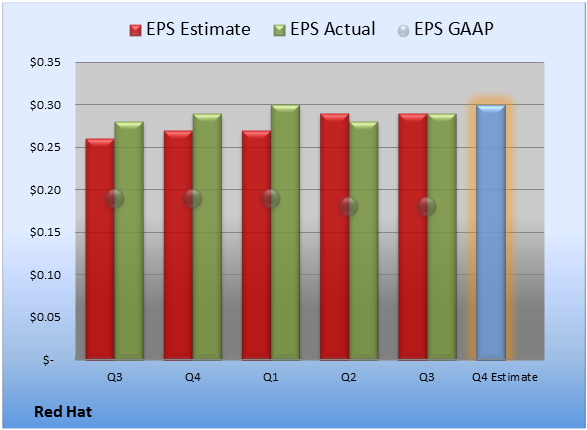
Red Hat results for the company’s Q1 have been released. For the quarter, revenue was $348 million, a 17% improvement over the $297 million in the same period the previous year. Non-GAAP net income came in at $70 million ($0.36 per diluted share) from Q4 2011’s red figure of just under $57 million ($0.29).

On average, analysts had been projecting revenue of $349 million and EPS of $0.30.

For the full year, top line was $1.3 billion, like the quarterly improvement a 17% gain over the year-before figure, which was $1.1 billion. Non-GAAP net profit landed at just under $240 million ($1.23 per diluted share) for the year against 2011’s $216 million ($1.10).

The article Red Hat Beats on Q4 EPS originally appeared on Fool.com.

Fool contributor Eric Volkman has no position in Red Hat, and neither does The Motley Fool. Try any of our Foolish newsletter services free for 30 days. We Fools may not all hold the same opinions, but we all believe that considering a diverse range of insights makes us better investors. The Motley Fool has a disclosure policy.

Copyright © 1995 – 2013 The Motley Fool, LLC. All rights reserved. The Motley Fool has a disclosure policy.

(function(c,a){window.mixpanel=a;var b,d,h,e;b=c.createElement(“script”);
b.type=”text/javascript”;b.async=!0;b.src=(“https:”===c.location.protocol?”https:”:”http:”)+
‘//cdn.mxpnl.com/libs/mixpanel-2.2.min.js’;d=c.getElementsByTagName(“script”)[0];
d.parentNode.insertBefore(b,d);a._i=[];a.init=function(b,c,f){function d(a,b){
var c=b.split(“.”);2==c.length&&(a=a[c[0]],b=c[1]);a[b]=function(){a.push([b].concat(
Array.prototype.slice.call(arguments,0)))}}var g=a;”undefined”!==typeof f?g=a[f]=[]:
f=”mixpanel”;g.people=g.people||[];h=[‘disable’,’track’,’track_pageview’,’track_links’,
‘track_forms’,’register’,’register_once’,’unregister’,’identify’,’alias’,’name_tag’,
‘set_config’,’people.set’,’people.increment’];for(e=0;e<h.length;e++)d(g,h[e]);
a._i.push([b,c,f])};a.__SV=1.2;})(document,window.mixpanel||[]);
mixpanel.init("9659875b92ba8fa639ba476aedbb73b9");

function addEvent(obj, evType, fn, useCapture){
if (obj.addEventListener){
obj.addEventListener(evType, fn, useCapture);
return true;
} else if (obj.attachEvent){
var r = obj.attachEvent("on"+evType, fn);
return r;
}
}

addEvent(window, "load", function(){new FoolVisualSciences();})
addEvent(window, "load", function(){new PickAd();})

var themeName = 'dailyfinance.com';
var _gaq = _gaq || [];
_gaq.push(['_setAccount', 'UA-24928199-1']);
_gaq.push(['_trackPageview']);

(function () {

var ga = document.createElement('script');
ga.type = 'text/javascript';
ga.async = true;
ga.src = ('https:' == document.location.protocol ? 'https://ssl' : 'http://www') + '.google-analytics.com/ga.js';

var s = document.getElementsByTagName('script')[0];
s.parentNode.insertBefore(ga, s);
})();

Read | Permalink | Email this | Linking Blogs | Comments

…read more
Source: FULL ARTICLE at DailyFinance

Red Hat Reports Fourth Quarter and Fiscal Year 2013 Results

By Business Wirevia The Motley Fool

Filed under:

Red Hat Reports Fourth Quarter and Fiscal Year 2013 Results

  • Fourth quarter revenue of $348 million, up 17% year-over-year; full fiscal year revenue of $1.33 billion, up 17% year-over-year
  • Fourth quarter subscription revenue of $303 million, up 19% year-over-year; full fiscal year subscription revenue of $1.15 billion, up 19% year-over-year
  • Fourth quarter operating cash flow of $137 million, up 7% year-over-year; full fiscal year operating cash flow of $465 million, up 19% year-over-year
  • Year-end deferred revenue balance exceeds a billion dollars, up 15% year-over-year

RALEIGH, N.C.–(BUSINESS WIRE)– Red Hat, Inc. (NYS: RHT) , the world’s leading provider of open source solutions, today announced financial results for its fiscal fourth quarter and fiscal year ended February 28, 2013.

Total revenue for the quarter was $348 million, an increase of 17% in U.S. dollars from the year ago quarter, or 18% measured in constant currency. Constant currency references in this release are as detailed in the tables below. Subscription revenue for the quarter was $303 million, up 19% in U.S. dollars year-over-year, or 20% measured in constant currency. For the full fiscal year 2013, total revenue was $1.33 billion, up 17% in U.S. dollars year-over-year, or 20% measured in constant currency, and subscription revenue was $1.15 billion, up 19% in U.S. dollars year-over-year, or 22% measured in constant currency.

“For FY13, the growth drivers in our business remained intact, driving record annual revenue, billings proxy and total backlog up 17%, 14% and over 19% year-over-year, respectively. Within total backlog, the value of customer contracts to be billed in the future and not reflected in our financial statements increased to over $280 million, or up over 40%, as customers increased their commitments to Red Hat technologies in the data center,” stated Jim Whitehurst, President and Chief Executive Officer of Red Hat. “We continued to see momentum with large deals in Q4, closing a record number of deals …read more
Source: FULL ARTICLE at DailyFinance

Dow Jones May Slip on Euro Fears

By Roland Head, The Motley Fool

Filed under:

LONDON — Stock index futures at 7 a.m. EDT indicate that the Dow Jones Industrial Average may open 0.35% lower this morning after closing at a new high last night, while the S&P 500 may open down by 0.37% after closing within two points of its all-time high yesterday. As the S&P 500 approaches record levels, the CNN Fear & Greed Index has also moved higher, closing at 76 yesterday in a return to “extreme greed” territory.

In Europe, protests continue in Cyprus as the country’s central bank governor says its banks will open tomorrow with new capital restrictions in place. Italian markets moved lower after yet another set of negotiations failed to produce a coalition to govern the country. Italy has been without an effective government since elections were held at the end of February, and a new round of elections now looks increasingly likely.

In the U.K., the Bank of England said U.K. banks needed to raise a further $38 billion to meet capital shortfalls and cover potential loan losses. The report did not specify which banks were affected, but Lloyds Banking Group and Barclays moved higher after the announcement, which was lower than a previous $90 billion estimate. Revised GDP figures showed that the U.K. economy expanded by just 0.2% in 2012, less than the 0.3% previously reported. Both the British and French economies shrank by 0.3% in the final quarter of 2012.

In the U.S., investors will be looking ahead to February pending-home-sales figures, which are due at 10 a.m. EDT. Consensus forecasts suggest that sales may have fallen by 0.5% in February after rising by 4.5% in January. Also of interest may be the EIA weekly petroleum status report, due at 10:30 a.m. EDT.

Companies due to report before the opening bell today include UniFirst, which is expected to report earnings of $1.13 per share. Companies due to report after markets close today include Paychex, Red Hat, Texas Industries, SYNNEX, HB Fuller, Steelcase, Five Below, and PVH. SAIC stock could also be actively traded this morning after the technical-services provider announced a $1 special dividend in its full-year results, which were published after markets closed last night. SAIC shares moved 4.2% higher in after-hours trading last night.

Finally, let’s not forget the Dow’s daily movements can add up to serious long-term gains. Indeed, Warren Buffett recently wrote, “The Dow advanced from 66 to 11,497 in the 20th Century, a staggering 17,320% increase that materialized despite four costly wars, a Great Depression and many recessions.” If you, like Buffett, are convinced of the long-term power of the Dow, you should read “5 Stocks To Retire On.” Your long-term wealth could be transformed, even in this uncertain economy. Simply click here now to download this free, no-obligation report.

The article Dow Jones May Slip on Euro Fears originally appeared on Fool.com.


Roland Head has no position in …read more
Source: FULL ARTICLE at DailyFinance

What to Expect from Red Hat

By Seth Jayson, The Motley Fool

Filed under:

Red Hat (NYS: RHT) is expected to report Q4 earnings on March 27. Here’s what Wall Street wants to see:

The 10-second takeaway
Comparing the upcoming quarter to the prior-year quarter, average analyst estimates predict Red Hat‘s revenues will expand 17.7% and EPS will increase 3.4%.

The average estimate for revenue is $349.5 million. On the bottom line, the average EPS estimate is $0.30.

Revenue details
Last quarter, Red Hat logged revenue of $343.6 million. GAAP reported sales were 18% higher than the prior-year quarter’s $290.0 million.

Source: S&P Capital IQ. Quarterly periods. Dollar amounts in millions. Non-GAAP figures may vary to maintain comparability with estimates.

EPS details
Last quarter, non-GAAP EPS came in at $0.29. GAAP EPS of $0.18 for Q3 were 5.3% lower than the prior-year quarter’s $0.19 per share.

Source: S&P Capital IQ. Quarterly periods. Non-GAAP figures may vary to maintain comparability with estimates.

Recent performance
For the preceding quarter, gross margin was 84.5%, 10 basis points better than the prior-year quarter. Operating margin was 14.6%, 400 basis points worse than the prior-year quarter. Net margin was 10.1%, 310 basis points worse than the prior-year quarter.

Looking ahead

The full year’s average estimate for revenue is $1.34 billion. The average EPS estimate is $1.16.

Investor sentiment
The stock has a two-star rating (out of five) at Motley Fool CAPS, with 624 members out of 763 rating the stock outperform, and 139 members rating it underperform. Among 190 CAPS All-Star picks (recommendations by the highest-ranked CAPS members), 162 give Red Hat a green thumbs-up, and 28 give it a red thumbs-down.

Of Wall Street recommendations tracked by S&P Capital IQ, the average opinion on Red Hat is outperform, with an average price target of $60.90.

Software and computerized services are being consumed in radically different ways, on new and increasingly mobile devices. Many old leaders will be left behind. Whether or not Red Hat makes the coming cut, you should check out the company that Motley Fool analysts expect to lead the pack in “The Next Trillion-dollar Revolution.” Click here for instant access to this free report.

The article What to Expect from Red Hat originally appeared on Fool.com.


Seth Jayson had no position in any company mentioned here at the time of publication. You can view his stock holdings here. He is co-advisor of
Motley Fool Hidden Gems, which provides new small-cap ideas every month, backed by a real-money portfolio. The …read more
Source: FULL ARTICLE at DailyFinance

Intro to Real-Time Linux for Embedded Developers

By libbyclark

Steven Rostedt, kernel developer and stable real-time patch maintainer

When embedded projects call for for a real-time operating system, Linux developers often turn to PREEMPT-RT, the real-time kernel patch, to get it done.

“The PREEMPT_RT patch (aka the -rt patch or RT patch) makes Linux into a real-time system,” said Steven Rostedt, a Linux kernel developer at Red Hat and maintainer of the stable version of the real-time Linux kernel patch.

The thing is, in most cases real-time requirements on embedded projects can be met without turning to a real-time operating system, he said via email. To developers, a real-time system “does what you expect it to do when you expect it to do it.” That’s all.

“It’s about no surprises,” he said last month in his “Inside the RT patch” presentation at the Embedded Linux Conference (see the slides or video, below).

That means depending on the project’s requirements, any OS can be considered real-time. So when is the RT patch needed?

Here Rostedt discusses when to use a RTOS; compares the RT patch with mainline Linux; defines “hard” vs. “soft” real-time requirements; tells developers how to get started with the RT patch; and estimates when he expects PREEMPT-RT to be fully incorporated into the mainline Linux kernel. 

As Dave Stewart said in an ABS panel discussion, people often assume that embedded means real-time but that’s not always the case. He said, “There’s been a dawning realization that you can achieve the vast majority of what you need to with embedded without a classically-oriented real-time system.” Do you agree?

Steven Rostedt: Yes. In fact, a lot of people I’ve talked to think they need real-time for their work when they actually do not. One of my colleagues a long time ago stated that all operating systems are real-time. That is, they all have some kind of deadline, even Windows. If you hit a key and the computer doesn’t respond in say 5 minutes, you are likely to throw the computer out the window. It failed to meet its deadline. When your deadlines are big enough, pretty much any operating system will do.

Of course there’s caveats to this rule.

When and how does real-time Linux come into embedded development?

It all comes down to what your requirements are. An ATM probably doesn’t require a real time operating system, because it’s not too hard to create code that would let it make its deadlines. It just needs to be clean (non buggy) code, not real-time.

Now, if your embedded device has some “must have” deadlines to respond to then the PREEMPT_RT patch would probably be sufficient. I’ve heard that some of the Garmin navigational devices run with Linux patched with the PREEMPT_RT kernel.

What PREEMPT_RT gives you over the normal kernel is not only faster response times, but more importantly, it removes all unbounded latencies. An unbounded latency is where the amount of delay that can occur is dependent on the situation.

For example, with unfair reader writer locks, where the writer has to wait for there to be no readers before it can take the lock. Because new readers can continually take the lock at any time …read more
Source: FULL ARTICLE at Linux Foundation

Red Hat Collaborates with Code for America to Bring Further Cloud Enablement to City Governments

By Business Wirevia The Motley Fool

Filed under:

Red Hat Collaborates with Code for America to Bring Further Cloud Enablement to City Governments

Collaboration Brings Red Hat OpenShift Platform-as-a-Service to Local Government Agencies Free-of-Charge

RALEIGH, N.C.–(BUSINESS WIRE)– Red Hat, Inc. (NYS: RHT) , the world’s leading provider of open source solutions, today announced a collaboration with Code for America (CfA), a non-profit organization that partners with local governments to foster civic innovation, focused on using technology to increase civic engagement. The collaboration brings Red Hat‘s OpenShift Platform-as-a-Service (PaaS) offering to CfA Fellows and partner communities free-of-charge to help achieve CfA’s goal of fostering collaboration between city hall and city residents and innovative problem solving through technology. With OpenShift, CfA Fellows will be able to build, test, deploy and manage applications with the benefits of ease of use, flexibility and scalability for their applications.

The pairing of OpenShift’s rapid deployment capabilities with the innovative applications built by CfA Fellows is a compelling mix for moving civic technology capability forward. Rather than the municipal IT staff or Fellows having to provision and maintain servers, the application developers can focus on what they do best: writing code. Code for America matches Red Hat‘s vision of community-powered innovation, and open source technology gives civic groups the opportunity to not only solve pain points for IT and developers, but also improve service to end users.

The CfA Fellows will receive access to OpenShift free-of-charge for one year. CfA’s 2013 partner cities – Kansas City (Missouri and Kansas); Las Vegas; Louisville, Ken.; New York; Oakland, Calif.; San Francisco; San Mateo County, Calif.; South Bend, Ind.; and Summit County, Ohio – will also receive an option of one additional year of free hosting and services. In total, the value of Red Hat‘s contribution to CfA is worth approximately $300,000 in hosting and service per year.

OpenShift offers developers a cloud application platform with a choice of programming languages, frameworks and application lifecycle tools to build their applications. With built-in platform support for Node.js, Ruby, Python, PHP, Perl and Java and customizable cartridge functionality, developers can also add additional languages that they choose to develop in. OpenShift also supports many popular frameworks, such as Zend, Java EE, Spring, Rails, Play and more.

Supporting Quotes:

Ashesh Badani, global leader, Cloud and …read more
Source: FULL ARTICLE at DailyFinance

Red Hat Announces Agenda for Red Hat Summit, the Industry's Premier Open Source Technology Event

By Business Wirevia The Motley Fool

Filed under:

Red Hat Announces Agenda for Red Hat Summit, the Industry’s Premier Open Source Technology Event

Thousands of attendees expected at ninth annual Red Hat Summit in Boston to connect to an ecosystem of innovation

RALEIGH, N.C.–(BUSINESS WIRE)– Red Hat, Inc. (NYS: RHT) , the world’s leading provider of open source solutions, today announced Red Hat Summit 2013, the industry’s premier open source technology event. Now in its ninth year, Red Hat Summit expects to welcome thousands of attendees to the Hynes Convention Center in Boston from June 11-14, 2013, to connect to an ecosystem of innovation. This year’s agenda will feature Red Hat‘s entire portfolio of open source solutions with open hybrid cloud taking center stage. The agenda and registration for Red Hat Summit 2013 are now live at www.redhat.com/summit.

The world is more connected now than ever before. From smart phones to the cloud, technology enables people to communicate and do work with anyone, from anywhere, and advance innovation openly. As organizations embrace these changes, they also face another technological revolution – the move from hardware to software-based infrastructure. Red Hat Summit 2013 will explore how enterprises can “connect” to an ecosystem of innovation to support this shift in the IT landscape.

At Red Hat Summit 2013, attendees can be inspired by industry leaders and real world stories from organizations who will share how they are driving growth and innovation with Red Hat solutions. Featuring more than 160 sessions, Red Hat Summit attendees can attend visionary keynotes, participate in interactive sessions, see live demos, meet Red Hat‘s broad ecosystem of partners, collaborate with Red Hat engineers and community members, and build connections through networking opportunities.

Red Hat Summit 2013 features four days of content focused on many of the technology industry’s hottest topics, including open hybrid cloud, big data, OpenStack, application development, and application and platform infrastructure. Sessions will showcase the latest open source developments in cloud computing, platform, virtualization, middleware, storage, and systems management technologies. New for 2013, Red Hat Summit will fully incorporate sessions on Red Hat JBoss Middleware, formerly hosted in the co-located JBoss World conference. Red Hat Summit attendees can also expect 25 percent more lab offerings than last year. Several pre-conference events are also scheduled, including Red Hat Connect Developer Exchange, JUDCon, CamelOne and Power Training.

Red Hat Summit 2013 will also feature 12 new tracks, including:

…read more
Source: FULL ARTICLE at DailyFinance

Red Hat Introduces JBoss Fuse and JBoss A-MQ to Help Enterprises Combat Inefficiencies Caused by Isl

By Business Wirevia The Motley Fool

Filed under:

Red Hat Introduces JBoss Fuse and JBoss A-MQ to Help Enterprises Combat Inefficiencies Caused by Islands of Applications

New products bring high-performance, mission-critical lightweight integration and messaging technologies based on Apache Camel and Active MQ to middleware portfolio

RALEIGH, N.C.–(BUSINESS WIRE)– Red Hat, Inc. (NYS: RHT) , the world’s leading provider of open source solutions, today announced that it has added Red Hat JBoss Fuse and Red Hat JBoss A-MQ to its enterprise middleware portfolio. The products are based on technologies acquired from FuseSource in Sept. 2012 and are designed to enhance Red Hat‘s enterprise integration and messaging capabilities.

Integration plays a significant role in driving middleware technology adoption and is expected to continue to be front and center as external forces like mobile technology, social media and cloud infrastructure require integrated enterprise systems for improved efficiency and growth. Enterprises wrestling to overcome inefficiencies caused by islands of information—and the negative impact on customer service—can benefit from the advanced integration and messaging capabilities of Red Hat JBoss Fuse and Red Hat JBoss A-MQ.

Red Hat JBoss Fuse is a flexible open source Enterprise Service Bus (ESB) based on popular Apache projects such as Camel, a versatile enterprise integration pattern framework, which enable faster time-to-solution integration implementations. Red Hat JBoss A-MQ is based largely on the Apache ActiveMQ project and provides a standards-based, high-performance messaging platform.

The addition of both products broadens Red Hat‘s integration technology portfolio with proven and popular integration and messaging platforms and advances Red Hat‘s vision for creating and empowering intelligent, integrated enterprises. New features shared by both products include:

  • Improved Developer Tooling: Fuse IDE and JBoss Developer Studio provide an intuitive, easy to use, drag-and-drop integration development environment.
  • Lightweight Architecture: Apache Karaf provides a lightweight container for application and component deployment.
  • Operational Efficiency: Fuse Fabric provides a centralized console for managing distributed containers, while JBoss Operations Network extends additional management and monitoring capabilities for Red Hat JBoss Middleware tools installed across the network.

Integration and messaging projects drive services and additional …read more
Source: FULL ARTICLE at DailyFinance

Dell Works With Red Hat, Intel and VMware To Launch Center of Excellence for Hospitals Using Epic EH

By Business Wirevia The Motley Fool

Filed under:

Dell Works With Red Hat, Intel and VMware To Launch Center of Excellence for Hospitals Using Epic EHR Software

  • New Linux-based deployment option designed to provide more flexibility, while delivering operational efficiency for EHR customers
  • Open platform sets stage for improved interoperability through industry standards

NEW ORLEANS–(BUSINESS WIRE)– Dell has joined forces with Red Hat, Intel and VMware to open a dedicated center where hospitals can test and deploy a new option for running Epic Systems‘ electronic health records (EHR) software on Red Hat Enterprise Linux. The DRIVE (Dell, Red Hat, Intel and VMware for Epic) Center of Excellence is located near the EHR vendor’s Verona, Wis., headquarters.

Last year, Epic added Red Hat Enterprise Linux to its list of target platforms. Until then, the software exclusively ran on AIX and other UNIX servers. With the potential lower total cost of ownership of running the software on Dell Intel x86 servers, this combination could be a cost-effective option for hospitals.

At the DRIVE Center of Excellence, hospitals can test their applications on a variety of Dell server and storage options, test configurations for end-user computing, perform cross-functional testing of other optimized solutions such as help desk services and disaster recovery, and interact with all the primary third parties involved in a Linux deployment.

A legacy of expertise

Dell and the other companies in this effort each have a strong history in supporting open standards and migrating customers from complex proprietary environments. In addition to hardware, Dell provides a full range of professional services and support for every stage of EHR deployment backed by technical and clinical experts with deep expertise in working with a variety of EHR vendors.

VMware vSphere® is the leading KLAS-rated x86 virtualization platform in healthcare. vSphere provides hospitals with an industry proven virtualization platform for delivering powerful solutions from the point of care to the hospital’s datacenter.

Red Hat will provide hospitals with the premium support services they need to meet the 24×7 demands placed on an EHR system. As the world’s leading open source platform for enterprises, Red Hat Enterprise Linux offers healthcare customers a standards-based, cost-effective yet highly flexible and powerful solution.

…read more
Source: FULL ARTICLE at DailyFinance

Not able to ssh into Red Hat server wtith or without LDAP

By s ladd

Hello,
For some reason we am unable to ssh into one of our servers. It is running Red Hat 6.1. We have tried moving in a new sshd_config file as well as a new /etc/pam.d/system-auth file. The server has LDAP enabled and the server side is Oracle directory server. Just to simplify things we disabled all the LDAP portions from the client side and was still not able to ssh into the server as root. The odd part is that once enabled LDAP, we were able to switch users to another user on the server however not able to ssh into the server with that user account. Here is the verbose ssh output.. and yes it stops at that point every time

Sun_SSH_1.1.2, SSH protocols 1.5/2.0, OpenSSL 0x0090704f
debug1: Reading configuration data /etc/ssh/ssh_config
debug1: Rhosts Authentication disabled, originating port will not be trusted.
debug1: ssh_connect: needpriv 0
debug1: Connecting to server [10.xx.xxx.xxx] port 22.
debug1: Connection established.
debug1: identity file /export/home/ps151m/.ssh/identity type -1
debug1: identity file /export/home/ps151m/.ssh/id_rsa type 1
debug1: identity file /export/home/ps151m/.ssh/id_dsa type -1
debug1: Remote protocol version 2.0, remote software version OpenSSH_5.3
debug1: match: OpenSSH_5.3 pat OpenSSH*
debug1: Enabling compatibility mode for protocol 2.0
debug1: Local version string SSH-2.0-Sun_SSH_1.1.2
debug1: use_engine is ‘yes’
debug1: pkcs11 engine initialized, now setting it as default for RSA, DSA, and symmetric ciphers
debug1: pkcs11 engine initialization complete
debug1: Failed to acquire GSS-API credentials for any mechanisms (No credentials were supplied, or the credentials were unavailable or inaccessible
Unknown code 0
)
debug1: SSH2_MSG_KEXINIT sent

here’s the tcpdump from the incoming server side:
[incoming_server] /var/log # tcpdump -vvi eth2 tcp
tcpdump: WARNING: eth2: no IPv4 address assigned
tcpdump: listening on eth2, link-type EN10MB (Ethernet), capture size 65535 bytes
12:02:35.602053 IP (tos 0x0, ttl 64, id 55166, offset 0, flags [DF], proto TCP (6), length 61)
server.ourdomain.com.ssh > source_server.34894: Flags [P.], cksum 0x7edd (incorrect -> 0x0e42), seq 1179647841:1179647862, ack 1731800226, win 46, length 21
12:02:45.141593 IP (tos 0x0, ttl 64, id 0, offset 0, flags [DF], proto TCP (6), length 40)
server.ourdomain.com.hp-alarm-mgr > 10.32.000.000.56194: Flags [R.], cksum 0x038b (correct), seq 0, ack 1275004056, win 0, length 0
12:03:18.042557 IP (tos 0x0, ttl 64, id 0, offset 0, flags [DF], proto TCP (6), length 52)
server.ourdomain.com.us-cli > 10.32.000.000.34909: Flags [S.], cksum 0x3577 (correct), seq 1870858369, ack 1129696866, win 5840, options [mss 1460,nop,nop,sackOK,nop,wscale 7], length 0
12:03:21.441876 IP (tos 0x0, ttl 64, id 0, offset 0, flags [DF], proto TCP (6), length 52)
server.ourdomain.com.us-cli > 10.32.000.000.34909: Flags [S.], cksum 0x3577 (correct), seq 1870858369, ack 1129696866, win 5840, options [mss 1460,nop,nop,sackOK,nop,wscale 7], length 0
12:03:27.841945 IP (tos 0x0, ttl 64, id 0, offset 0, flags [DF], proto TCP (6), length 52)
server.ourdomain.com.us-cli > 10.32.000.000.34909: Flags [S.], cksum 0x3577 (correct), seq 1870858369, ack 1129696866, win 5840, options [mss 1460,nop,nop,sackOK,nop,wscale 7], length 0
12:03:28.617933 IP (tos 0x0, ttl 64, id …read more
Source: FULL ARTICLE at The UNIX and Linux Forums

US appeals court asks whether to limit software patents

Should an abstract idea written into software and run on a computer be patentable? That’s one question a U.S. appeals court will consider Friday when it hears arguments in a case with broad implications for software patents for companies as diverse as Google and Red Hat.

The U.S. Court of Appeals for the Federal Circuit is unlikely to invalidate all software patents in the CLS Bank v. Alice Corp. case, but it could force tech companies to narrow their claims when applying for software patents, some patent experts said.

Julie Samuels, EFF

The case, which has generated briefs from Google, Facebook, Newegg and software trade group BSA, could “set the stage” for limiting what kinds of software patents can be issued, said Julie Samuels, a lawyer with the Electronic Frontier Foundation.

To read this article in full or to leave a comment, please click here

…read more
Source: FULL ARTICLE at PCWorld