Tag Archives: ABS

2013 Honda Odyssey Touring Elite Review & Test Drive

By Harvey Schwartz

2013 Honda Odyssey MiniVan Beauty Left Done Small

Minivans continue to be a big seller for large active families that can take care of their local personal needs and take them in comfort and safety to their favorite weekend or vacation locations.  It continues to lead its class in fuel economy (19mpg/city/28mpg/highway), safety while giving up to eight passengers a spacious comfortable interior with a refined and fun-to-drive experience.

I tested the ‘top-of-the-line’ Touring Elite Odyssey and was impressed with all of the attributes that makes today’s minivan such a favorite among families.

2013 Honda Odyssey MiniVan Engine Done Small

All Odyssey models (there are five) are powered by an advanced 3.5 liter, 24-valve, SOHC, all-aluminum V6 engine with i-TEC and variable cylinder management.  It generates 248hp at 5,700rpm and 250lb.ft. of torque at 4,800rpm combining a balanced combination of fuel efficiency and low emissions.  The engine gives excellent responsiveness and acceleration that I really enjoyed while maneuvering around slow city traffic and when merging on the highway.  The engine is mated to a six-speed automatic transmission turning the front wheels.  This Honda six-speed changes gears quickly with no perception of each change.  It pulls strongly all the way up the gears.

2013 Honda Odyssey MiniVan Beauty Side Done Small

The body of the Odyssey is very rigid utilizing 59% high-strength steel to help isolate noise and to reduce body weight for agile handling and excellent fuel efficiency.  This strong and rigid body structure and long 118.1 inch wheelbase, ensures a comfortable ride and confident driving performance further enhanced with the fully independent suspension.  Up front is a MacPherson strut setup with gas-charged shocks and a 24mm stabilizer bar.  The rear features a unique multi-link double-wishbone setup with gas-charged shocks and a 24mm stabilizer bar.  This suspension keeps body lean to a minimum when traveling on curving roads and flattens out poorly paved road surfaces.  Standard Vehicle Stability Assist and traction control keep you in control when driving on steeply curving roads at speed.  Variable power-assisted rack & pinion steering gave me an excellent feel for the road, good on-center feel and light steering effort when driving slow and heavier steering feel at highway speeds.  It was responsive to all of my steering inputs.  It is one of the best driving minivans that I have tested over the years.

2013 Honda Odyssey MiniVan Beauty Rear Done Small

Slowing the Odyssey Touring Elite down from speed are large, power-assisted, four-wheel disc brakes.  Up front are 12.6 inch vented discs clamped with dual-piston calipers and 13.1 inch solid discs clamped with large single-piston calipers in the rear.  Braking control and power are enhanced with standard ABS, EBD and BA.  Whenever I used the brakes hard the feel was very linear and assuring.

The Honda Odyssey Touring Elite rides on 17X7 inch alloy wheels wrapped with 235/60R18 inch all-season radial tires for excellent grip and a smooth, quiet ride.

<a target=_blank …read more

Source: FULL ARTICLE at Automotive Addicts

Plumbing issues?

By Northern Mike

Name:  IMG-20130719-00157.jpg
Views: 4
Size:  21.8 KB
Last night was my first night staying at a co-worker’s place in town to help with some renos her and her boyfriend have been working on.
I thought this job (of many) was going to be pretty easy. It was a bathroom that I had to move one wall, clean up some pipes in the ceiling, then start on the finishing work. Most of the plumbing had been roughed in by a plumber. Can’t be be so lucky.
The work the plumber did has left me with a couple questions.

The background:
The house is a 1910 semi-detatched brike downtown home (3 stories). The house has seen many renos over the years, some great, some ok and some leaving me with words I won’t repeat.

To keep things interesting, here is what I’m working with (note, a short 2ft wall deviding the bathroom and the utility room was removed after I got there).
After a bit of head sractching, I was able to follow the pipe and figure out that it goes from the meter, to where you see it. What you see beside the ABS goes up along the bottom of the joists, then back into the Utility room to feed the rest of the house and the hot water tank.
The wall behind the ABS and copper in picture 1 is the fire wall between houses, which is brick covered in concrete.

What issues do you see with what I’m looking at and what would you suggest?
Name:  IMG-20130719-00157.jpg
Views: 4
Size:  21.8 KB

Name:  IMG-20130719-00158.jpg
Views: 4
Size:  29.6 KB
Name:  IMG-20130719-00159.jpg
Views: 4
Size:  30.7 KB

Attached Images

…read more

Source: DoItYourself.com

2014 Acura RLX Review & Test Drive

By Harvey Schwartz

2014 Acura RLX Advance Beauty Right Done Small

‘ADDING THE X FACTOR’

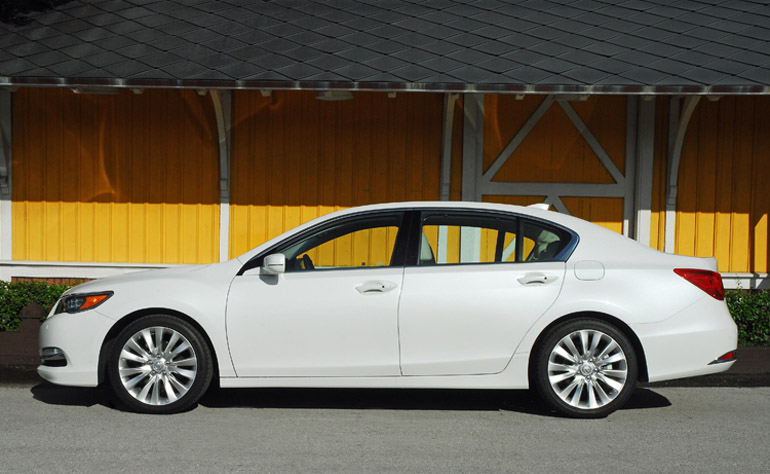
The all-new 2014 Acura RLX with the Advance Package adds more power, performance, comfort, luxury, high-tech connectivity and safety systems that take this all-new ‘top-of-the-line’ Acura into a higher position competing against the best mid-size luxury sport sedans on the market.

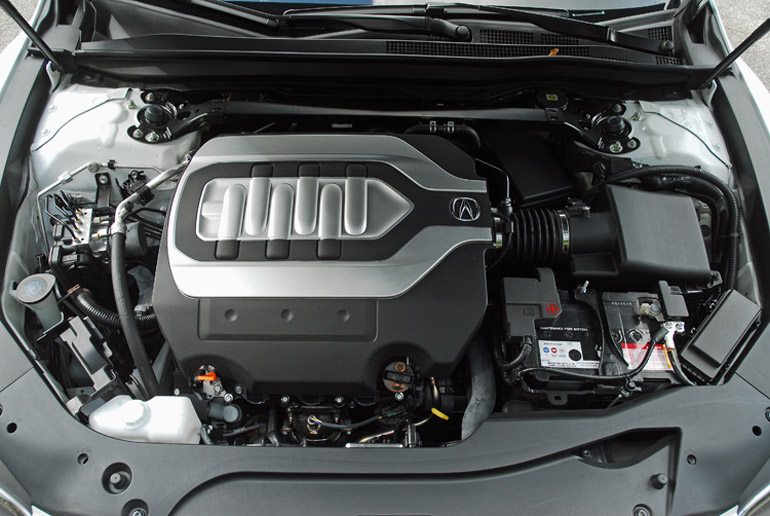
The all-new Acura is the most powerful, spacious and technologically advanced Acura sedan ever.  It is powered by an all-new 3.5 liter SOHC Earth Dreams Technology V6 engine featuring an aluminum block/heads, direct injection, and intelligent VVT + Lift electronic control, four-valves per cylinder, generating a healthy 310hp at 6,500rpm and 272lb. ft. of torque at 4,500rpm.  It also features variable cylinder management cylinder deactivation system that improves mpg when cruising.  This advanced engine is mated to a re-engineered, six-speed automatic FWD transaxle with sequential Sportshift paddle shifter on the steering wheel including a Sport mode to remap for faster and higher rpm gear changes and tighten the dampers for more spirited handling.  The new Grade Logic Control works with the transmission to keep it in the proper gear when driving up or down hilly terrain.

2014 Acura RLX Advance Engine Done Small

The state-of-the-art fully independent suspension gives you an amazing ride of a sport sedan and a luxury sedan all rolled into one.  Up front is a double-wishbone, lower double-joint setup with telescopic gas-filled Amplitude Reactive shocks and a 33mm solid stabilizer bar.  A multi-link rear suspension setup also features the telescopic gas-filled Amplitude Reactive shocks and a 25mm solid stabilizer bar to keep the RLX flat when attacking steep curving roads.  It is tremendously responsive and flattens out the potholes on rough roads.  Giving me an even more responsive feedback from my steering inputs is the electric power rack & pinion steering system that features Acura’s Precision All-Wheel Steer (P-AWS) that continuously monitors and calculates the correct amount of independent rear-wheel steering (toe angle) necessary to help you maneuver through tough curving roads with ease and stability.  With these innovative systems and Acura’s Vehicle Stability Assist with Traction Control, there is no hint that the all-new RLX is a front-wheel-drive sedan.  I felt no hint of ‘torque steer’, no understeer with the P-AWS system.  Steering is quick and responsive with a ratio of 13.9:1 and just 2.58 turns lock-to-lock.  You can shut down the Traction Control system to let the rear slide out a little at the apex of the curve to got my pulse running higher.

Quickly and safely slowing the all-new RLX down from speed are big, powerful brakes.  Up front are 12.3 inch vented discs clamped with large, Acura lettered single-piston calipers.  The rear features 12.2 inch solid discs also clamped with large single-piston calipers.  Keeping control of the RLX during hard braking on wet or slick pavement are standard ABS, EBD and BA systems.

2014 Acura RLX Advance Beauty Side Done Small

The all-new RLX with Advance came shod …read more

Source: FULL ARTICLE at Automotive Addicts

does elastomeric roof paint stick to ABS plastic?

By slo_down

Hello,
I would like to know if anyone who has used a white elastomeric roof paint like Black Jack Maxx-Cool or Henry’s Envirowhite can tell me if these products adhere well to ABS pipe extrustions on the roof. I need to paint an ABS sheet that is used as a roof, and I’ve heard that Kool Seal works well but I can’t get that product in my area.

Thank you,
Greg

San Luis Obispo, CA

…read more

Source: DoItYourself.com

3D printers may soon produce guns, startup Wiki Weapon says

A 3D-printed gun capable of firing multiple rounds may be unveiled soon.

Cody Wilson, the 25-year-old founder and director of nonprofit organization Defense Distributed, recently told Mashable that the end product of Wiki Weapon, the initiative to create an operational 3D-printed gun, may soon be ready to unveil to the public.

In a March interview with CNN, Wilson said he hoped to have a printable gun ready by the end of April.

While Wilson was sparse with details, he did tell Mashable that the prototype would be a handgun consisting of 12 parts made out of ABS+ thermoplastic, which is known for its durability and is commonly used in industrial settings. The firing pin would be the only steel component of the 3D-printed gun, which will be able to withstand a few shots before melting or breaking, Mashable reports.

To read this article in full or to leave a comment, please click here

Source: FULL ARTICLE at PCWorld

2014 Mazda CX-5 Review & Test Drive

By Harvey Schwartz

2015 Subaru WRX STI Spy Shots

‘A FASTER ZOOM ZOOM CX-5’

For the 2014 model year Mazda holds up to its famous ‘Zoom Zoom’ philosophy by increasing the size, horsepower and torque of its best-selling CX-5 sport utility vehicle.  The new inline four-cylinder engine now generates a healthier 184hp at 5,700 rpm and 185 lb.ft. of torque at just 3,250 rpm.  This all-aluminum, DOHC engine features advanced direct injection, S-VT variable valve timing on the intake and exhaust.  It also features a high 13:1 compression ratio and a uniquely crafted 4-2-1 exhaust system with dual exhaust outlets.  This new SKYACTIV-G 2.5 engine still maintains the fuel economy threshold of 25 mpg/city and 32 mpg/highway.  The engine is paired with a SKYACTIV Drive six-speed automatic sport-tuned (short shift strokes) transmission with sequential shifting to get you moving quickly.  Standard dynamic stability control and traction control help to minimize torque steer when launching quickly, or when accelerating to pass slower moving traffic on the highway.  This new powertrain is a seamless combination of power coming through as you need it.

The new 2014 CX-5 Grand Touring rides and handles like an upscale sport sedan with its fully independent sport-tuned suspension and rigid body structure using lightweight, high-tensile steel.  Up front is a MacPherson strut setup with coil springs, twin-tube shocks and a stabilizer bar.  The rear features a multi-link setup with coil springs, twin-tube shocks and a stabilizer bar.  The industry is changing over to electric power steering and the Mazda’s system benefits from a strut tower brace over the engine that gives you quick, precise response to your steering inputs as you easily maneuver around slow city traffic and when driving through curving roads.  The CX-5 also comes standard with Hill Launch Assist.

Slowing down behind the wheel of the new 2014 CX-5 is easy with four-wheel, power assisted steel disc brakes.  Up front are 11.7 inch vented discs and 11.9 inch solid discs in the rear.  Each disc is clamped with single-piston calipers and your control during braking is enhanced with standard ABS, EBD and BA.

The new Mazda CX-5 Grand Touring rides on large, 19X7 inch aluminum alloy wheels wrapped with Toyo 225/55R19 inch A23 all-season performance tires for a smooth ride and excellent grip.

The exterior design mirrors its sporting mechanicals under the sheet metal with Mazda’s current design language known as KODO, or ‘Soul of Motion’.  KODO gets its inspiration from nature-in its most calm and most furious times.  My Soul Red Metallic painted CX-5 comes with a black contrasting full-length lower bodykit to lower its center of gravity enhancing its handling capabilities and gives the truck a more sporty appearance.  Its sculptured body is taut and compact yet muscular.  Shapely flared front

From: http://feedproxy.google.com/~r/AutomotiveAddicts/~3/DEUAQrCB-n0/2014-mazda-cx-5-review-test-drive

Intro to Real-Time Linux for Embedded Developers

By libbyclark

Steven Rostedt, kernel developer and stable real-time patch maintainer

When embedded projects call for for a real-time operating system, Linux developers often turn to PREEMPT-RT, the real-time kernel patch, to get it done.

“The PREEMPT_RT patch (aka the -rt patch or RT patch) makes Linux into a real-time system,” said Steven Rostedt, a Linux kernel developer at Red Hat and maintainer of the stable version of the real-time Linux kernel patch.

The thing is, in most cases real-time requirements on embedded projects can be met without turning to a real-time operating system, he said via email. To developers, a real-time system “does what you expect it to do when you expect it to do it.” That’s all.

“It’s about no surprises,” he said last month in his “Inside the RT patch” presentation at the Embedded Linux Conference (see the slides or video, below).

That means depending on the project’s requirements, any OS can be considered real-time. So when is the RT patch needed?

Here Rostedt discusses when to use a RTOS; compares the RT patch with mainline Linux; defines “hard” vs. “soft” real-time requirements; tells developers how to get started with the RT patch; and estimates when he expects PREEMPT-RT to be fully incorporated into the mainline Linux kernel. 

As Dave Stewart said in an ABS panel discussion, people often assume that embedded means real-time but that’s not always the case. He said, “There’s been a dawning realization that you can achieve the vast majority of what you need to with embedded without a classically-oriented real-time system.” Do you agree?

Steven Rostedt: Yes. In fact, a lot of people I’ve talked to think they need real-time for their work when they actually do not. One of my colleagues a long time ago stated that all operating systems are real-time. That is, they all have some kind of deadline, even Windows. If you hit a key and the computer doesn’t respond in say 5 minutes, you are likely to throw the computer out the window. It failed to meet its deadline. When your deadlines are big enough, pretty much any operating system will do.

Of course there’s caveats to this rule.

When and how does real-time Linux come into embedded development?

It all comes down to what your requirements are. An ATM probably doesn’t require a real time operating system, because it’s not too hard to create code that would let it make its deadlines. It just needs to be clean (non buggy) code, not real-time.

Now, if your embedded device has some “must have” deadlines to respond to then the PREEMPT_RT patch would probably be sufficient. I’ve heard that some of the Garmin navigational devices run with Linux patched with the PREEMPT_RT kernel.

What PREEMPT_RT gives you over the normal kernel is not only faster response times, but more importantly, it removes all unbounded latencies. An unbounded latency is where the amount of delay that can occur is dependent on the situation.

For example, with unfair reader writer locks, where the writer has to wait for there to be no readers before it can take the lock. Because new readers can continually take the lock at any time …read more
Source: FULL ARTICLE at Linux Foundation

The Continental: Lingering Questions from the 2013 Geneva Auto Show

By Jens Meiners

The Continental

Each week, our German correspondent slices and dices the latest rumblings, news, and quick-hit driving impressions from the other side of the pond. His byline may say Jens Meiners, but we simply call him . . . the Continental.

No manual for you!

As this story is published, the Geneva auto show is in its second week. For me, the show triggered as many questions as it provided answers, and I could not identify a dominant theme for the show, which seemed to be weaker than usual on concept cars. Here are some random but thought-provoking observations:

Porsche and Manuals

The industry, unfortunately, is working to get rid of manual transmissions. Porsche is fitting its latest 911 GT3 with a seven-speed dual-clutch automatic, and when questioned about the move, the automaker responded with a flurry of rhetorical questions such as whether the company should go back to carburetors and or ditch ABS. Of course, the dual-clutch auto provides superior shifting times. But I contest the notion that it is therefore the only logical choice for the GT3. Shifting gears is an essential part of operating a car, over which I wish to exercise total control; even with paddle-actuated shifts, there is an extra layer between me and the car. And the dual-clutch automatic is heavier than a manual transmission, to boot. I hear that the upcoming GT3 RS could become available with a manual transmission. This is excellent news.

Porsche and others would do well to reflect on the enthusiastic reaction towards the Subaru BRZ/Scion FR-S/Toyota GT-86. It came in second in the European Car of the Year votes and placed among the top four in the World Car Awards; the actual winner will be announced later this month. The sports-car trio’s popularity is a powerful message to the industry: People love light-weight, tossable sports cars, even if they’re low on sophistication. And they love a manual. (The cars didn’t get votes because of their available slushboxes).

Qoros GQ3

Qoros Charging On

Qoros could permanently change the perception of Chinese cars. Funded by an Israeli-Chinese cooperation and engineereed with input from Austrian and German engineers, these cars are bordering on premium in content and appearance. The long-term dedication is visible in the three body variations shown in Geneva; an SUV is sure to come, as are further variations in the future. Qoros displays a consistent, attractive styling language (at which some German manufacturers need to take a hard look). Safety will not be an issue, the cars are expected to pass the (overrated) NCAP tests with flying colors. And Qoros also triggered the amusing footnote which is Audi’s lawsuit against the Chinese company’s use of the “GQ3″ moniker. Transforming the image of the Chinese auto industry, and topping it off with exposing the Volkswagen Group’s nervousness—no wonder Qoros executives were all smiles at this show.

<img class="aligncenter size-large wp-image-108015" title="2014 Alfa Romeo 4C" src="http://blog.caranddriver.com/wp-content/uploads/2013/03/2014-Alfa-Romeo-4C-313-626×382.jpg" alt="2014 Alfa …read more
Source: FULL ARTICLE at Car & Driver

AG Mortgage Investment Trust, Inc. Reports Fourth Quarter Earnings

By Business Wirevia The Motley Fool

Filed under:

AG Mortgage Investment Trust, Inc. Reports Fourth Quarter Earnings

NEW YORK–(BUSINESS WIRE)– AG Mortgage Investment Trust, Inc. (“MITT” or the “Company”) (NYS: MITT) today reported core earnings of $19.8 million and net income available to common stockholders of $14.6 million for the quarter ended December 31, 2012. AG Mortgage Investment Trust, Inc. is an actively managed REIT that opportunistically invests in a diversified risk-adjusted portfolio of Agency RMBS, Non-Agency RMBS, ABS, CMBS, commercial loans and other real estate related assets. A reconciliation of core earnings to net income appears at the end of this press release.

FINANCIAL HIGHLIGHTS

See footnotes at the end of this press release

  • Net income available to common stockholders of $0.62 per share (6) for the quarter and $7.18 per share for the year
  • Core Earnings of $0.85 per share for the quarter and $3.48 per share for the year
  • Net realized gains of $0.66 per share for the quarter and $1.62 per share for the year
  • $0.80 per share common dividend declared for the quarter and $2.97 per share for the year
  • $2.15 per share of undistributed taxable income (1)
    • Increase of $0.96 per share from September 30, 2012
  • $23.47 net book value per share as of December 31, 2012 (1), net of the fourth quarter dividend
    • $2.95 per share increase from $20.52 as of December 31, 2011
  • 31.4% return on stock in 2012
  • Raised approximately $91.2 million of gross proceeds through a common stock offering during the quarter
  • 49% of warrants outstanding exercised as of December 31, 2012

INVESTMENT HIGHLIGHTS

BMW’s New Z4 GTE ALMS Racer Makes M3 GTs Museum Pieces

By John Lamm

BMW Z4 GTE race car

BMW’s championship-winning M3 GTs are now museum pieces after the Bavarian automaker replaced them with the Z4 GTE for the 2013 American Le Mans Series season. The Rahal Letterman Lanigan team—who’s run M3 GTs under the BMW umbrella since the 2009 season—has been involved with the development of the Z4 GTE, which is based on the successful Z4 GT3 race car, from the beginning and first tested the new racer in mid-January. The result is a 2745-pound (rules-mandated) car powered by a 32-valve, 4.4-liter V-8 restricted via intake to 480 horsepower, down from the GT3′s 508, with maximum torque of 354 lb-ft and mated to a paddle-shifted six-speed automated manual. While the GT3 race cars are allowed to use such electronic aids as ABS and stability controll, they are banned on the GTE machines. The Z4 GTE will give BMW a race car to bridge the transition from ALMS in 2013 to the ALMS/Grand Am combined series in 2014.

Given the M3‘s cult status, you might be asking yourself, “Why the Z4?” For one thing, with last year’s launch of the new F30-generation 3-series, the current M3′s days were numbered. However, the next M3 isn’t scheduled to be revealed until late 2013 or early 2014, and if BMW wants to continue using a coupe, as it has, the wait will be even longer with the new M4 expected to follow six months or a year later. Given this confluence of bad timing, it made sense to convert the established Z4 GT3 to GTE specification. Not only does the logic check out, but it also provides BMW with a platform to further market the Z4, of which 2751 were sold in 2012—nearly two-thirds being coupes—and making it the basis for a race car can only help sales.

BMW’s efforts will be in the hands of venerable U.S. driver Bill Auberlen, teamed with an ALMS rookie, Belgium’s Maxime Martin. German Dirk Müller will be in the second car, his co-driver being one of two American drivers, Joey Hand when his BMW DTM commitments allow, or John Edwards. That lineup applies to eight of the ALMS races for 2013, while at the Sebring and Road Atlanta enduros, German drivers Jörg Müller and Uwe Alzen will join the team.


Those M3 GTs will prove to be a tough act to follow. They took the ALMS team and manufacturer GT crowns in 2010 and did the same in 2011, adding driver titles with Hand and Müller. Chevrolet won the title in 2012 with its Corvette thanks to Oliver Gavin and Tommy Milner, and BMW is hedging its bets for 2013 by calling it a “development year.” The Z4 GTE will get its first race action in March at the 12 Hours of Sebring.

…read more
Source: FULL ARTICLE at Car & Driver

Introduction To Asset-Backed And Mortgage-Backed Securities

By Investopedia, Contributor Asset-backed securities (ABS) and mortgage-backed securities (MBS) are two important types of asset classes. MBS are securities created from the pooling of mortgages, and then sold to interested investors, whereas ABS have evolved out of MBS and are created from the pooling of non-mortgage assets. These are usually backed by credit card receivables, home equity loans, student loans and auto loans. The ABS market was developed in the 1980s and has become increasingly important to the U.S. debt market. In this article, we will go through the structure, some examples of ABS and valuation.
Source: FULL ARTICLE at Forbes Latest

2013 Honda Accord Sport Review & Test Drive

By Harvey Schwartz

‘A SPORTING GOOD IDEA’

The all-new, ninth-generation, 2013 Honda Accord is a vast improvement over the last generation model.  The new Sport trim package placed just above the price for the base LX trim saves you money but gives you in return a very good performance version of the Accord.  No matter which model you choose, each is more sophisticated, higher-performing, and with a longer list of standard equipment.  The new Sport model comes with a new 189 hp 2.4 liter 4-cylinder engine, a new CVT transmission with seven gear ratios and paddle shifters, a leather-wrapped tilt/telescoping steering wheel with cruise control, audio control and Bluetooth buttons, a body color decklid spoiler, dual exhaust with chrome finishers, foglamps, and a 10-way powered driver’s seat with power lumbar control.  Filling the fenders are custom 18X8 in. machined aluminum alloy wheels wrapped with 235/45R18 in. performance tires for excellent grip and a smooth, quiet ride.

The new Accord is shorter, lower and wider than before which gives it a lower co-efficient of drag while improving its handling capabilities.  Even though it is slightly small in length, 189.2 in. versus last year’s 191 in., rear legroom and trunk room has improved.

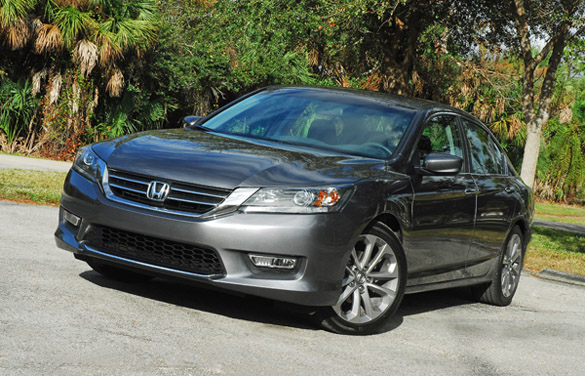
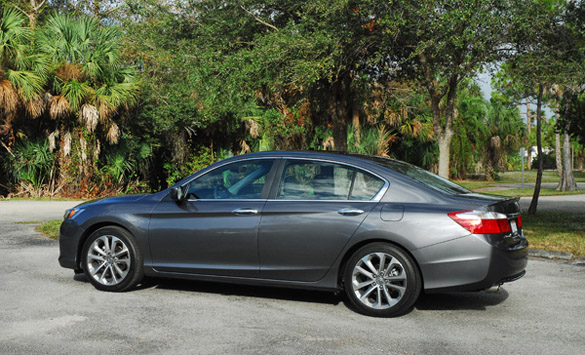
The newly styled Sport model that I tested features more chrome and cut angles beginning with the front end showing a more angular grille with chrome around its side, bottom and inside horizontal slats.  Just below is another air-intake with a chrome strip at the bottom, and at each side are new foglamps.  The ‘cat’s-eye’ headlamps are slimmer but put out more light with standard projector beam lights or optional HID lights.  The silhouette shows the steeply raked windshield A-pillars, aero-dynamic designed side mirrors, flared fenders, a full-perimeter chrome strip around the greenhouse, deep side extensions, and pull out chrome door handles.  A nicely scallop at each door rises slightly giving it a look of motion when parked.  The tapered roof ends with a spoiler mounted onto the back of the trunk lid to enhance rear downforce.  Moving over to the rear are big, wraparound taillight/brake/backup lamp clusters tied together with a wide chrome strip.  A bold bumper with a chrome bar just above an air-diffuser underneath better manage airflow.  Under the bumper at each side are large, chrome exhaust finishers.  The new look is sleek, lower and aggressive, yet more luxurious than before.

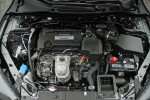
Under the hood of the Accord Sport is a new 2.4 liter 4-cylinder aluminum alloy DOHC, i-VTEC engine with direct injection.  Because of the high-flow dual exhaust system this engine pumps out 189 hp at 6,400 rpm and 182 lb.ft. of torque at 3,900 rpm compared to the standard 2.4 liter’s 185 hp and 181 lb.ft. of torque with the single exhaust.  An ECO Assist button on the left side of the dashboard decreases rpm when lightly pushing on the throttle to increase mpg.

The Accord Sport’s new engine can be mated to either a smooth shifting six-speed manual or a new Continuously Variable Transmission (CVT).  With a wider ratio range than the 5-speed automatic that it replaces and combined with greater efficiency and less weight, the new CVT is a major contributor to the Accord’s improved fuel efficiency of 21 mpg/city and 34 mpg/highway.  I tested the new CVT with steering wheel mounted paddle shifters and it was great fun changing gears when I wanted to hold to redline or downshift going into corners.  I saw 1-7 gears on the center readout plus the system wouldn’t let me advance the gears until I reached a certain speed, just like a real sequential shifting automatic.  Upshifting and downshifting was instant, great fun and sporty driving.
Most of the fun when behind the wheel is telegraphed through the new, more rigid fully independent suspension and the many electronic advancements that make the all-new Accord the most fun-to-drive and capable than ever.   The all-new chassis features a MacPherson strut setup that replaces the older, heavier double-wishbone setup.  The front includes a new steel and aluminum subframe that reduces noise, vibration and harshness, gas-charged shocks and a 17mm stabilizer bar.  The rear multi-link setup features new compliance bushings, coil springs, gas-charged shocks and a 14mm stabilizer bar.  Giving the front end more rigidity for enhanced response to your inputs is a strut tower brace.  The new electric power steering system uses an electric motor to assist to the rack & pinion steering thus reducing steering effort at slow speeds, improving precision, feel for the road and less power consumption.

When you put the gear selector in S (Sport) the engine mapping is quickened, the suspension tightens and the power steering is even more responsive giving a feeling and precision of driving a higher-priced, high-performance sport sedan.  When entering a highway on a cloverleaf I had the speedometer at 60 mph with no understeer or oversteer, partly thanks to the electronic vehicle assist and traction control that kept the wheels firmly planted as I sped around the circle.  Giving the new Accord a quieter ride than ever are standard Active Noise Control and Active Sound Control that counteract engine noise helping to create a more linear and sophisticated high-rpm engine note.

Slowing the new Accord Sport down from speed are larger, power-assisted, four-wheel steel disc brakes.  Up front are 11.4 in. vented discs clamped with dual-piston calipers and 11.1 in. solid discs clamped with single-piston calipers in the rear.  Braking control is enhanced with standard ABS, EBD and BA.

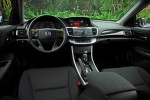
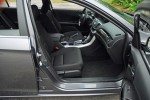
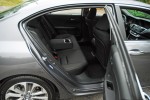
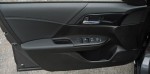
The interior of the Accord Sport is all new with more comfortable front bucket seats, new more simple instrumentation, brushed aluminum trimmed, dual tiered center stack with separate audio and climate controls sections, a center console with dual cupholders, storage bin up front and a deep and wide storage box under the padded armrest.  The leather-wrapped stick shifter is found on-line with P through S surrounded by a  chrome bezel.  All of the controls are within easy rear to use.  Although the car’s length as decreased over 3 in. and the wheelbase is almost an inch shorter, key interior dimensions have grown.  While the Accord’s sleeker shape decreases already plentiful headroom slightly, rear legroom increases over an inch, bot front and rear shoulder room increase, and trunk space is up over a cubic foot.  The larger volume trunk now features a flatter floor and more space for greater utility.  The interior shows Accord’s advancement with higher grades of soft-to-the-touch materials and greater craftsmanship.  The Sport features black plastic with a dot pattern on the dashboard, center console and door trim.

A bright, full-color 8 in. ‘intelligent’ Multi-Information Display (i-MID) serves as the control center for the Accord’s many electronic functions.  The i-MID screen displays the image from the new standard backup camera, fuel economy information, audio functions, and an available LaneWatch feature, which can help you on busy multi-lane roads by displaying a wide-angle view of the passenger side roadway of the vehicle.  A new audio with touchscreen system is standard and features a Pandora internet radio interface, and a convenient SMS text messaging function that can read incoming texts aloud and allow you to respond with factory preset text message.  A Bluetooth HandsFreeLink phone interface adds intuitive hands-free calling convenience.  Honda satellite-linked navigation system with voice recognition and FM Traffic is optional.  The all-new Accord is the first Honda product to offer available HondaLink technology, which works with the owner’s compatible smartphone to connect the Accord with music and other media sources, internet apps, roadside assistance and more to help improve the driving experience.  Aha by Harman is the first HondaLink internet app resource and future apps will expand HondaLink functionality substantially.

Standard equipment inside my Accord Sport not mentioned above included AM-FM-CD/MP3 audio system with four speakers, USB audio interface, MP3 auxiliary input jack, dual-zone climate control with air filtration system, power windows/door locks with driver-side express up/down, illuminated dual vanity mirrors, dual map lights, map pockets behind the front seatbacks, sunglass holder, cruise control, variable-speed wipers/washers, remote fuel filler door/trunk release, cargo area light, lockable glove box, exterior temperature gauge, thick cut-pile carpeting, floor maps front/rear, maintenance minder system, grab handles above each door, 60/40 split folding rear seat, and a pull-down rear armrest with dual cupholders.

Standard safety features include driver/front passenger dual stage airbags, driver/front passenger side airbags, side curtain airbags with rollover sensor, ACE body structure, tire pressure monitoring system, side impact door beams, 3-point safety belts for five with front pretensioners/load limiters, daytime running lamps and the LATCH system for child seats.

The all-new 2013 Honda Accord is a vast improvement over the last generation model with sleeker and more aerodynamic styling, more fuel efficient powertrains, a more refined and dynamic suspension system, a more spacious, refined, and comfortable interior with the latest in infotainment and safety systems.  The new Sport model that I tested gave me even greater pleasure and fun driving it around town and on the highways.  The price is surprisingly affordable at just $23,390.00 for this great looking and great performing new Accord Sport sedan.

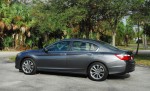
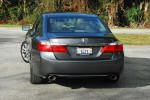
2013 Honda Accord Sport Beauty Right Up Done Small
2013 Honda Accord Sport Beauty Side Done Small
2013 Honda Accord Sport Beauty Rear Done Small
2013 Honda Accord Sport Dashboard Done Small
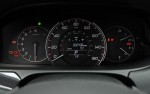
2013 Honda Accord Sport Cluster Done Small
2013 Honda Accord Sport Front Seats Done Small
2013 Honda Accord Sport Reaar Seats Done Small
2013 Honda Accord Sport Door Trim Done Small
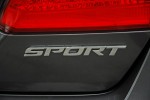
2013 Honda Accord Sport Badge Done Small
2013 Honda Accord Sport Engine Done Small

COPYRIGHT: 2012: HARVEY SCHWARTZ

SPECIFICATIONS

  • Price: Base Accord Sedan $21,680 / As-Tested Accord Sport $23,390
  • Engine: 2.4 liter DOHC 4-cylinder 185 horsepower @ 6,400 rpm / 181 ft-lbs. torque @ 3,900 rpm
  • Transmission: CVT (Continuously Variable Transmission)
  • Wheelbase: 109.3 in.
  • Total length: 191.4 in.
  • Total width: 72.8 in.
  • Total height: 57.7 in.
  • Curb weight: 3,342 lbs.
  • Track: f/r-62.4/62.4 in.
  • Headroom: f/r-39.1/37.5 in.
  • Legroom: f/r-42.5/38.5 in.
  • Cargo volume: 15.8 cu.ft.
  • Turing circle: 39.6 ft.
  • Fuel tank: 17.2 gallons
  • 0-60 mph: 7.5 seconds

Source: FULL ARTICLE at Automotive Addicts

Auctions: Original Porsche 959 prototype will be on the block at Barrett-Jackson auction

By Michael Harley

Filed under: , , ,

The Porsche 959 was arguably the finest supercar of its era (1986-1989). Beneath its fiberglass-reinforced Kevlar and aluminum body panels hid some of the world’s most advanced automotive technology, including an innovative all-wheel-drive system, a twin-shock suspension offering adjustable ride height and damping, four-channel ABS and run-flat tires. With the power of its rear-mounted twin-turbocharged 2.8-liter flat-six, developing 450 horsepower, the Porsche was capable of hitting 60 miles per hour in less than four seconds and a top speed of nearly 200 mph – performance numbers that are still highly respectable today.

If you’ve always wanted to get your hands on one (legal issues kept Porsche from importing the $225,000 coupe to the States in the 1980s), now is the time. Barrett-Jackson will be auctioning a 1986 Porsche 959 factory prototype at its Scottsdale event next week. This particular vehicle, a V-series prototype based on a 930 Turbo platform, was used for chassis development, brake engineering and high-speed testing. Porsche built 29 prototypes like it, but most were scrapped after the program ended. According to Barrett-Jackson, it is one of just two running prototypes and one of only four survivors.

Before you whip out your checkbook and plan your 959 summer road trip, you should know that this prototype isn’t certified for public roads (and its odd stance suggests that it needs a bit of work to get back into running shape). Regardless, with a history this interesting, its value is only going up.

Original Porsche 959 prototype will be on the block at Barrett-Jackson auction originally appeared on Autoblog on Fri, 11 Jan 2013 10:45:00 EST. Please see our terms for use of feeds.

Permalink | Email this | Comments

Source: FULL ARTICLE at Autoblog