Tag Archives: BAC

Bank of America to Pay $500M to Settle Investor Lawsuit

By The Associated Press

Filed under: , , , ,

Getty Images

By CHRISTINA REXRODE

NEW YORK — As soon as Bank of America puts one mortgage-related lawsuit behind it, another always seems to rear its head.

The bank announced Wednesday that it would pay $500 million to settle a class-action lawsuit led by pension funds and other investors who say they were misled about $350 billion worth of mortgage-backed investments they bought from Countrywide, a mortgage lender Bank of America Corp. (BAC) bought in 2008. The bank portrayed the settlement as good news because it resolved the bulk of securities claims related to residential mortgage-backed securities.

But financial analysts, in a conference call to discuss the bank’s first-quarter results, peppered bank executives with questions about another pending settlement. Bank of America is still waiting for court approval for a similar settlement it made with Bank of New York Mellon Corp. (BNY) almost two years ago. If it doesn’t get the go-ahead, Bank of America could have to spend more to resolve the claims.

Bank of America’s stock slumped nearly 5 percent to $11.70. While its earnings were just shy of what analysts expected, it was the bank’s latest liability from mortgage lawsuits that “seems to be the big question for investors,” banking analyst Meredith Whitney said on the conference call.

Chief Financial Officer Bruce Thompson told analysts that the bank felt “very good” about settling the pension funds’ lawsuit. But he acknowledged the uncertainty of potential lawsuits and declined to predict how much the bank might have to spend on litigation in the future.

“I don’t think anyone is going to ever, at this point, declare complete victory,” Thompson said, though he added that the bank was moving through “this pipeline of items” in “a pretty meaningful way.”

Sponsored Linksadsonar_placementId=1505951;adsonar_pid=1990767;adsonar_ps=-1;adsonar_zw=242;adsonar_zh=252;adsonar_jv=’ads.tw.adsonar.com’;

Bank of America’s current troubles are the latest fallout from its decision to buy Countrywide, which was known for making exotic mortgages that later went bad as borrowers defaulted. The purchase catapulted the bank into a spot at the top of the nation’s mortgage scene, but it’s been an albatross ever since, bringing lawsuits, investigations and quarterly losses. Hard-to-predict legal expenses have been a bane to Bank of America and throughout the banking industry.

It was just last quarter that two mortgage-related settlements overshadowed the bank’s results. In early January, the bank took a charge of $2.7 billion to settle a dispute with Fannie Mae, which forced Bank of America to buy back mortgages it had sold to the agency before the crisis. It also took a $1.1 billion charge to settle government accusations that it and other banks had wrongfully foreclosed on some homeowners. The charges sent fourth-quarter earnings down sharply.

Brian Moynihan has been wading through issues dating back to the financial crisis ever since he became CEO in

From: http://www.dailyfinance.com/2013/04/18/bank-america-lawsuit/

American Express Profit Boosted by Higher Cardmember Spending

By Reuters

Filed under: , , , ,

Getty Images

Credit card company American Express Co.’s quarterly revenue came in below analyst expectations as cardmember spending growth remained muted.

Cardmember spending in the first quarter increased 7 percent, adjusted for foreign currency translations. This was the fourth successive quarter of single-digit growth after nine quarters of double-digit growth.

Expense accounts have come under greater scrutiny as companies look to cut costs to protect profit margins, hurting the credit card lender, which gets more than a quarter of its U.S. billed business from affluent corporate customers.

However, American Express‘s billed business was up 6 percent at $224.5 billion and total cards in force crossed 100 million during the quarter.

The company has the lowest delinquency rate among the large credit card companies, including JPMorgan Chase & Co. (JPM), Discover Financial Services, Capital One Financial Corp. (COF), Bank of America Corp. (BAC) and Citigroup Inc. (C).

It set aside $497 million to cover future bad loans in the quarter, 21 percent more than it had provisioned last year, reflecting its larger lending portfolio.

American Express Co. (AXP), which lends directly to consumers and also competes with Visa Inc. (V) and MasterCard Inc. (MA) to process credit card transactions, said global network and merchant services revenue increased 4 percent to $1.3 billion.

Sponsored Linksadsonar_placementId=1505951;adsonar_pid=1990767;adsonar_ps=-1;adsonar_zw=242;adsonar_zh=252;adsonar_jv=’ads.tw.adsonar.com’;

Consolidated expenses during the quarter remained in check, rising marginally, as the company looks to control costs and maintain a leaner operating structure.

The company said in January it would cut about 5,400 jobs as part of a global restructuring and took a related $600 million charge.

Profit for the quarter ended March 31 rose to $1.28 billion, or $1.15 a share, from $1.26 billion, or $1.07 a share, a year earlier.

Total revenue, net of interest expense, increased 4 percent to $7.88 billion.

Analysts on average had expected earnings of $1.12 a share on revenue of $8.03 billion, according to Thomson Reuters I/B/E/S.

American Express shares were marginally down in trading after the bell. They closed Wednesday at $64.13 on the New York Stock Exchange.

%Gallery-183217%

Permalink | Email this | Linking Blogs | Comments

From: http://www.dailyfinance.com/2013/04/18/american-express-earnings/

Bank of America's Quarterly Profit Soars as Revenues Sink

By Reuters

Filed under: , , , ,

Richard Drew/AP

Bank of America reported a lower-than-expected first-quarter profit and its revenue fell, sending the No. 2 U.S. bank’s shares down 3 percent before the bell on Wednesday.

Net income quadrupled to $2.62 billion, or 20 cents a share, from $653 million, or 3 cents a share a year earlier as expenses dropped and the bank set aside less money to cover bad loans. But total adjusted revenue fell 8.4 percent to $23.85 billion.

Analysts on average had expected Bank of America to earn 22 cents a share, according to Thomson Reuters I/B/E/S.

Bank of America Corp. (BAC) shares dropped 3.3 percent before the bell to $11.88.

Earnings in the year-earlier period were affected by a host of one-time items including a $4.8 billion charge related to the value of its debt.

Chief Executive Brian Moynihan has made progress in building capital and settling mortgage-related lawsuits since taking over in January 2010. But he is under pressure to show that the bank can produce higher earnings at a time of low interest rates, stricter regulations and volatile economic conditions.

Sponsored Linksadsonar_placementId=1505951;adsonar_pid=1990767;adsonar_ps=-1;adsonar_zw=242;adsonar_zh=252;adsonar_jv=’ads.tw.adsonar.com’;

Bank of America, the last of the big four U.S. banks to report results, has pledged to cut $8 billion in expenses by mid-2015 and has said it could reduce expenses in its division that handles delinquent mortgages by $1 billion by the end of 2013.

The bank showed signs of progress in these efforts in the quarter, with total expenses falling 5.2 percent to $18.15 billion.

As with other big banks this quarter, Bank of America results were also boosted by reduced credit losses as borrowers did a better job of making their payments. The bank’s provision for loan losses fell 29.2 percent to $1.71 billion.

%Gallery-183453%

Permalink | Email this | Linking Blogs | Comments

From: http://www.dailyfinance.com/2013/04/17/bank-of-america-earnings/

Is Bank of America a Better Buy Than Apple?

By Robert Eberhard, The Motley Fool

Filed under:

A year ago, Apple was in the midst of a blistering nine-month stretch, cementing itself at the top of the market. Meanwhile, Bank of America stood pat after its less-than-stellar showing in the Fed stress test, while other banks rushed to return capital to shareholders. Apple looked like a stock that couldn’t lose, while Bank of America… well, was Bank of America: the stock so many love to hate. But since October, these stocks have switched places. Could the formerly scorned bank now be a better investment than the once-hot tech superstar?

BAC data by YCharts.

There’s no magic metric that can answer this question once and for all. With literally hundreds of data points available for comparison, let’s look at a few to see who comes out on top.

Valuation
Based on P/E ratio, Apple wins by a landslide, trading at around 10 times earnings. Bank of America shows its struggles over the past year; its reduced earnings expanded its P/E to almost 50. If we can believe the analysts’ and companies’ earnings forecasts, the gap between these numbers should narrow going forward, with Apple checking in at 8.6 times earnings and B of A at 9.2.

But price-to-earnings ratios don’t tell the whole story, and each balance sheet shows hidden value. Bank of America, the second-largest bank based on total assets, is currently trading at a 46% discount to book value. Apple, on the other hand, has a $137 billion cash hoard that it’s reluctant to part with, its year-old dividend notwithstanding. Though I like dividends as much as the next guy, the deep discount of B of A is slightly too enticing at this point, and its annual dividend will surely be more than $0.04 per share before too long.

Management
Bank of America CEO Brian Moynihan wasn’t in charge when Bank of America truly descended into madness with its acquisition of Countrywide, but he has done an admirable job extricating the bank from billions in bad loans related to the acquisition. Nevertheless, the bank is still facing billions of dollars in potential liabilities before it is completely out of hot water.

Tim Cook has done a great job as Apple’s CEO after taking over for the late Steve Jobs, but his honeymoon period could be coming to an end. Apple hasn’t truly released a new product since Jobs’ death — just upgrades — and the iPad Mini is a device that Jobs probably would have never released. Still, Apple and its products have a devout following, and the company still has little problem selling billions of devices every time it brings something to the market.

Business & risks
Each company is at a different kind of crossroads. At its core, Apple is based on innovation, and it could be just one new (or improved) product away from its …read more

Source: FULL ARTICLE at DailyFinance

Bank of America and Its Giant Ego

By David Hanson and Matt Koppenheffer, The Motley Fool

Filed under:

In the following video, Motley Fool financial analysts David Hanson and Matt Koppenheffer take a break from looking at the big banks in terms of their tangible book value, and instead examine the intangible assets that fall under the category of goodwill. They note that goodwill composes 30% of Bank of America‘s total equity, the highest of all the big banks, and discuss how it got to be such a large portion of BAC‘s equity and whether or not the value of BAC‘s goodwill may be overstated a bit. 

Bank of America’s stock doubled in 2012. Is there more yet to come? With significant challenges still ahead, it’s critical to have a solid understanding of this megabank before adding it to your portfolio. In The Motley Fool‘s premium research report on B of A, analysts Anand Chokkavelu, CFA, and Matt Koppenheffer, Financials bureau chief, lift the veil on the bank’s operations, including detailing three reasons to buy and three reasons to sell. Click here now to claim your copy.

var FoolAnalyticsData = FoolAnalyticsData || []; FoolAnalyticsData.push({ eventType: “TickerReportPitch”, contentByline: “David Hanson and Matt Koppenheffer“, contentId: “cms.29130”, contentTickers: “NYSE:C, NYSE:BAC, NYSE:JPM, NYSE:WFC”, contentTitle: “Bank of America and Its Giant Ego”, hasVideo: “True”, pitchId: “29”, …read more
Source: FULL ARTICLE at DailyFinance

Dow Seeing Red After Cyprus Deal Fails to Comfort Investors

By Jessica Alling, The Motley Fool

Filed under:

The Dow Jones Industrial Average rose to its ninth new intraday high for the month of March this morning, as investors felt a sigh of relief that leaders in Cyprus reached a deal to stave off a possible eurozone exit. But that sense of relief quickly turned sour and the Dow began a precipitous fall. Currently down 30 points, the Dow and 26 of its component stocks are in the red.

Biggest losers: Dow edition
Caterpillar
is leading the pack this morning with its 1.26% decline. The company has been on a steady descent since late January, with its monthly sales data releases spurring on increased concern due to consistent and rapid declines. Caterpillar is one of the largest manufacturers of heavy machinery, and with its key markets in Asia and America posing the greatest threat to growing sales, there is major concern among investors. The company has shown growth in its Latin American market, but the impact on overall growth is just too slight to make a difference. CAT was just awarded a contract by the Pentagon for $633 million that will run through March 2018, which may give the struggling company the boost it needs.

3M is down 1.12%, putting it in second place for the Dow’s biggest loser so far today. The multifaceted company has been long admired for its innovation, strong balance sheet, and rising dividend. But some analysts believe that the company is at an impasse, with its innovation being stifled. And though some firms on Wall Street have raised 3M’s target price, others have rated it as neutral, giving investors little to work with when trying to decide on their investment options.

Bank of America is running in third place, with the bank down 1.11% so far in trading this morning. The bank had been making great headway early last week following its approved capital plan and good showing in the Fed’s stress tests. But its gains were quickly cut when Freddie Mac announced a suit against 15 international banks for their participation in the rigging of LIBOR. BAC was named in the suit, just another in a long line of legal woes for the bank. With many investors believing that the legal troubles were mostly behind B of A, this was another blow to their confidence in the bank’s resurgence. Analysts at Goldman Sachs recently stated that they prefer JPMorgan and Citigroup to Bank of America, with Citi receiving a “conviction buy” rating and a target-price increase, giving investors reason to drop their growing confidence in the BAC. The bank has been making great strides to convince investors that its brand is better, but it looks like it still has some work to do.

Bank of America’s stock doubled in 2012. Is there more yet to come? With significant challenges still ahead, it’s critical to have a solid understanding of this megabank …read more
Source: FULL ARTICLE at DailyFinance

Dow Rebounds on Positive Economic News

By Jessica Alling, The Motley Fool

Filed under:

The Dow Jones Industrial Average is climbing this morning on the news that Cypriot banks have reopened without incident. Investors’ continued concern over the European country’s economic state held the Dow lower yesterday,  as it closed 33 points down. Currently up 43 points, the index has recovered thanks to some mixed yet overall positive economic news.

Jobless claims unexpectedly rose last week, but remain near five-year lows. The rolling four-week average remains under 350,000 new applicants, so economists believe this still shows a firm hiring market. This is great news to investors who may have thought that the labor market was taking a step backward from its marked improvements so far this year.

GDP rose by 0.4% over the last three months of 2012 thanks to increased business investments and exports of services. The rise was just shy of the 0.5% improvement analysts expected to see, but a notable improvement from the government‘s estimate of 0.1%. This is the third estimate of growth for the final quarter of 2012, with many of the reasons for its slow pace remaining the same — reduced inventories and defense spending.

No big winners
There aren’t any clear winners or losers so far this morning, and the financial sector remains mixed after following the Dow south yesterday. JPMorgan  continues its slide again today, down 0.57% so far, after losing 1.79% Wednesday. Investors may still be wary of the bank following the news that it hid the true losses sustained by the London Whale debacle — a development that may find the bank’s executives in hot water from federal prosecutors. Wednesday also brought other legal trouble for JPM, which lost its fight to have a suit dismissed that claims the bank made risky investments in Lehman Brothers at the expense of a pension fund (the plaintiff). Regardless of the continued legal battles JPMorgan might have, Standard & Poor revised its outlook on the bank back to “stable,” after changing it to “negative” following the London Whale trading fiasco last year.

Bank of America is also trading down this morning, by 0.45%, after closing down by 0.41% yesterday. The bank has been struggling to hold on to the gains it made following the positive outcome of its Fed stress test results. But continued negative investor sentiment keeps the highly traded, highly volatile stock from staying high for too long. Recent news regarding executive shares may help with that — CEO Brian Moynihan has to hold on to at least 500,000 shares until one year after his retirement, while other executives have to hold on to 300,000 shares until they retire from BAC. This new move helps further align the executive suite with shareholders, and may have a positive impact on the share price in the long run.

Both American Express and Travelers  are up today, by 0.30% and 0.38%, respectively. AmEx continues to ride the positive news from its Bluebird joint venture with …read more
Source: FULL ARTICLE at DailyFinance

The Dow and Financials Take a Tumble on European Fears

By Jessica Alling, The Motley Fool

Filed under:

The Dow Jones Industrial Average reached a new record high yesterday after rocketing up 111 points. But the gains were short-lived as investor fears regarding the continued financial struggles in Europe started taking their toll on the index. Protests have begun in Cypress, where the country waits for its banks to reopen tomorrow with the newly minted capital restrictions. Italy is also in a pickle as yet another round of failed negotiations leave the country without a functioning government. And British banks may find themselves scrambling to gather up more capital in order to meet their loan obligations.

And while the Dow was helped yesterday by our own positive economic news, it’s having no such luck this morning. Pending home sales fell 0.4% in February, and while this still leaves sales of existing homes at the highest level since April 2010, the drop exceeded the 0.3% fall analysts expected. This news has hit the Dow, and financials are also taking a beating this morning.

JPMorgan is leading the index losers this morning with a 1.79% drop. The bank has had a series of misfortunes lately, leading investors to start reconsidering the strength of the one bank that they considered unstoppable. With the news that JPM may have withheld the true losses sustained by the London Whale fiasco from regulators and shareholders, beloved CEO Jamie Dimon is being questioned more than ever. And the Fed’s stress tests found weaknesses in the bank’s capital plans, leaving investors to wonder if there’s a chink in JPMorgan’s armor. And now that economic data has given some mixed signals, new mortgages coming into the second largest originator from 2012 may be slowing — reducing JPM‘s chances of continued record profits.

Bank of America was also leading the Dow lower this morning, though not as heartily as JPMorgan. Down 0.69% this morning, B of A continues to slide as it lost 1% yesterday, even as the Dow climbed to a new all-time high. The bank has been dealing with a new crop of issues that continue to spring up, even when investors thought the worst might be over. A new lawsuit from Freddie Mac named BAC, JPM, and Citigroup among 15 international banks that participated in rigging the LIBOR interest rate. Foreclosures are rising again, and with the long, drawn-out processes, Bank of America will continue to suffer since it has the biggest pile of loans to deal with — thanks to Countrywide. And all of this negative news has really hit the bank that was making solid progress on improving its image, eliminating share dilution, and improving shareholder value.

Lastly from the Dow, American Express is fighting to stay at breakeven today after some big gains yesterday. The personal finance company is hoping to keep some of the spoils from yesterday’s big win following the announcement that its joint venture with Wal-Mart, Bluebird, was improving its …read more
Source: FULL ARTICLE at DailyFinance

Bank of America and Citigroup Can Still Outperform — Here's Why

By Alex DUMORTIER, CFA, The Motley Fool

BAC Chart

Filed under:

As I predicted yesterday, Cyprus managed to hammer out an agreement with its international lenders, thus averting a banking collapse (although its offshore-banking franchise has been irreparably harmed). This morning’s opening suggests instead that investors are cheering the result, with the S&P 500 and the narrower, price-weighted Dow Jones Industrial Average up 0.5% and 0.32%, respectively, at 10 a.m. EST. The S&P 500’s record (nominal) high of 1,565.15 of Oct. 2007 could well fall today.

These banks can still run
Shares of Dow component Bank of America and its peer Citigroup have easily bested the market over the past 12 months:

BAC data by YCharts.

Can this outperformance continue? There is at least one good reason to think so: The shares have an underweighting in some of the largest actively-managed U.S. mutual funds.:

Fund

Assets

Bank of America

Citigroup

American Funds Growth Fund of America (Dec. 31, 2012)

$114.8 billion

0.72%

0.59%

American Funds Income Fund of America (Dec. 31, 2012)

$72.9 billion

American Funds Capital Income Builder (Dec. 31, 2012)

$78.3 billion

Fidelity Contrafund (Jan. 31, 2012)

$61.5 billion

0.42%

Franklin Income Fund (Dec. 31, 2012)

$73.4 billion

American Funds Investment Company of America (Dec. 31, 2012)

$57.2 billion

0.37%

S&P 500


0.99%*

1%*

*Estimated. Source: Investment company documents.

These funds were no doubt burned by the meltdown in bank shares during the financial crisis, and they are tremendously conservative organizations. Both of these factors create inertia in the decision-making process, and as such, these funds’ holdings can be thought of as lagging indicators of performance. Once their holdings in B of A and Citi reflect (or exceed) the allocations dictated by their benchmarks, the shares will have run. The funds themselves, because of their massive footprints, will have played a big role in sparking that outperformance. Investors who stay one step ahead of them can reap the returns.

Bank of America’s stock doubled in 2012. With significant challenges still ahead, it’s critical to have a solid understanding of this megabank before adding it to your portfolio. In The Motley Fool’s premium research report on B of A, analyst Anand Chokkavelu, CFA, and Financials bureau chief Matt Koppenheffer lift the veil on the bank’s operations, detailing three reasons to buy and three reasons to sell. Click here now to claim your copy.

var FoolAnalyticsData = FoolAnalyticsData || []; FoolAnalyticsData.push({ …read more
Source: FULL ARTICLE at DailyFinance

JPMorgan Chase Plans to Limit Payday Lenders' Fees

By The Associated Press

jpmorgan chase payday lending fees

Filed under: , , , , ,

Justin Sullivan/Getty Images

NEW YORK — JPMorgan Chase said Wednesday that it will take steps to protect its customers from fees and other charges that payday lenders may slap on them.

The bank said it will limit the fees that customers are charged when they overdraft their accounts to make payments to payday lenders.

It will also “enhance communication and require additional training” for employees, to make it easier for customers to stop payments. The bank will also make it easier for customers to close their accounts even when there are pending charges, including payday lender payments.

Payday lenders are a controversial sliver of the financial system. They offer short-term loans, usually targeting the cash-strapped poor. They have high interest rates, making it hard for customers to repay the loans, and the spiral worsens when the payday lenders charge extra fees.

Sponsored Linksadsonar_placementId=1505951;adsonar_pid=1990767;adsonar_ps=-1;adsonar_zw=242;adsonar_zh=252;adsonar_jv=’ads.tw.adsonar.com’;

JPMorgan Chase & Co. (JPM) and other mainstream banks don’t make so-called payday loans. But they do allow the payday lenders access to their customers. The New York Times reported last month that JPMorgan, Bank of America Corp. (BAC) and Wells Fargo & Co. (WFC) allow payday lenders to automatically withdraw money from customers’ accounts, even in states where payday lending is banned. In some cases, the Times reported, the banks allow lenders to tap checking accounts even after the customers have begged for a reprieve.

Ryan McInerney, the bank’s head of consumer banking, said in a statement that the bank intended to protect customers from “unfair and aggressive collections practices.”

“Some customers agree to allow payday lenders or other billers to draw funds directly from their accounts, but they may not know some of the aggressive practices that can follow,” he said.

After the Times story last month, CEO Jamie Dimon described his reaction while speaking at the annual investor conference: “This is terrible, we’re going to fix it.”


%Gallery-177611%

Permalink | Email this | Linking Blogs | Comments

…read more
Source: FULL ARTICLE at DailyFinance

GE Capital Extends Financing Program for 1,200 Brunswick Marine Dealers across U.S. and Canada

By Business Wirevia The Motley Fool

Filed under:

GE Capital Extends Financing Program for 1,200 Brunswick Marine Dealers across U.S. and Canada

CHICAGO–(BUSINESS WIRE)– GE Capital’s Commercial Distribution Finance (CDF) business announced today an extension through 2016 of its dealer finance programs with Brunswick Corporation in the U.S. and Canada. This extension will provide Brunswick’s dealer network with inventory financing for its boat brands as well as Mercury Marine engines.

In the U.S., CDF and Brunswick agreed to extend their joint venture, known as Brunswick Acceptance Company (BAC). Formed in 2002, BAC provides a long-term source of wholesale inventory financing for Brunswick boat dealers. BAC is the largest floorplan finance provider for Brunswick boat brands and Mercury Marine engines in the U.S., as well as one of the largest providers of wholesale financing programs and service to the marine industry.

“We are very happy to continue our joint venture relationship with Brunswick for another four years,” said Bruce Van Wagoner, president of CDF‘s marine business. “We are committed to providing their dealers with flexible financing and the best customer experience possible to help them succeed.”

“Our relationships with our dealers extend well beyond providing them with just great boats and engines,” said Brunswick chairman and chief executive officer Dustan E. McCoy. “We have long believed that, as our dealers prosper, so will we. BAC has a demonstrated ability to provide market-leading products and services as a stable and affordable source of financing. It’s an important tool dealers can use to help provide boaters with a fully satisfying ownership experience. Further, the extension of this agreement is a reflection of our confidence in BAC as well as the commitment that the partners have in the U.S. marine industry.”

In Canada, CDF renewed its agreement to be the strategic inventory finance provider for Brunswick boat dealers through 2016. “Over the years, we have developed great relationships with their dealer network, and we look forward to continuing to serve them at the highest level,” said Howard Shiebler, president of CDF Canada.

For more than 50 years and through all business and economic cycles, CDF has offered customer-centric floorplan financing programs that enable marine dealers to stock a broad selection of new and pre-owned products. Floorplan financing, also known as inventory financing, is an important element of a successful manufacturer-dealer business model as manufacturers and distributors benefit from enhanced product flow and increased sales opportunities, and dealers obtain improved terms and credit availability.

About Brunswick Corporation

…read more
Source: FULL ARTICLE at DailyFinance

BioTime Announces Fourth Quarter and Fiscal Year End 2012 Financial Results and Recent Corporate Acc

By Business Wirevia The Motley Fool

Filed under:

BioTime Announces Fourth Quarter and Fiscal Year End 2012 Financial Results and Recent Corporate Accomplishments

ALAMEDA, Calif.–(BUSINESS WIRE)– BioTime, Inc. (NYSE MKT: BTX), today reported financial results for the fourth quarter and year ended December 31, 2012 and highlighted its fourth quarter and recent corporate accomplishments.

Fourth Quarter and Recent Highlighted Corporate Accomplishments

  • Entered into a definitive agreement with Geron Corporation in which BioTime’s subsidiary BioTime Acquisition Corporation (BAC) will acquire the patents and patent applications, biological materials, and other assets related to Geron’s human embryonic stem (hES) cell programs, including Geron’s Phase I clinical trial of oligodendrocyte progenitor cells in patients with acute spinal cord injury, as well as its Phase I/II clinical trial of its autologous cellular immunotherapy program in patients with acute myelogenous leukemia.
  • Expanded the HyStem® field-of-use license from the University of Utah to an exclusive worldwide license for all human medical applications.
  • Submitted protocol to European regulatory authorities for initiation of human clinical trials of Renevia™ as a medical device for the delivery of adipose stem cells for reconstructive surgery.
  • Updated plans for OncoCyte’s initiation of a clinical study using PanC-Dx™ for breast cancer screening in 2013.
  • Launched LifeMap BioReagents™ portal, Malacards database, and LifeMap Discovery™ database though LifeMap Sciences.
  • Raised cash proceeds of $14.7 million over the past five months through the sale of BioTime common shares, including $1.4 million in the fourth quarter of 2012, $13.3 million in the first quarter of 2013 to date, and will raise an additional $3 million through an amended agreement with an investor which is expected to close on April 10, 2013.

“We have positioned 2013 to be a very pivotal year in the development of our product opportunities as BioTime begins human clinical trials for Renevia™, OncoCyte initiates its PanC-Dx™ clinical study, LifeMap Sciences expands its revenue generating product offerings, and we move to close our transaction with BAC and Geron,” said Michael D. West, Ph.D., BioTime’s President and Chief Executive Officer. “The proceeds from our recent equity financings will support the funding of our operations and cash commitment to BAC through this year.”

Financial Results
…read more
Source: FULL ARTICLE at DailyFinance

24/7 Wall St. Closing Bell — March 15, 2013: Markets Open Lower, Don't Recover (FCX, NDAQ, DAL, CL, RDS-A, ARO, MCP, ZUMZ, BWS, SYNM, CLSN, HSOL, HAST, KIOR, BAC, MU, AMX)

By 24/7 Wall St.

Bull and Bear figures

Filed under:

U.S. equity markets opened lower this morning and were never able to shake off the doldrums as stocks traded below the break-even line all day. There was little data out in either Asia or Europe, and data released in the U.S. today was decidedly mixed. The U.S. consumer price index was higher than expected, but core data was inline (more coverage here). The Empire State manufacturing index beat expectations (more coverage here), and results of the Federal Reserve’s stress tests on big banks weighed on financial stocks today as well (more coverage here). U.S. industrial production rose more than expected (more coverage here), but consumer sentiment tanked (more coverage here).

The U.S. dollar index fell 0.42% today, now at 82.262. The GSCI commodity index is up 0.5% at 650.23, with commodities prices mixed today. WTI crude oil closed up 0.5% today, at $93.45 a barrel. Brent crude trades up 1% at $110.03 a barrel. Natural gas is up 1.6% today at about $3.87 per million BTUs. Gold settled up 0.1% today at $1,590.70 an ounce.

The unofficial closing bells put the DJIA down about 25 points to 14,514.11 (-0.17%), the NASDAQ fell about 10 points (-0.30%) to 3,249.07, and the S&P 500 fell -0.16% or more than 2 points to 1,560.71.

There were a several analyst upgrades and downgrades today, including Freeport McMoRan Copper & Gold Inc. (NYSE: FCX) raised to ‘buy’ with a price target of $42 at Goldman Sachs; Nasdaq OMX Group Inc. (NASDAQ: NDAQ) raised to ‘outperform’ at Wells Fargo; Delta Air Lines Co. (NYSE: DAL) cut to ‘market perform’ at Raymond James; Colgate-Palmolive Co. (NYSE: CL) cut to ‘equal weight’ at Morgan Stanley; and Royal Dutch Shell plc (NYSE: RDS-A) cut to ‘underweight’ at JPMorgan Chase.

Earnings reports since markets closed last night resulted in several price moves today, including these: Aeropostale Inc. (NYSE: ARO) is down 5.5% at $13.71; Molycorp Inc. (NYSE: MCP) is up 2.3% at $6.13 (more coverage here); Zumiez Inc. (NASDAQ: ZUMZ) is up 5.2% at $25.49; and Brown Shoe Co. Inc. (NYSE: BWS) is down 4.8% at $17.52.

Before markets open Monday morning we are scheduled to hear from Syntroleum Corp. (NASDAQ: SYNM), Celsion Corp. (NASDAQ: CLSN), Hanwha Solarone Co. Ltd. (NASDAQ: HSOL), Hastings Entertainment Inc. (NASDAQ: HAST), and Kior Inc. (NASDAQ: KIOR).

Some standouts among heavily traded stocks today include:

Bank of America Corp. (NYSE: BAC) is up 4.4% at $12.64 after posting a new 52-week high of $12.65 earlier. The big bank’s capital plan passed the Fed stress test and includes some big buyback plans. More coverage here.

Micron Technology Inc. (NASDAQ: MU) is down 3.1% at $9.39. The chipmaker reports earnings next week and expectations are high, probably leading some short sellers to dump their positions today.

America Movil S.A.B. de C.V. (NYSE: AMX) is down 4% at $18.59 after posting a new 52-week low of $18.49 earlier today. The telecommunications company has been through a spate of selling in the past week following an announcement that Mexico is seeking to increase competition …read more
Source: FULL ARTICLE at DailyFinance

Fed Stress Test Trips Up Some Big Banks' Plans

By 24/7 Wall St.

Bank of America

Filed under: ,

The annual stress tests on the biggest U.S. banks produced a few surprises when the results were announced last night. The capital plans submitted by J.P. Morgan Chase & Co. (NYSE: JPM), Goldman Sachs Group Inc. (NYSE: GS), BB&T Corp. (NYSE: BBT) and Ally Financial were rejected. That means that shareholders are unlikely to receive larger dividends or benefit from increased share buybacks from these banks.

Among the banks getting approval for their capital plans were Citigroup Inc. (NYSE: C) and Bank of America Corp. (NYSE: BAC). American Express Co. (NYSE: AXP) received approval to pare back its stock repurchase plan.

J.P. Morgan already had received approval to repurchase $6 billion in stock and boost its quarterly dividend from $0.30 to $0.38 a share, but the bank’s CEO warned that it may have to cut its plans after it prepares a new capital plan at the end of the third quarter. Goldman will also submit a new plan at the same time.

Bank of America plans to repurchase up to $5 billion in common stock and $5.5 billion in preferred stock. The bank’s quarterly dividend of $0.01 will not change.

Citigroup plans to buy back $1.2 billion in common stock through the end of the first quarter of next year and plans no change to its $0.01 quarterly dividend.

Shares of J.P. Morgan are trading down about 2% in the premarket this morning, at $50.06 in a 52-week range of $30.83 to $51.00.

Goldman’s shares are trading down about 1.6%, at $151.62 in a 52-week range of $90.43 to $159.00.

Bank of America is trading up 3.7% at $12.56, a 52-week high, in a current range of $6.72 to $12.44.

Citigroup is trading up fractionally at $47.50 in a range of $24.61 to $47.92.

Filed under: 24/7 Wall St. Wire, Banking & Finance, Regulation Tagged: AXP, BAC, BBT, C, GS, JPM

Read | Permalink | Email this | Linking Blogs | Comments

…read more
Source: FULL ARTICLE at DailyFinance

How Dividends Could Change the Game for Bank of America

By Anders Bylund, The Motley Fool

BAC Chart

Filed under:

The wealth-building power of compound interest will never cease to amaze me. It’s a story of patience and attention to detail, where small differences in the short term add up to massive divergence over decades. In the end, the biggest winners don’t always deliver the fattest share-price returns.

Bank of America slashed its dividend by 98% when the housing bubble popped in 2008. Regulatory oversight and financial stress tests have kept the annual payouts down at just $0.04 per share for a minuscule 0.3% dividend yield. At these rates, it will take a long time for Bank of America shares to build any real wealth for income investors.

But recent rumblings indicate that the Fed might let this megabank raise dividends again. Fellow money-center bank Wells Fargo was able to inch payouts up as soon as 2011 and has quadrupled its dividend rates over the last three years. JPMorgan Chase multiplied its payout fivefold in 2011 and has stayed strong ever since. These increases prove that the largest banks aren’t necessarily too big to succeed.

Their dividend moves actually have a direct effect on Bank of America. The last time Wells Fargo boosted its payout, the news sent B of A shares up nearly 2% on an otherwise slow news day. Investors do take rival bank moves as an indication of things to come for this giant.

What if?
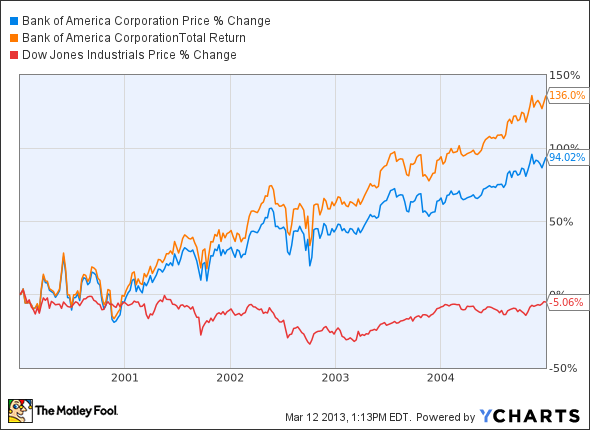
Both Wells and JPMorgan have just about restored their payouts to pre-crisis levels. What if Bank of America were allowed to do the same? Here’s how the bank’s dividends helped investors beat the market in a different era:

BAC data by YCharts.

Yes, Bank of America crushed the Dow Jones Industrial Average in the early aughts, with or without dividends. The real-estate bubble was just blowing up and getting ready to pop.

Focus your attention on the gap between straight-up share price gains and total, dividend-adjusted returns. Those steady payments added up to a 42% stronger total return on your investment. Not bad for just five years of market action.

Where did that spread come from?
It’s the same old story you’ve heard a million times before. Bank of America’s long-term shareholder value rested on a generous and always growing dividend policy

Crucially, the bank hiked its per-share payouts roughly in time with its rising share prices. That way, yields stayed steady around the 3% mark for several years. Management has said it would like to pay out roughly 30% of earnings in dividend form. That would add up to about $0.08 per share at current run rates, or $0.30 per share against estimated earnings for 2013. At that pace, Bank of America could be back to a 2.5% yield by the end of the year.

BAC Dividend data by YCharts.

You never really know what the Fed might do, but you can bet that a payout hike like that would boost the …read more
Source: FULL ARTICLE at DailyFinance

Merck the Sole Standout on a Flatlining Dow

By Jessica Alling, The Motley Fool

Filed under:

The Dow Jones Industrial Average is trading within a tight range today, and as of noon it sits less than four points above breakeven. If the index can maintain the positive momentum through the trading session, it will be on a nine-session winning streak, breaking yet another record set two years ago.

With the federal budget due this afternoon, that new record may be facing a large headwind. But many view the Dow’s journey north as unrealistic for our economic condition, so the budget may not affect investors’ enthusiasm the way it normally would.

With Dow components split between winners and losers, it’s anybody’s guess where the Dow will end the trading session.

Losers dragging the index down
Bank of America
is the biggest loser so far today, down 1.3%. The bank has been reaping the benefits of its stress test results, but investors will be more interested in what the Fed has to announce this Thursday. In the second set of results — the banks’ ability to manage dividend increases and share buybacks — many investors are anxious to see whether BAC will finally be permitted to raise its penny-per-share dividend. While Bank of America passed the first round, it has not received the full force of consumer confidence, as its compatriot Citigroup has. Citi was up 3% after the first round of results was announced, while B of A only got a 0.3% boost. We’ll see how both these banks fare at the end of the week.

General Electric is down for a second day, having lost about 0.9% at midday. The company is facing criticism from various angles and was recently downgraded by Wall Street analysts. From 2011 to 2012, CEO Jeff Immelt’s pay was increased by 80%. Though the company just inked a deal with Health Trust to provide new health-care equipment, the massive raise in Immelt’s pay is raising eyebrows. GE is also looking at a potential expansion of its multiyear cleanup of contaminants in the Hudson River. It’s no wonder, with all of this news, that GE has become one of the most shorted stocks on the market.

Pulling the index up
Merck is up more than 3% so far today. Following news that it can continue its clinical trials of the cholesterol drug Vytorin, Merck has gotten a solid boost. Sales of the drug had been declining over concerns about safety issues, so investors took the news as a sign that, so far, things are looking up for the drug and its producer. Though the best result would have been for the study to conclude due to a lack safety issues, this does bring the drug closer to market, where it can be used to treat heart-related problems like heart attacks, strokes, and other deadly conditions.

Can Merck beat the patent cliff?
This titan of the pharmaceutical industry stumbled into 2013 and continues to battle patent expirations and pipeline problems. …read more
Source: FULL ARTICLE at DailyFinance

1 Sector Making the Dow's Rise Look Easy

By Jessica Alling, The Motley Fool

Filed under:

One might have expected that reaching a new market milestone would incite some caution. But after setting a new all-time high with its close last night, the Dow Jones Industrial Average is still headed skyward. Breaking through the 14,300 mark in early trading, the index is still poised 28 points above yesterday’s close as of 11:55 a.m. ET. Perhaps news of the Dow’s record-breaking climb has finally brought back some investors who lacked confidence in the market.

Positive economic news continued this morning with the ADP jobs report, which showed steady improvement in private-sector job growth. Though the 150,000 jobs added in February was the lowest amount since October, it beat analyst expectations. Small businesses generated the most new positions, adding 77,000 jobs.

1 sector to rule them all
If you look at how the 30 Dow components are doing today, you’ll see a very clear pattern: Tech is up. Hewlett-Packard is leading the way this morning, up 3.14%. The computer-manufacturer held a webcast last night highlighting its new big-data software product, Vertica. The company’s product works in a “columnar” form, allowing queries to work against multiple data points at the same time, producing faster retrieval for analysis than a traditional relational database approach. In its infrastructure business, HP is adding new Texas Instrument ARM server processor options into its new “Project Moonshot” hyperscale servers — a big blow to Intel , which continues to fight for marketshare against ARM processors.

Despite HP‘s new plans for its Moonshot servers, Intel is up this morning by a solid 0.7%. The tech giant recently announced a new technology, DAAS, or Display as a Service, which may change the way people use their tech products. The service will disconnect the hardwire between a video source and the display, allowing people to view their phones or tablets on their big-screen TVs.The technology may also allow multiple devices to be linked to the same display. Intel has also announced that Chinese smartphone manufacturer ZTE will be using its new Atom Z2580 platform for its newest phone line.

Cisco Systems is also up 1.29% so far in trading. The network giant is one of the tech companies teaming up with European lawmakers to help improve technology training for the European workforce. With unemployment in Europe hitting new highs, it is important for workers to beef up their training for increasingly tech-centered jobs. Other Cisco news from Europe comes from Belgian cable company Telenet, which announced that it will be using Cisco’s Videoscape Snowflake user interface to provide increased user function for customers browsing through its available content.

Outside of tech
One company that doesn’t fit today’s trend is Bank of America . The bank is moving ever closer to the Fed’s release of its stress-test results, and many analysts are confident that BAC will pass with flying colors. If that is the case, investors may be trying to jump on board before the …read more
Source: FULL ARTICLE at DailyFinance

Did MBIA Get the Upper Hand on B of A?

By Matt Koppenheffer and David Hanson, The Motley Fool

Filed under:

Last week, the New York Attorney General disclosed that it would be investigating securitization and underwriting practices by Countrywide, which was acquired in 2008 by Bank of America . In this video, Motley Fool financial analysts Matt Koppenheffer and David Hanson discuss why this may push BAC to settle in its lawsuit with MBIA . MBIA claims that Bank of America still owes the company billions over bad mortgages that it wants the bank to buy back; allowing the case to continue might strengthen the Attorney General‘s case against BAC. Matt and David also talk about the dire straights MBIA is facing financially, and why this settlement might be life or death for the company. 

Many investors are also hoping to see Bank of America settle, and move one step closer to putting its legal troubles behind it. Bank of America’s stock doubled in 2012. Is there more yet to come? With significant challenges still ahead, it’s critical to have a solid understanding of this megabank before adding it to your portfolio. In The Motley Fool‘s premium research report on B of A, analysts Anand Chokkavelu, CFA, and Matt Koppenheffer, Financials bureau chief, lift the veil on the bank’s operations, including detailing three reasons to buy and three reasons to sell. Click here now to claim your copy, and as an added bonus, you’ll receive a full year of FREE updates and expert guidance as key news breaks.

var FoolAnalyticsData = FoolAnalyticsData || []; FoolAnalyticsData.push({ eventType: “TickerReportPitch”, contentByline: “Matt Koppenheffer and David Hanson”, contentId: “cms.21281”, contentTickers: “NYSE:BAC, NYSE:MBI”, contentTitle: “Did MBIA Get the Upper Hand on B of A?”, …read more
Source: FULL ARTICLE at DailyFinance

Short Interest Wanes in Some Big Stocks (GE, NOK, BAC, VZ, ANR, MCD, AAPL, RIMM, MSFT, DELL, GMCR, CSCO)

By 24/7 Wall St.

stock symbol ticker

Filed under:

We have tracked the key short interest changes as of February 15 in the following large cap stocks: General Electric Co. (NYSE: GE), Nokia Corp. (NYSE: NOK), Bank of America Corp. (NYSE: BAC), Verizon Communications Inc. (NYSE: VZ), Alpha Natural Resources Inc. (NYSE: ANR), McDonald’s Corp. (NYSE: MCD), Apple Inc. (NASDAQ: AAPL), Research in Motion, Microsoft Corp. (NASDAQ: MSFT), Dell Inc. (NASDAQ: DELL), Green Mountain Coffee Roasters Inc. (NASDAQ: GMCR) and Cisco Systems Inc. (NASDAQ: CSCO).

General Electric Co. (NYSE: GE) short interest rose 6.4% to 77.96 million shares. About 0.7% of GE’s float is now short.

Nokia Corp. (NYSE: NOK) saw short interest fall by 2.7% to 330.97 million shares, about 8.8% of the company’s total float.

Bank of America Corp. (NYSE: BAC) short interest rise 10.3% to 166 million shares, which represents 1.5% of the company’s float.

Verizon Communications Inc. (NYSE: VZ) saw a 3.8% rise in short interest to 47.05 million shares, which represents about 1.6% of the firm’s float.

Alpha Natural Resources Inc. (NYSE: ANR) showed a rise of 3.6% in short interest, to 33.13 million shares, about 15.2% of Alpha’s float.

McDonald’s Corp. (NYSE: MCD) showed a rise of 12.5% in short interest, to 13.92 million shares, about 1.4% of the company’s float.

Apple Inc. (NASDAQ: AAPL) saw a short interest fall by 0.4% to 18.78 million shares, or 2% of the company’s float.

Research In Motion changed its name to BlackBerry (NASDAQ: BBRY) on January 30, and short interest for this period was reported under the old name and ticker symbol RIMM. It saw short interest rise by 5.4% to 136.51 million shares, or 27.6% of the total float.

Microsoft Corp. (NASDAQ: MSFT) posted a 4.4% rise in short interest, to 83.58 million shares, about 1.1% of Microsoft’s float.

Dell Inc. (NASDAQ: DELL) short interest fall by 30.1%, to 28.73 million shares or about 2% of the company’s float.

Green Mountain Coffee Roasters Inc. (NASDAQ: GMCR) saw short interest increase by 13.9% to 30.89 million shares or 25.4% of the company’s float.

Cisco Systems Inc. (NASDAQ: CSCO) saw short interest fall by 3% to 55.11 million shares or about 1% of the company’s float.

Short interest in Dell has declined dramatically again following the buyout offer from Michael Dell and his partners. The rise in BlackBerry’s share price has brought more short interest because few people really believe the new smartphones will make much of dent in the armor of Apple, Google Inc. (NASDAQ: GOOG) or Samsung. GE’s rise in short interest is likely due to investors’ belief that the stock is fully valued and prospects are dimming as the global economy continues its slow motion recovery.

Filed under: 24/7 Wall St. Wire, Large Cap Stocks, Short Interest Tagged: AAPL, ANR, BAC, CSCO, DELL, GE, GMCR, GOOG, MCD, MSFT, NOK, RIMM, VZ

Read | Permalink | Email this | Linking Blogs | <a target=_blank href="http://www.dailyfinance.com/2013/02/28/short-interest-wanes-in-some-big-stocks-ge-nok-bac-vz-anr-mcd-aapl-rimm-msft-dell-gmcr-csco/#comments" …read more
Source: FULL ARTICLE at DailyFinance

What JPM,BAC,C,GS, MS,HSBC,BCS,UBS, Have in Common

By Robert Lenzner, Forbes Staff Not a week goes by without one of these financial institutions agreeing to pay a huge fine, settle a lawsuit charging fraud, be sued, blued and tattooed by a myriad of private plaintiffs, regulatory organizations concerning a broad sweep of activities that together give a sordid portrait of the global financial system. I find it difficult to absorb the charges these giants sold the public mortgage securities less valuable than portrayed, or laundered money for drug gangs, terrorist groups and nations like Iran that were on an embargoed list, or participated in another allegedly fraudulent practice that hurt their clients on behalf of the search for higher profits. So, I was not surprised that the Justice Department decided to sue the rating agency Standard & Poors for allegedly rating the credit quality of some faulty securities that collapsed in value during the meltdown of 2008. Still, I have a feeling the demand for a fine of $5 billion from the rating agency on transactions where the profit was a modest $33 million alerts me to the possible notion of excess government demands. I reckon these demands– and the swelter of ongoing investigations and lawsuits before the statute of limitations is over– has to do with the public’s anger at being exploited by the denizens of Wall Street. I reckon it has to with finally putting Brandeis’ glorious disinfectant on the wrongs done and making transparent to some greater extent precisely what went on behind the scenes in the financial community. It has also to do with the inability– harsh critics say unwillingness– of Uncle Sam to put a few corner-office culprits in prison. Justice takes time because investigations require careful discovery of who did what to whom as exampled in the email traffic at the core of the S & P case as well as most of the money laundering which involved bankers on foreign shores who may not be subject to the vestiges of American criminal law. For example, we still don’t know whom exactly is responsible for shifting the deposits of Iran from Europe or the UK to our shores. We don’t know — and we may never know who at HSBC decided to do business with Mexican drug cartels and arms of Al Qaeda. Note well; they were European institutions, not American, But, they were European institutions operating here. Be prepared for a further onslaught of lawsuits, many brought by foreign buyers of the damned mortgage-backed securities merchandised willy-nilly by Merrill Lynch, Bear Stearns and Washington Mutual before they were purchased by JP Morgan, Bank of America and others. I am told there are 175 suits against Standard & Poors including several from Arab institutions. There are still investigations from state Attorney-Generals and most likely from the Justice Department. This means reserves for litigation by the banks will be hiked in preparation, which does impair earnings to some extent. It means the staining of reputations and more importantly raises the question about the adherence to statutes, and …read more
Source: FULL ARTICLE at Forbes Latest