Tag Archives: CAT

Caterpillar Forecasts Smaller Profits on Mining Slowdown

By Reuters

Mary Nichols CARB

Filed under: , , , ,

Yves Logghe/AP

CHICAGO — Caterpillar cut its full-year outlook for 2013 on Monday to reflect a drop in demand for heavy equipment from its mining customers.

The Peoria, Illinois-based company said it now expects to report a profit of $7 a share on sales of $57 billion to $61 billion in 2013. That was down from a previously estimated profit of between $7 and $9 a share on sales of $60 billion to $68 billion.

“Mining is the big culprit,” said Eli Lustrgarten, a research analyst at Longbow Research. “The key question now is not 2013, but 2014 — will it be up or down?”

The news came as the company, the world’s largest maker of construction and mining equipment, reported a weaker-than-expected first-quarter profit.

Sponsored Linksadsonar_placementId=1505951;adsonar_pid=1990767;adsonar_ps=-1;adsonar_zw=242;adsonar_zh=252;adsonar_jv=’ads.tw.adsonar.com’;

Caterpillar Inc. (CAT) said it earned a profit of $880 million, or $1.31 a share, down from $1.586 billion, or $2.37 a share, in the year-ago quarter.

Analysts had expected the company to report a profit of $1.40 a share.

Sales during the period fell 17 percent to $13.20 billion.

Caterpillar, which announced earlier this month that it was laying off 460 workers, or about 11 percent of its workforce at an Illinois plant that makes mining equipment, said it had 11,000 fewer people working for it at the end of the first quarter of 2013 than in the year-ago period.


Permalink | Email this | Linking Blogs | Comments

From: http://www.dailyfinance.com/2013/04/22/caterpillar-forecasts-smaller-profit-earnings/

3M Cloud Library Unveils Better Tools, More Titles

By Business Wirevia The Motley Fool

Filed under:

3M Cloud Library Unveils Better Tools, More Titles


Catalog Acquisition Tool to be showcased at London Book Fair

ST. PAUL, Minn.–(BUSINESS WIRE)– 3M Library Systems announces the launch of a new Catalog Acquisition Tool (CAT) for the 3M Cloud Library, designed to give librarians more features to help manage content and to make the buying experience easier.

Along with the new CAT, 3M has signed agreements with new publishers to continue building on its extensive and varied list of titles. New additions include Random House Mondadori, which will add to the service’s collection of Spanish titles, as well as Houghton Mifflin Harcourt, including their strong list of children’s content.

“Our new catalog acquisition tool will provide librarians a great new buying experience,” said Matt Tempelis, global business manager, 3M Cloud Library. “With features for refined search, easy shopping, and quick purchase, our customers will be very pleased to see that this tool reflects their direct feedback.”

“Expanding our partnerships with publishers is part of our continuing effort to improve our eBook lending system,” said Tempelis. “The London Book Fair is a great opportunity to build those relationships and increase the availability of international content in the 3M Cloud Library.”

The 3M Cloud Library is exhibiting at the London Book Fair, April 15-17, visit stand U555 to learn more.

For more information about the 3M Cloud Library eLending system, visit 3M.com/Cloud.

3M is a trademark of 3M.


About 3M Library Systems


The global leader in library innovation for more than 40 years, 3M is committed to helping libraries connect with the diverse and rapidly evolving communities they serve. 3M’s eBook lending, security, and productivity solutions give librarians the flexibility to spend more time doing what they do best – helping people. Visit www.3M.com/library and follow us on Twitter (@3MLibrary) and Facebook.

From: http://www.dailyfinance.com/2013/04/11/3m-cloud-library-unveils-better-tools-more-titles/

Remarks by the President on the BRAIN Initiative and American Innovation

By The White House

East Room
10:04 A.M. EDT
THE PRESIDENT: Thank you so much. (Applause.) Thank you, everybody. Please have a seat. Well, first of all, let me thank Dr. Collins not just for the introduction but for his incredible leadership at NIH. Those of you who know Francis also know that he’s quite a gifted singer and musician. So I was asking whether he was going to be willing to sing the introduction — (laughter) — and he declined.
But his leadership has been extraordinary. And I’m glad I’ve been promoted Scientist-in-Chief. (Laughter.) Given my grades in physics, I’m not sure it’s deserving. But I hold science in proper esteem, so maybe that gives me a little credit.
Today I’ve invited some of the smartest people in the country, some of the most imaginative and effective researchers in the country — some very smart people to talk about the challenge that I issued in my State of the Union address: to grow our economy, to create new jobs, to reignite a rising, thriving middle class by investing in one of our core strengths, and that’s American innovation.
Ideas are what power our economy. It’s what sets us apart. It’s what America has been all about. We have been a nation of dreamers and risk-takers; people who see what nobody else sees sooner than anybody else sees it. We do innovation better than anybody else — and that makes our economy stronger. When we invest in the best ideas before anybody else does, our businesses and our workers can make the best products and deliver the best services before anybody else.
And because of that incredible dynamism, we don’t just attract the best scientists or the best entrepreneurs — we also continually invest in their success. We support labs and universities to help them learn and explore. And we fund grants to help them turn a dream into a reality. And we have a patent system to protect their inventions. And we offer loans to help them turn those inventions into successful businesses.
And the investments don’t always pay off. But when they do, they change our lives in ways that we could never have imagined. Computer chips and GPS technology, the Internet — all these things grew out of government investments in basic research. And sometimes, in fact, some of the best products and services spin off completely from unintended research that nobody expected to have certain applications. Businesses then used that technology to create countless new jobs.
So the founders of Google got their early support from the National Science Foundation. The Apollo project that put a man on the moon also gave us eventually CAT scans. And every dollar we spent to map the human genome has returned $140 to our economy — $1 of investment, …read more
Source: White House Press Office

Dow Seeing Red After Cyprus Deal Fails to Comfort Investors

By Jessica Alling, The Motley Fool

Filed under:

The Dow Jones Industrial Average rose to its ninth new intraday high for the month of March this morning, as investors felt a sigh of relief that leaders in Cyprus reached a deal to stave off a possible eurozone exit. But that sense of relief quickly turned sour and the Dow began a precipitous fall. Currently down 30 points, the Dow and 26 of its component stocks are in the red.

Biggest losers: Dow edition
Caterpillar
is leading the pack this morning with its 1.26% decline. The company has been on a steady descent since late January, with its monthly sales data releases spurring on increased concern due to consistent and rapid declines. Caterpillar is one of the largest manufacturers of heavy machinery, and with its key markets in Asia and America posing the greatest threat to growing sales, there is major concern among investors. The company has shown growth in its Latin American market, but the impact on overall growth is just too slight to make a difference. CAT was just awarded a contract by the Pentagon for $633 million that will run through March 2018, which may give the struggling company the boost it needs.

3M is down 1.12%, putting it in second place for the Dow’s biggest loser so far today. The multifaceted company has been long admired for its innovation, strong balance sheet, and rising dividend. But some analysts believe that the company is at an impasse, with its innovation being stifled. And though some firms on Wall Street have raised 3M’s target price, others have rated it as neutral, giving investors little to work with when trying to decide on their investment options.

Bank of America is running in third place, with the bank down 1.11% so far in trading this morning. The bank had been making great headway early last week following its approved capital plan and good showing in the Fed’s stress tests. But its gains were quickly cut when Freddie Mac announced a suit against 15 international banks for their participation in the rigging of LIBOR. BAC was named in the suit, just another in a long line of legal woes for the bank. With many investors believing that the legal troubles were mostly behind B of A, this was another blow to their confidence in the bank’s resurgence. Analysts at Goldman Sachs recently stated that they prefer JPMorgan and Citigroup to Bank of America, with Citi receiving a “conviction buy” rating and a target-price increase, giving investors reason to drop their growing confidence in the BAC. The bank has been making great strides to convince investors that its brand is better, but it looks like it still has some work to do.

Bank of America’s stock doubled in 2012. Is there more yet to come? With significant challenges still ahead, it’s critical to have a solid understanding of this megabank …read more
Source: FULL ARTICLE at DailyFinance

Titan In The Line Of Fire As Mining Optimism Cools

By Zacks.com, Contributor

The industrial sector has been hot this year, always a percent or two ahead of the broad market. The reasons for optimism have been sound, from a turn-around in the Chinese economy to the US housing recovery gaining steam. But that optimism may be cooling off and we need look no further than two big name equipment manufacturers to see it unfolding: Caterpillar (CAT) and Deere (DE). And one company in the direct line of fire of a machinery slow-down could be Titan International (TWI) , a global manufacturer of off-highway steel wheels and tires in the agricultural, earthmoving/construction and consumer markets. The mining industry, from metals to iron ore, has also seen earnings and outlooks take a hit recently, with names like Cliffs Natural Resources (CLF) and Joy Global (JOY) being sold as estimates soften. The gold miners are currently one of the lowest ranked industry groups in Zacks classification of 265 industries. Titan generally manufactures both wheels and tires for these markets and provides the value-added service of assembling the completed wheel-tire system. They offer a broad range of different products that are manufactured in relatively short production runs to meet original equipment manufacturers’ specifications and/or aftermarket customer requirements. Special Offer: What you don’t own is just as important as what investments you do own. Top investing experts named names when it comes to securities to avoid in the year ahead. Get the results in this free downloadable report, 24 Widely-Held Investments You Should Sell Now. Earnings Picture Rolling the Wrong Way Despite reporting record annual results on February 25, 2013, the hiccup in Titan’s growth outlook had been foreseen by the analysts since early this year. And missing the fourth quarter consensus EPS estimate of 47 cents by 80% didn’t help. Here’s the view from the Zacks proprietary Price & Consensus chart… Since that earnings report, the Zacks Consensus Estimate for 2013 has dropped by 10.4% to $2.41 per share while that for 2014 plummeted 16.6% to $2.75 per share. It’s worth mentioning the record revenue picture here too. Revenue of $493.6 million represented a 22.5% improvement over the year-ago quarter. The impact was, however, negated by a 28.4% increase in cost of sales that led to a 12.0% fall in gross profit, and a big drop from the year-ago quarter’s 37 cents EPS. Where the Big Wheels Meet the Dirt Decreasing earnings estimates together with a mixed bag of both positive and negative earnings surprise for the past year — producing an average of miss of -9.6% — raises skepticism over Titan International‘s performance in the quarters ahead. Titan is still projected by some analysts to have mid-teens earnings and sales growth. But until the estimate picture stabilizes, it’s probably best to stand aside. Watching how CAT and DE estimates shake out would be a good idea too. Kevin Cook is a Senior Stock Strategist with Zacks.com …read more
Source: FULL ARTICLE at Forbes Latest

How Dividends Change the Game for Caterpillar Investors

By Anders Bylund, The Motley Fool

CAT Chart

Filed under:

The wealth-building power of compound interest will never cease to amaze me. It’s a story of patience and attention to detail, where small, short-term differences add up to massive divergence over decades. And in the end, the biggest winners don’t always deliver the fattest share-price returns.

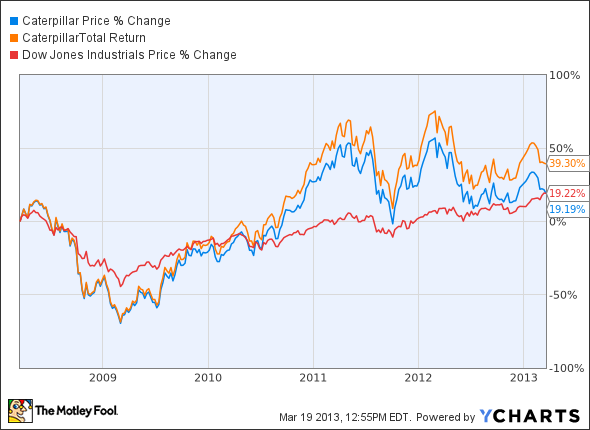
Today, I’ll take a look at construction machinery veteran Caterpillar . The stock is generally a good proxy for the global economy, given Caterpillar’s deep ties with infrastructure and housing improvements. It does swing up and down with more gusto than the Dow Jones Industrial Average , which has counted Caterpillar as a member since 1991. In the long run, the volatility has worked out in Caterpillar’s favor.

A generous dividend policy has poured gravy on top of Caterpillar’s already impressive share price returns:

CAT data by YCharts.

Caterpillar has more than tripled over the last decade — or quadrupled if you faithfully bought more shares with every dividend check. That’s a 40% increase in total returns, compared with a 16% dividend effect on the Dow as a whole.

Some dividend kings rest their shareholder value on rock-steady payout increases over the years. Caterpillar’s story is a bit different.

CAT data by YCharts.

Caterpillar took the crisis of 2008 and 2009 particularly hard, because construction activity ground to a halt on a global level. The stock lost 73% of its value between April 2008 and the bottom in March, 2009. But unlike the financial giants that stumbled on a similar scale, Caterpillar never slashed its dividends. You see, it’s torrential cash flows never stopped gushing, even at the worst of times. Maintaining the dividend was a no-brainer.

CAT Chart

CAT data by YCharts

So faithful shareholders ended up buying a lot of stock with their stable dividends. If you bought in at the right time, you could have locked in an effective yield of 7.2%.

It’s not the traditional dividend story of rapid payout boosts, but rather one of unshakable cash-building power in the face of global disaster. There’s nothing wrong with taking that alternative road to dividend riches.

Caterpillar is the market share leader in an industry in which size matters, and its quality products, extensive service network, and unparalleled brand strength combine to give it solid competitive advantages. Read all about Caterpillar’s strengths and weaknesses in The Motley Fool’s brand-new report. Just click here to access it now.

var FoolAnalyticsData = FoolAnalyticsData || []; FoolAnalyticsData.push({ …read more
Source: FULL ARTICLE at DailyFinance

Seven Stocks That Will Take the DJIA to 15,000 (IBM, CVX, MMM, MCD, UTX, CAT, XOM)

By 24/7 Wall St.

Wall St Bull statue

Filed under: , , , , , , ,

The Dow Jones Industrial Average hit a new high this week, and the new closing high is 14,253.77. We originally came up with a top price target for the DJIA of 14,590 for 2013 based upon our own DJIA analysis and methodology. We now expect that number to be surpassed, even if we have not officially raised the target. The reality is that by our take it will only require the top seven of the 30 DJIA stocks to perform this year for the DJIA to hit 15,000.

International Business Machines Corp. (NYSE: IBM), Chevron Corp. (NYSE: CVX), 3M Co. (NYSE: MMM), McDonald’s Corp. (NYSE: MCD), United Technologies Corp. (NYSE: UTX), Caterpillar Inc. (NYSE: CAT) and Exxon Mobil Corp. (NYSE: XOM) will likely be the seven stocks of the 30 DJIA components that lead the index to 15,000. At issue is that the DJIA is a price-weighted index that does not care about the market capitalization. These seven DJIA stocks account for 43% of the entire weighting of the 30 DJIA components.

For instance, General Electric Co. (NYSE: GE) has a $245 billion market cap, yet its $23.59 share price generates a weighing of only 1.27%. Then you have 3M Co. (NYSE: MMM) with a 5.63% weighting because its price is $104.45, and United Technologies Corp. (NYSE: UTX) has a 4.9% weighting in the DJIA because its price is $89.13. Combined, two these companies have a market cap of $159 billion. So GE is worth almost 150% of the market cap, but its weighting in the DJIA at 1.27% compares to the combined weighting of 10.73% for 3M and United Tech. Now you know how silly the DJIA can be as an index, even if investors are usually referring to the DJIA when they say “the market.”

If you took the bottom seven DJIA components, you barely get a 7% combined weighting in the DJIA. These stocks could all double in a static scenario, where the other stocks remain the same, and you would barely get close to the 15,000 mark.

A review at IndexArb.com shows just how much these weightings matter, with a cumulative weighting after each component:

1) IBM 11.13; 11.13
2) Chevron 6.35; 17.48
3) 3M 5.63; 23.11
4) McDonald’s 5.16; 28.27
5) United Technologies 4.90; 33.17
6) Caterpillar 4.86; 38.03
7) Exxon Mobil 4.83; 42.86

International Business Machines Corp. (NYSE: IBM) is at $206.53, against a 52-week range of $181.85 to $211.79. The consensus target price is $225.75, implying an expected gain of 9.3%. IBM‘s dividend yield is 1.7% but has been rising, and the company keeps buying back stock. Warren Buffett has bought a large stake that is likely to rise as well.

Chevron Corp. (NYSE: CVX) trades at $117.93, against a 52-week range of $95.73 to $118.53. Its consensus target price is $124.51, implying upside of 5.6%, and it has a 3.1% …read more
Source: FULL ARTICLE at DailyFinance

Caterpillar Crawls To A Standstill After Years Of Explosive Growth

By Zacks.com, Contributor

After three years of double digit earnings growth, including 93% growth in 2010, it looks like Caterpillar (CAT) is going to hit a wall in 2013 as earnings are expected to decline by 4.4%. The bad news started with a 13% fourth quarter 2012 earnings miss even as the company reported record full year 2012 sales. The world’s largest construction and mining equipment maker also had the embarrassing episode of having to announce it was writing down $580 million for its purchase of Zhengzhou Siwei Mechanical & Electrical Manufacturing, which made roof-support equipment for underground coal mines, after it discovered discrepancies in the physical inventory after it closed on the deal in October 2012. It blamed “coordinated accounting misconduct” inside the Chinese company. That acquisition had been the company’s largest Asia investment since 2010. Revenue fell to $16.08 billion from $17.24 billion in the fourth quarter of 2011 as China slowed and Europe remained mired in a recession. Inventory was lowered by $2 billion in the quarter. Special Offer: What you don’t own is just as important as what investments you do own. Top investing experts named names when it comes to securities to avoid in the year ahead. Get the results in this free downloadable report, 24 Widely-Held Investments You Should Sell Now. Caterpillar announced a huge EPS guidance range for 2013, which signals that it basically has no idea how business is going to be this year. It expects earnings anywhere from $7.00 to $9.00. China is still expected to be weak in the first half of 2013 which leaves a second half of the year rally to revive the company’s prospects. But will it? Eleven estimates have come down for 2013 in the last 30 days. The 2013 Zacks Consensus has fallen to $8.25 from $8.69 a month ago. The stock has slid to a Zacks Rank #5 (Strong Sell). CAT data by YCharts Tracey Ryniec is the value stock strategist for Zacks.com. She is also the editor of the Turnaround Trader and Value Investor services. You can follow her on twitter at @TraceyRyniec. Read the full Analyst Report on CAT …read more
Source: FULL ARTICLE at Forbes Latest

Signs of runaway heat seen in Boeing 787 Dreamliner batteries

An investigation into a lithium ion battery that overheated on a Boeing 787 flight in Japan last month found evidence of the same type of “thermal runaway” seen in a similar incident in Boston, officials said Tuesday.

The Japan Transportation Safety Board said that CAT scans and other analysis found damage to all eight cells in the battery that overheated on the All Nippon Airways 787 on Jan. 16, which prompted an emergency landing and probes by both U.S. and Japanese aviation safety regulators.

They also found signs of short-circuiting and “thermal runaway,” a chemical reaction in which rising temperature causes progressively hotter temperatures. U.S. investigators found similar evidence in the battery that caught fire last month on a Japan Airlines 787 parked in Boston.

Photos distributed by the Japanese investigators show severe charring of six of the eight cells in the ANA 787’s battery and a frayed and broken earthing wire — meant to minimize the risk of electric shock.

All 50 Boeing 787s in operation are grounded as regulators and Boeing investigate the problem. The Japanese probe is focusing on flight data records and on the charger and other electrical systems connected to the damaged battery.

Lithium ion batteries are more susceptible to catching fire when they overheat or to short-circuit than other types of batteries. Boeing built in safeguards to gain safety certification for use of the relatively light and powerful batteries to power various electrical systems on the 787, the world’s first airliner made mostly from lightweight composite materials.

Investigators earlier said they found no evidence of quality problems with production of the 787’s batteries by Kyoto, Japan-based, GS Yuasa, whose own aerospace ambitions are on the line.

Yuasa said Tuesday that its April-December net profit fell 3.6 percent to $59.6 million from a year earlier, as demand for batteries lagged due to sluggish demand in Japan and overseas.

The company has struggled to turn its lithium ion business to profitability. In April-December its lithium ion business posted a $78.2 million loss, it said, compared with an operating loss of 3.26 billion yen in the full-year that ended March 31, 2012.

Source: FULL ARTICLE at Fox World News

Japan 787 probe finds thermal runaway in battery

Japan‘s Transport Safety Board says the lithium ion battery aboard a Boeing 787 flight in Japan last month found evidence of the same type of “thermal runaway” seen in a similar incident in Boston.

The board said in a report Tuesday that CAT scans and other analysis found damage to all eight cells in the battery that overheated on an All Nippon Airways 787 on Jan. 16, prompting an emergency landing.

They also found signs of “thermal runaway,” a chemical reaction in which rising temperature causes progressively hotter temperatures. U.S. investigators found similar evidence in the battery that caught fire last month on a Japan Airlines 787 parked in Boston.

All 50 Boeing 787s in operation are grounded as regulators and Boeing investigate the problem.

Source: FULL ARTICLE at Fox World News

Japan probe finds 787 battery not overcharged

A lithium ion battery on a Boeing 787 that overheated during an All Nippon Airways flight earlier this month, prompting an emergency landing, was not overcharged, Japan‘s transport safety agency said Wednesday.

Japan Transport Safety Board chairman Norihiro Goto told reporters the flight’s data recorder showed the main battery, used to power many electrical systems on the jet, was not overcharged.

That contradicts an earlier finding by the agency as it investigates with the U.S. Federal Aviation Administration.

All 50 of the 787 Dreamliners that Boeing has delivered to airlines were grounded after the emergency landing by the ANA flight on Jan. 16. Boeing has halted deliveries of new planes until it can address the electrical problems.

Goto said the maximum voltage recorded for the battery was 31 volts, which was below its 32 volt limit. But the data also showed a sudden, unexplained drop in the battery’s voltage, he said.

Aircraft do not usually use the kind of lithium ion battery chosen for the 787, and investigators are still struggling to figure out what may have gone wrong.

“It’s not that it is difficult, but that we are not so familiar with it,” Goto said.

The Transport Safety Board said it also will study the aircraft’s auxiliary battery and compare data from each.

Investigators from both sides are probing the maker of the charred battery, GS Yuasa, and are examining it using CAT scans at a facility of Japan‘s aerospace agency.

U.S. investigators also said that they found no evidence of overcharging in a battery that ignited on a Japan Airlines Boeing 787 as it sat on the tarmac in Boston’s airport.

Source: FULL ARTICLE at Fox World News

Notable ETF Inflow Detected – VIG, CL, CAT, MDT

By ETFChannel.comLooking today at week-over-week shares outstanding changes among the universe of ETFs covered at ETF Channel, one standout is the Vanguard Dividend Appreciation ETF (AMEX: VIG) where we have detected an approximate $47.1 million dollar inflow — that’s a 0.4% increase week over week in outstanding units (from 201,267,829 to 202,069,593). Among the largest underlying components of VIG, in trading today Colgate-Palmolive Co. (NYSE: CL) is off about 0.7%, Caterpillar Inc. (NYSE: CAT) is up about 1.3%, and Medtronic, Inc. (NYSE: MDT) is lower by about 0.7%. For a complete list of holdings, visit the VIG Holdings page »
Source: Forbes Markets