Tag Archives: Treasury Department

U.S. to Let Spy Agencies Scour Americans' Finances

By Reuters

Filed under: , ,

(Photo Credit: Jupiterimages, Colin Anderson)

By Emily Flitter and Stella Dawson and Mark Hosenball

NEW YORK/WASHINGTON — The Obama administration is drawing up plans to give all U.S. spy agencies full access to a massive database that contains financial data on American citizens and others who bank in the country, according to a Treasury Department document seen by Reuters.

The proposed plan represents a major step by U.S. intelligence agencies to spot and track down terrorist networks and crime syndicates by bringing together financial databanks, criminal records and military intelligence. The plan, which legal experts say is permissible under U.S. law, is nonetheless likely to trigger intense criticism from privacy advocates.

Financial institutions that operate in the United States are required by law to file reports of “suspicious customer activity,” such as large money transfers or unusually structured bank accounts, to Treasury’s Financial Crimes Enforcement Network (FinCEN).

The Federal Bureau of Investigation already has full access to the database. However, intelligence agencies, such as the Central Intelligence Agency and the National Security Agency, currently have to make case-by-case requests for information to FinCEN.

The Treasury plan would give spy agencies the ability to analyze more raw financial data than they have ever had before, helping them look for patterns that could reveal attack plots or criminal schemes.

The planning document, dated March 4, shows that the proposal is still in its early stages of development, and it is not known when implementation might begin.

Financial institutions file more than 15 million “suspicious activity reports” every year, according to Treasury. Banks, for instance, are required to report all personal cash transactions exceeding $10,000, as well as suspected incidents of money laundering, loan fraud, computer hacking or counterfeiting.

“For these reports to be of value in detecting money laundering, they must be accessible to law enforcement, counter-terrorism agencies, financial regulators, and the intelligence community,” said the Treasury planning document.

Sponsored Links

A Treasury spokesperson said U.S. law permits FinCEN to share information with intelligence agencies to help detect and thwart threats to national security, provided they adhere to safeguards outlined in the Bank Secrecy Act. “Law enforcement and intelligence community members with access to this information are bound by these safeguards,” the spokesperson said in a statement.

Some privacy watchdogs expressed concern about the plan when Reuters outlined it to them.

A move like the FinCEN proposal “raises concerns as to whether people could find their information in a file as a potential terrorist suspect without having the appropriate predicate for that and find themselves potentially falsely accused,” said Sharon Bradford Franklin, senior counsel for the Rule of Law Program at the Constitution Project, a non-profit watchdog group.

Despite these concerns, legal experts emphasize that this sharing of data is permissible under U.S. law. Specifically, banks’ suspicious activity reporting requirements are dictated by a combination of the …read more
Source: FULL ARTICLE at DailyFinance

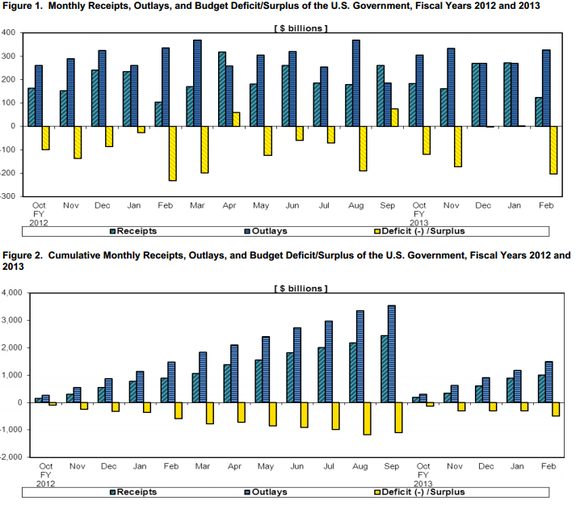
Deficit Drops 15% for FY 2013

By Justin Loiseau, The Motley Fool

Filed under:

After a rare January surplus, the U.S. Treasury deficit clocked in at $203.5 billion for February, according to a Treasury Department report (link opens in PDF) released today. February is traditionally a month of low receipts, and this newest data slightly exceeded analyst expectations.

Source: fms.treas.gov 

For FY 2013, the current deficit is $494.0 billion, a whopping 15% less than the same period in FY 2012. The improvement comes mainly from a 13.1% jump in receipts, overshadowing a slight 2.1% spending increase.

Reduced defense spending and lower debt payments have helped keep costs low for this fiscal year. At the government‘s current spending rate, debt interest accounts for $16.9 billion in interest payments per month, or 5% of total outlays.

The article Deficit Drops 15% for FY 2013 originally appeared on Fool.com.

Y
ou can follow Justin Loiseau on Twitter, @TMFJLo, and on Motley Fool CAPS, @TMFJLo.
Try any of our Foolish newsletter services free for 30 days. We Fools don’t all hold the same opinions, but we all believe that considering a diverse range of insights makes us better investors. The Motley Fool has a disclosure policy.

Copyright © 1995 – 2013 The Motley Fool, LLC. All rights reserved. The Motley Fool has a disclosure policy.

(function(c,a){window.mixpanel=a;var b,d,h,e;b=c.createElement(“script”);
b.type=”text/javascript”;b.async=!0;b.src=(“https:”===c.location.protocol?”https:”:”http:”)+
‘//cdn.mxpnl.com/libs/mixpanel-2.2.min.js’;d=c.getElementsByTagName(“script”)[0];
d.parentNode.insertBefore(b,d);a._i=[];a.init=function(b,c,f){function d(a,b){
var c=b.split(“.”);2==c.length&&(a=a[c[0]],b=c[1]);a[b]=function(){a.push([b].concat(
Array.prototype.slice.call(arguments,0)))}}var g=a;”undefined”!==typeof f?g=a[f]=[]:
f=”mixpanel”;g.people=g.people||[];h=[‘disable’,’track’,’track_pageview’,’track_links’,
‘track_forms’,’register’,’register_once’,’unregister’,’identify’,’alias’,’name_tag’,
‘set_config’,’people.set’,’people.increment’];for(e=0;e<h.length;e++)d(g,h[e]);
a._i.push([b,c,f])};a.__SV=1.2;})(document,window.mixpanel||[]);
mixpanel.init("9659875b92ba8fa639ba476aedbb73b9");

function addEvent(obj, evType, fn, useCapture){
if (obj.addEventListener){
obj.addEventListener(evType, fn, useCapture);
return true;
} else if (obj.attachEvent){
var r = obj.attachEvent("on"+evType, fn);
return r;
}
}

addEvent(window, "load", function(){new FoolVisualSciences();})
addEvent(window, "load", function(){new PickAd();})

var themeName = 'dailyfinance.com';
var _gaq = _gaq || [];
_gaq.push(['_setAccount', 'UA-24928199-1']);
_gaq.push(['_trackPageview']);

(function () {

var ga = document.createElement('script');
ga.type = 'text/javascript';
ga.async = true;
ga.src = ('https:' == document.location.protocol ? 'https://ssl' : 'http://www') + '.google-analytics.com/ga.js';

var s = document.getElementsByTagName('script')[0];
s.parentNode.insertBefore(ga, s);
})();

Read | Permalink | Email this | Linking Blogs | Comments

…read more
Source: FULL ARTICLE at DailyFinance

Budget Deficit Up Sharply But Lower Than Last Year's Pace

By The Associated Press

biudget deficit february up sharply

Filed under: , , ,

Rep. Paul Ryan, R-Wis., holds up a copy of the House Budget Committee 2014 Budget Resolution during a news conference on Capitol Hill on Tuesday. Projections by the Congressional Budget Office suggest the federal deficit grew sharply in February. (Carolyn Kaster/AP)

WASHINGTON — The federal deficit likely grew sharply in February from January but stayed below last year’s pace through the first five months of the budget year. Higher taxes and an improving economy are expected to keep the annual deficit below $1 trillion, the first time that has happened since President Barack Obama took office.

The Congressional Budget Office projects deficit grew by $205 billion in February. That’s down $27 billion from the same month a year ago. The government recorded a small surplus of nearly $3 billion in January.

For the period October through February, the CBO projects a deficit of $495 billion. That would be $86 billion lower than the same period a year ago. The government‘s budget year runs from Oct. 1 to Sept. 30.

Last month, the CBO released its estimate of the deficit for the entire budget year, projecting it would total $845 billion. Even with the improvement, the government would be required to borrow 24 cents of every dollar it spends this year.

That estimate doesn’t reflect the $44 billion of across-the-board spending cuts that kicked in March 1. Those cuts many reduce the deficit further. But their impact won’t appear in February’s total.

The monthly budget update from the Treasury Department comes as both the White House and GOP leaders in Congress are renewing their efforts to reach agreement on a broad deal to reduce the deficit. But so far, both sides are staking out familiar turf.

GOP Rep. Paul Ryan, chairman of the House Budget Committee, on Tuesday introduced a plan that would sharply cut taxes and spending in an effort to balance the budget in 10 years. President Barack Obama campaigned against Ryan’s approach in 2012, when he ran against former Massachusetts Governor Mitt Romney and Ryan was the GOP vice-presidential nominee.

Obama met with Senate Democrats on Capitol Hill as part of a broader outreach effort to members of both parties. Senate Democrats plan to introduce a counterproposal to Ryan’s budget on Wednesday that will include $975 billion in higher taxes, which Republicans steadfastly oppose.

The deficit is the amount the government must borrow when its expenses exceed its revenue. Each month’s deficit is volatile and can be affected by calendar quirks that shift government spending or revenue from one month to another.

Modest economic growth has boosted federal tax receipts. And the Treasury Department has also issued about $20 billion less in tax refunds in January and February compared to the same two months last year. That’s because the White House and Congress didn’t agree on tax policy until Jan. 1.<br …read more
Source: FULL ARTICLE at DailyFinance

What's Important in the Financial World (3/12/2013)

By 24/7 Wall St.

Sports Equipment

Filed under:

The U.K. Probes HP

The never-ending battle over the Hewlett-Packard Co. (NYSE: HPQ) buyout of Autonomy continues. HP took a $5 billion write-off less than a year after the deal. It seems that the big company was duped by Autonomy’s financial claims, or so it says. Now, the United Kingdom has decided that it should weigh in. According to the BBC:

The UK‘s Serious Fraud Office (SFO) is investigating the sale of technology firm Autonomy to Hewlett Packard, according to a filing from HP.

It joins the US Department of Justice and the UK accounting regulator in questioning the firm.

A number of investors and due diligence experts believe that some fault sits with HP management and its board. The company engaged investment banks and auditors to review the numbers. Certainly, with so much money involved, it would be prudent to make a meticulous evaluation. HP clearly did not. Now it has to rely on regulators, and probably the court system, to clean up the mess.

Treasury Sells GM Shares

The Treasury Department continues to dump massive numbers of shares in General Motors Co. (NYSE: GM), either because it wants to show it can get some taxpayer money back from its bailout of the largest American car maker, or its does not like the firm’s future prospects. Certainly GM‘s years of losses in Europe may be a trigger for Treasury’s concerns. In its monthly TARP Report to Congress, the Treasury Department reported:

In February, Treasury’s brokers for GM stock sales informed Treasury that they had engaged six smaller broker dealers, including minority and women owned broker dealers, assist with Treasury’s sales of its GM common stock.

In February 2013, Treasury received total net proceeds of approximately $489.9 million from the sales of GM common stock To date, Treasury has recovered approximately $ 29.8 billion of its investment in GM through repayments, sales of stock, dividends, interest, and other income

Lenovo Sniffs Around BlackBerry

Lenovo, the Chinese PC maker, is once again hinting it might like to own BlackBerry. Given the battered Canadian company’s results, it is hard to see the appeal. But Lenovo has no real spot in the smartphone market, which is a vulnerability as it ponders the shift of consumer buying activity from personal computers to handheld devices. Lenovo may believe it needs to take a long shot. According to EWeek:

Lenovo, which offers Android-based smartphones, may be in the market for the troubled device maker, according to Lenovo’s CEO. Lenovo executives, less than two months after disavowing rumors that they were interested in buying struggling smartphone maker BlackBerry, reportedly are again raising that possibility.

Lenovo CEO Yang Yuanqing told a French financial newspaper in an interview that was published March 11 that a deal for BlackBerry “could possibility make sense,” though he would first have to assess the market and BlackBerry’s standing in it.

Filed under: 24/7 Wall St. Wire, Market Open Tagged: HPQ

Read | Permalink | <a target=_blank href="http://www.dailyfinance.com/forward/20498428/" title="Send this entry to …read more
Source: FULL ARTICLE at DailyFinance

Annaly Capital: 1 Big Risk We Are Facing Right Now

By Amanda Alix, The Motley Fool

Filed under:

This time of year is oodles of fun for investors, when companies’ annual reports and letters to shareholders shed a bit more light on the inner workings of investment favorites.

The “Risk Factors” section is an especially good read and, while often filled with generalized statements about the economy, future legislation, and such, can sometimes give a real clue as to what these companies themselves consider a threat to their bottom lines.

Such is the case with Annaly Capital Management , whose latest 10-K filing I recently perused. One particular risk the company identified caught my eye, as I had been thinking about this issue myself — and it’s a doozy: the winding down of Fannie Mae and Freddie Mac.

Fannie, Freddie wind-down will cause upheaval
As Annaly management notes in its 10-K, the idea to unwind Fannie and Freddie was first floated by the Treasury Department in early 2011, in a white paper regarding housing finance reform. As an entity that invests primarily in mortgage-backed securities backed by these government-sponsored entities, any change in the status of these behemoths would have an impact on Annaly and other pure-agency mREITs, such as American Capital Agency and Armour Residential .

Lately, the changes to those GSEs have been accelerated. Just this week, Edward DeMarco, the acting director of the Federal Housing Finance Agency decreed that the two must work together to create a new, joint company that will securitize home loans for a fee. This new entity could end up being either public or private, depending upon which way the political winds blow.

Since the two GSEs currently insure about 90% of all home loans being written, shutting them down, no matter how slowly, will cause issues for mREITs. As Annaly points out, market uncertainty pursuant to this process can easily cause market jitters that could decrease the value of the company’s holdings. Not a good thing, of course, since it is these very securities that Annaly, American Capital Agency, and Armour use to secure financing with which to invest further.

And that’s not the worst of it. Management notes that elimination of Fannie and Freddie — or even substantial changes to those enterprises — just might also eliminate the government guarantee for those coveted agency MBSes, effectively putting the pure-agency players out of business.

A real and abiding concern
While these assessments of risk may sound dire, they are well within the realm of possibility. This seems to be the year of change at the GSEs, and a group of legislators have recently sought to bump the issue of GSE reform into the spotlight. The Wall Street Journal notes that much of the debate concerns the continued availability of 30-year, fixed rate mortgages — the bread and butter of mREITs — which are common products in the U.S. and Denmark, but not in other parts of the world.

Once again, Annaly management is showing forethought in keeping a close eye on these developments. Mortgage …read more
Source: FULL ARTICLE at DailyFinance

AIG Buys Back Warrants From Treasury

By Eric Volkman, The Motley Fool

Filed under:

AIG has concluded the repurchase of warrants it issued to the Treasury Department during the financial crisis. This removes the final element of government involvement in the company.

The warrants, which were sold in two tranches in 2008 and 2009, were repurchased for roughly $25 million. The 2008 tranche gave Treasury the right to buy around 2.7 million shares of the company’s common stock for $50 per share. The figures for the tiny 2009 tranche were for up to 150 shares at $0.00002 apiece.

During the financial crisis, AIG was the recipient of around $182 billion in bailout funds from the government, which subsequently took a 92% stake in the company. Over the past few years, the government has divested itself of its shareholding.

The article AIG Buys Back Warrants From Treasury originally appeared on Fool.com.

Fool contributor Eric Volkman has no position in AIG. The Motley Fool recommends, owns shares of, and has options on AIG. Try any of our Foolish newsletter services free for 30 days. We Fools don’t all hold the same opinions, but we all believe that considering a diverse range of insights makes us better investors. The Motley Fool has a disclosure policy.

Copyright © 1995 – 2013 The Motley Fool, LLC. All rights reserved. The Motley Fool has a disclosure policy.

(function(c,a){window.mixpanel=a;var b,d,h,e;b=c.createElement(“script”);
b.type=”text/javascript”;b.async=!0;b.src=(“https:”===c.location.protocol?”https:”:”http:”)+
‘//cdn.mxpnl.com/libs/mixpanel-2.2.min.js’;d=c.getElementsByTagName(“script”)[0];
d.parentNode.insertBefore(b,d);a._i=[];a.init=function(b,c,f){function d(a,b){
var c=b.split(“.”);2==c.length&&(a=a[c[0]],b=c[1]);a[b]=function(){a.push([b].concat(
Array.prototype.slice.call(arguments,0)))}}var g=a;”undefined”!==typeof f?g=a[f]=[]:
f=”mixpanel”;g.people=g.people||[];h=[‘disable’,’track’,’track_pageview’,’track_links’,
‘track_forms’,’register’,’register_once’,’unregister’,’identify’,’alias’,’name_tag’,
‘set_config’,’people.set’,’people.increment’];for(e=0;e<h.length;e++)d(g,h[e]);
a._i.push([b,c,f])};a.__SV=1.2;})(document,window.mixpanel||[]);
mixpanel.init("9659875b92ba8fa639ba476aedbb73b9");

function addEvent(obj, evType, fn, useCapture){
if (obj.addEventListener){
obj.addEventListener(evType, fn, useCapture);
return true;
} else if (obj.attachEvent){
var r = obj.attachEvent("on"+evType, fn);
return r;
}
}

addEvent(window, "load", function(){new FoolVisualSciences();})
addEvent(window, "load", function(){new PickAd();})

var themeName = 'dailyfinance.com';
var _gaq = _gaq || [];
_gaq.push(['_setAccount', 'UA-24928199-1']);
_gaq.push(['_trackPageview']);

(function () {

var ga = document.createElement('script');
ga.type = 'text/javascript';
ga.async = true;
ga.src = ('https:' == document.location.protocol ? 'https://ssl' : 'http://www') + '.google-analytics.com/ga.js';

var s = document.getElementsByTagName('script')[0];
s.parentNode.insertBefore(ga, s);
})();

Read | Permalink | Email this | Linking Blogs | Comments

…read more
Source: FULL ARTICLE at DailyFinance

U.S. gives banking green light to Myanmar tycoons

File photo of an employee standing behind a MasterCard logo during the launch of the international credit card issuer's first ATM transaction in Myanmar, in Yangon

YANGON (Reuters) – Two banks owned by tycoons associated with Myanmar's former military regime will start to do business with U.S. companies and investors in the latest reward for the Southeast Asian country's rapid political transformation. The U.S. Treasury Department said on Friday it would issue a general licence for four of Myanmar's biggest banks — Myanma Economic Bank, Myanma Investment and Commercial Bank, Asia Green Development Bank and Ayeyarwady Bank — allowing U.S. companies and citizens to deal with them. …

…read more
Source: FULL ARTICLE at Yahoo Business

Apple Snaps Up Enterprise Customers At BlackBerry's Expense

By Trefis Team, Contributor

After emerging as the darling of retail customers over the past few years, Apple seems to be hard at work wooing enterprises as well as government bodies. The company recently announced two important wins at Home Depot and the New Zealand government, both of which have come at the expense of BlackBerry. While Home Depot is reportedly replacing 10,000 BlackBerry smartphones with iOS devices, the New Zealand police force plans to arm 6,000 officers with iPhones and about two-third of them with iPads over the next three months. Other notable agencies that have recently announced their BlackBerry to iOS migrations include the U.S. Immigration and Customs Enforcement Agency, the National Transportation Safety Board and Australia’s Treasury Department. …read more
Source: FULL ARTICLE at Forbes Latest

UN takes charity founder off Al Qaida list

A Saudi Arabian government official who started an Islamic charity in Oregon has been taken off a United Nations list of people subject to sanctions for ties to al-Qaida but remains on a similar U.S. list.

The U.N. Security Council committee monitoring sanctions against al-Qaida removed Soliman al-Buthe, now a deputy minister in Saudi Arabia‘s Ministry of Municipalities, from the list Monday.

Al-Buthe still faces arrest if he returns to the United States. A federal indictment alleges he smuggled $150,000 in cash collected by Al Haramain Islamic Foundation in Ashland to Saudi Arabia in 2000 to help terrorists in Chechnya. His co-defendant, Iranian-American tree surgeon Pete Seda, is serving 33 months in prison after being convicted of conspiracy and tax fraud.

Al-Buthe’s attorney Tom Nelson said the U.N. action is some vindication for his client, but al-Buthe is still trying to get off the U.S. terrorism list.

“It all goes back to the days immediately after 9/11, when the government embarked on a crusade to find terrorists under every bed,” Nelson said. “A lot of innocent people got sucked in and harmed very significantly as a result. More and more of those cases are coming out all the time.”

Al-Buthe said in a statement that all he ever wanted was a fair chance to clear his name.

“While the Americans still refuse to disclose reasons behind their actions, the United Nations now prohibits unfair practices. It was this change that allowed me to clear my name.”

He and Al Haramain remain on the Treasury Department‘s al-Qaida sanctions list. The foundation disbanded after the department froze its assets in 2004 for allegedly aiding terrorists in Chechnya and Albania. A federal appeals court upheld the listing, but not the assets freeze.

Nelson said Treasury has not responded to his application to be taken off the list since he filed it two years ago.

Treasury spokesman John Sullivan said people are taken off the list, but he did immediately respond to questions about whether al-Buthe’s request to be removed had been received or why Nelson has received no response.

The reasons al-Buthe was taken off the U.N. list were not given by the committee, which said in a statement only that it considered …read more
Source: FULL ARTICLE at Fox US News

Mexico man on US kingpin list for money laundering

The U.S. Treasury Department says it is levying financial sanctions against a Mexican businessman who allegedly launders money for the Zetas drug cartel.

The department’s Office of Foreign Assets Control says in a statement Tuesday that it is acting against Filemon Garcia Ayala under the U.S. Kingpin Act. A listing bars U.S. citizens from having business transactions with the person and allows authorities to freeze their assets in the United States.

The department says it is also acting against two of Garcia Ayala‘s companies in Zacatecas, Mexico, Prodira Casa de Cambio S.A. de C.V. and Trastreva S.A. de C.V. It has also blocked three of his companies in the United States.

It says Mexican authorities tried to arrest Garcia Ayala in June on money laundering charges, but he fled and remains a fugitive.

Source: FULL ARTICLE at Fox World News

Threat of terror attacks against US by Iran and Hezbollah rising, report says

Iran‘s elite Quds Force and Hezbollah militants are learning from a series of botched terror attacks over the past two years and pose a growing threat to the U.S. and other Western targets as well as Israel, a prominent counterterrorism expert says.

Operating both independently and together, the militant groups are escalating their activities around the world, fueling worries in the U.S. that they increasingly have the ability and the willingness to attack the U.S., according to a report by Matthew Levitt of the Washington Institute for Near East Studies. His report points to two attacks last year — one successful and one foiled by U.S. authorities — as indications that the militants are adapting and are determined to take revenge on the West for efforts to disrupt Tehran’s nuclear program and other perceived offenses.

The report’s conclusions expand on comments late last year from U.S. terrorism officials who told Congress that the Quds Force and Hezbollah, which often coordinate efforts, have become “a significant source of concern” for the U.S. The Quds Force is an elite wing of Iran‘s powerful Revolutionary Guard, the defenders of Iran‘s ruling clerics and their hold on power.

The report comes amid ongoing tensions between Iran and the West, including a persistent stalemate over scheduling six-party talks on Tehran’s nuclear program and anger over reports that the U.S. and Israel were behind the Stuxnet computer attack that forced the temporary shutdown of thousands of centrifuges at an Iranian nuclear facility in 2010.

More than 20 terror attacks by Hezbollah or Quds Force operatives were thwarted around the world between May 2011 and July 2012, with nine coming in the first nine months of 2012, Levitt said in the report.

“What is particularly striking is how amateurish the actions of both organizations have been: Targets were poorly chosen and assaults carried out with gross incompetence,” Levitt said in the report. “But as the groups brush off the cobwebs and professionalize their operations, this sloppy tradecraft could quickly be replaced by operational success.”

Levitt is a senior fellow and director of the Washington Institute’s Stein Program on Counterterrorism and Intelligence. From 2005 to early 2007, he served as deputy assistant secretary for intelligence and analysis at the Treasury Department.

The two key attacks, the report said, include the plot by a Texas man to assassinate Saudi Arabia‘s ambassador to the United States. Manssor Arbabsiar, a U.S. citizen with an Iranian passport, pleaded guilty to conspiracy and murder-for-hire last October and told the court that Iranian military officials were involved in the planning. Iran has denied that link.

His effort was foiled when he tried to hire what he thought was a drug dealer to carry out the attack in a Washington restaurant. The man was actually a U.S. Drug Enforcement Administration confidential source.

While that plot highlighted a growing willingness to wage attacks in the U.S., a second, more successful plot in Bulgaria suggests that militants may be learning from their missteps.

Last July, a bomb killed a bus driver and five Israelis, and wounded 30 others, when it struck a tour bus in a caravan. Officials have blamed the attack on Hezbollah.

Other attacks over the past two years have also identified repeated links between Hezbollah and the Quds force — a long alliance that historically involved the Iranians arming, funding or training the Lebanon-based militants and using them as proxies.

In testimony before the Senate Homeland Security and Governmental Affairs Committee last September, Matthew Olsen, director of the National Counterterrorism Center, said “the Quds force, as well as the group that it coordinates with, Lebanese Hezbollah” posed a significant source of concern.

FBI associate deputy director Kevin Perkins added, “We look at it as a serious threat, and … we are focusing intelligence analysts and other resources on that on a daily basis to monitor that threat.”

According to Levitt, the efforts to disrupt Iran‘s nuclear program have only made Tehran more eager to see a successful attack carried out. He said that both Hezbollah and the Quds Force have been hampered by the increased security triggered by the 9/11 attacks.

Source: FULL ARTICLE at Fox World News

Report: Iran, Hezbollah terror threat rising

Iran‘s elite Quds Force and Hezbollah militants are learning from a series of botched terror attacks over the past two years and pose a growing threat to the U.S. and other Western targets as well as Israel, a prominent counterterrorism expert says.

Operating both independently and together, the militant groups are escalating their activities around the world, fueling worries in the U.S. that they increasingly have the ability and the willingness to attack the U.S., according to a report by Matthew Levitt of the Washington Institute for Near East Studies. His report points to two attacks last year — one successful and one foiled by U.S. authorities — as indications that the militants are adapting and are determined to take revenge on the West for efforts to disrupt Tehran’s nuclear program and other perceived offenses.

The report’s conclusions expand on comments late last year from U.S. terrorism officials who told Congress that the Quds Force and Hezbollah, which often coordinate efforts, have become “a significant source of concern” for the U.S. The Quds Force is an elite wing of Iran‘s powerful Revolutionary Guard, the defenders of Iran‘s ruling clerics and their hold on power.

The report comes amid ongoing tensions between Iran and the West, including a persistent stalemate over scheduling six-party talks on Tehran’s nuclear program and anger over reports that the U.S. and Israel were behind the Stuxnet computer attack that forced the temporary shutdown of thousands of centrifuges at an Iranian nuclear facility in 2010.

More than 20 terror attacks by Hezbollah or Quds Force operatives were thwarted around the world between May 2011 and July 2012, with nine coming in the first nine months of 2012, Levitt said in the report.

“What is particularly striking is how amateurish the actions of both organizations have been: Targets were poorly chosen and assaults carried out with gross incompetence,” Levitt said in the report. “But as the groups brush off the cobwebs and professionalize their operations, this sloppy tradecraft could quickly be replaced by operational success.”

Levitt is a senior fellow and director of the Washington Institute’s Stein Program on Counterterrorism and Intelligence. From 2005 to early 2007, he served as deputy assistant secretary for intelligence and analysis at the Treasury Department.

The two key attacks, the report said, include the plot by a Texas man to assassinate Saudi Arabia‘s ambassador to the United States. Manssor Arbabsiar, a U.S. citizen with an Iranian passport, pleaded guilty to conspiracy and murder-for-hire last October and told the court that Iranian military officials were involved in the planning. Iran has denied that link.

His effort was foiled when he tried to hire what he thought was a drug dealer to carry out the attack in a Washington restaurant. The man was actually a U.S. Drug Enforcement Administration confidential source.

While that plot highlighted a growing willingness to wage attacks in the U.S., a second, more successful plot in Bulgaria suggests that militants may be learning from their missteps.

Last July, a bomb killed a bus driver and five Israelis, and wounded 30 others, when it struck a tour bus in a caravan. Officials have blamed the attack on Hezbollah.

Other attacks over the past two years have also identified repeated links between Hezbollah and the Quds force — a long alliance that historically involved the Iranians arming, funding or training the Lebanon-based militants and using them as proxies.

In testimony before the Senate Homeland Security and Governmental Affairs Committee last September, Matthew Olsen, director of the National Counterterrorism Center, said “the Quds force, as well as the group that it coordinates with, Lebanese Hezbollah” posed a significant source of concern.

FBI associate deputy director Kevin Perkins added, “We look at it as a serious threat, and … we are focusing intelligence analysts and other resources on that on a daily basis to monitor that threat.”

According to Levitt, the efforts to disrupt Iran‘s nuclear program have only made Tehran more eager to see a successful attack carried out. He said that both Hezbollah and the Quds Force have been hampered by the increased security triggered by the 9/11 attacks.

Source: FULL ARTICLE at Fox US News

History lesson: Why did Congress create a national debt limit?

By hnn

Now that the Treasury Department has nixed the odd idea of issuing a platinum coin to get around the federal debt limit, Congress once again will be forced to decide whether to raise the debt limit.

When this issue last loomed in 2011, we looked deeply at the question of whether the United States had ever defaulted before. (Answer: It is not entirely unprecedented. There are three instances when the United States could be seen to have defaulted on its obligations — in 1790, in 1933 and in 1971.)

The debt limit covers both publicly-held debt and debts the United States owes to itself (bonds to Social Security and Medicare for future obligations) so no matter what happens, the debt limit will have to be raised, one way or the other….

Source:
WaPo

Source URL:
http://www.washingtonpost.com/blogs/fact-checker/post/history-lesson-why-did-congress-create-a-national-debt-limit/2013/01/13/21114db8-5db8-11e2-9940-6fc488f3fecd_blog.html

Date:
1-14-13

Source: FULL ARTICLE at History News Network – George Mason University