Tag Archives: Kinder Morgan

How to Find the Best Place to Retire

By Dan Caplinger, The Motley Fool

Filed under:

Everyone looks forward to the freedom that retirement living offers. But with the financial realities of living on a fixed income, how can you make your savings go further? The choice of where you want to live in retirement will affect not just your lifestyle but also your finances.

In the following video, Motley Fool investment-planning editor Lauren Kuczala talks with longtime Fool contributor and retirement expert Dan Caplinger about deciding the best place to live when you retire. Dan notes that while there are obvious non-financial considerations, cost of living, taxes, and available benefits make a big difference for retirees trying to make ends meet. He notes that for those with substantial savings, looking for low-cost states without an income tax is often the best way to minimize taxes on investment income. Yet for those who want to live in higher-cost states, Dan has suggestions that can help you reduce taxes to the fullest extent possible.

Retirees often seek income for their portfolios, and midstream operator Kinder Morgan has enormous potential for profits. In The Motley Fool‘s premium research report on Kinder Morgan, we break down the company’s growing opportunity — as well as the risks to watch out for — to uncover whether it’s a buy or a sell. To determine whether this dividend giant is right for your portfolio, simply click here now to claim your copy of this invaluable investor’s resource.

var FoolAnalyticsData = FoolAnalyticsData || []; FoolAnalyticsData.push({ eventType: “TickerReportPitch”, contentByline: “Dan Caplinger“, contentId: “cms.35305”, contentTickers: “NYSE:KMI, NYSE:OXY, NYSEMKT:MUB, NYSE:APA”, contentTitle: “How to Find the Best Place to Retire”,

Source: FULL ARTICLE at DailyFinance

What Could Alleviate High Gasoline Prices in This State?

By Taylor Muckerman, The Motley Fool

Filed under:

Due to its California Air Resources Board and the regulations imposed by it, Californians pay a premium at the pump to every state that’s not named Alaska. One might wonder why California is able to enforce these standards; it’s because the state-run organization was already in place before the Clean Air Act was passed. Currently, the Environmental Protection Agency is trying to enact the low sulfur and nitrogen oxide standards throughout the country, but there has been some pushback.

Is there any help on the horizon?
Those who call California home are certainly hoping so. Increased infrastructure to get cheaper Bakken formation and other mid-continent oil to the West Coast is likely to begin appearing in 2014. One of the state’s biggest refiners, Tesoro , plans on increasing rail capacity to ports on the coast where it can then ship the cheaper, lighter oil to its refineries throughout the state. Couple this with pipeline expansions in Canada, and some, not total, relief could be in sight. 

The general partner of Kinder Morgan Energy Partners will likely see some payback, as well
It’s easy to forget the necessity of midstream operators that seamlessly transport oil and gas throughout the United States. Kinder Morgan is one of these operators, and one that investors should commit to memory due to its sheer size – it’s the fourth largest energy company in the U.S. — not to mention its enormous potential for profits. In The Motley Fool’s premium research report on Kinder Morgan, we break down the company’s growing opportunity – as well as the risks to watch out for – in order to uncover whether it’s a buy or a sell. To determine whether this dividend giant is right for your portfolio, simply click here now to claim your copy of this invaluable investor’s resource.

var FoolAnalyticsData = FoolAnalyticsData || []; FoolAnalyticsData.push({ eventType: “TickerReportPitch”, contentByline: “Taylor Muckerman”, contentId: “cms.35256”,

Source: FULL ARTICLE at DailyFinance
What to Expect from Kinder Morgan

By Seth Jayson, The Motley Fool

Filed under:

Kinder Morgan (NYS: KMI) is expected to report Q1 earnings around April 16. Here’s what Wall Street wants to see:

The 10-second takeaway
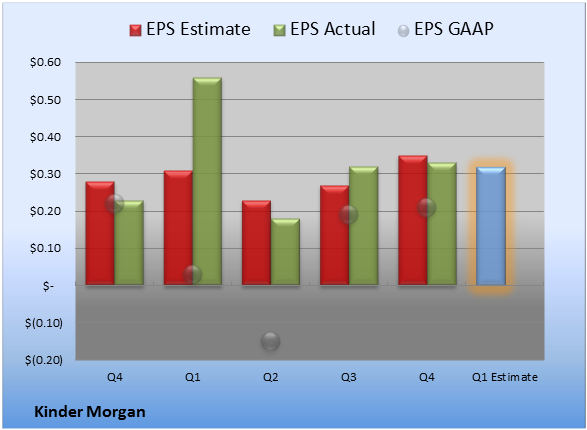
Comparing the upcoming quarter to the prior-year quarter, average analyst estimates predict Kinder Morgan’s revenues will expand 57.0% and EPS will wither -42.9%.

The average estimate for revenue is $2.92 billion. On the bottom line, the average EPS estimate is $0.32.

Revenue details
Last quarter, Kinder Morgan booked revenue of $3.08 billion. GAAP reported sales were 59% higher than the prior-year quarter’s $1.94 billion.

Source: S&P Capital IQ. Quarterly periods. Dollar amounts in millions. Non-GAAP figures may vary to maintain comparability with estimates.

EPS details
Last quarter, non-GAAP EPS came in at $0.33. GAAP EPS of $0.21 for Q4 were 4.5% lower than the prior-year quarter’s $0.22 per share.

Source: S&P Capital IQ. Quarterly periods. Non-GAAP figures may vary to maintain comparability with estimates.

Recent performance
For the preceding quarter, gross margin was 51.2%, 570 basis points better than the prior-year quarter. Operating margin was 31.1%, 770 basis points better than the prior-year quarter. Net margin was 7.1%, 90 basis points worse than the prior-year quarter.

Looking ahead

The full year’s average estimate for revenue is $12.32 billion. The average EPS estimate is $1.33.

Investor sentiment

Of Wall Street recommendations tracked by S&P Capital IQ, the average opinion on Kinder Morgan is outperform, with an average price target of $40.38.

Can your portfolio provide you with enough income to last through retirement? You’ll need more than Kinder Morgan. Learn how to maximize your investment income and “Secure Your Future With 9 Rock-Solid Dividend Stocks.” Click here for instant access to this free report.

The article What to Expect from Kinder Morgan originally appeared on Fool.com.


Seth Jayson had no position in any company mentioned here at the time of publication. You can view his stock holdings here. He is co-advisor of
Motley Fool Hidden Gems, which provides new small-cap ideas every month, backed by a real-money portfolio. The Motley Fool recommends Kinder Morgan. The Motley Fool owns shares of Kinder Morgan. Try any of our Foolish newsletter services free for 30 days. We Fools may not all hold the same opinions, but we all believe that considering a diverse range of insights makes us better investors. The Motley Fool has a disclosure policy.

Copyright © 1995 – 2013 The Motley Fool, LLC. All rights reserved. The Motley Fool has

From: http://www.dailyfinance.com/2013/04/12/what-to-expect-from-kinder-morgan/

Countries Are Clamoring for U.S. Natural Gas

By Dan Dzombak, The Motley Fool

Filed under:

Around the world, countries pay two to five times more for natural gas than we do in the U.S., and they are clamoring for the U.S. to export it. It would be a win-win situation: U.S. producers would get higher prices than they would domestically, then they could turn around and use that money to drill for more natural gas and oil, boosting the U.S. economy.

Data in dollars per MMBtu. Source: FERC, Waterborne Energy

On Monday, Indian Ambassador to the U.S. Nirupama Rao wrote an op-ed in The Wall Street Journal making the case for the U.S. to export natural gas.

In the video below, Motley Fool contributor Dan Dzombak explains his reasoning on how exporting natural gas would be a boon to the U.S.

Only time will tell what will happen with exports in the U.S. natural gas market. Despite that they are integral to the gas and oil industry, it’s easy to forget the necessity of midstream operators that seamlessly transport oil and gas throughout the United States. Kinder Morgan is one of these operators, and one that investors should commit to memory due to its sheer size – it’s the third-largest energy company in the U.S. – not to mention its enormous potential for profits. In The Motley Fool‘s premium research report on Kinder Morgan, we break down the company’s growing opportunity – as well as the risks to watch out for – in order to uncover whether it’s a buy or a sell. To determine whether this dividend giant is right for your portfolio, simply click here now to claim your copy of this invaluable investor’s resource.

var FoolAnalyticsData = FoolAnalyticsData || []; FoolAnalyticsData.push({ eventType: “TickerReportPitch”, contentByline: “Dan Dzombak“, contentId: “cms.31264”, contentTickers: “NYSE:XOM, NYSE:CHK, NYSE:SD, NYSEMKT:LNG, NYSEMKT:CQP”,

From: http://www.dailyfinance.com/2013/04/12/countries-are-clamoring-for-us-natural-gas/

An Unlikely Industry Is Turning to Green Energy

By Aimee Duffy, The Motley Fool

Filed under:

BP just announced it is getting out of the wind power game, and in fact big oil’s green energy initiatives are pretty negligible at this point. It could be disheartening state of affairs, but luckily pipeline companies are stepping in and picking up the slack. In this video, Fool.com contributor Aimee Duffy explores Enbridge‘s recent deal to buy into a wind project in Alberta, and reviews the alternative energy efforts already under way in the North American midstream industry.

It’s easy to forget the necessity of midstream operators that seamlessly transport oil and gas throughout the United States. Kinder Morgan is one of these operators, and one that investors should commit to memory due to its sheer size – it’s the third-largest energy company in the U.S. – not to mention its enormous potential for profits. In The Motley Fool’s premium research report on Kinder Morgan, we break down the company’s growing opportunity – as well as the risks to watch out for – in order to uncover whether it’s a buy or a sell. To determine whether this dividend giant is right for your portfolio, simply click here now to claim your copy of this invaluable investor’s resource.

var FoolAnalyticsData = FoolAnalyticsData || []; FoolAnalyticsData.push({ eventType: “TickerReportPitch”, contentByline: “Aimee Duffy“, contentId: “cms.30836”, contentTickers: “NYSE:KMP, NYSE:BP, NYSE:TRP, NYSE:ENB”, contentTitle: “An Unlikely Industry Is Turning to Green Energy“, hasVideo: “True”,

Source: FULL ARTICLE at DailyFinance

These Pipeline Companies Are Great, but Which Is the Best?

By Taylor Muckerman and Joel South, The Motley Fool

Filed under:

When it comes to the midstream segment, it’s clear that some companies are in place to succeed. Demand far outstrips supply, so those that are well diversified with future plans are likely to take the lion’s share of the growth. For Motley Fool analyst Taylor Muckerman, the one company that stands out is Kinder Morgan Energy Partners . While it’s expensive compared with its peers, its portfolio of assets is second to none, especially when supplemented with capital expenditures. 

If that company doesn’t fit your investing style, analyst Joel South offers his take on Boardwalk Pipeline Partners . This natural gas-focused operator offers a tremendous distribution yield above 7% and is diversified into the mid-continent and Utica shale regions. Those interested in high distribution yields would be well served by taking a deeper dive here.

A different vehicle to play the midstream segment
It’s easy to forget the necessity of midstream operators that seamlessly transport oil and gas throughout the United States. Kinder Morgan is one of these operators, and it’s one that investors should commit to memory because of its sheer size — it’s the fourth largest energy company in the U.S. — not to mention its enormous potential for profits. In The Motley Fool’s premium research report on Kinder Morgan, we break down the company’s growing opportunity — as well as the risks to watch out for — to uncover whether it’s a buy or a sell. To determine whether this dividend giant is right for your portfolio, simply click here now to claim your copy of this invaluable investor’s resource.

var FoolAnalyticsData = FoolAnalyticsData || []; FoolAnalyticsData.push({ eventType: “TickerReportPitch”, contentByline: “Taylor Muckerman and Joel South“, contentId: “cms.30216”, contentTickers: “NYSE:BTU, NYSE:ACI, NYSE:KMI, NYSE:KMP, NYSE:BWP”, …read more

Source: FULL ARTICLE at DailyFinance

One Step Closer to Exporting Natural Gas

By Dan Dzombak, The Motley Fool

Filed under:

Dow Chemical and other chemicals companies have been leading the fight against exporting liquefied natural gas, or LNG, as they want to take advantage of constrained natural gas prices.

They are especially worried of the U.S. exporting to Asia where LNG prices are tied to the price of oil. This week, though, Japan announced that the country is planning futures contracts for LNG in an effort to unlink the price of LNG from oil. This should alleviate one of the big fears of opponents of exporting natural gas from the U.S.

In the below video Motley Fool contributor Dan Dzombak explains why and how this situation brings the U.S. closer to exporting natural gas.

Only time will tell what will happen with exports in the U.S. natural gas market. No matter what happens, it’s easy to forget the necessity of midstream operators that seamlessly transport oil and gas throughout the United States. Kinder Morgan is one of these operators, and one that investors should commit to memory due to its sheer size – it’s the third-largest energy company in the U.S. – not to mention its enormous potential for profits. In The Motley Fool‘s premium research report on Kinder Morgan, we break down the company’s growing opportunity – as well as the risks to watch out for – in order to uncover whether it’s a buy or a sell. To determine whether this dividend giant is right for your portfolio, simply click here now to claim your copy of this invaluable investor’s resource.

var FoolAnalyticsData = FoolAnalyticsData || []; FoolAnalyticsData.push({ eventType: “TickerReportPitch”, contentByline: “Dan Dzombak“, contentId: “cms.29988”, contentTickers: “NYSE:XOM, NYSE:CHK, NYSE:DOW, NYSE:SD, NYSEMKT:LNG“, …read more

Source: FULL ARTICLE at DailyFinance

Which MLPs Should Investors Choose From the Herd?

By Taylor Muckerman and Joel South, The Motley Fool

Filed under:

With such a broad range of MLPs out there right now, investors have many options. Distributions from these companies are vital to shareholders’ total returns. This key fact is why the stability of the long-term, fee-based contracts of the midstream MLPs are a great place for investors to focus.

Heightened visibility
Take this long-term revenue stream and compare it to that of MLPs that produce oil and natural gas, and its clear that distribution growth and stability should be much more reliable at a midstream company like Kinder Morgan Energy Partners . Risk is also reduced because expected production from wells is not always guaranteed. 

If KMP doesn’t fit your investment profile, perhaps its general partner will
It’s easy to forget the necessity of midstream operators that seamlessly transport oil and gas throughout the United States. Kinder Morgan is one of these operators, and one that investors should commit to memory due to its sheer size – it’s the third-largest energy company in the U.S. – not to mention its enormous potential for profits. In The Motley Fool’s premium research report on Kinder Morgan, we break down the company’s growing opportunity – as well as the risks to watch out for – in order to uncover whether it’s a buy or a sell. To determine whether this dividend giant is right for your portfolio, simply click here now to claim your copy of this invaluable investor’s resource.

var FoolAnalyticsData = FoolAnalyticsData || []; FoolAnalyticsData.push({ eventType: “TickerReportPitch”, contentByline: “Taylor Muckerman and Joel South“, contentId: “cms.29172”, contentTickers: “NYSE:EPD, NYSE:KMP, NYSE:NRP, NASDAQ:BBEP”, contentTitle: “Which MLPs Should Investors Choose From the Herd?”, …read more
Source: FULL ARTICLE at DailyFinance

The 3 Best Midstream Companies

By Aimee Duffy, The Motley Fool

Filed under:

The midstream industry is having a great 2013, and many companies in this energy subsector are outperforming the S&P 500. In this video, Motley Fool contributor Aimee Duffy takes a look at the three top performers through the first quarter of 2012. All three companies grew their respective share prices by at least 30%; they make for three great places to start researching the next company to add to your portfolio.

It’s easy to forget the necessity of midstream operators that seamlessly transport oil and gas throughout the United States. Kinder Morgan is one of these operators, and one that investors should commit to memory due to its sheer size – it’s the fourth largest energy company in the U.S. – not to mention its enormous potential for profits. In The Motley Fool‘s premium research report on Kinder Morgan, we break down the company’s growing opportunity – as well as the risks to watch out for – in order to uncover whether it’s a buy or a sell. To determine whether this dividend giant is right for your portfolio, simply click here now to claim your copy of this invaluable investor’s resource.

var FoolAnalyticsData = FoolAnalyticsData || []; FoolAnalyticsData.push({ eventType: “TickerReportPitch”, contentByline: “Aimee Duffy“, contentId: “cms.28799”, contentTickers: “NYSE:KMP, NYSE:GEL, NYSE:SMLP, NYSE:TLP”, contentTitle: “The 3 Best Midstream Companies“, hasVideo: “True”, pitchId: “131”, …read more
Source: FULL ARTICLE at DailyFinance

Kinder Morgan Energy Partners to Make Significant Investment in Chemical Industry

By Business Wirevia The Motley Fool

Filed under:

Kinder Morgan Energy Partners to Make Significant Investment in Chemical Industry

HOUSTON–(BUSINESS WIRE)– Kinder Morgan Energy Partners, L.P. (NYS: KMP) today announced that KMP will invest approximately $58 million to expand its chemical storage capacity. KMP has entered into a long-term contract with Methanex Corporation (NAS: MEOH) to support the construction of methanol storage capacity near Kinder Morgan‘s Geismar Liquids Terminal (GLT) in Geismar, La. Kinder Morgan will build, own and operate the storage tanks and related infrastructure, including improvements to its existing dock at GLT. The assets will provide critical marine, rail and truck access in support of a 1 million tonne per year methanol production plant being relocated by Methanex from Chile, South America. The terminal infrastructure is expected to be in service during the second half of 2014, coinciding with the anticipated startup of the relocated plant.

KMP has also acquired Quality Carriers, Inc.’s 26-acre terminal located in Chester, S.C. The 19-tank facility currently provides storage for a single customer of 35,000 barrels and receives product by rail and distributes by truck.

“The abundance of attractively priced domestic natural gas has led to a resurgence in the chemical and manufacturing industries,” said John Schlosser, president of Kinder Morgan Terminals. “We are very pleased to be able to leverage our existing footprint in Geismar in support of Methanex’s significant capital project, and look forward to continuing to provide logistical and infrastructure solutions for Methanex and others as the renewed industrial development continues along the Gulf Coast and elsewhere. We are also pleased to be entering the public liquid terminal market in the greater Charlotte area and look forward to growing that business with new chemical customers.”

Kinder Morgan Energy Partners, L.P. (NYS: KMP) is a leading pipeline transportation and energy storage company and one of the largest publicly traded pipeline limited partnerships in America. It owns an interest in or operates approximately 44,000 miles of pipelines and 180 terminals. The general partner of KMP is owned by Kinder Morgan, Inc. (NYS: KMI) . Kinder Morgan is the largest midstream and the third largest energy company in North America with a combined enterprise value of approximately $100 billion. It owns an interest in or operates approximately 73,000 miles of pipelines and 180 terminals. Its pipelines transport natural gas, gasoline, crude oil, CO2 and other products, and its terminals store petroleum products and chemicals and handle such products as ethanol, coal, petroleum coke and steel. KMI …read more
Source: FULL ARTICLE at DailyFinance

3 Opportunities in Booming South Texas

By Aimee Duffy, The Motley Fool

Filed under:

Earlier this week, the Texas Railroad Commission announced that its preliminary numbers for oil production in the Eagle Ford Shale are outstanding. Production climbed 50% from 2011 to 2012, averaging 373,303 barrels per day. That growth is significant, and provides investors with some pretty compelling opportunities, so let’s take a closer look at what’s going on in southeastern Texas.

Eagle eye
The Eagle Ford shale seems to have come out of nowhere. In 2008, oil production in the region was a scant 358 barrels per day — but take a look at what’s happened since then:

Source: Texas Railroad Commission

You can see that the biggest production increase in the short four year history of the play came last year. Keep in mind that the slight uptick at the end of the graph is a mere month’s worth of production — and even that increased by more than 12,000 bpd.

What’s the story here?
The Eagle Ford Shale is a geologic wonder that stretches from the southern border of Texas up through to around Austin.

Source: Energy Information Association

The shale’s pay zone is thicker than most U.S. plays, with a higher percentage of carbonate material. On top of that, the distinct banding pattern of the Eagle Ford allows producers to target specific commodities for production. In the picture above, the green band is the oil region, the yellow band is for natural gas liquids, and the pink band is for dry gas.

Three winners
This sort of production growth is hard to ignore. The companies behind these staggering numbers are making a killing … so who are they?

The top producer in the play is EOG Resources . In fact, EOG cranks so much oil out of the Eagle Ford — 109,776 barrels per day in 2012 — that it’s actually the second largest oil producer in all of Texas.

Another winner here is ConocoPhillips . The company drills the cheapest wells in the industry, and is the second-biggest producer in the shale.

Finally, we have Kinder Morgan Energy Partners . All of the oil and NGLs produced in the Eagle Ford are worthless without transportation and processing infrastructure. Kinder Morgan had the pipeline asset base in the Eagle Ford, and its buyout of Copano Energy will give it a processing footprint, as well, when the deal closes in the third quarter of this year.

More to come?
Producers are increasingly targeting the region, which includes both the Eagle Ford and the Woodbine sandstone formations. This area, cleverly titled “Eaglebine,” is northeast of where the bulk of the oil activity is in the Eagle Ford right now. Halcon Resources is one company that plans to make the most of the new sweet spot. The company has nine wells there, and plans to spend $490 million on drilling and completing many more this year.

All this oil still needs a way to …read more
Source: FULL ARTICLE at DailyFinance

Kinder Morgan Secures Additional Throughput Commitment for Condensate Processing Facility Expansion

By Business Wirevia The Motley Fool

Filed under:

Kinder Morgan Secures Additional Throughput Commitment for Condensate Processing Facility Expansion


Company to invest approximately $170 million to expand facility for second phase

HOUSTON–(BUSINESS WIRE)– Kinder Morgan Energy Partners, L.P. (NYS: KMP) today announced it has entered into a long-term, fee-based agreement with BP North America to underwrite an additional 50,000 barrels per day (bpd) of throughput capacity at the petroleum condensate processing facility Kinder Morgan is constructing near its Galena Park terminal on the Houston Ship Channel. With the new agreement, Kinder Morgan will invest an additional $170 million to add a second unit to its previously announced $200 million condensate processing facility and increase the facility’s total capacity to 100,000 bpd. The investment also includes the company building an additional 700,000 barrels of storage capacity for product being split at the facility.

“We are pleased to secure long-term contracts for all of the throughput capacity at our facility, and provide BP with the processing needed for Eagle Ford Shale production and other condensates,” said KMP Products Pipelines President Ron McClain. “Combined with our recently completed Kinder Morgan Crude Condensate (KMCC) pipeline, we are able to provide unparalleled connectivity to crude oil and clean products markets on the Texas Gulf Coast.” The transaction is expected to be immediately accretive to cash distributable to KMP unitholders upon the project’s completion in the second quarter of 2015.

Kinder Morgan‘s processing facility will split condensate into its various components, such as light and heavy naphtha, kerosene, diesel and gas oil, and can be further expanded pending additional market interest. Kinder Morgan previously announced the first phase of its processing facility when it secured the initial commitment of 25,000 bpd of capacity. The company expects to place the first unit in service in the first quarter of 2014.

Paul Reed, Chief Executive of BP‘s integrated supply and trading business, said, “BP is proud to build upon our strategic partnership with Kinder Morgan through an increased footprint in Galena Park. We believe that by accessing this additional throughput capacity we will be better placed to provide U.S. producers a full suite of services including access to the best homes for their crude and condensates. It will also enable BP to service our customers better and more efficiently manage their feedstock and product needs. BP …read more
Source: FULL ARTICLE at DailyFinance

The News Natural Gas Has Been Waiting For

By Tyler Crowe and Aimee Duffy, The Motley Fool

Filed under:

The slow uptick in natural gas prices has finally made natural gas production less of a burden on a company’s assets and more of a valuable part of a diversified energy company. There’s no better indicator than the Marcellus shale formation. Despite being the largest gas formation in the U.S., it’s never been the highest-producing region — until recently. Now, at 7 billion cubic feet per day, it’s the highest-producing unconventional gas play in the United States.

Today, Fool.com contributors Tyler Crowe and Aimee Duffy talk about how the increase in midstream infrastructure from companies such as Kinder Morgan have made this possible, and how both customers and top gas producers in the Marcellus, such as Chespaeake Energy and Talisman Energy , are reaping the benefits.

It’s easy to forget the necessity of midstream operators that seamlessly transport oil and gas throughout the United States. Kinder Morgan is one of these operators, and one that investors should commit to memory because of its sheer size — it’s the fourth largest energy company in the U.S. — not to mention its enormous potential for profits. In The Motley Fool’s premium research report on Kinder Morgan, we break down the company’s growing opportunity — as well as the risks to watch out for — to uncover whether it’s a buy or a sell. To determine whether this dividend giant is right for your portfolio, simply click here now to claim your copy of this invaluable investor’s resource.

var FoolAnalyticsData = FoolAnalyticsData || []; FoolAnalyticsData.push({ eventType: “TickerReportPitch”, contentByline: “Tyler Crowe and Aimee Duffy“, contentId: “cms.25770”, contentTickers: “NYSE:TLM, NYSE:CHK, NYSE:KMI, NYSE:SXL, NYSE:BWP”, contentTitle: “The News Natural Gas Has Been Waiting For”, …read more
Source: FULL ARTICLE at DailyFinance

CAPS' Weekly Top Stock Idea: CARBO Ceramics

By Dan Dzombak, The Motley Fool

Filed under:

Each week I cull a top stock idea from the pitches made on CAPS, the Motley Fool‘s 180,000-member, free investing community. Want your idea considered for this series? Make a compelling pitch on CAPS with a minimum length of 400 words.

Company

CARBO Ceramics

Star Rating

*****

Industry

Oil & Gas Equipment and Services

Market Cap

$2.22 billion

Outperform Pick Submitted By:

googlespooch

Member Rating:

37.88

Submitted On:

3/18/2013

Stock Price At Outperform Recommendation:

$95.98

Sources: S&P Capital IQ, Yahoo! Finance, and Motley Fool CAPS

This week’s pitch:

Carbo Ceramics makes some of the best proppant in the entire industry. Unlike US Silica’s sand-based proppant and Chinese low-quality sand/ceramic proppant, Carbo Ceramics makes ceramic proppant that is high in quality. In doing so, Carbo Ceramics improves the yields of the companies that it does business with (Halliburton and Schlumberger). This fact has started to greatly improve Carbo Ceramics‘ position with these and other drillers as drillers are starting to realize that Carbo Ceramics can provide them with a greater ROI.

In addition, Carbo Ceramics is in the process of opening a new plant in the Bakken in order to be closer to its customers so that it does not have to deal with shipping its inventory to the Bakken. This should help greatly in reducing logistical costs (which I can imagine are high considering that proppant is dealt with in millions of tons).

It is very important to also consider that, while rig counts are currently depressed, they will not likely stay that way in the long run. Many experts are starting to figure that there will be a large economic boom resulting from the Bakken oil drilling as well as other American drilling. Resulting from this will be increased focus on oil plays and other liquid plays. As anyone will agree, a rising ocean lifts all boats… and Carbo Ceramics is one of those lucky boats.

Making an investment in Carbo Ceramics protects the investor from the commodity prices of oil to some degree since all drillers will need proppant of some kind in order to continue fracking operations. Though rig count may increase or decrease, Carbo’s products will still be needed regardless.

This is why I’m putting Carbo Ceramics as outperform for the long-term.

Another idea
CARBO Ceramics is highly dependent on drilling activity in the U.S., which is currently booming as companies switch from natural gas to drilling for oil. While drilling activity can fluctuate wildly, oil and natural gas needs to be moved from the fields to where it is in demand.

It’s easy to forget the necessity of midstream operators that seamlessly transport oil and gas throughout the United States. Kinder Morgan is one of these operators, and one …read more
Source: FULL ARTICLE at DailyFinance

Lower Gas Prices? Not Before This Happens

By Aimee Duffy, The Motley Fool

Filed under:

Oil giant Hess made news at the beginning of this year when it announced it was exiting the refining business. The company stated it would sell its Port Reading refinery, or close it down if it couldn’t find a buyer by the end of the month. Now the union representing its employees at its the refinery has launched a campaign to find a buyer and save jobs. There is one other thing that would be avoided if the sale is made: higher gas prices.

East Coast gas
Many refineries on the East Coast were forced to shut down during Hurricane Sandy, which prevented them from building up stockpiles of gasoline for the summer driving season. On top of that, refinery closures in Europe and the Caribbean are affecting volumes as well. Some estimates show stocks of gas are 10% lower than they were last year. If the Hess refinery closes, the pain will be exacerbated; the plant primarily manufactures gasoline and heating oil.

Refineries on the Gulf Coast have gasoline surpluses, but there are logistical problems getting that gas to the East Coast. The Jones Act stipulates that business between American ports must be done by American ships with American crews. There is a shortage of tankers fitting the bill, so that option is out. There is also a pipeline that brings gasoline to the East Coast, but it’s already full. An expansion coming on line this summer could help the situation, but if the Hess refinery closes it won’t make near the impact people need it to.

There is hope
Before, owning an oil refinery on the East Coast was a surefire way to lose money. While refineries in the middle of America and on the Gulf Coast could link up to pipelines carrying cheap domestic crude, East Coast refineries were out of luck. Instead, they were forced to buy oil at world prices, which were much more expensive than domestic crude.

But this story is starting to turn around. It turns out, oil producers can make more money if they put their oil on a train to the East Coast. The market for crude there isn’t as saturated as it is at oil hubs in Cushing, Okla., and Midland, Texas, where much oil used to end up.

Refiners like PBF Energy have built up the rail facilities at their refineries, and now receive that cheaper crude, which means its refineries won’t be shutting down any time soon.

Foolish takeaway
PBF has proven that it is possible to win with East Coast refining, and I would be surprised if Hess is unable to find a buyer for its Port Reading facility. Last year, Delta Airlines bought a refinery from Phillips 66 for $150 million, so stranger things have happened.

It’s easy to forget the necessity of midstream operators that seamlessly transport oil and gas throughout the United States. Kinder Morgan is one of …read more
Source: FULL ARTICLE at DailyFinance

The Biggest Oil Winners in Texas

By Aimee Duffy, The Motley Fool

Filed under:

At the end of 2012, oil production in the state of Texas had reached a level not seen since the late 1990s. The state was cranking out more than 2.2 million barrels per day in December, accounting for roughly 31% of all U.S. oil production. This resurgence can present an opportunity for investors, and with that in mind today we will take a look at the five top producers in the great state of Texas.

The list
The most important thing about the 2012 list is that it did not look the same in 2011. The emergence of the Eagle Ford Shale in East Texas, and the application of horizontal drilling and hydraulic fracturing in certain segments of the Permian Basin has caused some changes:

Company

Avg. Daily
Production

Annual
Production

% State

Occidental Petroleum

116,911

42.7 M

8.0%

EOG Resources

109,776

40.1 M

7.5%

Pioneer Natural
Resources

62,507

22.8 M

4.3%

Apache

57,876

21.1 M

4.0%

Kinder Morgan Energy Partners

51,705

18.9 M

3.5%

Source: Texas Railroad Commission 

In 2011, all of these companies were on the list, but in a different order. Kinder Morgan ranked second then, but almost failed to rank this year, and no one outside of Occidental was posting production numbers over 52,000 barrels per day, let alone 100,000. Things will continue to change, no doubt, so let’s take a closer look at what these companies are up to.

The players
Occidental Petroleum is the top producer in the Permian Basin. The company has mastered the art of using carbon dioxide in tertiary recovery to increase well production by 15%-25% in certain fields. Kinder Morgan, aside from using CO2 to produce oil and natural gas liquids, sources and distributes the gas to other producers in the play. If you’re looking for a diversified operator in the Permian, that’s the company for you.

Apache is another Permian player with the potential to rise up on this list next year. The chart above reflects an annual average number for daily production, but by the end of 2012 Apache was producing 134,123 barrels per day in the Permian. While some of that production was outside of Texas on the New Mexico side, the company has really ramped up its growth in the Texas shale portion of the Permian. 

Pioneer Natural Resources is double dipping, exploiting both the Permian and the Eagle Ford for its benefit. The company is really doing it all right now, as far as drilling goes. It is focused on vertical wells in the Spraberry section of the Permian, horizontal wells in the Wolfcamp region of the same play, and of course horizontal wells in the Eagle Ford. If you include the state’s Barnett Shale, the company plans to spend about $2.4 billion drilling in Texas …read more
Source: FULL ARTICLE at DailyFinance

Inside Kinder Morgan: CO2

By Aimee Duffy, The Motley Fool

Filed under:

Based on combined enterprise value, Kinder Morgan is the third-largest energy company in North America. We tend to associate the giant with its 75,000 miles of pipelines, but in reality its operations are incredibly diverse. Over the past week, I’ve taken a closer look at each of the midstream company’s five distinct business units: So far I’ve reviewed terminalsnatural gas pipelines, products pipelines, and Kinder Morgan Canada. Today we dig into the last business segment, one of the least understood parts of the partnership’s operations: CO2.

Background on the assets
Kinder Morgan is at the top of the heap when it comes to the CO2 business, serving as North America‘s leading transporter and marketer of the gas. The company delivers about 1.3 billion cubic feet per day through its 1,300 miles of CO2 pipe. Before we get into the nitty-gritty of Kinder Morgan‘s assets (which are technically owned by Kinder Morgan Energy Partners ), let’s remind ourselves of what the CO2 business actually is.

Most often, when it comes to energy production, carbon dioxide is the enemy. However, in the mature oil fields of West Texas, carbon dioxide is an oil man’s best friend. The gas is injected into a well at high pressure, in a process called flooding, to force out every last bit of oil. Companies such as Occidental Petroleum in the Permian Basin and Denbury Resources on the Gulf Coast have used enhanced oil recovery, or EOR, to maximize output. The process is often called tertiary recovery, because it’s the third step after normal production, followed by water flooding.

Kinder Morgan engages in the transportation of CO2, selling it to customers in the Permian, but it also uses it to produce oil. The partnership has four CO2 source fields in Arizona, New Mexico and Colorado, and three oil-producing fields in Texas. Its assets also include the requisite CO2 and oil pipelines.

In 2012, oil production at Kinder Morgan‘s SACROC field beat management’s expectations by more than 1,000 barrels per day, and it was the same story with NGL production. However, as many midstream industry fans know, the NGL price collapse last year really hurt, and Kinder Morgan was no exception, suffering a $59 million impact on distributable cash flow.

Let’s look at how the segment’s assets performed in 2012 compared with management’s expectations. Note that the CO2 producing fields and pipelines are grouped together as “Source & Transportation,” or S&T:

Asset

Expected

Actual

Difference

SACROC (oil)

27,868 Bbl/D

28,968 Bbl/D

3.8%

SACROC (NGL)

17,361 Bbl/D

18,825 Bbl/D

7.8%

Yates

20,986 Bbl/D

20,839 Bbl/D

(0.7%)

Katz

2,267 Bbl/D

1,722 Bbl/D

(24%)

CO2 S&T

1,264 Mmcf/D

1,212 Mmcf/D

(4.1%)

Source: Company presentation. 

A combination of high oil prices and higher production at SACROC allowed Kinder Morgan to partially mitigate lower production at Katz …read more
Source: FULL ARTICLE at DailyFinance

Canada Is Drowning in Oil, Even With Keystone XL

By Taylor Muckerman and Joel South, The Motley Fool

Filed under:

Western Canadian Select crude from Canada‘s oil sands has been trading at a steep discount to WTI and Brent crude oils. As a result, Canadian producers such as Suncor Energy  and Talisman Energy  have been suffering. One way to reverse the trend is if these producers can gain access to the Asian markets, which command a higher price. 

Come one, Come all
That’s exactly how Kinder Morgan Energy Partners  feels right now, as it’s the company in the best position to help bring this crude to the West Coast. It also owns the only terminal on the West Coast with the ability to export this crude once it reaches the Pacific Ocean. Despite Enbridge‘s proposed Northern Gateway pipeline and the hotly contested Keystone XL pipeline, it still appears that KMP will be the dominant player in this market.

See more in the following video.

Need a closer look at the entire Kinder Morgan family?
It’s easy to forget the necessity of midstream operators that seamlessly transport oil and gas throughout the United States. Kinder Morgan is one of these operators, and one that investors should commit to memory because of its sheer size — it’s the fourth largest energy company in the U.S. — not to mention its enormous potential for profits. In The Motley Fool’s new premium research report on Kinder Morgan, our top energy analyst breaks down the company’s growing opportunity, as well as the risks to watch out for, to uncover whether it’s a buy or a sell. To determine whether this dividend giant is right for your portfolio, simply click here now to claim your copy of this invaluable investor’s resource.

var FoolAnalyticsData = FoolAnalyticsData || []; FoolAnalyticsData.push({ eventType: “TickerReportPitch”, contentByline: “Taylor Muckerman and Joel South“, contentId: “cms.23675”, contentTickers: “NYSE:TLM, NYSE:TRP, NYSE:ERF, NYSE:SU, NYSE:KMP“, …read more
Source: FULL ARTICLE at DailyFinance

Inside Kinder Morgan: KM Canada

By Aimee Duffy, The Motley Fool

Filed under:

Based on combined enterprise value, Kinder Morgan is the third-largest energy company in North America. We tend to associate the giant with its 75,000 miles of pipelines, but in reality its operations are incredibly diverse. Over the next few days, I’ll take a closer look at each of the midstream company’s five distinct business units. I’ve already tackled terminalsnatural gas pipelines, and products pipelines, so today we’ll break down the partnership’s Canada segment.

Background on the assets
Kinder Morgan Canada consists of five pipeline systems and two terminals. The capacity of the pipeline systems are broken out below:

  • Trans Mountain (crude oil, refined products): 300,000 bpd 
  • Trans Mountain Jet Fuel (jet fuel): 45,000 bpd 
  • Puget Sound (crude oil, refined products): 180,000 bpd
  • Express & Platte (crude oil): Express, 280,000 bpd; Platte, ~150,000 bpd
  • Cochin (propane): 70,000 bpd

There are five terminals that are technically part of the Trans Mountain pipeline system. The biggest one is the Edmonton terminal, which features 19 storage tanks and a current capacity of 2.5 million barrels.

The two main terminals are operated by a Kinder Morgan Energy Partners subsidiary, cleverly titled Kinder Morgan Canada Terminals. Its North Forty terminal is located east of Edmonton. It provides storage and blending services for crude oil and petroleum products and has a capacity of 2.2 million barrels. Its Vancouver Wharves terminal sits in Port Metro, British Columbia, and handles over 3 million tons of bulk cargo every year.

From a fiscal standpoint, Kinder Morgan Canada makes the smallest contribution to the bottom line out of all of the partnership’s business segments. It earned $71 million in the fourth quarter of last year, which was a 38% increase over 2011. At the end of 2012, Kinder Morgan sold its ownership interest in the Express-Platte pipeline system to Spectra Energy, which will affect earnings in the short term. That being said, this segment is going to be a powerhouse in five years, based largely on some expansion work.

A look ahead
The biggest news for the segment is the potential growth of the Trans Mountain line, which we’ll get to in a minute. First, let’s cover the expansion of the Edmonton terminal, which sits on the Trans Mountain line.

In January, Kinder Morgan announced that it had secured contracts that would support the additional expansion of the facility. This would be phase two of the build out (phase one is already under way), and it will add 1.2 million barrels of additional storage capacity to the site. The partnership expects to spend $112 million to bring the new capacity online by the end of 2014. Once completed, the Edmonton terminal will have a total capacity of 9.4 million barrels.

And now on to the Trans Mountain expansion. As stated above, the current capacity is 300,000 barrels per day. Management was originally looking to increase that number to 750,000 bpd, but received so much interest during its open season, that the target is now …read more
Source: FULL ARTICLE at DailyFinance

Kinder Morgan Energy Partners Completes Sale of One-Third Interest in Express-Platte Pipeline System

By Business Wirevia The Motley Fool

Filed under:

Kinder Morgan Energy Partners Completes Sale of One-Third Interest in Express-Platte Pipeline System

HOUSTON–(BUSINESS WIRE)– Kinder Morgan Energy Partners, L.P. (NYS: KMP) , today announced that it has closed its previously announced sale of its one-third interest in the Express-Platte Pipeline System to Spectra Energy Corp for approximately $380 million pre-tax. KMP‘s joint venture partners in Canada (Ontario Teachers’ Pension Plan Board and Borealis Infrastructure, the infrastructure investment arm of the OMERS pension plan) also sold their interests in the pipeline system, as Spectra Energy Corp purchased 100 percent of Express-Platte—a 1,700-mile oil pipeline system connecting Canadian and U.S. producers to refineries in the Rocky Mountain and Midwest regions of the United States.

Based on the structure of KMP‘s investment with the Express-Platte Pipeline partners, KMP received approximately $15 million of cash flow on an annual basis from its investment, consisting primarily of debenture interest. KMP plans to redeploy the proceeds from the sale into various growth projects to further benefit its unitholders.

Kinder Morgan Energy Partners, L.P. (NYS: KMP) is a leading pipeline transportation and energy storage company and one of the largest publicly traded pipeline limited partnerships in America. It owns an interest in or operates more than 44,000 miles of pipelines and 180 terminals. The general partner of KMP is owned by Kinder Morgan, Inc. (NYS: KMI) . Kinder Morgan is the largest midstream and the third largest energy company in North America with a combined enterprise value of approximately $100 billion. It owns an interest in or operates more than 73,000 miles of pipelines and 180 terminals. Its pipelines transport natural gas, gasoline, crude oil, CO2 and other products, and its terminals store petroleum products and chemicals and handle such products as ethanol, coal, petroleum coke and steel. KMI owns the general partner interests of KMP and El Paso Pipeline Partners, L.P. (NYS: EPB) , along with limited partner interests in KMP, Kinder Morgan Management, LLC (NYS: KMR) and EPB. For more information please visit www.kindermorgan.com.

This news release includes forward-looking statements. These forward-looking statements are subject to risks and uncertainties and are based on the beliefs and assumptions of management, based on information currently available to them. Although Kinder Morgan believes that these forward-looking statements are based on reasonable assumptions, it can give no assurance that such assumptions will materialize. Important factors that could cause actual …read more
Source: FULL ARTICLE at DailyFinance