Tag Archives: ECU

2013 Hyundai Santa Fe Limited FWD Review & Test Drive

By Malcolm Hogan

2013-hyundai-santa-fe-limited

The all-new 2013 Hyundai Santa Fe has already set in motion a new movement by Hyundai to attract buyers seeking an affordable crossover utility vehicle with room for 5 and several highly sought after amenities wrapped in a good looking versatile package. With the introduction of the new Santa Fe GLS and Limited trims with third row seating, the crossover segment has a much larger reach for Hyundai proving to set the bar just a bit higher when you factor in the over-all value.

The newest Hyundai Santa Fe gets a complete redesign for the 2013 model year introduced last year (2012). Since the conception of the new Santa Fe Sport model Hyundai promised a new trim level to offer third row seating, which is an adored feature for many who are shopping crossovers and have the need to transport 6 or 7 passengers. The two trim levels offered for a 3-row Santa Fe is the GLS and Limited. My 2013 Santa Fe Limited featured a 6 passenger seating setup where the 2nd row has captain chairs and the rear a two-seater 50/50 split-folding bench. Both 3-row capacity Hyundai Santa Fe trims are equipped with a new 3.3-liter DOHC V6 engine producing 290 horsepower at 6,400 rpm and 252 ft-lbs. of torque at 5,200 rpm.

2013-hyundai-santa-fe-limited-engine

The new powertrain on the Santa Fe Limited mates the V6 engine to a 6-speed automatic transmission with either front wheel drive or an advanced all-wheel-drive system. All trim levels for the new Santa Fe can be equipped with an optional all-wheel-drive system. My front-wheel-drive Santa Fe Limited test vehicle has a respectable amount of power for what is considered to be an extended wheelbase over the base Sport and Sport 2.0 Turbo trim level’s standard 5-passenger setup. Power delivery, though, is somewhat unpredictable due to a lofty rpm where the torque peaks.

2013-hyundai-santa-fe-limited-rear-side

The 3.3-liter V6 in the Hyundai Santa Fe Limited coupled with the transmission’s initial eco-mapping is like a virtual on-off switch at times. Basically, pressing the throttle through mid-range does not give you enough over-taking power on the highway. Subsequently, you are required to press the pedal nearly to the floor for a substantial downshift to take place and for the engine to really turn over to generate passing power. Unfortunately, this shortcoming tends to develop a bit too much of an abrupt power surge to the front wheels to either break them loose activating traction control or at least accentuate your senses to counteract a rash of mild torque steer. You can say the V6 engine and 6-speed transmission may need new ECU programming to give the Santa Fe Limited a better communicating mid-range power output, especially considering the V6 engine is capable of a decent 290 horsepower and 252 ft-lbs. of torque.

2013-hyundai-santa-fe-limited-side

Looking past the unpredictable power delivery, the new 2013 Hyundai Santa Fe …read more

Source: FULL ARTICLE at Automotive Addicts

Video: Super sleeper Saab 900 does 174 mph in the standing mile

By Jonathon Ramsey

Sleeper Saab 900 takes on Texas Mile - video screencap

Filed under:

Somewhere behind Hennessey setting a new top speed record at this year’s Texas Mile with its camouflage Ford GT, a stock-looking 1996 Saab 900T pulled up to the line to see what it could do. The dealer showroom wheels wouldn’t offer any indication that the 2.0-liter four-cylinder under the hood was getting help from a Garrett turbocharger, a tuned ECU and E85 gas to put out 465 horsepower at the front wheels.

Knowing that, it shouldn’t be too much of a surprise that at the other end of the mile the sky blue Swedish wonder was doing 174 miles per hour. The four-cylinder class at the Texas Mile has plenty such rockets, too, this Swede coming just behind a Dodge Neon that did 175.8 mph. You can watch the Saab do its thing in the video below.

Continue reading Super sleeper Saab 900 does 174 mph in the standing mile

Super sleeper Saab 900 does 174 mph in the standing mile originally appeared on Autoblog on Sun, 14 Apr 2013 19:03:00 EST. Please see our terms for use of feeds.

Permalink | Email this | Comments

From: http://feeds.autoblog.com/~r/weblogsinc/autoblog/~3/_n5M5sBm0qA/

Shelby Pumps Ford F-150 Raptor to 575 hp, Earth’s Crust Braces for Imminent Pummeling [2013 New York Auto Show]

By Andrew Wendler

Nissan Tama EV

The only surprising thing about Shelby’s recently unveiled take on Ford’s Raptor is that it took them this long to work one over. After all, Shelby has been operating in near-lockstep with Ford for years, unleashing tuned, tweaked, and twisted versions of Blue Oval products in a reliable cadence.

For the princely starting price of $17,995, the gang at Shelby American will poke and prod a production Raptor’s 6.2-liter V-8 to 575 horsepower, a hearty increase over the stock Raptor’s already randy 411. The additional 164 ponies arrive in the pasture largely due to a 2.9-liter supercharger, a “massive” intercooler, and a Shelby/Borla Exhaust system. Both the supercharger and intercooler come from Whipple (it also supplies Ford Racing with many performance components), as does the ECU re-flash. And you don’t need a brand-spanking-new Raptor to bring it in for the Shelby makeover: John Luft, president of Shelby American, told C/D that current owners are welcome to bring their Raptors to its facility.

Originally slated for a production run of only 100 units, the initial response was so strong Shelby American now says production will be capped at 500. “Not a week goes by without someone asking us about doing a truck, so I guess we shouldn’t be too surprised that we received dozens of phone calls within an hour of its New York debut,” says Luft. Interestingly, most buyers are planning on putting their Raptor to work, not shrink-wrapping it and stowing it away as an investment: “The Raptor will probably see more miles than any other Shelby vehicle,” Luft says, “as the overwhelming amount of buyers have made it clear they want to use their Shelby Raptor as a tow vehicle—preferably for their Shelby track car—or for real off-road use.”


Exterior graphics packages come in three Shelby-fied flavors: faux mud splashes and two stripe packages differentiated only by the hood graphics. The custom Shelby leather interior is designed by Katzkin and is included in the standard package. You can add wheels and tires, light bars, bumpers, and roll bars, and an off-road performance package of unspecified components is in the final stages of development. And it wouldn’t be a Shelby without a badge bearing the signature of Ol’ Shel’ himself and inclusion on the Shelby Registry. Build one for yourself here.

…read more
Source: FULL ARTICLE at Car & Driver

Official: BMW offers M Performance Power Kit for 2012 335i sedan

By Jonathon Ramsey

2012 BMW E30-generation 3 Series - white - front three-quarter view

Filed under:

BMW has let loose a new M Performance Power Kit for its F30-generation 335i and 335i xDrive sedans. Starting at $1,100 for the kit – installation is extra – your car will be fitted with a new ECU and air intake on the functional side and an M Performance engine cover and rocker panel stickers on the decorative side. The Power Kit raises the 3.0-liter inline six-cylinder’s horsepower rating from 300 to 320, and on automatic models, torque gets a boost from 300 pound-feet to 332 lb-ft – manual transmission models get a smaller bump to 317 lb-ft.

According to the Bavarian automaker, you’ll be able to hear the change in the overrun exhaust note, and 0-60 mile-per-hour times drop by 0.2 seconds. The package is available now at all BMW Centers in the US, and if you get it installed when you purchase the car new, it will get the same four-year, 50,000-mile warranty as the vehicle. Have it done after the fact and the kit will be warranted for two years and unlimited miles. There’s a press release below with some more details.

Continue reading BMW offers M Performance Power Kit for 2012 335i sedan

BMW offers M Performance Power Kit for 2012 335i sedan originally appeared on Autoblog on Thu, 28 Mar 2013 18:00:00 EST. Please see our terms for use of feeds.

Permalink | Email this | Comments

…read more
Source: FULL ARTICLE at Autoblog

Recall Alert: Acura MDX, RL And TSX Models

By Kurt Ernst

2005 Acura MDX

2005 Acura MDX

Do you drive a 2005-06 Acura MDX, a 2005 Acura RL or a 2004-08 Acura TSX? If you answered yes to this question, be prepared to receive a recall notice on your vehicle from Honda. MDX and RL models are being recalled for an unintended braking issue, while TSX models sold or currently registered in snow belt states are being recalled for a corrosion issue that could affect the car’s ECU.

The braking issue on MDX and RL models (which also affects 2005 Honda Pilot SUVs) ties back to a capacitor that may have damaged during Vehicle Stability Assist (VSA) control module assembly. Vehicles with the damaged capacitor may show intermittent, light application of the brakes without driver assist. If the driver applies the brakes while the VSA system is malfunctioning, the brakes may bring the vehicle to a sudden stop.

To remedy this, Acura and Honda dealers will install a new partial wiring harness that includes a replacement capacitor. As a loose ground may further complicate matters on Honda Pilots included in this recall, Honda dealers will tighten ground wires as well.

The TSX recall affects vehicles in states that use salts for de-icing. Drivers can track in road salts, which leach through the footwell carpeting and can cause a short in vehicle’s Electronic Control Unit (ECU), leading to potential stalling.

To remedy this, Acura dealers will inspect affected vehicles and replace ECU assemblies (under warranty) as needed. All cars in the recall will also get a waterproof cover for the ECU, designed to prohibit re-occurrence of the issue.

Owners with questions or concerns can contact Honda’s customer service at (800) 999-1009, or the National Highway Traffic Safety Administration’s Vehicle Safety Hotline at (888) 327-4236.

…read more
Source: FULL ARTICLE at Automotive Addicts

Acura recalling 76,000 TSX sedans in certain cold-weather states

By Seyth Miersma

Filed under:

Parent company Honda is issuing a recall for Acura TSX vehicles from model years 2004 to 2008, for a rather interesting fault with the electrical systems (well, kind of). It seems that TSX made between during that range have carpeting that degrades when it becomes saturated with “corrosive materials for deicing.” The carpeting is in contact with each Acura’s electronic control unit, which may in turn rust or become corroded as a result. All of that business could cause the engine to stall.

Acura is singling out cars registered in states that use these corrosive deicing materials (presumably road salt): Connecticut, Delaware, Illinois, Indiana, Iowa, Kentucky, Maine, Maryland, Massachusetts, Michigan, Minnesota, Missouri, New Hampshire, New Jersey, New York, Ohio, Pennsylvania, Rhode Island, Vermont, Virginia, West Virginia, Wisconsin and the District of Columbia.

Owners of affected vehicles will be notified by Honda and instructed to bring their cars into the nearest Acura dealership. Dealers will inspect the ECU for damage, replace if needed, and cover with a waterproof piece; all free of charge. Check out the official recall notice below.

Continue reading Acura recalling 76,000 TSX sedans in certain cold-weather states

Acura recalling 76,000 TSX sedans in certain cold-weather states originally appeared on Autoblog on Sun, 24 Mar 2013 09:00:00 EST. Please see our terms for use of feeds.

Permalink | Email this | Comments

…read more
Source: FULL ARTICLE at Autoblog

COBB Tuning Introduces 300-hp Tanner Foust Edition Ford Focus ST

By Alexander Stoklosa

Tanner Foust Edition Focus ST

COBB Tuning has long been associated with modifying Subarus of the WRX and STI variety, but lately it has begun branching out to other brands. One of the latest objects of the firm’s attention is Ford’s Focus. The outfit brought a regular Focus modified for racing duty to the 2011 SEMA show, and now it is rolling out a slew of performance parts for the Focus ST and introducing a turn-key Tanner Foust Edition based on the ST. Tanner Foust, for those who don’t watch television or pay attention to Rallycross and drifting, is a race-car driver and one of the hosts of Top Gear USA.

If the Foust Edition Focus ST looks familiar, it’s because a very similar-looking car graced Ford’s show stand at the 2012 SEMA show. The production version is loaded with COBB parts, including a new intercooler, intake, exhaust, and suspension bits. There’s also an ECU upgrade, and COBB claims that total output rises from the stock car’s 252 horsepower to 300. Cosmetically, the Tanner Foust Edition is festooned with carbon-fiber aero pieces, a unique grille, Mustang GT–style hood vents, a racy graphics package, and a handsome set of black wheels.


The good news is that buyers won’t have to cough up a yet-undisclosed amount of money over a regular ST to step into the Tanner Foust Edition to get some COBB love. All of the upgrades will be available from COBB individually or bundled into stage upgrade kits. If the complete Tanner Foust Edition ST tickles your fancy, COBB will be selling them directly and will make them available for sale in select Ford dealerships later this year. If it were our money, we’d go for the performance goodies individually and keep our ST’s exterior as stock-looking as possible for the ultimate 300-hp hot-hatch sleeper.

…read more
Source: FULL ARTICLE at Car & Driver

Official: Tanner Foust gets eponymous hotted-up Ford Focus ST from Cobb Tuning

By Zach Bowman

Tanner Foust Cobb Ford Focus ST - front three-quarter view

Filed under:

Racer and Top Gear USA host Tanner Foust has partnered up with Cobb Tuning to create a special-edition Ford Focus ST. The limited-edition hatches will come packing a reflashed ECU, special intercooler, tweaked intake and freer-flowing exhaust for up to 20 percent more power than the stock creation. Cobb says that the changes should push the final dyno figure to above 300 horsepower. Buyers can also expect to find special carbon fiber aerodynamic bits on board along with a new grille, graphics and wheels. Cobb hasn’t released pricing on this Tanner Foust Edition Ford Focus ST as of yet, but you can bet the whole kit won’t be cheap.

Fortunately, the company will sell you bits and pieces from the overall package for your Ford, and word has it engineers are also whipping up a Foust Fiesta ST. Look for Cobb’s Focus ST website to go live next month, complete with accurate specs and pricing. Until then, enjoy clicking through the gallery here. You can also check out the full press release below.

Continue reading Tanner Foust gets eponymous hotted-up Ford Focus ST from Cobb Tuning

Tanner Foust gets eponymous hotted-up Ford Focus ST from Cobb Tuning originally appeared on Autoblog on Thu, 14 Mar 2013 11:30:00 EST. Please see our terms for use of feeds.

Permalink | Email this | Comments

…read more
Source: FULL ARTICLE at Autoblog

Video: Witness this insane 736-hp VW Golf immolate its front tires

By Jonathon Ramsey

736-hp Volkswagen Mk1 Golf smoking its tires - video screencap

Filed under:

There’s torque steer and then there’s what we’ll from now on dub “The Boba,” as in Boba Kettler. The German tuner has a way with the Volkswagen Golf, and the MkI example you see above has been touched with 736 horsepower – that’s right, 96 more ponies than a new SRT Viper, all trying to get to ground through those two front wheels.

The 2.0-liter, 16-valve engine has an 8,800 rpm redline and is aided by a Garrett GTX3582R turbocharger shoving 50 psi through the internals. Other upgrades include a new ECU (natch) and a six-speed ‘box among other treats. The rubber is Toyo R888s – street-legal competition tires. The result is enough smoke for three Chinese New Years when the lights go green. Indeed, the standing start isn’t its forte, but it can apparently get from 62 miles per hour to 124 mph in five seconds.

Watch it go in the video below. And know that this isn’t even Boba’s best work; he’s got a 900-hp MkII Golf that’ll do 0-62 mph in 2.3 seconds.

Continue reading Witness this insane 736-hp VW Golf immolate its front tires

Witness this insane 736-hp VW Golf immolate its front tires originally appeared on Autoblog on Mon, 11 Mar 2013 14:58:00 EST. Please see our terms for use of feeds.

Permalink | Email this | Comments

…read more
Source: FULL ARTICLE at Autoblog

They Call It TrackSTer: Ken Block–inspired, 350-hp Ford Focus ST [2013 Chicago Auto Show]

By John Lamm

Fifteen52 and Project ST Focus TrackSTer

Ken Block, famed rallycross and gymkhana driver, is working with Ford and Los Angeles–based tuner fifteen52 to create a burly Ford Focus ST dubbed the Project Focus TrackSTer. The TrackSTer is the first of an intended three-car lineup that offers stepped levels of performance that range from streetable to full-on competition.

Underhood sits the ST’s 2.0-liter direct-injected turbo four, of course, but it’s been augmented by additional parts from Mountune in England. Those include new forged rods and pistons, plus turbo plumbing and an intercooler to go with a larger Garrett turbocharger. Mountune also supplies the ECU. The car was finished just in time for the Chicago auto show, and power is estimated at 350, but the feeling is that output could be cranked to as much as 400 and still be usable on the street. Torque at this point is 380 lb-ft with the potential for 420. A regular ST has 252 horsepower, so, yeah, this sounds ridiculously fun. (The Popeye forearms will be a bonus.)

Teamed with the Ford six-speed manual gearbox are a Quaife limited-slip diff developed for the Focus ST-R race car and a Centerforce Focus ST-R clutch/pressure plate. The TrackSTer squats lower than stock thanks to a coil-over kit and remote reservoirs developed by fifteen52 and Eibach. The wheels are 9.5×18 fifteen52 Tarmacs. The car also incorporates Ford Racing parts, including a short-throw shifter and a performance exhaust that will soon be available to ST owners. The front brakes have been beefed up with ST-R four-piston calipers from StopTech.

Most prominent among the exterior bits are fender flares derived from those used on the Chinese Touring Car Championship Focus. At the back is a Focus RS wing, while the rear extractor is a modified RS piece. The front splitter, ducts, and grille modifications are by fifteen52. Inside, it’s no surprise to find Recaro seats, a Sparco steering wheel, and a four-point harness.

Interested? Don’t get too anxious. Fifteen52 figures it could be up to year before it will be ready to start pumping out customer TrackSTers and, of course, offers no prices yet. When the firm is ready to take orders, the customer will buy their donor car from a dealer and ship it to fifteen52 for the modifications, as is done with some Shelbyfied Mustangs.

Fifteen52 and Project ST Focus TrackSTer photo gallery

2013 Chicago Auto Show full coverage

…read more
Source: FULL ARTICLE at Car & Driver

Behind the Scenes with the Diesel-Powered Mazda 6 Grand-Am Racer

By John Lamm

Mazda often has created race cars with a twist, dating back to when Car and Driver campaigned a Wankel rotary–powered RX-2 in 1973. Come 1991, the last year before the rotary was banned from the 24 Hours of Le Mans, and the Japanese automaker took its 787B Wankel-powered racer to a win in that round-the-clock classic. Old song, new tune for Mazda in 2013 as it puts its new Mazda 6 on the track and again steps away from the crowd, racing the sedan with the same turbocharged 2.2-liter Skyactiv-D turbo-diesel that will arrive in the 6 later this year. John Doonan, who heads Mazda’s racing efforts in the U.S., smiles as he explains how they take pride in “being different.”

Diesel-powered race cars aren’t new; Cummins began racing them in the Indy 500 in the early 1930s and put one on the pole in 1952. Audi’s R10, R15, and R18 have proved the diesel’s worth at Le Mans, but there aren’t many oil-burners powering non-prototype racers. Mazda wants to make the point that its Skyactiv-D production engine is as quick as it is reliable by racing it in Grand-Am’s new GX class.

Doonan quickly points out the teams using disel-powered 6s in Daytona are “able to use so much of the production engine in the race engine. We’re up to over 250 part numbers straight out of the road-car engine that are in the race engine. It’s about 63 percent of the motor. The crankshaft, rods, pistons, and valves are all racing-based for material changes. Those pieces that have been changed have had that done only for durability and materials. If you set a stock valve and a race valve next to each other, they would look identical.

“We have to run a stock Bosch ECU because that’s spec for the series. We’ve had the Bosch guys on because they run the Audi program. Our stock ECU is Nippon Denso, so making that change has been a long process and probably the hardest part of transferring over from stock to race car.”

Also stock is the 14:1 compression ratio, and with Garrett bi-turbos pumping to a max of about 70 psi, the diesel is rated at 400 horsepower and 445 lb-ft of torque. Other than the manner in which it is mounted in the car, this engine is almost identical to the 450-hp, 500-lb-ft diesel that Mazda will race at Le Mans in the LMP2 class.

Doonan adds, “The other big piece is the fuel story. We’re running a renewable synthetic-diesel fuel from a company called Dynamic Fuels. They’re using non-feedstock or non-food-chain remnants of fat, oils, and other meat processing refuse to make this fuel. Dynamic makes 75 millions gallons of it each year and the Navy is currently flying fighter jets off the aircraft carrier Nimitz using this fuel. We’re not using any particulate filters and no after-treatment on the engine. You can sit in the paddock, see the driver push the starter button and there’s no smoke whatsoever.”

Doonan explains that, “When we poured the Dynamic fuel in we didn’t change any of the mapping and the exhaust gas temperatures dropped 50–100 degrees. The horsepower and torque numbers showed a smidge of an increase by 2–4 horsepower.” Given diesel’s reputation for better mileage, Mazda figures the 6 and its mandated smaller fuel tank—14-and-a-half gallons—will go about the same distance as its gas-fired competitors.

While the engine in the 6 race car is new, the chassis, Doonan points out, “is converted from the RX-8. We lengthened it six inches behind the driver’s bulkhead, but it’s essentially the same underpinnings.” Those would include the Alcon racing brakes and the EMCO six-speed sequential transaxle, which has one interesting addition, a strain gauge that automatically blips the engine to keep the drivers from overrevving the diesel, which is sensitive to high revs. While the redline in the race engine is 5200 rpm, they limited it to 4750 for Daytona.

Mazda brought three diesel 6s to Daytona. The “factory” car had drivers Jonathan Bomarito, Marino Franchitti, Tom Long, Sylvain Tremblay, and IndyCar driver James Hinchcliffe. The second car was entered with young drivers who have risen through Mazda’s driver-development program: Joel Miller, Tristan Nunez, Spencer Pigot, Tristan Vautier; but also 65-year-old Yojiro Terada, who has run Le Mans 29 times and is a big icon at Mazda. Car three had drivers Andrew Carbonell, Tom Long, Rhett O’Doski, and Derek Whitis.

After practice at Daytona we talked with Franchitti and Hinchcliffe about their experience in the diesel-powered Mazda 6. Not surprisingly, they liked the chassis, Franchitti saying, “You can feel the RX-8 DNA in the car. Even though it’s a longer-wheelbase, heavier car, they’ve got it feeling very similar, which is nice because the RX-8 was a really nice-handling car. I think the thing that limits these Grand-Am cars are the tires. And there is more downforce than with the RX-8.”

Hinchcliffe agreed, adding, “The brakes are phenomenal, the transmission is excellent. The big difference, of course, is the engine, which revs so low and yet is still so torquey. It’s a big adjustment. And we’ve come from driving what is essentially the loudest engine ever produced by man (the rotary) to one of the quietest ones.” A point we can confirm as the cars (relatively) whispered past at speed.

Franchitti thought that, “Sound isn’t a big deal. Maybe it’s quieter outside, but you still have a good amount of sound inside the car so it’s not like you don’t have any reference. You’re aware of the engine noise and can still drive by ear.” Hinchcliffe added that, for him, “You have to rely a lot more on the shift lights on the dash because you cannot hear the motor as much, especially out on the banking with all the wind noise.”

As for the engine, you have to “get used to the turbo and how it spools up,” according to Hinchcliffe. “It requires a bit of a different driving style. You have to keep the turbos spooled up to stay in the power band and you have to work more with the throttle to keep the rpm up, so you get into the throttle a bit earlier.” The shifter came in for specific praise from Franchitti, saying, “It’s beautiful. It blips the throttle because the engine is sensitive to over revving on the downshifts, so you just brake, push the lever, it blips and the gear just slides in. It’s like butter; so nice and natural.”


The Skyactiv-D Mazda 6s are the first diesel-powered race cars to compete in the Grand-Am series or at the 24 Hours of Daytona. While the race cars were beautifully finished, their lack of long-distance testing showed too soon. The team had been able to fix such initial problems as a troublesome belt tensioner, but a recurring vibration harmonic problem was bothersome. Before sunset, the 6s weren’t part of the parade at Daytona. Reality had hit the fan.

Two of the cars lost a cylinder because of problems with their fuel rails, while the third had a main-seal failure. Mazda wasn’t willing to assign fault to the rails or the seal, and will be chasing down that harmonic problem to see if that was the source. Doonan summed up Daytona this way: “Today will be noted as a learning experience, a data point, if you will. The Mazda and SpeedSource engineers had over 400 hours on the dyno, but only a few on the track.” Now that process will continue.

Even before the problems, Franchitti had said, “This is just the starting point for this car.”

Jim O’Sullivan, who heads Mazda in the U.S. and is quite passionate about the diesel race cars, looked to the next race, which is at the Circuit of the Americas, and said, “Just wait until Austin.”

Diesel Mazda 6 from Daytona

Source: FULL ARTICLE at Car & Driver

Official: McLaren confirms 12C GT3 competition model details

By Zach Bowman

Filed under: , , , , ,

McLaren 12C GT3

McLaren has given the 12C GT3 the once over for the 2013 competition season. Those who already own one of the race-spec cars can order the tweaks as a stand-alone package, effectively updating their vehicles to 2013 spec. McLaren says the updates are designed to improve drivability, reliability and efficiency while simultaneously simplifying the machine’s mechanicals. A new aerodynamic package, refreshed ECU, electrical system and revised suspension dampers are all part of the kit. Buyers can look forward to improved cooling thanks to a new hood and extensive duct work.

Engineers claim the changes should allow the new 12C GT3 to compete at higher temperatures for longer periods of time, and the new aero work will reduce tire wear over the course of a race.

Last year, the 12C GT3 competed in a total of 98 race events, and brought home 19 outright wins and an additional 19 podium finishes. Moving forward, the car will be available to GT teams around the world as well as private collectors. You can check out the full press release below for more information on the revised 2013 McLaren 12C GT3.

Continue reading McLaren confirms 12C GT3 competition model details

McLaren confirms 12C GT3 competition model details originally appeared on Autoblog on Sat, 19 Jan 2013 13:58:00 EST. Please see our terms for use of feeds.

Permalink | Email this | Comments

Source: FULL ARTICLE at Autoblog

McLaren MP4-12C GT3 Now for Everyman—Every Man Who Can Spare $519,865

By John Lamm

McLaren will build still more of its MP4-12C GT3 models for 2013, not just increasing the venues at which it can race, but also making the supercars available to collectors and those who want to have the 493-hp, 3.8-liter twin-turbo V-8 competition McLaren, but don’t care to race it. And, for that matter, have enough cash in the bank to cover the asking price of $519,865. The Woking, U.K.–based automaker built more than 20 examples of the GT3 that were raced in 2012 by 13 teams, taking 19 wins and 19 additional podium finishes in 98 races. For that season, McLaren only had European-based teams compete with the GT3 in various championships, plus outings in Abu Dhabi, Macau, and Azerbaijan. With the new production run, the MP4-12C GT3 will be able to race throughout the world.


Lessons learned in 2012 have led to changes for the 2013 12C GT3s. Aerodynamics have been reworked to improve the balance and tire wear of the cars. There’s a revised ECU as part of a redone electrical system and a new choice of shock absorbers for the double wishbone suspensions. To allow for the fact that the cars might compete in warmer climates around the world, McLaren has redone the hood and ducting to better vent heat. Among the new teams that will race the 12C GT3 is that of nine-time World Rally champion Sébastien Loeb, who will co-drive one of the team’s pair of cars.

Source: FULL ARTICLE at Car & Driver

2013 Ford Focus ST Review & Test Drive

By Malcolm Hogan

The all-new 2013 Ford Focus ST has put Ford well into the hot-hatch game with their brightly shining and highly anticipated hot-hatchback star. With a sharp focus on performance, no pun intended, the new Focus ST exudes front-wheel-drive performance at its best in functional hatchback package.

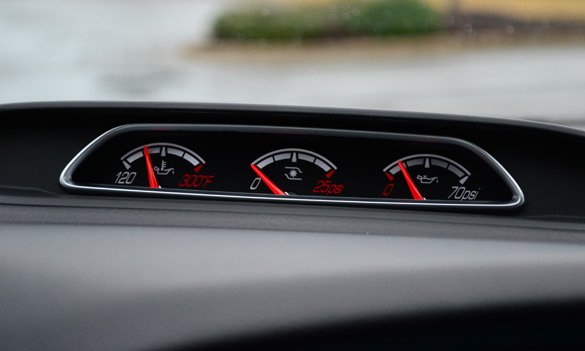
The new 2013 Ford Focus ST is something that I would have jumped at the chance to purchase during my late teen and early adult-hood years, if such a thing were available. The boy-racer aptitude of the Focus ST is surely present as it somewhat departs from the sophistication of its competitors. But don’t let that distract you from its 252 horsepower and 270 ft-lbs. of torque turbocharged 2.0-liter 4-cylinder engine. The powerplant for the Focus ST is the ‘fast’ beating heart of a vehicle that has the moves to match whatever rpm-rhythm thrown at its chassis.

The handling dynamics of Ford’s new Focus ST pocket-rocket are among the best in the market for a front-wheel-drive vehicle, especially one with 4 doors and a rear hatch. Driving the new 2013 Ford Focus ST you will come to know that Ford engineers did their homework on most aspects of turning out a vehicle capable of daily commutes, as well as weekend track days. Possibly one particular cue that may have been an afterthought, is the abundance of torque steer you get when the surge of all 270 ft. lbs. of torque kicks in around 2,500 rpm. Torque steer is not only noticeable, it is notorious.  Torque steer from the new Focus ST, however, is not a complete deal breaker for me as it should not distract potential consumers, because this hot-hatch has the over-all performance to overshadow this minor drawback.

Acceleration in the new Focus ST comes on strong and carries through until about 500 rpm short of redline. As a common characteristic of turbocharged 4-cylinder engine, the 2.0-liter starts to gasp around 6,200 rpm. Though, there is a large enough sweet spot in the rpm band to keep you well-entertained even with a slight patch of turbo lag until it reaches 2,500 rpm. The Focus ST pulls hard with authority, well enough to have the front 235/40 18-inch Goodyear Eagle F1 tires begging for mercy and the tendency to shutter with a bit of axle hop, if you are not careful. Basically, you can light up the front tires at the drop of a dime placing a large smile on your face after the front wheels hook up. Be sure to hold down the traction control button for a few seconds to fully disengage stability and traction control. Just pressing the button will put the Focus ST into Sport mode, which is allows some extra lateral slide but starts to clamp the brakes down on the front wheels in between your money shifts.

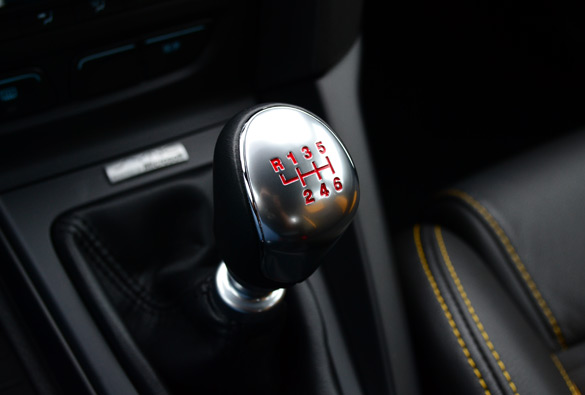
The 6-speed manual transmission, the only one offered on the new 2013 Focus ST, is a joy to row through all gears with somewhat of an assuring direct feel. Shifts are easy to precisely land every time while the nicely weighted flywheel keeps the engine hanging onto its momentum just as it should.

All of the performance qualities of the new Focus ST can be had with an economical sound mind in knowing that the 2.0-liter force-fed 4-cylinder engine gets 23 mpg in the city and 32 mpg highway. Though, the Focus ST makes you want to drive like a hoon, so I only saw an average of 21 mpg around town and a nearly EPA estimate matching 31 mpg on the highway.

Handling is a mastered balancing act in the new Focus ST, getting an astonishing average of 0.96 g in lateral acceleration tests. You can push it around with a slight kick out of the rear end and still nail your anticipated apex without breaking too much of a sweat. Understeer is present as expected but is kept to a minimum. How did you do it Ford?

The steering rack is extremely quick, almost razor sharp with the slightest movement nudging the front wheels in your desired direction. With such a quick rack, steering turn-travel lock-to-lock is among the shortest of performance vehicles currently on the market. Road feedback through the electric steering is good, though with an abundance of torque steer, you would guess that the Focus ST’s steering wheel is one of the strongest force-feedback sets you can find for the latest gaming system. Aside from the torque steer, steering dynamics are ideal for track use, even if the steering assist is supposed to counteract torque steer when the ECU detects it. Basically, any noticeable counteraction from the assist gives you an unnatural feel as it tends to boost your effort to steer in the opposite direction. With that said, ‘torque-steer correction’ is non-existent -so plant your paws firmly on the padded-leather-wrapped steering wheel at all times.

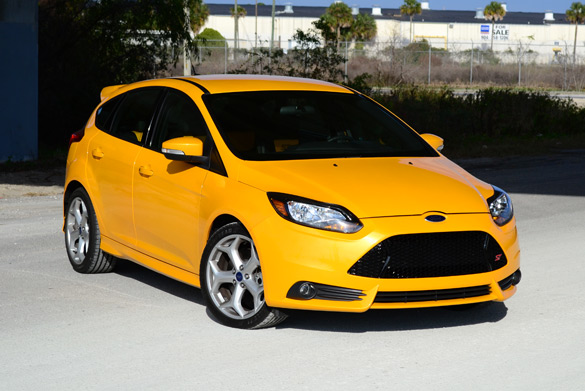
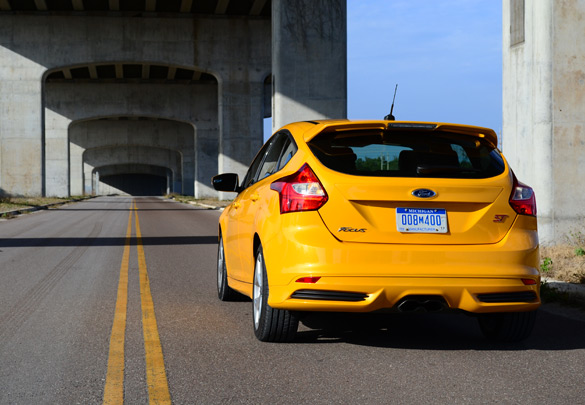
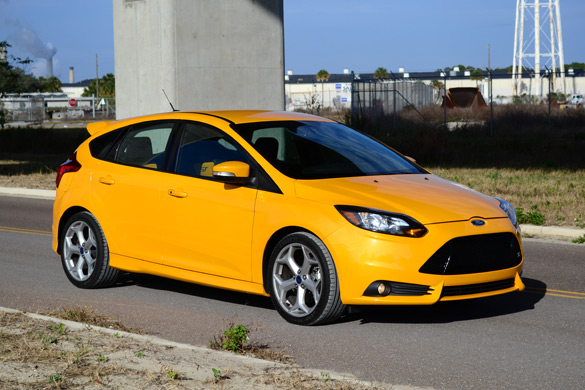
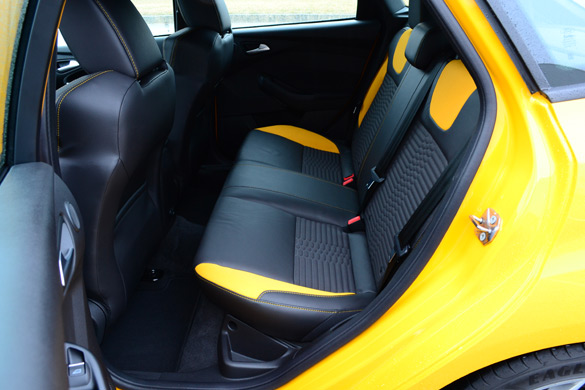
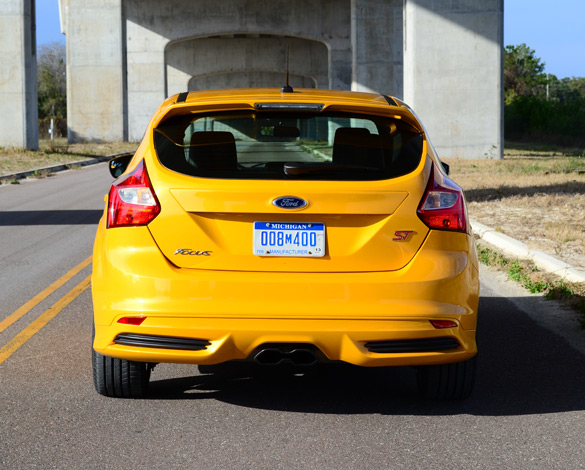
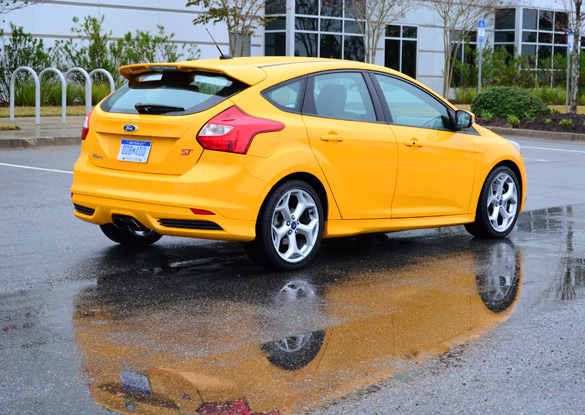
Any relatively high-horsepower front-wheel-drive car deserves the looks to go with its capabilities. Ford has left nothing to really be desired in this forefront as the Focus ST is unmistakable for being something different and special. From my test vehicles visually loud ‘Tangerine Scream’ paint color and center-mounted exhaust, to the color-accented Recaro bucket seats and large bass-mouthed grill, the Focus ST is a head-turner. Don’t worry, if you are not fond of my test vehicle’s yellowish Tangerine Scream exterior color and seat color scheme, Ford offers 5 other color options to choose from: Performance Blue, Race Red, Ingot Silver, Oxford White and Tuxedo Black.

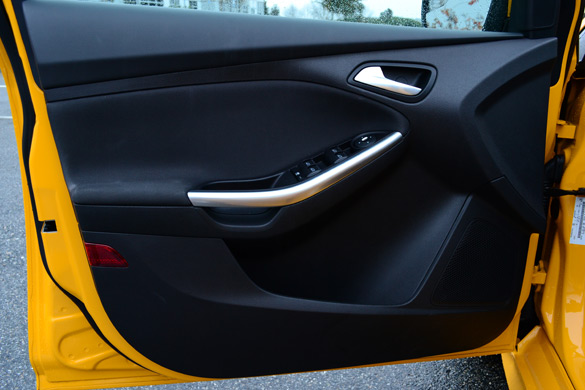
Inside of the new 2013 Focus ST is a familiar dashboard layout, much like the new Ford Escape CUV of which these vehicles share some underpinnings and the 2.0-liter turbocharged engine on certain trims levels. Much of the interior uses plastics that really do not pretend to be anything other than plastic. Though the optional MyFord Touch infotainment system adds substance to what would otherwise be a boring dashboard apart from quickly-sweeping red rpm and speedometer needles. With every new generation of the MyFord Touch system I find it to be better than before with faster processing of inputs, once the major qualm among consumers. Controls are easily dialed-in with the slight exception of the MyFord Touch interface. Still, despite the upgrades and improvements made by engineers, MyFord Touch can be somewhat of a cumbersome interface. As an example, the buttons require precise inputs from your fingers as there is not much room for error within a half-inch space on some on-screen buttons. In-all, the system works well and I totally get where they are trying to go with it but have not quite crossed that finish line. It is more of a white flag deal headed for a photo finish here.

The seating positions in the new Ford Focus ST are ideal for track use. The Recaro buckets with their loud body-color accented bolsters are aggressive in their approach to supporting your body. Basically, the bolsters are not friendly to those with a posterior wider than your average skinny jeans-wearing person. Though, the seats provide exceptional lateral support almost hugging you like your favorite aunt. In a nutshell, the seats perfectly match the Focus ST’s handling abilities and performance-edged style.

For obvious reasons, the new Ford Focus ST is a deviation from the normal run-of-the-mill Focus sedan and hatchback models. Making the choice for the Focus ST to be a hatchback makes perfect sense considering its target demographic and direct competitors, such as the MazdaSpeed3 and VW Golf R. Looking past the new Focus ST having the most torque steer out of its competition, it has a slight edge with its performance numbers. Although, the new MazdaSpeed3 plays catch-up in straight-line performance tests, the Focus ST gets up to 60 mph in just under 6 seconds.

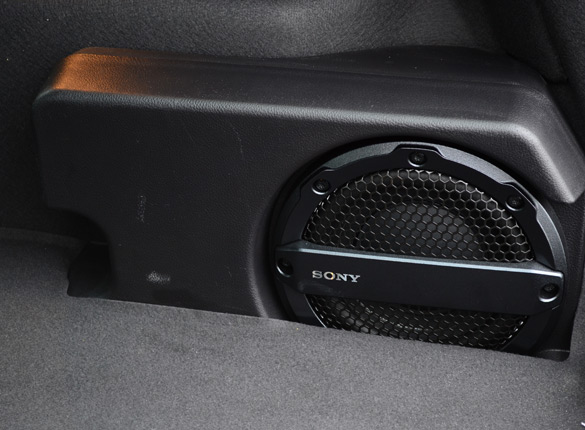
My loaded-up 2013 Ford Focus ST test vehicle has an as-tested price of $28,290 including a $796 destination and delivery charge. The added options on my test vehicle included the Equipment Group 201A (MyFord Touch system with added GPS navigation option, Sony sound system, Sirius radio and dual-zone climate control), and the tri-coat Tangerine Scream paint job.

The all-new 2013 Ford Focus ST is the return of an American pocket-rocket with the added European refinement that cumulates practicality and a spicy blend of performance. With a low starting price point at just $23,700, you would be hard pressed to find anything that can compete in its class and performance bracket for a lower price of admission.

2013-ford-focus-st
2013-ford-focus-st-2
2013-ford-focus-st-side
2013-ford-focus-st-front
2013-ford-focus-st-rear
2013-ford-focus-st-rear-2
2013-ford-focus-st-rear-rain
2013-ford-focus-st-dashboard
2013-ford-focus-st-gauge-cluster
2013-ford-focus-st-front-seats-1
2013-ford-focus-st-front-seats-2
2013-ford-focus-st-rear-seats
2013-ford-focus-st-door-trim
2013-ford-focus-st-boost-temp-oil-pressure-guages
2013-ford-focus-st-sony-subwoofer
2013-ford-focus-st-shifter
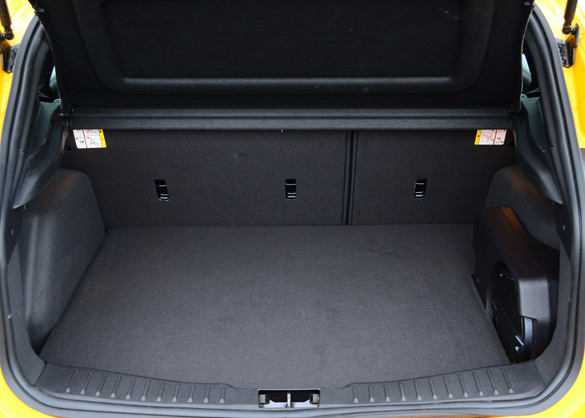
2013-ford-focus-st-rear-carg-seats-down
2013-ford-focus-st-rear-cargo-seats-up
2013-ford-focus-st-badge
2013-ford-focus-st-engine

Copyright: 2012 AutomotiveAddicts.com

SPECIFICATIONS

  • Price: Base Focus ST $23,700 / As-Tested $28,290
  • Engine: 2.0-liter DOHC Turbocharged 4-cylinder 252 horsepower @ 5,500 rpm / 270 ft-lbs. torque @ 2,500 rpm
  • Wheelbase: 104.3in.
  • Total length: 171.7in.
  • Total width: 71.8in.
  • Total height: 58.4in.
  • Track: f/r-61.2/60.4in.
  • Fuel tank: 12.1 gallons
  • Turning circle: 39.4 ft.
  • Headroom: f/r-39.1/37.9in.
  • Legroom: f/r-43.1/33.4in.
  • Rear Cargo Capacity (seats in place): 23.8cu.ft.
  • Curb weight: 3,150lbs.
  • 0-60 mph: 5.9 seconds
  • EPA mileage: 23 mpg/city, 32 mpg/highway

Source: FULL ARTICLE at Automotive Addicts

2013 Lexus ES300h Hybrid Review & Test Drive

By Malcolm Hogan

The business of combining luxury, exceptional fuel economy numbers and suitable performance in a functional hybrid package is no easy feat. Lexus, however, has formulated the perfect balance of what a luxury hybrid should offer for the consumer in the all-new 2013 Lexus ES300h Hybrid.

The relentless pursuit of perfection has paid off well when it comes to offering a hybrid that meshes so well into the mainstream mid-sized luxury sedan market with the new 2013 Lexus ES300h. All-new for the 2013 model year, the Lexus ES receives the newfound trademark design language with the spindle Lexus grill up front. The new hybrid ES, dubbed the ES300h, is put in the mix of the V6-powered ES350 (268 horsepower – 21 mpg city 31 mpg highway) to offer uncompromised fuel efficiency without sacrificing the relaxed but pristine driving dynamics of its more powerful sibling.
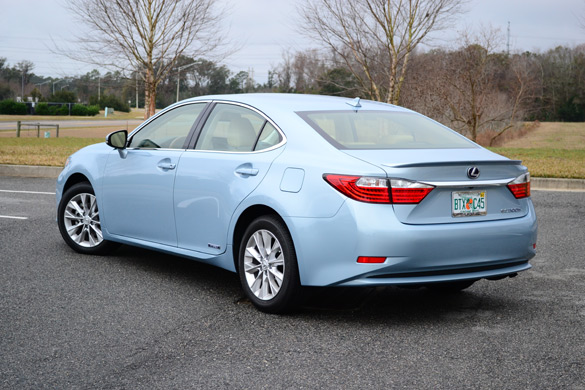
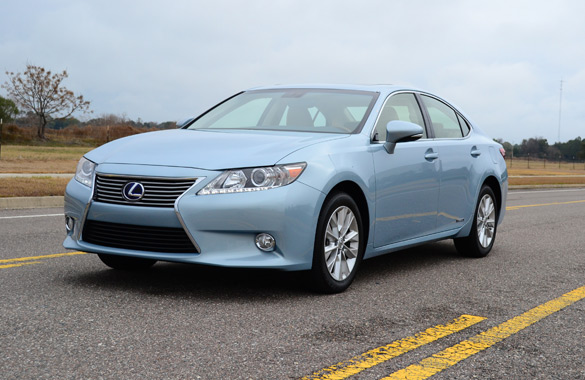
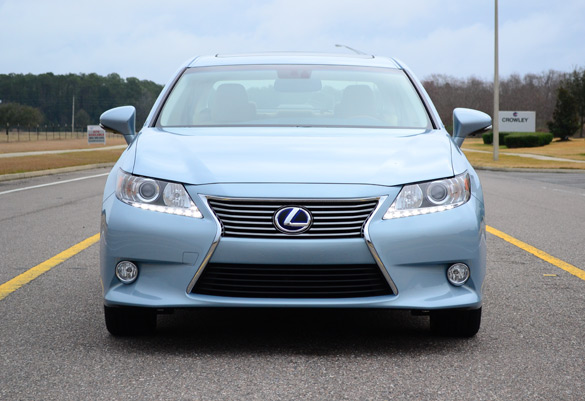
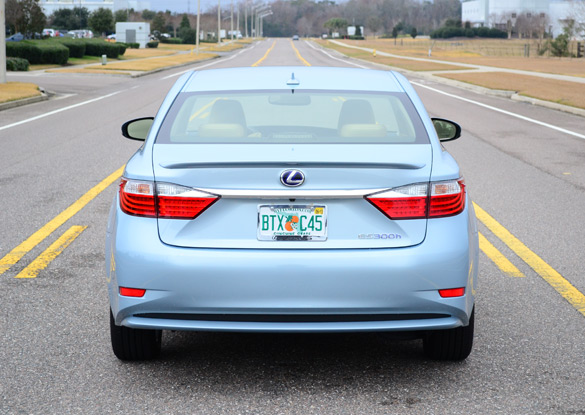
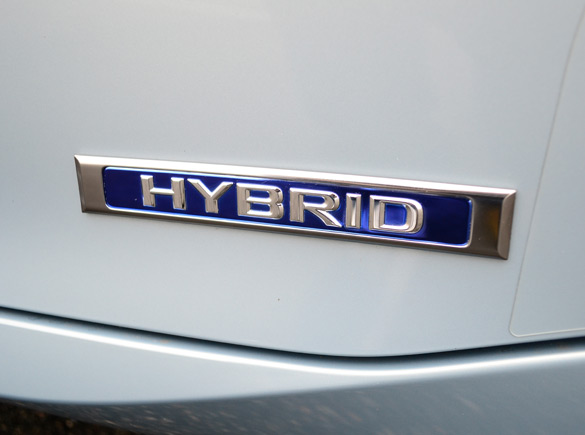
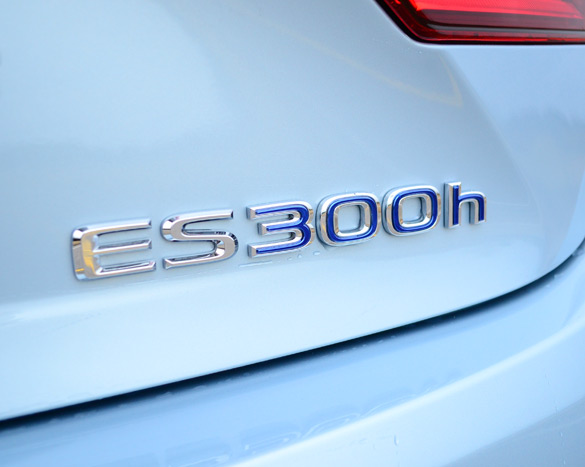
The all-new 2013 Lexus ES gets a new design carrying the new signature spindle grill found throughout the new line of Lexus vehicles. The larger dimensions of the new ES open it up to receive larger seating areas and more of a broader demeanor visually on the road. The only thing signifying the new ES300h as a hybrid apart from the ES350 is its rear passenger door ‘Hybrid’ badges, the ES300h emblem on the trunk lid, and the blue-accented Lexus emblems on the front and rear.

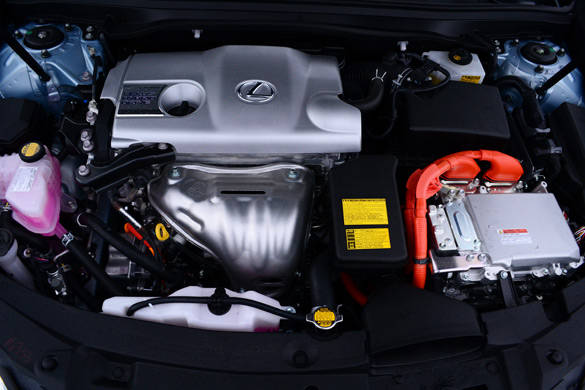
The new 2013 Lexus ES300h is powered by a 2.5-liter 4-cylinder engine and electric motor, which together produce 200 horsepower. Power is fed through a continuously variable transmission (CVT) to the front wheels. The new Lexus ES300h is able to make a dash from 0-60 mph in 8.1 seconds (about 1 second slower than ES350), which is pretty decent for a hybrid vehicle but slightly underwhelming for a midsized luxury sedan. However, the Lexus ES300h is far from a push-over when power is demanded, even when in Eco mode.

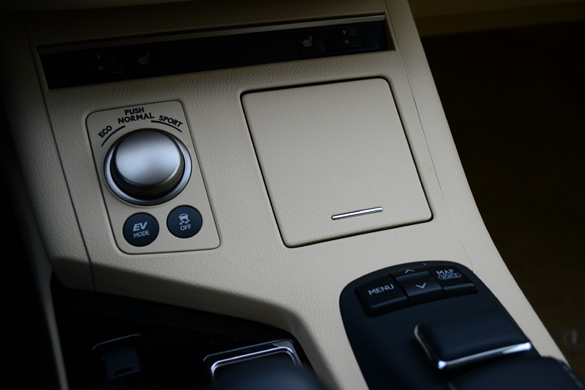
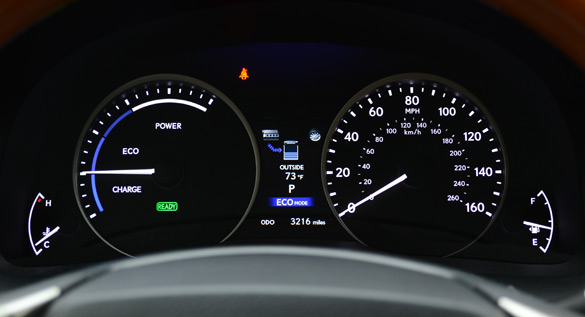
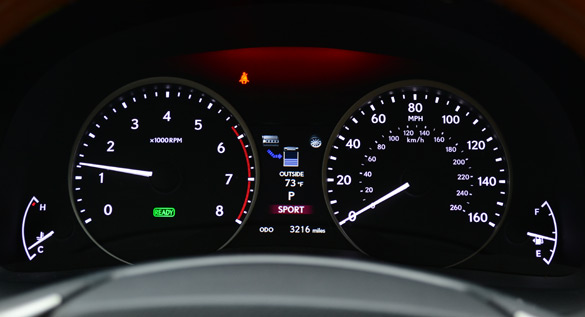
Lexus carries over their drive select mode dial into the 2013 ES300h with Eco, Normal, and Sport modes. Interestingly enough, the Eco mode can be a desirable setting as it does not limit throttle response to the level of the vehicle falling flat at mid-range gas pedal positions. Eco mode does an excellent job to automatically sort out driving conditions to optimize fuel economy without sapping too much response and feedback from the driver. Sport mode, also utilizing the traditional hybrid features such as regenerative braking and auto start/stop, spices things up a bit by adding weight to the steering wheel, advancing the throttle response, and by default, illuminating the gauge cluster with a red accent while activating an rpm tachometer in place of the Eco metering. The Sport mode can be customized in a menu set to display the Eco meter and turn off the red colored cluster illumination.

Transitions between the engine and electric motor are virtually seamless and barely noticeable. Everything about the hybrid powertrain is smooth and well-adapted to mostly any driving style. At idle, the Lexus ES300h is nearly silent even when the 4-cylinder engine is still running. The faint hum of the electric motor, mostly noticeable during deceleration, is one of the very few audible giveaways of the ES300h being a hybrid.

In the traditional sense of Toyota and Lexus hybrids, the all-new ES300h utilizes advanced control systems to activate the electric motor running solely off of battery power when proper conditions present themselves. At times I found my Lexus ES300h test vehicle humming along at 40 mph on battery power only. In mostly Eco mode the ES300h, much like the Prius hybrid, can run on battery power at speeds below 45 mph provided you are barely accelerating. The EV mode, a mode designed to keep the vehicle using the electric motor up to 27 mph, is more of a novelty that can easily be defeated if the gas pedal is pressed too fast or too much acceleration for the motor to handle is recognized by the ECU. Around town the ES300h really shines on fuel consumption figures. I saw times where I was averaging about 45 mpg while roaming around the downtown streets of St. Augustine. Many times I was maximizing my fuel economy by only using the electric motor provided I was cautions of my gas pedal position. While the stated EPA fuel consumption estimates are 40 mpg city and 39 highway, travelling at interstate speeds and above can drastically reduce fuel economy. At times traveling 5 or even 10 mph above the stated interstate speed limit, the ES300h would reduce itself to about 33 mpg. Although, keeping a steady and reasonable highway speed, you will see realistic mpg numbers around 37 and 38 mpg.

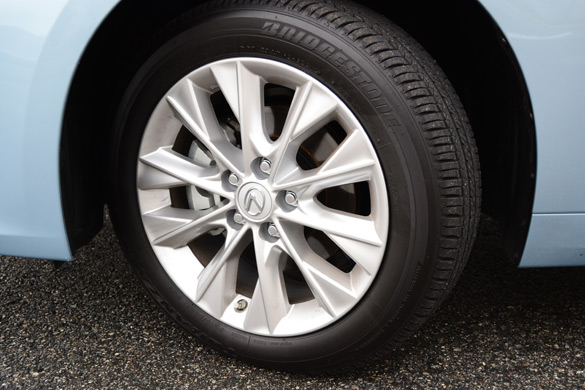
The level of refinement in the all-new 2013 Lexus ES300h is nothing short of what you would expect in a Lexus. Fit and finish is top notch while the suspension is perfectly dampened to soak up large bumps and imperfections in the road. On the enthusiastic side of things, the Lexus ES300h is still civilized and graces out of serious lateral maneuvers with a loud howl of the 17-inch low-rolling-resistance tires. I have to say, the new Lexus ES300h, despite being a mid-sized luxury hybrid, does not promote driving crazy in any way. However, the new ES300h can still handle its own among its mid-sized brethren.

In true Lexus form, the new 2013 ES300h has a quiet cabin isolating most road and wind noises. Though, the buzzing sound of the 2.5-liter 4-cylinder engine winding up when power is needed, comes through the firewall into the cabin as an unusual trait for a Lexus. The only take away from the new ES300h being anything un-Lexus-like is the buzz and slight drone sound from the engine bay when the upper rpm range is reached. Having a CVT transmission makes matters slightly worse under full throttle in keeping the 4-cylinder engine hovering near its 6000 rpm power sweet spot. Aside from the 4-cylinde engine noise, the ES300h is pure luxury.

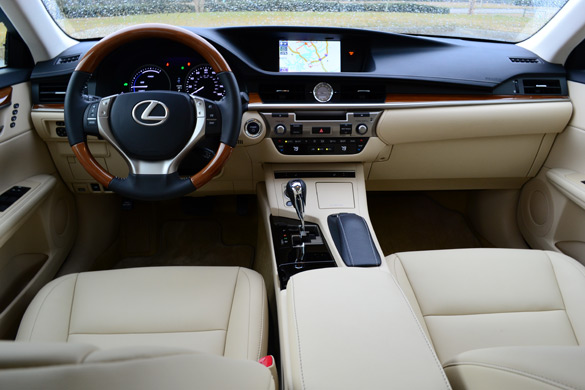
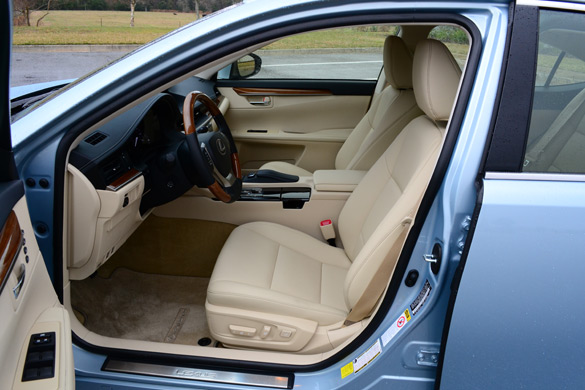
Inside of the cabin the new Lexus ES300h has well-appointed and soft leather seating areas. The entire cabin, virtually identical to the V6-powered ES350, makes the best use of plastics, soft touch buttons, accent dashboard stitching and bamboo wood trim to treat passengers to a quant taste of luxury. The use of a traditional automatic transmission shifter is a wise choice that goes a long way for those who may be new to the hybrid genre of cars -instead of the Prius’ gated hodgepodge hybrid and iRobot shifter.

The seating areas of the new ES300h are larger than ever for the ES line. No longer just a dressed up Toyota Avalon or Camry, the new ES makes its sportier mark even stronger as a more refined and luxurious entry-level Lexus, even in hybrid form.

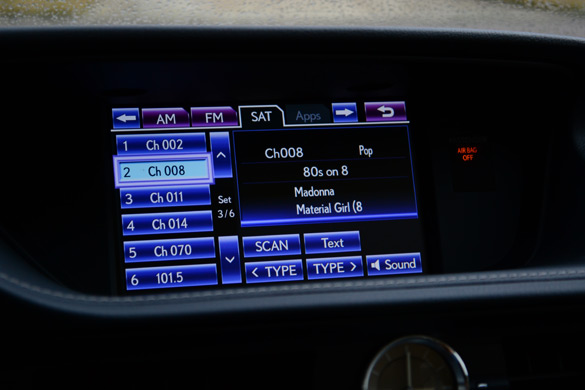
A long list of standard safety equipment graces the new Lexus ES300h starting with antilock brakes, stability and traction control, front and rear side airbags, side curtain airbags, front knee airbags, Lexus Safety Connect w/automatic crash notification, stolen vehicle location and an emergency assist button. In addition to the safety blanket, the new ES300h hybrid gets standard 17-inch alloy wheels, auto headlights, fog lights, LED day-time-running lights, sunroof, heated mirrors, keyless ignition/entry, cruise control, dual-zone automatic climate control, eight-way power front seats w/ power lumbar adjustment, “NuLuxe” premium vinyl upholstery, a tilt-and-telescoping steering wheel, an auto-dimming rearview mirror, Lexus Safety Connect emergency communications, Bluetooth and an eight-speaker sound system with a six-CD changer, satellite radio, an auxiliary audio jack and an iPod/USB audio interface.

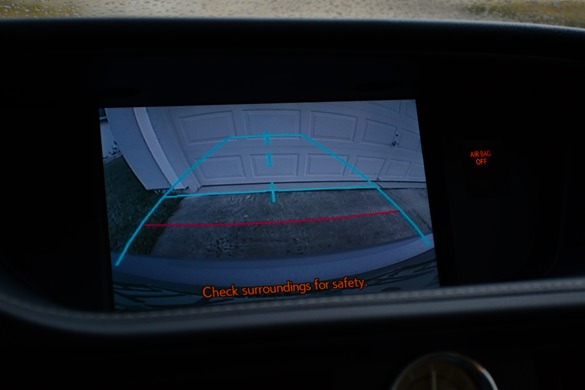
My 2013 Lexus ES300h was optioned out with a navigation system upgrade including hard-drive based GPS navigation system, backup camera, 8-inch VGA LCD screen, Lexus Enform with App Suite, Lexus Insider, voice command, in-dash DVD/CD player, HD Radio and SiriusXM Radio w/ NavTraffic. The Premium Package on my ES300h test vehicle included memory for driver’s seat, outside mirrors and power telescoping steering wheel, bamboo wood trim, and remote keyless entry-linked memory. Additional options included HID headlights, heated front seats, leather-trimmed and wood steering wheel, cargo net and trunk mat. The total as-tested price for my 2013 Lexus ES300h hybrid came to $44,524 including a $895 destination and handling charge. A base Lexus ES300h hybrid starts at just $38,850, which is about a $2,750 premium over its E350 V6-powered sibling.

2013-lexus-es300h-hybrid
2013-lexus-es300h-hybrid-side
2013-lexus-es300h-hybrid-front-angle
2013-lexus-es300h-hybrid-rear-angle
2013-lexus-es300h-hybrid-front
2013-lexus-es300h-hybrid-rear
2013-lexus-es300h-hybrid-wheel-tire
2013-lexus-es300h-hybrid-dashboard
2013-lexus-es300h-hybrid-gauge-cluster-eco-mode
2013-lexus-es300h-hybrid-gauge-cluster-sport-mode
2013-lexus-es300h-hybrid-front-seats
2013-lexus-es300h-hybrid-rear-seats
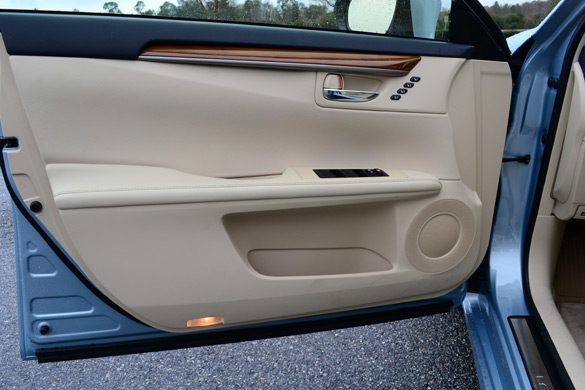
2013-lexus-es300h-hybrid-door-trim
2013-lexus-es300h-hybrid-drive-select-screen-controls
2013-lexus-es300h-hybrid-lcd-screen
2013-lexus-es300h-hybrid-backup-camera
2013-lexus-es300h-hybrid-trunk
2013-lexus-es300h-hybrid-badge
2013-lexus-es300h-hybrid-emblem
2013-lexus-es300h-hybrid-engine-cover
2013-lexus-es300h-hybrid-engine-motor

Copyright: 2012 AutomotiveAddicts.com

SPECIFICATIONS

  • Price: Base ES300h $38,850.00 / As-Tested $44,524.00
  • Engine: 2.5-liter 4-cylinder (156 horsepower) with two hybrid electric motors for total output of 200 horsepower @ 5,700 rpm / 199 lb.ft. of torque
  • Wheelbase: 111 in.
  • Overall length: 192.7 in.
  • Overall width: 71.7 in.
  • Overall height: 57.1 in.
  • Track: f/r-62.6/62 in.
  • Headroom: f/r-37.7/37.5 in. with glass sunroof
  • Legroom: f/r-41.9/40 in.
  • EPA cargo volume: 12.1 cu.ft.
  • Curb weight: 3,660 lbs.
  • Fuel tank: 17.2 gallons
  • Turning radius: 18.7 ft.
  • 0-60 mph: 8.1 seconds
  • EPA fuel economy: 40 mpg/city 39 mpg/highway
  • Range: 688 miles city / 670.8 miles highway

Source: FULL ARTICLE at Automotive Addicts