Tag Archives: GX

Report: Lexus to replace GX SUV with new TX crossover

By Jeffrey N. Ross

2012 Lexus GX

Filed under:

There’s been a lot of news regarding future Lexus products recently, including spy shots of new RC coupe and NX compact crossover, and reports that a 2+2 coupe based on the LF-LC concept is heading for production. Now, Automotive News says that Japan’s #1 luxury automaker is planning to replace the fullsize, body-on-frame Lexus GX SUV with a three-row crossover called the TX.

The article says that the GX, which is based on the foreign-market Toyota Land Cruiser Prado, will get a styling update for 2014 before being phased out in 2016. In a similar move as Infiniti made with its new three-row JX/QX60, the new TX will be car-based, but details are still unknown as to whether it will be front-wheel-drive riding on the Toyota Avalon platform or rear-wheel-drive using the Lexus GS platform. Either way, this new luxury crossover could join the Lexus lineup as soon as late 2016.

Lexus to replace GX SUV with new TX crossover originally appeared on Autoblog on Wed, 31 Jul 2013 11:31:00 EST. Please see our terms for use of feeds.

Permalink | Email this | Comments

…read more

Source: FULL ARTICLE at Autoblog

Official: Grand-Am, ALMS merger results in new United SportsCar Racing series

By Jeffrey N. Ross

Filed under:

After the merger between Grand-Am and the American Le Mans Series was announced last year, a contest was held to name the new combined series, and that new name is now officially the United SportCar Racing series. This new branding will take place at the start of the 2014 season beginning with the Rolex 24 at Daytona.

Fans of the American Le Mans Series are probably losing the most in this new series. Not only is the ALMS name (along with the connection to the 24 Hours of Le Mans) going away, but the more exciting P1 prototype class is also being dropped. In the new United SportCar Racing series, the new Prototype class will consist of Daytona Prototypes, ALMS P2 cars and the DeltaWing (including a new closed-cockpit version). The ALMS GT class will be renamed GT Le Mans (GTLM), while GT Daytona (GTD) will combine the current Grand-Am GT class and the ALMS‘ GTC cars. The Prototype Challenge (PC) and GX classes will both carry over unchanged from Grand-Am and ALMS, respectively.

Grand-Am, ALMS merger results in new United SportsCar Racing series originally appeared on Autoblog on Fri, 15 Mar 2013 13:29:00 EST. Please see our terms for use of feeds.

Permalink | Email this | Comments

…read more
Source: FULL ARTICLE at Autoblog

Behind the Scenes with the Diesel-Powered Mazda 6 Grand-Am Racer

By John Lamm

Mazda often has created race cars with a twist, dating back to when Car and Driver campaigned a Wankel rotary–powered RX-2 in 1973. Come 1991, the last year before the rotary was banned from the 24 Hours of Le Mans, and the Japanese automaker took its 787B Wankel-powered racer to a win in that round-the-clock classic. Old song, new tune for Mazda in 2013 as it puts its new Mazda 6 on the track and again steps away from the crowd, racing the sedan with the same turbocharged 2.2-liter Skyactiv-D turbo-diesel that will arrive in the 6 later this year. John Doonan, who heads Mazda’s racing efforts in the U.S., smiles as he explains how they take pride in “being different.”

Diesel-powered race cars aren’t new; Cummins began racing them in the Indy 500 in the early 1930s and put one on the pole in 1952. Audi’s R10, R15, and R18 have proved the diesel’s worth at Le Mans, but there aren’t many oil-burners powering non-prototype racers. Mazda wants to make the point that its Skyactiv-D production engine is as quick as it is reliable by racing it in Grand-Am’s new GX class.

Doonan quickly points out the teams using disel-powered 6s in Daytona are “able to use so much of the production engine in the race engine. We’re up to over 250 part numbers straight out of the road-car engine that are in the race engine. It’s about 63 percent of the motor. The crankshaft, rods, pistons, and valves are all racing-based for material changes. Those pieces that have been changed have had that done only for durability and materials. If you set a stock valve and a race valve next to each other, they would look identical.

“We have to run a stock Bosch ECU because that’s spec for the series. We’ve had the Bosch guys on because they run the Audi program. Our stock ECU is Nippon Denso, so making that change has been a long process and probably the hardest part of transferring over from stock to race car.”

Also stock is the 14:1 compression ratio, and with Garrett bi-turbos pumping to a max of about 70 psi, the diesel is rated at 400 horsepower and 445 lb-ft of torque. Other than the manner in which it is mounted in the car, this engine is almost identical to the 450-hp, 500-lb-ft diesel that Mazda will race at Le Mans in the LMP2 class.

Doonan adds, “The other big piece is the fuel story. We’re running a renewable synthetic-diesel fuel from a company called Dynamic Fuels. They’re using non-feedstock or non-food-chain remnants of fat, oils, and other meat processing refuse to make this fuel. Dynamic makes 75 millions gallons of it each year and the Navy is currently flying fighter jets off the aircraft carrier Nimitz using this fuel. We’re not using any particulate filters and no after-treatment on the engine. You can sit in the paddock, see the driver push the starter button and there’s no smoke whatsoever.”

Doonan explains that, “When we poured the Dynamic fuel in we didn’t change any of the mapping and the exhaust gas temperatures dropped 50–100 degrees. The horsepower and torque numbers showed a smidge of an increase by 2–4 horsepower.” Given diesel’s reputation for better mileage, Mazda figures the 6 and its mandated smaller fuel tank—14-and-a-half gallons—will go about the same distance as its gas-fired competitors.

While the engine in the 6 race car is new, the chassis, Doonan points out, “is converted from the RX-8. We lengthened it six inches behind the driver’s bulkhead, but it’s essentially the same underpinnings.” Those would include the Alcon racing brakes and the EMCO six-speed sequential transaxle, which has one interesting addition, a strain gauge that automatically blips the engine to keep the drivers from overrevving the diesel, which is sensitive to high revs. While the redline in the race engine is 5200 rpm, they limited it to 4750 for Daytona.

Mazda brought three diesel 6s to Daytona. The “factory” car had drivers Jonathan Bomarito, Marino Franchitti, Tom Long, Sylvain Tremblay, and IndyCar driver James Hinchcliffe. The second car was entered with young drivers who have risen through Mazda’s driver-development program: Joel Miller, Tristan Nunez, Spencer Pigot, Tristan Vautier; but also 65-year-old Yojiro Terada, who has run Le Mans 29 times and is a big icon at Mazda. Car three had drivers Andrew Carbonell, Tom Long, Rhett O’Doski, and Derek Whitis.

After practice at Daytona we talked with Franchitti and Hinchcliffe about their experience in the diesel-powered Mazda 6. Not surprisingly, they liked the chassis, Franchitti saying, “You can feel the RX-8 DNA in the car. Even though it’s a longer-wheelbase, heavier car, they’ve got it feeling very similar, which is nice because the RX-8 was a really nice-handling car. I think the thing that limits these Grand-Am cars are the tires. And there is more downforce than with the RX-8.”

Hinchcliffe agreed, adding, “The brakes are phenomenal, the transmission is excellent. The big difference, of course, is the engine, which revs so low and yet is still so torquey. It’s a big adjustment. And we’ve come from driving what is essentially the loudest engine ever produced by man (the rotary) to one of the quietest ones.” A point we can confirm as the cars (relatively) whispered past at speed.

Franchitti thought that, “Sound isn’t a big deal. Maybe it’s quieter outside, but you still have a good amount of sound inside the car so it’s not like you don’t have any reference. You’re aware of the engine noise and can still drive by ear.” Hinchcliffe added that, for him, “You have to rely a lot more on the shift lights on the dash because you cannot hear the motor as much, especially out on the banking with all the wind noise.”

As for the engine, you have to “get used to the turbo and how it spools up,” according to Hinchcliffe. “It requires a bit of a different driving style. You have to keep the turbos spooled up to stay in the power band and you have to work more with the throttle to keep the rpm up, so you get into the throttle a bit earlier.” The shifter came in for specific praise from Franchitti, saying, “It’s beautiful. It blips the throttle because the engine is sensitive to over revving on the downshifts, so you just brake, push the lever, it blips and the gear just slides in. It’s like butter; so nice and natural.”


The Skyactiv-D Mazda 6s are the first diesel-powered race cars to compete in the Grand-Am series or at the 24 Hours of Daytona. While the race cars were beautifully finished, their lack of long-distance testing showed too soon. The team had been able to fix such initial problems as a troublesome belt tensioner, but a recurring vibration harmonic problem was bothersome. Before sunset, the 6s weren’t part of the parade at Daytona. Reality had hit the fan.

Two of the cars lost a cylinder because of problems with their fuel rails, while the third had a main-seal failure. Mazda wasn’t willing to assign fault to the rails or the seal, and will be chasing down that harmonic problem to see if that was the source. Doonan summed up Daytona this way: “Today will be noted as a learning experience, a data point, if you will. The Mazda and SpeedSource engineers had over 400 hours on the dyno, but only a few on the track.” Now that process will continue.

Even before the problems, Franchitti had said, “This is just the starting point for this car.”

Jim O’Sullivan, who heads Mazda in the U.S. and is quite passionate about the diesel race cars, looked to the next race, which is at the Circuit of the Americas, and said, “Just wait until Austin.”

Diesel Mazda 6 from Daytona

Source: FULL ARTICLE at Car & Driver

2013 Rolex 24 Hours of Daytona Wrap-Up and Mega Gallery

By John Lamm

There was a time when the 24-hour sports-car race at Daytona International Speedway was something of an oddity. We loved it for being the first serious race of the year, but it also was like the poor step child of the Daytona 500. The crowds were okay, but not crushing. Not anymore. These days the infield is crammed with fans, the grid walk before the start a mass of well-wishers straining to see the likes of Dario Franchitti or Juan Pablo Montoya. The 2013 entry list ran to 57 race cars in three classes: the Daytona Prototypes running for the overall win, 34 GTs ready to duke it out, plus a small-but-new class, the GX cars.

Top dogs were, of course, the DP cars, which are not only fast and wonderfully noisy, but have a driver’s list that includes not just Grand-Am heroes like Scott Pruett and Alex Gurney, but some from IndyCars—Franchitti, Scott Dixon, Paul Tracy, and newly-crowned champ Ryan Hunter-Reay—and NASCAR’s Montoya, Jamie McMurray, and Marcos Ambrose.

Cool, but what also makes you smile are the GTs, the cars we often hunger after for the road. Porsche once owned this class—and there were 18 Porsche 911 GT3 Cup cars entered this year—but now Audi and Ferrari have stepped up with their R8 Grand-Ams and 458s. Throw in a handful of Corvettes, a Viper, a Camaro, a pair of BMW M3s, and a hangover Mazda RX-8, all crowding each other, and it’s gotta make you smile.

Then there were the six GX machines, a fledgling class meant to draw new technology, which it did with the three Mazda 6s and their Skyactiv-D turbo-diesel engines. There also was a trio of Porsche Caymans, one—seen above—painted in the same colors and scheme as the Psychedelic Hippie 917L from the 1970 24 Hours of Le Mans.

Throw in that crowded infield with its Ferris wheel and fireworks and it’s quite an all-night party with decided overtones of wood smoke, barbecue, and beer.


So who were the winners? Chip Ganassi’s team did it again, Pruett taking his fifth win, tying the legendary Hurley Haywood for most all time. Pruett’s teammates were Montoya, Dixon, Charlie Kimball, and Memo Rojas. Audi finished one-two in GT, the leading team being Filipe Albuquerque, Dion von Moltke, Oliver Jarvis, and Edoardo Mortara. Porsche took the GX win thanks to David Donohue, Jim Norman, Shane Lewis, and Nelson Canache in the Psychedelic Hippie Cayman.

Next year’s party promises to be even better with the integration of Grand-Am and the American Le Mans Series. Come to think of it, the infield at Daytona would make for a legendary Super Bowl party.

24 Hours of Daytona Race Recap

Source: FULL ARTICLE at Car & Driver

BMW-Riley of Ganassi Racing & WeatherTech Audi R8 Win Rolex 24 at Daytona

By Malcolm Hogan

rolex-24-01-ganassi-bmw

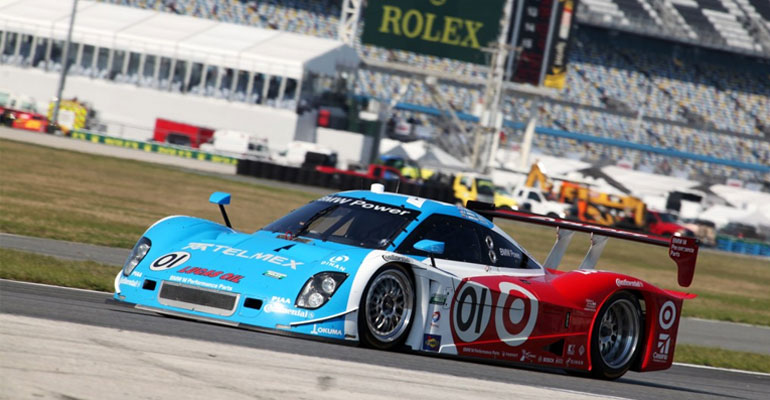
Piloting the #1 Chip Ganassi Racing BMW-Riley protype, Scott Pruett (fifth over-all win), Rojas, Montoya, Kimball and Dixon take home the win for Rolex 24 Hour at Daytona for DP class this year, while the #24 Audi Sport Customer Racing/AJR WeatherTech Audi R8 of Alburquerque, Jarvis, Mortara, and Von Moltke take the checkered flag for GT class. The Napleton Racing #16 Porsche Cayman won in the GX series with Shane Lewis, David Donohue, Dr. Jim Norman and Nelson Canache.

weathertech-audi-r8

There was no doubt that this year’s Rolex 24 at Daytona was eventful with an exciting last couple hours thought to come down to a fuel-racing-game. All through the night there were only a few incidents while the race as a whole did not have many serious mishaps. Scott Pruett will surely get a nod in the history books as he ties Hurley Haywood with a record 5 Rolex 24 at Daytona wins.

NASCAR drivers Marcos Ambrose and A.J Allmendinger (one of last year’s Rolex 24 at Daytona winner) finished third. Jamie McMurray in the #02 car for CG finished in 32nd position. Clint Bowyer and Michael Waltrip in the GT series finished 15th overall.

Source: FULL ARTICLE at Automotive Addicts

Video: Mazda6 GX Grand-Am racer goes where no diesel sedan has gone before

By Jonathon Ramsey

Filed under: , , , , ,

There has never been a four-door diesel sedan in the Grand-Am series, until now: The blunt, bewinged grille of the Mazda6 GX has blown right through that wall. It’s said that racing improves the breed, but usually the breed has gone on sale when the racing begins. One of the unusual aspects of the Mazda6 GX, on the other hand, is that while the diesel won’t go on sale to the public until later this year, it will already have tasted racing blood by the end of the day. That kind of reversal is more likely found with super coupes like the Lexus LFA and Honda NSX.

Mazda has taken class wins at Daytona’s 24-hour race a whopping 23 times since 1975, most recently in 2010 with the RX-8 in the GT class. This year the Hiroshima company decided to show off its SkyActiv technology, then turned things up to eleven by opting for its SkyActiv-D instead of the more conventional SkyActiv-G gas engine to run in the new GX class. It will be joined by competitors like the Lotus Evora and Porsche Cayman in the class, nevertheless, at 2.4 liters, it’s the smallest engine on the grid.

Time has not been a friend, either – Mazda said that the first five SkyActiv-D engines off the production line went to Speed Source in Coral Gables, Florida, the company that preps Mazda’s race vehicles. Still, race driver Jonathan Baumarito on the #70 car said that although the engine’s been on the dyno since February of last year, it’s only been in the car for about a month and there have been only a couple of test days.

Speed Source owner, team driver and multiple 24-hour winner Sylvain Tremblay – he drove in the teams that won in 2008 and 2010 in the RX-8 – said the big challenge right now is getting the gearing right. Both Tremblay and Baumarito said that the diesel’s torque is a plus through the Bus Stop section at the back of the course, entered after coming off the high-speed banked turn. But Tremblay said that the first infield section of horseshoes is more trying because the SkyActiv-D needs to be on boost to get its power on, and that doesn’t happen until after 3,500; maintaining that through slow-speed turns and having enough to get the job done through the high-speed ovals is the test.

There are three Mazda6 GXs competing, Everyone is cautiously optimistic about how things might go during the race, but in fairness this has to be looked at as a 24-hour testing session. Road & Track rode shotgun for a lap in the #00 Visit Florida Racing car, you can check out the sounds of diesel at Daytona in the video below.

Continue reading Mazda6 GX Grand-Am racer goes where no diesel sedan has gone before

Mazda6 GX Grand-Am racer goes where no diesel sedan has gone before originally appeared on Autoblog on Sat, 26 Jan 2013 19:03:00 EST. Please see our terms for use of feeds.

Permalink | Email this | Comments

Source: FULL ARTICLE at Autoblog