

Cape Verde are back in the race for a 2014 World Cup place after FIFA punished Equatorial Guinea for twice using an ineligible player against them. …read more
Source: FULL ARTICLE at Fox World News
Cape Verde are back in the race for a 2014 World Cup place after FIFA punished Equatorial Guinea for twice using an ineligible player against them. …read more
Source: FULL ARTICLE at Fox World News
Australia great Shane Warne was inducted into the International Cricket Council (ICC) Hall of Fame at Lord’s on Friday.
The leg-spin legend received the honour during the tea interval of the second day of the second Ashes Test between England and Australia.
Warne, credited with reviving interest in leg-spin outside Asia, was the first bowler to take 700 Test wickets and represented Australia in 145 Tests between 1992 and 2007. In all he took 708 Test wickets at an average of 25.41.
Warne also took 293 wickets in 194 one-day internationals at an average of 25.73 and was a member of the Australia side that beat Pakistan in the 1999 World Cup final at Lord’s where his team-mates included fellow Hall of Famers Glenn McGrath and Steve Waugh.
His return in the final of four wickets for 33 runs in nine overs saw Warne named man-of-the-match.
“I’m very honoured and proud to be inducted into the ICC Cricket Hall of Fame today and I thank the voting academy very much for even considering me,” Warne said Friday.
“Many of the Hall of Fame members were my heroes when I was growing up, including the likes of Ian Chappell and Dennis Lillee.
“I am delighted that I am celebrating my induction with my friends and family in front of the crowd at Lord’s during the second Ashes Test.
“I was very lucky to play in a wonderful era of Australian cricket and make so many friends along my 20 year journey. I hope I kept everyone entertained and on the edge of their seat when they watched the Australian cricket team play.”
Seeing Warne was a reminder of happier times for many Australian fans in a capacity Lord’s crowd of over 28,000 as they watched Michael Clarke’s men collapse to 128 all out, a first innings deficit of 233.
Warne is the 69th male member of the Hall of Fame and the 18th from Australia.
Source: FULL ARTICLE at Fox World News
Premier League chiefs have slammed FIFA president Sepp Blatter’s plan to move the 2022 World Cup in Qatar to the winter.
There has been widespread concern over the health dangers posed by staging the tournament in the Gulf in June and July where temperatures rocket to 50 degrees (122 degrees Fahrenheit).
And Blatter this week confronted the issue by stating he believed the tournament could not take place in the summer, and that position has been backed up by the international players’ union FIFPro.
Blatter insisted he would push to have the World Cup moved despite the effects it could have on domestic leagues when the FIFA Executive Committee meets on October 3 and 4.
“The Executive Committee will certainly follow me,” he was quoted as saying.
“It is clear that you cannot play in this heat in the summer and we have to consider the players.”
But the Premier League have been vocal opponents of the winter idea on the grounds it will cause major disruption to three domestic seasons, the 2021-22 season and the ones either side, as well as impacting on broadcasting contracts.
And Blatter’s latest comments drew a scathing response from the organisation on Thursday.
“The Premier League position remains unchanged. The prospect of a winter World Cup is neither workable nor desirable for European domestic football,” a Premier League spokesman said.
Qatar plans to spend around ??65 billion ($101 billion, 76 billion euros) on infrastructure projects, including building new high-tech stadiums, which the Qatar 2022 Supreme Committee said would likely cost $4-5 billion.
But average temperatures in Qatar are markedly cooler in December, with highs of 24C and lows of 15C.
And UEFA general secretary Gianni Infantino recently added his weight to calls for the 2022 World Cup to be staged later in the year.
“I fully share the view that you have to play in the best period for football; that is not June or July in Qatar. This is an issue that FIFA has to sort out,” he said.
Qatar, who won their World Cup hosting bid three years ago, has already said it was ready to stage the tournament in summer or winter.
“Various figures from the world of football have raised preferences for hosting in the winter,” the Qatar 2022 Supreme Committee said in a statement earlier this year.
“We are ready to host the World Cup in summer or winter. Our planning isn’t affected either way.”
Source: FULL ARTICLE at Fox World News
FIFA president Sepp Blatter will push for the 2022 World Cup in Qatar to be moved to the winter after getting a personal taste of the Middle East’s blast furnace climate.
There has been widespread concern over the health dangers posed by staging the tournament in the Gulf in June and July where temperatures rocket to 50 degrees (122 degrees Fahrenheit).
Blatter insisted on Wednesday that he will push to have the World Cup moved despite the effects it could have on domestic leagues when the FIFA Executive Committee meets in October.
“The Executive Committee will certainly follow me,” Blatter was quoted by AFP subsidiary, SID, as telling a two-day sports conference in Austria.
Blatter said that a recent visit to Jordan and the Palestinian Territories had brought home the dangers of the intense heat.
He expressed his fears despite the Qataris’ ambitious plans to build air-conditioned arenas.
“It is clear that you cannot play in this heat in the summer and we have to consider the players,” he said.
“It is certainly possible to cool a stadium, but not an entire country. That’s why we need to have courage in the Executive Committee and to create awareness among the leagues that we need to change something.”
Qatar plans to spend around ??65 billion ($101 billion, 76 billion euros) on infrastructure projects, including building new high-tech stadiums, which the Qatar 2022 Supreme Committee said would likely cost $4-5 billion.
Average temperatures in Qatar are markedly cooler in December, with highs of 24C and lows of 15C.
In June this year, UEFA general secretary Gianni Infantino added his weight to calls for the 2022 World Cup to be staged later in the year.
“I fully share the view that you have to play in the best period for football; that is not June or July in Qatar. This is an issue that FIFA has to sort out,” he said.
“The sooner they do it, the better. The decision for 2022 was taken in 2010, so in 12 years you can organise yourself.”
Qatar has already said it was ready to host the World Cup in summer or in winter.
“Various figures from the world of football have raised preferences for hosting in the winter,” the Qatar 2022 Supreme Committee said in a statement earlier this year.
“We are ready to host the World Cup in summer or winter. Our planning isn’t affected either way.”
The committee said it planned to provide air-conditioning in stadiums, training area and public zones, and would do so with renewable energy.
“We will forge ahead with implementing and developing this technology. Our commitment to this is grounded in the legacy it will offer for Qatar and countries with similar climates.”
Source: FULL ARTICLE at Fox World News
Brazil is rolling out a massive security operation to protect Pope Francis during his visit next week to deter any repetition of last month’s social unrest.
More than 1.5 million pilgrims from around the world are expected to flock to Rio de Janeiro for the July 22-28 visit during World Youth Day (WYD), a major Roman Catholic youth fest.
The Defense Ministry, which is coordinating security, is boosting from an initial 8,500 to 10,266 the number of army, air force and navy personnel to be deployed for the high-profile event.
The troop increase was decided due to “the massive street protests in June,” according to a ministry spokesman, speaking on condition of anonymity.
In addition to the armed forces, state security officials will launch “the biggest police operation in the city’s history,” said Roberto Alzir Dias Chaves, the undersecretary for major events.
So “7,000 police will beef up the city’s 12,000 police, in addition to 1,700 members of the elite National Force and units of the civilian, highway and federal police forces,” he said last week.
“It will be a bigger mobilization than what occurred two years ago at the Madrid WYD,” he added, noting that the plan was developed well before the June street protests.
The nationwide turmoil, held during the Confederations Cup, brought more than one million Brazilians onto the streets of various cities to demand an end to political corruption and greater investment in public services rather than in sporting events such as next year’s World Cup.
The unprecedented protests, coordinated via social media, were often marred by violence and acts of vandalism.
And officials initially feared that the unrest might flare anew during the papal visit to the world’s largest mostly Catholic country.
But presidential chief of staff Gilberto Carvalho and Catholic leaders are now confident that this will not happen “given the very nature of the event”.
“The pope will be safe here. And not because of the armed forces, but because of our people, our democracy, the sympathy he inspires since he represents a new hope not just for the Church but for mankind,” said Carvalho.
As a sign of easing concern, the pontiff will not use his traditional closed popemobile but instead two open jeeps, to be closer to the people.
However press reports said a so-called “beija??o”, a demonstration at which gay couples kiss each other on the lips, or massive distributions of condoms might take place along the papal motorcade’s route.
In Rio, the pontiff will tour a small shantytown in the northern district.
But the biggest security concern will focus on events on Copacabana beach where the pope will deliver a welcoming speech for the youth and in Guaratiba, 40 kilometers (25 miles) west of Rio where a papal mass and youth vigil will be held.
On July 24, the pontiff will travel to Aparecida, a pilgrimage site in Sao Paulo state, where more than 4000 troop will provide security.
The defense ministry spokesman said the armed forces will handle security in 10 areas, including control of the airspace, border surveillance, chemical and biological weapons, explosives …read more
Source: FULL ARTICLE at Fox World News
Pakistan sacked their hockey coach Monday over the national team’s poor finish in the World Hockey League, which raised fears they will not qualify for next year’s World Cup.
Hanif Khan, a gold medallist from the 1984 Olympics, served as coach during this month’s League in Malaysia where Pakistan dropped to seventh after topping the group phase.
“We have replaced Khan with Tahir Zaman, our consultant, as coach while Akhtar Rasool will remain the head coach and manager,” Pakistan Hockey Federation (PHF) secretary Asif Bajwa told reporters.
The top three teams — Germany, Argentina and England — from the league qualified for the World Cup, to be held in the Netherlands next year.
Pakistan now must win next month’s Asia Cup — also scheduled in Malaysia — to earn a berth in the World Cup, an event introduced to field hockey in 1971.
“We took into account manager’s report as Khan failed to achieve an easy task,” said Bajwa of the League, where Pakistan lost to South Korea in the quarter-finals.
Zaman, a member of Pakistan’s last World Cup win in 1994 is a certified coach of the International Hockey Federation.
Khan lashed out at the decision to sack him.
“For the past two months there were efforts to displace me,” Khan told AFP. “I will hold a press conference to tell everyone about the politics in the PHF and of reasons for my ouster.”
Pakistan have won three Olympic gold medals in hockey and been world champions four times but have slumped at international level in the last few years.
They finished at their worst 12th and last in the 2010 World Cup held in India and were eighth and seventh respectively in the last two Olympics.
India, who also failed to qualify for the World Cup from a separate round of the league in the Netherlands, sacked their Australian coach Michael Nobbs earlier this month.
Besides Pakistan and India, South Korea, China, Malaysia and Japan will feature in the Asia Cup.
Source: FULL ARTICLE at Fox World News
African Nations Championship (CHAN) holders Tunisia were eliminated this weekend in the first qualifying round.
They drew 0-0 away to Morocco in the second leg, but fell 1-0 on aggregate after losing at home last Saturday.
Packed with stars from CAF title-winning clubs Esperance, Etoile Sahel, CS Sfaxien, Club Africain and CA Bizertin, Tunisia were expected to advance.
But a last-minute breakaway goal from striker Abdessamad Mbarki in Mediterranean resort Sousse proved decisive over two defence-dominated games.
Tunisia won the second edition of the tournament for home-based footballers with a 3-0 drubbing of Angola in Sudan two years ago.
But coach Nabil Maaloul chose only goalkeeper Farouk Ben Mustapha from the title-winning squad to confront the Moroccans.
The 16-nation 2014 tournament is scheduled for January 11-February 1 in South Africa and Morocco will appear at the finals for the first time.
South Africa qualify automatically as hosts and Ghana and Libya have secured places after opponents Benin and Algeria withdrew.
Uganda are set to join them after building a 1-0 away advantage over Tanzania in an east Africa derby.
Midfielder Brian Majwega was the architect of the 48th-minute winner, setting up defender Denis Iguma to fire across goalkeeper Juma Kaseja into the net.
Tanzania had more possession in the eagerly anticipated Dar es Salaam showdown, but were let down by woeful finishing.
Mrisho Ngasa was repeatedly off target with long-range shots and striker John Bocco also disappointed when offered scoring opportunities.
It was the third consecutive victory for Serb coach Milutin Sredojevic since succeeding sacked Scot Bobby Williamson as Uganda coach last month.
He guided the ‘Cranes’ to World Cup qualifying wins over Liberia and Angola, and a victory over Senegal during September would take them to the play-offs.
However, Sredojevic cautioned against premature celebrations, especially given the Ugandan habit of snatching defeat from the jaws of victory.
“By winning the first leg we have got only the passports for South Africa and now we need to get the visas by winning the return match,” he told reporters.
Ethiopia host Rwanda later on Sunday in the remaining fixture this weekend with second-leg fixtures scheduled for late July.
Source: FULL ARTICLE at Fox World News
Hosts Zambia embark on Sunday on a Cosafa Cup journey they hope will last seven days and finish with a record-equalling fourth title.
They face Mozambique in the second half of a quarter-finals double-header at Nkana Stadium in mining city Kitwe.
Surprise qualifiers Lesotho, who topped a qualifying group ahead of Botswana and Kenya, meet Angola in the other match.
Chipolopolo (Copper Bullets) won the first two editions of the 16-year southern Africa national team championship.
They were successful again in 2006, but the closest they came to glory since was collecting silver medals twice.
Although France-born coach Herve Renard has chosen an experimental squad, his side are favoured to lift the trophy.
And he accepts the pressure is on him and his team as they try and put a miserable year for the Copper Bullets behind them.
“Every Zambian believes we will win the Cosafa Cup this year, especially as we are hosting the tournament,” admitted Renard.
“This means there is only one path for us to follow — the one that leads to the winners’ podium in Ndola next Saturday.”
Renard became a national hero in Zambia last year when his team emerged as shock winners of the 2012 Africa Cup of Nations.
After 120 goalless minutes against Didier Drogba-skippered Ivory Coast, the underdogs won a penalty shootout in Gabon.
But little has gone right for Zambia since with a disappointing Africa Cup title defence followed by poor World Cup qualifying results.
They failed to win at the 2013 Nations Cup in South Africa, drawing with Ethiopia, Nigeria and Burkina Faso and making a first-round exit.
And draws with minnows Lesotho and Sudan have left dreams of a first World Cup appearance on the verge of extinction.
Renard hopes goalkeeper Danny Munyau, defender Kondwani Mtonga and midfielder Mukuka Mulenga can lead by example in Kitwe.
The local stars were promoted to the first team for recent World Cup ties and offer experience amid exciting but untested talent.
Mozambique coach Joao Chissano has been in charge less than a month since German Gert Engels paid the price for a 6-1 World Cup drubbing in Guinea.
His Cosafa Cup build-up has been nightmarish with a spate of withdrawals owing to injuries and club commitments leading to 11 squad changes.
Almiro Lobo and Dario Khan are long-serving defenders and Alberto Diogo is a midfielder with a fondness for goals.
Striker Josimar Machaisse gave Chissano a timely boost by scoring in a 1-0 friendly victory away to Malawi last weekend.
Lesotho held Kenya 2-2 and Botswana 3-3 before defeating Swaziland 2-0 to top Group B on goal difference and book an unexpected last-eight place.
The Botswana clash stamped Likuena (Crocodiles) as a team to watch when they came from behind twice to level deep in stoppage time.
Angola dare not concede any penalties as midfielder Ralekoti Mokhahlane has proven his worth by converting two spot kicks.
Striker Thapelo Tale has also netted twice and defender Nkau Lerotholi and strikers Mojela Letsie and Tsepo Seturumane once each.
A team averaging 2.3 goals a game and full of never-say-die spirit could trouble Angola, even though they are 65 …read more
Source: FULL ARTICLE at Fox World News
South Africa coach Gordon Igesund is wary of Namibia before a Cosafa Cup quarter-final in Zambia on Saturday.
The ‘Brave Warriors’ have shocked ‘Bafana Bafana’ (The Boys) twice in previous editions of the annual southern Africa national team championship.
Boths upsets came in Windhoek with an extra-time goal bringing a 3-2 victory and Namibia winning another showdown on penalties after a 1-1 stalemate.
South Africa received a FIFA rankings-related bye into the quarter-finals this year and withdrawals have robbed Igesund of half his original 20 players.
Namibia secured a date with their neighbours by defeating Indian Ocean challengers Mauritius 2-1 and Seychelles 4-2 to top Group A.
Both wins came at the compact Nkoloma Stadium in Lusaka, the setting for a last-eight double-header with title-holders Zimbabwe facing Malawi first.
Tackling Bafana Bafana is a dream come true for Namibia coach Ricardo Mannetti, a South Africa-based professional for many years.
His most successful spell was under Igesund as unfashionable Cape Town outfit Santos defied the odds to be crowned 2002 South African Premiership champions.
“Anything can happen when Namibia face South Africa because it is always an emotional occasion,” recently appointed Mannetti told reporters.
“We have defied the odds to shock Bafana Bafana several times in the Cosafa Cup and I would love to get one over my former boss Gordon.”
Igesund concedes that the 66-place advantage South Africa enjoy over Namibia in the FIFA world rankings will count for little this weekend.
“It would be foolhardy to take Namibia for granted after they achieved good victories over Mauritius and the Seychelles.
“They held Africa Cup of Nations champions Nigeria in a World Cup qualifier last month and that is sufficient warning for us,” he stressed.
While Mannetti watched his team waste many chances when beating the Mauritians and the Seychellois, Igesund battled with a spate of pull-outs.
“My players are not horses,” fumed Kaizer Chiefs official Bobby Motaung after withdrawing four players.
Other clubs preparing for a new Premiership season took similar action, leaving Igesund with a squad including two players from second-tier side Jomo Cosmos.
Anger over a $10,000 (7,600-euro) bonus offer to Malawi caretaker coach Tom Saintfiet has overshadowed the clash with Zimbabwe.
The Belgian says he is working for free and will pocket the cash only if Malawi win in Nigeria during September and reach the play-offs for 2014 World Cup slots.
“Why do officials not make similar offers to the players?,” asked captain and midfielder Joseph Kamwendo before the squad left for Zambia.
“We have been fighting for bonus increases for a long time, but officials just ignore us.”
Kamwendo, once on the books of South African giants Orlando Pirates, says he and his team-mates will get just $85 (65 euros) each for toppling Zimbabwe.
Ex-Namibia and Ethiopia coach Saintfiet has made changes to the list of predecessor Edington Ng’onamo, including axing goalkeeper Charles Swini.
Zimbabwe coach Klaus-Dieter Pagels can draw confidence from a 1-1 friendly draw in Malawi last month as he takes an experimental squad to Lusaka.
Among those called up for the first time are strikers Tendai Ndoro and Lot Chiwunga and goalkeeper Tafadzwa Dube.
The other …read more
Source: FULL ARTICLE at Fox World News
A new poll shows Brazilian President Dilma Rousseff‘s popularity has plummeted since the outbreak of nationwide protests several weeks ago.
The Datafolha survey published Saturday finds 30 percent of respondents giving positive marks to Rousseff’s government, down from 57 percent registered in its previous poll before the demonstrations began.
Datafolha says it’s the biggest drop in a president’s approval rating since a 1990 fall for then-President Fernando Collor de Mello, who was forced from office because of a corruption scandal.
The recent protests first targeted transportation fare hikes and quickly expanded to a variety of causes including government corruption, high taxes, poor public services and billions of dollars spent for next year’s World Cup soccer tournament.
Datafolha surveyed 4,717 people on June 27 and 28. Its poll has a margin of error of 2 percentage points.
Source: FULL ARTICLE at Fox World News
Brazilian officials said Tuesday they were closely following the investigation into the explosions at the Boston Marathon as they consider whether to change security measures for next year’s World Cup and the 2016 Olympics.
But a top official with FIFA, soccer’s world governing body, said his organization was already planning tougher security for the 2014 World Cup in Brazil in light of the Boston attack.
FIFA Secretary-General Jerome Valcke said during a visit to Haiti on Tuesday that the measures would include secret service agents, police officers, military and Interpol.
Valcke also said a perimeter adding a second layer of security protection would be set up around Brazil‘s stadiums, with inspections of everyone passing through. As during the last World Cup in South Africa, a satellite will provide surveillance over Brazil, he said.
“As you can imagine with what happened in Boston, (security) will be even … stronger,” Valcke said at a news conference in the Haitian capital of Port-au-Prince. “We will push the limit to make sure that we have the security, from the beach, to the airport, to the stadium.”
Valke, who was in the Caribbean country as part of a delegation led by FIFA President Sepp Blatter, said the soccer organization will work with police departments from all 32 countries participating in the 2014 World Cup and will draw on security measures adopted during the 2010 event in South Africa.
While Brazil has never been a target of international terrorism, Monday’s attack in Boston underscored how vulnerable big sporting events can be, and Brazil‘s foreign minister stressed that “all necessary measures” would be taken to make sure the upcoming mega-events are safe. Brazil is also two months away from hosting the Confederations Cup, the World Cup warm-up tournament.
“We are confident there will be measures which will guarantee the security of the events,” Antonio Patriota told reporters in the capital, Brasilia, adding that authorities here were awaiting the conclusions of the investigation into the two Boston blasts.
Alexandre Castilho, a spokesman for the government department that oversees safety during major events, stressed that no changes to security plans had been made, but didn’t rule out future changes.
“It would be too soon to change our strategy, especially because not even the American government has definite conclusions about what happened
From: http://feeds.foxnews.com/~r/foxnews/world/~3/29qjv5eLvrA/
Brazil‘s foreign minister says “all necessary measures” are being taken to ensure security at next year’s soccer World Cup and the 2016 Olympics following the deadly explosions at the Boston Marathon.
Antonio Patriota said Tuesday he is confident the country’s security measures “will guarantee the security of the events.”
While Brazil has never been a target of international terrorism, Monday’s attacks underscore how vulnerable big sporting events can be. Some observers are predicting authorities beef up security heading for the events, though officials have so far provided few details.
Rio will also host two major events later this year, the Confederations Cup soccer tournament and the World Youth Day, a Roman Catholic pilgrimage that’s expected to be attended by Pope Francis and as many as 2.5 million visitors.
From: http://feeds.foxnews.com/~r/foxnews/world/~3/nlH7IAvczpo/
A glance at some sporting events and teams that have been affected by attacks and threats:
__
Sept. 5-6, 1972 — Palestinians going by the name of “Black September” kill 11 Israeli athletes at the 1972 Munich Olympics.
April 21, 1987 — A car bomb kills more than 100 people at a bus station in Colombo, Sri Lanka. The blast came during a tour of the country by the New Zealand cricket team. The three-Test tour was cut to one.
Feb. 11, 1996 — Cricket teams from australia and the West Indies refuse to play preliminary World Cup matches in Sri Lanka a week after a huge bomb blast in Colombo killed 80 people and injures 1,200.
July 27, 1996 — Centennial Park bombing at Atlanta Olympics. The attack took place during a nighttime music concert at the Centennial Olympic Park. The explosion killed one person and injured over 100 others.
April 5, 1997 — The Grand National, the most famous horse race in England, was abandoned after two coded bomb threats were reportedly received from the IRA. Sixty-thousand spectators (including Princess Anne), jockeys, race personnel and local residents were evacuated, and the course was secured by police. The race was run two days later.
May 1, 2002 — Hours before the Champions League semifinal between Real Madrid and Barcelona, a car bomb was detonated near Bernabeu Stadium in Madrid. Seventeen people were injured. UEFA made security checks before going ahead with the match.
May 8, 2002 — A suicide bomber killed 14 people outside the hotel where the New Zealand cricket team was staying in Karachi, Pakistan. Fourteen people died in the attack and the New Zealand team returned home.
2006 — Iraqi sportsmen and women were targeted three times. On May 17, 15 athletes and officials of the Iraqi taekwondo team were kidnapped as they headed to Jordan for a training camp. None of the athletes were seen alive again. On May 26, gunmen shot and killed the Iraqi tennis coach and two of his players. The final attack on July 16 involved 50 gunmen who attacked a sports conference in Baghdad. They kidnapped 30 athletes and officials, including the head of Iraq’s Olympic Committee, Ahmed
From: http://feeds.foxnews.com/~r/foxnews/national/~3/SGc8jxGiuKE/

South Korean Rapper Psy released his new single, “Gentleman,” to a packed crowd at Seoul’s World Cup stadium over the weekend. The physical
By Harvey Jones, The Motley Fool
Filed under: Investing
I’m shopping for shares, and I’ve found plenty of goodies for sale. Should I pop Rexam into my basket?
It’s in the can
If you’re reading this while sipping from a can of drink, there’s a good chance you are contributing to the profits of Rexam. This solid FTSE 100-listed stock earns most of its income by manufacturing drinks cans, and is one of the world’s top five consumer packaging firms. Should I buy it?
I have developed a quiet respect for the unsung heroes of the FTSE 100, names such as distribution group Bunzl, outsourcer Serco, plumbing merchant Wolseley, and now can-maker Rexam. These companies may be low on glamour but they have quietly knuckled down to the admirable job of boosting sales, pioneering new markets and boosting shareholder value. Rexam is up 77% in the last three years and 29% in the past 12 months. That puts it nicely ahead of the FTSE 100 as a whole, which grew 11% and 14% respectively in that time.
T-Rexam
Its full-year results for 2012 showed a 6% rise in beverage can volumes and 5% rise in operating profits to £456 million. Sales rose 2% to £4.31 billion, while adjusted profit before tax rose 1% to £418 million. There was good news for shareholders, with the board proposing a 6% hike in its final dividend to 10.2 pence, taking the total dividend to 15.2 pence for the year. Rexam is stripping out its non-core business to focus on beverage cans, a strategy that included the sale of its Personal Care business in December, which allowed it to return £395 million to shareholders.
While acknowledging “less than ideal” market conditions, chairman Stuart Chambers has highlighted Rexam’s “underlying resilience”, with disciplined capital spending and healthy cash generation maintaining a strong balance sheet. Its health care operation had a difficult year, largely due to one of its customers products coming off patent, with operating profit plunging from £65 million in 2011 to £48 million. But its return on capital employed (ROCE) looks healthier 14.7% in 2012, and Chambers says it is on course to hit its 15% target this year.
Tin cups
One of the key things I look for in a FTSE 100 company is exposure to fast-growing emerging markets. Rexam doesn’t disappoint on that score, with a market-leading position in beverage cans in three out of the four BRIC countries, and a new Brazilian plant coming online just in time for both the World Cup and Olympics. In these troubled times, I also like its focus on cost savings, which helped cut group net debt from £1.2 billion to just £800 million. Although I’m concerned about its exposure to the cost of one single commodity, aluminum.
Rexam now yields 2.9%, against 3.3 for the FTSE as a whole, neatly covered 2.3 times. Earnings per share growth looks strong at 15% this year and 8% in 2014. For me, the figure that really stands out is
From: http://www.dailyfinance.com/2013/04/11/should-i-buy-rexam-2/
A night on the town turned into a six-hour-long nightmare after an American woman was gang raped and beaten aboard a public transit van while her handcuffed French boyfriend looked on helplessly, in an incident that’s shocked this resort city as it gears up to host next year’s World Cup and the 2016 Olympics.
The police response to the attack was swift: The three alleged perpetrators, aged 20 to 22, have all been taken into custody, and investigators are combing databases to determine whether the men might have been behind any other crimes.
Many still ask whether Rio authorities, who have succeeded in cracking down on much of the city’s drug violence, are up to the task of protecting the waves of tourists expected to flood the city during the upcoming double-header of mega-events. Some 2 million people are also expected to flock to the city in late July for World Youth Day, a Roman Catholic pilgrimage that Pope Francis is scheduled to attend.
Some observers said the attack came as a particular shock given that safety has improved at least in the city’s tourist-friendly, seaside South Zone neighborhoods. Foreigners and moneyed local residents who even three or four years ago would have hesitated to hail a taxi in the street or walk around after dark now do both without thinking twice.
“No one expects to be attacked in Disneyland, handcuffed and roughed up,” Globo newspaper quoted Alfredo Lopes, the head of an association representing Brazil‘s hotel sector. “Copacabana is our Disneyland.”
Yet it was in that very beachfront neighborhood, full of senior citizens in bikinis by day but seedier by night, that the two foreigners hailed one of the fleet of public transit vans often used as a speedier alternative to buses. Police investigating the case say the two foreigners, both in their early-20s, were headed shortly after midnight Saturday to Lapa, a popular downtown nightlife hotspot where Rio’s youth converges on clubs, bars and samba venues.
But the pair never made it to their destination. A few minutes into their journey, the van operators forced the other passengers off and inflicted on the two foreigners what Alexandre Braga, the police officer leading the investigation, has called a “party of evil.”
The three suspects took turns raping the woman and beating the man, whom they handcuffed and sometimes struck with a metal crowbar, Braga told a news conference Tuesday.
An American woman and her French companion were brutally assaulted and held for hours aboard a public transport van they boarded in Rio de Janeiro’s showcase Copacabana beach neighborhood, police said in a statement.
The victims’ nationalities were identified by The New York Times. The two were held for around six hours starting shortly after midnight on Saturday, police said. Two men aged 20 and 22 have been taken into custody and a third is being sought in connection with the incident .
Police said the suspects forced other passengers to get out of the van and then sexually assaulted the American woman, 21, inside the vehicle, which was one of a fleet of vans that serve bus routes and seat about a dozen people. During the alleged assault, the tourists were driven to the poor suburban neighborhood of Sao Goncalo, where the two suspects were apprehended, the statement said.
Reports said the two had been studying Portuguese in Rio for about a month and that both left the country following the incident.
The statement said one of the victims’ cellphone was found in the suspects’ possession. The suspects had also used a debit card belonging to one of the victims at two gas stations, the statement said.
The Globo television network broadcast surveillance camera images of two men filling up the white van and showed police images of a metal bar the suspects are thought to have used to beat and intimidate the victims.
The victims positively identified the two suspects, and a Brazilian woman has said she’d also been assaulted by the pair on March 23, the statement said.
In an interview with Globo television, commanding officer Alexandre Braga, who heads the Rio police unit specializing in crimes against tourists, said the suspects had gone on a sex crime spree.
“The characteristics of both crimes, both the Brazilian case and the one with the foreigners, lead us to believe that they (the suspects) wanted to have a `party of evil,’ in quotes,” Braga said. “The principal motive appears to have been the satisfaction of their lust.”
He added that the robbery and other crimes appear to have been “secondary.”
Multiple calls to police seeking further detail Monday have not been returned.
The incident raises new questions about security in Rio, which has cracked down on once-endemic drug violence in preparation for hosting next year’s soccer World Cup and the 2016 summer Olympic games.
The city will also be playing host to World Youth Day, a Roman Catholic pilgrimage expected to draw some 2 million people in late July.
The attack also drew comparisons with the fatal December beating and gang rape of a young woman on a New Delhi bus. Six men beset a 23-year-old university student and male friend after they boarded a private bus, touching off a wave of protests across India demanding stronger protection for women.
In Brazil, more than 5,300 cases of sexual assault were reported between January and June 2012, according to the country’s Health Ministry.
Click for more from The New York Times
The Associated Press contributed …read more
Source: FULL ARTICLE at Fox World News
By The Huffington Post News Editors
The altitude of La Paz is too much for this Argentine soccer star.
Lionel Messi vomited in the locker room at halftime Tuesday during Argentina’s World Cup qualifying game against Bolivia in the nearly 12,000-mile high city of La Paz, Spanish newswire EFE reports.
The world’s greatest soccer player obviously wasn’t feeling too hot, periodically bending over to catch his breath. He missed a clear opportunity to score, which some observers chalked up to his lack of oxygen.
By The Huffington Post News Editors
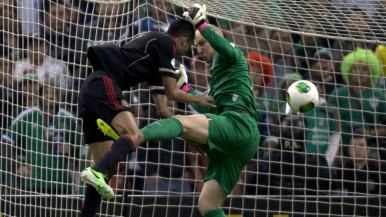
MEXICO CITY — Brad Guzan swatted away shot after shot and the Americans hung on for a 0-0 draw with Mexico on Tuesday night, earning only their second point in a World Cup qualifier at Azteca Stadium.
The tie moved the U.S. into third place in World Cup qualifying for the North and Central American and Caribbean region after three of 10 matches, one point behind Panama and behind Costa Rica on goal difference. The Americans and Costa Ricans both have four points, but the Ticos, who earlier Tuesday lost their appeal over Friday’s loss to the United States in a Colorado snow storm, are ahead on goal difference.
AFP/Getty Images
…read more
Source: FULL ARTICLE at AOL
