Tag Archives: TI

The 10 most important graphics cards in PC history

2009, ATI

One of the last truly powerful cards to bear the ATI nameplate before new owner AMD dropped the “TI” in favor of “MD,” the Radeon HD 5970 was so
masterfully engineered, so infused with mega-wonderfulness that it remains an option even today, some four years later. Indeed, some reviewers of the time
looked at the 5970, this elongated monument to 3D excess, as not only the fastest video card ever, but perhaps also a digital dagger through the heart of rival Nvidia. That notion proved to be a bit much, as our final entry will attest, but this dual-GPU brute (12 by 4 by 1.5 inches, 3.5 pounds)
most assuredly fanned the flames of an already impassioned battle.

Image credit: iXBT.com

From: http://www.pcworld.com/article/2034487/the-10-most-important-graphics-cards-in-pc-history.html#tk.rss_all

This Tiny Chip Will Stake a Big Claim on the Internet of Things

By Alex Planes, The Motley Fool

Filed under:

The Internet of Things is about to get a little smaller. Make that a lot smaller — so small you could put it on a pill and become a thing on the Internet yourself.
Freescale Semiconductor

unveiled a new
ARM Holdings

-based microcontroller chip last month, dubbed the Kinetis KL02,
that has everything necessary on board to produce, track, record, and analyze the essential information that device creators might need in a package smaller than your pinky toenail. That’s it over to the left — all 1.9 millimeters by 2 millimeters of it.

Freescale’s hardly the first chipmaker to step into the Internet of Things arena. A number of chips are already working in a number of devices, from wearable fitness trackers to the upcoming Google Project Glass, making the Internet feel more like a part of your body. Texas Instruments has gotten small and simple with bare-bones Wi-Fi chips that could pair with Freescale’s microcontroller to transmit information — if only they were a little bit smaller. No one has come up with something this small yet, and there’s a reason Freescale believes that the tiny new Kinetis micro-controllers could be used to track users’ health from inside their own bodies:


Source: Freescale Semiconductor.

The drawback to this chip, which Freescale claims is 25% smaller than any other ARM-based microcontroller, is that it might actually be too small to pair with existing Wi-Fi chips — Freescale doesn’t include wireless connectivity on the Kinetis, for obvious reasons. For comparison (although there’s no real sense of scale, unfortunately), this is TI‘s flagship Internet of Things Wi-Fi chip:


Source: Texas Instruments.

It may be a little tough to compare the size between pictures (just how small is that washing machine?), but TI‘s product description places the size of this chip at 16.3 millimeters by 13.5 millimeters. That’s almost 60 times the surface area of Freescale’s mini-microcontroller. Intel has also been working on tiny Wi-Fi chips for years, but the greatest obstacle to scaling down in a manner approaching other chips is the continued use of analog components, which aren’t subject to the same Moore’s Law miniaturization processes governing transistors. Intel unveiled what it called “the first complete Wi-Fi digital

Source: FULL ARTICLE at DailyFinance

Is Texas Instruments Destined for Greatness?

By Alex Planes, The Motley Fool

Filed under:

Investors love stocks that consistently beat the Street without getting ahead of their fundamentals and risking a meltdown. The best stocks offer sustainable market-beating gains, with robust and improving financial metrics that support strong price growth. Does Texas Instruments fit the bill? Let’s take a look at what its recent results tell us about its potential for future gains.

What we’re looking for
The graphs you’re about to see tell TI‘s story, and we’ll be grading the quality of that story in several ways:

  • Growth: are profits, margins, and free cash flow all increasing?
  • Valuation: is share price growing in line with earnings per share?
  • Opportunities: is return on equity increasing while debt to equity declines?
  • Dividends: are dividends consistently growing in a sustainable way?

What the numbers tell you
Now, let’s take a look at TI‘s key statistics:

TXN Total Return Price data by YCharts.

Passing Criteria

3-Year* Change 

Grade

Revenue growth > 30%

23%

Fail

Improving profit margin

(59.1%)

Fail

Free cash flow growth > Net income growth

54.4% vs. 18.9%

Pass

Improving EPS

31.3%

Pass

Stock growth (+ 15%) < EPS growth

40.4% vs. 31.3%

Pass

Source: YCharts.
*Period begins at end of Q4 2009.

TXN Return on Equity data by YCharts.

Passing Criteria

3-Year* Change

Grade

Improving return on equity

0.2%

Pass

Declining debt to equity

61.7% (since Q2 2011)

Fail

Dividend growth > 25%

75%

Pass

Free cash flow payout ratio < 50%

28.1% 

Pass

Source: YCharts.
*Period begins at end of Q4 2009.

How we got here and where we’re going
Most mature companies struggle to earn passing grades on many of these growth tests, but TI puts in a solid showing, earning six out of nine possible passing grades. The only real failing in the company’s progress is a deteriorating profit margin. Can TI push that margin higher by the time we examine it next year? Let’s dig a bit deeper into the company’s potential in 2013.

We know one area that won’t offer TI any potential for growth this year: mobile. That’s because the chipmaker made a high-profile decision to stop developing for the space last year, citing the fact that many large customers were beginning to produce chip designs in-house. According to Foolish tech analyst Evan Niu, that may have been the right choice. Samsung has long developed most of its chips in-house, and other major mobile makers (say that five times fast) either are doing the same, or soon will. Licensing ARM Holdings‘ reference designs, tweaking them for efficiency, and outsourcing the fabrication to Taiwan Semiconductor seems to be the order of the day. Where does that leave TI?

TI seems to be doing all right focusing on what it knows. One thing it’s been good at is developing simple Wi-Fi chips that are ideal for use in the nascent industrial Internet, a project spearheaded by General Electric but supported …read more

Source: FULL ARTICLE at DailyFinance

Nimble Quest Is An Addictive Little Gem

By Daniel Tack, Contributor

Nimblebit’s latest free-to-play mobile offering is Nimble Quest, a “snakelike” RPG that has a plethora of maps to explore, characters to unlock, and achievements to pursue.  Snake has come a long way since being the quintessential TI-86 title, and although Nimblebit is straying far from their sim offerings such as Tiny Tower and Pocket Planes, the title has a lot going for it.  Let’s just get this out there – Nimble Quest is what All the Bravest could have been. Nimble Quest is monetized through upgrades and character unlocks, but almost all of these are available through play as well.  In fact, if you’re buying anything but an odd character or two you’re probably defeating the point of playing the game entirely.  At its worst, the title can feel a bit grindy as players work on leveling up their characters and traversing through the same maps over and over.  At its best, it’s an addictive RPG romp that keeps players looking to acquire that next big level up, the next cool character unlock, and the next map to beat. …read more
Source: FULL ARTICLE at Forbes Latest

Amazon.com's Race to the Bottom

By Evan Niu, CFA, The Motley Fool

Filed under:

Always one to go low, Amazon.com may be about to go even lower with its popular Kindle Fire tablet. TechCrunch is reporting that the e-tail juggernaut is preparing to launch a $99 Kindle Fire with a seven-inch display.

Amazon is reportedly going with a 1280 x 800 resolution along with a processor from Texas Instruments . If those specs sound familiar, that’s because the current $199 Kindle Fire HD bears the same characteristics. The company continues to put pressure on Apple‘s iPad mini, and also recently dropped the price of its 8.9-inch Kindle Fire HD, which is now $60 cheaper than Apple’s smaller model. A possible $99 model could potentially add even more heat, costing less than a third of an entry-level iPad mini.

Here, have some cost savings
When Amazon reduced the price of its bigger tablet, the company said that it was passing along cost savings that have materialized since the initial launch as Amazon increased production volumes. The possibility of a $99 Kindle Fire would follow in those same footsteps, and also implies that costs have come down significantly since launch.

In November, IHS iSuppli estimated that Amazon’s component costs including manufacturing totaled $174, so costs must have had to come down significantly for Amazon to make this move. The largest component for any tablet in general is always the display and touchscreen assembly ($64 of iSuppli’s November estimate). That was five months ago, and any cost reductions related to the display would go a long way in facilitating a retail price drop.

Going with TI would show how cozy the pair is, since TI publicly exited the mobile chip sector last year. TI processors have powered every Kindle Fire to date, and Amazon is undoubtedly the biggest buyer of its OMAP chips.

IDC Research Director Tom Mainelli said the $99 price point seems within reach for Amazon, since the company does have the required scale to make it worthwhile.

Stuck in the middle with you
With Google‘s upcoming second-generation Nexus 7 expected within a matter of months, a $99 Kindle Fire would also be a viable threat to the search giant if it were still targeting the original $199 price point. Google similarly pursues a strategy of little to no hardware margins for most of its devices (other than its new high-end Chromebook Pixel), so the company can also be expected to pass along cost savings to consumers wherever possible.

Although Google has also been following Apple’s lead with pushing higher-resolution displays, such as the one found in the larger Nexus 10 and the aforementioned Chromebook Pixel. If the search giant opts for a sharper display in the second-generation Nexus 7, that’s going to add a lot to the bill of materials and may prohibit a more aggressive price point. On the other hand, a higher-resolution Nexus 7 would also be positioned higher than a $99 tablet.

There aren’t a whole lot of rumors …read more
Source: FULL ARTICLE at DailyFinance

iPrefs: The Product Apple Didn't Know It Wanted

By Richard Saintvilus, The Motley Fool

Filed under:

Steve Jobs once said, “A lot of times, people don’t know what they want until you show it to them.” Apple has always innovated on this premise. It has brought the tech giant much success. But lately, success has been hard to come by; the stock has plummeted 40% from an intraday high of $705 last September.

The sentiment bubble
Apple has a problem that every company wants — a cash hoard of $137 billion, but no epic idea of what do with it. I’ve done my part as a shareholder; the company now has all of my routing numbers. I’m still waiting to hear back. But in the meantime, here comes David Einhorn, the outspoken hedge-fund manager at Greenlight Capital. He’s got a few ideas of his own. One in particular is called “iPrefs,” which has brought him much scrutiny.

I never wanted to like the idea. My loyalty to Apple was too strong. Even CEO Tim Cook called it “a silly sideshow.” I agreed. Besides, Apple didn’t grow to become the largest company in the world with clueless management. Therefore, who’s this guy Einhorn to make cash-use demands? In a recent article, I talked about how I felt he was doing more harm than good. That article prompted an exchange. Einhorn reached out to me and we discussed Apple’s current situation — more specifically, how the company is being appraised by the market.

It requires, however, much more than just a cursory view of Apple’s status to appreciate the company’s $137 billion cash pile in relation to the ebb and flow of market sentiment. Consider this: From January 2009, when the stock traded at $82.33, to its recent intraday high of $705, shares gained 756% in just four years. That’s an absurd average of almost 20% per month for 44 consecutive months. Yet, the P/E ratio never fully reflected confidence — dropping from 35 to 9, where it is today. But the cash kept rising. What’s the problem? The company was carrying too much cash.

The market punished Apple for this by discounting the cash and its future value. By contrast, Texas Instruments , which has 43% more debt than it does cash, is making new 52-week highs. I’ve been scratching my head around this for quite some time. This is despite struggles with declining revenue. There’s no way TI deserves a higher P/E than Qualcomm, much less Apple. Same goes for IBM , which has $33 billion in debt and only $11 billion in cash. It’s not a great ratio. But the market forgives IBM‘s highly levered balance sheet because the company is seen as “shareholder-friendly.” For that matter, IBM‘s 85% return on equity is one of the best on the market.

Coming to terms
There are two lines of thinking here — what management sees and what the Street wants. You can chose to focus on the unit figure misses, but management sees an operation …read more
Source: FULL ARTICLE at DailyFinance

Why These Shares are Still Too Expensive

By Richard Saintvilus, Contributor

As much as I want to like semiconductor giant Texas Instruments, the stock is trading at a valuation that is too rich relative to the company’s performance. While this company still has a solid market position in over all chip sales, TI still lags behind Qualcomm and Broadcom in that all important mobile devices category. And if fourth quarter earnings were any indication, the company does not expect an immediate recovery. So why then, are shares trading at a P/E that presumes it will outperform Qualcomm? …read more
Source: FULL ARTICLE at Forbes Latest

Anna Lamb-Creasey Learns Of Son’s Death Through Bizarre Facebook Message Sent By Police

By The Huffington Post News Editors

Anna Lamb-Creasey of Clayton County, Ga., learned of her son’s death almost a month after it happened. But she didn’t see it on the news or hear it from a neighbor. She found out from a Facebook message sent by a police-controlled masquerade account, reports Atlanta-based news outlet WSBTV.

Lamb-Creasey’s son, Rickie Lamb, was killed by a vehicle in Forest Park in the last week in January. It wasn’t until Valentine’s Day that she found out he had died, according to a post she wrote on the fundraising website set up for her son’s funeral.

Clarence Cox, a spokesperson for the Clayton County Police, told The Huffington Post over the phone Tuesday that police sent the Facebook message to the distraught mother from an account bearing the name “Misty Hancock” and a profile photo of rapper TI. The account had been used previously “in an undercover capacity,” Cox said. “We had no intention of it getting out all over the media like this.”

Read More…
More on Video

…read more
Source: FULL ARTICLE at Huffington Post

Blocking infinity in a topological insulator

(Phys.org)—In bulk, topological insulators (TIs) are good insulators, but on their surface they act as metals, with a twist: the spin and direction of electrons moving across the surface of a TI are locked together. TIs offer unique opportunities to control electric currents and magnetism, and new research by a team of scientists from China and the U.S., working with Berkeley Lab’s Alexei Fedorov at beamline 12.0 at the Advanced Light Source, points to ways to manipulate their surface states. …read more
Source: FULL ARTICLE at Phys.org

Viewsonic puts Nvidia inside

LAS VEGAS—PC displays are rarely sexy, but Viewsonic showed off several decidedly cool displays on the CES show floor Tuesday.

One of the more intriguing monitors is their new VSD240 smart display. Whether it’s a “smart display” or an Android Jelly  Bean-powered All-in-One PC is arguable, since the Tegra 3 processor offers pretty robust CPU and graphics performance in its own right. You can just run the VSD240 as an Android-based computer or connect it to a Windows based PC. This isn’t Viewsonic’s first smart display, but it’s the first to use Tegra 3. Earlier models used TI’s OMAP 4 processor.

You can just run the VSD240 as an Android-based computer or connect it to a Windows based PC.

The VSD240 is also a capable 1080p monitor when connected to a PC. As you’d expect from a computer, the monitor includes USB ports, SD card slots, an Ethernet jack and support for 802.11n Wi-fi. If you connect the display to a Windows 8 system, you have limited touch capability—mostly basic swipes and UI gestures since the VSD240 only supports 2-point touch, rather than the 10-point touch required to be fully Windows 8 certified.

The VSD240 will be shipping in April, with a suggested retail price of $499.

To read this article in full or to leave a comment, please click here

Source: FULL ARTICLE at PCWorld

Update on Work

As some of you know, I work for Pelagicore. We do in-vehicle infotainment using open source, Linux and Qt. I’m not in Las Vegas right now, but a whole bunch of colleagues are there, showing of at CES. This year, we’re doing loads of demos together with various partners. We demo together with Visteon (makes infotainment hardware, and more), Digia (makers of Qt), GENIVI (infotainment platform standardization organization), Cinemo (media indexing, rendering and streaming) and Rightware (cool 3D UIs).

IMG_20130108_111108

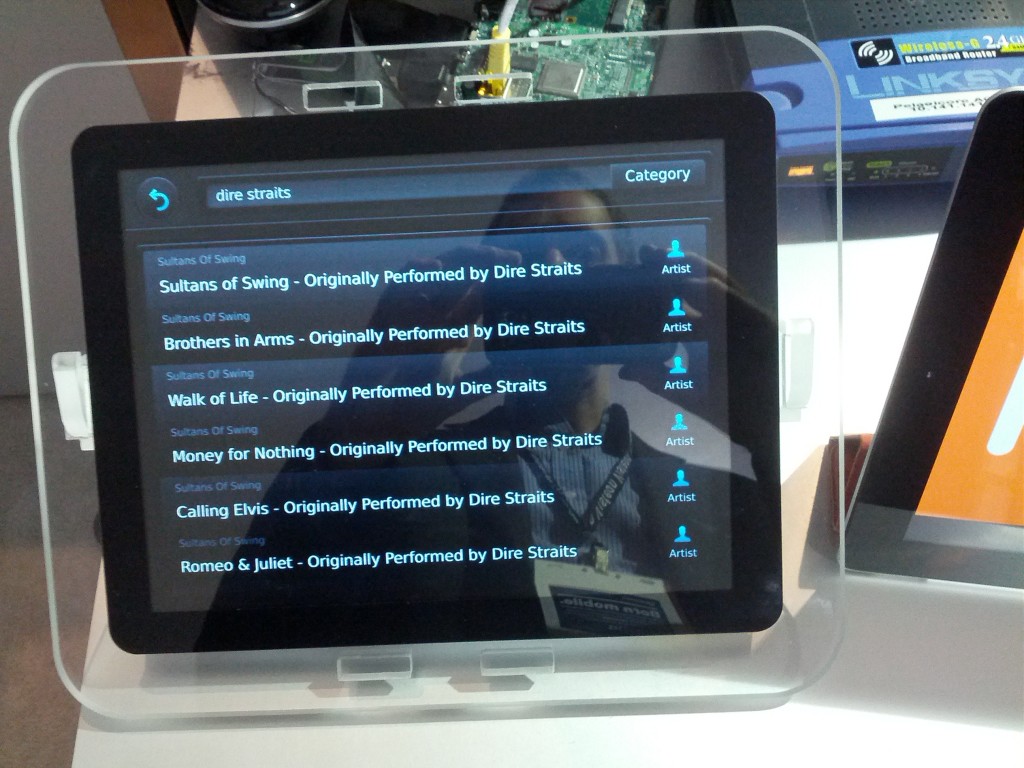
One of the fun parts of working at Pelagicore is that you get to see cool hardware. I’ve personally worked with Qt on Intel prototype systems, Freescale iMXs, TI’s OMAPs and more stuff that I can’t mention. This year’s demo setup for CES is based on iMX6. The UI has been developed with DesignIt, our design partner company. Let’s face it, those who enjoy coding generally do not excel at polishing pixels. With their help, we’ve been able to make something really beautiful. The picture I’ve got of the UI itself does not say much of the look and feel, but it has a nice reflection of my kind colleague taking the photos, so I’ll use it to say thanks to him and give some credits ;-).
IMG_20130108_111352

The demo is built around Qt and QtQuick (what else is there :-P) on a Linux platform. It integrates our core platform with all the services you might need. For CES, we have some new stuff in there. I have been involved in the integration of technologies from two other companies.

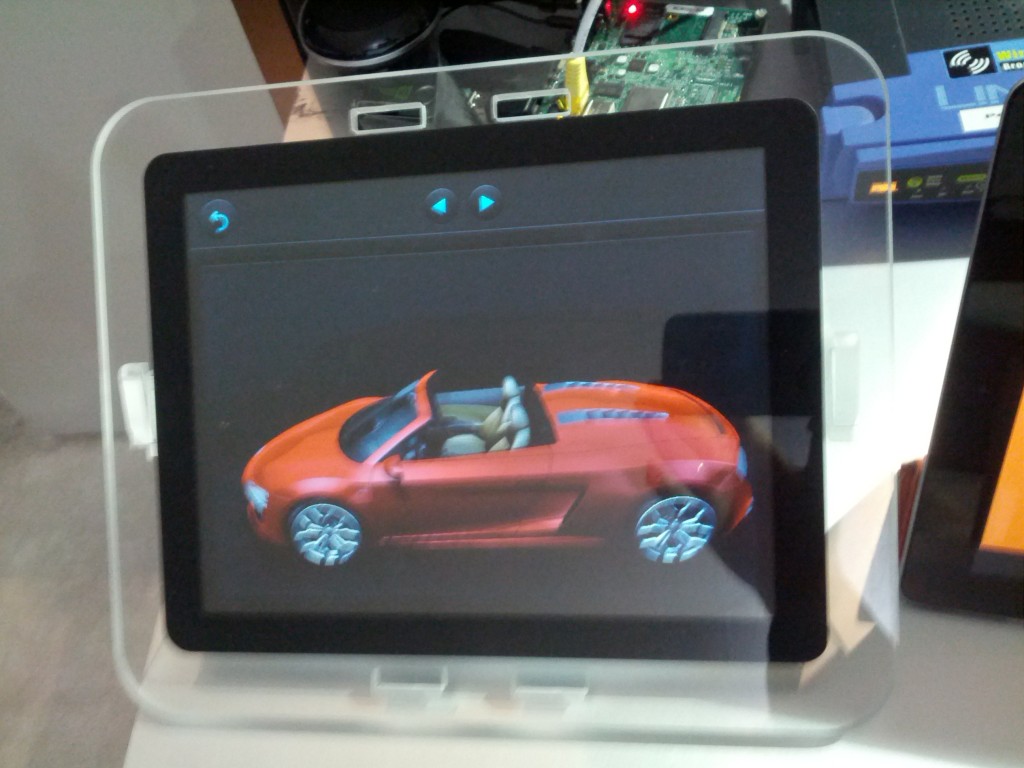
First, we have Righware and Kanzi, a nice 3D engine with an easy to use studio to create the scenes. The car shown below spins around as you change position with nice lighting and material effects. The demo is integrated as an element in the QML scene, and it is possible to bind to and from Kanzi properties, as well as hook into events from Kanzi UI elements, e.g. 3D slides and buttons.
IMG_20130108_111440

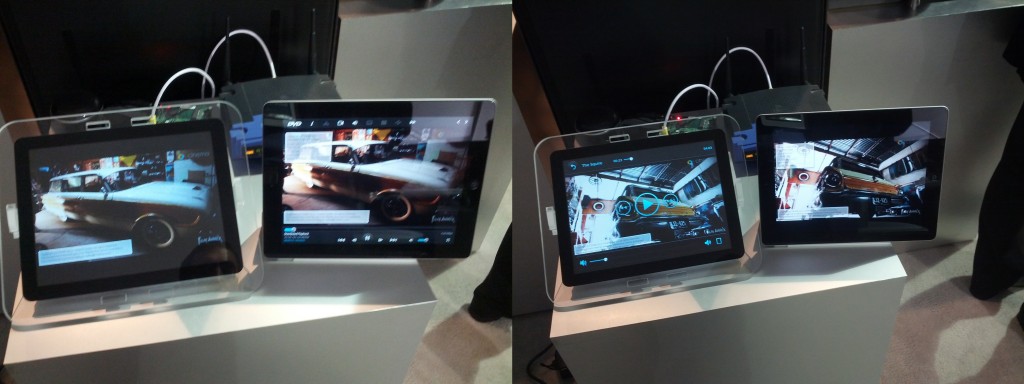
The second piece of technology is Cinemo’s media platform. It indexes, renders and streams video and audio. For instance, you can sync multiple devices showing the same video stream, so that you can share the audio through the main speakers. Again, the video stream is integrated into the QML scene, so you can do all sorts of fancy things with it. The images below show an iPad and our demo system sharing a video stream. As you can see, you can control it from either device, and they are always in perfect frame sync.
IMG_20130108_111136+7

From a business standpoint, I guess CES is one of the highlights of the year. We really get to show our stuff to a large audience. However, since I’m not in sales, to me it means overtime, but also having a chance to work with companies making awesome technology. Also, as an added bonus this year, we got to work closely with our team of former Trolls based in Munich, which always is good fun.

So, to all of you at CES. Come visit our demos! To the rest of you, look our for our platform in your next car!

Source: FULL ARTICLE at Planet KDE