Tag Archives: EFF

Awesome days during Akademy 2013

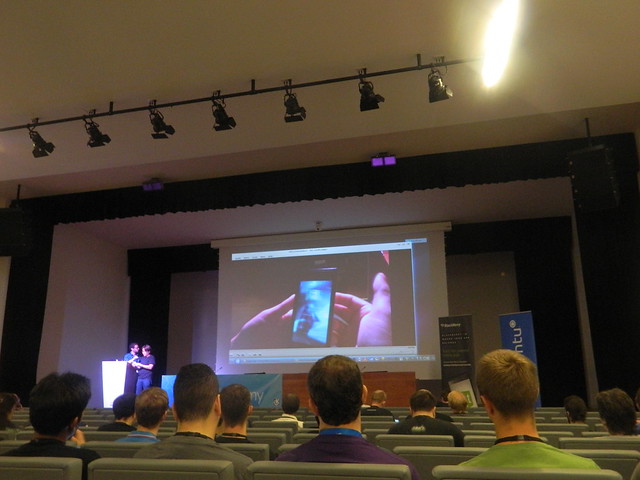
Joola Phone demo

Awesome days during Akademy 2013

Hi all,

Being a part of KDE Akademy is one of the most awesome experiences ever. This was my second Akademy after the one in 2012 . Akademy 2013 was held in the beautiful city of Bilbao in Spain. Held from 13th July to 19 July, it had 2 days conference followed by 5 days of workshop, Birds of a Feather sessions (BoFs), lots of hacking, and of course lots of fun!

Day 0

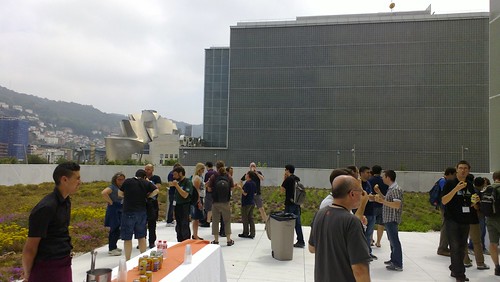
I reached Bilbao on 12th July and went for pre-registration where I also met many KDE folks (some of them I already met during last Akademy and some new people). It was great to meet everyone again, we all had a fun time together with greeting each other, drinks and lovely music.

Day 1

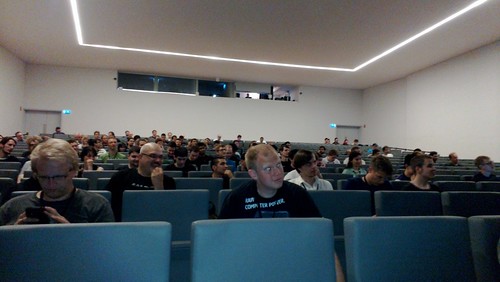
The first day of the conference started with a keynote by Eva Galperin . A member of EFF, she talked about the NSA surveillance and how it affects people outside the US.

After keynote, Kevin Krammer gave talk on Declarative widgets where he explained and showed demo on how to create widgets based UI in QML. This approach enables non-C++ programmers to participate in UI development for traditional desktop applications.

Till Adam talked about KDE on Blackberry where he explained about Blackberry …read more

Source: FULL ARTICLE at Planet KDE

Jonathan Riddell: Akademy 2013 Day 1 in Photos

13070001

KDE Project:

…read more

Source: FULL ARTICLE at Planet Ubuntu

Benjamin Kerensa: LinuxFest Northwest 2013: Recap of Day 1

IMG 20130427 073018 225x300 LinuxFest Northwest 2013: Recap of Day 1

Linux Fest Northwest Expo Hall before opening!

Welcome to the first daily recap of LinuxFest Northwest 2013 (LFNW). I’m up in Bellingham, Washington evangelizing Firefox OS, WebFWD and Mozilla Reps. Just in the first few hours we had close to 50% of LinuxFest Northwest attendees visit the Mozilla booth and a majority of those people who visited the booth said they are long time Firefox users many of whom also use Firefox for Android and many of them have heard about Firefox OS but had not had the opportunity to actually get more information. This presented an excellent opportunity to let visitors check out Firefox OS running on one of the developer handsets and then educate them about the platform and how to get involved.


Mozilla Booth

Me showing attendees the Firefox OS platform

We were lucky to be in a nice area of the expo floor and just to the left we had folks from the EFF and just across was the Ubuntu booth ran by the Ubuntu Washington LoCo and the Greater Seattle Linux User Group (GSLUG). Lanyards and buttons were really popular and we gave almost all our lanyards out during the first few hours of the expo hall opening.

Geeksphone

Although I do not yet have a Geeksphone but instead have another handset running Firefox OS one of the most popular questions I got asked was “Where can I buy a phone running Firefox OS?” This started the discussion about the recent Geeksphone launch and in turn people were really surprised to hear how affordable those phones were.

Highlighting MoCo Session and Other Tidbits

IMG 20130427 151059 300x225 LinuxFest Northwest 2013: Recap of Day 1

LFNW Attendee shows Firefox shirt he won.

I want to suggest to those who will be at LFNW tomorrow that they try and make it to Spencer Krum and Ben Kero’s session about Git on the server. Ben Kero is a Mozilla Systems Administrator and well known in the Pacific Northwest Open Source community and his session should be informative for those who are interested in getting started with Gitolite.

One other thing I got to do today was to sit down with Thomas from Slashdot to do an interview about Firefox OS. I also went on Linux Action Show live to discuss Firefox OS and even discuss Ubuntu for a bit.


The post LinuxFest Northwest 2013: Recap of Day 1 appeared first on Benjamin Kerensa dot Com.

Source: FULL ARTICLE at Planet Ubuntu

Judge rules secret FBI letters unconstitutional

They’re called national security letters and the FBI issues thousands of them a year to banks, phone companies and other businesses demanding customer information. They’re sent without judicial review and recipients are barred from disclosing them.

On Friday, a federal judge in San Francisco declared the letters unconstitutional, saying the secretive demands for customer data violate the First Amendment.

The government has failed to show that the letters and the blanket non-disclosure policy “serve the compelling need of national security,” and the gag order creates “too large a danger that speech is being unnecessarily restricted,” U.S. District Judge Susan Illston wrote.

She ordered the FBI to stop issuing the letters, but put that order on hold for 90 days so the U.S. Department of Justice can pursue an appeal to the 9th U.S. Circuit Court of Appeals.

The DOJ said it is reviewing the decision.

FBI counter-terrorism agents began issuing the letters after Congress passed the USA Patriot Act in the wake of the Sept. 11, 2001, attacks.

The case arises from a lawsuit that lawyers with the Electronic Frontier Foundation filed in 2011 on behalf of an unnamed telecommunications company that received an FBI demand for customer information.

“We are very pleased that the court recognized the fatal constitutional shortcomings of the NSL statute,” EFF lawyer Matt Zimmerman said. “The government‘s gags have truncated the public debate on these controversial surveillance tools. Our client looks forward to the day when it can publicly discuss its experience.”

Illston wrote that she was also troubled by the limited powers judges have to lift the gag orders.

Judges can eliminate the gag order only if they have “no reason to believe that disclosure may endanger the national security of the United States, interfere with a criminal counter-terrorism, or counterintelligence investigation, interfere with diplomatic relations, or endanger the life or physical safety of any person.”

That provision also violated the Constitution because it blocks meaningful judicial review.

Illston isn’t the first federal judge to find the letters troubling. The 2nd U.S. Circuit Court of Appeals in New York also found the gag order unconstitutional, but allowed the FBI to …read more
Source: FULL ARTICLE at Fox US News

National Security Letter Gag Orders Struck Down As Unconstitutional

By The Huffington Post News Editors

NEW YORK — Concluding that they suffer from “significant constitutional infirmities,” a federal district court judge in San Francisco on Thursday struck down sections of federal law that allow the FBI to warrantlessly obtain private information under a gag order in the name of national security.

But U.S. District Judge Susan Illston temporarily put her order on hold to allow the government to appeal her decision, recognizing that a higher court should first be able to “consider the weighty questions of national security and First Amendment rights” at issue in the case. The authority of national security letters, government orders to communications providers to reveal user information, was vastly expanded in the post-9/11 Patriot Act. The federal government has made wide use of them in the name of the fight against terrorism.

In May 2011, the non-profit Electronic Frontier Foundation brought a lawsuit against the national security letter statutes on behalf of an unnamed telephone service provider, arguing that placing the company under a gag order violated its First Amendment rights. EFF also argued that the 2005 renewal of the Patriot Act provided too little judicial review for the secret letters.

Read More…

…read more
Source: FULL ARTICLE at Huffington Post

Benjamin Kerensa: Patch to Fix Unity Shopping Lens Bug Ignored

I have to really commend Kees Cook who has made the most sensible suggestions to address the issues that the EFF and others raised about the Unity Shopping Lens. In fact Kees submitted a patch back in November which would fix this bug and the patch as you can see below is quite sane but it has been ignored. Why?

1
2
3
4
5
6
7
8
9
10
11
=== modified file ‘data/com.canonical.Unity.Lenses.gschema.xml.in.in’
— data/com.canonical.Unity.Lenses.gschema.xml.in.in 20120925 15:10:07 +0000
+++ data/com.canonical.Unity.Lenses.gschema.xml.in.in 20121113 19:36:25 +0000
@@1,7 +1,7 @@

‘all’
+ ‘none’

Content fetching from remote source preference.

“all” is to enable the supported default lens to search from remote and commercial sources. “none” will indicate the lenses to not perform that remote search at all.

Why is the Unity Team not accepting this patch? If they disagree with it they can comment and reject but to just let it sit there for months seems like they have no interest in addressing a valid bug.

The post Patch to Fix Unity Shopping Lens Bug Ignored appeared first on Benjamin Kerensa dot Com.

Source: FULL ARTICLE at Planet Ubuntu

Greg Grossmeier: Secrecy is power over others

[Think of this post as something like a public draft, fittingly enough. I’m looking for feedback. Poke holes. Make it (or make me make it) better.]

Secrecy is power over others. Seems like a pretty obvious statement right? Obviously when you keep something a secret you are the one choosing whether someone else can know that thing. In some cases that isn’t a huge deal (eg: I didn’t tell anyone else that I ate the last two oranges just now) but in other cases it is a horrible act of malice (let your brain run wild for a second on this one).

Luckily, our society is starting to become more accustomed to not protecting everything as a secret. There are better places and worse places, but it seems to me that the anti-secret (or pro-knowledge) crowd is gaining support.

But it hasn’t always been that way, of course.

Not that long ago, it was common practice for cancer sufferers to not know they had cancer. Their doctors would know and sometimes part of their family would (eg: parents or kids, depending on which one was “vulnerable”), but they would die of cancer never knowing they had cancer. In fact, from a quick web search, it seems that is still not an uncommon thing in Japan.

Not that long ago it was impossible for a citizen in the USA to request information about actions the government is taking. Now we have FOIA (which is still pretty limited and there are still far too many governmental secrets, I argue all of them).

What is behind all secrecy? The notion that one person/group can know something while another person/group is too dumb/smart/vulnerable/bad/good/whatever to know it.

One group is unilaterally creating a caste system. The other (non-knowers) have no agency in this choice and have no recourse other than begging the knowers. The knowers wield power over the nonknowers in many unfathomable ways, ways not yet even known when the knowers decided to create the nonknowers.

If you are a person in the group of nonknowers, it is easy for you to feel alone and as an outcast. Someone has decided that you, personally you, are not worthy of some bit of information, no matter how inconsequential it is (and the more inconsequential it is the worse the feeling). And when that information is about you, or your place in life, you are justified in feeling that you are worthless because you aren’t even worth as much as your own information.

Now, the question becomes, what do you as a knower or a person in a position who can delineate people as knowers vs nonknowers do? Do you share with everyone all you know or do you keep some things completely to yourself and other things somewhere in between (even through enforceable means such as NDAs, contracts/licenses, and the like)?

Does it matter depending on the information you possess? You will undoubtedly argue yes, of course it does. I did initially.

But should that be the answer?

Let’s start to dissect the usual excuses.

1.Just because something is normally treated as a secret doesn’t mean it should continue to be a secret. See the poor souls who died of cancer and at the same time completely confused and alone. “What we’ve always done” is never an acceptable excuse. Everything is open for reassessment.

2.Just because one group thinks the information can be misinterpreted by a “less informed” or “not as smart” person doesn’t mean it should continue as a secret. This is my biggest critique of the mentality I see in many researchers, even those who are pro “open”. They continue to sometimes be paternalistic and pretentious. This mentality should be corrected as early in a person’s life as possible.

2a.Some “open” licenses even codify this. The Open Government License from the UK says one must “ensure that you do not mislead others or misrepresent the Information or its source”. That sure is burdensome. Ensuring? I need to make sure that everyone who reads my work based on your data understands me correctly? As Mike Linksvayer has said about the OGL, it is quite problematic.

3.We are starting to see that business secrets are more costly than beneficial and this will only accelerate in the future due to the mode of production asymptotically approaching 100% digital. Thus, if this is the excuse, it should be justified (and not just in a anyway that is refuted before or after this bullet).

3a.Some research in this area is starting to come out from people such as Eric Von Hippel.

4. If your reputation as a person will be hurt by the information you tend to want it secret. This one is huge and complex. Defining the “you” the “others”, along with “reputation” and “hurt”, and lastly with a new word of “justified” are tough to do in a single bullet. I may expand this and do a full blog post on it later.

4a. Are you making the choice for a company? Is the information damning to you/the business because you are/the business is doing things that are illegal or unethical? Share it. Period. No questions asked. If you have the power to share that information and you don’t you are culpable (to the greater good). If you think my assertion here is wrong, tell me why any company should get away with actions which the rest of the world/country/state/county/whatever thinks is unacceptable? If you are a libertarian, isn’t knowledge the first requisite to being able to “choose with your money?”

4b. Are you making the choice for yourself? This one is where I will allow some leeway, until I can figure out a reason not to. Again, this one I’ll revisit in more detail later.

5. Money. This one is simple: why are you hiding your expenses? People feel like their finances are personal and private for reasons I can’t quite pin down. Jealousy (either direction)? Ashamed? Something else? Why is this? Why does it matter what my salary is? You can already infer much of it based on how a person lives (what the buy, what they don’t, etc). True, there are many that live below their means, but you can also infer that as well.

5a This is doubly so for ANY type of organization. I believe that the three main points of Open-book management are almost perfect. I only make one correction: “The company should share finances as well as critical data with all employees.” This means: everyone’s salary (especially the C-level types), where the money comes from (grants, products, services, and how much from where and for what), rent, utilities, everything. It’s easy, too. That document is already circulated among the C-level types and the board at least once a year. Just add it to archive.org and be done with it.

5a-continued I know of many non-profits that make their 990s and Financial Statements easily findable. In fact, many Free Software and related orgs’ documents are collated by Bradley Kuhn in this gitorious repository (https://gitorious.org/floss-foundations). And Carl Malamud has made this much easier by providing bulk access to all of the publicly available IRS documents for Tax Exempt Organizations (non-profits), ie: their 990s.

6. What’s your excuse? Please share (really).

Based on these refutations of the above excuses it is plainly clear that most, if not all, information should be freely available. Secrecy harms more than it protects.

Let’s think of all the ways that secrecy harms individuals and our society.

1. The countless deaths from secret drone attacks.

2. The countless deaths from secret wars perpetrated by democracies.

3. The countless deaths from secrets withheld by pharmaceutical companies.

4. The countless deaths from secrets withheld by car manufacturers.

… If those weren’t enough …

5. Unable to make quality non-profit donation decisions because we don’t know the organizations current financials and roadmap(s). I complain about this every year when donation time rolls around. This year a lot of non-profits were (minimally) hurt because I chose not to give to them, even after I did last year, because of a lack of information. In some small way, their own secrecy directly hurt them.

But, I don’t want to end on such an insignificant thought like me not donating $50 to the EFF this year. So instead, I’ll let you know that I’m not the only one thinking about this (Mike Linksvayer has alluded to this idea, while I was drafting this post, no less).

And now, let me ask you a question:

What secrets are you keeping and why?

flattr this!

Source: FULL ARTICLE at Planet Ubuntu