Tag Archives: American Dream

Remarks by the First Lady to the National Council of La Raza

By The White House

Earnest M. Morial Convention Center
New Orleans, Louisiana

11:59 A.M. CDT

MRS. OBAMA: Buenos dias! Oh, my goodness. You all rest yourselves. You've been busy. I understand you are having a phenomenal conference. And it is such a pleasure to be here with all of you today for this 2013 Annual Conference.

Of course, I want to start by thanking Janet not just for that very kind introduction, but I want to thank her, as well as Jorge Plasencia, for their leadership, for this outstanding organization. I also very much want to thank all of you who are part of this great American organization.

As you know, for more than four decades, NCLR has served as a powerful voice on the most important issues of our time — from voting rights to health care, from education to immigration. Because of all of you, your steadfast work, we have seen such great progress for the Latino community and for our country.

And please know that whether it’s implementing health reform or passing common-sense immigration reform, your President and his administration are going to keep working with you and fighting with you every step of the way. (Applause.) Know that. And I know these debates are hard — particularly on immigration. But do not give up, because I promise you that my husband won’t give up until a good bill gets on his desk. (Applause.)

That's because in the end, these issues are all about one simple thing: They’re about achieving the American Dream. They’re about building a country where no matter who you are, or where you’re from, or what you look like, or who you love, you can build a decent life for yourself and an even better life for your kids.

But, of course, as you all know, keeping that dream alive isn’t just about changing our laws out in Washington. It’s also about changing people’s lives on the ground. It’s about the grassroots, community-based work that so many of you have been doing for so long. And that's especially true of the issue that I want to discuss with you today — as Janet mentioned, an issue that affects the lives of children and families across this country — and that is the epidemic of childhood obesity in America today.

Now, we often talk about this issue as a policy issue, which it is, since our laws certainly affect our children’s health. And we often say that it is a public health issue, which is true, since we now spend $190 billion a year treating obesity-related illnesses like diabetes, cancer and heart disease. But more than anything else, how we raise and nourish our children is very much a family issue. It’s very much a community issue.

And see, that’s where it gets complicated, because that's where it gets personal and emotional. Because the truth is, for so …read more

Source: FULL ARTICLE at The White House Press Office

Is America Stealing Entrepreneurs? Immigration And The Small Business Dream

By Meghan Casserly, Forbes Staff

According to new research released this month, the glory of entrepreneurship, the American Dream to trump all American Dreams, isn’t the reason that immigrants are more likely than any other demographic to launch a small business soon after setting foot on American soil. Instead, at least according to one study, it’s because once they get here their employers treat them like crap. …read more

Source: FULL ARTICLE at Forbes Latest

How the American Dream Is Keeping Us Broke

By LearnVest

American Dream window shopping

Filed under: , , ,

Alamy

By ASHLEY STETTS

Our grandparents grew up in a time when you had to learn to be resourceful.

Things were fixed and not replaced, women made their own clothes, and neighbors shared one phone. Things were purchased because they were necessary, not because they were simply wanted — and guess what? No one would ever have dared to refer to your Nana as a cheap-ass.

So where did we go wrong? Research from Ohio State University found that people in their late 20s and early 30s carry significantly higher credit card debt than older generations and pay it off much more slowly. Much of this can be attributed to the rising costs of education, but the bigger problem, in my opinion, is our generation’s fear of looking cheap.

Looking Rich Doesn’t Make You Rich

Success is naturally equated to wealth, and no one idolizes someone who isn’t successful. The younger generation adores ultra-rich celebrities, and this has only helped to morph the American Dream into a whole new level of status and luxury we all think we can achieve.

Sponsored Linksadsonar_placementId=1505951;adsonar_pid=1990767;adsonar_ps=-1;adsonar_zw=242;adsonar_zh=252;adsonar_jv=’ads.tw.adsonar.com’;

In pop culture today, having the appearance of wealth trumps actually having any money. We see rappers in chinchilla jackets popping Ace of Spades champagne in their videos, not driving a Toyota and having game night in with their friends. Kanye said it best: “What you think I rap for, to push a fu@#ing Rav4?” What needs to be understood, though, is that people who are really wealthy actually attribute their frugal habits to getting and staying there.

The number one quality of successful people is living below their means: For example, there are 1,138,070 millionaire households living in homes valued under $300,000, yet at the same time, 86 percent of people driving the most expensive “status” cars are non-millionaires.

Most people who actually have money are not scared of seeming cheap — that’s how poor people think, and it keeps them poor.

Why ‘Cheap’ Isn’t an Insult

Pictured: Ashley Stetts

I’ve lived in New York City — a not particularly inexpensive city — for nine years, and I saved almost a half a million dollars before I was 30. I didn’t create some stupid app that I sold for a bunch of money — I was a waitress and a model. I wasn’t even a big model. Not even close, actually … I mean, I’m not ugly or anything, but you get the point.

I lived in an affordable apartment, I never took taxis, and I never feared being labeled as cheap. Did people call me that because I always looked for better deals and watched my spending? Sure, but while they racked up debt

Source: FULL ARTICLE at DailyFinance

It’s ALL About OIL — Period!

By Dale-Dawson

A British think tank, Chatham House, has just released a report that confirms what many of us have always known (but environmental wackos refuse to believe.)  The group says that biofuels harm the planet more than fossil fuels, and fossil fuels are a lot more cost effective.

What’s caused my blood to boil is that we (the sane conservative majority) have silently stood by for decades while the most extreme elements of the left have stayed in motion, fighting for their depraved cause.  We may have thought that because we were right, we would eventually win the battle.  That logic is as naïve as if David, when he was facing the towering Goliath, had not bent down to pick up some stones for his slingshot, passively assuming that God would make everything right.

IF we had fought these social terrorists decades ago, we would not have needed to go into Kuwait in 1991 when Saddam Hussein invaded the country and was determined to blow up their oil fields.  HAD we had been energy independent then, we could have, perhaps, offered some humanitarian assistance (but little else.)

Thanks to the weakness of presidential administrations going back decades (obviously, both parties are to blame), we went into Kuwait (NOT for the noble reasons then stated) to prevent this nasty dictator (who hated us) from blowing up some real estate of another country that also had no love for the U.S.

The plain truth (I agree with the ‘anti-war’ groups on this point) is that it really was all about the oil.  But the story in the liberal media should not have ended there.  It was ‘all about oil’ because the agenda-driven environmentalists have blocked every effort here in America for American companies to tap into the vast resources of crude oil beneath the surface of many areas of the United States.

Had it not been for the ‘tree-hugger’ extremists, many U.S. soldiers who died in these senseless Middle East deployments would have been alive today, raising their families and going on with their American Dream.

I think these groups have a whole lot of blood on their hands, and for WHAT?  Though they have disrupted a lot of progress in the United States, they have no factual data to justify or document the chaos they have caused for decades.  With liberal/progressive ‘fanatics,’ it is always about “feelings,” not facts.

If administrations of both parties had pushed back decades ago, we would have a lot more troops still alive today, a lot more money in our national bank account (with a positive rather than a negative balance via savings from ‘wars’ and deployments that never happened), and a whole lot more jobs, thanks to fossil fuel extraction sites around the nation. We would also not now be thinking that $3.39 a gallon for gasoline is a real BARGAIN!

I think it might be time to start pushing back — before it is just plain TOO LATE!

ON TARGET NEWS

www.ontargetnews.com

Photo credit: terrellaftermath

Gen-Xers, Millennials May Reap Big Benefits From Great Recession

By John E. Girouard

It?s become accepted wisdom that the Boomer generation?s wretched excesses and the financial crises that followed have spoiled the financial and career prospects of the next generations, especially those born since the mid-to-late 1960s. Known variously as Generations X, Y, and Z?or Busters, Millennials and Digitals?these 20- to 40-somethings are said to be doomed to lives of under-achievement and financial uncertainty.
The Great Recession has taken its toll on everyone, but if I were advising an X, Y or Z, I would suggest that it may also have handed them a once-in-a-lifetime opportunity. What better time to get serious about saving for retirement or investing for the distant future than right after asset prices have been beaten down?
Has the American Dream really died, or is it possible that the inflated prosperity before the crash of the housing market was the aberration and now we are back to normal? Is it possible that the house that sold for a million in 2005 after a frenzied bidding war, but which no one wants today for half that, was never worth a million to begin with?
Instead of accepting the narrative that there is no hope and they should get used to it, I would advise Busters, Millennials and Digitals to double down on their futures. Not only is it not too late to save for the future, it may be the perfect moment to begin. That?s the lesson of history.
The argument for lowered expectations?a sick economy, bloated government, global economic storms, public disgust with Wall Street?will sound familiar to Boomers. The 1970s?when millions were graduating from high school and college and beginning their working careers?was defined by the Vietnam War, the Cold War, urban decay, rising crime rates, two oil shocks, crippling inflation, a deep recession, a go-nowhere stock market, crumbling auto and other manufacturing industries, official corruption at the highest levels, a bubble in markets for gold and art, inflated home values, and government deficits so onerous that the City of New York was at one point essentially bankrupt. This was the American Dream inherited by the Baby Boomers.
For those who lived through the 1970s, the future looked grim indeed?so grim that Business Week magazine ran a cover story in August 1979 entitled ?The Death of Equities.? The Dow Jones Industrial Average?the oldest and most commonly used marker for our relative financial health?had essentially gone nowhere for thirteen years. From a record high of 995 in 1966, when the Business Week article appeared, the Dow was treading water just below 900.
The writers argued that high inflation and Wall Street?s finagling and financial engineering of new, complex products had rendered stock investing irrelevant to the public. ?The U.S. economy probably has to regard the death of equities as a near-permanent condition?reversible some day, but not soon.?
Four years later, in December, 1982, the Dow Jones Industrial Average finally closed above the 1966 high and the reports of the death of equities turned out to be premature. With plenty of ups and downs along the way, …read more
Source: FULL ARTICLE at Forbes Markets

Is Boston Beer One of the Best Companies in America?

By Daniel Ferry, The Motley Fool

Filed under:

When The Motley Fool set out to discover America’s best publicly traded companies, our team combed through more than 1,700 names and examined how well they served four groups of stakeholders: investors, customers, employees, and the world at large. The result was our list of the 25 best companies in America. Of course, picking so few winners leaves quite a few remarkably high-quality companies that deserve an honorable mention. One company that finished in the top 40 was Boston Beer .

In 1984, Jim Koch gave up a consulting career to brew beer in his kitchen from an old family recipe. He named his beer Samuel Adams, and the Boston Beer Company was born. From that first batch in the kitchen, Boston Beer has grown to become a $1.8 billion company.

The popularity of Sam Adams was a big factor in the emergence of small, high-quality craft breweries in recent decades. Today, Sam Adams ships about 3 million barrels of beer annually. That means that while it makes up only about 1% of the overall U.S. beer market, Boston Beer controls nearly a fifth of the fast-growing craft-beer segment. Boston Beer hasn’t let the heady brew of success get to its head, though. The company remains devoted to nurturing other brewers and small entrepreneurs, inspired to help other small businesses overcome the hurdles Jim Koch encountered when he was just starting out.

The case for Boston Beer
Boston Beer certainly helped smaller brewers just by introducing drinkers nationwide to craft beers, and it’s gone a step further through its “Brewing the American Dream” program, which provides loans and business coaching to entrepreneurs in the food, beverage, and hospitality industry. In 2007, Koch and some employees volunteered to paint a community center. Afterwards, Koch realized he’d “just taken about $10,000 worth of management time and talent, and turned it into about $1,000 worth of painting,” and set about to make better use of philanthropic resources.

Partnering with the small-business microlending organization ACCION, Boston Beer invested $250,000 in lending capital that has become $1.4 million in startup financing. Boston Beer‘s executives also take time to coach and counsel loan recipients, making the company’s expertise and resources available to small entrepreneurs who would struggle to get started otherwise.

Far from seeing new craft brewers as competitors, Boston Beer has actively encouraged small brewers through its philanthropy, even going so far as to give out 40,000 pounds of its own hops to struggling brewers during a 2008 global hops shortage. This approach hasn’t just created jobs and spurred community development, but it’s also allowed Boston Beer to maintain a cool image as a real craft brewer even as it has grown to dominate the space.

Boston Beer is undoubtedly a “cool” place to work, what with the company’s entrepreneurial culture and focus on hip craft beers. The Boston Globe also recognized Boston Beer as having the region’s greatest perk: Employees get to take home two …read more
Source: FULL ARTICLE at DailyFinance

Jamie Dimon Agrees With Occupy Wall Street: 'Too Much Inequality'

By Eamon Murphy

Jamie Dimon agrees there is financial inequality

Filed under: , , ,

Getty Images

Jamie Dimon has said many notable things over the years, from calling a multibillion dollar trading loss “a complete tempest in a teapot” to answering a critical analyst’s doubts by explaining, “That’s why I’m richer than you.” The JPMorgan Chase (JPM) CEO made news again Tuesday, while delivering the keynote address at the 2013 Annual Greater Louisville Inc. meeting.

According to Chris Otts of The Courier-Journal, Dimon told his audience that the United States has “too much inequality.” This isn’t a novel insight — the Occupy Wall Street protests were predicated on this idea, expressed through the slogan “we are the 99 percent” — but it’s striking to hear it coming from Wall Street‘s most outspoken defender of financial elites.

“It doesn’t mean we blame the successful,” Dimon continued, sounding more characteristic, “but it’s true. You want to have problems in society? Have inequality.” Dimon mentioned “struggling inner-city public schools” in particular, Otts reports.

The statements represent a rhetorical softening for Dimon, who has in the past rejected the anti-banker sentiment that arose after the financial crisis of 2008. “Acting like everyone who’s been successful is bad and because you’re rich you’re bad, I don’t understand it,” he said in late 2011 at an investors’ conference in New York. Since then, a lot has changed for JPMorgan: the bank, seen as the most successful of the financial behemoths during the crisis, was recently the subject of a “scathing” Senate panel report that accused Dimon and other executives of hiding trading losses from investors and regulators.

According to The New York Times, a criminal investigation of this affair — known popularly, after the trader who caused the losses, as “the London Whale” — is “at an advanced stage.”

Over at AlterNet, Lynn Stuart Parramore traces “The Spectacular Rise and Fall of Jamie Dimon, Wall Street’s Golden Boy,” presenting his life story as “a critique of the American Dream.” Dimon, she argues, was singularly concerned with pursuing wealth, although in his early days as JPM CEO he “was widely perceived as a smart and cautious leader, shrewdly avoiding many of the fancy financial engineering tricks that were all the rage on Wall Street.” And a society that has long viewed material flourishing as a sign of God’s favor — perhaps in some secularized form, more recently — embraced the “success” Dimon so often touts, along with his self-professed prudence (embodied by his favorite catchphrase, “fortress balance sheet”), as a sign of goodness. President Barack Obama, for instance, held up JPMorgan and its leader as worthy examples of American finance: “there are a lot of banks that are actually pretty well managed,” the president said in Feb. 2009, explaining why his administration did not seek to replace executives at bailed-out firms, “JPMorgan being a good example. Jamie Dimon, …read more
Source: FULL ARTICLE at DailyFinance

Owning a Home Is Still the American Dream

By Business Wirevia The Motley Fool

Filed under:

Owning a Home Is Still the American Dream

87% of Americans want their own home – even after crisis

Rising home values boost confidence

NEW YORK–(BUSINESS WIRE)– The American dream of homeownership is alive and well even after the battering prices and budgets took during the housing crisis, according to a survey released today by Chase. A total of 87% of respondents said owning their home is something they have always wanted.

“Owning a home is at the heart of most Americans’ dreams,” said Kevin Watters, Chief Executive Officer of Mortgage Banking at Chase. “And people are saving as much as possible to achieve homeownership.”

While 66% believe housing is a good financial investment, 75% see it as an important part of raising a family.

“Owning a home will not only give my husband and me pride and roots, but it will also bring pride in my children and respect from my friends and family,” said one respondent.

Potential home buyers are gaining confidence. Compared to six months ago, nearly twice as many potential first-time buyers are optimistic about being able to save for a down payment over the next six months. Overall, 56% of consumers expect their finances to improve over the next six months while only 8% expect them to worsen.

“First-time home buyers are crucial to the housing market and the overall economy – and to their communities,” Watters said. “As families buy their first home, they are investing in their communities and enable other families to move up. That will eventually spur more new construction, generating additional jobs.”

Other findings include:

  • Twice as many consumers who refinanced plan on spending more over the next six months than those who did not refinance.
  • 68% of renters want to own a home, but cite saving money to purchase a home as becoming increasingly difficult. While pulling together a down payment has always been challenging, tighter requirements have raised the hurdle.
  • 60% of home owners plan to invest in improving their property in the next year.

…read more
Source: FULL ARTICLE at DailyFinance

5 Tips for Women Investing in Entrepreneurs via Crowdfunding

By Geri Stengel, Contributor

You, too, can help fuel the American Dream by investing in entrepreneurs whose companies may become the next Spanx or SlideShare. Investment in start-up and growing businesses isn’t just for financial institutions any more. Many people, not just friends and family, want to help entrepreneurs solve problems, innovate, and create jobs. …read more
Source: FULL ARTICLE at Forbes Latest

8 Fascinating Reads

By Morgan Housel, The Motley Fool

Never gets old
Barry Ritholtz

Filed under:

Happy Friday! There are more good news articles, commentaries, and analyst reports on the Web every week than anyone could read in a month. Here are eight fascinating ones I read this week.

Welcome back
Companies are now buying back a record amount of their own stock, writes Birinyi Associates. This is typically a bad sign, as companies have an abysmal history of timing buybacks. Enjoy it while it lasts:

We recorded $117.8 billion in buyback authorizations during the month of February, representing a 103% gain over the same period in 2012 ($118 bln vs. $68 bln). February was the largest month, in dollar terms, on record.

We are currently on a run-rate to log $827 bln of authorizations in 2013 vs $477 bln in 2012. 2007 was the only year in our database where we recorded more ($863 bln).

Good news if you’re worried about the budget
The decline in health care cost growth appears to be alive and well, writes The Wall Street Journal:

The latest numbers from St. Louis-based Express Scripts Holdings show that the pharmacy-benefit company saw spending on traditional drugs among commercially insured members slip 1.5% last year — the first-ever decline in two decades of tracking data.

The U.S. will continue to dominate oil
As a result of America’s ongoing oil boom, the U.S. overtook Saudi Arabia as the world’s largest oil-producer in November. The International Energy Agency predicts that this will be true on an annual basis within a decade (via the American Enterprise Institute):

The new normal of retail
Financial blogger Josh Brown shares a chart from The Atlantic showing the decline in brick-and-mortar retail jobs since 2001:

Never gets old
Barry Ritholtz dug up a BusinessWeek story from February 2000. We now know that this was the prevailing view about a month before stocks and the economy peaked:

Time to celebrate. This month, the current economic expansion became the longest in U.S. history. The boom has done more than create millions of new jobholders and stock owners. It has also restored the public’s confidence and given more people than ever a shot at the American Dream. We tell the story.

Wisdom
Greenbackd found an old speech by Dean Williams of Batterymarch Financial Management packed with timeless insight:

Prediction: Most of us spend a lot of our time doing something that human beings just don’t do very well. Predicting things.

Forecasting: Confidence in a forecast rises with the amount of information that goes into it. But the accuracy of the forecast stays the same. 

The importance of mean reversion: If there is a reliable and helpful principle at works in our markets, my choice would be the ones the statisticians call “regression to the mean”. The tendency toward average profitability is a fundamental, if not the fundamental principle of competitive markets.

How to win at investing
Bankers Anonymous shares the wisdom of the book Simple Wealth, Inevitable Wealth by Nick Murray:

Timing the market …read more
Source: FULL ARTICLE at DailyFinance

First to Die: Groupon or Zynga?

By Chris Hill, The Motley Fool

Filed under:

The following video is from Wednesday’s Investor Beat, in which host Chris Hill and analysts Austin Smith and Eric Bleeker dissect the hardest-hitting investing stories of the day.

Shares of daily deal site Groupon and social gaming company Zynga have had a rough 12 months. Which stock is in more trouble? In this installment of Investor Beat, our analysts discuss the future of the embattled companies.

Groupon’s story is one of the American Dream. The company went from 400 subscribers in 2008 to over 150 million today. While this story is definitely one of triumph on a business level, its success most certainly hasn’t been shared by investors. Company shares have fallen over 80% over the past year and left investors panicked. Will this company live out its American Dream or leave shareholders empty-handed? In order to answer that question, our analyst has compiled a premium research report with in-depth analysis on whether you should buy or sell Groupon right now and why. Simply click here now to get started.

var FoolAnalyticsData = FoolAnalyticsData || []; FoolAnalyticsData.push({ eventType: “TickerReportPitch”, contentByline: “Chris Hill“, contentId: “cms.21934”, contentTickers: “NASDAQ:ZNGA, NASDAQ:GRPN”, contentTitle: “First to Die: Groupon or Zynga?”, hasVideo: “True”, pitchId: “77”, …read more
Source: FULL ARTICLE at DailyFinance

American Dream Shows Its Dark Side In Mike Mellia’s Satirical Photography Series (PHOTOS)

By The Huffington Post News Editors

As one of the characters states in Gary Shteyngart’s “Super Sad True Love Story,” it’s “zero hour for our economy, zero hour for our military might, zero hour for everything that used to make us proud to be ourselves.” Photographer Mike Mellia scratches through the pastel exterior of squeaky clean Americans in the series below to show a shocking dystopian reality. Smart phones, syringes, handguns and stilettos populate Mellia’s vision, where perfection comes at a dangerous cost.

The photographer went with a palette of “Psychiatric Green and Barbie Pink” to depict the warped ideals in our current culture. The artist explains his vision in a work featured below: “In an over-medicating world of delusional distraction, the images explore if the American Dream has become a perverse, deformed cliché.”

This isn’t the first time Mellia, a commercial photographer, has used his professional medium to let out some steam; we featured the satirical artist’s takedown of overweight American consumers last year. However, if you’re offended, Mellia’s words might not console you: “If you are following your vision with a clear concept, the level of offensiveness is irrelevant.”

Read More…
More on Video

…read more
Source: FULL ARTICLE at Huffington Post

Apple Hits a 52-Week Low, and Groupon Goes CEO-Shopping

By Chris Hill, The Motley Fool

Filed under:

The following video is from Friday’s Investor Beat, in which host Chris Hill, and analysts Jason Moser and Charly Travers dissect the hardest-hitting investing stories of the day.

In today’s edition, Apple hits a 52-week low, despite a rally from Dow stocks today. Also, Groupon pops after CEO Andrew Mason announces his resignation. These stories, plus three more of today’s big market movers, and two stocks we’ll be watching closely this week.

Groupon’s story is one of the American Dream. The company went from 400 subscribers in 2008 to over 150 million today. While this story is definitely one of triumph on a business level, its success most certainly hasn’t been shared by investors. Company shares have fallen over 80% over the past year, and left investors panicked. Will this company live out its American Dream, or leave shareholders empty-handed? In order to answer that question, our analyst has compiled a premium research report with in-depth analysis on whether you should buy or sell Groupon right now, and why. Simply click here now to get started.

//<!– var FoolAnalyticsData = FoolAnalyticsData || []; FoolAnalyticsData.push({ eventType: "TickerReportPitch", contentByline: "Chris Hill", contentId: "cms.21006", contentTickers: "NASDAQ:AAPL, NYSE:BBY, NASDAQ:ISRG, NASDAQ:GRPN, NASDAQ:DECK", contentTitle: "Apple Hits a 52-Week Low, and Groupon Goes CEO-Shopping", hasVideo: "True", …read more
Source: FULL ARTICLE at DailyFinance

Groupon's Big Opportunity

By Chris Hill, The Motley Fool

Filed under:

The following video is from Friday’s Motley Fool Money roundtable discussion, in which host Chris Hill, along with analysts Jason Moser, Ron Gross, and Charly Travers discuss the week’s biggest investing news.

Groupon CEO Andrew Mason was fired on Thursday after the daily deal site reported poor fourth-quarter results. Will Mason’s departure help the embattled company? Are shares of Groupon now a good deal for investors? In this installment of Motley Fool Money, our analysts discuss the prospects for the daily deal site, and explain why Groupon should consider partnering with American Express .

Groupon’s story is one of the American Dream. The company went from 400 subscribers in 2008 to over 150 million today. While this story is definitely one of triumph on a business level, its success most certainly hasn’t been shared by investors. Company shares have fallen over 80% over the past year, and left investors panicked. Will this company live out its American Dream, or leave shareholders empty-handed? In order to answer that question, our analyst has compiled a premium research report with in-depth analysis on whether you should buy or sell Groupon right now, and why. Simply click here now to get started.

//<!– var FoolAnalyticsData = FoolAnalyticsData || []; FoolAnalyticsData.push({ eventType: "TickerReportPitch", contentByline: "Chris Hill", contentId: "cms.21008", contentTickers: "NYSE:AXP, NASDAQ:GRPN", contentTitle: "Groupon's Big Opportunity", hasVideo: "True", …read more
Source: FULL ARTICLE at DailyFinance

Fact Sheet: The President’s Plan to Reward Work by Raising the Minimum Wage

By The White House

The President’s plan strengthens the middle class by making America a magnet for jobs, equipping every American with the skills they need to do those jobs, and ensuring hard work leads to a decent living.

The President believes that no one who works fulltime should have to raise their family in poverty. But right now, a full-time minimum wage worker makes $14,500 a year – which leaves too many families struggling to make ends meet, with a family of four with a minimum wage worker still living below the poverty line. That’s why the President is calling on Congress to raise the Federal minimum wage for working Americans in stages to $9 in 2015 and index it to inflation thereafter.

  • Reward work by raising the Federal minimum wage from $7.25 to $9: The President is calling on Congress to raise the minimum wage from $7.25 to $9 in stages by the end of 2015 and index it to inflation thereafter, which would directly boost wages for 15 million workers and reduce poverty and inequality.
  • A stronger middle class is a key to a stronger economy: A range of economic studies show that modestly raising the minimum wage increases earnings and reduces poverty without jeopardizing employment. In fact, leading economists like Lawrence Katz, Richard Freeman, and Laura Tyson and businesses like Costco, Wal-Mart, and Stride Rite have supported past increases to the minimum wage, in part because increasing worker productivity and purchasing power for consumers will also help the overall economy.
  • Helping parents make ends meet: Around 60 percent of workers benefiting from a higher minimum wage are women. Less than 20 percent are teenagers. Also, those workers who would benefit from an increase in the minimum wage brought home 46 percent of their household’s total wage and salary income in 2011. These factors show that raising the minimum wage directly helps parents make ends meet and support their families.

Rewarding Work and Ensuring a Decent Living for Working Families

  • Raising wages for over 15 million workers: The minimum wage has a substantial impact on the wages of low-income workers. Raising the minimum wage to $9 would directly boost the wages of about 15 million workers by the end of 2015 and would raise wages for millions more by causing a ripple effect of employers choosing to raise wages for workers above the minimum wage.
  • Reducing poverty and inequality, and helping more families realize the American Dream: A higher minimum wage will allow more families a shot at the American Dream– lifting many out of poverty and offsetting the roughly 10 to 20 percent of the increase in income inequality since 1980 that can be traced to the erosion of the minimum wage adjusted for inflation.
  • Raising the minimum wage to $9 an hour would restore its real value to what it was at the beginning of the Reagan Administration: Since it was first established in 1938, the minimum wage has been increased 22 times, but was eroded substantially over several …read more
    Source: White House Press Office

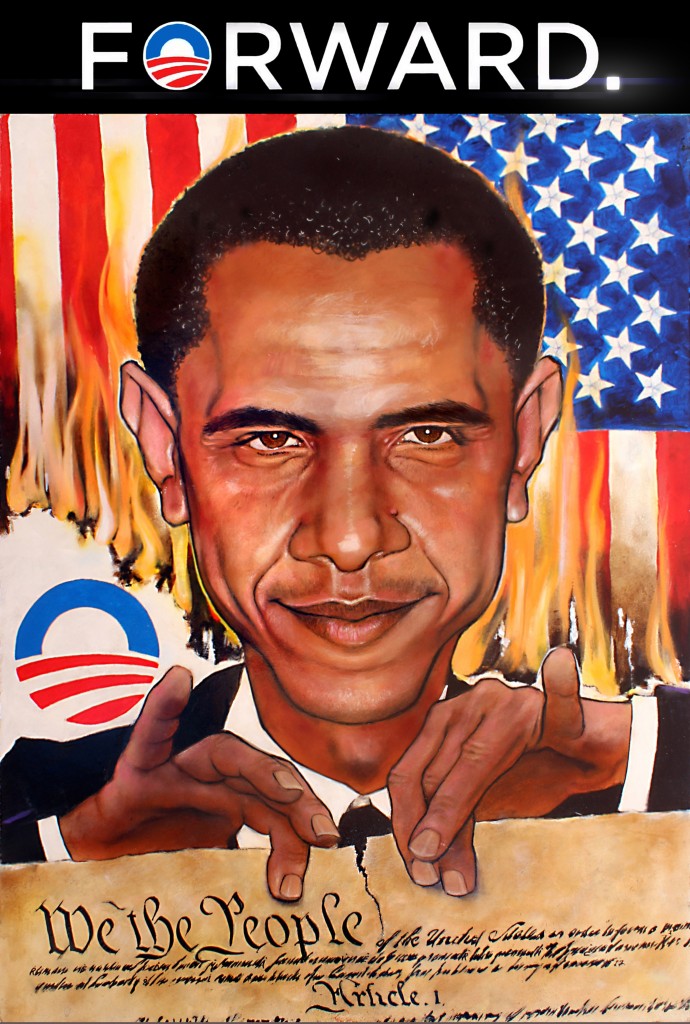
Obama Redefines America’s Founding Principles

By Richard Larsen

Obama Forward SC 690x1024 Obama Redefines Americas Founding Principles

Historically, Presidential Inaugural Addresses have sought to inspire and unite the nation and provide directional leadership for the next presidential term. Perhaps to some, Monday’s speech did that. But to adherents of American exceptionalism, it was disconcerting. The president’s speech was laced with references to our founding principles; but their meanings were twisted, misrepresented, and stripped of their historical and definitional significance.

God was mentioned seven times in the address, which may exceed the number of times the Almighty has been invoked by Obama over the past four years, which made their invocation seem superficial. The Constitution was mentioned once, at the very beginning, citing his second term as evidence of its “enduring strength” (in spite of the fact that he has stretched and distorted that document’s limitations on the executive branch beyond recognition of the founding fathers so dramatically during his first term.)

Even the Declaration of Independence was cited along with those eternal classical-liberal ideals of life, liberty, and the pursuit of happiness that led to the severance of our relationship with Great Britain and the perceived tyranny of King George. It was no surprise that he was reticent regarding the breadth and scope of our current federal government, which arguably wields immensely more tyranny over the American people than the British crown held over colonial America.

Even free market economics were mentioned, although it was in the context that the omnipotent and omniscient federal government must constrain and control it.

Clearly, through artistry and manipulation, precept-by-precept, the principles upon which the American republic was established were being redefined. Those tenets, which are distinctly and singularly American, which once were the pillars that the nation stood upon, were going through a historical revision right before our eyes. They were being reframed, redefined, and reshaped to fit a new progressive lexicon of American patriotic buzzwords that vitiate their original meanings.

The Constitution seems to have relevance since it returned him to power for another four years. But in terms of governance, it seems that to him, it has lost its applicability to 21st century American politics since he can issue Executive and Administrative Orders that circumvent the very document he moments earlier swore he would uphold and defend.

God has no relevance in the godless, morally relativistic, and warped values of the ideology that seeks to make omnipotent government the central component in every American life, replacing an omnipotent deity. As the president’s campaign website so proudly portrays with its “Life of Julia”, the government is to be there at every turn and juncture in the life of the average American: governing, regulating, “helping,” and “supporting.”

And perhaps most invidious of all, Obama presented a perverted sense of “liberty.” No spurious redefinition of liberty could be more antithetical to the founder’s intent than “being true to our founding documents … does not mean we all define liberty in exactly the same way.”

In any language and any culture, liberty is synonymous with freedom. Not just a freedom “to,” as in “to do something,” but also a freedom “from,” as in freedom from control, repression, and tyranny. Each time liberty or freedom were mentioned, the words rang increasingly hollow and meaningless. For freedom to, and freedom from, have an inverse relationship to government growth, government power, and government control, which have dramatically increased over the past four years.

With each incremental Executive Order or legislative Act that broadens and expands central governmental authority, and with every dollar taken out of the pockets of Americans to fund the insatiable spending appetite of government, individual liberty and freedom are disproportionately diminished. As government grows, individual liberty decreases. No wonder, then, that he would frame the concept of individual freedom in the context of “collective action.” The progressive statist agenda is always based on collectivism, not individuality.

It’s difficult to separate the causation, or at least correlation, of the massive expansion of governmental power, and the alarming growth of government debt of the past four years, from the perceived elusiveness of the American Dream. Four years ago, over 52% of Americans still believed the “American Dream” was attainable. That has now dropped to less than 40%, according to pollsters at Zogby.

And regrettably, the perception seems accurate. Between legislative Act, presidential declarations, and bureaucratic regulatory expansion, Investor’s Business Daily now calculates that the government has direct or indirect control of more than 60% of the entire U.S. economy. Energy production, oil production and distribution, banking and finance, manufacturing, logging, mining, health care, insurance, automobile manufacturing, and more are all now controlled by the central government. A strict political classification of such an economy is clearly fascistic, where government controls, not necessarily owns, the means of production. Individual and collective freedoms are sacrificed when government wields so much power over the entire economy.

Clearly typifying the moral relativism of our dysfunctional culture, the phrase “We cannot mistake absolutism for principle” perverts the very meaning of principle. After all, a principle is  “a fundamental truth or proposition that serves as the foundation for a system of belief or behavior or for a chain of reasoning.” As such, a principle is definitionally absolute. When they are no longer absolute, they are no longer principles; they’re simply good ideas. Such facile application of relativism to fundamental tenets like individual freedom and liberty diminishes the principled foundation of our republic.

The implications for the next four years are indeed ominous if this Inaugural Address represents the ideologically tortured state of our founding principles. With fundamental precepts marginalized through redefinition, token relevance accorded the Constitution, and free markets only viable with governmental control of the means of production, we are well on our way to the president’s desired “fundamental transformation of America.”

AP award winning columnist Richard Larsen is President of Larsen Financial, a brokerage and financial planning firm in Pocatello, Idaho, and is a graduate of Idaho State University with a BA in Political Science and History and former member of the Idaho State Journal Editorial Board.  He can be reached at rlarsenen@cableone.net.

Photo credit: Dave Merrick

Source: FULL ARTICLE at Western Journalism