Tag Archives: ADP

Dow Falls on Weak Economic News

By Jessica Alling, The Motley Fool

Filed under:

Another record high for the Dow Jones Industrial Average was hit yesterday, as the index rallied following positive news from the automotive sector and factory sales data. But just as quickly, the index has lost 62 points so far this morning on disappointing economic news. With the Dow continuing to climb to new heights on any given day, it’s clear that investors are keeping a close eye on news reports and balk at any sign that there may be trouble in the water.

First up this morning was the ADP private-sector payroll report for March. The report showed that job growth slowed considerably from February’s surge of 237,000 jobs, with only 158,000 new jobs added. This also missed the consensus estimate of 197,000 new jobs. March was the slowest month since October, mainly due to a decrease in hiring by construction companies, which had been adding new jobs at a rate of 29,000 per month.

Next was the ISM non-manufacturing index data — and though analysts had expected a decrease, March numbers came in at a five-month low. Dropping to 54.4 from 56.0 in February, March’s results came in far below expectations of 55.8. A result above 50 still signals an expanding economy, but any sign of slowing can give investors serious concerns.

Financials fall
As the Dow dropped this morning, the financial sector was right there with it. One of the most scrutinized sectors in the market, financials are used to the fluctuations caused by investor uncertainty. Bank of America is certainly no stranger to sudden drops, including this morning’s 2.88% fall so far. Due to the bank’s large trading volume, it is extremely volatile and susceptible to big swings. On top of this morning’s economic disappointment, the bank is dealing with some investor pushback from its continued legal battles. B of A will be paying $165 million in a settlement over its sale of mortgage-backed securities that led some corporate credit unions to fail. Though the settlement will be covered by the bank’s existing legal reserves, continued court battles only bring the financial crisis back into the minds of investors, leading to negative sentiment toward the company.

JPMorgan is on a similar path this morning, down 2.07% so far in trading. Much like Bank of America, JPMorgan is dealing with issues from the past that have reduced its shareholders’ certainty about the bank. With federal investigators putting the full-court press on the bank regarding its London Whale disclosures, it seems that JPM will be under the magnifying glass for quite some time yet. Perhaps more telling for the bank, however, is today’s ex-dividend date. The $0.30 per share dividend will be available to shareholders at the end of the month, and leading up to today’s ex-dividend trading, the stock was climbing higher.

American Express is also sliding this morning. Down 0.87% so far in trading, the personal finance company shares the same ex-dividend date as JPMorgan — …read more
Source: FULL ARTICLE at DailyFinance

3 Numbers Driving Markets This Week

By Travis Hoium, The Motley Fool

Filed under:

Today is the final day of the first quarter, which means earnings season is just around the corner. But before we get there, the market will have its sights set on progress in the labor market, which will drive the market this week. Both the Dow Jones Industrial Average and the S&P 500 are near all-time highs, and a strong jobs report will keep the momentum going, while a weak report could make the markets rethink their bullishness.

The first number I’ll be watching this week is the ADP employment change on Wednesday. This is a private reading of employment, similar to nonfarm payrolls, but it doesn’t match the government reading exactly. Economists are expecting 200,000 jobs to be added, and this should be a preview of the rest of the week.

On Friday, economists expect nonfarm payrolls to increase by 185,000, highlighted by a rise of 210,000 in private payrolls. That’s below the 236,000 jobs created in February, but it’s still a strong reading, considering the challenges facing the U.S. in the first half of this year. For markets, this is a very important reading, because it will drive consumer spending, which accounts for about 70% of our economy. 

At the same time nonfarm payrolls are announced, the government will give us the unemployment rate. Unemployment currently stands at 7.7%, but economists expect a slight increase to 7.8% as more people enter the market. The unemployment rate is probably the most volatile of these three numbers, but it’s psychologically important, because it’s the best indicator of the ease of getting a job. 

Progress in the labor market has been slow but steady, and we’re still trying to get an idea of the impact that higher taxes and lower government spending will have on the economy. These three numbers will give an import progress report.

To learn more about a few ETFs that have great promise for delivering profits to shareholders in a recovering global economy, check out The Motley Fool’s special free report “3 ETFs Set to Soar During the Recovery.” Just click here to access it now.

The article 3 Numbers Driving Markets This Week originally appeared on Fool.com.

Fool contributor Travis Hoium and The Motley Fool have no position in any of the stocks mentioned. Try any of our Foolish newsletter services free for 30 days. We Fools don’t all hold the same opinions, but we all believe that considering a diverse range of insights makes us better investors. The Motley Fool has a disclosure policy.

Copyright © 1995 – 2013 The Motley Fool, LLC. All rights reserved. The Motley Fool has a disclosure policy.

(function(c,a){window.mixpanel=a;var b,d,h,e;b=c.createElement(“script”);
b.type=”text/javascript”;b.async=!0;b.src=(“https:”===c.location.protocol?”https:”:”http:”)+
‘//cdn.mxpnl.com/libs/mixpanel-2.2.min.js’;d=c.getElementsByTagName(“script”)[0];
d.parentNode.insertBefore(b,d);a._i=[];a.init=function(b,c,f){function d(a,b){
var c=b.split(“.”);2==c.length&&(a=a[c[0]],b=c[1]);a[b]=function(){a.push([b].concat(
…read more
Source: FULL ARTICLE at DailyFinance

The Most Talented IT Executives are Advancing Beyond CIO

By Peter High, Contributor

I recently completed a series in this column referring to the CIO-plus. In it, I interviewed a number of chief information officers who had been asked to take on additional responsibilities, due to the great work done as CIOs and the appreciation that that good work translates well into other functions within the company. The companies were a diverse lot, including ADP, P&G, Marsh & McLennan, Waste Management, McKesson, Merck, Walgreens, Owens Corning, and the San Francisco Giants among others.  (To access the entire series, please visit this link.) …read more
Source: FULL ARTICLE at Forbes Latest

Paychex Earnings: An Early Look

By Dan Caplinger, The Motley Fool

Filed under:

Earnings season is just about over, with almost all companies already having reported their quarterly results. But there are still a few companies left to report, and Paychex is about to release its quarterly earnings. The key to making smart investment decisions with stocks releasing their quarterly reports is to anticipate how they’ll do before they announce results, leaving you fully prepared to respond quickly to whatever inevitable surprises arise. That way, you’ll be less likely to make an uninformed knee-jerk reaction to news that turns out to be exactly the wrong move.

With the U.S. economy having suffered from consistently high unemployment for years, Paychex has faced tough conditions for its payroll and HR services business. But the company has done a good job of holding up well despite those employment headwinds. Let’s take an early look at what’s been happening with Paychex over the past quarter and what we’re likely to see in its quarterly report on Wednesday.

Stats on Paychex

Analyst EPS Estimate

$0.39

Change From Year-Ago EPS

5.4%

Revenue Estimate

$592.6 million

Change From Year-Ago Revenue

4.1%

Earnings Beats in Past 4 Quarters

1

Source: Yahoo! Finance.

Will Paychex hire some better numbers this quarter?
Analysts have been reasonably secure in their estimates of Paychex’s earnings in recent months, reducing their call for the just-ended quarter by a penny per share but keeping their full 2013 fiscal year estimates unchanged. The stock has risen almost 10% since mid-December.

Over the years, Paychex has benefited from what Fool contributor Brian Stoffel recently called the “stickiness effect.” Once a client signs up with Paychex, it becomes difficult to switch to another provider or to give up the service entirely. That’s a big part of why Paychex and rival Automatic Data Processing have divided up the industry the way they have, with ADP gravitating toward bigger corporate customers and Paychex picking up a lot of medium-sized and small business customers.

But Paychex has faced new competition from Intuit , which has successfully leveraged the popularity of its Quickbooks and TurboTax software packages among small-business owners to try to cross-sell its Intuit Online package of payroll and invoicing software. Given Intuit’s long history of innovative products and expansion into new areas, it may be Paychex’s biggest threat.

One area where Paychex could see improvement is in retirement plan administration. With more employers moving to auto-enrollment for 401(k) plans, plan administrator Aon Hewitt hopes to see business pick up. Paychex also plays a role in that area, and a pick-up in small-business participation in providing retirement plans to workers could disproportionately help Paychex over its rivals.

In its quarterly report, watch Paychex not just for its own earnings but for the state of employment in the U.S. economy generally. If things are looking up for Paychex, they could be getting more favorable for the entire nation.

<p …read more
Source: FULL ARTICLE at DailyFinance
Sirius XM Is a Used-Car Salesman

By Rick Munarriz, Munarriz, The Motley Fool

Filed under:

Sirius XM Radio sees the future of used cars, and there will be more lemonade than lemons.

The satellite radio giant’s CFO spoke at Piper Jaffray Technology, Media and Telecommunications Conference yesterday, and David Frear is encouraged by the potential of secondhand cars.

It remains an untapped market for the company, especially as more and more used cars hit the market with preinstalled Sirius or XM receivers.

There are 50 million cars with satellite radios at the moment, and more than half of those receivers are dormant. In 10 years, Frear sees 150 million vehicles out there with receivers. There’s a big opportunity here for Sirius XM to grow its reach, especially as cars get passed along.

Data suggests that just 30% of automobile transactions are for new cars. Sirius XM has a strong presence in the new-car market, but that’s just 15 million of the 50 million cars that are being exchanged every year. Sirius XM has teamed up with its auto partners to offer free trials to buyers of certified pre-owned cars, but that’s just a 5% sliver of the market.

Sirius XM is starting to get aggressive.

Back in November, Sirius XM announced a deal with Automatic Data Processing subsidiary Digital Motorworks to reach out to more used-car showrooms. The partnership allows the more than 7,000 dealerships doing business with Digital Motorworks to offer car buyers three free months of Sirius XM service.

Sirius XM has a lot to gain through this deal with ADP‘s data intermediary. Unlike new cars where Sirius XM has to subsidize the receiver, acquisition costs for subscribers buying used cars with receivers already installed is substantially less.

One might imagine that used-car buyers are less reluctant to pay for satellite radio, but Frear argues that those who convert do stick around. There is no difference in the churn rate between subscribers in new cars and old cars. There is naturally a higher churn rate for those paying month by month instead of annually — and one can argue that used-car buyers are more likely to be living month by month — but generally the churn levels are the same for new and used cars.

Data can be surprising that way.

Frear was asked toward the end of the presentation if the buyers of new cars that seamlessly allow smartphone owners to stream Pandora through their dashboards convert at a lower rate than buyers of more conventional cars. Critics have argued that Sirius XM is a transitory technology and Pandora — with its growing user base — will begin to eat into Sirius XM as it becomes more accessible on the road.

Well, Frear surprised the audience by pointing out that conversion rates have clocked in higher for high-tech cars. He was puzzled by the data at first, but his theory is that the kind of early adopter that wants that kind of dashboard technology is already consuming across multiple channels. They …read more
Source: FULL ARTICLE at DailyFinance

Hereditary neurodegeneration linked to ADP-ribose modification

Attaching chains of the small molecule ADP-ribose to proteins is important for a cell’s survival and the repair of DNA damage, making this process a promising target for the development of new cancer drugs. Researchers have now identified a much sought after enzyme that removes such ADP-ribose modifications from proteins by studying a genetic mutation that causes neurodegenerative disease in humans. These findings, published today in The EMBO Journal, suggest that not only addition but also removal of ADP-ribose from proteins is essential for normal cell function. …read more
Source: FULL ARTICLE at Phys.org

CAPScall of the Week: Clovis Oncology

By Sean Williams, The Motley Fool

Filed under:

For years, satirical late-night TV host Stephen Colbert has been running a series on his show called “Better Know a District,” which highlights one of the 435 U.S. congressional districts and its representative. While I am no Stephen Colbert, I am brutally inquisitive when it comes to the 5,000-plus listed companies on the U.S. stock exchanges.

That’s why I’ve made it a weekly tradition to examine one seldom-followed company within the Motley Fool CAPS database, and make a CAPScall of outperform or underperform on that company.

For this week’s round of “Better Know a Stock,” I’m going to take a closer look at Clovis Oncology .

What Clovis Oncology does
As Clovis’ name would imply, there’s no smoke-and-mirror tricks here regarding what it does: It’s a biotechnology company engaged in researching anti-cancer compounds. It has three compounds currently in its pipeline: CO-1686 — which is an oral phase I/II epidermal growth factor receptor, or EGFR, inhibitor for the treatment of non-small-cell lung cancer, or NSCLC — that it’s partnered with Roche in developing; Rucaparib — which is a poly ADP-ribose polymerase, or PARP, inhibitor in phase I/II trials for ovarian and breast cancer; and a preclinical cKIT inhibitor for gastrointestinal stromal tumors that it’s partnered with Array BioPharma on.  

In Clovis’ most recently ended fourth quarter, it reported a loss of $21.1 million compared to a loss of just $14.9 million in the year-ago period as its total cash level rose modestly to $144.1 million from the $140.2 million it ended with in 2011.

Whom it competes against
This is one of those cases where I say there are a ton of competitors in NSCLC, but few that target the T790M mutation that CO-1686 is being developed to treat. In fact, there are no FDA-approved treatments to specifically target the mutation at the moment. However, that may change very shortly as Boehringer Ingelheim does have an experimental drug known as Afatinib under an accelerated FDA review for EGFR mutation-positive NSCLC. With Clovis still early in its development, Afatinib could have a chance to clean up before CO-1686 even gets to late-stage enrollment.

Something similar can be said for Clovis’ competition in breast cancer with regard to PARP inhibitors. However, unlike with NSCLC, advancements in PARP inhibitors are still very slow, so a drug like Rucaparib that is still being studied in phase 1 trials has just as much chance of success as AbbVie‘s Veliparib, which is being tested as a combination PARP inhibiting therapy in phase 1/2 trials.

The call
After carefully reviewing Clovis Oncology‘s prospects, I’ve decided to place a CAPScall of underperform on the company for a number of reasons.

The primary reason for my distaste of this recent run relates to its complete failure with CO-101 for metastatic pancreatic cancer. The results from the phase 1/2 trial were noted by CEO Patrick Mahaffy to be “even more ambiguous than we could have imagined,” as CO-101 was …read more
Source: FULL ARTICLE at DailyFinance

The Top 3 Stocks in the Dow's Record Week

By Travis Hoium, The Motley Fool

Filed under:

It was a record-setting week for the Dow Jones Industrial Average , which set new highs on its way to a 2.18% gain this week. The S&P 500 kept pace by moving 2.17% higher as well. Stronger-than-expected employment data from ADP and the Department of Labor had investors in a good mood all week, and it appears higher payroll taxes and the recent sequester haven’t dampened the private sector.

Bank of America led the Dow with a 6.4% jump this week. The company rallied ahead of the Federal Reserve’s stress test results, which were released midweek, and then cooled off after the company passed the first round. There’ll be another round of tests released this week, and the Fed will then decide whether Bank of America and other big banks will be able to increase their dividends or buy back shares. That’s the big carrot for investors, so there may be room for the stock to move higher in the coming weeks.

Boeing jumped 5.1% as investors bet that the company will soon resume test flights of the 787 Dreamliner. The National Transportation Safety Board still hasn’t determined the cause of the Dreamliner fire, but investors are looking past that to better days right now, believing that the worst is behind Boeing. Customers certainly haven’t lost faith in Boeing since the 787 problems. The company disclosed $4 billion in new orders on Thursday, and if the 787 gets off the ground soon, the stock could continue to fly.  

Rounding out the top three this week is Cisco Systems , which was up 4.8%. Tech stocks have been lagging the Dow’s gains in recent months, and with a ton of cash and a low valuation, it’s about time Cisco had a good week. The company didn’t release any earth-shattering news, but falling unemployment and a slow-growing economy have given investors confidence that tech companies will be able to grow and may even have good uses for their cash hoards. Cisco trades at 10.4 times forward earnings estimates and pays a 2.7% dividend — a great value in today’s market.

Cisco is now on the radar of value-oriented dividend lovers. Get the lowdown on the routing juggernaut in The Motley Fool’s premium report. Click here now to get started.

var FoolAnalyticsData = FoolAnalyticsData || []; FoolAnalyticsData.push({ …read more
Source: FULL ARTICLE at DailyFinance

This Stock Is Leading the Dow's Rise

By Dan Dzombak, The Motley Fool

US Change in Nonfarm Payrolls Chart

Filed under:

The Dow Jones Industrial Average is up following a far-better-than-expected jobs report from the Department of Labor. As of 1:10 p.m. EST, the Dow is up 37 points, or 0.26%, to 14,367. The S&P 500 is up 0.23% to 1,548.

There were two U.S. economic releases today.

Report

Period

Result

Previous

Nonfarm payrolls

February

236,000

119,000

Unemployment rate

February

7.7%

7.9%

Source: MarketWatch U.S. Economic Calendar.

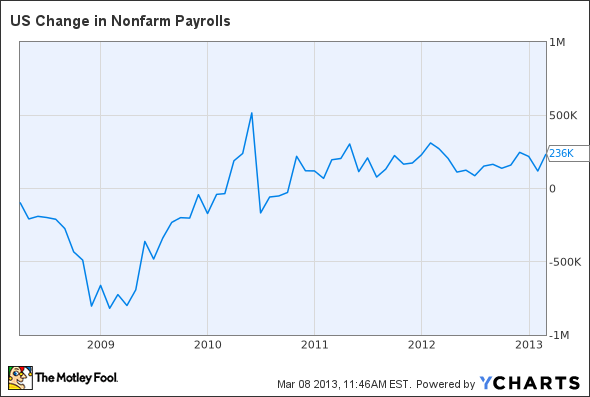
This morning, the Department of Labor reported that nonfarm payrolls grew by 236,000 in February and the unemployment rate fell from 7.9% to 7.7%, led by job gains in professional and business services, construction, and health care. Nonfarm payrolls include both public and private-sector jobs but do not include farming jobs. Both these numbers were better than economists had expected at the start of the week and above the three-month average jobs growth of 195,000. Following January‘s low jobs growth of just 119,000, economists were expecting jobs growth of 160,000 and an unchanged unemployment rate of 7.9%.

US Change in Nonfarm Payrolls data by YCharts.

While the jobs report smashed economists’ expectations from earlier this week, payroll processor ADP released its private-sector payrolls report on Wednesday, showing that private-sector jobs growth was better than expected in February. ADP always releases the report two days before the government report, giving investors a general idea of the employment situation. Therefore today’s positive jobs report was not totally unexpected, hence the markets’ moderate response to the news.

Jobs growth and employment are especially important, as consumer spending makes up 70% of the U.S. economy. Another reason the market is not up higher today is the lower unemployment rate is a bit misleading as it was mainly caused by people leaving the labor market. More and more baby boomers are deciding to retire. The rate of people leaving the jobs market is higher than the number entering which has been the primary reason the unemployment rate has been shrinking.

Today’s Dow leader
Today’s Dow leader is McDonald’s , up 1.6% to $98.64. This morning McDonald’s reported that same-store sales declined 1.5% in February. That’s slightly better than analyst expectations of a 1.6% decline. In November, McDonald’s reported its first same-store sales decline in nine years. This month’s same-store sales decline is not as bad as it looks, as sales last year got a boost from the extra day in February. Excluding the extra day, same store sales would have been up 1.7%.

In February, McDonald’s sales declined the most in the U.S. with a 3.3% drop. Excluding the extra day in 2012, same-store sales in the U.S. were flat. In the Asia-Pacific region, sales were down 1.6%, or up 1.5% excluding the extra day. In Europe and Russia, sales were down just 0.5%, or up 2.7% excluding the extra day. McDonald’s has high hopes for China, where it plans to have 2,000 stores by the end of the year. For comparison, …read more
Source: FULL ARTICLE at DailyFinance

Dow Does It Like a Boss

By Jeremy Bowman, The Motley Fool

Filed under:

The Dow Jones Industrial Average didn’t stop at the finish line. A day after setting breaking the record it set back in 2007, the blue chips added another 42 points, or 0.3%. A strong February employment report from the ADP helped get today’s session started off on the right foot as the payroll processor said 198,000 private-sector jobs were added in February.

While ADP‘s report often differs significantly from the official data from the Labor Department, which is due out on Friday, the numbers were better than the expected total of 150,000 and conform with the market‘s belief that the employment picture is improving despite an unemployment rate still near 8%.

The Fed’s summary of economic conditions, or its beige book as it’s known, was also released this afternoon. The report showed that the economy expanded all 12 of the central bank’s regions in January and February, though a variety of factors, including the payroll tax increase, the new health-care law, and the prospective budget cuts dampened the growth. The market seemed mostly ambivalent as shares traded within a narrow range following the release.

Bank of America was the Dow’s strongest performer on the day, benefiting from the strong jobs report and the Fed’s mostly positive assessment of the economy. B of A is also awaiting the results of the Federal Reserve‘ stress tests due out tomorrow. Investors seem to be optimistic, as my colleague John Maxfield explains here. Passing the Fed’s tests would allow the bank to raise its quarterly dividend, which currently stands at just a penny, despite the bank’s return to profitability.

Microsoft was absent from today’s rising tide, falling 0.9% after getting fined $731 million by the European Union because it did not provide a web browser choice screen in its new Windows 7 operating system, steering users toward its own Internet Explorer. The sum is negligible for a company worth over $230 billion, but could be a sign of other monopoly abuses across the Atlantic as well as of its need to bend the rules to hold market share.

Elsewhere in the tech world, Dell got another jolt today, rising 1.8% late in the session after news broke that activist investor Carl Icahn has reportedly amassed a 6% stake in the PC maker and plans to oppose the leveraged buyout the board agreed to in January. The vote of confidence from Icahn comes fresh off his big win after backing Netflix and likely has shareholders thinking there may be similar hidden value in Dell.

Bank of America’s stock doubled in 2012. Is there more yet to come? With significant challenges still ahead, it’s critical to have a solid understanding of this megabank before adding it to your portfolio. In The Motley Fool’s premium research report on B of A, analysts Anand Chokkavelu, CFA, and Matt Koppenheffer, Financials bureau chief, lift the veil on the bank’s operations, including detailing three reasons to buy …read more
Source: FULL ARTICLE at DailyFinance

Dollar rises a day after Dow hits record

The dollar is risings against most major currencies a day after the Dow Jones industrial average closed at an all-time high. Traders also bought the dollar following positive signs on the U.S. job market.

The euro fell to $1.2990 in midday trading from $1.3040 late Tuesday. The British pound fell to $1.5035 from $1.5115.

The Dow closed Tuesday at 14,253.77, beating the previous closing record by nearly 90 points.

Payroll processor ADP says private employers added 198,000 jobs in February. The figure suggests that Friday’s February jobs report from the U.S. government may come in above economists’ forecasts.

The dollar rose to 93.65 Japanese yen from 93.29 Japanese yen and 0.9470 Swiss franc from 0.9417 Swiss franc.

…read more
Source: FULL ARTICLE at Fox US News

Stocks Close Even Higher Following Dow's Record Day

By The Associated Press

U.S. futures head higher; Dow set to extend record

Filed under: , , ,

By MATTHEW CRAFT

NEW YORK — After barreling through a record the day before, the Dow Jones industrial average meandered higher on Wednesday.

The Dow edged up 42.47 points, or 0.3 percent, to close at 14,296.24. An encouraging job-market report helped nudge the stock market up and pushed bond prices lower.

On Tuesday, the Dow blew past the previous all-time high it hit more than five years ago. The index of 30 big corporations has more than doubled since hitting a low during the financial crisis in March 2009.

The question now is, how much longer can it keep climbing?

In the past, stock indexes have often drifted lower in the months after breaking through record highs. David Brown, director of Sabrient Systems, an investment research firm, sees plenty of reasons for the market to keep climbing, however. People are putting their cash into the stock market again. And the alternatives, like bonds, are hardly appealing.

“There is literally nowhere else to go,” Brown said. “Do you really want to make 1.9 percent on a 10-year Treasury? You won’t make any money doing that.”

In other trading, the Standard & Poor’s 500 index rose 1.67 points, or 0.1 percent, to 1,541.46. The Nasdaq slipped 1.77, less than 0.1 percent, to 3,222.36.

Microsoft (MSFT) led a decline in tech stocks, losing 26 cents to $28.09. European regulators fined the company for breaking an antitrust agreement requiring the software giant to offer computer users a choice of Internet browsers, instead of just Internet Explorer.

Sponsored Linksadsonar_placementId=1505951;adsonar_pid=1990767;adsonar_ps=-1;adsonar_zw=242;adsonar_zh=252;adsonar_jv=’ads.tw.adsonar.com’;

Companies added 198,000 U.S. workers to their payrolls in February, according to payment processor ADP. The firm also said employers added 23,000 more jobs in January than first reported.

The ADP survey suggests that government spending cuts have yet to deter employers from hiring. Investors look to the ADP survey as a preview to the closely watched Labor Department report, which comes out Friday. Economists expect the government to say employers added 152,000 jobs in February, lowering the unemployment rate to 7.8 percent from 7.9 percent.

As traders anticipated better news about the job market, bond prices fell and the yield on the 10-year Treasury rose to 1.93 percent from 1.90 percent late Tuesday.

Expectations of a stronger economy tend to lure traders out of Treasurys and into investments that tend to rise with economic growth, like stocks.

Over the long haul, stock markets head higher, but the path is rarely smooth. In October 2007, the Dow hit its previous high of 14,164. A year later, the country was in the middle of a financial crisis and the Dow was in free fall. In January 1987, the Dow closed above 2,000 for the first time, then hit a record of 2,722 in August. Two months later, the Dow had plunged 36 percent from its peak, including …read more
Source: FULL ARTICLE at DailyFinance

3 Stocks Leading the Dow to New Heights

By Travis Hoium, The Motley Fool

Filed under:

The Dow Jones Industrial Average continues to blow past all-time highs, having briefly reached 14,321 this morning. The market fell slightly as the day went on, and as of 3:15 p.m. EST the Dow is up 0.35%.

The market was driven higher by better-than-expected employment data. According to payroll company ADP, the U.S. added 198,000 jobs during February and added 23,000 more in January than originally estimated. Analysts only expected 175,000 jobs to be added in February, so this was a significant beat.

Bank of America is charging 3.5% higher today. The megabank tends to jump when positive economic data is released, but investors are also speculating that tomorrow’s stress-test results will show a bank healthier than it was a year ago. This could lead to an increased dividend, which investors would love to hear in the next few months.

Hewlett-Packard leads the Dow with a 3.6% gain after it signed a deal with Teradyne for networking solutions. Teradyne expects the deal to speed up development of new testing products, which is data-intensive. At this point any good news is great for HP, and the improving economy gives the company a larger pool of customers to draw from.

Alcoa rounds out the top three, gaining 3.2% for the day. Alcoa was down last week on fear that China would slow down, but now it’s spiking on hope for the U.S. economy. The stock can be volatile based on economic news, but with the U.S. economy growing gradually, investors looking to buy Alcoa can get in when the stock drops and then take advantage of days like today.

Materials industries are traditionally known for their high barriers to entry, and the aluminum industry is no exception. Representing 14.7% of 2011 global production in this highly consolidated industry, Alcoa is in prime position to take advantage of growth that some expect will lead to total industry revenue approaching $160 billion by 2017. Based on this prospective and several other company-specific factors, Alcoa is certainly worth a closer look. For a Foolish investment perspective on this global giant, simply click here to get started.

var FoolAnalyticsData = FoolAnalyticsData || []; FoolAnalyticsData.push({ eventType: “TickerReportPitch”, …read more
Source: FULL ARTICLE at DailyFinance

Bullish On Jobs After ADP Report? Watch Out For Winter Storm Nemo And Soft Retail Sales

By Agustino Fontevecchia, Forbes Staff

The private sector added 198,000 jobs in February, according to the ADP report, which is a notoriously bad forward indicator for Friday’s all-important nonfarm payroll numbers released by the Bureau of Labor Statistics.  Regardless, analysts at Nomura and Barclays believe the underlying strength in ADP’s report, which showed solid gains in construction and the service sector, are good omens, indicating there is upside risk to consensus expectations for Friday. …read more
Source: FULL ARTICLE at Forbes Latest

HP's Surge Leads the Dow to a New All-Time High

By Dan Dzombak, The Motley Fool

ADP Change in Nonfarm Payrolls Chart

Filed under:

The Dow Jones Industrial Average is making moderate gains following two better-than-expected economic reports. As of 1:20 p.m. EST, the Dow is up 39 points, or 0.27%, to 14,287. The S&P 500 was up just 0.1% to 1,541.

There were two U.S. economic releases today.

Report

Period

Result

Previous

ADP private-sector jobs

February

198,000

215,000

Factory orders

January

(2%)

1.3%

Source: MarketWatch U.S. Economic Calendar.

First up, payroll processor ADP reported that the private sector added 198,000 jobs in February. That’s down slightly from January’s addition of 215,000 jobs but above analyst expectations of 175,000. ADP‘s report always comes out two days before the government‘s nonfarm payrolls report, which will be released on Friday. The government‘s report includes both private and public jobs data. Economists expect the government‘s report to show jobs growth of just 160,000 and no change in the unemployment rate, which sits at 7.9%.

ADP Change in Nonfarm Payrolls data by YCharts.

The second economic release came from the Department of Commerce, which reported that factory orders dropped 2% in January. That’s below December’s 1.3% growth but better than analyst expectations of a 2.2% drop. Factory orders include both durable and nondurable goods. Last week the advance report on durable-goods manufacturers showed that durable-goods orders dropped 5.2% in January. This led analysts to lower their expectations for the factory goods report. However, the initial report from the Department of Commerce was slightly too dour, as the drop in durable-goods orders was revised upward to a 4.9% drop for January.

Today’s Dow leader
Today’s Dow leader is Hewlett-Packard , up 3.6% to $21.10. HP is leading the Dow higher for the second day in a row. Yesterday the company announced that it was selected by Teradyne “to improve operational efficiency, reduce network downtime and boost design-phase efficiency for new products” by using HP‘s FlexNetwork architecture. While this is a small victory, it shows that HP can continue to innovate and win contracts in the hotly contested networking and enterprise-storage space.

Public-facing wins are a must, as Hewlett-Packard is undergoing a turnaround under new CEO Meg Whitman. Three members of the company’s board came under fire yesterday from proxy advisory firm ISS, which recommended that investors vote against re-electing Chairman Ray Lane, head of the audit committee; G. Kennedy Thompson; and John Hammergren, the head of the finance and investments committee. All three were in their positions in August of 2011 when HP paid $10.3 billion for Autonomy, which later earned HP a massive $8.8 billion writedown. While HP is alleging fraud by Autonomy’s executives, this was the second $8 billion-plus writedown of a recent acquisition by HP in 2012. Meg Whitman certainly has her work cut out for her.

The question remains: Is HP one of the least appreciated turnaround stories on the market, or is this a minor detour on its road to irrelevance? The Motley …read more
Source: FULL ARTICLE at DailyFinance

ADP Benchmark Revision Adds Over 600K Private Sector Jobs

By Karl Smith, Contributor

ADP released its new benchmark series today. The headline number has private sector jobs growing at a strong 200K clip in January, but dramatically from our perspective, the entire series is moved up by over 600K. Notice also how the blue line had US private sector job growth decelerating after March  2011 – the BLS benchmark date that ultimately benchmarks ADP as well. Now the red line has US job growth decelerating after March 2012. This is the tell-tale sign of a set of series which remains behind the curve and repeatedly tells us it was “most off trend” on the very date it was hand checked against the data. It is unlikely that the strongest outlier also happens to be the most robust data point. More likely is that your estimation procedure is biased downward. Of course, I mean bias here in a strictly statistical sense and not in any sociological or psychological sense. We should expect that the strong trend moving through the beginning of 2012 is eventually revised into a straight-ish line probably adding another half a million or so jobs to our 2012 estimates. …read more
Source: FULL ARTICLE at Forbes Latest

ADP Payrolls Gains May Adjust Labor Department Payrolls Higher

By 24/7 Wall St.

business meeting

Filed under: ,

It was just on Tuesday that we showed how so many jobs reports are coming out this week that could change the consensus for Friday’s key unemployment and payrolls report from the Labor Department. The first on the list was the ADP private payrolls report for February and that number has been released.

ADP reported that its index of payrolls shows that some 198,000 payrolls were added in the month of February. Dow Jones was calling for 175,000 and Bloomberg had a consensus of 173,000. The range was 140,000 to 210,000 from Bloomberg. That being said, this number was quite a bit higher on the surface, but it was not such a blowout that it surpassed all the economist targets. ADP revised its January report up by 23,000 to 215,000.

We would caution that the report is seasonally adjusted, and we would point out that ADP is often considerably off the mark. It is one of the newer labor stats that is meant to front-run the full Labor Department report on Friday.

Bloomberg is calling for 171,000 nonfarm payrolls and 195,000 private sector payrolls. Its consensus is for the official unemployment rate to drop by 0.1% down to 7.8%.

Filed under: 24/7 Wall St. Wire, Economy, Labor, Labor & Unions

Read | Permalink | Email this | Linking Blogs | Comments

…read more
Source: FULL ARTICLE at DailyFinance

U.S. Futures Head Higher; Dow Set to Extend Record

By The Associated Press

U.S. futures head higher; Dow set to extend record

Filed under:

NEW YORK (AP) – Stock futures are rising ahead of new jobs and manufacturing data expected to show that companies continue to bring more workers on board and businesses are ramping up factory orders to meet demand.

The Dow rode a triple-digit gain into the history books this week and appears ready to do it again Wednesday.

Dow Jones industrial futures are up 49 points to 14,282. S&P futures have added 5.7 points to 1,542.80. Nasdaq futures are up 6.5 points to 2,805.75.

The February job growth report from payroll processor ADP is expected to show employers added 170,000 jobs in the private sector in February.

A more revealing peak into the health of the job market arrives Friday, when the Department of Labor releases its February report. Economists expect the U.S. added 152,000 jobs.

Permalink | Email this | Linking Blogs | Comments

…read more
Source: FULL ARTICLE at DailyFinance

Dow Poised for New Highs as Staples and Big Lots Beat the Street

By Roland Head, The Motley Fool

Filed under:

LONDON — Stock index futures at 7 a.m. EST indicate that the Dow Jones Industrial Average may continue its record-breaking run and open up by 0.31% this morning, while the S&P 500 may open 0.34% higher. Yesterday’s all-time high helped drive a big improvement in sentiment, and the CNN Fear & Greed Index swung higher to close at 71, up from a previous close of 60.

Today’s economic reports begin at 8:15 a.m. EST with the latest ADP employment figures, which are expected to show that 175,000 new private-sector jobs were created in February, down from 192,000 in January. At 10 a.m. EST, January’s factory-order data is expected to show a 2.2% fall in orders during the first month of 2013 following a 1.8% increase in December 2012. Finally, at 2 p.m. EST, the latest Federal Reserve Beige Book will provide further insight into the state of the economy.

In an earnings release this morning, Staples beat analysts’ expectations with adjusted Q4 earnings of $0.46 per share, ahead of consensus forecast for $0.45. The office supplies company also announced a 9% increase to its quarterly dividend. However, including one-time charges, Staples earned just $0.12 per share, and the company gave downbeat guidance for 2013. Shares are down 5.2% in premarket trading.

Big Lots also beat expectations, reporting fourth-quarter adjusted earnings of $2.09, ahead of consensus estimates of $1.99 per share. Other companies expected to release quarterly earnings before the markets open this morning include American Eagle Outfitters, Fresh Market, and Hovnanian Enterprises, while PetSmart is due to report earnings after the closing bell tonight.

European markets
Most markets were broadly unchanged in Europe this morning as investors took stock of recent gains and awaited further developments in Europe — particularly in Italy, where a new government has still not been formed following the country’s recent elections.

At 7:30 a.m. EST, the DAX was up 1%, the CAC 40 was up 0.15%, the FTSE MIB was up 0.1%, and the IBEX 35 was up 0.34%. In London, the FTSE 100 was up 0.28%, led by telecom heavyweight Vodafone , which surged 6.8% higher after Bloomberg reported last night that the firm has been in discussions with Verizon over a possible merger. The report suggested that merger discussions had failed, leaving a sale to Verizon of Vodafone’s 45% stake in Verizon Wireless as a more likely option.

If you’re looking for shares that can outperform the wider market, you need to look beyond the news headlines. This free Motley Fool report, “The Top Growth Share For 2013,” highlights a share that gained 38% in 2012, during which time the wider market rose just 6%. The company is a household name, and its earnings per share have risen by 44% since 2009 — so click here now to download your free copy of this report while it is still available.

The article Dow Poised for New …read more
Source: FULL ARTICLE at DailyFinance

1 Sector Making the Dow's Rise Look Easy

By Jessica Alling, The Motley Fool

Filed under:

One might have expected that reaching a new market milestone would incite some caution. But after setting a new all-time high with its close last night, the Dow Jones Industrial Average is still headed skyward. Breaking through the 14,300 mark in early trading, the index is still poised 28 points above yesterday’s close as of 11:55 a.m. ET. Perhaps news of the Dow’s record-breaking climb has finally brought back some investors who lacked confidence in the market.

Positive economic news continued this morning with the ADP jobs report, which showed steady improvement in private-sector job growth. Though the 150,000 jobs added in February was the lowest amount since October, it beat analyst expectations. Small businesses generated the most new positions, adding 77,000 jobs.

1 sector to rule them all
If you look at how the 30 Dow components are doing today, you’ll see a very clear pattern: Tech is up. Hewlett-Packard is leading the way this morning, up 3.14%. The computer-manufacturer held a webcast last night highlighting its new big-data software product, Vertica. The company’s product works in a “columnar” form, allowing queries to work against multiple data points at the same time, producing faster retrieval for analysis than a traditional relational database approach. In its infrastructure business, HP is adding new Texas Instrument ARM server processor options into its new “Project Moonshot” hyperscale servers — a big blow to Intel , which continues to fight for marketshare against ARM processors.

Despite HP‘s new plans for its Moonshot servers, Intel is up this morning by a solid 0.7%. The tech giant recently announced a new technology, DAAS, or Display as a Service, which may change the way people use their tech products. The service will disconnect the hardwire between a video source and the display, allowing people to view their phones or tablets on their big-screen TVs.The technology may also allow multiple devices to be linked to the same display. Intel has also announced that Chinese smartphone manufacturer ZTE will be using its new Atom Z2580 platform for its newest phone line.

Cisco Systems is also up 1.29% so far in trading. The network giant is one of the tech companies teaming up with European lawmakers to help improve technology training for the European workforce. With unemployment in Europe hitting new highs, it is important for workers to beef up their training for increasingly tech-centered jobs. Other Cisco news from Europe comes from Belgian cable company Telenet, which announced that it will be using Cisco’s Videoscape Snowflake user interface to provide increased user function for customers browsing through its available content.

Outside of tech
One company that doesn’t fit today’s trend is Bank of America . The bank is moving ever closer to the Fed’s release of its stress-test results, and many analysts are confident that BAC will pass with flying colors. If that is the case, investors may be trying to jump on board before the …read more
Source: FULL ARTICLE at DailyFinance