Tag Archives: Peter Lynch

It's Showtime for Mercer International

By Seth Jayson, The Motley Fool

Filed under:

Mercer International (NAS: MERC) is expected to report Q1 earnings on May 2. Here’s what Wall Street wants to see:

The 10-second takeaway
Comparing the upcoming quarter to the prior-year quarter, average analyst estimates predict Mercer International‘s revenues will drop -6.4% and EPS will compress 0.0%.

The average estimate for revenue is $268.8 million. On the bottom line, the average EPS estimate is $0.01.

Revenue details
Last quarter, Mercer International recorded revenue of $248.5 million. GAAP reported sales were 17% lower than the prior-year quarter’s $300.9 million.

Source: S&P Capital IQ. Quarterly periods. Dollar amounts in millions. Non-GAAP figures may vary to maintain comparability with estimates.

EPS details
Last quarter, non-GAAP EPS came in at -$0.18. GAAP EPS were -$0.12 for Q4 against -$0.04 per share for the prior-year quarter.

Source: S&P Capital IQ. Quarterly periods. Non-GAAP figures may vary to maintain comparability with estimates.

Recent performance
For the preceding quarter, gross margin was 16.4%, 420 basis points better than the prior-year quarter. Operating margin was 3.8%, 250 basis points better than the prior-year quarter. Net margin was -2.7%, 190 basis points worse than the prior-year quarter.

Looking ahead

The full year’s average estimate for revenue is $1.12 billion. The average EPS estimate is $0.54.

Investor sentiment
The stock has a four-star rating (out of five) at Motley Fool CAPS, with 150 members out of 164 rating the stock outperform, and 14 members rating it underperform. Among 33 CAPS All-Star picks (recommendations by the highest-ranked CAPS members), 32 give Mercer International a green thumbs-up, and one give it a red thumbs-down.

Of Wall Street recommendations tracked by S&P Capital IQ, the average opinion on Mercer International is hold, with an average price target of $8.00.

The rich are different than you and me: They might not notice the moneymaking stories right under our noses. In our new report, “Middle-Class Millionaire-Makers: 3 Stocks Wall Street‘s Too Rich to Notice,” we give you three Peter Lynch-inspired buy-what-you-know stocks for the 99%. Click here for instant access to this free report.

The article It’s Showtime for Mercer International originally appeared on Fool.com.


Seth Jayson had no position in any company mentioned here at the time of publication. You can view his stock holdings here. He is co-advisor of
Motley Fool Hidden Gems, which provides new small-cap ideas every month, backed by a real-money portfolio. The Motley Fool has no position in any of the stocks mentioned. Try

Source: FULL ARTICLE at DailyFinance

Does The Street Have Zoltek Companies Figured Out?

By Seth Jayson, The Motley Fool

Filed under:

Zoltek Companies (NAS: ZOLT) is expected to report Q2 earnings around May 1. Here’s what Wall Street wants to see:

The 10-second takeaway
Comparing the upcoming quarter to the prior-year quarter, average analyst estimates predict Zoltek Companies‘s revenues will wane -20.2% and EPS will contract 0.0%.

The average estimate for revenue is $37.5 million. On the bottom line, the average EPS estimate is $0.10.

Revenue details
Last quarter, Zoltek Companies reported revenue of $35.9 million. GAAP reported sales were 24% lower than the prior-year quarter’s $47.0 million.

Source: S&P Capital IQ. Quarterly periods. Dollar amounts in millions. Non-GAAP figures may vary to maintain comparability with estimates.

EPS details
Last quarter, EPS came in at $0.09. GAAP EPS of $0.09 for Q1 were 68% lower than the prior-year quarter’s $0.28 per share.

Source: S&P Capital IQ. Quarterly periods. Non-GAAP figures may vary to maintain comparability with estimates.

Recent performance
For the preceding quarter, gross margin was 25.3%, 270 basis points worse than the prior-year quarter. Operating margin was 10.2%, 720 basis points worse than the prior-year quarter. Net margin was 8.3%, much worse than the prior-year quarter.

Looking ahead

The full year’s average estimate for revenue is $156.4 million. The average EPS estimate is $0.44.

Investor sentiment
The stock has a four-star rating (out of five) at Motley Fool CAPS, with 721 members out of 765 rating the stock outperform, and 44 members rating it underperform. Among 140 CAPS All-Star picks (recommendations by the highest-ranked CAPS members), 127 give Zoltek Companies a green thumbs-up, and 13 give it a red thumbs-down.

Of Wall Street recommendations tracked by S&P Capital IQ, the average opinion on Zoltek Companies is hold, with an average price target of $8.50.

The rich are different than you and me: They might not notice the moneymaking stories right under our noses. In our new report, “Middle-Class Millionaire-Makers: 3 Stocks Wall Street‘s Too Rich to Notice,” we give you three Peter Lynch-inspired buy-what-you-know stocks for the 99%. Click here for instant access to this free report.

The article Does The Street Have Zoltek Companies Figured Out? originally appeared on Fool.com.


Seth Jayson had no position in any company mentioned here at the time of publication. You can view his stock holdings here. He is co-advisor of
Motley Fool Hidden Gems, which provides new small-cap ideas every month, backed by a real-money portfolio. The Motley Fool has no position in any of the stocks

Source: FULL ARTICLE at DailyFinance

It's Showtime for ZAGG

By Seth Jayson, The Motley Fool

Filed under:

ZAGG (NAS: ZAGG) is expected to report Q1 earnings on May 2. Here’s what Wall Street wants to see:

The 10-second takeaway
Comparing the upcoming quarter to the prior-year quarter, average analyst estimates predict ZAGG‘s revenues will grow 19.9% and EPS will expand 56.3%.

The average estimate for revenue is $66.5 million. On the bottom line, the average EPS estimate is $0.25.

Revenue details
Last quarter, ZAGG reported revenue of $87.5 million. GAAP reported sales were 29% higher than the prior-year quarter’s $67.6 million.

Source: S&P Capital IQ. Quarterly periods. Dollar amounts in millions. Non-GAAP figures may vary to maintain comparability with estimates.

EPS details
Last quarter, non-GAAP EPS came in at $0.35. GAAP EPS of $0.01 for Q4 were 97% lower than the prior-year quarter’s $0.32 per share.

Source: S&P Capital IQ. Quarterly periods. Non-GAAP figures may vary to maintain comparability with estimates.

Recent performance
For the preceding quarter, gross margin was 44.1%, 900 basis points worse than the prior-year quarter. Operating margin was 19.2%, 940 basis points worse than the prior-year quarter. Net margin was 0.2%, much worse than the prior-year quarter.

Looking ahead

The full year’s average estimate for revenue is $315.8 million. The average EPS estimate is $1.17.

Investor sentiment
The stock has a one-star rating (out of five) at Motley Fool CAPS, with 279 members out of 364 rating the stock outperform, and 85 members rating it underperform. Among 76 CAPS All-Star picks (recommendations by the highest-ranked CAPS members), 36 give ZAGG a green thumbs-up, and 40 give it a red thumbs-down.

Of Wall Street recommendations tracked by S&P Capital IQ, the average opinion on ZAGG is outperform, with an average price target of $13.68.

The rich are different than you and me: They might not notice the moneymaking stories right under our noses. In our new report, “Middle-Class Millionaire-Makers: 3 Stocks Wall Street‘s Too Rich to Notice,” we give you three Peter Lynch-inspired buy-what-you-know stocks for the 99%. Click here for instant access to this free report.

The article It’s Showtime for ZAGG originally appeared on Fool.com.


Seth Jayson had no position in any company mentioned here at the time of publication. You can view his stock holdings here. He is co-advisor of
Motley Fool Hidden Gems, which provides new small-cap ideas every month, backed by a real-money portfolio. The Motley Fool has no position in any of the stocks mentioned. Try any of our Foolish newsletter services <a target=_blank

Source: FULL ARTICLE at DailyFinance
1 Dividend Stock Every Investor Should Own

By John Maxfield, The Motley Fool

Filed under:

It’s easy to lose sight of the purpose of investing. Despite what CNBC might lead you to believe, investing is not about adroitly maneuvering in and out of the market on a daily, if not hourly, basis trying to beat the pros. The only one that gets rich when you do this is your broker — ever wonder why brokerage commercials show people with home offices far nicer than yours?

The true purpose is instead much more pedestrian in nature — as billionaire George Soros has been known to say, “If investing is entertaining, if you’re having fun, you’re probably not making any money.” First and foremost, the purpose of investing is to preserve your hard-earned capital against inflation. And beyond this, it’s to generate a respectable return.

So how do you go about doing this?

Most people think the way to do so is to pick great stocks. I would agree, with a caveat.

Picking individual stocks that don’t put your capital at undue risk while also offering a reasonable return is hard. Anybody who leads to you believe otherwise has no idea what they’re talking about. What do you think the world’s greatest investors do all day? Here’s a hint: They don’t have day jobs — or, rather, their day jobs revolve exclusively around investing.

It’s easy for people like Peter Lynch, the longtime manager of Fidelity’s Magellan Fund, to proclaim that you should “invest in what you know,” or for Warren Buffett, the greatest investor of all time (click here to see Buffett’s 10 largest stock holdings), to quip that you should “be fearful when others are greedy and greedy when others are fearful,” but the fact of the matter is that these guys didn’t get rich by following cliches. They got rich by spending countless hours studying the companies behind the stocks they invested in — or, perhaps more importantly, didn’t invest in.

With this in mind, here’s something else Lynch has said: “If you don’t study any companies, you have the same success buying stocks as you do in a poker game if you bet without looking at your cards.” I don’t know if you play poker, but your odds aren’t very good if you don’t know what’s in your hand.

If you nevertheless want to go down this path, subscribe to our Stock Advisor newsletter service. That’s a shameless pitch, I know. But hear me out. It’s run by demonstrated winners who, as far as I can tell, spend the vast majority of their waking hours reading up on, researching, and thinking about great companies. And they have the results to back it up. Since starting the service in 2002, their picks have returned 105%, outperforming the S&P 500 by 69%.

In the event you’re not convinced — and given my obvious bias, I couldn’t blame you — here’s what I recommend: Buy index funds, and exchange-traded funds in particular (click here to

Source: FULL ARTICLE at DailyFinance

CarMax Beats on Revenue, Matches Expectations on EPS

By Seth Jayson, The Motley Fool

Filed under:

CarMax (NYS: KMX) reported earnings on April 10. Here are the numbers you need to know.

The 10-second takeaway
For the quarter ended Feb. 28 (Q4), CarMax beat expectations on revenues and met expectations on earnings per share.

Compared to the prior-year quarter, revenue grew. GAAP earnings per share grew.

Gross margins shrank, operating margins shrank, net margins were steady.

Revenue details
CarMax reported revenue of $2.83 billion. The 12 analysts polled by S&P Capital IQ predicted a top line of $2.73 billion on the same basis. GAAP reported sales were 14% higher than the prior-year quarter’s $2.54 billion.

Source: S&P Capital IQ. Quarterly periods. Dollar amounts in millions. Non-GAAP figures may vary to maintain comparability with estimates.

EPS details
EPS came in at $0.46. The 15 earnings estimates compiled by S&P Capital IQ averaged $0.46 per share. GAAP EPS of $0.46 for Q4 were 15% higher than the prior-year quarter’s $0.40 per share.

Source: S&P Capital IQ. Quarterly periods. Non-GAAP figures may vary to maintain comparability with estimates.

Margin details
For the quarter, gross margin was 15.3%, 60 basis points worse than the prior-year quarter. Operating margin was 6.2%, 90 basis points worse than the prior-year quarter. Net margin was 3.7%, much about the same as the prior-year quarter. (Margins calculated in GAAP terms.)

Looking ahead
Next quarter’s average estimate for revenue is $3.11 billion. On the bottom line, the average EPS estimate is $0.57.

Next year’s average estimate for revenue is $12.16 billion. The average EPS estimate is $2.09.

Investor sentiment

Of Wall Street recommendations tracked by S&P Capital IQ, the average opinion on CarMax is outperform, with an average price target of $40.00.

The rich are different than you and me: They might not notice the moneymaking stories right under our noses. In our new report, “Middle-Class Millionaire-Makers: 3 Stocks Wall Street’s Too Rich to Notice,” we give you three Peter Lynch-inspired buy-what-you-know stocks for the 99%. Click here for instant access to this free report.

The article CarMax Beats on Revenue, Matches Expectations on EPS originally appeared on Fool.com.


Seth Jayson had no position in any company mentioned here at the time of publication. You can view his stock holdings here. He is co-advisor of
Motley Fool Hidden Gems, which provides new small-cap ideas every month, backed by a real-money portfolio. The Motley Fool has no position in any of the stocks mentioned. Try any of our Foolish

From: http://www.dailyfinance.com/2013/04/11/carmax-beats-on-revenue-matches-expectations-on-e/

McCormick Beats on Revenue, Matches Expectations on EPS

By Seth Jayson, The Motley Fool

Hennessey Venom GT

Filed under:

McCormick (NYS: MKC) reported earnings on April 2. Here are the numbers you need to know.

The 10-second takeaway
For the quarter ended Feb. 28 (Q1), McCormick beat slightly on revenues and met expectations on earnings per share.

Compared to the prior-year quarter, revenue grew. GAAP earnings per share expanded.

Margins dropped across the board.

Revenue details
McCormick logged revenue of $934.4 million. The 10 analysts polled by S&P Capital IQ wanted to see revenue of $922.8 million on the same basis. GAAP reported sales were the same as the prior-year quarter’s.

Source: S&P Capital IQ. Quarterly periods. Dollar amounts in millions. Non-GAAP figures may vary to maintain comparability with estimates.

EPS details
EPS came in at $0.57. The 14 earnings estimates compiled by S&P Capital IQ anticipated $0.57 per share. GAAP EPS of $0.57 for Q1 were 3.6% higher than the prior-year quarter’s $0.55 per share.

Hennessey Venom GT

Source: S&P Capital IQ. Quarterly periods. Non-GAAP figures may vary to maintain comparability with estimates.

Margin details
For the quarter, gross margin was 38.7%, 50 basis points worse than the prior-year quarter. Operating margin was 12.0%, 40 basis points worse than the prior-year quarter. Net margin was 8.1%, 10 basis points worse than the prior-year quarter. (Margins calculated in GAAP terms.)

Looking ahead
Next quarter’s average estimate for revenue is $1.02 billion. On the bottom line, the average EPS estimate is $0.61.

Next year’s average estimate for revenue is $4.22 billion. The average EPS estimate is $3.20.

Investor sentiment
The stock has a four-star rating (out of five) at Motley Fool CAPS, with 410 members out of 428 rating the stock outperform, and 18 members rating it underperform. Among 174 CAPS All-Star picks (recommendations by the highest-ranked CAPS members), 171 give McCormick a green thumbs-up, and three give it a red thumbs-down.

Of Wall Street recommendations tracked by S&P Capital IQ, the average opinion on McCormick is hold, with an average price target of $64.27.

The rich are different than you and me: They might not notice the moneymaking stories right under our noses. In our new report, “Middle-Class Millionaire-Makers: 3 Stocks Wall Street’s Too Rich to Notice,” we give you three Peter Lynch-inspired buy-what-you-know stocks for the 99%. Click here for instant access to this free report.

The article McCormick Beats on Revenue, Matches Expectations on EPS originally appeared on Fool.com.


Seth Jayson had no position in any company mentioned here at the time of …read more
Source: FULL ARTICLE at DailyFinance

5 Stock Picks to Profit From What You Already Buy

By Dan Caplinger, The Motley Fool

Filed under:

Legendary investor and One Up on Wall Street author Peter Lynch had a simple piece of advice: Buy what you know. Most investors find that what they know the best are the things they spend money on every day.

But it’s not just enough to go down your shopping list and buy shares of all the companies that make those things. You also have to be smart about picking companies that can actually profit from the popular products they sell. With that in mind, here are five stock picks that combine the simplicity of the buy-what-you-know mantra with the potential for rising share prices over the long run.

Disney
Generations of Americans have grown up with Disney entertainment. From its long history of creating go-to destination theme parks and making landmark movies to its more recent rise as a television and multimedia giant, Disney defines our national culture, both here and with its many international ventures.

But despite its long history, Disney continues moving forward. Its purchases of Pixar, Marvel, and most recently Lucasfilm promise a growing library of desirable content that will draw interest from the many companies seeking to deliver entertainment to their customers. Moreover, Disney’s growing reach across the globe will broaden its customer base to serve billions of people worldwide. The future is bright both for Disney and for its shareholders.

Ford
Americans love cars and trucks, and Ford has long been a top player in the auto industry. Its F-Series of pickups has consistently topped the list of best-selling vehicles in the country for years, and its Ford Fiesta is attracting huge interest from the new generation of Millennial car-owners.

From an investing standpoint, Ford has crushed its competitors. General Motors and Chrysler both went bankrupt, with GM taking on the moniker “Government Motors” because of the U.S. Treasury’s huge stake in the automaker. By contrast, Ford has gotten its credit rating back up to investment grade, restarted its dividend payments, and brought its stock from the brink of collapse to deliver huge gains over the past four years. Ford faces struggles in Europe, but it still has further potential to grow as it looks for new ways to boost sales both domestically and abroad.

Valero
Speaking of cars and trucks, you’re probably all too familiar with how much you pay for gasoline. Even with all the new oil and gas discoveries everyone’s talking about, prices at the pump just keep rising.

With its refineries and gas stations across the country, Valero is benefiting from cheap oil, paying less for newly produced domestic crude and then earning big profits on more expensive refined products. As long as those conditions last, Valero is poised to keep a healthy bottom line, and that will make shareholders happy with the stock.

Whole Foods Market
Another popular trend has come from the grocery industry. Rather than looking for the lowest-price option, millions …read more
Source: FULL ARTICLE at DailyFinance

What to Expect from Landec

By Seth Jayson, The Motley Fool

Filed under:

Landec (NAS: LNDC) is expected to report Q3 earnings on March 26. Here’s what Wall Street wants to see:

The 10-second takeaway
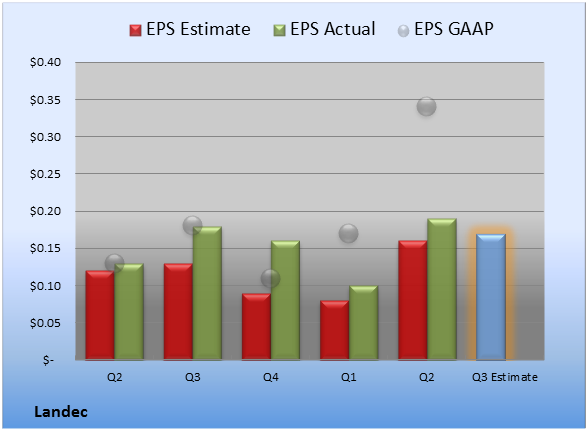
Comparing the upcoming quarter to the prior-year quarter, average analyst estimates predict Landec’s revenues will grow 35.9% and EPS will wane -5.6%.

The average estimate for revenue is $108.8 million. On the bottom line, the average EPS estimate is $0.17.

Revenue details
Last quarter, Landec logged revenue of $114.7 million. GAAP reported sales were 41% higher than the prior-year quarter’s $81.6 million.

Source: S&P Capital IQ. Quarterly periods. Dollar amounts in millions. Non-GAAP figures may vary to maintain comparability with estimates.

EPS details
Last quarter, non-GAAP EPS came in at $0.19. GAAP EPS of $0.34 for Q2 were 162% higher than the prior-year quarter’s $0.13 per share.

Source: S&P Capital IQ. Quarterly periods. Non-GAAP figures may vary to maintain comparability with estimates.

Recent performance
For the preceding quarter, gross margin was 16.1%, 20 basis points better than the prior-year quarter. Operating margin was 6.2%, 100 basis points better than the prior-year quarter. Net margin was 7.8%, 370 basis points better than the prior-year quarter.

Looking ahead

The full year’s average estimate for revenue is $431.9 million. The average EPS estimate is $0.78.

Investor sentiment
The stock has a three-star rating (out of five) at Motley Fool CAPS, with 910 members out of 935 rating the stock outperform, and 25 members rating it underperform. Among 291 CAPS All-Star picks (recommendations by the highest-ranked CAPS members), 288 give Landec a green thumbs-up, and three give it a red thumbs-down.

Of Wall Street recommendations tracked by S&P Capital IQ, the average opinion on Landec is buy, with an average price target of $13.88.

The rich are different than you and me: They might not notice the moneymaking stories right under our noses. In our new report, “Middle-Class Millionaire-Makers: 3 Stocks Wall Street‘s Too Rich to Notice,” we give you three Peter Lynch-inspired buy-what-you-know stocks for the 99%. Click here for instant access to this free report.

The article What to Expect from Landec originally appeared on Fool.com.


Seth Jayson had no position in any company mentioned here at the time of publication. You can view his stock holdings here. He is co-advisor of
Motley Fool Hidden Gems, which provides new small-cap ideas every month, backed by a real-money portfolio. The Motley Fool has no position in any of the stocks mentioned. Try any of our Foolish …read more
Source: FULL ARTICLE at DailyFinance
It's Showtime for Lindsay

By Seth Jayson, The Motley Fool

Filed under:

Lindsay (NYS: LNN) is expected to report Q2 earnings on March 27. Here’s what Wall Street wants to see:

The 10-second takeaway
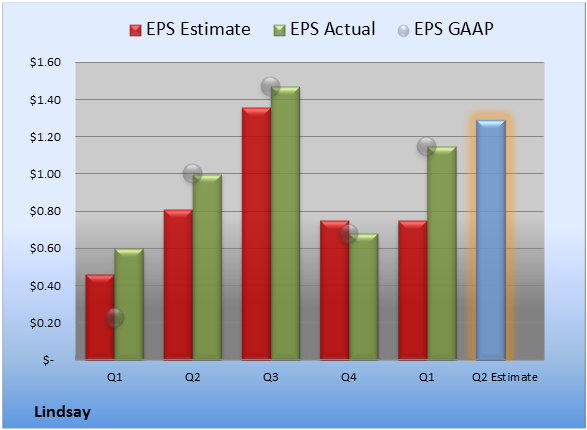
Comparing the upcoming quarter to the prior-year quarter, average analyst estimates predict Lindsay’s revenues will expand 22.9% and EPS will grow 29.0%.

The average estimate for revenue is $162.4 million. On the bottom line, the average EPS estimate is $1.29.

Revenue details
Last quarter, Lindsay recorded revenue of $147.4 million. GAAP reported sales were 24% higher than the prior-year quarter’s $119.2 million.

Source: S&P Capital IQ. Quarterly periods. Dollar amounts in millions. Non-GAAP figures may vary to maintain comparability with estimates.

EPS details
Last quarter, EPS came in at $1.15. GAAP EPS of $1.15 for Q1 were 400% higher than the prior-year quarter’s $0.23 per share.

Source: S&P Capital IQ. Quarterly periods. Non-GAAP figures may vary to maintain comparability with estimates.

Recent performance
For the preceding quarter, gross margin was 29.1%, 370 basis points better than the prior-year quarter. Operating margin was 15.1%, much better than the prior-year quarter. Net margin was 10.0%, 750 basis points better than the prior-year quarter.

Looking ahead

The full year’s average estimate for revenue is $638.9 million. The average EPS estimate is $4.86.

Investor sentiment
The stock has a four-star rating (out of five) at Motley Fool CAPS, with 308 members out of 337 rating the stock outperform, and 29 members rating it underperform. Among 83 CAPS All-Star picks (recommendations by the highest-ranked CAPS members), 76 give Lindsay a green thumbs-up, and seven give it a red thumbs-down.

Of Wall Street recommendations tracked by S&P Capital IQ, the average opinion on Lindsay is hold, with an average price target of $71.20.

The rich are different than you and me: They might not notice the moneymaking stories right under our noses. In our new report, “Middle-Class Millionaire-Makers: 3 Stocks Wall Street‘s Too Rich to Notice,” we give you three Peter Lynch-inspired buy-what-you-know stocks for the 99%. Click here for instant access to this free report.

The article It’s Showtime for Lindsay originally appeared on Fool.com.


Seth Jayson had no position in any company mentioned here at the time of publication. You can view his stock holdings here. He is co-advisor of
Motley Fool Hidden Gems, which provides new small-cap ideas every month, backed by a real-money portfolio. The Motley Fool has no position in any of the stocks mentioned. Try any of our Foolish newsletter services free …read more
Source: FULL ARTICLE at DailyFinance

The Cornerstone of American Investing

By Alex Planes, The Motley Fool

Filed under:

On this day in economic and financial history…

The Massachusetts Investors Trust , the first mutual fund in market history, was organized on Mar. 21, 1924 by Edward G. Leffler. The fund’s signature characteristics — redeemable daily at current values and offering new shares on a regular basis — continue to define the mutual-fund market to this day. Leffler, an ardent teetotaler and Prohibition supporter, saw the relatively low risk of professionally managed, pooled liquid investments as the antidote to the rising exuberance of the Roaring ’20s, which was then still more cultural than financial; the Dow Jones Industrial Average had at this point gained a relatively modest 50% since its 1921 lows. The greater liquidity and accurate valuation of mutual funds also presented an apparent advantage over closed-end funds, which used leverage instead of share issuance to add value to their portfolios.

Leffler devised this investment vehicle while working on Boston’s State Street, which has been a hotbed of money-management innovation for nearly a century. In fact, a mere four months later, the notable financial-services firm State Street was incorporated to provide what’s typically considered the second mutual-fund offering in market history. Fidelity, the longtime home of superinvestor Peter Lynch and one of the largest mutual-fund administrators in the world, is also based in Boston’s financial district (though not on State Street).

Leffler created another mutual fund a year and a half later, and between his two funds and State Street‘s offering, the mutual-fund industry had all it needed for a foundation. Several other Boston-based investment companies established their own funds throughout the Roaring ’20s, but these stock-like vehicles at first failed to catch on. By the end of 1929, there were only 19 mutual funds with $140 million in assets under management, compared to 162 closed-end funds, which had roughly $2.6 billion in assets.

The leveraged closed-end funds soared during the boom years, but their characteristic leverage proved to be a major drawback when the market crashed. The pioneering mutual funds bettered the Dow’s performance during the early phase of the Great Depression — Leffler’s two funds lost a respective 75% and 81%, and State Street‘s mutual fund lost 71%, versus the Dow’s 89% implosion. Closed-end funds, on the other hand, ended the bear-market slide with their shares worth 35% less than the value of their underlying assets. From the start of the crash to the onset of World War II, mutual-fund assets grew to $450 million, while closed-end funds shrank to an aggregate net asset value of about $780 million.

More recently, mutual funds have continued to grow and are now one of the most popular investment vehicles for millions of American investors. In 2011, 44% of all American households — more 52 million of them — owned mutual funds. That year, according to the Investment Company Institute, nearly 8,700 mutual funds held roughly …read more
Source: FULL ARTICLE at DailyFinance
Will These Numbers from Winnebago Industries Be Good Enough for You?

By Seth Jayson, The Motley Fool

Filed under:

Winnebago Industries (NYS: WGO) is expected to report Q2 earnings around March 21. Here’s what Wall Street wants to see:

The 10-second takeaway
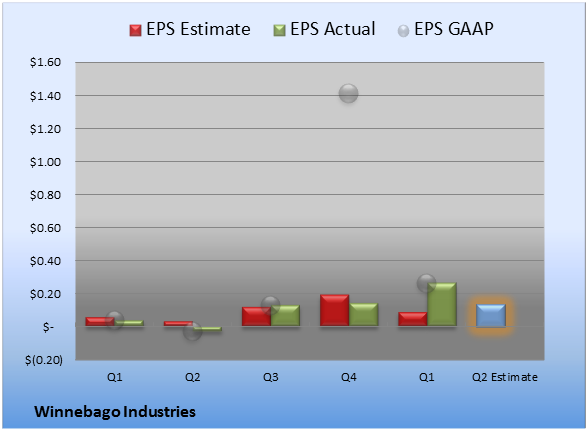
Comparing the upcoming quarter to the prior-year quarter, average analyst estimates predict Winnebago Industries‘s revenues will expand 29.8% and EPS will turn positive

The average estimate for revenue is $170.9 million. On the bottom line, the average EPS estimate is $0.14.

Revenue details
Last quarter, Winnebago Industries reported revenue of $193.6 million. GAAP reported sales were 47% higher than the prior-year quarter’s $131.8 million.

Source: S&P Capital IQ. Quarterly periods. Dollar amounts in millions. Non-GAAP figures may vary to maintain comparability with estimates.

EPS details
Last quarter, EPS came in at $0.26. GAAP EPS of $0.26 for Q1 were much higher than the prior-year quarter’s $0.04 per share.

Source: S&P Capital IQ. Quarterly periods. Non-GAAP figures may vary to maintain comparability with estimates.

Recent performance
For the preceding quarter, gross margin was 10.7%, 430 basis points better than the prior-year quarter. Operating margin was 5.2%, 470 basis points better than the prior-year quarter. Net margin was 3.8%, 300 basis points better than the prior-year quarter.

Looking ahead

The full year’s average estimate for revenue is $730.9 million. The average EPS estimate is $0.80.

Investor sentiment
The stock has a two-star rating (out of five) at Motley Fool CAPS, with 142 members out of 275 rating the stock outperform, and 133 members rating it underperform. Among 81 CAPS All-Star picks (recommendations by the highest-ranked CAPS members), 53 give Winnebago Industries a green thumbs-up, and 28 give it a red thumbs-down.

Of Wall Street recommendations tracked by S&P Capital IQ, the average opinion on Winnebago Industries is outperform, with an average price target of $16.00.

The rich are different than you and me: They might not notice the moneymaking stories right under our noses. In our new report, “Middle-Class Millionaire-Makers: 3 Stocks Wall Street‘s Too Rich to Notice,” we give you three Peter Lynch-inspired buy-what-you-know stocks for the 99%. Click here for instant access to this free report.

The article Will These Numbers from Winnebago Industries Be Good Enough for You? originally appeared on Fool.com.


Seth Jayson owned shares of the following at the time of publication: Winnebago Industries. You can view his stock holdings here. He is co-advisor of
Motley Fool Hidden Gems, which provides new small-cap ideas every month, backed by a real-money portfolio. The Motley Fool owns shares of Winnebago …read more
Source: FULL ARTICLE at DailyFinance

What Does Wall Street See for Herman Miller's Q3?

By Seth Jayson, The Motley Fool

Filed under:

Herman Miller (NAS: MLHR) is expected to report Q3 earnings around March 20. Here’s what Wall Street wants to see:

The 10-second takeaway
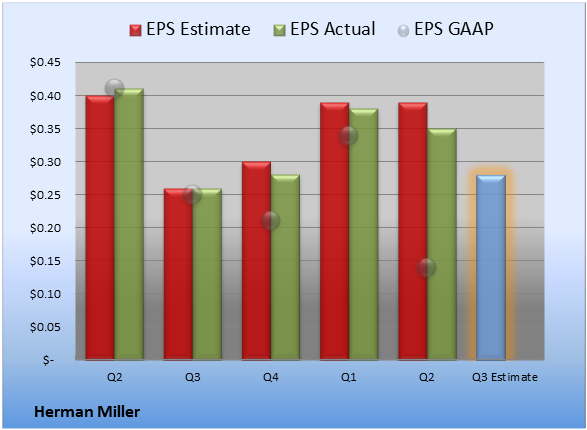
Comparing the upcoming quarter to the prior-year quarter, average analyst estimates predict Herman Miller‘s revenues will grow 9.5% and EPS will grow 7.7%.

The average estimate for revenue is $437.7 million. On the bottom line, the average EPS estimate is $0.28.

Revenue details
Last quarter, Herman Miller chalked up revenue of $441.8 million. GAAP reported sales were 0.9% lower than the prior-year quarter’s $445.6 million.

Source: S&P Capital IQ. Quarterly periods. Dollar amounts in millions. Non-GAAP figures may vary to maintain comparability with estimates.

EPS details
Last quarter, non-GAAP EPS came in at $0.35. GAAP EPS of $0.14 for Q2 were 66% lower than the prior-year quarter’s $0.41 per share.

Source: S&P Capital IQ. Quarterly periods. Non-GAAP figures may vary to maintain comparability with estimates.

Recent performance
For the preceding quarter, gross margin was 33.6%, 50 basis points worse than the prior-year quarter. Operating margin was 4.1%, 500 basis points worse than the prior-year quarter. Net margin was 1.9%, 340 basis points worse than the prior-year quarter.

Looking ahead

The full year’s average estimate for revenue is $1.78 billion. The average EPS estimate is $1.37.

Investor sentiment
The stock has a five-star rating (out of five) at Motley Fool CAPS, with 120 members out of 132 rating the stock outperform, and 12 members rating it underperform. Among 44 CAPS All-Star picks (recommendations by the highest-ranked CAPS members), 42 give Herman Miller a green thumbs-up, and two give it a red thumbs-down.

Of Wall Street recommendations tracked by S&P Capital IQ, the average opinion on Herman Miller is outperform, with an average price target of $29.00.

The rich are different than you and me: They might not notice the moneymaking stories right under our noses. In our new report, “Middle-Class Millionaire-Makers: 3 Stocks Wall Street‘s Too Rich to Notice,” we give you three Peter Lynch-inspired buy-what-you-know stocks for the 99%. Click here for instant access to this free report.

The article What Does Wall Street See for Herman Miller’s Q3? originally appeared on Fool.com.


Seth Jayson had no position in any company mentioned here at the time of publication. You can view his stock holdings here. He is co-advisor of
Motley Fool Hidden Gems, which provides new small-cap ideas every month, backed by a real-money portfolio. The Motley Fool has no position …read more
Source: FULL ARTICLE at DailyFinance
It's Showtime for Lennar

By Seth Jayson, The Motley Fool

Filed under:

Lennar (NYS: LEN) is expected to report Q1 earnings on March 20. Here’s what Wall Street wants to see:

The 10-second takeaway
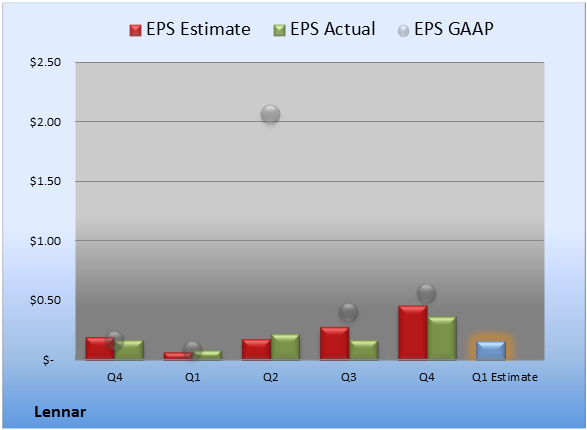
Comparing the upcoming quarter to the prior-year quarter, average analyst estimates predict Lennar’s revenues will expand 28.4% and EPS will expand 100.0%.

The average estimate for revenue is $931.0 million. On the bottom line, the average EPS estimate is $0.16.

Revenue details
Last quarter, Lennar logged revenue of $1.35 billion. GAAP reported sales were 42% higher than the prior-year quarter’s $952.7 million.

Source: S&P Capital IQ. Quarterly periods. Dollar amounts in millions. Non-GAAP figures may vary to maintain comparability with estimates.

EPS details
Last quarter, non-GAAP EPS came in at $0.36. GAAP EPS of $0.56 for Q4 were 250% higher than the prior-year quarter’s $0.16 per share.

Source: S&P Capital IQ. Quarterly periods. Non-GAAP figures may vary to maintain comparability with estimates.

Recent performance
For the preceding quarter, gross margin was 25.7%, 290 basis points better than the prior-year quarter. Operating margin was 12.6%, 540 basis points better than the prior-year quarter. Net margin was 9.2%, 600 basis points better than the prior-year quarter.

Looking ahead

The full year’s average estimate for revenue is $5.56 billion. The average EPS estimate is $1.68.

Investor sentiment
The stock has a two-star rating (out of five) at Motley Fool CAPS, with 538 members out of 1,228 rating the stock outperform, and 690 members rating it underperform. Among 363 CAPS All-Star picks (recommendations by the highest-ranked CAPS members), 178 give Lennar a green thumbs-up, and 185 give it a red thumbs-down.

Of Wall Street recommendations tracked by S&P Capital IQ, the average opinion on Lennar is hold, with an average price target of $37.47.

The rich are different than you and me: They might not notice the moneymaking stories right under our noses. In our new report, “Middle-Class Millionaire-Makers: 3 Stocks Wall Street‘s Too Rich to Notice,” we give you three Peter Lynch-inspired buy-what-you-know stocks for the 99%. Click here for instant access to this free report.

The article It’s Showtime for Lennar originally appeared on Fool.com.


Seth Jayson had no position in any company mentioned here at the time of publication. You can view his stock holdings here. He is co-advisor of
Motley Fool Hidden Gems, which provides new small-cap ideas every month, backed by a real-money portfolio. The Motley Fool has no position in any of the stocks mentioned. Try any of our Foolish newsletter …read more
Source: FULL ARTICLE at DailyFinance

What Does Wall Street See for EnergySolutions's Q4?

By Seth Jayson, The Motley Fool

Filed under:

EnergySolutions (NYS: ES) is expected to report Q4 earnings around March 21. Here’s what Wall Street wants to see:

The 10-second takeaway
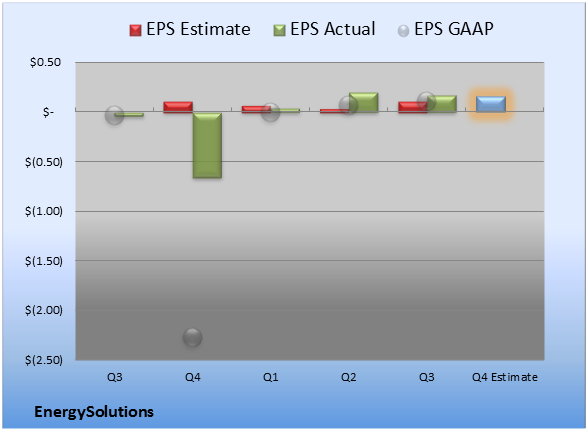
Comparing the upcoming quarter to the prior-year quarter, average analyst estimates predict EnergySolutions’s revenues will compress -1.9% and EPS will turn positive

The average estimate for revenue is $459.6 million. On the bottom line, the average EPS estimate is $0.16.

Revenue details
Last quarter, EnergySolutions notched revenue of $444.2 million. GAAP reported sales were 5.5% higher than the prior-year quarter’s $421.0 million.

Source: S&P Capital IQ. Quarterly periods. Dollar amounts in millions. Non-GAAP figures may vary to maintain comparability with estimates.

EPS details
Last quarter, non-GAAP EPS came in at $0.17. GAAP EPS were $0.11 for Q3 compared to -$0.04 per share for the prior-year quarter.

Source: S&P Capital IQ. Quarterly periods. Non-GAAP figures may vary to maintain comparability with estimates.

Recent performance
For the preceding quarter, gross margin was 10.4%, 160 basis points better than the prior-year quarter. Operating margin was 4.0%, 280 basis points better than the prior-year quarter. Net margin was 2.3%, 320 basis points better than the prior-year quarter.

Looking ahead

The full year’s average estimate for revenue is $1.79 billion. The average EPS estimate is $0.44.

Investor sentiment
The stock has a five-star rating (out of five) at Motley Fool CAPS, with 790 members out of 820 rating the stock outperform, and 30 members rating it underperform. Among 183 CAPS All-Star picks (recommendations by the highest-ranked CAPS members), 178 give EnergySolutions a green thumbs-up, and five give it a red thumbs-down.

Of Wall Street recommendations tracked by S&P Capital IQ, the average opinion on EnergySolutions is hold, with an average price target of $4.60.

The rich are different than you and me: They might not notice the moneymaking stories right under our noses. In our new report, “Middle-Class Millionaire-Makers: 3 Stocks Wall Street‘s Too Rich to Notice,” we give you three Peter Lynch-inspired buy-what-you-know stocks for the 99%. Click here for instant access to this free report.

The article What Does Wall Street See for EnergySolutions’s Q4? originally appeared on Fool.com.


Seth Jayson had no position in any company mentioned here at the time of publication. You can view his stock holdings here. He is co-advisor of
Motley Fool Hidden Gems, which provides new small-cap ideas every month, backed by a real-money portfolio. The Motley Fool has no position in any of the stocks mentioned. Try any of …read more
Source: FULL ARTICLE at DailyFinance
Does The Street Have KB Home Figured Out?

By Seth Jayson, The Motley Fool

Filed under:

KB Home (NYS: KBH) is expected to report Q1 earnings on March 21. Here’s what Wall Street wants to see:

The 10-second takeaway
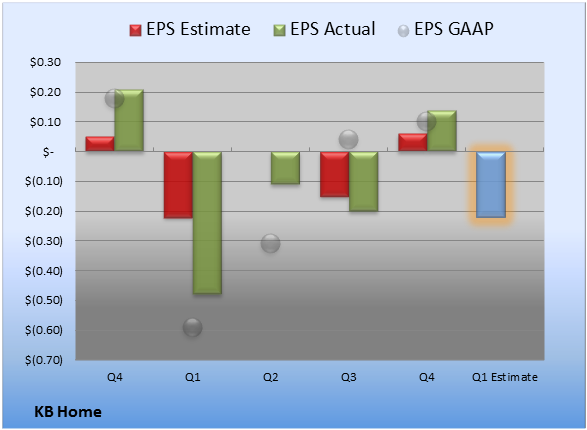
Comparing the upcoming quarter to the prior-year quarter, average analyst estimates predict KB Home’s revenues will grow 36.4% and EPS will remain in the red.

The average estimate for revenue is $347.1 million. On the bottom line, the average EPS estimate is -$0.22.

Revenue details
Last quarter, KB Home logged revenue of $578.2 million. GAAP reported sales were 20% higher than the prior-year quarter’s $479.9 million.

Source: S&P Capital IQ. Quarterly periods. Dollar amounts in millions. Non-GAAP figures may vary to maintain comparability with estimates.

EPS details
Last quarter, non-GAAP EPS came in at $0.14. GAAP EPS of $0.10 for Q4 were 44% lower than the prior-year quarter’s $0.18 per share.

Source: S&P Capital IQ. Quarterly periods. Non-GAAP figures may vary to maintain comparability with estimates.

Recent performance
For the preceding quarter, gross margin was 15.6%, 420 basis points worse than the prior-year quarter. Operating margin was 4.2%, 20 basis points better than the prior-year quarter. Net margin was 1.3%, 160 basis points worse than the prior-year quarter.

Looking ahead

The full year’s average estimate for revenue is $2.03 billion. The average EPS estimate is $0.14.

Investor sentiment
The stock has a two-star rating (out of five) at Motley Fool CAPS, with 582 members out of 1,255 rating the stock outperform, and 673 members rating it underperform. Among 336 CAPS All-Star picks (recommendations by the highest-ranked CAPS members), 158 give KB Home a green thumbs-up, and 178 give it a red thumbs-down.

Of Wall Street recommendations tracked by S&P Capital IQ, the average opinion on KB Home is hold, with an average price target of $14.52.

The rich are different than you and me: They might not notice the moneymaking stories right under our noses. In our new report, “Middle-Class Millionaire-Makers: 3 Stocks Wall Street‘s Too Rich to Notice,” we give you three Peter Lynch-inspired buy-what-you-know stocks for the 99%. Click here for instant access to this free report.

The article Does The Street Have KB Home Figured Out? originally appeared on Fool.com.


Seth Jayson had no position in any company mentioned here at the time of publication. You can view his stock holdings here. He is co-advisor of
Motley Fool Hidden Gems, which provides new small-cap ideas every month, backed by a real-money portfolio. The Motley Fool has no position …read more
Source: FULL ARTICLE at DailyFinance

Cintas Earnings Are on Deck

By Seth Jayson, The Motley Fool

Filed under:

Cintas (NAS: CTAS) is expected to report Q3 earnings on March 19. Here’s what Wall Street wants to see:

The 10-second takeaway
Comparing the upcoming quarter to the prior-year quarter, average analyst estimates predict Cintas’s revenues will expand 4.3% and EPS will grow 6.9%.

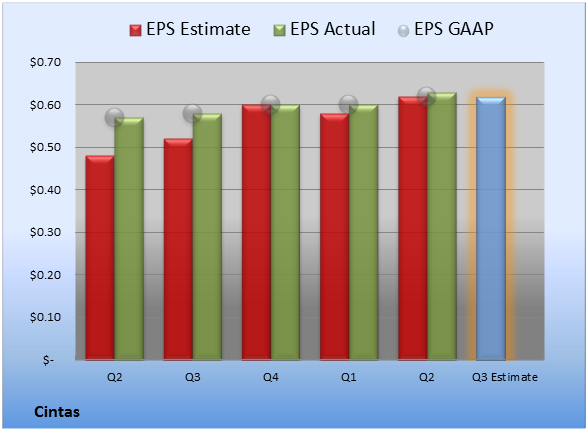
The average estimate for revenue is $1.06 billion. On the bottom line, the average EPS estimate is $0.62.

Revenue details
Last quarter, Cintas booked revenue of $1.06 billion. GAAP reported sales were 4.0% higher than the prior-year quarter’s $1.02 billion.

Source: S&P Capital IQ. Quarterly periods. Dollar amounts in millions. Non-GAAP figures may vary to maintain comparability with estimates.

EPS details
Last quarter, non-GAAP EPS came in at $0.63. GAAP EPS of $0.62 for Q2 were 8.8% higher than the prior-year quarter’s $0.57 per share.

Source: S&P Capital IQ. Quarterly periods. Non-GAAP figures may vary to maintain comparability with estimates.

Recent performance
For the preceding quarter, gross margin was 40.9%, 130 basis points worse than the prior-year quarter. Operating margin was 13.3%, 30 basis points better than the prior-year quarter. Net margin was 7.4%, 10 basis points better than the prior-year quarter.

Looking ahead

The full year’s average estimate for revenue is $4.28 billion. The average EPS estimate is $2.54.

Investor sentiment
The stock has a five-star rating (out of five) at Motley Fool CAPS, with 363 members out of 386 rating the stock outperform, and 23 members rating it underperform. Among 167 CAPS All-Star picks (recommendations by the highest-ranked CAPS members), 164 give Cintas a green thumbs-up, and three give it a red thumbs-down.

Of Wall Street recommendations tracked by S&P Capital IQ, the average opinion on Cintas is hold, with an average price target of $42.29.

The rich are different than you and me: They might not notice the moneymaking stories right under our noses. In our new report, “Middle-Class Millionaire-Makers: 3 Stocks Wall Street‘s Too Rich to Notice,” we give you three Peter Lynch-inspired buy-what-you-know stocks for the 99%. Click here for instant access to this free report.

The article Cintas Earnings Are on Deck originally appeared on Fool.com.


Seth Jayson had no position in any company mentioned here at the time of publication. You can view his stock holdings here. He is co-advisor of
Motley Fool Hidden Gems, which provides new small-cap ideas every month, backed by a real-money portfolio. The Motley Fool recommends Cintas. Try any of our Foolish newsletter services free for 30 days. …read more
Source: FULL ARTICLE at DailyFinance
This Bank Stock Could Be a Double

By Jim Royal, The Motley Fool

Filed under:

TFS Financial is a gem hiding in plain sight. While the market hates the uncertainty surrounding the company, you should love it, because it makes the stock a great bargain. This investment exploits a trick mastered by investing greats Peter Lynch and Seth Klarman.

That’s why my Special Situations portfolio is buying shares in the bank on the next market day. Read on to see why this stock could easily double from here with the potential for dividends and buybacks.

The business
From an operational standpoint, there’s nothing truly exceptional about TFS Financial. It runs your average bank, taking deposits and lending for mainly residential property. Some 78% of its lending takes place in Ohio, with another 17% in Florida, and the remainder in various states across the U.S. In contrast to seemingly cheap peers such as Bank of America, Citigroup, and JPMorgan Chase — each with huge exposure to risky derivatives and other financial arcana — TFS looks much more like your hometown corner bank. You don’t have to worry that a London Whale will swallow this one.

TFS‘s credit metrics have improved greatly since the worst of the financial crisis, though there’s still room for gains. For example, delinquent loans have been cut in half since 2009, and non-performing assets have trended down consistently since 2010. These levels are still elevated, meaning profitability should increase as the economy normalizes. The bank has continued to grow book value since 2009.

TFS expects to continue growing book value through its emphasis on adjustable rate financing. The company has moved much of its portfolio — 48% as of December 31, 2012 — to adjustable rate. That means that when interest rates rise, as they someday will, TFS is somewhat insulated from the destruction. In addition, recent mortgages have strong credit quality. On first mortgages originated in the 2012 fiscal year, FICO scores came in at 782 with an average loan to value of 63%, so high credit quality with borrowers having plenty of skin in the game. Those figures are similar so far this year.

How much would you expect to pay for a bank like this? At a minimum, I would say a fair price is tangible book value. TFS trades for about half that. It gets better, because TFS has a way to drive book value per share higher even if its banking operations don’t improve.

The special situation
If Apple were trading at only the value of cash on its books and had a profitable business besides, would you hesitate to buy? That’s exactly the situation here, but it’s even better, because TFS plans to actually return that cash to you, unlike Apple. Here’s what I mean.

By law, banks have to maintain equity over a minimum level to be considered well-capitalized. For TFS, that means having risk-based capital of at least 10% of assets. TFS vastly exceeds this, with 22.8%. In fact, …read more
Source: FULL ARTICLE at DailyFinance

Fool Checkup: Chiquita Brands International Earnings

By Seth Jayson, The Motley Fool

Filed under:

Chiquita Brands International (NYS: CQB) reported earnings on March 11. Here are the numbers you need to know.

The 10-second takeaway
For the quarter ended Dec. 31 (Q4), Chiquita Brands International met expectations on revenues and exceeded expectations on earnings per share.

Compared to the prior-year quarter, revenue increased slightly. Non-GAAP loss per share grew. GAAP loss per share increased.

Margins contracted across the board.

Revenue details
Chiquita Brands International logged revenue of $738.0 million. The one analyst polled by S&P Capital IQ expected revenue of $737.8 million on the same basis. GAAP reported sales were the same as the prior-year quarter’s.

Source: S&P Capital IQ. Quarterly periods. Dollar amounts in millions. Non-GAAP figures may vary to maintain comparability with estimates.

EPS details
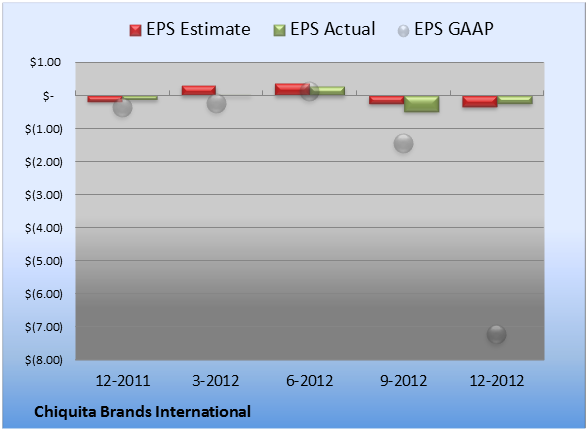
EPS came in at -$0.24. The two earnings estimates compiled by S&P Capital IQ predicted -$0.34 per share. Non-GAAP EPS were -$0.24 for Q4 versus -$0.12 per share for the prior-year quarter. GAAP EPS were -$7.24 for Q4 compared to -$0.36 per share for the prior-year quarter.

Source: S&P Capital IQ. Quarterly periods. Non-GAAP figures may vary to maintain comparability with estimates.

Margin details
For the quarter, gross margin was 9.6%, 60 basis points worse than the prior-year quarter. Operating margin was -2.3%, 150 basis points worse than the prior-year quarter. Net margin was -45.4%, much worse than the prior-year quarter. (Margins calculated in GAAP terms.)

Looking ahead
Next quarter’s average estimate for revenue is $826.8 million. On the bottom line, the average EPS estimate is $0.20.

Next year’s average estimate for revenue is $3.11 billion. The average EPS estimate is $0.80.

Investor sentiment
The stock has a four-star rating (out of five) at Motley Fool CAPS, with 272 members out of 316 rating the stock outperform, and 44 members rating it underperform. Among 73 CAPS All-Star picks (recommendations by the highest-ranked CAPS members), 62 give Chiquita Brands International a green thumbs-up, and 11 give it a red thumbs-down.

Of Wall Street recommendations tracked by S&P Capital IQ, the average opinion on Chiquita Brands International is outperform, with an average price target of $12.00.

The rich are different than you and me: They might not notice the moneymaking stories right under our noses. In our new report, “Middle-Class Millionaire-Makers: 3 Stocks Wall Street’s Too Rich to Notice,” we give you three Peter Lynch-inspired buy-what-you-know stocks for the 99%. Click here for instant access to this free report.

The article Fool Checkup: Chiquita Brands International Earnings originally appeared …read more
Source: FULL ARTICLE at DailyFinance
Does The Street Have Federal Signal Figured Out?

By Seth Jayson, The Motley Fool

Filed under:

Federal Signal (NYS: FSS) is expected to report Q4 earnings on March 15. Here’s what Wall Street wants to see:

The 10-second takeaway
Comparing the upcoming quarter to the prior-year quarter, average analyst estimates predict Federal Signal‘s revenues will shrink -6.7% and EPS will grow 22.2%.

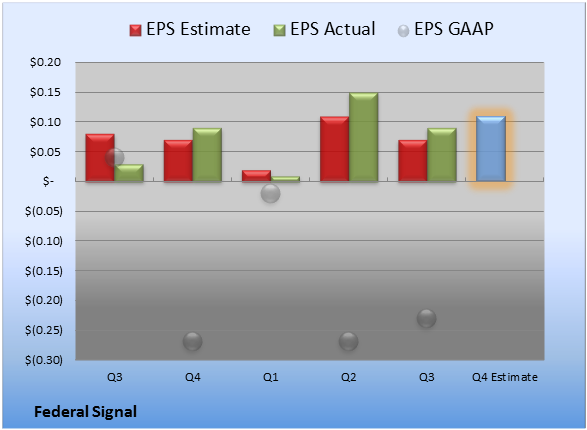
The average estimate for revenue is $208.4 million. On the bottom line, the average EPS estimate is $0.11.

Revenue details
Last quarter, Federal Signal tallied revenue of $185.0 million. GAAP reported sales were 10% higher than the prior-year quarter’s $167.8 million.

Source: S&P Capital IQ. Quarterly periods. Dollar amounts in millions. Non-GAAP figures may vary to maintain comparability with estimates.

EPS details
Last quarter, non-GAAP EPS came in at $0.09. GAAP EPS were -$0.23 for Q3 against $0.04 per share for the prior-year quarter.

Source: S&P Capital IQ. Quarterly periods. Non-GAAP figures may vary to maintain comparability with estimates.

Recent performance
For the preceding quarter, gross margin was 24.6%, 280 basis points better than the prior-year quarter. Operating margin was 6.7%, 160 basis points better than the prior-year quarter. Net margin was -7.9%, 930 basis points worse than the prior-year quarter.

Looking ahead

The full year’s average estimate for revenue is $822.4 million. The average EPS estimate is $0.40.

Investor sentiment
The stock has a three-star rating (out of five) at Motley Fool CAPS, with 67 members out of 81 rating the stock outperform, and 14 members rating it underperform. Among 22 CAPS All-Star picks (recommendations by the highest-ranked CAPS members), 20 give Federal Signal a green thumbs-up, and two give it a red thumbs-down.

Of Wall Street recommendations tracked by S&P Capital IQ, the average opinion on Federal Signal is hold, with an average price target of $7.00.

The rich are different than you and me: They might not notice the moneymaking stories right under our noses. In our new report, “Middle-Class Millionaire-Makers: 3 Stocks Wall Street‘s Too Rich to Notice,” we give you three Peter Lynch-inspired buy-what-you-know stocks for the 99%. Click here for instant access to this free report.

The article Does The Street Have Federal Signal Figured Out? originally appeared on Fool.com.


Seth Jayson had no position in any company mentioned here at the time of publication. You can view his stock holdings here. He is co-advisor of
Motley Fool Hidden Gems, which provides new small-cap ideas every month, backed by a real-money portfolio. The Motley Fool has no position in any of the …read more
Source: FULL ARTICLE at DailyFinance

3 Bank Investing Mistakes to Avoid in 2013

By John Grgurich, The Motley Fool

Filed under:

Though we’ve passed over the cusp of March, I thought it still might not be too late to offer bank investors some sage advice for 2013. The year is still young, and investing adventure awaits. Without further ado, then, here are three bank-investing mistakes to avoid for the rest of the year, and beyond.

1. Not investing in banks, period
This one is here just in case you’ve never invested in banks, but are interested in trying and perhaps a bit hesitant. And maybe I’m addressing how I felt about investing in banks not so very long ago.

For beginning investors, I think banks can be a bit daunting, especially if you come from the Peter Lynch school of investing: Essentially, invest in what you know and what you can get your head around. Hence, I think it’s easier for most people to start off their lifetime investing adventures with classic consumer-goods companies, like Starbucks, Procter & Gamble, and Apple. Companies that you “get” right away. It’s what I did.

But with a little homework, you can learn enough about how banks operate — along with some basic do’s and don’ts — that should leave you feeling quite comfortable with the idea of plunking your money down in the banking sector. And it’s worth the effort, because there’s money to be made, here.

People who had Bank of America stock at the beginning of last year saw share prices double by the end of the year. I bought my first shares of Goldman Sachs at the end of last November, which have so far returned me better than 25%. Banks as investments are simply too potentially profitable to be ignored.

2. Not investing in too-big-to-fail banks
Once you’ve decided to invest in banks, you might be put off by the too-big-to-fail banks, so-called because so many weren’t allowed to fail on their own — as they almost surely would have — at the height of the financial crisis, without government intervention. This elite-for-the-wrong-reason group includes Bank of America, Citigroup , JPMorgan Chase , and Wells Fargo.

But again, there’s money to be made, here, as spelled out above in the case of B of A. Also, in the past year, Citi has returned 27% to its shareholders, JPMorgan has returned 21%, and Wells Fargo more than 15%.

And stop me if I’m being too cynical, but as long as these banks remain too big to fail — that is, until they’re broken up or otherwise configured to be unable to single-handedly take down the economy if they go under — you the shareholder have an all-but-explicit guarantee from the federal government that your investment will never go out of business.

3. Not paying enough attention to balance sheet quality
This is what separates the JPMorgans from the Bank of Americas, and the Wells Fargos from the Citigroups: what’s on the balance sheet.

It’s no secret that B of A and Citigroup …read more
Source: FULL ARTICLE at DailyFinance