Tag Archives: Mississippian Lime

Midstates Petroleum to Participate in the IPAA Oil and Gas Investment Symposium

By Business Wirevia The Motley Fool

Filed under:


Midstates Petroleum to Participate in the IPAA Oil and Gas Investment Symposium

HOUSTON–(BUSINESS WIRE)– Midstates Petroleum Company, Inc. (“Midstates” or the “Company”) (NYS: MPO) announced today that Steve Pugh, the Company’s Executive Vice President and Chief Operating Officer, will present at the IPAA Oil and Gas Investment Symposium on Wednesday, April 17, 2013 in New York City. In conjunction with the conference, an updated presentation will be posted to the “Investors” section of the Company’s website, www.midstatespetroleum.com.

About Midstates Petroleum Company, Inc.

Midstates Petroleum Company, Inc. is an independent exploration and production company focused on the application of modern drilling and completion techniques to oil-prone resources in previously discovered yet underdeveloped hydrocarbon trends. The Company’s operations are currently focused on oilfields in the Upper Gulf Coast Tertiary trend onshore in central Louisiana and in the Mississippian Lime trend in northwestern Oklahoma and southern Kansas. The Company is headquartered in Houston, Texas. Additional information about the Company is available at www.midstatespetroleum.com.

Midstates Petroleum Company, Inc.
Al Petrie, 713-595-9427
Al.Petrie@midstatespetroleum.com
or
Garrett Galloway, 713-595-9323
Garrett.Galloway@midstatespetroleum.com

KEYWORDS:   United States  North America  New York  Texas

INDUSTRY KEYWORDS:

The article Midstates Petroleum to Participate in the IPAA Oil and Gas Investment Symposium originally appeared on Fool.com.

Try any of our Foolish newsletter services free for 30 days. We Fools may not all hold the same opinions, but we all believe that considering a diverse range of insights makes us better investors. The Motley Fool has a disclosure policy.

Copyright © 1995 – 2013 The Motley Fool, LLC. All rights reserved. The Motley Fool has a disclosure policy.

(function(c,a){window.mixpanel=a;var b,d,h,e;b=c.createElement(“script”);
b.type=”text/javascript”;b.async=!0;b.src=(“https:”===c.location.protocol?”https:”:”http:”)+
‘//cdn.mxpnl.com/libs/mixpanel-2.2.min.js’;d=c.getElementsByTagName(“script”)[0];
d.parentNode.insertBefore(b,d);a._i=[];a.init=function(b,c,f){function d(a,b){
var c=b.split(“.”);2==c.length&&(a=a[c[0]],b=c[1]);a[b]=function(){a.push([b].concat(
Array.prototype.slice.call(arguments,0)))}}var g=a;”undefined”!==typeof f?g=a[f]=[]:
f=”mixpanel”;g.people=g.people||[];h=[‘disable’,’track’,’track_pageview’,’track_links’,
‘track_forms’,’register’,’register_once’,’unregister’,’identify’,’alias’,’name_tag’,
‘set_config’,’people.set’,’people.increment’];for(e=0;e<h.length;e++)d(g,h[e]);
a._i.push([b,c,f])};a.__SV=1.2;})(document,window.mixpanel||[]);
mixpanel.init("9659875b92ba8fa639ba476aedbb73b9");

function addEvent(obj, evType, fn, useCapture){
if (obj.addEventListener){
obj.addEventListener(evType,

From: http://www.dailyfinance.com/2013/04/11/midstates-petroleum-to-participate-in-the-ipaa-oil/

Why I Bought Shares of Heckmann

By Matt DiLallo, The Motley Fool

Filed under:

Every so often you’re introduced to a company that’s doing something unique. It’s blazing new trails to form an industry that’s solving a real problem. What’s even better is that the problem that’s being solved involves a multibillion dollar industry that’s still just getting started.

You see, the energy industry has an image problem because it has a water problem. The industry requires millions of gallons of water to frack one oil and gas well. Once produced, that water represents a fairly significant environmental risk, which is one reason why so many people are opposed to fracking in the first place.

Heckmann enters the equation as the environmental services company that offers a full-cycle solution for the management of water. It has the plan, and the assets to help mitigate many of the risks involved in fracking. As you take a look at the chart below, notice how Heckmann handles the water from delivery to disposal:

Source: Heckmann investor presentation

What differentiates Heckmann, and is also the driving force behind my personal investment, is the company’s strength in recycling that leads to less disposal. Before we tackle the all-important recycling component of Heckmann’s solution, let’s drill down a bit into looking at disposal wells.

In the slide above you’ll notice that Heckmann owns 46 wastewater disposal wells. Disposal wells have come under increasing scrutiny of late because it’s suspected that they are behind increased seismic activity. That’s a real problem for the industry, and the evidence is compelling. For example, one area that’s seen increased seismic activity is Ohio which would seem to correspond to the increased activity of the Utica Shale.

While the data is by no means conclusive, it is a risk that bears watching. A variety of companies are drilling these disposal wells, with master limited partnerships like Crosstex Energy being one of the many to watch. The company owns an interest in seven disposal wells in Ohio and West Virginia with another well coming on line soon. These wells are designed to simply dispose of the wastewater. Even if the wells prove not to be the cause, the business of owning disposal wells could be tougher to grow because of the perceived risk.

Not only are there increased risks but this wastewater disposal infrastructure doesn’t come cheap. SandRidge Energy , for example, has spent more than $450 million to build out a disposal system in the Mississippian Lime formation. The company has constructed 700 miles of pipeline and has 116 active disposal wells.

Heckmann, however, takes a different approach with a renewed focus on recycling the produced water. It owns an interest in a Marcellus Shale wastewater recycling facility and it’s in the process of expanding its treatment and recycling capabilities so that less produced water is being disposed of and more is being reused. While few would believe that the fracking process can become greener, that’s exactly what Heckmann is trying to accomplish.

As it works

Source: FULL ARTICLE at DailyFinance

Is SandRidge a Good $5 Buy?

By Joel South and Taylor Muckerman, The Motley Fool

Filed under:

TPG-Axon won its bid to overhaul SandRidge Energy‘s board of directors; however, the company continues to fall, currently sitting around 52-week lows. 

With the stock trading below $5 per share, SandRidge presents an attractive value proposition. With 1.85 million net acres in the Mississippian Lime, in addition to 32 thousand barrels of oil equivalent per day production in the Gulf of Mexico, SandRidge is trading significantly below its net asset value. In addition, the company has its capital expenditures covered for the next year after unloading interests in the Permian Basin for $2.6 billion. Check out the video below for more information on SandRidge.

Investors were startled after SandRidge plummeted when natural gas prices reached 10-year lows, but with the company focusing on growing liquids production, the future looks optimistic. If you are unsure about the future of this emerging oil and gas junior and are looking to find out more about its strengths and weaknesses, then check out The Motley Fool’s premium research report detailing SandRidge’s game plan and what to expect from the company going forward. To get started, simply click here now!

var FoolAnalyticsData = FoolAnalyticsData || []; FoolAnalyticsData.push({ eventType: “TickerReportPitch”, contentByline: “Joel South and Taylor Muckerman“, contentId: “cms.30170”, contentTickers: “NYSE:CHK, NYSE:SD”, contentTitle: “Is SandRidge a Good $5 Buy? “, hasVideo: “True”, pitchId: “11”, …read more

Source: FULL ARTICLE at DailyFinance

Midstates Petroleum Announces Favorable Louisiana Supreme Court Ruling Regarding Pine Prairie/Clovel

By Business Wirevia The Motley Fool

Filed under:


Midstates Petroleum Announces Favorable Louisiana Supreme Court Ruling Regarding Pine Prairie/Clovelly Litigation

HOUSTON–(BUSINESS WIRE)– Midstates Petroleum Company, Inc. (“Midstates” or the “Company”) (NYS: MPO) announced today that it has received a favorable unanimous opinion from the Louisiana State Supreme Court regarding the Company’s litigation with Clovelly Oil Company (“Clovelly”). In the lawsuit, Clovelly alleged that the Company is subject to an unrecorded Joint Operating Agreement dated July 16, 1972 (“1972 JOA“), as the result of the Company’s 2007 purchase of working interests in certain acreage in the Pine Prairie field. The Louisiana Supreme Court unanimously ruled that the 1972 JOA does not apply to any leases acquired by Midstates after that date and that the JOA only applies to leases which were owned by the parties to the 1972 JOA at the time it was originally executed. The Supreme Court’s decision eliminates any exposure to the Company from this lawsuit, as all leases at issue in the matter were acquired after July 16, 1972.

John Crum, Chairman, President and CEO commented, “We are pleased with the expeditious manner in which the Louisiana Supreme Court ruled on this important matter for the Company. This ruling affirms our ownership of acreage in Pine Prairie and we look forward to continued execution of our development plans in the field.”

A copy of the Louisiana Supreme Court decision is available at http://www.lasc.org/opinions/2013/12C2055.opn.pdf.

About Midstates Petroleum Company, Inc.

Midstates Petroleum Company, Inc. is an independent exploration and production company focused on the application of modern drilling and completion techniques to oil-prone resources in previously discovered yet underdeveloped hydrocarbon trends. The Company’s operations are currently focused on oilfields in the Upper Gulf Coast Tertiary trend onshore in central Louisiana and in the Mississippian Lime trend in northwestern Oklahoma and southern Kansas. The Company is headquartered in Houston, Texas. Additional information about the Company is available at www.midstatespetroleum.com.

Midstates Petroleum Company, Inc.
Al Petrie, 713-595-9427
Al.Petrie@midstatespetroleum.com
or
Garrett Galloway, 713-595-9323
Garrett.Galloway@midstatespetroleum.com

KEYWORDS:   United States  North America  Louisiana  Texas

INDUSTRY KEYWORDS:

The article Midstates Petroleum Announces Favorable Louisiana Supreme Court Ruling Regarding Pine …read more
Source: FULL ARTICLE at DailyFinance

Midstates Petroleum to Participate in the Howard Weil 41st Annual Energy Conference

By Business Wirevia The Motley Fool

Filed under:

Midstates Petroleum to Participate in the Howard Weil 41 st Annual Energy Conference

HOUSTON–(BUSINESS WIRE)– Midstates Petroleum Company, Inc. (“Midstates” or the “Company”) (NYS: MPO) announced today that it will present at the Howard Weil 41st Annual Energy Conference on Monday, March 18, 2013 in New Orleans, Louisiana. In conjunction with the conference, an updated presentation will be posted to the “Investors” section of the Company’s website, www.midstatespetroleum.com, the morning of the conference.

About Midstates Petroleum Company, Inc.

Midstates Petroleum Company, Inc. is an independent exploration and production company focused on the application of modern drilling and completion techniques to oil-prone resources in previously discovered yet underdeveloped hydrocarbon trends. The Company’s operations are currently focused on oilfields in the Upper Gulf Coast Tertiary trend onshore in central Louisiana and in the Mississippian Lime trend in northwestern Oklahoma and southern Kansas. The Company is headquartered in Houston, Texas. Additional information about the Company is available at www.midstatespetroleum.com.

Midstates Petroleum Company, Inc.
Al Petrie, 713-595-9427
Al.Petrie@midstatespetroleum.com
or
Garrett Galloway, 713-595-9323
Garrett.Galloway@midstatespetroleum.com

KEYWORDS:   United States  North America  Texas

INDUSTRY KEYWORDS:

The article Midstates Petroleum to Participate in the Howard Weil 41st Annual Energy Conference originally appeared on Fool.com.

Try any of our Foolish newsletter services free for 30 days. We Fools may not all hold the same opinions, but we all believe that considering a diverse range of insights makes us better investors. The Motley Fool has a disclosure policy.

Copyright © 1995 – 2013 The Motley Fool, LLC. All rights reserved. The Motley Fool has a disclosure policy.

(function(c,a){window.mixpanel=a;var b,d,h,e;b=c.createElement(“script”);
b.type=”text/javascript”;b.async=!0;b.src=(“https:”===c.location.protocol?”https:”:”http:”)+
‘//cdn.mxpnl.com/libs/mixpanel-2.2.min.js’;d=c.getElementsByTagName(“script”)[0];
d.parentNode.insertBefore(b,d);a._i=[];a.init=function(b,c,f){function d(a,b){
var c=b.split(“.”);2==c.length&&(a=a[c[0]],b=c[1]);a[b]=function(){a.push([b].concat(
Array.prototype.slice.call(arguments,0)))}}var g=a;”undefined”!==typeof f?g=a[f]=[]:
f=”mixpanel”;g.people=g.people||[];h=[‘disable’,’track’,’track_pageview’,’track_links’,
‘track_forms’,’register’,’register_once’,’unregister’,’identify’,’alias’,’name_tag’,
‘set_config’,’people.set’,’people.increment’];for(e=0;e<h.length;e++)d(g,h[e]);
a._i.push([b,c,f])};a.__SV=1.2;})(document,window.mixpanel||[]);
mixpanel.init("9659875b92ba8fa639ba476aedbb73b9");

function addEvent(obj, evType, fn, useCapture){
if (obj.addEventListener){
obj.addEventListener(evType, fn, useCapture);
return true;
…read more
Source: FULL ARTICLE at DailyFinance

Is SandRidge Wrong About the Mississippian Lime?

By Matt DiLallo, The Motley Fool

Filed under:

It’s been said that one man’s trash is another man’s treasure. In the case of the oil and gas exploration business, one company’s core operations is another company’s non-core asset that’s ripe to be sold to the highest bidder. That’s why investors shouldn’t initially get so worked up about asset sales because they’re never as cut and dry as they would appear.

The values placed on an asset can vary for any number of reasons, and a company’s reason to sell could be due more to distress than unlocking asset value. That’s part of the intrigue with the Mississippian Lime formation in Kansas. To one company, it’s a treasure, so it is selling everything it has to shine up that treasure for the world to see. Others see it as an outlier; it has potential but it’s better to get what you can before it loses all of its luster.

As an investor, it’s tough to know who to believe. You’re talking about some of the smartest people in the energy industry with two very different opinions on the same energy play. Let’s take a close look at the play and see what all the fuss is about.

Source: SandRidge Investor Presentation

To SandRidge Energy the Mississippian Lime is not just a treasure, but a gold mine. The company is basically building its business around this one asset. That’s why it seized the opportunity to sell its high-demand and attractively priced Permian Basin operations for $2.6 billion. The company’s plan is to invest all that cash to fund the development of its 1.85 million net acres in the Mississippian for the next two years.

This would appear to be in stark contrast to peers Chesapeake Energy and Devon Energy which have both sold partial stakes in their Mississippian Lime acres in the past year. Devon has about 600,000 net acres in the play, but it sold a 33% joint venture interest to Sinopec in a package with four other emerging plays for $2.5 billion last year. The deal covered 1.5 million net acres and a rough estimate puts the value of these acres at slightly less than $1,700 per acre. However, Devon’s sale was more about de-risking its emerging plays than anything against the Mississippian. In fact, the company currently has 15 rigs in the play and could increase that to 20 by the end of the year. It plans to drill about 400 wells and its early results are in line with expectations.

Chesapeake’s recent Mississippian asset sale is of a bit more concern to investors for a number of reasons. First, it appears to be offered at a fire-sale price given that the company had boasted much higher values for the assets. In fact, at a price per acre of less than $2,400, it’s less than a third of what the company claimed the land was worth at an investor presentation last …read more
Source: FULL ARTICLE at DailyFinance

Will Investors Regret Hating This Natural Gas Stock?

By Matt DiLallo, The Motley Fool

Filed under:

A few years ago Chesapeake Energy was one of the market‘s hottest stocks. From 2003 until its peak in 2008, the company’s shares, fueled by a rise in natural gas, went up by more than 700%. Since its peak in July of 2008 shares are off by nearly 70%. With so many investors being burned over the past five years, no wonder the company is hated by investors.

That hate has turned some investors to actively bet against the company’s future success. At last count, 13.5% of its outstanding shares were sold short. While the short interest is down slightly from the end of last year, investors still hate this stock. Are these investors too focused on the past to miss a potentially exciting future?

Why it’s hated
I’ll be honest with you, there are some good reasons to hate this stock. Under the leadership of CEO Aubrey McClendon the company has undergone an ambitious growth phase which enabled it to become the nation’s No. 2 natural gas producer. The problem here is that its growth came at a great cost as the company took on massive amounts of debt. With the plunge in natural gas prices, the company is having trouble managing this heavy debt load while also investing to grow.

In order to fund its capital expenditures Chesapeake has turned to selling off assets to make ends meet. Last year the company sold its interest in Access Midstream Partners , along with a host of other assets, in an effort to raise billions in cash. Chesapeake is planning to sell $4 billion-$7 billion more in assets in the year ahead. It already sold a portion of its Mississippian Lime acreage to a Chinese national oil company and has put its stake in Clean Energy Fuels up for sale. The concern here is that the company’s precarious debt position is forcing it to sell these assets at fire-sale prices.

While the company labels these sales as non-core, the assets are top-notch. Access Midstream for example is a stable, low-risk, cash flow asset. Clean Energy just happens to be the company behind America’s Natural Gas Highway and is helping to spur the growth of natural gas demand. For investors shorting the stock, they see a debt-laden company that needs to sell excellent assets in hopes that those asset it keeps turn out to be worth more in the long run.

Why it should be loved
Now, with that out of the way, let’s get to why you’d want to buy this company. Chesapeake is an emerging liquids story and is now the 11th largest liquids producer in the country, and is aiming to grow that production by 27% this year to a total of 26% of its production. As you can see in the map below, Chesapeake has acreage positions in most of the top onshore plays, positioning it to continue to grow …read more
Source: FULL ARTICLE at DailyFinance

Will Our Energy Be Stamped "Made in China," Too?

By Matt DiLallo, The Motley Fool

Filed under:

Recently, I’ve been wondering if oil and gas asset sales to national oil companies have the potential to jeopardize our dreams of energy independence. In the past couple of years, we’ve seen domestic energy producers such as Devon Energy and Chesapeake Energy rake in billions of dollars by selling a piece of future oil and gas production. It’s becoming pretty clear that more deals are on the way. 

Probably feeling the pressure of competition following Chesapeake’s $1.02 billion Mississippian Lime joint venture with rival Sinopec, China National Petroleum Company’s chairman recently said that it’s currently studying whether it, too, will join the fray. As that nation’s largest oil company it has the financial firepower to pursue a big deal. Overall, Chinese explorers have an estimated $40 billion to spend on locking up production.

One of the issues is that these companies could be bidding for our production assets with an unfair competitive advantage, as they can use Chinese government loans to stake their claim. Most of the U.S. deals involve having these companies simply buying joint venture stakes in production assets, with Chesapeake’s sale involving a 50% stake in 850,000 net acres. Devon also recently completed a transaction with Sinopec totaling $2.5 billion in which it sold a 33% interest in three emerging energy plays, including the Mississippian. The company uses these to minimize exploration costs by de-risking the acreage and increasing exploration activity. A larger looming issue will be when a Chinese national bids for control of a U.S. oil and gas producer.

The question is, what are the Chinese and other foreign buyers after? It’s not to lock up supply and ship it back to China, as instead the production will be sold in the states. The profits, on the other hand, will eventually make their way back to the mainland, which can then be used to purchase oil and gas on the open market. However, that’s probably not the real reason behind these deals. Instead, it’s more about the technology being used to unlock our vast shale resource.

You see, China has its own untapped resource potential, as the country is believed to hold the world’s third largest recoverable natural gas reserves. The problem is that most of these reserves are trapped in shale: 

To best understand how to tap its own reserves, the country’s oil and gas companies are investing in the U.S. companies that have harnessed the technology to unlock our shale. Because our assets are cheaper on a relative basis and our political climate is stable, it makes the most sense to invest directly in U.S. production and learn firsthand.

In conjunction with a growing number of asset transactions, U.S. oil-field service companies with expertise in fracking are setting up shop in mainland China. Both Baker Hughes and Halliburton have set up strategic partnerships with Chinese companies. Baker Hughes is setting up a research center for unconventional energy as …read more
Source: FULL ARTICLE at DailyFinance

Why SandRidge Energy Is Not a Dud

By Matt DiLallo, The Motley Fool

Filed under:

Friend and Fool blogger Robert Zimmerman recently wrote a post entitled, “A Proven Winner, a Likely Winner and a Dud.” While I agree wholeheartedly with his two winners, I have some issues with his calling SandRidge Energy a dud. Let’s drill down into his thesis and why I think he, and investors like him, are letting the company’s spotty past cloud its future potential.

Topping the list of criticisms is CEO Tom Ward and the eerily similar “shenanigans” (as Bob calls them) to Chesapeake Energy‘s CEO Aubrey McClendon. Now, I’ll be quite honest with you, I have my questions, too, and after hearing about McClendon’s early retirement I wondered if Ward might be next. SandRidge, with Ward at the helm, has made many of the same mistakes as Chesapeake in taking on too much debt and betting that borrowed money too heavily on a volatile commodity.  

Both men have profited wildly, and in some cases questionably. It is hard to justify how Chesapeake’s Founder’s Well Program and SandRidge’s conflicted related-party transactions were completely aligned with shareholders. Meanwhile, investors have suffered as shares of both companies have crumbled.

However, the value in the company goes much deeper than management’s ability to destroy it. Bob points out that the all-in strategy to develop the Mississippian Lime will likely be the wrong one. I don’t think the numbers would agree with that.

Sure, given the recently reported poor results from SandRidge’s two royalty trusts, SandRidge Mississippian Trust I and SandRidge Mississippian Trust II  there is reason to be concerned. It’s hard to spin the numbers as SDT‘s sales volumes increased just 1% due to higher natural gas production and slightly lower oil production. This led SDT to produce a 10% lower distribution per unit than was targeted. Over at SDR, sales decreased 7% due to lower oil production along with slightly higher natural gas production. That caused SDR to produce an 11% lower distribution per unit than was targeted. The key takeaway on both, oil volumes were down and gas was up, not exactly the mix you want to see on what’s supposed to be an oil-levered play. However, it is still very early in the play and, more importantly, the key metrics being reported by SandRidge are a bit more positive.

This is a company that delivered 20% reserve growth, with its oil reserves growing even faster at 35%. Further, its proved reserve replacement was up 454%. Reserves are the lifeblood of an oil and gas company, so growth here is important. Production was also up and the company expects its Mississippian Lime production to jump 72% in 2013. If you can find a company growing both production and reserves, then you’ve found a potential winner, even better if that growth is in oil and liquids. 

This is a company that’s also improving its financial metrics in that core Mississippian Lime play. Drilling and completion costs dropped by 14%, or half a …read more
Source: FULL ARTICLE at DailyFinance

This Lucky Refiner Could Make You Rich

By Tyler Crowe, The Motley Fool

Filed under:

Life is good for refiners right now. Crude prices are low, finished product prices are high, and the discrepancies in midstream infrastructure give the appearance that this trend could continue for a while. Of all the refiners out there, HollyFrontier has serendipitously found itself in an ideal position to capitalize on the unconventional shale boom. Let’s check in with the company and see how it landed in this lucky spot.

A cough here, a burp there
Hopefully, you ignored the buzz about how the company missed earnings estimates earlier this week, because it doesn’t do the company justice. Yes, the company missed EPS targets, but this was in large part because it experienced some extra costs and some longer delays during some of its facility maintenance. If you look at the margins the company had on what it did process, you would see that the company had some almost absurd crack spreads. The company reported that it had crack spreads for its mid-continent operations of $38 per barrel, which eclipses the 2007 to 2012 average of $7 to $24 per barrel.

The operational fits HollyFrontier experienced this quarter are more than likely a one-time event, and not really an indication of the company’s health. Other smaller, independent refiners similar to HollyFrontier had better-than-expected results for the quarter and expect to continue those results for the foreseeable future.

Just lucky, I guess
What may be considered a great stroke of luck could potentially be one of HollyFrontier’s greatest competitive advantages going forward. Unlike large competitors Phillips 66 and Valero , which have a majority of their refining capacity in the Gulf of Mexico or on the coasts, HollyFrontier’s five refineries are all located in the mid-continent, Rockies, and southwest regions, which puts them all smack-dab in the middle of the Mississippian Lime, Niobrara, Permian, and Uinta formations.

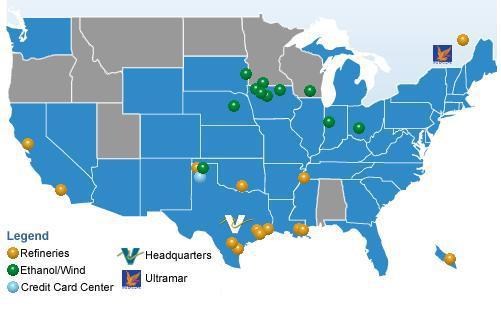
Valero Refining locations (Source: Company Website)

Phillips 66 US Operations, Red represents refineries (Source: Company Website)

HollyFrontier Operations, white squares represent refineries (Source: Company Website)

This could be a huge opportunity for the company for two reasons. First, these crudes won’t need to travel far, so the transportation costs to get them to the facilities could be much less than for its competitors that need to move it to their facilities.

Second, most of these unconventional plays lack sufficient capacity. So E&P companies that have leveraged their entire portfolios into a single play — think SandRidge Energy and its 1.85 million acres in the Mississippian Lime — will need to rely heavily on local refiners to buy product. A bottlenecked market could lead to discounted prices for local crudes. Bad for E&P, very good for HollyFrontier.

As of right now, several of the younger shale plays, like the Mississippian lime and the Niobrara, have yet to deliver crude to HollyFrontier refiners, because the company’s refineries are currently designed to handle Western Canadian Select blend and Christina Lake crudes. This is probably due to change, though. CEO Michael Jennings recently stated in a …read more
Source: FULL ARTICLE at DailyFinance